Experimental Stress Analysis
Department of Mechanical Engineering Page 1
Unit 5: THREE DIMENSIONAL
PHOTOELASTICITY
The stress-freezing method:
In the stress freezing method, the model deformations caused by the applied loads are locked in
the model. This is made possible by the diphase behavior of many polymeric materials when
they are heated. Polymeric materials are composed of hydrocarbon molecular chains. These
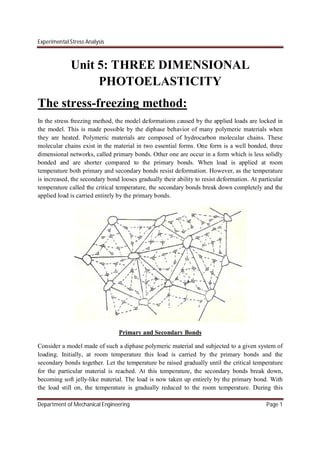
molecular chains exist in the material in two essential forms. One form is a well bonded, three
dimensional networks, called primary bonds. Other one are occur in a form which is less solidly
bonded and are shorter compared to the primary bonds. When load is applied at room
temperature both primary and secondary bonds resist deformation. However, as the temperature
is increased, the secondary bond looses gradually their ability to resist deformation. At particular
temperature called the critical temperature, the secondary bonds break down completely and the
applied load is carried entirely by the primary bonds.
Primary and Secondary Bonds
Consider a model made of such a diphase polymeric material and subjected to a given system of
loading. Initially, at room temperature this load is carried by the primary bonds and the
secondary bonds together. Let the temperature be raised gradually until the critical temperature
for the particular material is reached. At this temperature, the secondary bonds break down,
becoming soft jelly-like material. The load is now taken up entirely by the primary bond. With
the load still on, the temperature is gradually reduced to the room temperature. During this
Experimental Stress Analysis
Department of Mechanical Engineering Page 2
process, the secondary bonds gradually solidify and lock the primary bonds tend to regain their
original unreformed configuration, but this is however prevented by the secondary bonds.
Consequently, an equilibrium configuration is reached which does not differ appreciably from
the deformed configuration. Hence, the deformations are locked inside the model.
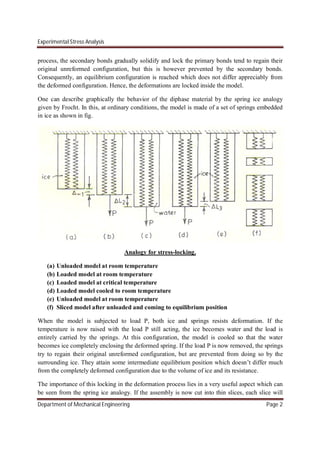
One can describe graphically the behavior of the diphase material by the spring ice analogy
given by Frocht. In this, at ordinary conditions, the model is made of a set of springs embedded
in ice as shown in fig.
Analogy for stress-locking.
(a) Unloaded model at room temperature
(b) Loaded model at room temperature
(c) Loaded model at critical temperature
(d) Loaded model cooled to room temperature
(e) Unloaded model at room temperature
(f) Sliced model after unloaded and coming to equilibrium position
When the model is subjected to load P, both ice and springs resists deformation. If the
temperature is now raised with the load P still acting, the ice becomes water and the load is
entirely carried by the springs. At this configuration, the model is cooled so that the water
becomes ice completely enclosing the deformed spring. If the load P is now removed, the springs
try to regain their original unreformed configuration, but are prevented from doing so by the
surrounding ice. They attain some intermediate equilibrium position which doesn’t differ much
from the completely deformed configuration due to the volume of ice and its resistance.
The importance of this locking in the deformation process lies in a very useful aspect which can
be seen from the spring ice analogy. If the assembly is now cut into thin slices, each slice will
Experimental Stress Analysis
Department of Mechanical Engineering Page 3
retain the corresponding parts of the deformed springs. This experiments shown that even very
thin slices can be carefully cut and polished without destroying their locked in bifriengement
characteristics. It is this important aspect that is extensively used in three-dimensional photo
elastic analysis.
Scattered Light Polariscopes:
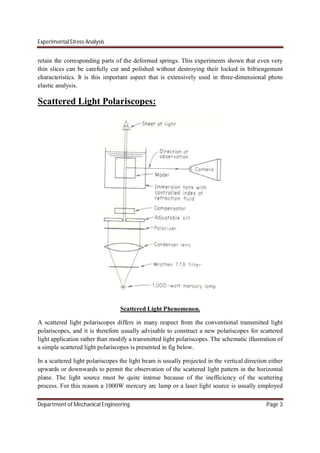
Scattered Light Phenomenon.
A scattered light polariscopes differs in many respect from the conventional transmitted light
polariscopes, and it is therefore usually advisable to construct a new polariscopes for scattered
light application rather than modify a transmitted light polariscopes. The schematic illustration of
a simple scattered light polariscopes is presented in fig below.
In a scattered light polariscopes the light beam is usually projected in the vertical direction either
upwards or downwards to permit the observation of the scattered light pattern in the horizontal
plane. The light source must be quite intense because of the inefficiency of the scattering
process. For this reason a 1000W mercury arc lamp or a laser light source is usually employed
Experimental Stress Analysis
Department of Mechanical Engineering Page 4
together with a condenser lenses and an adjustable light slit to provide a high-intensity sheet of
light which can be used to illuminate any plane in the model.
The model is placed in the immersion tank. The tank contain same refractive index as that of the
model and the fluid so that the incident light enters the model without any refraction and also the
scattered light leaves the model without any refraction. The camera located in horizontal plane
should be capable of rotation about the vertical axis of the polariscopes so that the scattered light
pattern could be photographed at any arbiter angle. Moreover, the polarizer located forward of
the adjustable slit should be mounted so that it can be rotated to vary the angle. Finally, it is
sometime desirable to locate a compensator or a Q.W.P or both in the light path forward of the
model. Mounting for these two elements should be provided so that they can be freely rotated.
Scattered light method:
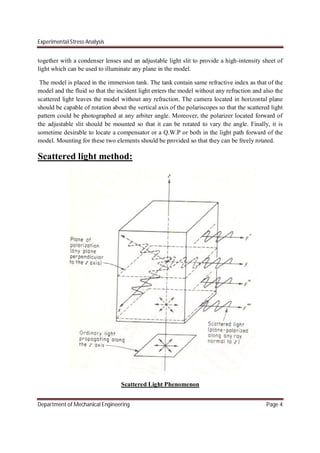
Scattered Light Phenomenon
Experimental Stress Analysis
Department of Mechanical Engineering Page 5
The scattered light method of photo elasticity is based on the scattering characteristics of a wave
of light as it passes through a transparent medium. To illustrate this scattering phenomenon,
consider a wave of ordinary light propagating in the Z direction and vibrating in the x-y plane, as
shown in fig. however, most materials do not transmit light perfectly, and some scattering of the
light occurs. This scattering can be viewed as a secondary set of vibrations which are excited by
the main wave and which propagate radially outwards from the scattering source. For a main
wave of ordinary light propagating in the Z direction, the vibrations associated with the scattered
light will all lie in planes normal to z axes. Thus, when the scattered light is viewed along any
ray which is normal to the Z axes, it will be plane-polarized.
For the purpose of photo elasticity it may be assumed that the photo elastic material has an
infinite number of scattering sources uniformly distributed throughout the material. Therefore,
the incident light will scatter at every point and will produce a secondary source of plane-
polarized light which propagates radially outwards from the source. It is possible to use this
polarization produced by the scattering of the light within a photo elastic model in place of either
the polarizer or the analyzer in a photo elastic polariscopes. This utilization of scattered light,
which is equivalent to locating a polarizer or an analyzer in the interior of the model, provides an
approach to the general three dimensional problems. Since either the polarizer or the analyzer
can be optically positioned at arbitrary planes in the photo elastic model, stress information can
be obtained without stress-freezing or slicing of the model.
Scattered Light as an Interior Polarizer:
Since the light scattered within a photo elastic model at right angle to the direction of the
incident beam is plane polarized, it can be used as either a polarizer or an analyzer. Consider a
beam of un-polarized light which enters through the model at point P. as the incident light beam
passes through the model, each point along the beam acts as a source of plane polarized light, the
direction of vibration being mutually perpendicular to the direction of observation and the
incident beam.
Consider first the light scattered from an interior point Q in the model. If the model is stressed,
the polarized light scattered from point Q is resolved into two components along the direction of
secondary principal stress and . As the light propagates outward over the distance QR, a
phase difference develops between the two components. This phase difference can be measured
by inserting an analyzer between point R and the camera. In this instance
=
ℎ
( − )
Where ( − ) is the average value of − over the distance Q R
Experimental Stress Analysis
Department of Mechanical Engineering Page 6
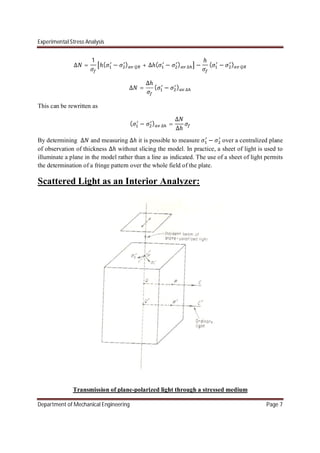
Transmission of un-polarized light through a stressed medium
If the line which is illuminated is moved from PQ to P’Q’, the relative retardation observed at the
camera will be given by
=
ℎ + ∆ℎ
( − )
=
1
ℎ( − ) + ∆ℎ( − )
=
1
ℎ( − ) + ∆ℎ( − ) ∆
The difference in retardations is due to the additional retardation ∆ acquired by the light in
transferring the distance ′ = ∆ℎ. This value of ∆ can be obtained from above equation
∆ = −
Experimental Stress Analysis
Department of Mechanical Engineering Page 7
∆ =
1
ℎ( − ) + ∆ℎ( − ) ∆ −
ℎ
( − )
∆ =
∆ℎ
( − ) ∆
This can be rewritten as
( − ) ∆ =
∆
∆ℎ
By determining ∆ and measuring ∆ℎ it is possible to measure − over a centralized plane
of observation of thickness ∆ℎ without slicing the model. In practice, a sheet of light is used to
illuminate a plane in the model rather than a line as indicated. The use of a sheet of light permits
the determination of a fringe pattern over the whole field of the plate.
Scattered Light as an Interior Analyzer:
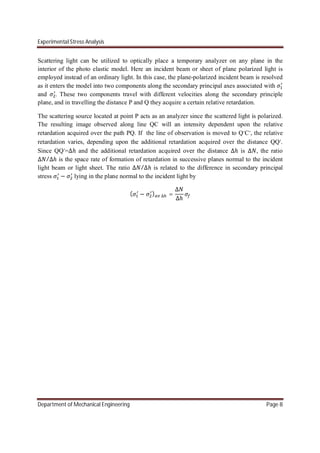
Transmission of plane-polarized light through a stressed medium
Experimental Stress Analysis
Department of Mechanical Engineering Page 8
Scattering light can be utilized to optically place a temporary analyzer on any plane in the
interior of the photo elastic model. Here an incident beam or sheet of plane polarized light is
employed instead of an ordinary light. In this case, the plane-polarized incident beam is resolved
as it enters the model into two components along the secondary principal axes associated with
and . These two components travel with different velocities along the secondary principle
plane, and in travelling the distance P and Q they acquire a certain relative retardation.
The scattering source located at point P acts as an analyzer since the scattered light is polarized.
The resulting image observed along line QC will an intensity dependent upon the relative
retardation acquired over the path PQ. If the line of observation is moved to Q’C’, the relative
retardation varies, depending upon the additional retardation acquired over the distance QQ’.
Since QQ’=∆ℎ and the additional retardation acquired over the distance ∆ℎ is ∆ , the ratio
∆ /∆ℎ is the space rate of formation of retardation in successive planes normal to the incident
light beam or light sheet. The ratio ∆ /∆ℎ is related to the difference in secondary principal
stress − lying in the plane normal to the incident light by
( − ) ∆ =
∆
∆ℎ

experimental stress analysis-Chapter 5

  • 1.
    Experimental Stress Analysis Departmentof Mechanical Engineering Page 1 Unit 5: THREE DIMENSIONAL PHOTOELASTICITY The stress-freezing method: In the stress freezing method, the model deformations caused by the applied loads are locked in the model. This is made possible by the diphase behavior of many polymeric materials when they are heated. Polymeric materials are composed of hydrocarbon molecular chains. These molecular chains exist in the material in two essential forms. One form is a well bonded, three dimensional networks, called primary bonds. Other one are occur in a form which is less solidly bonded and are shorter compared to the primary bonds. When load is applied at room temperature both primary and secondary bonds resist deformation. However, as the temperature is increased, the secondary bond looses gradually their ability to resist deformation. At particular temperature called the critical temperature, the secondary bonds break down completely and the applied load is carried entirely by the primary bonds. Primary and Secondary Bonds Consider a model made of such a diphase polymeric material and subjected to a given system of loading. Initially, at room temperature this load is carried by the primary bonds and the secondary bonds together. Let the temperature be raised gradually until the critical temperature for the particular material is reached. At this temperature, the secondary bonds break down, becoming soft jelly-like material. The load is now taken up entirely by the primary bond. With the load still on, the temperature is gradually reduced to the room temperature. During this
  • 2.
    Experimental Stress Analysis Departmentof Mechanical Engineering Page 2 process, the secondary bonds gradually solidify and lock the primary bonds tend to regain their original unreformed configuration, but this is however prevented by the secondary bonds. Consequently, an equilibrium configuration is reached which does not differ appreciably from the deformed configuration. Hence, the deformations are locked inside the model. One can describe graphically the behavior of the diphase material by the spring ice analogy given by Frocht. In this, at ordinary conditions, the model is made of a set of springs embedded in ice as shown in fig. Analogy for stress-locking. (a) Unloaded model at room temperature (b) Loaded model at room temperature (c) Loaded model at critical temperature (d) Loaded model cooled to room temperature (e) Unloaded model at room temperature (f) Sliced model after unloaded and coming to equilibrium position When the model is subjected to load P, both ice and springs resists deformation. If the temperature is now raised with the load P still acting, the ice becomes water and the load is entirely carried by the springs. At this configuration, the model is cooled so that the water becomes ice completely enclosing the deformed spring. If the load P is now removed, the springs try to regain their original unreformed configuration, but are prevented from doing so by the surrounding ice. They attain some intermediate equilibrium position which doesn’t differ much from the completely deformed configuration due to the volume of ice and its resistance. The importance of this locking in the deformation process lies in a very useful aspect which can be seen from the spring ice analogy. If the assembly is now cut into thin slices, each slice will
  • 3.
    Experimental Stress Analysis Departmentof Mechanical Engineering Page 3 retain the corresponding parts of the deformed springs. This experiments shown that even very thin slices can be carefully cut and polished without destroying their locked in bifriengement characteristics. It is this important aspect that is extensively used in three-dimensional photo elastic analysis. Scattered Light Polariscopes: Scattered Light Phenomenon. A scattered light polariscopes differs in many respect from the conventional transmitted light polariscopes, and it is therefore usually advisable to construct a new polariscopes for scattered light application rather than modify a transmitted light polariscopes. The schematic illustration of a simple scattered light polariscopes is presented in fig below. In a scattered light polariscopes the light beam is usually projected in the vertical direction either upwards or downwards to permit the observation of the scattered light pattern in the horizontal plane. The light source must be quite intense because of the inefficiency of the scattering process. For this reason a 1000W mercury arc lamp or a laser light source is usually employed
  • 4.
    Experimental Stress Analysis Departmentof Mechanical Engineering Page 4 together with a condenser lenses and an adjustable light slit to provide a high-intensity sheet of light which can be used to illuminate any plane in the model. The model is placed in the immersion tank. The tank contain same refractive index as that of the model and the fluid so that the incident light enters the model without any refraction and also the scattered light leaves the model without any refraction. The camera located in horizontal plane should be capable of rotation about the vertical axis of the polariscopes so that the scattered light pattern could be photographed at any arbiter angle. Moreover, the polarizer located forward of the adjustable slit should be mounted so that it can be rotated to vary the angle. Finally, it is sometime desirable to locate a compensator or a Q.W.P or both in the light path forward of the model. Mounting for these two elements should be provided so that they can be freely rotated. Scattered light method: Scattered Light Phenomenon
  • 5.
    Experimental Stress Analysis Departmentof Mechanical Engineering Page 5 The scattered light method of photo elasticity is based on the scattering characteristics of a wave of light as it passes through a transparent medium. To illustrate this scattering phenomenon, consider a wave of ordinary light propagating in the Z direction and vibrating in the x-y plane, as shown in fig. however, most materials do not transmit light perfectly, and some scattering of the light occurs. This scattering can be viewed as a secondary set of vibrations which are excited by the main wave and which propagate radially outwards from the scattering source. For a main wave of ordinary light propagating in the Z direction, the vibrations associated with the scattered light will all lie in planes normal to z axes. Thus, when the scattered light is viewed along any ray which is normal to the Z axes, it will be plane-polarized. For the purpose of photo elasticity it may be assumed that the photo elastic material has an infinite number of scattering sources uniformly distributed throughout the material. Therefore, the incident light will scatter at every point and will produce a secondary source of plane- polarized light which propagates radially outwards from the source. It is possible to use this polarization produced by the scattering of the light within a photo elastic model in place of either the polarizer or the analyzer in a photo elastic polariscopes. This utilization of scattered light, which is equivalent to locating a polarizer or an analyzer in the interior of the model, provides an approach to the general three dimensional problems. Since either the polarizer or the analyzer can be optically positioned at arbitrary planes in the photo elastic model, stress information can be obtained without stress-freezing or slicing of the model. Scattered Light as an Interior Polarizer: Since the light scattered within a photo elastic model at right angle to the direction of the incident beam is plane polarized, it can be used as either a polarizer or an analyzer. Consider a beam of un-polarized light which enters through the model at point P. as the incident light beam passes through the model, each point along the beam acts as a source of plane polarized light, the direction of vibration being mutually perpendicular to the direction of observation and the incident beam. Consider first the light scattered from an interior point Q in the model. If the model is stressed, the polarized light scattered from point Q is resolved into two components along the direction of secondary principal stress and . As the light propagates outward over the distance QR, a phase difference develops between the two components. This phase difference can be measured by inserting an analyzer between point R and the camera. In this instance = ℎ ( − ) Where ( − ) is the average value of − over the distance Q R
  • 6.
    Experimental Stress Analysis Departmentof Mechanical Engineering Page 6 Transmission of un-polarized light through a stressed medium If the line which is illuminated is moved from PQ to P’Q’, the relative retardation observed at the camera will be given by = ℎ + ∆ℎ ( − ) = 1 ℎ( − ) + ∆ℎ( − ) = 1 ℎ( − ) + ∆ℎ( − ) ∆ The difference in retardations is due to the additional retardation ∆ acquired by the light in transferring the distance ′ = ∆ℎ. This value of ∆ can be obtained from above equation ∆ = −
  • 7.
    Experimental Stress Analysis Departmentof Mechanical Engineering Page 7 ∆ = 1 ℎ( − ) + ∆ℎ( − ) ∆ − ℎ ( − ) ∆ = ∆ℎ ( − ) ∆ This can be rewritten as ( − ) ∆ = ∆ ∆ℎ By determining ∆ and measuring ∆ℎ it is possible to measure − over a centralized plane of observation of thickness ∆ℎ without slicing the model. In practice, a sheet of light is used to illuminate a plane in the model rather than a line as indicated. The use of a sheet of light permits the determination of a fringe pattern over the whole field of the plate. Scattered Light as an Interior Analyzer: Transmission of plane-polarized light through a stressed medium
  • 8.
    Experimental Stress Analysis Departmentof Mechanical Engineering Page 8 Scattering light can be utilized to optically place a temporary analyzer on any plane in the interior of the photo elastic model. Here an incident beam or sheet of plane polarized light is employed instead of an ordinary light. In this case, the plane-polarized incident beam is resolved as it enters the model into two components along the secondary principal axes associated with and . These two components travel with different velocities along the secondary principle plane, and in travelling the distance P and Q they acquire a certain relative retardation. The scattering source located at point P acts as an analyzer since the scattered light is polarized. The resulting image observed along line QC will an intensity dependent upon the relative retardation acquired over the path PQ. If the line of observation is moved to Q’C’, the relative retardation varies, depending upon the additional retardation acquired over the distance QQ’. Since QQ’=∆ℎ and the additional retardation acquired over the distance ∆ℎ is ∆ , the ratio ∆ /∆ℎ is the space rate of formation of retardation in successive planes normal to the incident light beam or light sheet. The ratio ∆ /∆ℎ is related to the difference in secondary principal stress − lying in the plane normal to the incident light by ( − ) ∆ = ∆ ∆ℎ