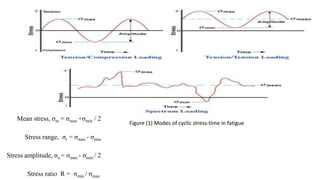
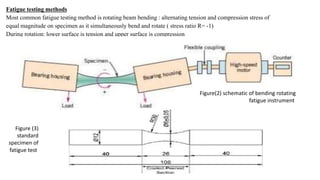
Fatigue is a type of failure that occurs in structures subjected to repeatedly applied loads, such as bridges and aircraft components. It can cause failure at stress levels lower than the material's static strength. Fatigue is responsible for approximately 90% of all metallic failures and occurs suddenly without warning. Fatigue failure is brittle-like and involves crack initiation and propagation. The fatigue behavior of materials is characterized by S-N curves, which relate the cyclic stress amplitude to the number of cycles to failure. Some materials exhibit a fatigue limit below which failure will not occur, while others do not have a fatigue limit. Surface treatments like shot peening can improve fatigue resistance by inducing compressive stresses near the surface.