PATIENT EDUCATION Prof. Dr M. A. BADR
 
Components of the Diabetes Team   The Ideal Scenario Dietitian Endocrinologist Nurse Educator Exercise Therapist Case Manager PCP            
Patient Education Change of the Attitude and Behavior towards common health problems for better control or  reduce its complication
Goal of Health Education Knowledge Improvement , development and corrects skills Change attitudes and believes LIFE STYLE MODIFICATION
STAGES OF PATIENT HEATH EDUCATION Explanation of details Convinced by the knowledge given  Change believe Application attitude Transformation of recipient to donor health educator
WHO PERFORM THE HEATH EDUCATION Physicians Nurses Dieteticien Social support Volunteers Patients themselves
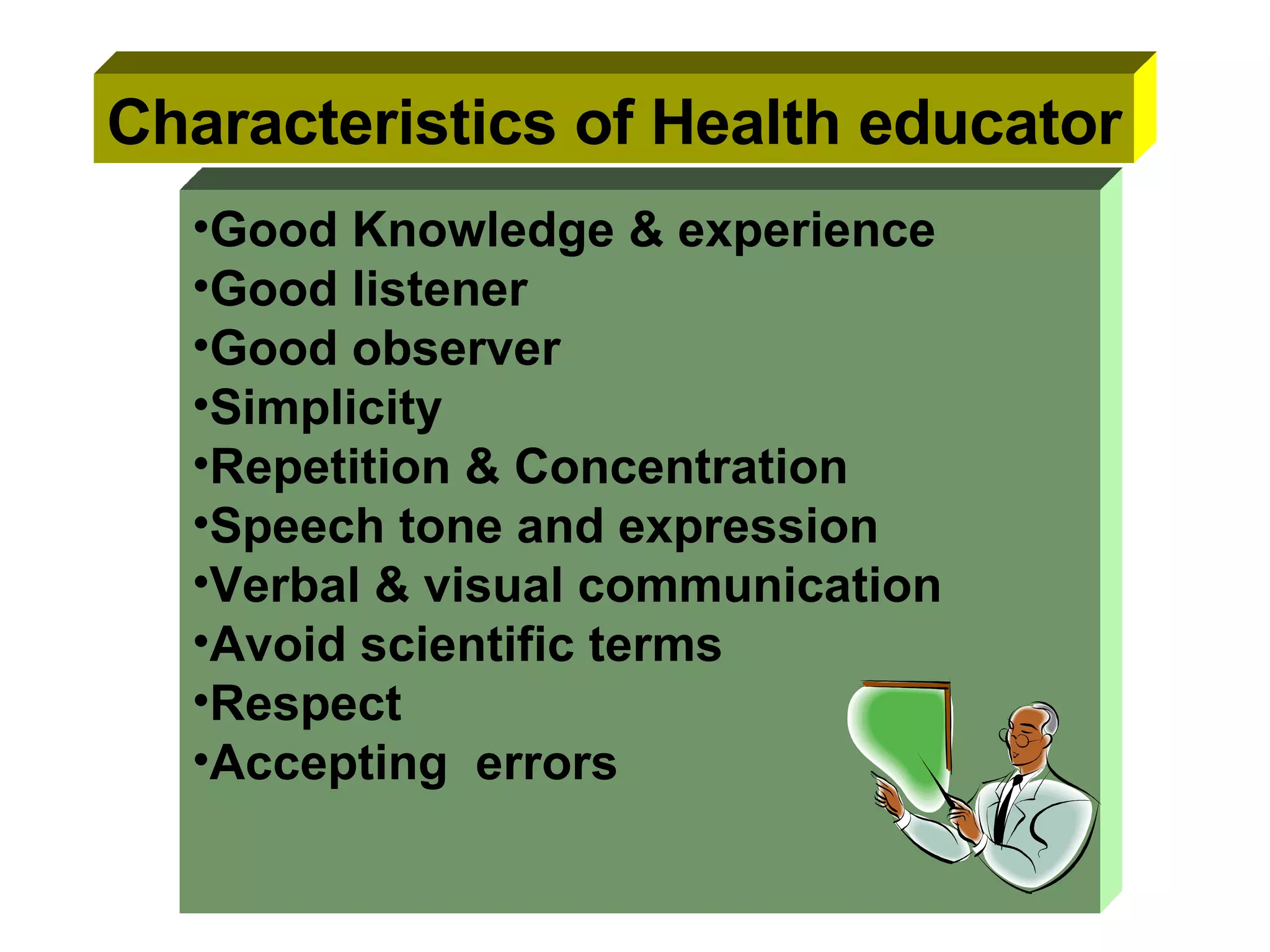
Characteristics of Health educator Good Knowledge & experience Good listener Good observer Simplicity Repetition & Concentration Speech tone and expression Verbal & visual communication Avoid scientific terms Respect  Accepting  errors
Factors in The recipient Interest  Concentration The capability to change the attitude
Factors Affecting the Process of Learning Time Place Intellectual ability Motive
The Subject must be : short Clear Complete
Plan For health education program What are the goal Who will do it Content of knowledge  & skills When & to who Duration &cost
THE WAY USED Person to person Small groups Large group lecture Media:  Newspaper Radio T V Pamphlets
Person to person education Influence and effective Friendship environment Convenient to newly discovered Disadvantage : Time consuming
Success depend on  Welcoming & friendship environment Expression and voice pitch changes Selection of subject Simplicity, clarity, local accent Good occasion to ask questions Person to person
 
Small group health education No from 8 to 12 Done on short interval Once weekly on 6 sessions Not more than 60-90 minutes Selection of the group Type of disease Age & sex Special situation pregnancy Intellectual  level Previous attendance Encourage Discussion Self experience
Some beneficial notes in group education Stop and ask questions Summarize before transition from point to point No blame for wrong answer Use verbal and visual expression Tell small story to increase attention Skills explained on vivid examples and tools
 
Education of large group Communication with audience weaker Low degree of retention Prerequisites Clear goal Good Lecturer Good comfortable place Good preparation Selection of the group Duration 20 to 25 minutes Allow enough time for discussion Use audio visual aids Simple language Summarize the lecture
Patient Education through the Media TV, Videocassette…… Easy to large no in short time and attractive Can be repeated Disadvantages Increase knowledge but not the attitude Misunderstanding Not free from marketing influence
Evaluation of educational program Degree of disease control Bld sugar, Wt,Glycated Hb, Lipids, Bld pressure Prevalence of acute and chronic complication Evaluation of the degree of retention Pre and post program questionnaire Skills direct observation Continuous health education and repetition
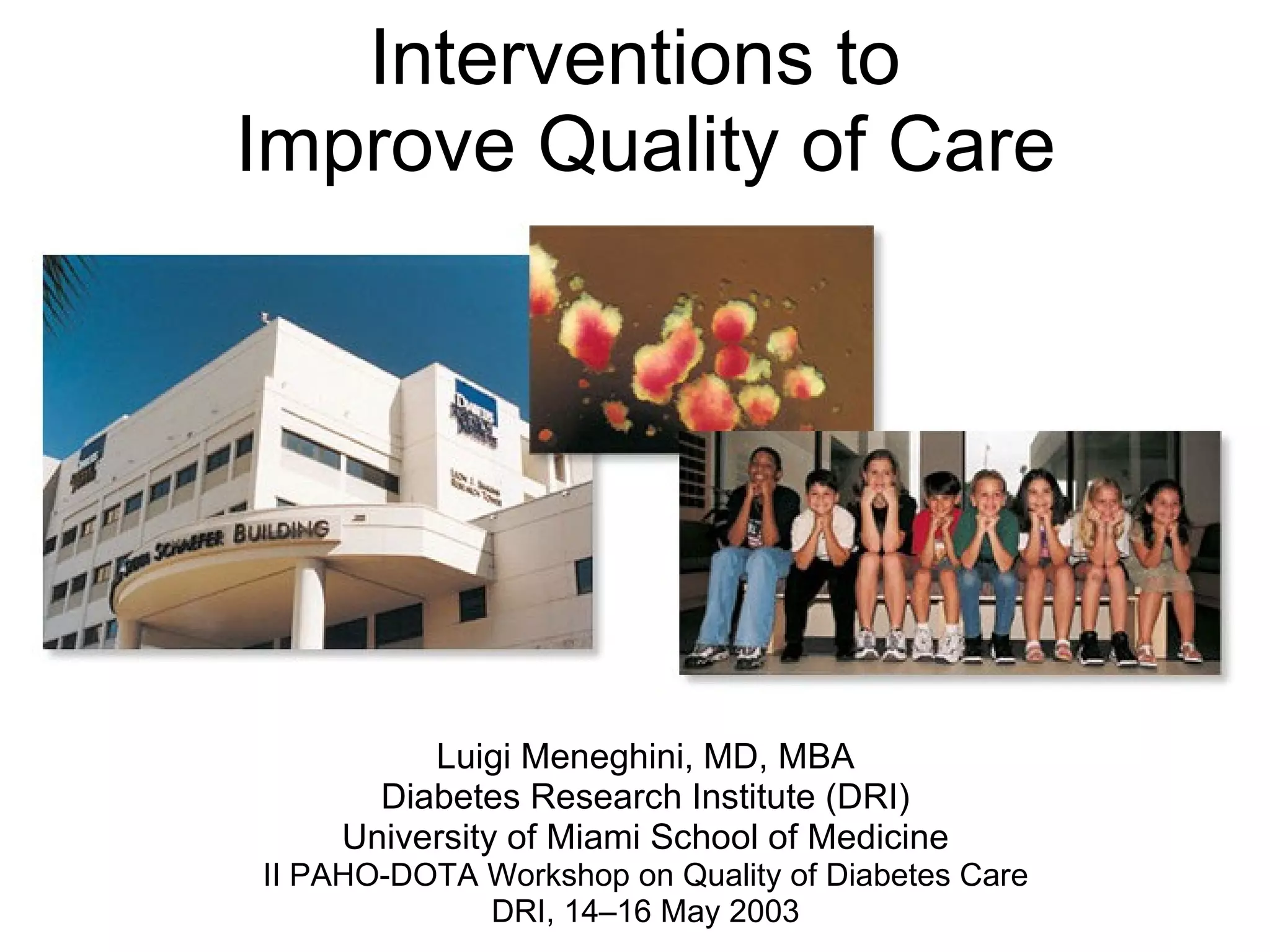
Interventions to  Improve Quality of Care Luigi Meneghini, MD, MBA Diabetes Research Institute (DRI) University of Miami School of Medicine II PAHO-DOTA Workshop on Quality of Diabetes Care DRI, 14–16 May 2003
Mastering Your Diabetes   Metabolic & Psychosocial Outcomes Diabetes Empowerment Scale (DES) The DES is a valid and reliable survey of patient empowerment which yields an overall empowerment score based on all 28 items and three subscale scores (range for all scales: 1.0-5.0).  Improvement was evident on all DES scales for participants in the MYD pilot study, despite high baseline values. Diabetes Empowerment Scale   Pretest   Posttest   3mF/U Overall empowerment   4.1  4.2   4.3* Managing psychosocial aspects  3.9  4.2   4.2 Dissatisfaction/readiness to change 4.3  4.5   4.6* Setting/ achieving diabetes goals 4.0  4.0   4.1 (*P<0.05 v. baseline) Quality of Life & Self-Efficacy Measures of both Quality of Life (QOL) and Self-Efficacy showed statistically significant improvement following the intervention.  At the three month follow-up the most significant improvement in QOL sub-scales was for Satisfaction (p=0.0113).   8.84 8.01 7.65 8.10 7.50 6.80 7.00 7.20 7.40 7.60 7.80 8.00 8.20 8.40 8.60 8.80 Mean HbA1c % Mo 1-3 Pre-MYD * p<0.05 v. pre-MYD Mo 4-6 Mo 7-9 Mo 10-12 * * *
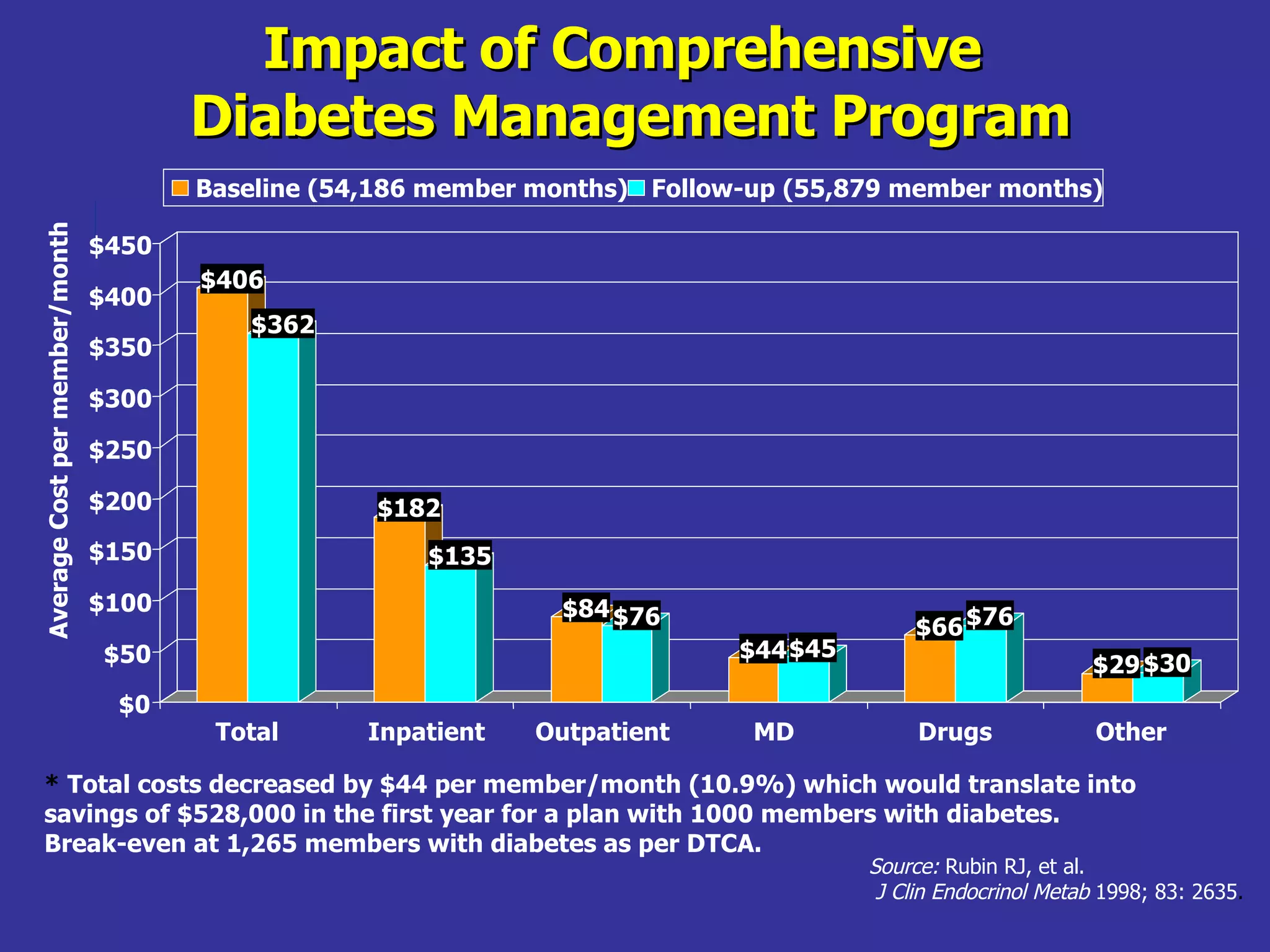
Impact of Comprehensive  Diabetes Management Program Source:  Rubin RJ, et al.    J Clin Endocrinol Metab  1998; 83: 2635 . *  Total costs decreased by $44 per member/month (10.9%) which would translate into savings of $528,000 in the first year for a plan with 1000 members with diabetes.  Break-even at 1,265 members with diabetes as per DTCA.  $406 $362 $182 $135 $84 $76 $44 $45 $66 $76 $29 $30 $0 $50 $100 $150 $200 $250 $300 $350 $400 $450 Average Cost per member/month Total Inpatient Outpatient MD Drugs Other Baseline (54,186 member months) Follow-up (55,879 member months)
 
The END

Basis of Health Education

  • 1.
  • 2.
  • 3.
    Components of theDiabetes Team The Ideal Scenario Dietitian Endocrinologist Nurse Educator Exercise Therapist Case Manager PCP         
  • 4.
    Patient Education Changeof the Attitude and Behavior towards common health problems for better control or reduce its complication
  • 5.
    Goal of HealthEducation Knowledge Improvement , development and corrects skills Change attitudes and believes LIFE STYLE MODIFICATION
  • 6.
    STAGES OF PATIENTHEATH EDUCATION Explanation of details Convinced by the knowledge given Change believe Application attitude Transformation of recipient to donor health educator
  • 7.
    WHO PERFORM THEHEATH EDUCATION Physicians Nurses Dieteticien Social support Volunteers Patients themselves
  • 8.
    Characteristics of Healtheducator Good Knowledge & experience Good listener Good observer Simplicity Repetition & Concentration Speech tone and expression Verbal & visual communication Avoid scientific terms Respect Accepting errors
  • 9.
    Factors in Therecipient Interest Concentration The capability to change the attitude
  • 10.
    Factors Affecting theProcess of Learning Time Place Intellectual ability Motive
  • 11.
    The Subject mustbe : short Clear Complete
  • 12.
    Plan For healtheducation program What are the goal Who will do it Content of knowledge & skills When & to who Duration &cost
  • 13.
    THE WAY USEDPerson to person Small groups Large group lecture Media: Newspaper Radio T V Pamphlets
  • 14.
    Person to personeducation Influence and effective Friendship environment Convenient to newly discovered Disadvantage : Time consuming
  • 15.
    Success depend on Welcoming & friendship environment Expression and voice pitch changes Selection of subject Simplicity, clarity, local accent Good occasion to ask questions Person to person
  • 16.
  • 17.
    Small group healtheducation No from 8 to 12 Done on short interval Once weekly on 6 sessions Not more than 60-90 minutes Selection of the group Type of disease Age & sex Special situation pregnancy Intellectual level Previous attendance Encourage Discussion Self experience
  • 18.
    Some beneficial notesin group education Stop and ask questions Summarize before transition from point to point No blame for wrong answer Use verbal and visual expression Tell small story to increase attention Skills explained on vivid examples and tools
  • 19.
  • 20.
    Education of largegroup Communication with audience weaker Low degree of retention Prerequisites Clear goal Good Lecturer Good comfortable place Good preparation Selection of the group Duration 20 to 25 minutes Allow enough time for discussion Use audio visual aids Simple language Summarize the lecture
  • 21.
    Patient Education throughthe Media TV, Videocassette…… Easy to large no in short time and attractive Can be repeated Disadvantages Increase knowledge but not the attitude Misunderstanding Not free from marketing influence
  • 22.
    Evaluation of educationalprogram Degree of disease control Bld sugar, Wt,Glycated Hb, Lipids, Bld pressure Prevalence of acute and chronic complication Evaluation of the degree of retention Pre and post program questionnaire Skills direct observation Continuous health education and repetition
  • 23.
    Interventions to Improve Quality of Care Luigi Meneghini, MD, MBA Diabetes Research Institute (DRI) University of Miami School of Medicine II PAHO-DOTA Workshop on Quality of Diabetes Care DRI, 14–16 May 2003
  • 24.
    Mastering Your Diabetes Metabolic & Psychosocial Outcomes Diabetes Empowerment Scale (DES) The DES is a valid and reliable survey of patient empowerment which yields an overall empowerment score based on all 28 items and three subscale scores (range for all scales: 1.0-5.0). Improvement was evident on all DES scales for participants in the MYD pilot study, despite high baseline values. Diabetes Empowerment Scale Pretest Posttest 3mF/U Overall empowerment 4.1 4.2 4.3* Managing psychosocial aspects 3.9 4.2 4.2 Dissatisfaction/readiness to change 4.3 4.5 4.6* Setting/ achieving diabetes goals 4.0 4.0 4.1 (*P<0.05 v. baseline) Quality of Life & Self-Efficacy Measures of both Quality of Life (QOL) and Self-Efficacy showed statistically significant improvement following the intervention. At the three month follow-up the most significant improvement in QOL sub-scales was for Satisfaction (p=0.0113). 8.84 8.01 7.65 8.10 7.50 6.80 7.00 7.20 7.40 7.60 7.80 8.00 8.20 8.40 8.60 8.80 Mean HbA1c % Mo 1-3 Pre-MYD * p<0.05 v. pre-MYD Mo 4-6 Mo 7-9 Mo 10-12 * * *
  • 25.
    Impact of Comprehensive Diabetes Management Program Source: Rubin RJ, et al. J Clin Endocrinol Metab 1998; 83: 2635 . * Total costs decreased by $44 per member/month (10.9%) which would translate into savings of $528,000 in the first year for a plan with 1000 members with diabetes. Break-even at 1,265 members with diabetes as per DTCA. $406 $362 $182 $135 $84 $76 $44 $45 $66 $76 $29 $30 $0 $50 $100 $150 $200 $250 $300 $350 $400 $450 Average Cost per member/month Total Inpatient Outpatient MD Drugs Other Baseline (54,186 member months) Follow-up (55,879 member months)
  • 26.
  • 27.