Fat Embolism
Gladson M. Robin
Definition
Fat embolism indicates the often
asymptomatic presence of fat
globules in the lung parenchyma
and peripheral circulation.
Symptomatic – Fat Embolism Syndrome (FES)
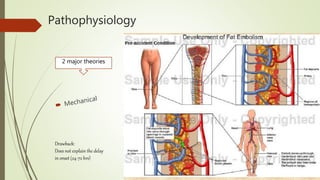
Pathophysiology
2 major theories
Drawback:
Does not explain the delay
in onset (24-72 hrs)
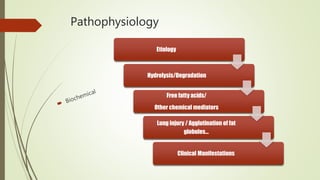
Pathophysiology
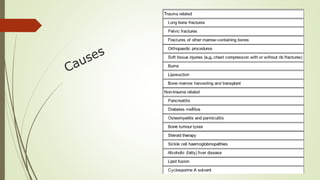
Etiology
Hydrolysis/Degradation
Free fatty acids/
Other chemical mediators
Lung injury / Agglutination of fat
globules...
Clinical Manifestations
 Presents within 24 – 72 hrs
 Rarely <12 hrs or >2 weeks
 Classical triad:
 Respiratory changes
 Neurological abnormalities
 Petechial rash
Paradoxical embolism
Respiratory changes
 First clinical feature
 Frequent findings: Dyspnoea, Tachypnoea, Hypoxaemia
 Syndrome indistinguishable from ARDS may develop due to alveolar hemorrhage
 50% require mechanical ventilation
Clinical Presentation…
Neurological features
 86% of them with cerebral emboli manifest neurological signs after respiratory
distress
 Mild confusion and drowsiness  severe seizures
 Common clinical state: Acute confusional state
 All neurological symptoms are transient and fully reversible
Clinical Presentation…
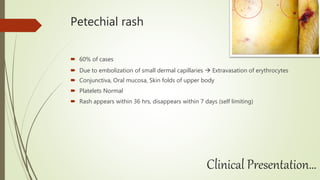
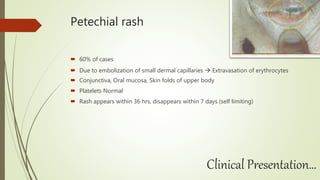
Petechial rash
 60% of cases
 Due to embolization of small dermal capillaries  Extravasation of erythrocytes
 Conjunctiva, Oral mucosa, Skin folds of upper body
 Platelets Normal
 Rash appears within 36 hrs, disappears within 7 days (self limiting)
Clinical Presentation…
Petechial rash
 60% of cases
 Due to embolization of small dermal capillaries  Extravasation of erythrocytes
 Conjunctiva, Oral mucosa, Skin folds of upper body
 Platelets Normal
 Rash appears within 36 hrs, disappears within 7 days (self limiting)
Clinical Presentation…
Minor features
due to release of toxic mediators
 Pyrexia
 Tachycardia
 Myocardial depression
 ECG changes due to right heart strain
 Soft fluffy retinal exudates with macular edema scotomata
 Coagulation abnormalities
 Renal Changes (Oliguria, Lipiduria, Proteinuria, Hematuria)
Clinical Presentation…
Diagnosis
 Diagnosis usually by clinical finings
 Biochemical values may be helpful
 Criteria for diagnosis:
 Gurd’s criteria (commonly used)
 Lindeque’s criteria
 Schonfeld’s criteria
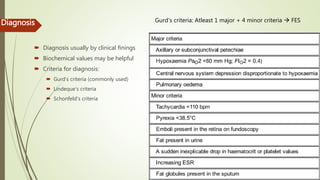
Gurd’s criteria: Atleast 1 major + 4 minor criteria  FES
 Unexplained Anaemia (70%)
 Unexplained Thrombocytopenia (<1,50,000 in 50%)
 Hypocalcaemia due to binding of calcium with free fatty acids
 Radiology – No significant help for diagnosis. Can be used as support
Diagnosis
Management
 Mortality: 10% - !5%
 Immobilization of fracture site
 Early definitive reduction of fracture (Open or Closed)
 Maintain intravascular volume to maintain cardiovascular stability (hypovolemic shock
resuscitation), may use colloids (albumin) as it can expand fluid and bind FFA.
 Mechanical ventilation with PEEP
 Corticosteroid as prophylactic (controversial)
 IV Ethanol as prophylactic in Russia, Europe & some American countries
 “A raised level of alcohol in the blood was associated with a lower incidence of fat
embolism” - J Bone Joint Surg Am. 1977 Oct;59(7):878-80
 Corticosteroids and Ethanol is of no use after onset of FES
Fat embolism

Fat embolism

  • 1.
  • 2.
    Definition Fat embolism indicatesthe often asymptomatic presence of fat globules in the lung parenchyma and peripheral circulation. Symptomatic – Fat Embolism Syndrome (FES)
  • 4.
    Pathophysiology 2 major theories Drawback: Doesnot explain the delay in onset (24-72 hrs)
  • 5.
    Pathophysiology Etiology Hydrolysis/Degradation Free fatty acids/ Otherchemical mediators Lung injury / Agglutination of fat globules... Clinical Manifestations
  • 6.
     Presents within24 – 72 hrs  Rarely <12 hrs or >2 weeks  Classical triad:  Respiratory changes  Neurological abnormalities  Petechial rash Paradoxical embolism
  • 7.
    Respiratory changes  Firstclinical feature  Frequent findings: Dyspnoea, Tachypnoea, Hypoxaemia  Syndrome indistinguishable from ARDS may develop due to alveolar hemorrhage  50% require mechanical ventilation Clinical Presentation…
  • 8.
    Neurological features  86%of them with cerebral emboli manifest neurological signs after respiratory distress  Mild confusion and drowsiness  severe seizures  Common clinical state: Acute confusional state  All neurological symptoms are transient and fully reversible Clinical Presentation…
  • 9.
    Petechial rash  60%of cases  Due to embolization of small dermal capillaries  Extravasation of erythrocytes  Conjunctiva, Oral mucosa, Skin folds of upper body  Platelets Normal  Rash appears within 36 hrs, disappears within 7 days (self limiting) Clinical Presentation…
  • 10.
    Petechial rash  60%of cases  Due to embolization of small dermal capillaries  Extravasation of erythrocytes  Conjunctiva, Oral mucosa, Skin folds of upper body  Platelets Normal  Rash appears within 36 hrs, disappears within 7 days (self limiting) Clinical Presentation…
  • 11.
    Minor features due torelease of toxic mediators  Pyrexia  Tachycardia  Myocardial depression  ECG changes due to right heart strain  Soft fluffy retinal exudates with macular edema scotomata  Coagulation abnormalities  Renal Changes (Oliguria, Lipiduria, Proteinuria, Hematuria) Clinical Presentation…
  • 12.
    Diagnosis  Diagnosis usuallyby clinical finings  Biochemical values may be helpful  Criteria for diagnosis:  Gurd’s criteria (commonly used)  Lindeque’s criteria  Schonfeld’s criteria Gurd’s criteria: Atleast 1 major + 4 minor criteria  FES
  • 13.
     Unexplained Anaemia(70%)  Unexplained Thrombocytopenia (<1,50,000 in 50%)  Hypocalcaemia due to binding of calcium with free fatty acids  Radiology – No significant help for diagnosis. Can be used as support Diagnosis
  • 14.
    Management  Mortality: 10%- !5%  Immobilization of fracture site  Early definitive reduction of fracture (Open or Closed)  Maintain intravascular volume to maintain cardiovascular stability (hypovolemic shock resuscitation), may use colloids (albumin) as it can expand fluid and bind FFA.  Mechanical ventilation with PEEP  Corticosteroid as prophylactic (controversial)  IV Ethanol as prophylactic in Russia, Europe & some American countries  “A raised level of alcohol in the blood was associated with a lower incidence of fat embolism” - J Bone Joint Surg Am. 1977 Oct;59(7):878-80  Corticosteroids and Ethanol is of no use after onset of FES