Topic Name
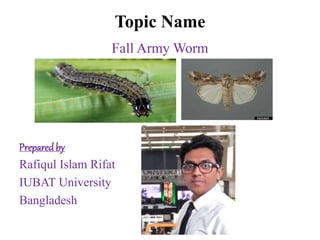
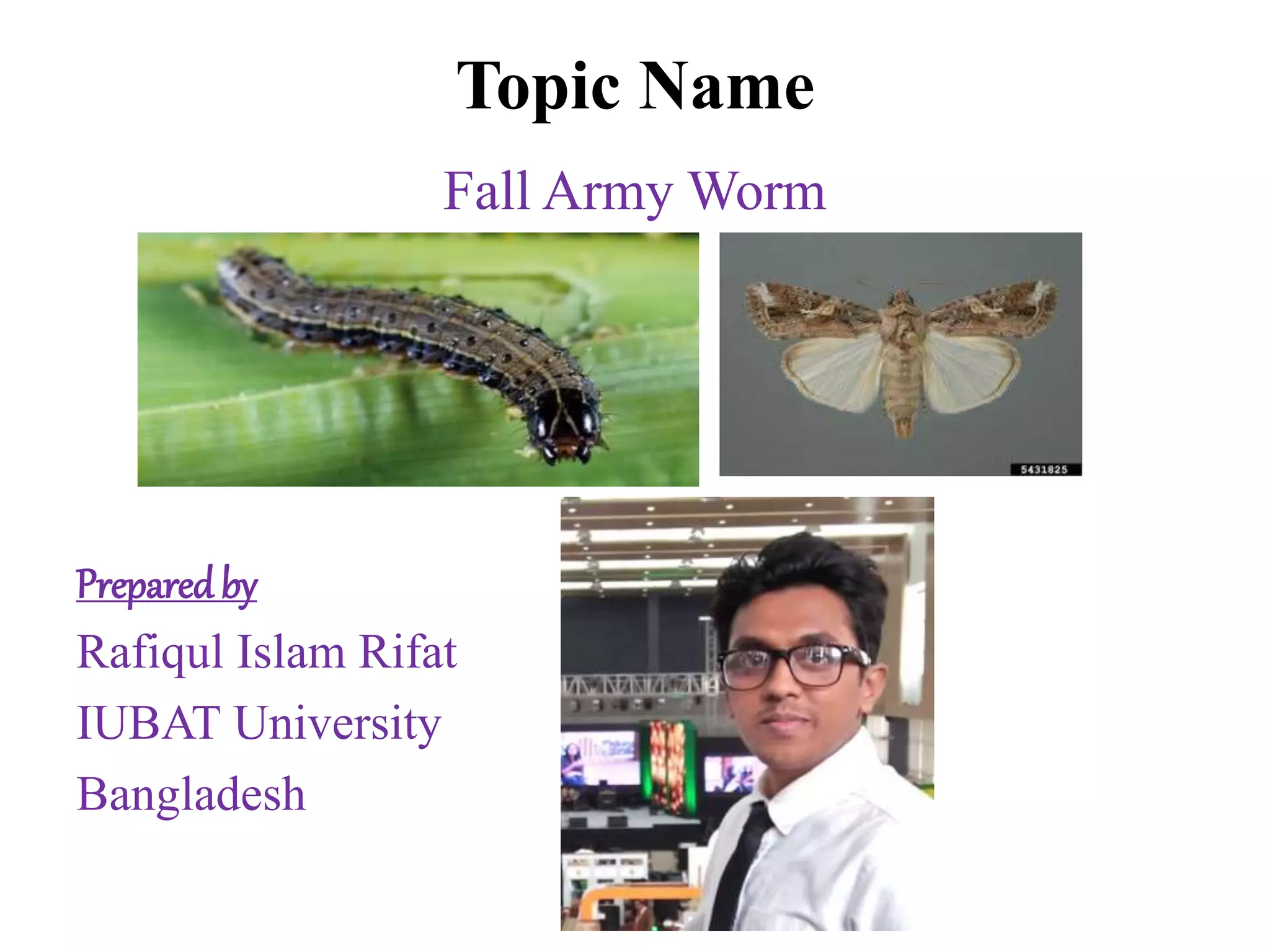
Fall Army Worm
Preparedby
Rafiqul Islam Rifat
IUBAT University
Bangladesh
History of Fall Army Worm
• Fall army worm was first visible in America.
• Then it spread out through out the Africa in 2016. After that
this pest was recorded in India in 2018 also.
• Fall army worm also have found in Bangladesh.
• Then December 2018- Fall Army Worm has indentified in
Bangladesh. First it was visible in corn field at Nator district.
Harmful For:
• About 80 Crops.
• Maize cultivation will be destroyed in the first due to
this insect.
• Then it will spread in rice, wheat and others crops.
• If it is continue to grow, the big threat will come in
our food security.
Reasons for its severity
• FAW spreads quickly across large geographic areas.
moths can migrate over 500 km, a flight of 1,600 km
from the southern U.S. state of Mississippi to
southern Canada in 30 hours has been recorded.
• FAW can persist throughout the year.
Host
• The caterpillars are mainly found feeding on young maize
plants,
• but they can also attack other crops including millet, sorghum,
rice, wheat, sugar cane and vegetables.
Suitable Time for growth
• Summer and winter both are perfect for growth
• but in the summer season they can spread more and
also damage more crops.
Damage Symptoms on Maize
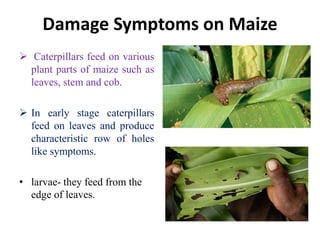
 Caterpillars feed on various
plant parts of maize such as
leaves, stem and cob.
 In early stage caterpillars
feed on leaves and produce
characteristic row of holes
like symptoms.
• larvae- they feed from the
edge of leaves.
Con…
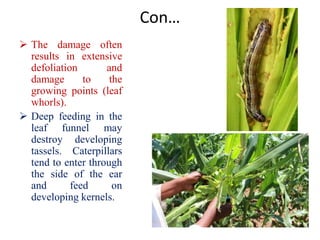
 The damage often
results in extensive
defoliation and
damage to the
growing points (leaf
whorls).
 Deep feeding in the
leaf funnel may
destroy developing
tassels. Caterpillars
tend to enter through
the side of the ear
and feed on
developing kernels.
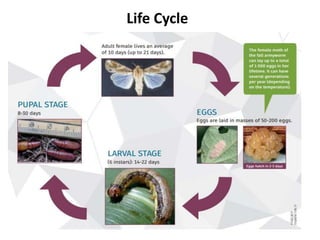
Life Cycle
Way of Control
• 5-6 Feromone Trap should be establish in per begha.
• Flood irrigation.
• Collection eggs and larva manually and kill it.
• Organic pesticide SNPV- 0.2g/L should be spray 2-3
times.
• Acimix 55 EC( Emulsifiable concentration) or Lamix
28.7 EC.
• Spray organic pesticide Spodopotera Nuclear
Polihydrosis virus (0.2g/L) surrounding area
Attacking plant.
Fall Army Worm

Fall Army Worm

  • 1.
    Topic Name Fall ArmyWorm Preparedby Rafiqul Islam Rifat IUBAT University Bangladesh
  • 2.
    History of FallArmy Worm • Fall army worm was first visible in America. • Then it spread out through out the Africa in 2016. After that this pest was recorded in India in 2018 also. • Fall army worm also have found in Bangladesh. • Then December 2018- Fall Army Worm has indentified in Bangladesh. First it was visible in corn field at Nator district.
  • 3.
    Harmful For: • About80 Crops. • Maize cultivation will be destroyed in the first due to this insect. • Then it will spread in rice, wheat and others crops. • If it is continue to grow, the big threat will come in our food security.
  • 4.
    Reasons for itsseverity • FAW spreads quickly across large geographic areas. moths can migrate over 500 km, a flight of 1,600 km from the southern U.S. state of Mississippi to southern Canada in 30 hours has been recorded. • FAW can persist throughout the year.
  • 5.
    Host • The caterpillarsare mainly found feeding on young maize plants, • but they can also attack other crops including millet, sorghum, rice, wheat, sugar cane and vegetables.
  • 6.
    Suitable Time forgrowth • Summer and winter both are perfect for growth • but in the summer season they can spread more and also damage more crops.
  • 7.
    Damage Symptoms onMaize  Caterpillars feed on various plant parts of maize such as leaves, stem and cob.  In early stage caterpillars feed on leaves and produce characteristic row of holes like symptoms. • larvae- they feed from the edge of leaves.
  • 8.
    Con…  The damageoften results in extensive defoliation and damage to the growing points (leaf whorls).  Deep feeding in the leaf funnel may destroy developing tassels. Caterpillars tend to enter through the side of the ear and feed on developing kernels.
  • 9.
  • 10.
    Way of Control •5-6 Feromone Trap should be establish in per begha. • Flood irrigation. • Collection eggs and larva manually and kill it. • Organic pesticide SNPV- 0.2g/L should be spray 2-3 times. • Acimix 55 EC( Emulsifiable concentration) or Lamix 28.7 EC. • Spray organic pesticide Spodopotera Nuclear Polihydrosis virus (0.2g/L) surrounding area Attacking plant.