Insect Pests of Rice
EHTISHAM ALI HUSSAIN
BAGF15E258
University College Of Agriculture, University of
Sargodha
RICE LEAF FOLDER
 Taxonomy
 Occurrence
 Identification
 Life cycle
 Damage
 Control
 Research
Taxonomy
 Technical name :
Cnaphalocrocis medinalis L.
 Family :
Pyralidae
 Order :
Lepidoptera
Occurance
 Moths are recorded to be warm tropic.
 Most abundant in rainy season.
 Active from may to october.
 During active period it complete 4-5 generations.
 Humid and high temperature is considered important for
insect abundance.
Identification
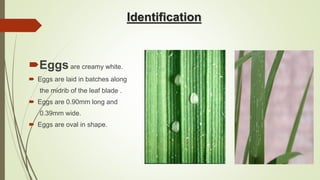
Eggsare creamy white.
 Eggs are laid in batches along
the midrib of the leaf blade .
 Eggs are 0.90mm long and
0.39mm wide.
 Eggs are oval in shape.
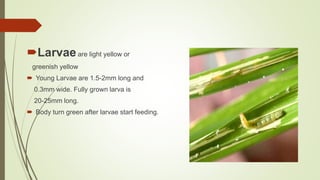
Larvaeare light yellow or
greenish yellow
 Young Larvae are 1.5-2mm long and
0.3mm wide. Fully grown larva is
20-25mm long.
 Body turn green after larvae start feeding.
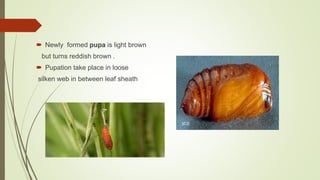
 Newly formed pupa is light brown
but turns reddish brown .
 Pupation take place in loose
silken web in between leaf sheath
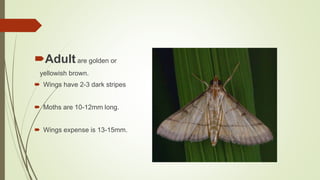
Adultare golden or
yellowish brown.
 Wings have 2-3 dark stripes
 Moths are 10-12mm long.
 Wings expense is 13-15mm.
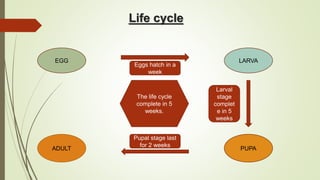
Life cycle
EGG LARVA
ADULT PUPA
Eggs hatch in a
week
Larval
stage
complet
e in 5
weeks
Pupal stage last
for 2 weeks
The life cycle
complete in 5
weeks.
Damage
 During high insect population densities, rice plants dry up and appear scorched.
 Before feeding, the larvae fold the leaves longitudinally and fasten leaf margins with
stitches of threadlike silk.
 The larvae feed by scraping the green mesophyll
from within the folded leaves . This results in
pale white stripe damage to the leaf.
 after feeding on one fold for 2-3 days,
it moves to another leaf.
 each larva destroys a number of leaves during its growth.
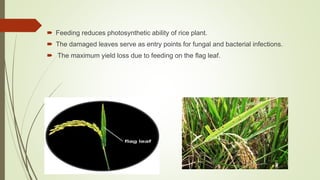
 Feeding reduces photosynthetic ability of rice plant.
 The damaged leaves serve as entry points for fungal and bacterial infections.
 The maximum yield loss due to feeding on the flag leaf.
Control
 CULTURAL CONTROL:-
 trapping the moths by light traps.
 Removal of grassy weeds from rice fields and surrounding borders prevents
the buildup of rice leaf- folders on alternate hosts.
 BIOLOGICAL CONTROL:-
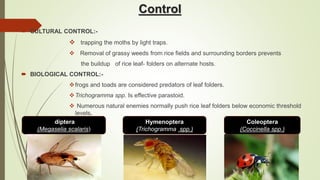
frogs and toads are considered predators of leaf folders.
Trichogramma spp. Is effective parastoid.
 Numerous natural enemies normally push rice leaf folders below economic threshold
levels.
diptera
(Megaselia scalaris)
Hymenoptera
(Trichogramma spp.)
Coleoptera
(Coccinella spp.)
 CHEMICAL CONTROL:-
 use of nitrogenous fertilizer in split applications is
recommended.
Microbial insecticides, particularly Bacillus
thuringiensis (Acrobe,leptox ) is effective against
larvae.
Application of cartap G 9kg/acre .
(cartep hydrochloride)
Application of chlorpyrisfos EC 1000ml/acre.
RESEARCH
 More than 18,000 rice varities from the germplasm collection
of IRRI have been screened for resistance to Cnaphalocrocis
medinalis. Nearly 115 were found resistant or moderately
resistant. Several rice varieties such as Ptb 21, Ptb 33, TKMI,
TKM2, TKM6, Muthuman- ikam, and WC1263, are resistant to
Cnaphalocrocis medinalis.
 REFERENCE
Heinrichs E A, Camafiag E, Romena A (1985) Evaluation of rice cultivar for resistance
to Cnaphalocrocis medinalis Guenée (Lepidoptera: Pyralidae). J. Econ. Entomol.
78:274-278.

Rice leaf folder

  • 1.
  • 2.
    EHTISHAM ALI HUSSAIN BAGF15E258 UniversityCollege Of Agriculture, University of Sargodha
  • 3.
    RICE LEAF FOLDER Taxonomy  Occurrence  Identification  Life cycle  Damage  Control  Research
  • 4.
    Taxonomy  Technical name: Cnaphalocrocis medinalis L.  Family : Pyralidae  Order : Lepidoptera
  • 5.
    Occurance  Moths arerecorded to be warm tropic.  Most abundant in rainy season.  Active from may to october.  During active period it complete 4-5 generations.  Humid and high temperature is considered important for insect abundance.
  • 6.
    Identification Eggsare creamy white. Eggs are laid in batches along the midrib of the leaf blade .  Eggs are 0.90mm long and 0.39mm wide.  Eggs are oval in shape.
  • 7.
    Larvaeare light yellowor greenish yellow  Young Larvae are 1.5-2mm long and 0.3mm wide. Fully grown larva is 20-25mm long.  Body turn green after larvae start feeding.
  • 8.
     Newly formedpupa is light brown but turns reddish brown .  Pupation take place in loose silken web in between leaf sheath
  • 9.
    Adultare golden or yellowishbrown.  Wings have 2-3 dark stripes  Moths are 10-12mm long.  Wings expense is 13-15mm.
  • 10.
    Life cycle EGG LARVA ADULTPUPA Eggs hatch in a week Larval stage complet e in 5 weeks Pupal stage last for 2 weeks The life cycle complete in 5 weeks.
  • 11.
    Damage  During highinsect population densities, rice plants dry up and appear scorched.  Before feeding, the larvae fold the leaves longitudinally and fasten leaf margins with stitches of threadlike silk.  The larvae feed by scraping the green mesophyll from within the folded leaves . This results in pale white stripe damage to the leaf.  after feeding on one fold for 2-3 days, it moves to another leaf.  each larva destroys a number of leaves during its growth.
  • 12.
     Feeding reducesphotosynthetic ability of rice plant.  The damaged leaves serve as entry points for fungal and bacterial infections.  The maximum yield loss due to feeding on the flag leaf.
  • 13.
    Control  CULTURAL CONTROL:- trapping the moths by light traps.  Removal of grassy weeds from rice fields and surrounding borders prevents the buildup of rice leaf- folders on alternate hosts.  BIOLOGICAL CONTROL:- frogs and toads are considered predators of leaf folders. Trichogramma spp. Is effective parastoid.  Numerous natural enemies normally push rice leaf folders below economic threshold levels. diptera (Megaselia scalaris) Hymenoptera (Trichogramma spp.) Coleoptera (Coccinella spp.)
  • 14.
     CHEMICAL CONTROL:- use of nitrogenous fertilizer in split applications is recommended. Microbial insecticides, particularly Bacillus thuringiensis (Acrobe,leptox ) is effective against larvae. Application of cartap G 9kg/acre . (cartep hydrochloride) Application of chlorpyrisfos EC 1000ml/acre.
  • 15.
    RESEARCH  More than18,000 rice varities from the germplasm collection of IRRI have been screened for resistance to Cnaphalocrocis medinalis. Nearly 115 were found resistant or moderately resistant. Several rice varieties such as Ptb 21, Ptb 33, TKMI, TKM2, TKM6, Muthuman- ikam, and WC1263, are resistant to Cnaphalocrocis medinalis.  REFERENCE Heinrichs E A, Camafiag E, Romena A (1985) Evaluation of rice cultivar for resistance to Cnaphalocrocis medinalis Guenée (Lepidoptera: Pyralidae). J. Econ. Entomol. 78:274-278.