Insect pests of plantation crops
Dr. M. Thippaiah
Professor
Department of Entomology
University of Agricultural Sciences
GKVK, Bangalore- 65
The important plantation crops grown commercially in Asia are
the various palm trees, namely
Coconut,
Areca nut and other trees and shrubs like
Cashew nut
Coffee
Tea
Cardamom
Pepper etc.
Dr. M. Thippaiah
Insect pests of coconut and their management
Dr. M. Thippaiah
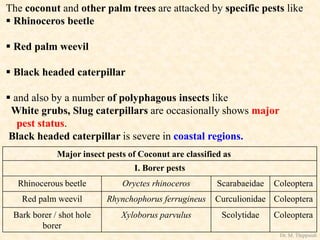
The coconut and other palm trees are attacked by specific pests like
 Rhinoceros beetle
 Red palm weevil
 Black headed caterpillar
 and also by a number of polyphagous insects like
White grubs, Slug caterpillars are occasionally shows major
pest status.
Black headed caterpillar is severe in coastal regions.
Major insect pests of Coconut are classified as
I. Borer pests
Rhinocerous beetle Oryctes rhinoceros Scarabaeidae Coleoptera
Red palm weevil Rhynchophorus ferrugineus Curculionidae Coleoptera
Bark borer / shot hole
borer
Xyloborus parvulus Scolytidae Coleoptera
Dr. M. Thippaiah
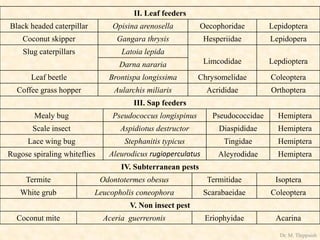
II. Leaf feeders
Black headed caterpillar Opisina arenosella Oecophoridae Lepidoptera
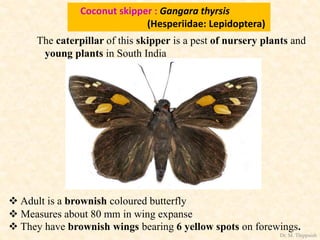
Coconut skipper Gangara thrysis Hesperiidae Lepidopera
Slug caterpillars Latoia lepida
Limcodidae LepdiopteraDarna nararia
Leaf beetle Brontispa longissima Chrysomelidae Coleoptera
Coffee grass hopper Aularchis miliaris Acrididae Orthoptera
III. Sap feeders
Mealy bug Pseudococcus longispinus Pseudococcidae Hemiptera
Scale insect Aspidiotus destructor Diaspididae Hemiptera
Lace wing bug Stephanitis typicus Tingidae Hemiptera
Rugose spiraling whiteflies Aleurodicus rugioperculatus Aleyrodidae Hemiptera
IV. Subterranean pests
Termite Odontotermes obesus Termitidae Isoptera
White grub Leucopholis coneophora Scarabaeidae Coleoptera
V. Non insect pest
Coconut mite Aceria guerreronis Eriophyidae Acarina
Dr. M. Thippaiah
I. Borer pest of Coconut
Dr. M. Thippaiah
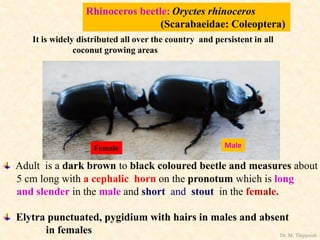
Rhinoceros beetle: Oryctes rhinoceros
(Scarabaeidae: Coleoptera)
It is widely distributed all over the country and persistent in all
coconut growing areas
Adult is a dark brown to black coloured beetle and measures about
5 cm long with a cephalic horn on the pronotum which is long
and slender in the male and short and stout in the female.
Elytra punctuated, pygidium with hairs in males and absent
in females
Female Male
Dr. M. Thippaiah
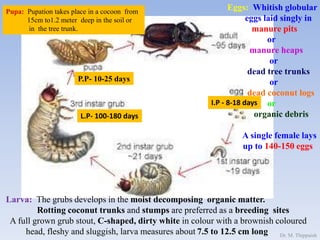
I.P - 8-18 days
Larva: The grubs develops in the moist decomposing organic matter.
Rotting coconut trunks and stumps are preferred as a breeding sites
A full grown grub stout, C-shaped, dirty white in colour with a brownish coloured
head, fleshy and sluggish, larva measures about 7.5 to 12.5 cm long
L.P- 100-180 days
Pupa: Pupation takes place in a cocoon from
15cm to1.2 meter deep in the soil or
in the tree trunk.
P.P- 10-25 days
Eggs: Whitish globular
eggs laid singly in
manure pits
or
manure heaps
or
dead tree trunks
or
dead coconut logs
or
organic debris
A single female lays
up to 140-150 eggs
Dr. M. Thippaiah
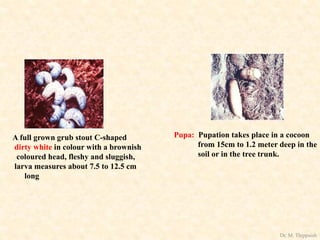
A full grown grub stout C-shaped
dirty white in colour with a brownish
coloured head, fleshy and sluggish,
larva measures about 7.5 to 12.5 cm
long
Pupa: Pupation takes place in a cocoon
from 15cm to 1.2 meter deep in the
soil or in the tree trunk.
Dr. M. Thippaiah
 Adult survive for a month without food and with food they live
more than 280-290 days
 It is abundant during March-May.
 On a tree occasionally five to six beetles may be present.
Alternative hosts: Apart from coconut it attacks date palm,
African oil palm, Areca sugar and pineapple
Nature and symptoms of damage
• Adults are responsible for the damage to young as well as old trees
• The beetle injures the trees by boring in to the central shoots, spathes
and petioles
• Beetles are also found in crevices between leaf sheaths near the
crown region and burrow into the softer portions and feeding on the
compact mass of tissues of the unopened fronds and inflorescence.
Dr. M. Thippaiah
• The beetles chews the internal tissues and after injecting the juicy
part and throws out the fibrous part which comes out of holes is the
indication for the presence of beetle in the crown
• The infested fully opened fronds showing the characteristic
‘V- shaped cuts on the leaflets
or
Damaged leaves show characteristic clippings or holes in the leaf lets
• The young seedlings are often killed when the growing points
are damaged
• The wounds are provide entry of harmful bacteria, fungi etc, some
times the stalk of the frond is also bored
• The damage done to the spathe reduces the yield up to 10 – 15 %
• The attack central shoot topples down and repeated attack in old
trees causes stunting of growth and present sickly appearance of the trees
Dr. M. Thippaiah
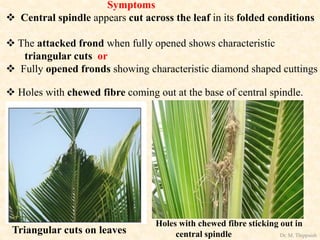
Triangular cuts on leaves
Holes with chewed fibre sticking out in
central spindle
Symptoms
 Central spindle appears cut across the leaf in its folded conditions
 The attacked frond when fully opened shows characteristic
triangular cuts or
 Fully opened fronds showing characteristic diamond shaped cuttings
 Holes with chewed fibre coming out at the base of central spindle.
Dr. M. Thippaiah
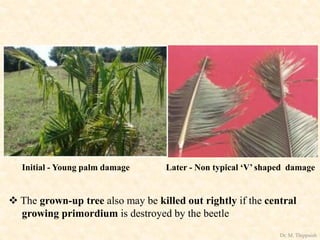
Initial - Young palm damage Later - Non typical ‘V’ shaped damage
 The grown-up tree also may be killed out rightly if the central
growing primordium is destroyed by the beetle
Dr. M. Thippaiah
MANAGEMENT PRACTICES:
Follow IPM practices for control of Rhinoceros beetle
I. Cultural Practices:
1. Remove and burn all dead coconut trees in the garden which are
likely to serve as good breeding place and to maintain good
sanitation
2. Collect and destroy various bio-stages of the beetles from manure
pits (breeding place) when ever manure is lifted from the pits.
II. Mechanical practices:
1. Artificial breeding traps has been found effective against this pest
 soak the castor cake at 1 kg in 5 lit. of water and
 add dung slurry allow for decaying and
 add 2-3 ml of Nuvan
and keep them in the coconut gardens in small mud pots to
attract and kill the adults and above materials should be changed
once in a month Dr. M. Thippaiah
2. Pieces of tender coconut stem split longitudinally and treated with
fresh dung will also be an effective trap to attract the beetles
3. Growing banana or Sugarcane to prevent flying the beetle
4. Light traps set up in the gardens following first rains in summer
and monsoon period to attract and kill the adult beetles.
5. The adult beetles may be extracted from crowns by using a beetle
hook, which is an Iron rod during peak period of infestation i.e.,
July-Sept and
fill leaf axils with fine sand and mancozeb mixtures @ 3:1ratio
6. Attract the beetle by using pheromone bucket trap
or
Aggregation pheromone bucket trap @ 2 lures/ha
Dr. M. Thippaiah
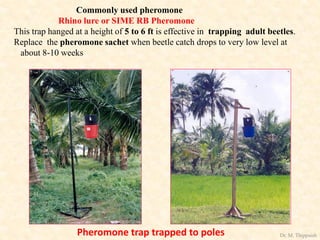
Pheromone trap trapped to poles
Commonly used pheromone
Rhino lure or SIME RB Pheromone
This trap hanged at a height of 5 to 6 ft is effective in trapping adult beetles.
Replace the pheromone sachet when beetle catch drops to very low level at
about 8-10 weeks
Dr. M. Thippaiah
III. Biological control Practices
1. Incorporate green muscardine fungus, Meterrhizium anisopliae
or
white muscardine fungus, Beauveria bassiana
in manure pits to check the perpetuation of pest
2. Use of oryctes baculovirus (OBV) for controlling beetles
The beetles themselves are good disseminators of the virus.
Release of the infected beetles @ 10-15 infected beetle / ha spreads
the disease to subsequent generation if beetles and larvae in
breeding sites
3 To encourage natural enemies - Predators:
1. Santalus parallelus- Histerid beetles is predaceous
on the eggs and all the stages of grubs
2. Omphra atrata – Carbid beetle can also encouraged
3. Release Platymeris laevicollis - Reduviid bug to check the
adult population i.e. predator on adults Dr. M. Thippaiah
VI. Chemicals control
1. Drench the manure pits with chlorpyriphos @ 0.05 % concentration
once in three months
2. Treat the crowns inner most 2 to 3 or 4 leaf axils of the palms in border
rows with lindane1.3 %D + sand mixture @ 225gm /palm during
April-May
and
October-Nov
3. Mix salt and Turmeric powder and apply this mixture into the
crown this is a common practice followed in Tamil Nadu.
4. Mixtures of either neem seed powder + sand ( 1: 2)@ 150gm / palm
or
Neem seed kernel powder + sand (1: 2) @ 150gm / palm applied at
the base of the inner most leaves in the crown region
Dr. M. Thippaiah
Red palm weevil: Rhynchophorus ferruginous
( RPW) (Curculionidae: Coleoptera)
 This is the most serious pest of coconut plantations in India because
once the palm is attacked it is killed in 6-8 months, if timely control
measures are not adopted.
 It is present all most all the coconut growing tracts, but as a serious
pest only in Kerala, Karnataka, TN, Assam and Maharashtra
Severity of damage is confined to certain endemic pockets such as
 Areas having high water table and associated with luxuriant growth
 Areas affected with by leaf rot and bud rot diseases
 Palm below the age of 20 years are more susceptible to weevil
Dr. M. Thippaiah
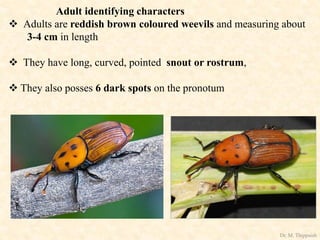
Adult identifying characters
 Adults are reddish brown coloured weevils and measuring about
3-4 cm in length
 They have long, curved, pointed snout or rostrum,
 They also posses 6 dark spots on the pronotum
Dr. M. Thippaiah
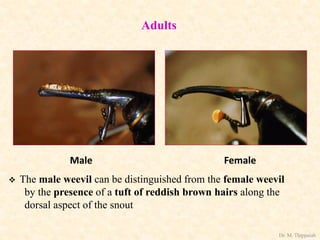
Male Female
Adults
 The male weevil can be distinguished from the female weevil
by the presence of a tuft of reddish brown hairs along the
dorsal aspect of the snout
Dr. M. Thippaiah
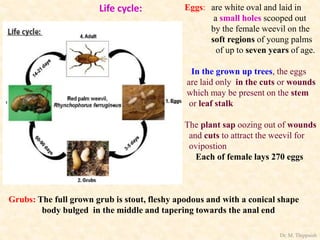
Life cycle: Eggs: are white oval and laid in
a small holes scooped out
by the female weevil on the
soft regions of young palms
of up to seven years of age.
In the grown up trees, the eggs
are laid only in the cuts or wounds
which may be present on the stem
or leaf stalk
The plant sap oozing out of wounds
and cuts to attract the weevil for
ovipostion
Each of female lays 270 eggs
Grubs: The full grown grub is stout, fleshy apodous and with a conical shape
body bulged in the middle and tapering towards the anal end
Dr. M. Thippaiah
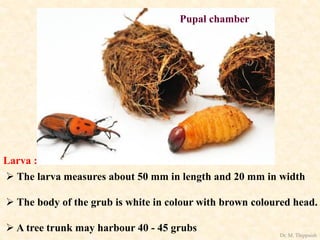
 The larva measures about 50 mm in length and 20 mm in width
 The body of the grub is white in colour with brown coloured head.
 A tree trunk may harbour 40 - 45 grubs
Pupal chamber
Larva :
Dr. M. Thippaiah
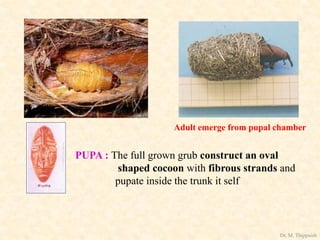
PUPA : The full grown grub construct an oval
shaped cocoon with fibrous strands and
pupate inside the trunk it self
Adult emerge from pupal chamber
Dr. M. Thippaiah
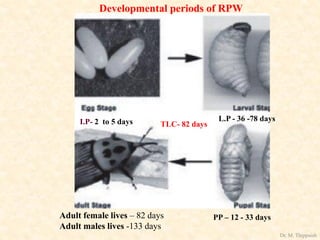
I.P- 2 to 5 days L.P - 36 -78 days
PP – 12 - 33 days
TLC- 82 days
Adult female lives – 82 days
Adult males lives -133 days
Developmental periods of RPW
Dr. M. Thippaiah
Nature and Symptoms of damage
 Grub is the damaging stage of the pest
 It feeds with in the stem tissues in large numbers making tunnels
There are three types infestations are noted by RPW
1. Infestation in the crown – This is helped by the injuries to the
crown by rhinoceros beetle and bud rot and leaf rot diseases in
such situation the grubs directly enter into the growing point of the
crown
2. Damage in the stem
3. Bole infestation – bole infestation occurs in young palms
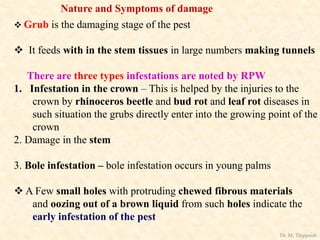
 A Few small holes with protruding chewed fibrous materials
and oozing out of a brown liquid from such holes indicate the
early infestation of the pest
Dr. M. Thippaiah
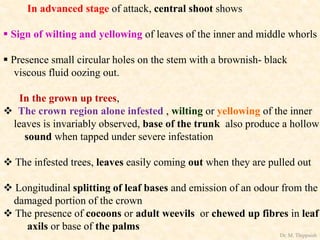
In advanced stage of attack, central shoot shows
 Sign of wilting and yellowing of leaves of the inner and middle whorls
 Presence small circular holes on the stem with a brownish- black
viscous fluid oozing out.
In the grown up trees,
 The crown region alone infested , wilting or yellowing of the inner
leaves is invariably observed, base of the trunk also produce a hollow
sound when tapped under severe infestation
 The infested trees, leaves easily coming out when they are pulled out
 Longitudinal splitting of leaf bases and emission of an odour from the
damaged portion of the crown
 The presence of cocoons or adult weevils or chewed up fibres in leaf
axils or base of the palms
Dr. M. Thippaiah
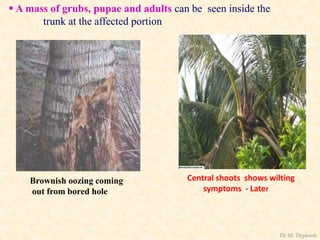
Brownish oozing coming
out from bored hole
Central shoots shows wilting
symptoms - Later
 A mass of grubs, pupae and adults can be seen inside the
trunk at the affected portion
Dr. M. Thippaiah
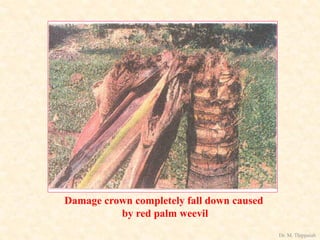
Damage crown completely fall down caused
by red palm weevil
Dr. M. Thippaiah
Management practices
Follow IPM practices for the control of RPW
1. Cultural methods:
1.Regular monitoring of plants and maintain good sanitation
2. Remove and burn all wilting or damaged palms in coconut gardens
to prevent further perpetuation of the pest,
3. Avoid injuries / wounds on stems of palms as they serve as
ovipositon sites of the weevil
To fill all the holes in the stem with cement / clay
4. Avoid cutting of green leaves, if needed they should be cut about
120cm away from the stem.
II. Behavioural methods:
1. Setting up of attractant traps – a plastic bucket of 5-10 lit. capacity
hang on the palms at chest height. So effectively capture RPW
Make 3-4 holes on the bucket with bait materials or Use mud pots
Dr. M. Thippaiah
Bait materials consists of :
Sugarcane / Pineapple are sliced into small pieces
+
Add one litre of water
+
4-5 yeast tablets and soak for a day
+
Add 2 gms of carbofuran granules
+
Add water as when required
change the food once in 15 days or use mud pots
2) Pheromone trapping: ‘Ferro lure’ placed in specially designed
traps and hanged on the palms to trap and kills adult weevil.
The pheromone trapping of red palm weevil is an
 Ecologically safe and
 Environmentally friendly tool in the IPM strategy
currently adopted worldwide for the red palm weevil management in
coconut, oil palm and date palm Dr. M. Thippaiah
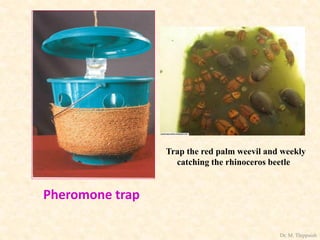
Pheromone trap
Trap the red palm weevil and weekly
catching the rhinoceros beetle
Dr. M. Thippaiah
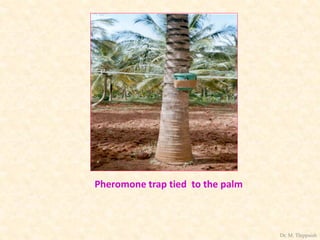
Pheromone trap tied to the palm
Dr. M. Thippaiah
III. Biological methods:
 The grubs are infested by a CPV (cytoplasmic polyhedrosis virus)
 A predacious earwig- chelisoches moris prey on the egg and early
instar grubs
 Pseudomonas aeroginosa is a facultative pathogen of the weevil
especially the early instar larvae.
IV Chemical methods:
1. Insert one or two tablets of Aluminium phosphide inside the
tunnelled trunk and plug all the holes with clay
or
cement mixed with copper oxychloride to kill the insect by
fumigant action.
2. The weevil infested palms can be saved by the application of
chlorpyriphos@ 0.1% concentration to the palms.
Normally 1 to 1.5 litres of insecticides suspension is required for
treating one palm
Dr. M. Thippaiah
Shot hole or Bark borer: Xyleborus parvulus
( Scolytidae : Coleoptera)
Adults are small brown coloured beetles
Symptoms of damage
 Both grubs and adults attack the base of the palm and extend to the
upper regions.
 Deposits of white powdery materials on the ground, around the base
of the palm and numerous small strings of frass and white powdery
material hang downwards from the pin size holes are the symptoms
of attack.
 Damaged palms loose their vigour and are prone to attack by ants.
 The infested palms die in six months.
Dr. M. Thippaiah
Management practices
 Follow the root feeding of monocrotophos 10 ml + water 10 ml
per palm. (Procedure seen in the black headed caterpillar management)
 Give stem injection through a stove wick soaked in
0.2% fenthion
or
2% dichlorvos
plugging the hole and repeating the treatment using the same wick and
same hole a month after.
Dr. M. Thippaiah
II. Leaf feeders
Dr. M. Thippaiah
Black headed caterpillar : Opisinia arenosella
(Oecophoridae: Lepidoptera)
 The black headed or leaf eating caterpillar is a serious pest of
coconut palm all over peninsular India, but more injurious along
the East and West Coast regions
 Of late it has been observed infesting coconut in some interior
regions of Karnataka and TN
 The pest is active throughout the year but usually out breaks in
serious proportions during the hot months of March, April and May,
especially after the Pre South-West monsoon showers.
 The population generally subsides after the onset of heavy rains.
Dr. M. Thippaiah
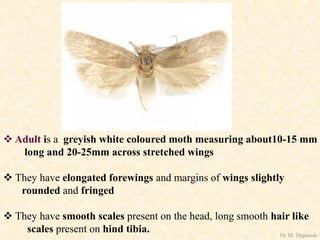
 Adult is a greyish white coloured moth measuring about10-15 mm
long and 20-25mm across stretched wings
 They have elongated forewings and margins of wings slightly
rounded and fringed
 They have smooth scales present on the head, long smooth hair like
scales present on hind tibia. Dr. M. Thippaiah
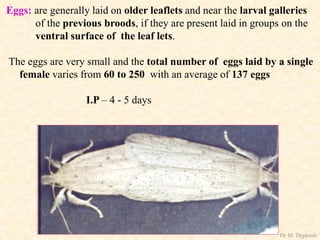
Eggs: are generally laid on older leaflets and near the larval galleries
of the previous broods, if they are present laid in groups on the
ventral surface of the leaf lets.
The eggs are very small and the total number of eggs laid by a single
female varies from 60 to 250 with an average of 137 eggs
I.P – 4 - 5 days
Dr. M. Thippaiah
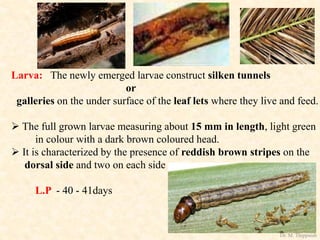
Larva: The newly emerged larvae construct silken tunnels
or
galleries on the under surface of the leaf lets where they live and feed.
 The full grown larvae measuring about 15 mm in length, light green
in colour with a dark brown coloured head.
 It is characterized by the presence of reddish brown stripes on the
dorsal side and two on each side
L.P - 40 - 41days
Dr. M. Thippaiah
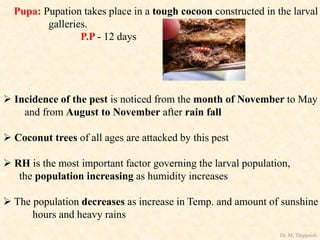
Pupa: Pupation takes place in a tough cocoon constructed in the larval
galleries.
P.P - 12 days
 Incidence of the pest is noticed from the month of November to May
and from August to November after rain fall
 Coconut trees of all ages are attacked by this pest
 RH is the most important factor governing the larval population,
the population increasing as humidity increases
 The population decreases as increase in Temp. and amount of sunshine
hours and heavy rains
Dr. M. Thippaiah
Nature and Symptom of damage:
* The larvae feed on the green matter of the leaf lets / surface tissues
from the under surface of the leaf, as a result reducing the functional
leaf surface as well as the yield.
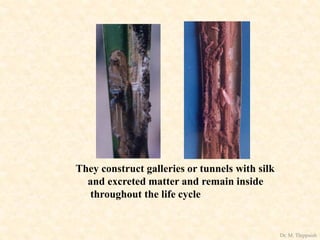
* They construct galleries or tunnels with silk and excreted
matter and remain inside throughout the life cycle, feeding
on the chlorophyll containing green parenchymatous tissues of
the leaf lets.
• The attacked leaflets slowly turn greyish brown in colour and dry
up in patches along the area where each larva has been feeding.
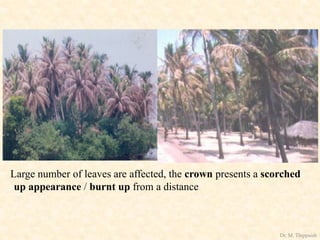
* When a large number of leaves are affected, the crown presents
a scorched up appearance with substantial decline in the yield.
Dr. M. Thippaiah
They construct galleries or tunnels with silk
and excreted matter and remain inside
throughout the life cycle
Dr. M. Thippaiah
Large number of leaves are affected, the crown presents a scorched
up appearance / burnt up from a distance
Dr. M. Thippaiah
Management practices:
Follow the IPM practices for control of CBHC
1. Cultural methods:
1. The infected leaves / leaf lets showing the presence of larval
galleries should be cut and burnt in order to reduce the pest
population and its further spread
2. Regulate the microclimatic conditions of the garden through
inter cropping.
II. Mechanical methods
Light traps are useful to attract the adult moths.
This is very effective immediately after summer showers.
Since natural enemies are also attracted to the light, the use
of light traps is not recommended in coconut gardens
Dr. M. Thippaiah
III. Biological methods
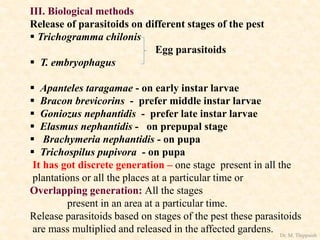
Release of parasitoids on different stages of the pest
 Trichogramma chilonis
Egg parasitoids
 T. embryophagus
 Apanteles taragamae - on early instar larvae
 Bracon brevicorins - prefer middle instar larvae
 Goniozus nephantidis - prefer late instar larvae
 Elasmus nephantidis - on prepupal stage
 Brachymeria nephantidis - on pupa
 Trichospilus pupivora - on pupa
It has got discrete generation – one stage present in all the
plantations or all the places at a particular time or
Overlapping generation: All the stages
present in an area at a particular time.
Release parasitoids based on stages of the pest these parasitoids
are mass multiplied and released in the affected gardens. Dr. M. Thippaiah
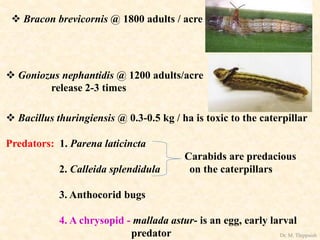
 Bracon brevicornis @ 1800 adults / acre
 Goniozus nephantidis @ 1200 adults/acre
release 2-3 times
 Bacillus thuringiensis @ 0.3-0.5 kg / ha is toxic to the caterpillar
Predators: 1. Parena laticincta
Carabids are predacious
2. Calleida splendidula on the caterpillars
3. Anthocorid bugs
4. A chrysopid - mallada astur- is an egg, early larval
predator Dr. M. Thippaiah
IV. Chemical control:
1. In severe epidemic out break give the spray of dichlorvos 0.02%
to cover under surface of leaves thoroughly in the young palms.
2 Root feeding with monocrotophos is effective
Root feeding: With monocrotophos 10 ml
+
10 ml water, totally 20 ml.
Dig around the base of the stem or 1 to 2 feet away from the palm,
select a fresh and live root which is brick red in colour or bronze
coloured mature root and give a slanting cut. (Do not select yellow
or dark brown root)
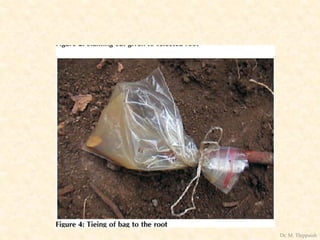
Take 20 ml of insecticide mixtures in a vial or 7 X 10 cm polythene
bag.
Secure the bag tightly to the root with a cotton thread, one day later
check whether there is absorption or not. Dr. M. Thippaiah
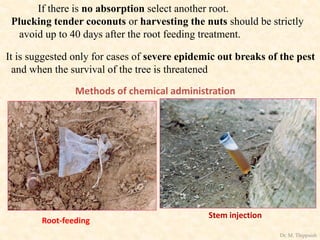
Methods of chemical administration
Root-feeding
Stem injection
It is suggested only for cases of severe epidemic out breaks of the pest
and when the survival of the tree is threatened
If there is no absorption select another root.
Plucking tender coconuts or harvesting the nuts should be strictly
avoid up to 40 days after the root feeding treatment.
Dr. M. Thippaiah
Coconut skipper : Gangara thyrsis
(Hesperiidae: Lepidoptera)
 Adult is a brownish coloured butterfly
 Measures about 80 mm in wing expanse
 They have brownish wings bearing 6 yellow spots on forewings.
The caterpillar of this skipper is a pest of nursery plants and
young plants in South India
Dr. M. Thippaiah
Eggs: are laid in irregular masses on the inner surface of leaves
I.P - 7 days.
Caterpillar: The full grown caterpillar is pale green with reddish
markings, Body is concealed in a covering of white
waxy filaments.
L.P - 5 weeks
Pupa: Pupation takes places in the leaf tube / leaf roll for a period of
about10 days
pupa vibrates vigorously within its leaf tube when disturbed
making rattling sound.
Nature of damage
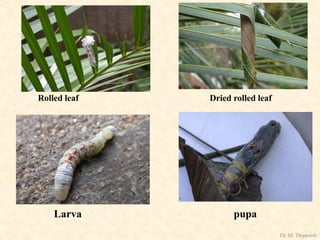
The caterpillars constructs tubes out of the leaves and feed within
leaf blades leaving behind only the midribs.
Control measure
Collect and destroy immature stages of the insects where ever
is possible Dr. M. Thippaiah
Rolled leaf Dried rolled leaf
Larva pupa
Dr. M. Thippaiah
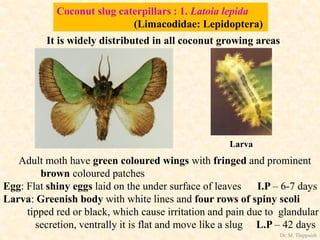
Coconut slug caterpillars : 1. Latoia lepida
(Limacodidae: Lepidoptera)
It is widely distributed in all coconut growing areas
Adult moth have green coloured wings with fringed and prominent
brown coloured patches
Egg: Flat shiny eggs laid on the under surface of leaves I.P – 6-7 days
Larva: Greenish body with white lines and four rows of spiny scoli
tipped red or black, which cause irritation and pain due to glandular
secretion, ventrally it is flat and move like a slug L.P – 42 days
Larva
Dr. M. Thippaiah
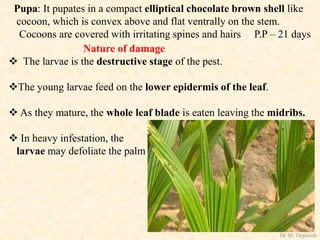
Pupa: It pupates in a compact elliptical chocolate brown shell like
cocoon, which is convex above and flat ventrally on the stem.
Cocoons are covered with irritating spines and hairs P.P – 21 days
Nature of damage
 The larvae is the destructive stage of the pest.
The young larvae feed on the lower epidermis of the leaf.
 As they mature, the whole leaf blade is eaten leaving the midribs.
 In heavy infestation, the
larvae may defoliate the palm
Dr. M. Thippaiah
Management practices
Mechanical Method:
Set up light traps to trap and collect adult moths. About 5 light traps
may be installed per hectare.
Chemical Method:
Collect and destroy the immature stages of the insects wherever possible
and spray dichlorvos 76 WSC @ 2 ml / lit.
Dr. M. Thippaiah
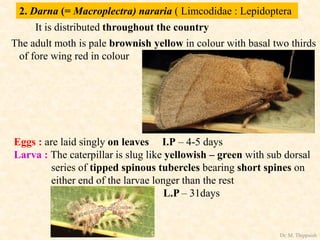
2. Darna (= Macroplectra) nararia ( Limcodidae : Lepidoptera
It is distributed throughout the country
The adult moth is pale brownish yellow in colour with basal two thirds
of fore wing red in colour
Eggs : are laid singly on leaves I.P – 4-5 days
Larva : The caterpillar is slug like yellowish – green with sub dorsal
series of tipped spinous tubercles bearing short spines on
either end of the larvae longer than the rest
L.P – 31days
Dr. M. Thippaiah
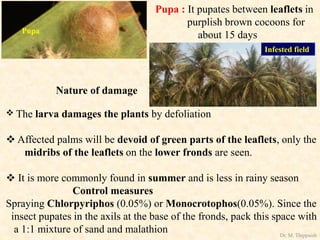
Nature of damage
 The larva damages the plants by defoliation
 Affected palms will be devoid of green parts of the leaflets, only the
midribs of the leaflets on the lower fronds are seen.
 It is more commonly found in summer and is less in rainy season
Control measures
Spraying Chlorpyriphos (0.05%) or Monocrotophos(0.05%). Since the
insect pupates in the axils at the base of the fronds, pack this space with
a 1:1 mixture of sand and malathion
Pupa : It pupates between leaflets in
purplish brown cocoons for
about 15 daysPupa
Infested field
Dr. M. Thippaiah
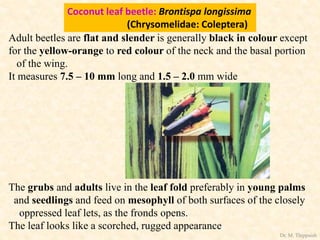
Coconut leaf beetle: Brontispa longissima
(Chrysomelidae: Coleptera)
Adult beetles are flat and slender is generally black in colour except
for the yellow-orange to red colour of the neck and the basal portion
of the wing.
It measures 7.5 – 10 mm long and 1.5 – 2.0 mm wide
The grubs and adults live in the leaf fold preferably in young palms
and seedlings and feed on mesophyll of both surfaces of the closely
oppressed leaf lets, as the fronds opens.
The leaf looks like a scorched, rugged appearance
Dr. M. Thippaiah
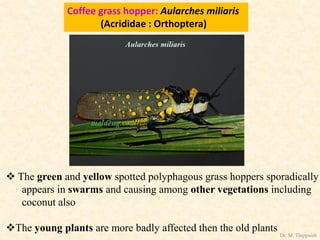
Coffee grass hopper: Aularches miliaris
(Acrididae : Orthoptera)
 The green and yellow spotted polyphagous grass hoppers sporadically
appears in swarms and causing among other vegetations including
coconut also
The young plants are more badly affected then the old plants
Dr. M. Thippaiah
The adults gather themselves on the ground and to lay eggs in mid
November
A female lays about 80 eggs in soil and these eggs hatch in four months
The hopper coming out in April
The hopper passes through six instars and becomes adult in about
three months
Nature of damage
Nymphs and adults feeds on leaf lamina in young plants in the nursery
and in the main field and defoliate the plants
Control measure
The pest appears in serious, dust with malathion 5 %D
Dr. M. Thippaiah
III. Sap feeders
Dr. M. Thippaiah
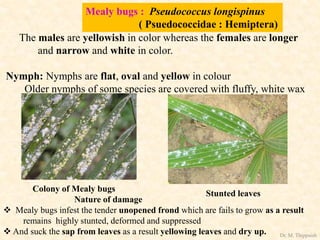
Mealy bugs : Pseudococcus longispinus
( Psuedococcidae : Hemiptera)
The males are yellowish in color whereas the females are longer
and narrow and white in color.
Nymph: Nymphs are flat, oval and yellow in colour
Older nymphs of some species are covered with fluffy, white wax
Colony of Mealy bugs
Stunted leaves
Nature of damage
 Mealy bugs infest the tender unopened frond which are fails to grow as a result
remains highly stunted, deformed and suppressed
 And suck the sap from leaves as a result yellowing leaves and dry up. Dr. M. Thippaiah
 It is often confused with the leaf rot disease symptoms.
 The affected inflorescences are malformed and do not open
Management practices
Cultural Method
Remove leaflets harbouring mealy bugs and destroy them.
Chemical Method
Spray any one of the following; insecticides
Malathion 50 EC @ 2 ml / lit
or
Dimethoate 30 EC @1 ml / lit
or
Methyl demeton 25 EC @1 ml / lit
or
Phosphamidon 40 SL @1.25 ml / lit
or
3% Neem oil
Dr. M. Thippaiah
Scale insect : Aspidiotus destructor
( Diaspididae : Hemiptera)
 The circular hard scale insect occur as a serious persistent pest in
some part of West Coast regions
 The scale insects are bright yellow in colour and round or reddish
in case of female and some what oval in shape in case of male
covered with semitransparent grayish white flat scale.
 Females are always wingless and remain under their scale entire life.
 Adult males have one pair of membranous wings, move about
actively in search of females and do not feed during adult stage.
Dr. M. Thippaiah
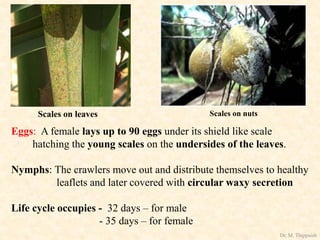
Eggs: A female lays up to 90 eggs under its shield like scale
hatching the young scales on the undersides of the leaves.
Nymphs: The crawlers move out and distribute themselves to healthy
leaflets and later covered with circular waxy secretion
Life cycle occupies - 32 days – for male
- 35 days – for female
Scales on leaves Scales on nuts
Dr. M. Thippaiah
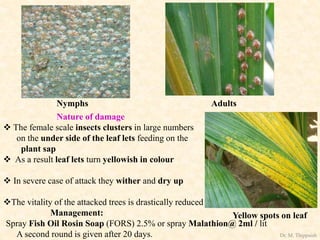
Nymphs Adults
Nature of damage
 The female scale insects clusters in large numbers
on the under side of the leaf lets feeding on the
plant sap
 As a result leaf lets turn yellowish in colour
 In severe case of attack they wither and dry up
The vitality of the attacked trees is drastically reduced
Yellow spots on leafManagement:
Spray Fish Oil Rosin Soap (FORS) 2.5% or spray Malathion@ 2ml / lit
A second round is given after 20 days. Dr. M. Thippaiah
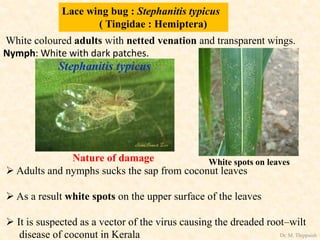
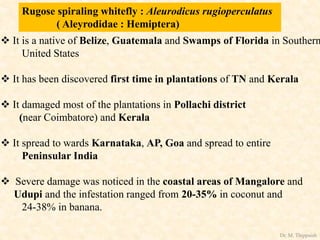
Lace wing bug : Stephanitis typicus
( Tingidae : Hemiptera)
White coloured adults with netted venation and transparent wings.
Nymph: White with dark patches.
Nature of damage
 Adults and nymphs sucks the sap from coconut leaves
 As a result white spots on the upper surface of the leaves
 It is suspected as a vector of the virus causing the dreaded root–wilt
disease of coconut in Kerala
White spots on leaves
Dr. M. Thippaiah
Rugose spiraling whitefly : Aleurodicus rugioperculatus
( Aleyrodidae : Hemiptera)
 It is a native of Belize, Guatemala and Swamps of Florida in Southern
United States
 It has been discovered first time in plantations of TN and Kerala
 It damaged most of the plantations in Pollachi district
(near Coimbatore) and Kerala
 It spread to wards Karnataka, AP, Goa and spread to entire
Peninsular India
 Severe damage was noticed in the coastal areas of Mangalore and
Udupi and the infestation ranged from 20-35% in coconut and
24-38% in banana.
Dr. M. Thippaiah
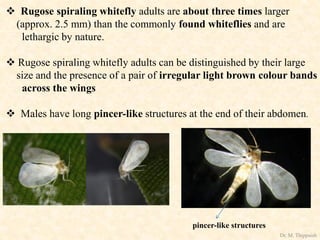
 Rugose spiraling whitefly adults are about three times larger
(approx. 2.5 mm) than the commonly found whiteflies and are
lethargic by nature.
 Rugose spiraling whitefly adults can be distinguished by their large
size and the presence of a pair of irregular light brown colour bands
across the wings
 Males have long pincer-like structures at the end of their abdomen.
pincer-like structures
Dr. M. Thippaiah
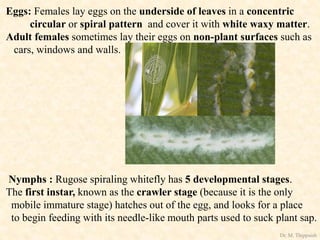
Eggs: Females lay eggs on the underside of leaves in a concentric
circular or spiral pattern and cover it with white waxy matter.
Adult females sometimes lay their eggs on non-plant surfaces such as
cars, windows and walls.
Nymphs : Rugose spiraling whitefly has 5 developmental stages.
The first instar, known as the crawler stage (because it is the only
mobile immature stage) hatches out of the egg, and looks for a place
to begin feeding with its needle-like mouth parts used to suck plant sap.
Dr. M. Thippaiah
Crawlers molt into immature stages that are immobile, oval and flat
initially but become more convex with the progression of its life cycle
Nymphs are about 1.1 - 1.5 mm long but may vary in size depending
on instars
Nature of damage
 Infestation of this pest usually does not kill the host plant,
but it may interfere with the normal growth of its host.
 Rugose spiraling whitefly can cause stress to the plant by
removing nutrients and water, and by promoting the growth
of black sooty molds.
 Rugose spiraling whitefly excretes a sticky, glistening liquid
substance (honeydew)
 Which provides an excellent substrate for growth of sooty molds
Dr. M. Thippaiah
Symptoms
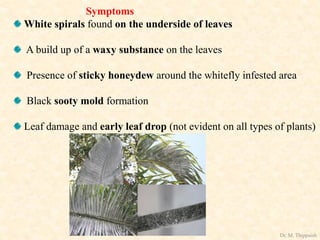
White spirals found on the underside of leaves
A build up of a waxy substance on the leaves
Presence of sticky honeydew around the whitefly infested area
Black sooty mold formation
Leaf damage and early leaf drop (not evident on all types of plants)
Dr. M. Thippaiah
Management practices
 Effective control can be achieved using systemic application of
insecticides (soil or trunk).
 Systemic insecticides can be applied by licensed professionals to the
soil (drenching, granular formulations, burying pellets, or
soil injection), to the trunk (basal bark spray and trunk injection),
or
to the foliage; however, soil and trunk applications take advantage
of the systemic properties of these products and provide longer term
control
Biological control
Two parasitoids,
1. Encarsia guadeluopae
2. Encarsia noyesii (Hymenoptera: Aphelinidae)
Beetle predator- Nephaspis oculatus ,
have shown the most promise for use against rugose spiraling
whitefly, but are not commercially available at this time.
Dr. M. Thippaiah
IV. Subterranean pests
Dr. M. Thippaiah
 They damage the coconut seedlings both in the nursery and in the
transplanted seedlings main field in West Coast regions
 They infest stem and feed on tissues of trunks and fill with sand
and excreta
 Affected plants shows drying and wilting of central shoot is a
common symptom of attack
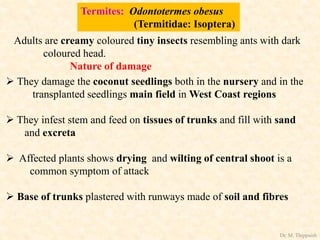
 Base of trunks plastered with runways made of soil and fibres
Termites: Odontotermes obesus
(Termitidae: Isoptera)
Adults are creamy coloured tiny insects resembling ants with dark
coloured head.
Nature of damage
Dr. M. Thippaiah
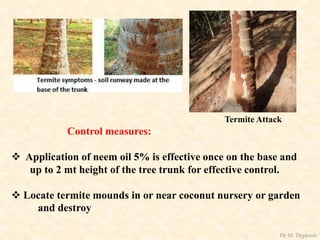
Termite Attack
Control measures:
 Application of neem oil 5% is effective once on the base and
up to 2 mt height of the tree trunk for effective control.
 Locate termite mounds in or near coconut nursery or garden
and destroy
Dr. M. Thippaiah
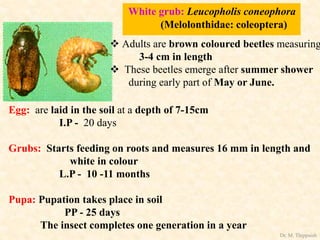
White grub: Leucopholis coneophora
(Melolonthidae: coleoptera)
Egg: are laid in the soil at a depth of 7-15cm
I.P - 20 days
Grubs: Starts feeding on roots and measures 16 mm in length and
white in colour
L.P - 10 -11 months
Pupa: Pupation takes place in soil
PP - 25 days
The insect completes one generation in a year
 Adults are brown coloured beetles measuring
3-4 cm in length
 These beetles emerge after summer shower
during early part of May or June.
Dr. M. Thippaiah
Nature of damage:
 The adult beetles feeds on leaves and defoliate the plants
 Grubs feed on roots and cause
 yellowing leaves,
 immature nuts shed down,
 stunting and
 delayed flowering
 Finally trees become weak and show the symptoms of premature
falling of the nuts.
Control measure
Dust the soil with lindane 2% @ 30 Kgs / ha
Dr. M. Thippaiah
V. Non insect pest
Dr. M. Thippaiah
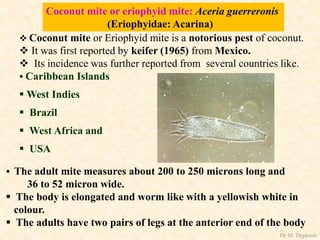
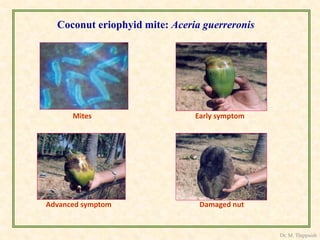
Coconut mite or eriophyid mite: Aceria guerreronis
(Eriophyidae: Acarina)
 Coconut mite or Eriophyid mite is a notorious pest of coconut.
 It was first reported by keifer (1965) from Mexico.
 Its incidence was further reported from several countries like.
 Caribbean Islands
 West Indies
 Brazil
 West Africa and
 USA
 The adult mite measures about 200 to 250 microns long and
36 to 52 micron wide.
 The body is elongated and worm like with a yellowish white in
colour.
 The adults have two pairs of legs at the anterior end of the body
Dr. M. Thippaiah
Biology:
 The female lays eggs which are white and oval
 The nymphs which hatch-out are small but resemble the adults
in shape
 Total period for development from egg to adult is 7 to 8 days
 The pest is present in the field throughout the year
 They are dispersed through the wind and hence they spread very
fast to the neighbouring plantations and even reach far off places
 The pest infestation has been observed even during the rainy
months
Dr. M. Thippaiah
Nature and Symptoms of damage
 This mite infests buttons during their early stages of growth
 The mite infestation starts soon after the pollination of the nuts
 One to three months old buttons harbour large number of mite colonies
 Nuts up to 9 months of growth are found to accommodate mite colonies in them
the mite inhibit the tender portion of the nut (button stage) covered with
perianth
 They multiply and colonise very fast on the meristematic tissues of growing
nuts under the perianth and suck the sap
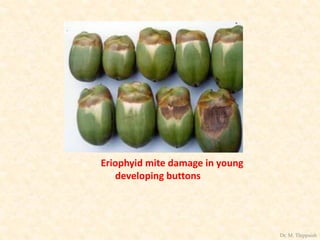
 The feeding sites which grow out of the perianth appear initially as whitish
longitudinal patches, turn brown, develop longitudinal fissures (Split)
and finally appear as warts
Dr. M. Thippaiah
Coconut eriophyid mite: Aceria guerreronis
Mites Early symptom
Advanced symptom Damaged nut
Dr. M. Thippaiah
Eriophyid mite damage in young
developing buttons
Dr. M. Thippaiah
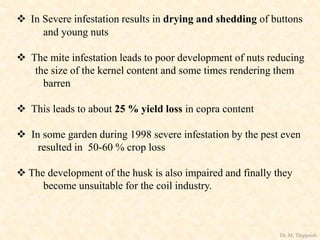
 In Severe infestation results in drying and shedding of buttons
and young nuts
 The mite infestation leads to poor development of nuts reducing
the size of the kernel content and some times rendering them
barren
 This leads to about 25 % yield loss in copra content
 In some garden during 1998 severe infestation by the pest even
resulted in 50-60 % crop loss
 The development of the husk is also impaired and finally they
become unsuitable for the coil industry.
Dr. M. Thippaiah
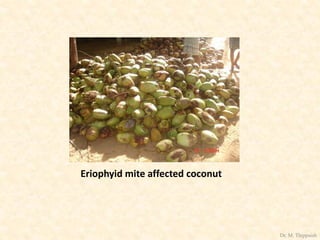
Eriophyid mite affected coconut
Dr. M. Thippaiah
Management practices
The pest should be managed by adopting an integrated approach,
which includes
 Clean cultivation or Field sanitation
 Nutrient management
 Pesticide treatment
 Growing inter crops
1. Field sanitation or clean cultivation
By keeping the garden clean in general many pests can avoided
• This mite is not known to feed on other plants in India except
Palmyra hence removal of weeds etc., will not directly influence
the mite, but will help the coconut palm to get adequate nutrition
* In a few mite affected palms, several nuts drop off in the initial
stages, such fallen nuts can be collected and destroyed.
Dr. M. Thippaiah
2. Nutrient Management
The coconut palms which are not taken care of properly are prone
to sever damage by this pest. Hence, it is important to provide
adequate nutrition and irrigation to the palms.
The following are to be provided at the appropriate time
a. FYM or compost 50 kg/palm/year
b. Neem cake 5 kg/palm/year
c. 1.1 kg urea
2.0 kg single super phosphate
2.0 kg muriate of potash/palm/year
d. Magnesium sulphate 500 gm/palm/year
e. Borax 50 gm/palm/year
f. Gypsum 1 kg/palm/year
Note: Urea, Superphosphate and Muriate of potash
Apply in 2 split doses in equal proportions
1st dose apply along with other nutrients in the months of May-June
(pre-monsoon period)
2nd dose apply in the month of September-October (Post monsoon period)
Dr. M. Thippaiah
III. Pesticide treatment
A few chemical pesticides have been found effective in reducing the population
of the mite, but these are not recommended considering the safety to
environment and non target organisms.
The following botanical pesticides are recommended for the management of
the mite
Spraying:
Neem oil (2%) + garlic (2%) with 0.5% soap solution
or
Azadirachtin (1%) @ 4 ml/lit
or
Azadirachtin (5%) 1 ml/lit on tender nuts
Root feeding :
Azadirachtin(1%)@ 10 ml with 10ml of water/palm
or
Azadirachtin(5%) @ 7.5 ml with 7.5 ml of water/palm
The above formulations apply 3 times in a year
• April – May
• September-October
• January-February
Dr. M. Thippaiah
Spraying is the most effective and economical method
IV. Growing inter crops
Grow inter crop with cocoa, black pepper, vanilla, Turmeric,
pineapple, Sapota and Shelter belt with casurina all around
the coconut garden to check the entry of mite population
Dr. M. Thippaiah
Dr. M. Thippaiah
Dr. M. Thippaiah

Insect pests of Cococnut

  • 1.
    Insect pests ofplantation crops Dr. M. Thippaiah Professor Department of Entomology University of Agricultural Sciences GKVK, Bangalore- 65
  • 2.
    The important plantationcrops grown commercially in Asia are the various palm trees, namely Coconut, Areca nut and other trees and shrubs like Cashew nut Coffee Tea Cardamom Pepper etc. Dr. M. Thippaiah
  • 3.
    Insect pests ofcoconut and their management Dr. M. Thippaiah
  • 4.
    The coconut andother palm trees are attacked by specific pests like  Rhinoceros beetle  Red palm weevil  Black headed caterpillar  and also by a number of polyphagous insects like White grubs, Slug caterpillars are occasionally shows major pest status. Black headed caterpillar is severe in coastal regions. Major insect pests of Coconut are classified as I. Borer pests Rhinocerous beetle Oryctes rhinoceros Scarabaeidae Coleoptera Red palm weevil Rhynchophorus ferrugineus Curculionidae Coleoptera Bark borer / shot hole borer Xyloborus parvulus Scolytidae Coleoptera Dr. M. Thippaiah
  • 5.
    II. Leaf feeders Blackheaded caterpillar Opisina arenosella Oecophoridae Lepidoptera Coconut skipper Gangara thrysis Hesperiidae Lepidopera Slug caterpillars Latoia lepida Limcodidae LepdiopteraDarna nararia Leaf beetle Brontispa longissima Chrysomelidae Coleoptera Coffee grass hopper Aularchis miliaris Acrididae Orthoptera III. Sap feeders Mealy bug Pseudococcus longispinus Pseudococcidae Hemiptera Scale insect Aspidiotus destructor Diaspididae Hemiptera Lace wing bug Stephanitis typicus Tingidae Hemiptera Rugose spiraling whiteflies Aleurodicus rugioperculatus Aleyrodidae Hemiptera IV. Subterranean pests Termite Odontotermes obesus Termitidae Isoptera White grub Leucopholis coneophora Scarabaeidae Coleoptera V. Non insect pest Coconut mite Aceria guerreronis Eriophyidae Acarina Dr. M. Thippaiah
  • 6.
    I. Borer pestof Coconut Dr. M. Thippaiah
  • 7.
    Rhinoceros beetle: Oryctesrhinoceros (Scarabaeidae: Coleoptera) It is widely distributed all over the country and persistent in all coconut growing areas Adult is a dark brown to black coloured beetle and measures about 5 cm long with a cephalic horn on the pronotum which is long and slender in the male and short and stout in the female. Elytra punctuated, pygidium with hairs in males and absent in females Female Male Dr. M. Thippaiah
  • 8.
    I.P - 8-18days Larva: The grubs develops in the moist decomposing organic matter. Rotting coconut trunks and stumps are preferred as a breeding sites A full grown grub stout, C-shaped, dirty white in colour with a brownish coloured head, fleshy and sluggish, larva measures about 7.5 to 12.5 cm long L.P- 100-180 days Pupa: Pupation takes place in a cocoon from 15cm to1.2 meter deep in the soil or in the tree trunk. P.P- 10-25 days Eggs: Whitish globular eggs laid singly in manure pits or manure heaps or dead tree trunks or dead coconut logs or organic debris A single female lays up to 140-150 eggs Dr. M. Thippaiah
  • 9.
    A full growngrub stout C-shaped dirty white in colour with a brownish coloured head, fleshy and sluggish, larva measures about 7.5 to 12.5 cm long Pupa: Pupation takes place in a cocoon from 15cm to 1.2 meter deep in the soil or in the tree trunk. Dr. M. Thippaiah
  • 10.
     Adult survivefor a month without food and with food they live more than 280-290 days  It is abundant during March-May.  On a tree occasionally five to six beetles may be present. Alternative hosts: Apart from coconut it attacks date palm, African oil palm, Areca sugar and pineapple Nature and symptoms of damage • Adults are responsible for the damage to young as well as old trees • The beetle injures the trees by boring in to the central shoots, spathes and petioles • Beetles are also found in crevices between leaf sheaths near the crown region and burrow into the softer portions and feeding on the compact mass of tissues of the unopened fronds and inflorescence. Dr. M. Thippaiah
  • 11.
    • The beetleschews the internal tissues and after injecting the juicy part and throws out the fibrous part which comes out of holes is the indication for the presence of beetle in the crown • The infested fully opened fronds showing the characteristic ‘V- shaped cuts on the leaflets or Damaged leaves show characteristic clippings or holes in the leaf lets • The young seedlings are often killed when the growing points are damaged • The wounds are provide entry of harmful bacteria, fungi etc, some times the stalk of the frond is also bored • The damage done to the spathe reduces the yield up to 10 – 15 % • The attack central shoot topples down and repeated attack in old trees causes stunting of growth and present sickly appearance of the trees Dr. M. Thippaiah
  • 12.
    Triangular cuts onleaves Holes with chewed fibre sticking out in central spindle Symptoms  Central spindle appears cut across the leaf in its folded conditions  The attacked frond when fully opened shows characteristic triangular cuts or  Fully opened fronds showing characteristic diamond shaped cuttings  Holes with chewed fibre coming out at the base of central spindle. Dr. M. Thippaiah
  • 13.
    Initial - Youngpalm damage Later - Non typical ‘V’ shaped damage  The grown-up tree also may be killed out rightly if the central growing primordium is destroyed by the beetle Dr. M. Thippaiah
  • 14.
    MANAGEMENT PRACTICES: Follow IPMpractices for control of Rhinoceros beetle I. Cultural Practices: 1. Remove and burn all dead coconut trees in the garden which are likely to serve as good breeding place and to maintain good sanitation 2. Collect and destroy various bio-stages of the beetles from manure pits (breeding place) when ever manure is lifted from the pits. II. Mechanical practices: 1. Artificial breeding traps has been found effective against this pest  soak the castor cake at 1 kg in 5 lit. of water and  add dung slurry allow for decaying and  add 2-3 ml of Nuvan and keep them in the coconut gardens in small mud pots to attract and kill the adults and above materials should be changed once in a month Dr. M. Thippaiah
  • 15.
    2. Pieces oftender coconut stem split longitudinally and treated with fresh dung will also be an effective trap to attract the beetles 3. Growing banana or Sugarcane to prevent flying the beetle 4. Light traps set up in the gardens following first rains in summer and monsoon period to attract and kill the adult beetles. 5. The adult beetles may be extracted from crowns by using a beetle hook, which is an Iron rod during peak period of infestation i.e., July-Sept and fill leaf axils with fine sand and mancozeb mixtures @ 3:1ratio 6. Attract the beetle by using pheromone bucket trap or Aggregation pheromone bucket trap @ 2 lures/ha Dr. M. Thippaiah
  • 16.
    Pheromone trap trappedto poles Commonly used pheromone Rhino lure or SIME RB Pheromone This trap hanged at a height of 5 to 6 ft is effective in trapping adult beetles. Replace the pheromone sachet when beetle catch drops to very low level at about 8-10 weeks Dr. M. Thippaiah
  • 17.
    III. Biological controlPractices 1. Incorporate green muscardine fungus, Meterrhizium anisopliae or white muscardine fungus, Beauveria bassiana in manure pits to check the perpetuation of pest 2. Use of oryctes baculovirus (OBV) for controlling beetles The beetles themselves are good disseminators of the virus. Release of the infected beetles @ 10-15 infected beetle / ha spreads the disease to subsequent generation if beetles and larvae in breeding sites 3 To encourage natural enemies - Predators: 1. Santalus parallelus- Histerid beetles is predaceous on the eggs and all the stages of grubs 2. Omphra atrata – Carbid beetle can also encouraged 3. Release Platymeris laevicollis - Reduviid bug to check the adult population i.e. predator on adults Dr. M. Thippaiah
  • 18.
    VI. Chemicals control 1.Drench the manure pits with chlorpyriphos @ 0.05 % concentration once in three months 2. Treat the crowns inner most 2 to 3 or 4 leaf axils of the palms in border rows with lindane1.3 %D + sand mixture @ 225gm /palm during April-May and October-Nov 3. Mix salt and Turmeric powder and apply this mixture into the crown this is a common practice followed in Tamil Nadu. 4. Mixtures of either neem seed powder + sand ( 1: 2)@ 150gm / palm or Neem seed kernel powder + sand (1: 2) @ 150gm / palm applied at the base of the inner most leaves in the crown region Dr. M. Thippaiah
  • 19.
    Red palm weevil:Rhynchophorus ferruginous ( RPW) (Curculionidae: Coleoptera)  This is the most serious pest of coconut plantations in India because once the palm is attacked it is killed in 6-8 months, if timely control measures are not adopted.  It is present all most all the coconut growing tracts, but as a serious pest only in Kerala, Karnataka, TN, Assam and Maharashtra Severity of damage is confined to certain endemic pockets such as  Areas having high water table and associated with luxuriant growth  Areas affected with by leaf rot and bud rot diseases  Palm below the age of 20 years are more susceptible to weevil Dr. M. Thippaiah
  • 20.
    Adult identifying characters Adults are reddish brown coloured weevils and measuring about 3-4 cm in length  They have long, curved, pointed snout or rostrum,  They also posses 6 dark spots on the pronotum Dr. M. Thippaiah
  • 21.
    Male Female Adults  Themale weevil can be distinguished from the female weevil by the presence of a tuft of reddish brown hairs along the dorsal aspect of the snout Dr. M. Thippaiah
  • 22.
    Life cycle: Eggs:are white oval and laid in a small holes scooped out by the female weevil on the soft regions of young palms of up to seven years of age. In the grown up trees, the eggs are laid only in the cuts or wounds which may be present on the stem or leaf stalk The plant sap oozing out of wounds and cuts to attract the weevil for ovipostion Each of female lays 270 eggs Grubs: The full grown grub is stout, fleshy apodous and with a conical shape body bulged in the middle and tapering towards the anal end Dr. M. Thippaiah
  • 23.
     The larvameasures about 50 mm in length and 20 mm in width  The body of the grub is white in colour with brown coloured head.  A tree trunk may harbour 40 - 45 grubs Pupal chamber Larva : Dr. M. Thippaiah
  • 24.
    PUPA : Thefull grown grub construct an oval shaped cocoon with fibrous strands and pupate inside the trunk it self Adult emerge from pupal chamber Dr. M. Thippaiah
  • 25.
    I.P- 2 to5 days L.P - 36 -78 days PP – 12 - 33 days TLC- 82 days Adult female lives – 82 days Adult males lives -133 days Developmental periods of RPW Dr. M. Thippaiah
  • 26.
    Nature and Symptomsof damage  Grub is the damaging stage of the pest  It feeds with in the stem tissues in large numbers making tunnels There are three types infestations are noted by RPW 1. Infestation in the crown – This is helped by the injuries to the crown by rhinoceros beetle and bud rot and leaf rot diseases in such situation the grubs directly enter into the growing point of the crown 2. Damage in the stem 3. Bole infestation – bole infestation occurs in young palms  A Few small holes with protruding chewed fibrous materials and oozing out of a brown liquid from such holes indicate the early infestation of the pest Dr. M. Thippaiah
  • 27.
    In advanced stageof attack, central shoot shows  Sign of wilting and yellowing of leaves of the inner and middle whorls  Presence small circular holes on the stem with a brownish- black viscous fluid oozing out. In the grown up trees,  The crown region alone infested , wilting or yellowing of the inner leaves is invariably observed, base of the trunk also produce a hollow sound when tapped under severe infestation  The infested trees, leaves easily coming out when they are pulled out  Longitudinal splitting of leaf bases and emission of an odour from the damaged portion of the crown  The presence of cocoons or adult weevils or chewed up fibres in leaf axils or base of the palms Dr. M. Thippaiah
  • 28.
    Brownish oozing coming outfrom bored hole Central shoots shows wilting symptoms - Later  A mass of grubs, pupae and adults can be seen inside the trunk at the affected portion Dr. M. Thippaiah
  • 29.
    Damage crown completelyfall down caused by red palm weevil Dr. M. Thippaiah
  • 30.
    Management practices Follow IPMpractices for the control of RPW 1. Cultural methods: 1.Regular monitoring of plants and maintain good sanitation 2. Remove and burn all wilting or damaged palms in coconut gardens to prevent further perpetuation of the pest, 3. Avoid injuries / wounds on stems of palms as they serve as ovipositon sites of the weevil To fill all the holes in the stem with cement / clay 4. Avoid cutting of green leaves, if needed they should be cut about 120cm away from the stem. II. Behavioural methods: 1. Setting up of attractant traps – a plastic bucket of 5-10 lit. capacity hang on the palms at chest height. So effectively capture RPW Make 3-4 holes on the bucket with bait materials or Use mud pots Dr. M. Thippaiah
  • 31.
    Bait materials consistsof : Sugarcane / Pineapple are sliced into small pieces + Add one litre of water + 4-5 yeast tablets and soak for a day + Add 2 gms of carbofuran granules + Add water as when required change the food once in 15 days or use mud pots 2) Pheromone trapping: ‘Ferro lure’ placed in specially designed traps and hanged on the palms to trap and kills adult weevil. The pheromone trapping of red palm weevil is an  Ecologically safe and  Environmentally friendly tool in the IPM strategy currently adopted worldwide for the red palm weevil management in coconut, oil palm and date palm Dr. M. Thippaiah
  • 32.
    Pheromone trap Trap thered palm weevil and weekly catching the rhinoceros beetle Dr. M. Thippaiah
  • 33.
    Pheromone trap tiedto the palm Dr. M. Thippaiah
  • 34.
    III. Biological methods: The grubs are infested by a CPV (cytoplasmic polyhedrosis virus)  A predacious earwig- chelisoches moris prey on the egg and early instar grubs  Pseudomonas aeroginosa is a facultative pathogen of the weevil especially the early instar larvae. IV Chemical methods: 1. Insert one or two tablets of Aluminium phosphide inside the tunnelled trunk and plug all the holes with clay or cement mixed with copper oxychloride to kill the insect by fumigant action. 2. The weevil infested palms can be saved by the application of chlorpyriphos@ 0.1% concentration to the palms. Normally 1 to 1.5 litres of insecticides suspension is required for treating one palm Dr. M. Thippaiah
  • 35.
    Shot hole orBark borer: Xyleborus parvulus ( Scolytidae : Coleoptera) Adults are small brown coloured beetles Symptoms of damage  Both grubs and adults attack the base of the palm and extend to the upper regions.  Deposits of white powdery materials on the ground, around the base of the palm and numerous small strings of frass and white powdery material hang downwards from the pin size holes are the symptoms of attack.  Damaged palms loose their vigour and are prone to attack by ants.  The infested palms die in six months. Dr. M. Thippaiah
  • 36.
    Management practices  Followthe root feeding of monocrotophos 10 ml + water 10 ml per palm. (Procedure seen in the black headed caterpillar management)  Give stem injection through a stove wick soaked in 0.2% fenthion or 2% dichlorvos plugging the hole and repeating the treatment using the same wick and same hole a month after. Dr. M. Thippaiah
  • 37.
  • 38.
    Black headed caterpillar: Opisinia arenosella (Oecophoridae: Lepidoptera)  The black headed or leaf eating caterpillar is a serious pest of coconut palm all over peninsular India, but more injurious along the East and West Coast regions  Of late it has been observed infesting coconut in some interior regions of Karnataka and TN  The pest is active throughout the year but usually out breaks in serious proportions during the hot months of March, April and May, especially after the Pre South-West monsoon showers.  The population generally subsides after the onset of heavy rains. Dr. M. Thippaiah
  • 39.
     Adult isa greyish white coloured moth measuring about10-15 mm long and 20-25mm across stretched wings  They have elongated forewings and margins of wings slightly rounded and fringed  They have smooth scales present on the head, long smooth hair like scales present on hind tibia. Dr. M. Thippaiah
  • 40.
    Eggs: are generallylaid on older leaflets and near the larval galleries of the previous broods, if they are present laid in groups on the ventral surface of the leaf lets. The eggs are very small and the total number of eggs laid by a single female varies from 60 to 250 with an average of 137 eggs I.P – 4 - 5 days Dr. M. Thippaiah
  • 41.
    Larva: The newlyemerged larvae construct silken tunnels or galleries on the under surface of the leaf lets where they live and feed.  The full grown larvae measuring about 15 mm in length, light green in colour with a dark brown coloured head.  It is characterized by the presence of reddish brown stripes on the dorsal side and two on each side L.P - 40 - 41days Dr. M. Thippaiah
  • 42.
    Pupa: Pupation takesplace in a tough cocoon constructed in the larval galleries. P.P - 12 days  Incidence of the pest is noticed from the month of November to May and from August to November after rain fall  Coconut trees of all ages are attacked by this pest  RH is the most important factor governing the larval population, the population increasing as humidity increases  The population decreases as increase in Temp. and amount of sunshine hours and heavy rains Dr. M. Thippaiah
  • 43.
    Nature and Symptomof damage: * The larvae feed on the green matter of the leaf lets / surface tissues from the under surface of the leaf, as a result reducing the functional leaf surface as well as the yield. * They construct galleries or tunnels with silk and excreted matter and remain inside throughout the life cycle, feeding on the chlorophyll containing green parenchymatous tissues of the leaf lets. • The attacked leaflets slowly turn greyish brown in colour and dry up in patches along the area where each larva has been feeding. * When a large number of leaves are affected, the crown presents a scorched up appearance with substantial decline in the yield. Dr. M. Thippaiah
  • 44.
    They construct galleriesor tunnels with silk and excreted matter and remain inside throughout the life cycle Dr. M. Thippaiah
  • 45.
    Large number ofleaves are affected, the crown presents a scorched up appearance / burnt up from a distance Dr. M. Thippaiah
  • 46.
    Management practices: Follow theIPM practices for control of CBHC 1. Cultural methods: 1. The infected leaves / leaf lets showing the presence of larval galleries should be cut and burnt in order to reduce the pest population and its further spread 2. Regulate the microclimatic conditions of the garden through inter cropping. II. Mechanical methods Light traps are useful to attract the adult moths. This is very effective immediately after summer showers. Since natural enemies are also attracted to the light, the use of light traps is not recommended in coconut gardens Dr. M. Thippaiah
  • 47.
    III. Biological methods Releaseof parasitoids on different stages of the pest  Trichogramma chilonis Egg parasitoids  T. embryophagus  Apanteles taragamae - on early instar larvae  Bracon brevicorins - prefer middle instar larvae  Goniozus nephantidis - prefer late instar larvae  Elasmus nephantidis - on prepupal stage  Brachymeria nephantidis - on pupa  Trichospilus pupivora - on pupa It has got discrete generation – one stage present in all the plantations or all the places at a particular time or Overlapping generation: All the stages present in an area at a particular time. Release parasitoids based on stages of the pest these parasitoids are mass multiplied and released in the affected gardens. Dr. M. Thippaiah
  • 48.
     Bracon brevicornis@ 1800 adults / acre  Goniozus nephantidis @ 1200 adults/acre release 2-3 times  Bacillus thuringiensis @ 0.3-0.5 kg / ha is toxic to the caterpillar Predators: 1. Parena laticincta Carabids are predacious 2. Calleida splendidula on the caterpillars 3. Anthocorid bugs 4. A chrysopid - mallada astur- is an egg, early larval predator Dr. M. Thippaiah
  • 49.
    IV. Chemical control: 1.In severe epidemic out break give the spray of dichlorvos 0.02% to cover under surface of leaves thoroughly in the young palms. 2 Root feeding with monocrotophos is effective Root feeding: With monocrotophos 10 ml + 10 ml water, totally 20 ml. Dig around the base of the stem or 1 to 2 feet away from the palm, select a fresh and live root which is brick red in colour or bronze coloured mature root and give a slanting cut. (Do not select yellow or dark brown root) Take 20 ml of insecticide mixtures in a vial or 7 X 10 cm polythene bag. Secure the bag tightly to the root with a cotton thread, one day later check whether there is absorption or not. Dr. M. Thippaiah
  • 50.
    Methods of chemicaladministration Root-feeding Stem injection It is suggested only for cases of severe epidemic out breaks of the pest and when the survival of the tree is threatened If there is no absorption select another root. Plucking tender coconuts or harvesting the nuts should be strictly avoid up to 40 days after the root feeding treatment. Dr. M. Thippaiah
  • 51.
    Coconut skipper :Gangara thyrsis (Hesperiidae: Lepidoptera)  Adult is a brownish coloured butterfly  Measures about 80 mm in wing expanse  They have brownish wings bearing 6 yellow spots on forewings. The caterpillar of this skipper is a pest of nursery plants and young plants in South India Dr. M. Thippaiah
  • 52.
    Eggs: are laidin irregular masses on the inner surface of leaves I.P - 7 days. Caterpillar: The full grown caterpillar is pale green with reddish markings, Body is concealed in a covering of white waxy filaments. L.P - 5 weeks Pupa: Pupation takes places in the leaf tube / leaf roll for a period of about10 days pupa vibrates vigorously within its leaf tube when disturbed making rattling sound. Nature of damage The caterpillars constructs tubes out of the leaves and feed within leaf blades leaving behind only the midribs. Control measure Collect and destroy immature stages of the insects where ever is possible Dr. M. Thippaiah
  • 53.
    Rolled leaf Driedrolled leaf Larva pupa Dr. M. Thippaiah
  • 54.
    Coconut slug caterpillars: 1. Latoia lepida (Limacodidae: Lepidoptera) It is widely distributed in all coconut growing areas Adult moth have green coloured wings with fringed and prominent brown coloured patches Egg: Flat shiny eggs laid on the under surface of leaves I.P – 6-7 days Larva: Greenish body with white lines and four rows of spiny scoli tipped red or black, which cause irritation and pain due to glandular secretion, ventrally it is flat and move like a slug L.P – 42 days Larva Dr. M. Thippaiah
  • 55.
    Pupa: It pupatesin a compact elliptical chocolate brown shell like cocoon, which is convex above and flat ventrally on the stem. Cocoons are covered with irritating spines and hairs P.P – 21 days Nature of damage  The larvae is the destructive stage of the pest. The young larvae feed on the lower epidermis of the leaf.  As they mature, the whole leaf blade is eaten leaving the midribs.  In heavy infestation, the larvae may defoliate the palm Dr. M. Thippaiah
  • 56.
    Management practices Mechanical Method: Setup light traps to trap and collect adult moths. About 5 light traps may be installed per hectare. Chemical Method: Collect and destroy the immature stages of the insects wherever possible and spray dichlorvos 76 WSC @ 2 ml / lit. Dr. M. Thippaiah
  • 57.
    2. Darna (=Macroplectra) nararia ( Limcodidae : Lepidoptera It is distributed throughout the country The adult moth is pale brownish yellow in colour with basal two thirds of fore wing red in colour Eggs : are laid singly on leaves I.P – 4-5 days Larva : The caterpillar is slug like yellowish – green with sub dorsal series of tipped spinous tubercles bearing short spines on either end of the larvae longer than the rest L.P – 31days Dr. M. Thippaiah
  • 58.
    Nature of damage The larva damages the plants by defoliation  Affected palms will be devoid of green parts of the leaflets, only the midribs of the leaflets on the lower fronds are seen.  It is more commonly found in summer and is less in rainy season Control measures Spraying Chlorpyriphos (0.05%) or Monocrotophos(0.05%). Since the insect pupates in the axils at the base of the fronds, pack this space with a 1:1 mixture of sand and malathion Pupa : It pupates between leaflets in purplish brown cocoons for about 15 daysPupa Infested field Dr. M. Thippaiah
  • 59.
    Coconut leaf beetle:Brontispa longissima (Chrysomelidae: Coleptera) Adult beetles are flat and slender is generally black in colour except for the yellow-orange to red colour of the neck and the basal portion of the wing. It measures 7.5 – 10 mm long and 1.5 – 2.0 mm wide The grubs and adults live in the leaf fold preferably in young palms and seedlings and feed on mesophyll of both surfaces of the closely oppressed leaf lets, as the fronds opens. The leaf looks like a scorched, rugged appearance Dr. M. Thippaiah
  • 60.
    Coffee grass hopper:Aularches miliaris (Acrididae : Orthoptera)  The green and yellow spotted polyphagous grass hoppers sporadically appears in swarms and causing among other vegetations including coconut also The young plants are more badly affected then the old plants Dr. M. Thippaiah
  • 61.
    The adults gatherthemselves on the ground and to lay eggs in mid November A female lays about 80 eggs in soil and these eggs hatch in four months The hopper coming out in April The hopper passes through six instars and becomes adult in about three months Nature of damage Nymphs and adults feeds on leaf lamina in young plants in the nursery and in the main field and defoliate the plants Control measure The pest appears in serious, dust with malathion 5 %D Dr. M. Thippaiah
  • 62.
  • 63.
    Mealy bugs :Pseudococcus longispinus ( Psuedococcidae : Hemiptera) The males are yellowish in color whereas the females are longer and narrow and white in color. Nymph: Nymphs are flat, oval and yellow in colour Older nymphs of some species are covered with fluffy, white wax Colony of Mealy bugs Stunted leaves Nature of damage  Mealy bugs infest the tender unopened frond which are fails to grow as a result remains highly stunted, deformed and suppressed  And suck the sap from leaves as a result yellowing leaves and dry up. Dr. M. Thippaiah
  • 64.
     It isoften confused with the leaf rot disease symptoms.  The affected inflorescences are malformed and do not open Management practices Cultural Method Remove leaflets harbouring mealy bugs and destroy them. Chemical Method Spray any one of the following; insecticides Malathion 50 EC @ 2 ml / lit or Dimethoate 30 EC @1 ml / lit or Methyl demeton 25 EC @1 ml / lit or Phosphamidon 40 SL @1.25 ml / lit or 3% Neem oil Dr. M. Thippaiah
  • 65.
    Scale insect :Aspidiotus destructor ( Diaspididae : Hemiptera)  The circular hard scale insect occur as a serious persistent pest in some part of West Coast regions  The scale insects are bright yellow in colour and round or reddish in case of female and some what oval in shape in case of male covered with semitransparent grayish white flat scale.  Females are always wingless and remain under their scale entire life.  Adult males have one pair of membranous wings, move about actively in search of females and do not feed during adult stage. Dr. M. Thippaiah
  • 66.
    Eggs: A femalelays up to 90 eggs under its shield like scale hatching the young scales on the undersides of the leaves. Nymphs: The crawlers move out and distribute themselves to healthy leaflets and later covered with circular waxy secretion Life cycle occupies - 32 days – for male - 35 days – for female Scales on leaves Scales on nuts Dr. M. Thippaiah
  • 67.
    Nymphs Adults Nature ofdamage  The female scale insects clusters in large numbers on the under side of the leaf lets feeding on the plant sap  As a result leaf lets turn yellowish in colour  In severe case of attack they wither and dry up The vitality of the attacked trees is drastically reduced Yellow spots on leafManagement: Spray Fish Oil Rosin Soap (FORS) 2.5% or spray Malathion@ 2ml / lit A second round is given after 20 days. Dr. M. Thippaiah
  • 68.
    Lace wing bug: Stephanitis typicus ( Tingidae : Hemiptera) White coloured adults with netted venation and transparent wings. Nymph: White with dark patches. Nature of damage  Adults and nymphs sucks the sap from coconut leaves  As a result white spots on the upper surface of the leaves  It is suspected as a vector of the virus causing the dreaded root–wilt disease of coconut in Kerala White spots on leaves Dr. M. Thippaiah
  • 69.
    Rugose spiraling whitefly: Aleurodicus rugioperculatus ( Aleyrodidae : Hemiptera)  It is a native of Belize, Guatemala and Swamps of Florida in Southern United States  It has been discovered first time in plantations of TN and Kerala  It damaged most of the plantations in Pollachi district (near Coimbatore) and Kerala  It spread to wards Karnataka, AP, Goa and spread to entire Peninsular India  Severe damage was noticed in the coastal areas of Mangalore and Udupi and the infestation ranged from 20-35% in coconut and 24-38% in banana. Dr. M. Thippaiah
  • 70.
     Rugose spiralingwhitefly adults are about three times larger (approx. 2.5 mm) than the commonly found whiteflies and are lethargic by nature.  Rugose spiraling whitefly adults can be distinguished by their large size and the presence of a pair of irregular light brown colour bands across the wings  Males have long pincer-like structures at the end of their abdomen. pincer-like structures Dr. M. Thippaiah
  • 71.
    Eggs: Females layeggs on the underside of leaves in a concentric circular or spiral pattern and cover it with white waxy matter. Adult females sometimes lay their eggs on non-plant surfaces such as cars, windows and walls. Nymphs : Rugose spiraling whitefly has 5 developmental stages. The first instar, known as the crawler stage (because it is the only mobile immature stage) hatches out of the egg, and looks for a place to begin feeding with its needle-like mouth parts used to suck plant sap. Dr. M. Thippaiah
  • 72.
    Crawlers molt intoimmature stages that are immobile, oval and flat initially but become more convex with the progression of its life cycle Nymphs are about 1.1 - 1.5 mm long but may vary in size depending on instars Nature of damage  Infestation of this pest usually does not kill the host plant, but it may interfere with the normal growth of its host.  Rugose spiraling whitefly can cause stress to the plant by removing nutrients and water, and by promoting the growth of black sooty molds.  Rugose spiraling whitefly excretes a sticky, glistening liquid substance (honeydew)  Which provides an excellent substrate for growth of sooty molds Dr. M. Thippaiah
  • 73.
    Symptoms White spirals foundon the underside of leaves A build up of a waxy substance on the leaves Presence of sticky honeydew around the whitefly infested area Black sooty mold formation Leaf damage and early leaf drop (not evident on all types of plants) Dr. M. Thippaiah
  • 74.
    Management practices  Effectivecontrol can be achieved using systemic application of insecticides (soil or trunk).  Systemic insecticides can be applied by licensed professionals to the soil (drenching, granular formulations, burying pellets, or soil injection), to the trunk (basal bark spray and trunk injection), or to the foliage; however, soil and trunk applications take advantage of the systemic properties of these products and provide longer term control Biological control Two parasitoids, 1. Encarsia guadeluopae 2. Encarsia noyesii (Hymenoptera: Aphelinidae) Beetle predator- Nephaspis oculatus , have shown the most promise for use against rugose spiraling whitefly, but are not commercially available at this time. Dr. M. Thippaiah
  • 75.
  • 76.
     They damagethe coconut seedlings both in the nursery and in the transplanted seedlings main field in West Coast regions  They infest stem and feed on tissues of trunks and fill with sand and excreta  Affected plants shows drying and wilting of central shoot is a common symptom of attack  Base of trunks plastered with runways made of soil and fibres Termites: Odontotermes obesus (Termitidae: Isoptera) Adults are creamy coloured tiny insects resembling ants with dark coloured head. Nature of damage Dr. M. Thippaiah
  • 77.
    Termite Attack Control measures: Application of neem oil 5% is effective once on the base and up to 2 mt height of the tree trunk for effective control.  Locate termite mounds in or near coconut nursery or garden and destroy Dr. M. Thippaiah
  • 78.
    White grub: Leucopholisconeophora (Melolonthidae: coleoptera) Egg: are laid in the soil at a depth of 7-15cm I.P - 20 days Grubs: Starts feeding on roots and measures 16 mm in length and white in colour L.P - 10 -11 months Pupa: Pupation takes place in soil PP - 25 days The insect completes one generation in a year  Adults are brown coloured beetles measuring 3-4 cm in length  These beetles emerge after summer shower during early part of May or June. Dr. M. Thippaiah
  • 79.
    Nature of damage: The adult beetles feeds on leaves and defoliate the plants  Grubs feed on roots and cause  yellowing leaves,  immature nuts shed down,  stunting and  delayed flowering  Finally trees become weak and show the symptoms of premature falling of the nuts. Control measure Dust the soil with lindane 2% @ 30 Kgs / ha Dr. M. Thippaiah
  • 80.
    V. Non insectpest Dr. M. Thippaiah
  • 81.
    Coconut mite oreriophyid mite: Aceria guerreronis (Eriophyidae: Acarina)  Coconut mite or Eriophyid mite is a notorious pest of coconut.  It was first reported by keifer (1965) from Mexico.  Its incidence was further reported from several countries like.  Caribbean Islands  West Indies  Brazil  West Africa and  USA  The adult mite measures about 200 to 250 microns long and 36 to 52 micron wide.  The body is elongated and worm like with a yellowish white in colour.  The adults have two pairs of legs at the anterior end of the body Dr. M. Thippaiah
  • 82.
    Biology:  The femalelays eggs which are white and oval  The nymphs which hatch-out are small but resemble the adults in shape  Total period for development from egg to adult is 7 to 8 days  The pest is present in the field throughout the year  They are dispersed through the wind and hence they spread very fast to the neighbouring plantations and even reach far off places  The pest infestation has been observed even during the rainy months Dr. M. Thippaiah
  • 83.
    Nature and Symptomsof damage  This mite infests buttons during their early stages of growth  The mite infestation starts soon after the pollination of the nuts  One to three months old buttons harbour large number of mite colonies  Nuts up to 9 months of growth are found to accommodate mite colonies in them the mite inhibit the tender portion of the nut (button stage) covered with perianth  They multiply and colonise very fast on the meristematic tissues of growing nuts under the perianth and suck the sap  The feeding sites which grow out of the perianth appear initially as whitish longitudinal patches, turn brown, develop longitudinal fissures (Split) and finally appear as warts Dr. M. Thippaiah
  • 84.
    Coconut eriophyid mite:Aceria guerreronis Mites Early symptom Advanced symptom Damaged nut Dr. M. Thippaiah
  • 85.
    Eriophyid mite damagein young developing buttons Dr. M. Thippaiah
  • 86.
     In Severeinfestation results in drying and shedding of buttons and young nuts  The mite infestation leads to poor development of nuts reducing the size of the kernel content and some times rendering them barren  This leads to about 25 % yield loss in copra content  In some garden during 1998 severe infestation by the pest even resulted in 50-60 % crop loss  The development of the husk is also impaired and finally they become unsuitable for the coil industry. Dr. M. Thippaiah
  • 87.
    Eriophyid mite affectedcoconut Dr. M. Thippaiah
  • 88.
    Management practices The pestshould be managed by adopting an integrated approach, which includes  Clean cultivation or Field sanitation  Nutrient management  Pesticide treatment  Growing inter crops 1. Field sanitation or clean cultivation By keeping the garden clean in general many pests can avoided • This mite is not known to feed on other plants in India except Palmyra hence removal of weeds etc., will not directly influence the mite, but will help the coconut palm to get adequate nutrition * In a few mite affected palms, several nuts drop off in the initial stages, such fallen nuts can be collected and destroyed. Dr. M. Thippaiah
  • 89.
    2. Nutrient Management Thecoconut palms which are not taken care of properly are prone to sever damage by this pest. Hence, it is important to provide adequate nutrition and irrigation to the palms. The following are to be provided at the appropriate time a. FYM or compost 50 kg/palm/year b. Neem cake 5 kg/palm/year c. 1.1 kg urea 2.0 kg single super phosphate 2.0 kg muriate of potash/palm/year d. Magnesium sulphate 500 gm/palm/year e. Borax 50 gm/palm/year f. Gypsum 1 kg/palm/year Note: Urea, Superphosphate and Muriate of potash Apply in 2 split doses in equal proportions 1st dose apply along with other nutrients in the months of May-June (pre-monsoon period) 2nd dose apply in the month of September-October (Post monsoon period) Dr. M. Thippaiah
  • 90.
    III. Pesticide treatment Afew chemical pesticides have been found effective in reducing the population of the mite, but these are not recommended considering the safety to environment and non target organisms. The following botanical pesticides are recommended for the management of the mite Spraying: Neem oil (2%) + garlic (2%) with 0.5% soap solution or Azadirachtin (1%) @ 4 ml/lit or Azadirachtin (5%) 1 ml/lit on tender nuts Root feeding : Azadirachtin(1%)@ 10 ml with 10ml of water/palm or Azadirachtin(5%) @ 7.5 ml with 7.5 ml of water/palm The above formulations apply 3 times in a year • April – May • September-October • January-February Dr. M. Thippaiah
  • 91.
    Spraying is themost effective and economical method IV. Growing inter crops Grow inter crop with cocoa, black pepper, vanilla, Turmeric, pineapple, Sapota and Shelter belt with casurina all around the coconut garden to check the entry of mite population Dr. M. Thippaiah
  • 92.
  • 93.