Dr. Meenakshi Prasad
Assistant Professor
P.G. Department of
Geography
M.U, Bodh Gaya
Contents :
• Definition of Coral
Reef
• Distribution of Coral
Reefs
• Conditions for
Growth of Coral
Reefs
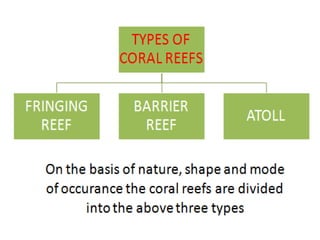
• Types of Coral Reefs
Source : google images
DEFINITION
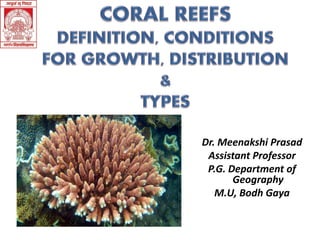
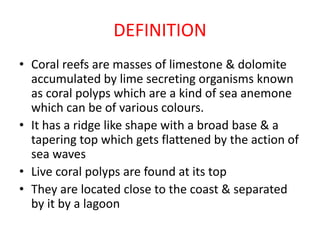
• Coral reefs are masses of limestone & dolomite
accumulated by lime secreting organisms known
as coral polyps which are a kind of sea anemone
which can be of various colours.
• It has a ridge like shape with a broad base & a
tapering top which gets flattened by the action of
sea waves
• Live coral polyps are found at its top
• They are located close to the coast & separated
by it by a lagoon
DISTRIBUTION
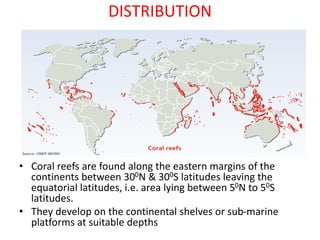
• Coral reefs are found along the eastern margins of the
continents between 300N & 300S latitudes leaving the
equatorial latitudes, i.e. area lying between 50N to 50S
latitudes.
• They develop on the continental shelves or sub-marine
platforms at suitable depths
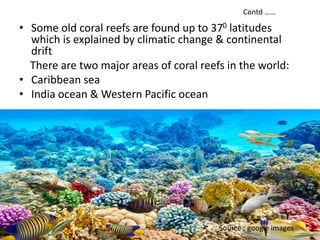
• Some old coral reefs are found up to 370 latitudes
which is explained by climatic change & continental
drift
There are two major areas of coral reefs in the world:
• Caribbean sea
• India ocean & Western Pacific ocean
Contd ……
Source : google images
CONDITIONS FOR GROWTH
• Temperature – Ideal temperature for the growth
of coral polyps is 200C, but under specific
conditions they can also develop between the
temperature of 180C - 250C
• Depth of Sea – The ideal depth of sea water for
the growth of coral reef is 45-55 m but it can also
develop till a depth of 90 m. The reefs cannot
develop if the depth of the water is less than 10
m. The reef can develop till the depth where the
sun light is able to penetrate the water and
where planktons can grow.
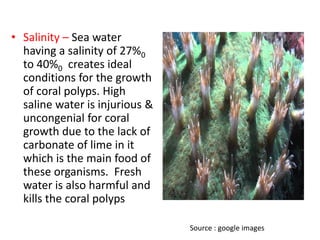
• Salinity – Sea water
having a salinity of 27%0
to 40%0 creates ideal
conditions for the growth
of coral polyps. High
saline water is injurious &
uncongenial for coral
growth due to the lack of
carbonate of lime in it
which is the main food of
these organisms. Fresh
water is also harmful and
kills the coral polyps
Source : google images
• Sediment free water – The living corals
demand a sediment free water as turbidity is
an important factor limiting their growth.
Sediments clog the mouth of the coral polyps
killing them which stunts the growth of the
reef.
• Presence of Plankton – Planktons are food for
coral polyps, thus their availability is
important for the growth of coral reefs.
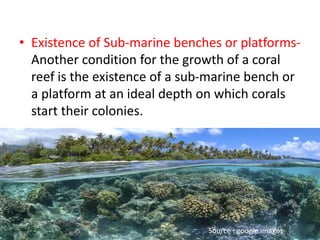
• Existence of Sub-marine benches or platforms-
Another condition for the growth of a coral
reef is the existence of a sub-marine bench or
a platform at an ideal depth on which corals
start their colonies.
Source : google images
• Those polyps which find ideal conditions of
growth & ideal resting places start their colonies.
They then grow in two ways –
➢ Upwards till they reach the low tide level
➢ Outwards from the land due to the abundance
of food gained in the open sea. This outward
growth determines the width of the coral reef
• Consequently, a shallow water lagoon develops
in between the land and the reef as the coral
polyps on the landward side of the reef are
killed due to excess of sediments in the
motionless water of the lagoon
• The width of the lagoon increases with the
growth of the coral reef & the erosion of the
landward side of the reef
Fringing Reef
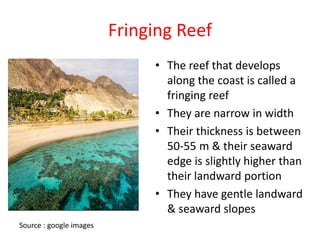
• The reef that develops
along the coast is called a
fringing reef
• They are narrow in width
• Their thickness is between
50-55 m & their seaward
edge is slightly higher than
their landward portion
• They have gentle landward
& seaward slopes
Source : google images
• They are separated from the land by a narrow lagoon
which has a depth of 0.3-1.5 m. This is known as a
boat channel
• The surface of the lagoon contains pieces of coral
rocks along with a mixture of clay & soil and
gradually become shallower with time
• Examples of such reefs are found along the coast of
Southern Florida (U.S.A) & Andaman & Nicobar
islands
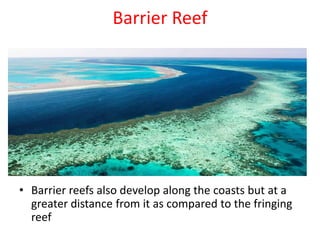
Barrier Reef
• Barrier reefs also develop along the coasts but at a
greater distance from it as compared to the fringing
reef
• The thickness of a barrier reef is greater than
that of a fringing reef. On an average it is more
than 50m and can be as high as 150m. The
maximum thickness of Great Barrier Reef is 180
m.
• Its lagoon is also comparatively deeper &
broader. The depth of the lagoon can be till 50 m.
• Both the seaward & landward slope of a barrier
reef are steep.
• The best example of a barrier reef is ‘Great
Barrier Reef’
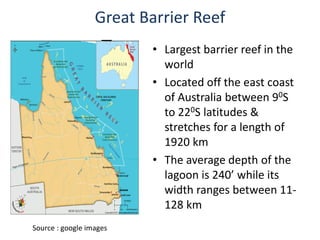
Great Barrier Reef
• Largest barrier reef in the
world
• Located off the east coast
of Australia between 90S
to 220S latitudes &
stretches for a length of
1920 km
• The average depth of the
lagoon is 240’ while its
width ranges between 11-
128 km
Source : google images
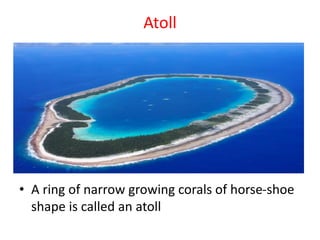
Atoll
• A ring of narrow growing corals of horse-shoe
shape is called an atoll
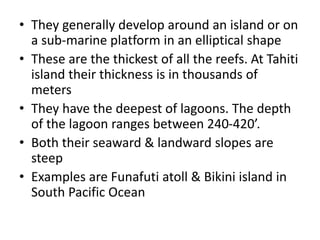
• They generally develop around an island or on
a sub-marine platform in an elliptical shape
• These are the thickest of all the reefs. At Tahiti
island their thickness is in thousands of
meters
• They have the deepest of lagoons. The depth
of the lagoon ranges between 240-420’.
• Both their seaward & landward slopes are
steep
• Examples are Funafuti atoll & Bikini island in
South Pacific Ocean
Types of Atolls
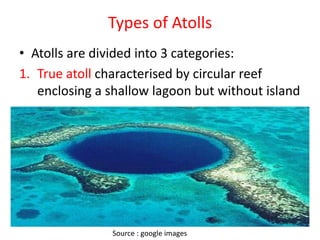
• Atolls are divided into 3 categories:
1. True atoll characterised by circular reef
enclosing a shallow lagoon but without island
Source : google images
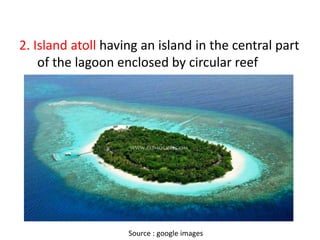
2. Island atoll having an island in the central part
of the lagoon enclosed by circular reef
Source : google images
3. Coral island or atoll island which does not
have an island in the beginning but later on
island is formed due to erosion & deposition
by sea waves
• Chains of small atolls having shallow small
lagoons are called faros
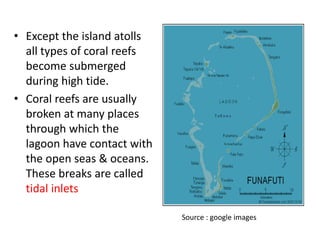
• Except the island atolls
all types of coral reefs
become submerged
during high tide.
• Coral reefs are usually
broken at many places
through which the
lagoon have contact with
the open seas & oceans.
These breaks are called
tidal inlets
Source : google images
REFERENCES:
• Sharma, R.C. & Vatal, M. : Oceanography for
Geographers, Chaitanya Publishing House,
Allahabad, 1995
• Singh. S : Physical Geography, Prayag Pustak
Bhawan, Allahabad,2012

Coral reefs i (english)-converted

  • 1.
    Dr. Meenakshi Prasad AssistantProfessor P.G. Department of Geography M.U, Bodh Gaya
  • 2.
    Contents : • Definitionof Coral Reef • Distribution of Coral Reefs • Conditions for Growth of Coral Reefs • Types of Coral Reefs Source : google images
  • 3.
    DEFINITION • Coral reefsare masses of limestone & dolomite accumulated by lime secreting organisms known as coral polyps which are a kind of sea anemone which can be of various colours. • It has a ridge like shape with a broad base & a tapering top which gets flattened by the action of sea waves • Live coral polyps are found at its top • They are located close to the coast & separated by it by a lagoon
  • 4.
    DISTRIBUTION • Coral reefsare found along the eastern margins of the continents between 300N & 300S latitudes leaving the equatorial latitudes, i.e. area lying between 50N to 50S latitudes. • They develop on the continental shelves or sub-marine platforms at suitable depths
  • 5.
    • Some oldcoral reefs are found up to 370 latitudes which is explained by climatic change & continental drift There are two major areas of coral reefs in the world: • Caribbean sea • India ocean & Western Pacific ocean Contd …… Source : google images
  • 6.
    CONDITIONS FOR GROWTH •Temperature – Ideal temperature for the growth of coral polyps is 200C, but under specific conditions they can also develop between the temperature of 180C - 250C • Depth of Sea – The ideal depth of sea water for the growth of coral reef is 45-55 m but it can also develop till a depth of 90 m. The reefs cannot develop if the depth of the water is less than 10 m. The reef can develop till the depth where the sun light is able to penetrate the water and where planktons can grow.
  • 7.
    • Salinity –Sea water having a salinity of 27%0 to 40%0 creates ideal conditions for the growth of coral polyps. High saline water is injurious & uncongenial for coral growth due to the lack of carbonate of lime in it which is the main food of these organisms. Fresh water is also harmful and kills the coral polyps Source : google images
  • 8.
    • Sediment freewater – The living corals demand a sediment free water as turbidity is an important factor limiting their growth. Sediments clog the mouth of the coral polyps killing them which stunts the growth of the reef. • Presence of Plankton – Planktons are food for coral polyps, thus their availability is important for the growth of coral reefs.
  • 9.
    • Existence ofSub-marine benches or platforms- Another condition for the growth of a coral reef is the existence of a sub-marine bench or a platform at an ideal depth on which corals start their colonies. Source : google images
  • 10.
    • Those polypswhich find ideal conditions of growth & ideal resting places start their colonies. They then grow in two ways – ➢ Upwards till they reach the low tide level ➢ Outwards from the land due to the abundance of food gained in the open sea. This outward growth determines the width of the coral reef • Consequently, a shallow water lagoon develops in between the land and the reef as the coral polyps on the landward side of the reef are killed due to excess of sediments in the motionless water of the lagoon • The width of the lagoon increases with the growth of the coral reef & the erosion of the landward side of the reef
  • 12.
    Fringing Reef • Thereef that develops along the coast is called a fringing reef • They are narrow in width • Their thickness is between 50-55 m & their seaward edge is slightly higher than their landward portion • They have gentle landward & seaward slopes Source : google images
  • 13.
    • They areseparated from the land by a narrow lagoon which has a depth of 0.3-1.5 m. This is known as a boat channel • The surface of the lagoon contains pieces of coral rocks along with a mixture of clay & soil and gradually become shallower with time • Examples of such reefs are found along the coast of Southern Florida (U.S.A) & Andaman & Nicobar islands
  • 14.
    Barrier Reef • Barrierreefs also develop along the coasts but at a greater distance from it as compared to the fringing reef
  • 15.
    • The thicknessof a barrier reef is greater than that of a fringing reef. On an average it is more than 50m and can be as high as 150m. The maximum thickness of Great Barrier Reef is 180 m. • Its lagoon is also comparatively deeper & broader. The depth of the lagoon can be till 50 m. • Both the seaward & landward slope of a barrier reef are steep. • The best example of a barrier reef is ‘Great Barrier Reef’
  • 16.
    Great Barrier Reef •Largest barrier reef in the world • Located off the east coast of Australia between 90S to 220S latitudes & stretches for a length of 1920 km • The average depth of the lagoon is 240’ while its width ranges between 11- 128 km Source : google images
  • 17.
    Atoll • A ringof narrow growing corals of horse-shoe shape is called an atoll
  • 18.
    • They generallydevelop around an island or on a sub-marine platform in an elliptical shape • These are the thickest of all the reefs. At Tahiti island their thickness is in thousands of meters • They have the deepest of lagoons. The depth of the lagoon ranges between 240-420’. • Both their seaward & landward slopes are steep • Examples are Funafuti atoll & Bikini island in South Pacific Ocean
  • 19.
    Types of Atolls •Atolls are divided into 3 categories: 1. True atoll characterised by circular reef enclosing a shallow lagoon but without island Source : google images
  • 20.
    2. Island atollhaving an island in the central part of the lagoon enclosed by circular reef Source : google images
  • 21.
    3. Coral islandor atoll island which does not have an island in the beginning but later on island is formed due to erosion & deposition by sea waves • Chains of small atolls having shallow small lagoons are called faros
  • 22.
    • Except theisland atolls all types of coral reefs become submerged during high tide. • Coral reefs are usually broken at many places through which the lagoon have contact with the open seas & oceans. These breaks are called tidal inlets Source : google images
  • 24.
    REFERENCES: • Sharma, R.C.& Vatal, M. : Oceanography for Geographers, Chaitanya Publishing House, Allahabad, 1995 • Singh. S : Physical Geography, Prayag Pustak Bhawan, Allahabad,2012