5 FACTORS AFFECTING LANGUAGE
LEARNING STRATEGIES.
WIRDA SYAHEERA
TESL
A150711
Motivation
• McIntyre and Noels (1996)
The individuals who are exceptionally motivated
have a tendency to utilize more language
learning strategies than the individuals who are
less motivated.
• Chang and Huang (1999)
Research shows most learning strategies use are
related to motivational level.
Age
• Ellis (1994)
Young children prefer using task-specific manner
strategies while older children and adults prefer
using generalized strategies.
Language Proficiency
• Chen (1990)
Low-proficiency students adopt more strategies
than high-proficiency students.
• Oxford and Burry-Stock (1995)
Learners with diverse dialect capability embrace
distinctive examples and frequencies of LLS.
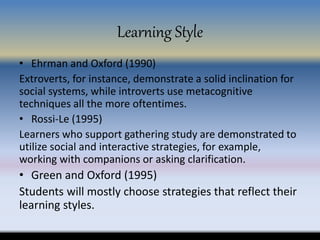
Learning Style
• Ehrman and Oxford (1990)
Extroverts, for instance, demonstrate a solid inclination for
social systems, while introverts use metacognitive
techniques all the more oftentimes.
• Rossi-Le (1995)
Learners who support gathering study are demonstrated to
utilize social and interactive strategies, for example,
working with companions or asking clarification.
• Green and Oxford (1995)
Students will mostly choose strategies that reflect their
learning styles.
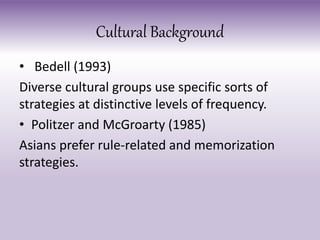
Cultural Background
• Bedell (1993)
Diverse cultural groups use specific sorts of
strategies at distinctive levels of frequency.
• Politzer and McGroarty (1985)
Asians prefer rule-related and memorization
strategies.
THANK YOU
Prepared by:
Wirda Syaheera Sulaiman

Factors affecting lls (1)

  • 1.
    5 FACTORS AFFECTINGLANGUAGE LEARNING STRATEGIES. WIRDA SYAHEERA TESL A150711
  • 2.
    Motivation • McIntyre andNoels (1996) The individuals who are exceptionally motivated have a tendency to utilize more language learning strategies than the individuals who are less motivated. • Chang and Huang (1999) Research shows most learning strategies use are related to motivational level.
  • 3.
    Age • Ellis (1994) Youngchildren prefer using task-specific manner strategies while older children and adults prefer using generalized strategies.
  • 4.
    Language Proficiency • Chen(1990) Low-proficiency students adopt more strategies than high-proficiency students. • Oxford and Burry-Stock (1995) Learners with diverse dialect capability embrace distinctive examples and frequencies of LLS.
  • 5.
    Learning Style • Ehrmanand Oxford (1990) Extroverts, for instance, demonstrate a solid inclination for social systems, while introverts use metacognitive techniques all the more oftentimes. • Rossi-Le (1995) Learners who support gathering study are demonstrated to utilize social and interactive strategies, for example, working with companions or asking clarification. • Green and Oxford (1995) Students will mostly choose strategies that reflect their learning styles.
  • 6.
    Cultural Background • Bedell(1993) Diverse cultural groups use specific sorts of strategies at distinctive levels of frequency. • Politzer and McGroarty (1985) Asians prefer rule-related and memorization strategies.
  • 7.