Factor Affect Language Learning
Strategy (LLS)
Najihah Binti Mohd Ismail Eh
A143850
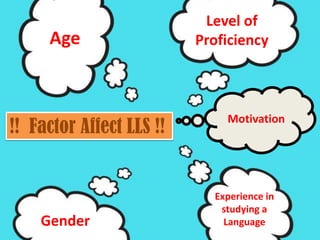
Age

!! Factor Affect LLS !!

Gender

Level of
Proficiency

Motivation

Experience in
studying a
Language
Gender
• Goh and Kwah (1997) , Gu (2002) , Hong-Nam &
Leavell (2006) , Mochizuki (1996) , Wahrton (2000) ;
A number of studies reported significantly more use of learning
strategies than their male counterparts. These studies
postulated that female students used Compensation and
Affective Strategy than male ones.
• Politzer (1938)
Do a survey on 19 undergraduate foreign language
learners, found a minor differences between female and male
learners with females making a greater use of social interaction
strategies.
Age
• Wong-Fillmore (1979)
A study of young children showed that cognitive and social
strategies were very important.

• White (1993)
A study of LLS by using specific age groups a learner of
French and Japanese in New Zealend and found that learner
aged over thirty used metacognitive self-management
strategies more than those who were younger.
Level Of Proficiency
• O’Malley et al. (1985a)
A study on ESL school beginners reported using more
strategies than did the students from the intermediate
level.

• O’Malley and Chamot (1990)
A study conducted on school learners of Spanish and
Russian, found that beginners reported less use of
strategies than did those from the intermediate level.
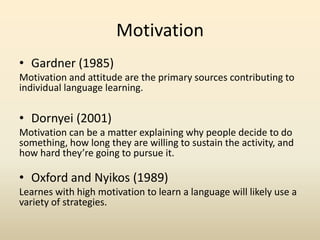
Motivation
• Gardner (1985)
Motivation and attitude are the primary sources contributing to
individual language learning.

• Dornyei (2001)
Motivation can be a matter explaining why people decide to do
something, how long they are willing to sustain the activity, and
how hard they’re going to pursue it.

• Oxford and Nyikos (1989)
Learnes with high motivation to learn a language will likely use a
variety of strategies.
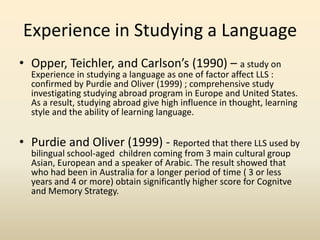
Experience in Studying a Language
• Opper, Teichler, and Carlson’s (1990) – a study on

Experience in studying a language as one of factor affect LLS :
confirmed by Purdie and Oliver (1999) ; comprehensive study
investigating studying abroad program in Europe and United States.
As a result, studying abroad give high influence in thought, learning
style and the ability of learning language.

• Purdie and Oliver (1999) - Reported that there LLS used by
bilingual school-aged children coming from 3 main cultural group
Asian, European and a speaker of Arabic. The result showed that
who had been in Australia for a longer period of time ( 3 or less
years and 4 or more) obtain significantly higher score for Cognitve
and Memory Strategy.
Thank You ! 
By Najihah Bt Mohd Ismail Eh
A143850
Faculty of Education / TESL
National University of Malaysia

Factor affect language learning strategy (lls) Najihah Bt Mohd Ismail Eh

  • 1.
    Factor Affect LanguageLearning Strategy (LLS) Najihah Binti Mohd Ismail Eh A143850
  • 2.
    Age !! Factor AffectLLS !! Gender Level of Proficiency Motivation Experience in studying a Language
  • 3.
    Gender • Goh andKwah (1997) , Gu (2002) , Hong-Nam & Leavell (2006) , Mochizuki (1996) , Wahrton (2000) ; A number of studies reported significantly more use of learning strategies than their male counterparts. These studies postulated that female students used Compensation and Affective Strategy than male ones. • Politzer (1938) Do a survey on 19 undergraduate foreign language learners, found a minor differences between female and male learners with females making a greater use of social interaction strategies.
  • 4.
    Age • Wong-Fillmore (1979) Astudy of young children showed that cognitive and social strategies were very important. • White (1993) A study of LLS by using specific age groups a learner of French and Japanese in New Zealend and found that learner aged over thirty used metacognitive self-management strategies more than those who were younger.
  • 5.
    Level Of Proficiency •O’Malley et al. (1985a) A study on ESL school beginners reported using more strategies than did the students from the intermediate level. • O’Malley and Chamot (1990) A study conducted on school learners of Spanish and Russian, found that beginners reported less use of strategies than did those from the intermediate level.
  • 6.
    Motivation • Gardner (1985) Motivationand attitude are the primary sources contributing to individual language learning. • Dornyei (2001) Motivation can be a matter explaining why people decide to do something, how long they are willing to sustain the activity, and how hard they’re going to pursue it. • Oxford and Nyikos (1989) Learnes with high motivation to learn a language will likely use a variety of strategies.
  • 7.
    Experience in Studyinga Language • Opper, Teichler, and Carlson’s (1990) – a study on Experience in studying a language as one of factor affect LLS : confirmed by Purdie and Oliver (1999) ; comprehensive study investigating studying abroad program in Europe and United States. As a result, studying abroad give high influence in thought, learning style and the ability of learning language. • Purdie and Oliver (1999) - Reported that there LLS used by bilingual school-aged children coming from 3 main cultural group Asian, European and a speaker of Arabic. The result showed that who had been in Australia for a longer period of time ( 3 or less years and 4 or more) obtain significantly higher score for Cognitve and Memory Strategy.
  • 8.
    Thank You ! By Najihah Bt Mohd Ismail Eh A143850 Faculty of Education / TESL National University of Malaysia