5 FACTORS AFFECTING
LANGUAGE LEARNING
STRATEGIES
ASNADIA BINTI ALIAS
P 71725
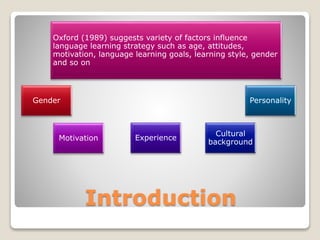
Introduction
Gender
Oxford (1989) suggests variety of factors influence
language learning strategy such as age, attitudes,
motivation, language learning goals, learning style, gender
and so on
Motivation Experience
Cultural
background
Personality
Gender
Males used a
greater number of
strategies
significantly more
often than females.
(Tran, 1988;
Wharton, 2000)
Several studies
have established
the existence of
gender
differences in the
use of language
learning
strategies.
Males were more
likely to use a
variety of learning
strategies than
females.
Males favored the
use of Metacognitive
and Compensation
strategies most and
Affective strategies
the least
Female participants
reported using
Social and
Metacognitive
strategies most and
Memory strate-gies
the least
Motivation
Gardner (1985), motivation and attitudes are the primary sources contributing to individual
language learning.
Learner will tend to learn faster
Highly motivated
learner use
variety of
strategies
Motivation can lead the
learner to achieve
something
"Expends effort, is persistent and
attentive to the tasks at hand, has
goals, desires and aspirations,
enjoys the activity, makes
attributions concerning success or
failure, is aroused and makes use of
strategies to aid in achieving
goals (Dornyei 2003, p.173).
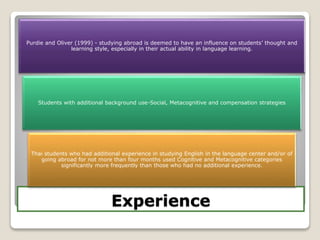
Experience
Purdie and Oliver (1999) - studying abroad is deemed to have an influence on students’ thought and
learning style, especially in their actual ability in language learning.
Students with additional background use-Social, Metacognitive and compensation strategies
Thai students who had additional experience in studying English in the language center and/or of
going abroad for not more than four months used Cognitive and Metacognitive categories
significantly more frequently than those who had no additional experience.
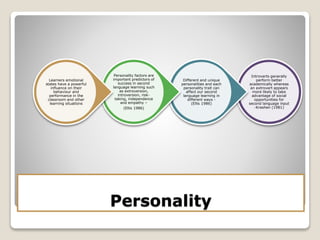
Personality
Introverts generally
perform better
academically whereas
an extrovert appears
more likely to take
advantage of social
opportunities for
second language input
-Krashen (1981)
Different and unique
personalities and each
personality trait can
affect our second
language learning in
different ways -
(Ellis 1986)
Personality factors are
important predictors of
success in second
language learning such
as extroversion,
introversion, risk-
taking, independence
and empathy –
(Ellis 1986)
Learners emotional
states have a powerful
influence on their
behaviour and
performance in the
classroom and other
learning situations
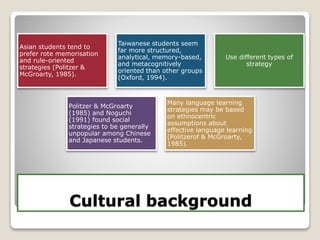
Cultural background
Asian students tend to
prefer rote memorisation
and rule-oriented
strategies (Politzer &
McGroarty, 1985).
Taiwanese students seem
far more structured,
analytical, memory-based,
and metacognitively
oriented than other groups
(Oxford, 1994).
Use different types of
strategy
Politzer & McGroarty
(1985) and Noguchi
(1991) found social
strategies to be generally
unpopular among Chinese
and Japanese students.
Many language learning
strategies may be based
on ethnocentric
assumptions about
effective language learning
(Politzerof & McGroarty,
1985).
References
 Gardner, R.C. (1985). Social psychological aspects of language learning: The role of attitudes and
motivation. London: Edward Arnold.
 Oxford, R.L. (1989). Use of language learning strategies: A synthesis of studies with implications
for strategy training. System, 17(2), 235–247.
 Oxford, R. & Burry-Stock, J. A. (1995). Assessing the use of language learning strategies
worldwide with the ESL/EFL version of the Strategy Inventory for language Learning (SILL).
System, 23, 153-175.
 Politzer, R. L., & McGroarty, M. (1985). An exploratory study of learning behaviours and their
relationship to gains in linguistic and communicative competence.TESOL Quarterly, 19, 103-123.
 Purdie, N., & Oliver, R. (1999). Language strategies used by bilingual school-aged children.
System, 27, 375–388.
 Tran, T.V. (1988). Sex differences in English language acculturation and learning strategies among
Vietnam-ese adults aged 40 and over in the United States. Sex Roles, 19, 747–758.
 Wharton, G. (2000). Language learning strategy use of bilingual foreign language learner in
Singapore. Lan-guage Learning, 50(2), 203–243.

Factors affecting LLS usage

  • 1.
    5 FACTORS AFFECTING LANGUAGELEARNING STRATEGIES ASNADIA BINTI ALIAS P 71725
  • 2.
    Introduction Gender Oxford (1989) suggestsvariety of factors influence language learning strategy such as age, attitudes, motivation, language learning goals, learning style, gender and so on Motivation Experience Cultural background Personality
  • 3.
    Gender Males used a greaternumber of strategies significantly more often than females. (Tran, 1988; Wharton, 2000) Several studies have established the existence of gender differences in the use of language learning strategies. Males were more likely to use a variety of learning strategies than females. Males favored the use of Metacognitive and Compensation strategies most and Affective strategies the least Female participants reported using Social and Metacognitive strategies most and Memory strate-gies the least
  • 4.
    Motivation Gardner (1985), motivationand attitudes are the primary sources contributing to individual language learning. Learner will tend to learn faster Highly motivated learner use variety of strategies Motivation can lead the learner to achieve something "Expends effort, is persistent and attentive to the tasks at hand, has goals, desires and aspirations, enjoys the activity, makes attributions concerning success or failure, is aroused and makes use of strategies to aid in achieving goals (Dornyei 2003, p.173).
  • 5.
    Experience Purdie and Oliver(1999) - studying abroad is deemed to have an influence on students’ thought and learning style, especially in their actual ability in language learning. Students with additional background use-Social, Metacognitive and compensation strategies Thai students who had additional experience in studying English in the language center and/or of going abroad for not more than four months used Cognitive and Metacognitive categories significantly more frequently than those who had no additional experience.
  • 6.
    Personality Introverts generally perform better academicallywhereas an extrovert appears more likely to take advantage of social opportunities for second language input -Krashen (1981) Different and unique personalities and each personality trait can affect our second language learning in different ways - (Ellis 1986) Personality factors are important predictors of success in second language learning such as extroversion, introversion, risk- taking, independence and empathy – (Ellis 1986) Learners emotional states have a powerful influence on their behaviour and performance in the classroom and other learning situations
  • 7.
    Cultural background Asian studentstend to prefer rote memorisation and rule-oriented strategies (Politzer & McGroarty, 1985). Taiwanese students seem far more structured, analytical, memory-based, and metacognitively oriented than other groups (Oxford, 1994). Use different types of strategy Politzer & McGroarty (1985) and Noguchi (1991) found social strategies to be generally unpopular among Chinese and Japanese students. Many language learning strategies may be based on ethnocentric assumptions about effective language learning (Politzerof & McGroarty, 1985).
  • 8.
    References  Gardner, R.C.(1985). Social psychological aspects of language learning: The role of attitudes and motivation. London: Edward Arnold.  Oxford, R.L. (1989). Use of language learning strategies: A synthesis of studies with implications for strategy training. System, 17(2), 235–247.  Oxford, R. & Burry-Stock, J. A. (1995). Assessing the use of language learning strategies worldwide with the ESL/EFL version of the Strategy Inventory for language Learning (SILL). System, 23, 153-175.  Politzer, R. L., & McGroarty, M. (1985). An exploratory study of learning behaviours and their relationship to gains in linguistic and communicative competence.TESOL Quarterly, 19, 103-123.  Purdie, N., & Oliver, R. (1999). Language strategies used by bilingual school-aged children. System, 27, 375–388.  Tran, T.V. (1988). Sex differences in English language acculturation and learning strategies among Vietnam-ese adults aged 40 and over in the United States. Sex Roles, 19, 747–758.  Wharton, G. (2000). Language learning strategy use of bilingual foreign language learner in Singapore. Lan-guage Learning, 50(2), 203–243.