FACTORS THAT 
AFFECTING LLS 
By : 
Engku Nor Fatin Nadia bt 
Engku Razali 
TESL Programme 
A147921
AGE 
Oxford (1990) stated that students of 
different ages and learning stage of second 
language employed somewhat different 
strategies; older or more advanced students 
used certain strategies more frequently than 
did younger or less advanced students. 
 Lee & Oxford (2008) indicated that young 
learners tended to use social strategies like 
discussing with and asking help from others 
more than other types of strategies.
MOTIVATION 
As Oxford (1990) indicated, factors affecting 
language learning are very complicated, 
including motivation, attitudes, language 
anxiety, self-confidence, language aptitude, 
family size, and personality variables. 
Motivation is one of the most important 
factors which affect students’ language 
learning achievement.
GENDER 
 Some studies designate that males used learning 
strategies more than females when learning a 
language (Tran, 1988; Wharton, 2000). 
 Wen and Wang’s findings correspond to Green and 
Oxford’s (1995) study, demonstrating that gender 
was one of factors affecting the choices of language 
learning strategies. That is, females used Memory 
and Metacognitive strategies more frequently than 
males. 
 In sharp contrast, some studies designate that 
males used learning strategies more than females.
FAMILY BACKGROUND 
 Blake(1989) indicated that learning resources will 
be diluted in the large families, including parental 
interaction and attention. 
 According to the model proposed by Swell and 
Shah (1967), parents’ background will affect 
grades positively because higher-educated 
parents will place more emphasis on academic 
achievement and create home situations that are 
conductive to study and concentration.
LEARNING STYLES 
 An individual’s learning style preferences 
influence the type of LLS they use. 
 Students with different learning styles 
often choose strategies that reflect their 
style preferences (Green & Oxford 1995) 
 Ehrman (1989) said that effective 
learners use a variety of learning 
strategies relevant to the individual’s 
personality, goals and stage of learning
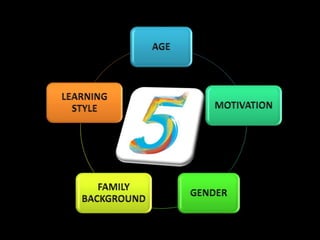
Five factors that affecting lls

Five factors that affecting lls

  • 1.
    FACTORS THAT AFFECTINGLLS By : Engku Nor Fatin Nadia bt Engku Razali TESL Programme A147921
  • 3.
    AGE Oxford (1990)stated that students of different ages and learning stage of second language employed somewhat different strategies; older or more advanced students used certain strategies more frequently than did younger or less advanced students.  Lee & Oxford (2008) indicated that young learners tended to use social strategies like discussing with and asking help from others more than other types of strategies.
  • 4.
    MOTIVATION As Oxford(1990) indicated, factors affecting language learning are very complicated, including motivation, attitudes, language anxiety, self-confidence, language aptitude, family size, and personality variables. Motivation is one of the most important factors which affect students’ language learning achievement.
  • 5.
    GENDER  Somestudies designate that males used learning strategies more than females when learning a language (Tran, 1988; Wharton, 2000).  Wen and Wang’s findings correspond to Green and Oxford’s (1995) study, demonstrating that gender was one of factors affecting the choices of language learning strategies. That is, females used Memory and Metacognitive strategies more frequently than males.  In sharp contrast, some studies designate that males used learning strategies more than females.
  • 6.
    FAMILY BACKGROUND Blake(1989) indicated that learning resources will be diluted in the large families, including parental interaction and attention.  According to the model proposed by Swell and Shah (1967), parents’ background will affect grades positively because higher-educated parents will place more emphasis on academic achievement and create home situations that are conductive to study and concentration.
  • 7.
    LEARNING STYLES An individual’s learning style preferences influence the type of LLS they use.  Students with different learning styles often choose strategies that reflect their style preferences (Green & Oxford 1995)  Ehrman (1989) said that effective learners use a variety of learning strategies relevant to the individual’s personality, goals and stage of learning