FACTORS AFFECTING LLS
USAGE
By : NUR ZAWANI MOHAMAD
DIN P76219
PREPARED FOR :
GGGE6533
LANGUAGE LEARNING STRATEGIES
INSTRUCTION
Prof. Dato’ Dr. Mohamed Amin Embi
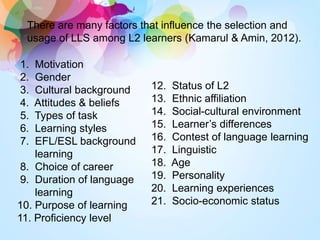
1. Motivation
2. Gender
3. Cultural background
4. Attitudes & beliefs
5. Types of task
6. Learning styles
7. EFL/ESL background
learning
8. Choice of career
9. Duration of language
learning
10. Purpose of learning
11. Proficiency level
12. Status of L2
13. Ethnic affiliation
14. Social-cultural environment
15. Learner’s differences
16. Contest of language learning
17. Linguistic
18. Age
19. Personality
20. Learning experiences
21. Socio-economic status
There are many factors that influence the selection and
usage of LLS among L2 learners (Kamarul & Amin, 2012).
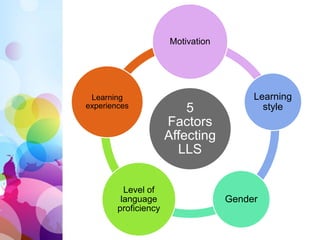
5
Factors
Affecting
LLS
Motivation
Learning
style
Gender
Level of
language
proficiency
Learning
experiences
Level of Language Proficiency
 Students’ learning experience and their awareness of the learning
processes have impact on their choice of LLS the higher the proficiency
level of the students, the more aware they are of the rules and
strategies of language learning (Rahimi, Riazi & Saif, 2008).
 A high level of proficiency has been associated with an increased use of
both direct and indirect strategies (Chang, 1990; Green and Oxford,
1995; Park, 1997; Chen, 2002). Specifically, cognitive and
metacognitive strategies show high correlations with high language
proficiency levels (Ku, 1995; Peacock and Ho, 2003).
 Cognitive and metacognitive strategies showed very high correlations
with the proficiency level of the participants and were used by high-
proficiency learners. Compensation strategies, however, were shown to
be favoured by both high and low proficiency students, with low-
proficiency students outperforming the high-proficiency ones in their use
of such strategies (Chen, 2002).
 Chen (1990), in a study on the relationship between communication
strategies and the proficiency level of L2 learners found that low-
proficiency students employed more communication strategies than
high-proficiency ones.
MOTIVATION
 Students’ motivation is influenced by their learning goals, purposes
or reasons of learning the L2, as well as clear application to real-life
contexts (Rahimi, Riazi & Saif, 2008).
 Oxford and Nyikos (1989), who studied the effect of a number of
factors on strategy use, including motivation, found the latter as the
single most important factor influencing strategy use.
 Dornyei (2001) one of the well-known leaders within the field of
motivation also states, motivation can be a matter explaining why
people decide to do something, how long they are willing to sustain
the activity, and how hard they are going to pursue it.
 Oxford and Nyikos (1989) indicate that the learners with high
motivation to learn a language will likely use a variety of strategies.
Therefore, in terms of language learning, achievement can be
viewed as one of indexes of motivation since motivation can lead
and support all activities.
 McIntyre and Noels (1996) examined the relationship between LLS
and motivational level among undergraduate foreign language
learners. They reported that, compared with less motivated learners,
those who were substantially motivated, tended to adopt more
learning strategies and used them more frequently.
 Gardner (1985), motivation and attitudes are the primary sources
contributing to individual language learning. He has described the
phenomenon of motivation as consisting of four components: a goal,
effort, want, and attitudes toward the learning activity. In addition, the
concept of motivation can be classified into two orientations of
reasons: instrumental and integrative.
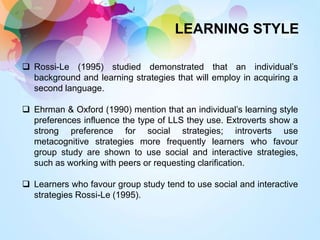
LEARNING STYLE
 Rossi-Le (1995) studied demonstrated that an individual’s
background and learning strategies that will employ in acquiring a
second language.
 Ehrman & Oxford (1990) mention that an individual’s learning style
preferences influence the type of LLS they use. Extroverts show a
strong preference for social strategies; introverts use
metacognitive strategies more frequently learners who favour
group study are shown to use social and interactive strategies,
such as working with peers or requesting clarification.
 Learners who favour group study tend to use social and interactive
strategies Rossi-Le (1995).
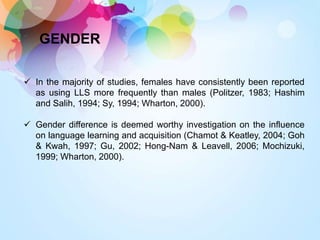
GENDER
 In the majority of studies, females have consistently been reported
as using LLS more frequently than males (Politzer, 1983; Hashim
and Salih, 1994; Sy, 1994; Wharton, 2000).
 Gender difference is deemed worthy investigation on the influence
on language learning and acquisition (Chamot & Keatley, 2004; Goh
& Kwah, 1997; Gu, 2002; Hong-Nam & Leavell, 2006; Mochizuki,
1999; Wharton, 2000).
 Wen and Wang’s findings correspond to Green and Oxford’s
(1995) study, demonstrating that gender was one of factors
affecting the choices of language learning strategies. That is,
females used Memory and Metacognitive strategies more
frequently than males.
 A number of studies reported significantly more use of learning
strategies than their male counterparts (e.g. Goh & Kwah, 1997;
Green & Oxford, 1995; Gu 2002). These studies postulated that
female students used Compensation and Affective strategies
more frequently than male ones.
Experiences In Studying a Language
 Khamkhien (2010) reported the experience in studying language is
also regarded one of the factors that it is claimed may affect the
choices of language learning strategies.
 Purdie and Olive’s (1999) highlights the importance of experience in
studying a language as one of the factors affecting the choices of
language learning strategies.
 Their study also confirmed the findings of Opper, Teichler, and
Carlson’s (1990) comprehensive study investigating studying abroad
programs in Europe and The United States. As a result of their study,
studying abroad is deemed to have an influence on students’ thought
and learning style, especially in their actual ability in language
learning.
REFERENCES
Chang, S.J. 1990. A study of language learning behaviors of Chinese students at the
University of Georgia and the relation of these behaviors to oral proficiency
and other factors. Doctoral dissertation, University of Georgia, Athens, GA.
Chen, I.J. 2002. Language learning strategies used by high and low English proficiency
students in a technology college. Master’s thesis, Changhua Normal University,
Changhua, Taiwan.
Chen, S.Q. 1990. A study of communication strategies in interlanguage production by
Chinese EFL learners. Language Learning, 40, pp. 155–187.
Ehrman, M. and R. Oxford. 1990. Adult language learning styles and strategies in an
intensive training setting. Modern Language Journal, 74, pp. 311–326.
Green, J.M. and R. Oxford. 1995. A closer look at learning strategies, L2 proficiency,
and gender. TESOL Quarterly, 29, pp. 261–297.
Gu, Y. 2002. Gender, academic major and vocabulary learning strategy of Chinese
EFL learners. RELC Journal 33(1): 35-54.
Khamkhien, A. 2010. Factors affecting language learning strategy: reported usage by
Thai and Vietnamese EFL learners. Electronic Journal of Foreign Language
Teaching 7 (1): 66-85.
McIntyre, P.D. & Noels, K. 1996. Using social-psychological variables to predict the use of
language learning strategies. Foreign Langage Annals 29:337-386.
Opper, S., Teicher, U. & Carlson, J. 1990. Impacts of studying abroad programmes on
students and graduate. London: Jessica Kinglsey Publishers.
Peacock, M. & Ho, B. 2003. Student language learning strategies across eight disciplines.
International Journal of Applied Linguistic 13: 179-200.
Purdie, N. & Oliver, R. 1999. Language strategies used by bilingual school-aged children.
System 27:375-388.
Rahimi, M. Riazi, A. & Saif, S.. 2008. An investigation into the factors affecting the use of
language learning strategies by Persian EFL learners. Canadian Journal of
Applied Linguistics 11(2):31-60.
Rossi-Le, L. 1995. Learning style and strategies in adult immigrant ESL students. In J.M.
Reid (ed.), Learning styles in the ESL?EFL classroom. Boston: Heinle &
Heinle,pp. 118-125.

Factors affecting lls usage

  • 1.
    FACTORS AFFECTING LLS USAGE By: NUR ZAWANI MOHAMAD DIN P76219 PREPARED FOR : GGGE6533 LANGUAGE LEARNING STRATEGIES INSTRUCTION Prof. Dato’ Dr. Mohamed Amin Embi
  • 2.
    1. Motivation 2. Gender 3.Cultural background 4. Attitudes & beliefs 5. Types of task 6. Learning styles 7. EFL/ESL background learning 8. Choice of career 9. Duration of language learning 10. Purpose of learning 11. Proficiency level 12. Status of L2 13. Ethnic affiliation 14. Social-cultural environment 15. Learner’s differences 16. Contest of language learning 17. Linguistic 18. Age 19. Personality 20. Learning experiences 21. Socio-economic status There are many factors that influence the selection and usage of LLS among L2 learners (Kamarul & Amin, 2012).
  • 3.
  • 4.
    Level of LanguageProficiency  Students’ learning experience and their awareness of the learning processes have impact on their choice of LLS the higher the proficiency level of the students, the more aware they are of the rules and strategies of language learning (Rahimi, Riazi & Saif, 2008).  A high level of proficiency has been associated with an increased use of both direct and indirect strategies (Chang, 1990; Green and Oxford, 1995; Park, 1997; Chen, 2002). Specifically, cognitive and metacognitive strategies show high correlations with high language proficiency levels (Ku, 1995; Peacock and Ho, 2003).
  • 5.
     Cognitive andmetacognitive strategies showed very high correlations with the proficiency level of the participants and were used by high- proficiency learners. Compensation strategies, however, were shown to be favoured by both high and low proficiency students, with low- proficiency students outperforming the high-proficiency ones in their use of such strategies (Chen, 2002).  Chen (1990), in a study on the relationship between communication strategies and the proficiency level of L2 learners found that low- proficiency students employed more communication strategies than high-proficiency ones.
  • 6.
    MOTIVATION  Students’ motivationis influenced by their learning goals, purposes or reasons of learning the L2, as well as clear application to real-life contexts (Rahimi, Riazi & Saif, 2008).  Oxford and Nyikos (1989), who studied the effect of a number of factors on strategy use, including motivation, found the latter as the single most important factor influencing strategy use.  Dornyei (2001) one of the well-known leaders within the field of motivation also states, motivation can be a matter explaining why people decide to do something, how long they are willing to sustain the activity, and how hard they are going to pursue it.
  • 7.
     Oxford andNyikos (1989) indicate that the learners with high motivation to learn a language will likely use a variety of strategies. Therefore, in terms of language learning, achievement can be viewed as one of indexes of motivation since motivation can lead and support all activities.  McIntyre and Noels (1996) examined the relationship between LLS and motivational level among undergraduate foreign language learners. They reported that, compared with less motivated learners, those who were substantially motivated, tended to adopt more learning strategies and used them more frequently.  Gardner (1985), motivation and attitudes are the primary sources contributing to individual language learning. He has described the phenomenon of motivation as consisting of four components: a goal, effort, want, and attitudes toward the learning activity. In addition, the concept of motivation can be classified into two orientations of reasons: instrumental and integrative.
  • 8.
    LEARNING STYLE  Rossi-Le(1995) studied demonstrated that an individual’s background and learning strategies that will employ in acquiring a second language.  Ehrman & Oxford (1990) mention that an individual’s learning style preferences influence the type of LLS they use. Extroverts show a strong preference for social strategies; introverts use metacognitive strategies more frequently learners who favour group study are shown to use social and interactive strategies, such as working with peers or requesting clarification.  Learners who favour group study tend to use social and interactive strategies Rossi-Le (1995).
  • 9.
    GENDER  In themajority of studies, females have consistently been reported as using LLS more frequently than males (Politzer, 1983; Hashim and Salih, 1994; Sy, 1994; Wharton, 2000).  Gender difference is deemed worthy investigation on the influence on language learning and acquisition (Chamot & Keatley, 2004; Goh & Kwah, 1997; Gu, 2002; Hong-Nam & Leavell, 2006; Mochizuki, 1999; Wharton, 2000).
  • 10.
     Wen andWang’s findings correspond to Green and Oxford’s (1995) study, demonstrating that gender was one of factors affecting the choices of language learning strategies. That is, females used Memory and Metacognitive strategies more frequently than males.  A number of studies reported significantly more use of learning strategies than their male counterparts (e.g. Goh & Kwah, 1997; Green & Oxford, 1995; Gu 2002). These studies postulated that female students used Compensation and Affective strategies more frequently than male ones.
  • 11.
    Experiences In Studyinga Language  Khamkhien (2010) reported the experience in studying language is also regarded one of the factors that it is claimed may affect the choices of language learning strategies.  Purdie and Olive’s (1999) highlights the importance of experience in studying a language as one of the factors affecting the choices of language learning strategies.  Their study also confirmed the findings of Opper, Teichler, and Carlson’s (1990) comprehensive study investigating studying abroad programs in Europe and The United States. As a result of their study, studying abroad is deemed to have an influence on students’ thought and learning style, especially in their actual ability in language learning.
  • 12.
    REFERENCES Chang, S.J. 1990.A study of language learning behaviors of Chinese students at the University of Georgia and the relation of these behaviors to oral proficiency and other factors. Doctoral dissertation, University of Georgia, Athens, GA. Chen, I.J. 2002. Language learning strategies used by high and low English proficiency students in a technology college. Master’s thesis, Changhua Normal University, Changhua, Taiwan. Chen, S.Q. 1990. A study of communication strategies in interlanguage production by Chinese EFL learners. Language Learning, 40, pp. 155–187. Ehrman, M. and R. Oxford. 1990. Adult language learning styles and strategies in an intensive training setting. Modern Language Journal, 74, pp. 311–326. Green, J.M. and R. Oxford. 1995. A closer look at learning strategies, L2 proficiency, and gender. TESOL Quarterly, 29, pp. 261–297. Gu, Y. 2002. Gender, academic major and vocabulary learning strategy of Chinese EFL learners. RELC Journal 33(1): 35-54.
  • 13.
    Khamkhien, A. 2010.Factors affecting language learning strategy: reported usage by Thai and Vietnamese EFL learners. Electronic Journal of Foreign Language Teaching 7 (1): 66-85. McIntyre, P.D. & Noels, K. 1996. Using social-psychological variables to predict the use of language learning strategies. Foreign Langage Annals 29:337-386. Opper, S., Teicher, U. & Carlson, J. 1990. Impacts of studying abroad programmes on students and graduate. London: Jessica Kinglsey Publishers. Peacock, M. & Ho, B. 2003. Student language learning strategies across eight disciplines. International Journal of Applied Linguistic 13: 179-200. Purdie, N. & Oliver, R. 1999. Language strategies used by bilingual school-aged children. System 27:375-388. Rahimi, M. Riazi, A. & Saif, S.. 2008. An investigation into the factors affecting the use of language learning strategies by Persian EFL learners. Canadian Journal of Applied Linguistics 11(2):31-60. Rossi-Le, L. 1995. Learning style and strategies in adult immigrant ESL students. In J.M. Reid (ed.), Learning styles in the ESL?EFL classroom. Boston: Heinle & Heinle,pp. 118-125.