Capital Structure
By:Akhil Sarda
Vishwak Kasturi
Ashwin
Disha
Prabhas
Chitrasen
Shabya
Contents
• Definition
• Concept of Optimal Capital Structure
• Significance of Capital Structure
• Features of Appropriate Capital Structure
• Elements of Capital Structure
• Determinants of Capital Structure
• Approaches to establish Capital Structure
• Evaluation of Capital Structure
DEFINITION
• The permanent long-term financing of a company
including long term debt, common stock and
preferred stock and retained earnings. Its is different
from financial structure which includes short term
debt and accounts payable.
• Debt comes in the form of bond issues or long-term
notes payable, whereas equity is classified as
common stock, preferred stock, or retained earnings.
• The capital structure is the firm's various sources of
funds used to finance its overall operations and
growth.
• The capital structure of a business enterprise should
be ideal , that is according to the requirement of the
business enterprise.
Capital
Structure
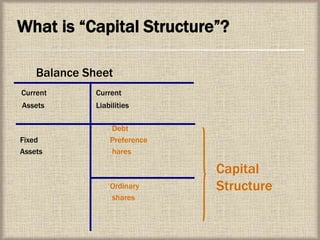
What is “Capital Structure”?
Balance Sheet
Current Current
Assets Liabilities
Debt
Fixed Preference
Assets hares
Ordinary
shares
For Example
A company has equity shares of RS. 5,00,000 and
reserves and surplus RS. 2,00,000 and Debentures of
RS. 3,00,000. The total long term capital or
capitalization is RS. 10,00,000.and the capital structure
of the firm or the mix of capitalization consists equity ,
retained earnings and debentures.
Concept of optimal capital
structure
• The capital structure that minimizes the firm's cost of
capital and thereby maximizes the value of the firm.
• The optimal capital structure is obtained when the
market value per share is at maximum or the
average cost is minimum.
• The determination of capital structure is formidable
task because a no. of factors influence the capital
structure of the company.
Significance of capital structure
• It is concerned with the formulation and designing of
proper capital structure .
• The most important decision of any company is
involved in the formulation of an appropriate capital
structure.
• Capital structure will maximize the earning per share
of shareholders.
• The design of the capital structure of a company has
some bearing on the profitability and influence on the
risk and return of the shareholders.
• A conservative policy may deprive the firm of its
benefits in terms of magnifying the rate of return of
its equity shareholder.
• This is concerned with the determination of debt-
equity combination.
• If capital structure is appropriate it may improve the
and solvency position of the company.
Features of capital structure
• The cost of capital should be minimum.
• The debt should be in limits.
• It should be flexible and adoptable.
• It should not dilute the control of the company.
ELEMENTS OF CAPITAL
STRUCTURE
• Debt-Equity Mix:
Firms should establish a standard debt- equity
ratio for their capital structure.
• Terms and conditions:
Interest payments may be based on fixed or
floating rates of interest. It should also keep in view the
terms and conditions laid down in the loan agreements
or debt instruments.
• Priority and Maturity:
Securities differ in case of maturities and also
priority of payments.
• Currency:
In recent times, companies are allowed to
mobilize funds from overseas markets .
• Financial Innovations:
Innovation has made the securities more
attractive to investors and reduces cost of capital to the
company.
• Financial market segments:
Financial markets have different segments.
Determinants of Capital
Structure
• The degree of business risk :- Companies
experiencing variation in their net operating income
rely more on equity than debt and others with stable
earnings add more debt.
• Control :- For retaining control, companies should
avoid the issue of new equity shares.
• Capital Market Condition:- Capital market condition
influence the capital structure of a company.
• Government Regulations :- Government regulations
influence the financing pattern of a company through
legislation.
• Attitude Towards Risk : The attitude of
management towards risks plays a vital role in
shaping the capital structure plan.
• Cost Of Capital :- It is a important factor which
formulate the capital structure.
• Flexibility : The capital structure must be flexible
and have debt reserve capacity.
• Size Of The Company :- Influences the availability
of funds from different sources.
• Trading On Equity :- Financial leverage effects on
EPS, is one of the important factor in capital
structure planning. High leverage results in high EPS
and vice versa.
APPROACHES TO ESTABLISH
TARGET CAPITAL STRUCTURE
EBIT-EPS approach: for analyzing the impact of debt on
EPS
Valuation approach: for determining the impact of debt
on the share holders value
Cash flow approach: for analyzing the firm’s ability to
service debt
EBIT-EPS ANALYSIS
• It refers to that EBIT level at which EPS remains the
same irrespective of different alternatives of debt
equity mix.
• At this level of EBIT, the rate of return on capital
employed is equal to the cost of debt and this is also
known as break-even level of EBIT for alternative
financial plans.
17
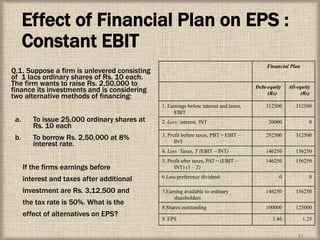
Effect of Financial Plan on EPS :
Constant EBIT
Q.1. Suppose a firm is unlevered consisting
of 1 lacs ordinary shares of Rs. 10 each.
The firm wants to raise Rs. 2,50,000 to
finance its investments and is considering
two alternative methods of financing:
a. To issue 25,000 ordinary shares at
Rs. 10 each
b. To borrow Rs. 2,50,000 at 8%
interest rate.
If the firms earnings before
interest and taxes after additional
investment are Rs. 3,12,500 and
the tax rate is 50%. What is the
effect of alternatives on EPS?
Financial Plan
Debt-equity
(Rs)
All-equity
(Rs)
1. Earnings before interest and taxes,
EBIT
312500 312500
2. Less: interest, INT 20000 0
3. Profit before taxes, PBT = EBIT –
INT
292500 312500
4. Less: Taxes, T (EBIT – INT) 146250 156250
5. Profit after taxes, PAT = (EBIT –
INT) (1 – T)
146250 156250
6.Less:preference dividend 0 0
7.Earning available to ordinary
shareholders
146250 156250
8.Shares outstanding 100000 125000
9. EPS 1.46 1.25
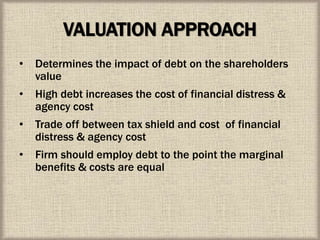
VALUATION APPROACH
• Determines the impact of debt on the shareholders
value
• High debt increases the cost of financial distress &
agency cost
• Trade off between tax shield and cost of financial
distress & agency cost
• Firm should employ debt to the point the marginal
benefits & costs are equal
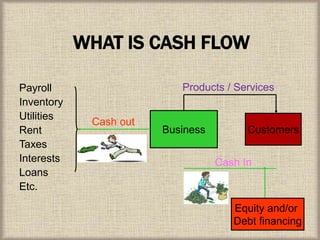
WHAT IS CASH FLOW
Business
Cash In
Customers
Products / Services
Cash out
Payroll
Inventory
Utilities
Rent
Taxes
Interests
Loans
Etc.
Equity and/or
Debt financing
CASH FLOW ANALYSIS
• In determining a firm’s target capital structure, a key
issue is the firm’s ability to service its debt.
• The focus of this analysis is also on the risk of cash
insolvency-the probability of running out of the cash
given a particular amount of debt in the capital
structure
• This analysis is based on a through cash flow analysis
and not on rules of thumb based on various coverage
ratios
Components of cash flows:
• This type of analysis is done through the
preparation of proforma cash flow statements.
• It is grouped into three kinds.
• Operating cash flows:
It is generated from the main operations of the
business and determined from the projected financial
statements.
• Non-operating cash flows:
Normally capital expenditure and working
capital changes included.
• Financial flows:
Payment of interest and dividends and
repayment of debt, lease rentals and other financial
charges are included.
EVALUATION OF CAPTIAL
STRUCTURE:
• Capital structure is evaluated from different
points of view.
• In the view of shareholders’ return, risk and value
are most important.
• From the strategic point of view, flexibility is
important.
• A sound capital structure must posses all these
factors.
The main consideration are
follows:
• Flexibility
The debt–equity mix should be within the debt
capacity. In other words the capital structure should be
flexible.
• Risk
Usage of more debt adds to the profitability of the
shareholders. It also adds financial risk to the company.
• Return
The objective of the capital structure is to minimize
the cost and maximize the market value of the shares.
• Control
The capital structure should not result in parting
with the control of the company.
• Timing
While designing a capital structure, the current and
future capital market condition should be taken into account.
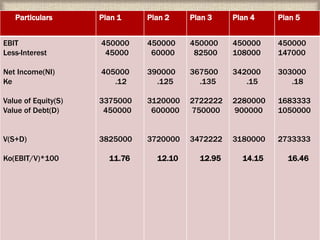
Particulars Plan 1 Plan 2 Plan 3 Plan 4 Plan 5
EBIT
Less-Interest
Net Income(NI)
Ke
Value of Equity(S)
Value of Debt(D)
V(S+D)
Ko(EBIT/V)*100
450000
45000
405000
.12
3375000
450000
3825000
11.76
450000
60000
390000
.125
3120000
600000
3720000
12.10
450000
82500
367500
.135
2722222
750000
3472222
12.95
450000
108000
342000
.15
2280000
900000
3180000
14.15
450000
147000
303000
.18
1683333
1050000
2733333
16.46
Bibliography
• I. M.Pandey
Capital Structure

Capital Structure

  • 1.
    Capital Structure By:Akhil Sarda VishwakKasturi Ashwin Disha Prabhas Chitrasen Shabya
  • 2.
    Contents • Definition • Conceptof Optimal Capital Structure • Significance of Capital Structure • Features of Appropriate Capital Structure • Elements of Capital Structure • Determinants of Capital Structure • Approaches to establish Capital Structure • Evaluation of Capital Structure
  • 3.
    DEFINITION • The permanentlong-term financing of a company including long term debt, common stock and preferred stock and retained earnings. Its is different from financial structure which includes short term debt and accounts payable. • Debt comes in the form of bond issues or long-term notes payable, whereas equity is classified as common stock, preferred stock, or retained earnings. • The capital structure is the firm's various sources of funds used to finance its overall operations and growth. • The capital structure of a business enterprise should be ideal , that is according to the requirement of the business enterprise.
  • 4.
    Capital Structure What is “CapitalStructure”? Balance Sheet Current Current Assets Liabilities Debt Fixed Preference Assets hares Ordinary shares
  • 5.
    For Example A companyhas equity shares of RS. 5,00,000 and reserves and surplus RS. 2,00,000 and Debentures of RS. 3,00,000. The total long term capital or capitalization is RS. 10,00,000.and the capital structure of the firm or the mix of capitalization consists equity , retained earnings and debentures.
  • 6.
    Concept of optimalcapital structure • The capital structure that minimizes the firm's cost of capital and thereby maximizes the value of the firm. • The optimal capital structure is obtained when the market value per share is at maximum or the average cost is minimum. • The determination of capital structure is formidable task because a no. of factors influence the capital structure of the company.
  • 7.
    Significance of capitalstructure • It is concerned with the formulation and designing of proper capital structure . • The most important decision of any company is involved in the formulation of an appropriate capital structure. • Capital structure will maximize the earning per share of shareholders. • The design of the capital structure of a company has some bearing on the profitability and influence on the risk and return of the shareholders.
  • 8.
    • A conservativepolicy may deprive the firm of its benefits in terms of magnifying the rate of return of its equity shareholder. • This is concerned with the determination of debt- equity combination. • If capital structure is appropriate it may improve the and solvency position of the company.
  • 9.
    Features of capitalstructure • The cost of capital should be minimum. • The debt should be in limits. • It should be flexible and adoptable. • It should not dilute the control of the company.
  • 10.
    ELEMENTS OF CAPITAL STRUCTURE •Debt-Equity Mix: Firms should establish a standard debt- equity ratio for their capital structure. • Terms and conditions: Interest payments may be based on fixed or floating rates of interest. It should also keep in view the terms and conditions laid down in the loan agreements or debt instruments.
  • 11.
    • Priority andMaturity: Securities differ in case of maturities and also priority of payments. • Currency: In recent times, companies are allowed to mobilize funds from overseas markets . • Financial Innovations: Innovation has made the securities more attractive to investors and reduces cost of capital to the company. • Financial market segments: Financial markets have different segments.
  • 12.
    Determinants of Capital Structure •The degree of business risk :- Companies experiencing variation in their net operating income rely more on equity than debt and others with stable earnings add more debt. • Control :- For retaining control, companies should avoid the issue of new equity shares. • Capital Market Condition:- Capital market condition influence the capital structure of a company.
  • 13.
    • Government Regulations:- Government regulations influence the financing pattern of a company through legislation. • Attitude Towards Risk : The attitude of management towards risks plays a vital role in shaping the capital structure plan. • Cost Of Capital :- It is a important factor which formulate the capital structure.
  • 14.
    • Flexibility :The capital structure must be flexible and have debt reserve capacity. • Size Of The Company :- Influences the availability of funds from different sources. • Trading On Equity :- Financial leverage effects on EPS, is one of the important factor in capital structure planning. High leverage results in high EPS and vice versa.
  • 15.
    APPROACHES TO ESTABLISH TARGETCAPITAL STRUCTURE EBIT-EPS approach: for analyzing the impact of debt on EPS Valuation approach: for determining the impact of debt on the share holders value Cash flow approach: for analyzing the firm’s ability to service debt
  • 16.
    EBIT-EPS ANALYSIS • Itrefers to that EBIT level at which EPS remains the same irrespective of different alternatives of debt equity mix. • At this level of EBIT, the rate of return on capital employed is equal to the cost of debt and this is also known as break-even level of EBIT for alternative financial plans.
  • 17.
    17 Effect of FinancialPlan on EPS : Constant EBIT Q.1. Suppose a firm is unlevered consisting of 1 lacs ordinary shares of Rs. 10 each. The firm wants to raise Rs. 2,50,000 to finance its investments and is considering two alternative methods of financing: a. To issue 25,000 ordinary shares at Rs. 10 each b. To borrow Rs. 2,50,000 at 8% interest rate. If the firms earnings before interest and taxes after additional investment are Rs. 3,12,500 and the tax rate is 50%. What is the effect of alternatives on EPS? Financial Plan Debt-equity (Rs) All-equity (Rs) 1. Earnings before interest and taxes, EBIT 312500 312500 2. Less: interest, INT 20000 0 3. Profit before taxes, PBT = EBIT – INT 292500 312500 4. Less: Taxes, T (EBIT – INT) 146250 156250 5. Profit after taxes, PAT = (EBIT – INT) (1 – T) 146250 156250 6.Less:preference dividend 0 0 7.Earning available to ordinary shareholders 146250 156250 8.Shares outstanding 100000 125000 9. EPS 1.46 1.25
  • 18.
    VALUATION APPROACH • Determinesthe impact of debt on the shareholders value • High debt increases the cost of financial distress & agency cost • Trade off between tax shield and cost of financial distress & agency cost • Firm should employ debt to the point the marginal benefits & costs are equal
  • 19.
    WHAT IS CASHFLOW Business Cash In Customers Products / Services Cash out Payroll Inventory Utilities Rent Taxes Interests Loans Etc. Equity and/or Debt financing
  • 20.
    CASH FLOW ANALYSIS •In determining a firm’s target capital structure, a key issue is the firm’s ability to service its debt. • The focus of this analysis is also on the risk of cash insolvency-the probability of running out of the cash given a particular amount of debt in the capital structure • This analysis is based on a through cash flow analysis and not on rules of thumb based on various coverage ratios
  • 21.
    Components of cashflows: • This type of analysis is done through the preparation of proforma cash flow statements. • It is grouped into three kinds. • Operating cash flows: It is generated from the main operations of the business and determined from the projected financial statements. • Non-operating cash flows: Normally capital expenditure and working capital changes included. • Financial flows: Payment of interest and dividends and repayment of debt, lease rentals and other financial charges are included.
  • 22.
    EVALUATION OF CAPTIAL STRUCTURE: •Capital structure is evaluated from different points of view. • In the view of shareholders’ return, risk and value are most important. • From the strategic point of view, flexibility is important. • A sound capital structure must posses all these factors.
  • 23.
    The main considerationare follows: • Flexibility The debt–equity mix should be within the debt capacity. In other words the capital structure should be flexible. • Risk Usage of more debt adds to the profitability of the shareholders. It also adds financial risk to the company. • Return The objective of the capital structure is to minimize the cost and maximize the market value of the shares.
  • 24.
    • Control The capitalstructure should not result in parting with the control of the company. • Timing While designing a capital structure, the current and future capital market condition should be taken into account.
  • 25.
    Particulars Plan 1Plan 2 Plan 3 Plan 4 Plan 5 EBIT Less-Interest Net Income(NI) Ke Value of Equity(S) Value of Debt(D) V(S+D) Ko(EBIT/V)*100 450000 45000 405000 .12 3375000 450000 3825000 11.76 450000 60000 390000 .125 3120000 600000 3720000 12.10 450000 82500 367500 .135 2722222 750000 3472222 12.95 450000 108000 342000 .15 2280000 900000 3180000 14.15 450000 147000 303000 .18 1683333 1050000 2733333 16.46
  • 26.