
- Facilitation - Prepared By: Jason Ernst The Pennsylvania State University
- Facilitation - Overview: Facilitation Defined Six Dimensions  Guidelines Why it Works 3M Example
- Facilitation - Facilitation is a learning process in which a leader, called a facilitator, guides a group or individual towards a goal destination. What is Facilitation ?
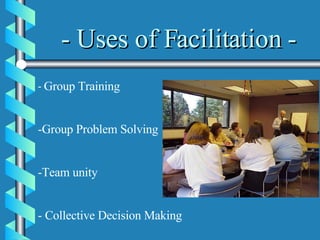
- Uses of Facilitation - Group Training Group Problem Solving  Team unity - Collective Decision Making
- Six Dimensions of Facilitation -   1. Planning 2. Meaning 3. Confronting 4. Feeling 5. Structuring 6. Valuing
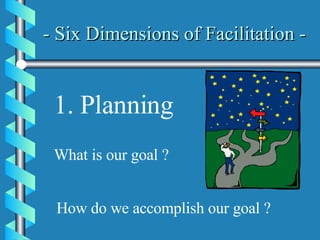
- Six Dimensions of Facilitation -   1. Planning What is our goal ? How do we accomplish our goal ?
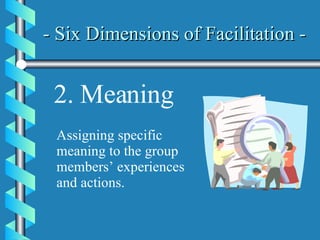
- Six Dimensions of Facilitation -   2. Meaning Assigning specific meaning to the group members’ experiences and actions.
- Six Dimensions of Facilitation -   3. Confronting Making certain that groups confront tough issues and problems that need dealt with.
- Six Dimensions of Facilitation -   4. Feeling To manage the overall feeling within the group.
- Six Dimensions of Facilitation -   5. Structuring How to structure the learning experience for a particular individual or group.
- Six Dimensions of Facilitation -   6. Valuing Maintaining the personal integrity and values of group members.
Facilitation Guidelines There is a particular chemistry that will make a group work well together.  The following are some general guidelines that will apply to most groups.
Facilitation Guidelines Encourage the following: Sharing Ideas Full participation Extracting the gold  Trust Inclusion of all Fun, joy and self-expression
Facilitation Guidelines Avoid the following: Pretending distress will go away Distress projected onto others Discussion that doesn’t go anywhere Domination by a few Withholding
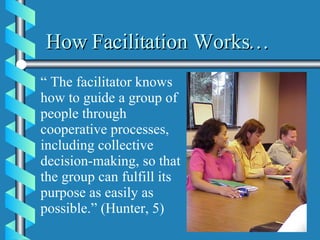
How Facilitation Works… “  The facilitator knows how to guide a group of people through cooperative processes, including collective decision-making, so that the group can fulfill its purpose as easily as possible.” (Hunter, 5)
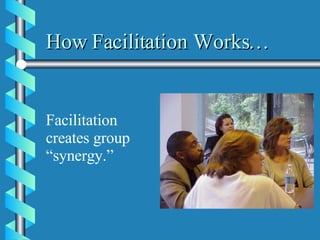
How Facilitation Works… Facilitation creates group “synergy.”
Real World Example Better meetings:   Dozens of articles & tips on how to run effective meetings - from the basics to advanced facilitation skills. http://www.3m.com/meetingnetwork/index.html
Real World Example Featured Articles: A Magical Tool for Group Decisions By: Christopher M. Avery, Ph. D. Partnerwerks, Inc. http://www.3m.com/meetingnetwork/articles_advice/christopher/01-02.html
Hypothetical Exercise Your company wants you to facilitate a group meeting where a course of action must be decided on four different issues. What basic methods do you use to facilitate the meeting and reach decisions on the issues ?
Hypothetical Exercise Answer to exercise: Encourage : Sharing Ideas, Full participation, Extracting the gold, Trust, Inclusion of all, Fun, joy and self-expression Avoid :  Pretending distress will go away, Distress projected onto others, Discussion that doesn’t go anywhere, Domination by a few, and Withholding
- Facilitation Summary- It is virtually impossible to measure the intangible benefits that group synergy through facilitation can have for your company.
Works Cited Avery, Christopher M. “A Magical Tool for Group Decisions.”  Internet.  http://www.3m.com/meetingnetwork/articles_advice/christopher/01-02.html  18 February 2001. “ Diversity Roundtable” Internet.  http://community.webshots.com/photo/5250780/5253718YaldEqXQav    12 February 2001. “ Diversity Roundtable” Internet. http://community.webshots.com/photo/5250780/5253716uolBbJbucN 12 February 2001. “ Diversity Roundtable” Internet. http://community.webshots.com/photo/5250780/5253720XuepcvPWcN 12 February 2001 “ Diversity Roundtable” Internet. http://community.webshots.com/photo/5276885/5277579xjRXzWrGdc 12 February 2001 “ Diversity Roundtable” Internet. http://community.webshots.com/photo/5276885/5277581taUATFQPby 12 February 2001 Heron, John.  The Facilitators’ Handbook.  New York: Kogan Page, 1989. Hunter, Dale and Bailey Anne, and Taylor, Bill.  The Art of Facilitation.  Tucson: Fisher Books, 1995.

Facilitation[1]

  • 1.
    - Facilitation -Prepared By: Jason Ernst The Pennsylvania State University
  • 2.
    - Facilitation -Overview: Facilitation Defined Six Dimensions Guidelines Why it Works 3M Example
  • 3.
    - Facilitation -Facilitation is a learning process in which a leader, called a facilitator, guides a group or individual towards a goal destination. What is Facilitation ?
  • 4.
    - Uses ofFacilitation - Group Training Group Problem Solving Team unity - Collective Decision Making
  • 5.
    - Six Dimensionsof Facilitation - 1. Planning 2. Meaning 3. Confronting 4. Feeling 5. Structuring 6. Valuing
  • 6.
    - Six Dimensionsof Facilitation - 1. Planning What is our goal ? How do we accomplish our goal ?
  • 7.
    - Six Dimensionsof Facilitation - 2. Meaning Assigning specific meaning to the group members’ experiences and actions.
  • 8.
    - Six Dimensionsof Facilitation - 3. Confronting Making certain that groups confront tough issues and problems that need dealt with.
  • 9.
    - Six Dimensionsof Facilitation - 4. Feeling To manage the overall feeling within the group.
  • 10.
    - Six Dimensionsof Facilitation - 5. Structuring How to structure the learning experience for a particular individual or group.
  • 11.
    - Six Dimensionsof Facilitation - 6. Valuing Maintaining the personal integrity and values of group members.
  • 12.
    Facilitation Guidelines Thereis a particular chemistry that will make a group work well together. The following are some general guidelines that will apply to most groups.
  • 13.
    Facilitation Guidelines Encouragethe following: Sharing Ideas Full participation Extracting the gold Trust Inclusion of all Fun, joy and self-expression
  • 14.
    Facilitation Guidelines Avoidthe following: Pretending distress will go away Distress projected onto others Discussion that doesn’t go anywhere Domination by a few Withholding
  • 15.
    How Facilitation Works…“ The facilitator knows how to guide a group of people through cooperative processes, including collective decision-making, so that the group can fulfill its purpose as easily as possible.” (Hunter, 5)
  • 16.
    How Facilitation Works…Facilitation creates group “synergy.”
  • 17.
    Real World ExampleBetter meetings:   Dozens of articles & tips on how to run effective meetings - from the basics to advanced facilitation skills. http://www.3m.com/meetingnetwork/index.html
  • 18.
    Real World ExampleFeatured Articles: A Magical Tool for Group Decisions By: Christopher M. Avery, Ph. D. Partnerwerks, Inc. http://www.3m.com/meetingnetwork/articles_advice/christopher/01-02.html
  • 19.
    Hypothetical Exercise Yourcompany wants you to facilitate a group meeting where a course of action must be decided on four different issues. What basic methods do you use to facilitate the meeting and reach decisions on the issues ?
  • 20.
    Hypothetical Exercise Answerto exercise: Encourage : Sharing Ideas, Full participation, Extracting the gold, Trust, Inclusion of all, Fun, joy and self-expression Avoid : Pretending distress will go away, Distress projected onto others, Discussion that doesn’t go anywhere, Domination by a few, and Withholding
  • 21.
    - Facilitation Summary-It is virtually impossible to measure the intangible benefits that group synergy through facilitation can have for your company.
  • 22.
    Works Cited Avery,Christopher M. “A Magical Tool for Group Decisions.” Internet. http://www.3m.com/meetingnetwork/articles_advice/christopher/01-02.html 18 February 2001. “ Diversity Roundtable” Internet. http://community.webshots.com/photo/5250780/5253718YaldEqXQav 12 February 2001. “ Diversity Roundtable” Internet. http://community.webshots.com/photo/5250780/5253716uolBbJbucN 12 February 2001. “ Diversity Roundtable” Internet. http://community.webshots.com/photo/5250780/5253720XuepcvPWcN 12 February 2001 “ Diversity Roundtable” Internet. http://community.webshots.com/photo/5276885/5277579xjRXzWrGdc 12 February 2001 “ Diversity Roundtable” Internet. http://community.webshots.com/photo/5276885/5277581taUATFQPby 12 February 2001 Heron, John. The Facilitators’ Handbook. New York: Kogan Page, 1989. Hunter, Dale and Bailey Anne, and Taylor, Bill. The Art of Facilitation. Tucson: Fisher Books, 1995.

Editor's Notes