LPI INDIVIDUAL REPORT October 11, 2013

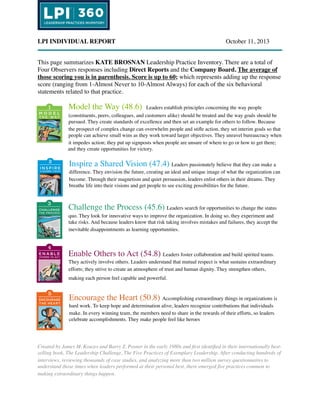
This page summarizes KATE BROSNAN Leadership Practice Inventory. There are a total of
Four Observers responses including Direct Reports and the Company Board. The average of
those scoring you is in parenthesis. Score is up to 60; which represents adding up the response
score (ranging from 1-Almost Never to 10-Almost Always) for each of the six behavioral
statements related to that practice.
Model the Way (48.6) Leaders establish principles concerning the way people
(constituents, peers, colleagues, and customers alike) should be treated and the way goals should be
pursued. They create standards of excellence and then set an example for others to follow. Because
the prospect of complex change can overwhelm people and stifle action, they set interim goals so that
people can achieve small wins as they work toward larger objectives. They unravel bureaucracy when
it impedes action; they put up signposts when people are unsure of where to go or how to get there;
and they create opportunities for victory.
Inspire a Shared Vision (47.4) Leaders passionately believe that they can make a
difference. They envision the future, creating an ideal and unique image of what the organization can
become. Through their magnetism and quiet persuasion, leaders enlist others in their dreams. They
breathe life into their visions and get people to see exciting possibilities for the future.
Challenge the Process (45.6) Leaders search for opportunities to change the status
quo. They look for innovative ways to improve the organization. In doing so, they experiment and
take risks. And because leaders know that risk taking involves mistakes and failures, they accept the
inevitable disappointments as learning opportunities.
Enable Others to Act (54.8) Leaders foster collaboration and build spirited teams.
They actively involve others. Leaders understand that mutual respect is what sustains extraordinary
efforts; they strive to create an atmosphere of trust and human dignity. They strengthen others,
making each person feel capable and powerful.
Encourage the Heart (50.8) Accomplishing extraordinary things in organizations is
hard work. To keep hope and determination alive, leaders recognize contributions that individuals
make. In every winning team, the members need to share in the rewards of their efforts, so leaders
celebrate accomplishments. They make people feel like heroes
Created by James M. Kouzes and Barry Z. Posner in the early 1980s and first identified in their internationally best-
selling book, The Leadership Challenge, The Five Practices of Exemplary Leadership. After conducting hundreds of
interviews, reviewing thousands of case studies, and analyzing more than two million survey questionnaires to
understand those times when leaders performed at their personal best, there emerged five practices common to
making extraordinary things happen.
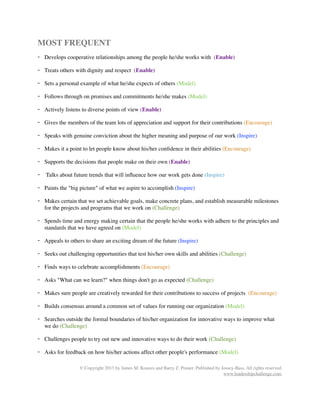
MOST FREQUENT
- Develops cooperative relationships among the people he/she works with (Enable)
- Treats others with dignity and respect (Enable)
- Sets a personal example of what he/she expects of others (Model)
- Follows through on promises and commitments he/she makes (Model)
- Actively listens to diverse points of view (Enable)
- Gives the members of the team lots of appreciation and support for their contributions (Encourage)
- Speaks with genuine conviction about the higher meaning and purpose of our work (Inspire)
- Makes it a point to let people know about his/her confidence in their abilities (Encourage)
- Supports the decisions that people make on their own (Enable)
- Talks about future trends that will influence how our work gets done (Inspire)
- Paints the big picture of what we aspire to accomplish (Inspire)
- Makes certain that we set achievable goals, make concrete plans, and establish measurable milestones
for the projects and programs that we work on (Challenge)
- Spends time and energy making certain that the people he/she works with adhere to the principles and
standards that we have agreed on (Model)
- Appeals to others to share an exciting dream of the future (Inspire)
- Seeks out challenging opportunities that test his/her own skills and abilities (Challenge)
- Finds ways to celebrate accomplishments (Encourage)
- Asks What can we learn? when things don't go as expected (Challenge)
- Makes sure people are creatively rewarded for their contributions to success of projects (Encourage)
- Builds consensus around a common set of values for running our organization (Model)
- Searches outside the formal boundaries of his/her organization for innovative ways to improve what
we do (Challenge)
- Challenges people to try out new and innovative ways to do their work (Challenge)
- Asks for feedback on how his/her actions affect other people's performance (Model)
© Copyright 2013 by James M. Kouzes and Barry Z. Posner. Published by Jossey-Bass. All rights reserved.
www.leadershipchallenge.com.

LPI

  • 1.
    LPI INDIVIDUAL REPORTOctober 11, 2013 This page summarizes KATE BROSNAN Leadership Practice Inventory. There are a total of Four Observers responses including Direct Reports and the Company Board. The average of those scoring you is in parenthesis. Score is up to 60; which represents adding up the response score (ranging from 1-Almost Never to 10-Almost Always) for each of the six behavioral statements related to that practice. Model the Way (48.6) Leaders establish principles concerning the way people (constituents, peers, colleagues, and customers alike) should be treated and the way goals should be pursued. They create standards of excellence and then set an example for others to follow. Because the prospect of complex change can overwhelm people and stifle action, they set interim goals so that people can achieve small wins as they work toward larger objectives. They unravel bureaucracy when it impedes action; they put up signposts when people are unsure of where to go or how to get there; and they create opportunities for victory. Inspire a Shared Vision (47.4) Leaders passionately believe that they can make a difference. They envision the future, creating an ideal and unique image of what the organization can become. Through their magnetism and quiet persuasion, leaders enlist others in their dreams. They breathe life into their visions and get people to see exciting possibilities for the future. Challenge the Process (45.6) Leaders search for opportunities to change the status quo. They look for innovative ways to improve the organization. In doing so, they experiment and take risks. And because leaders know that risk taking involves mistakes and failures, they accept the inevitable disappointments as learning opportunities. Enable Others to Act (54.8) Leaders foster collaboration and build spirited teams. They actively involve others. Leaders understand that mutual respect is what sustains extraordinary efforts; they strive to create an atmosphere of trust and human dignity. They strengthen others, making each person feel capable and powerful. Encourage the Heart (50.8) Accomplishing extraordinary things in organizations is hard work. To keep hope and determination alive, leaders recognize contributions that individuals make. In every winning team, the members need to share in the rewards of their efforts, so leaders celebrate accomplishments. They make people feel like heroes Created by James M. Kouzes and Barry Z. Posner in the early 1980s and first identified in their internationally best- selling book, The Leadership Challenge, The Five Practices of Exemplary Leadership. After conducting hundreds of interviews, reviewing thousands of case studies, and analyzing more than two million survey questionnaires to understand those times when leaders performed at their personal best, there emerged five practices common to making extraordinary things happen.
  • 2.
    MOST FREQUENT - Developscooperative relationships among the people he/she works with (Enable) - Treats others with dignity and respect (Enable) - Sets a personal example of what he/she expects of others (Model) - Follows through on promises and commitments he/she makes (Model) - Actively listens to diverse points of view (Enable) - Gives the members of the team lots of appreciation and support for their contributions (Encourage) - Speaks with genuine conviction about the higher meaning and purpose of our work (Inspire) - Makes it a point to let people know about his/her confidence in their abilities (Encourage) - Supports the decisions that people make on their own (Enable) - Talks about future trends that will influence how our work gets done (Inspire) - Paints the big picture of what we aspire to accomplish (Inspire) - Makes certain that we set achievable goals, make concrete plans, and establish measurable milestones for the projects and programs that we work on (Challenge) - Spends time and energy making certain that the people he/she works with adhere to the principles and standards that we have agreed on (Model) - Appeals to others to share an exciting dream of the future (Inspire) - Seeks out challenging opportunities that test his/her own skills and abilities (Challenge) - Finds ways to celebrate accomplishments (Encourage) - Asks What can we learn? when things don't go as expected (Challenge) - Makes sure people are creatively rewarded for their contributions to success of projects (Encourage) - Builds consensus around a common set of values for running our organization (Model) - Searches outside the formal boundaries of his/her organization for innovative ways to improve what we do (Challenge) - Challenges people to try out new and innovative ways to do their work (Challenge) - Asks for feedback on how his/her actions affect other people's performance (Model) © Copyright 2013 by James M. Kouzes and Barry Z. Posner. Published by Jossey-Bass. All rights reserved. www.leadershipchallenge.com.