• Palsy :- Complete or partial muscle paralysis, often
accompanied by loss of sensation and uncontrollable body
movements or tumors.
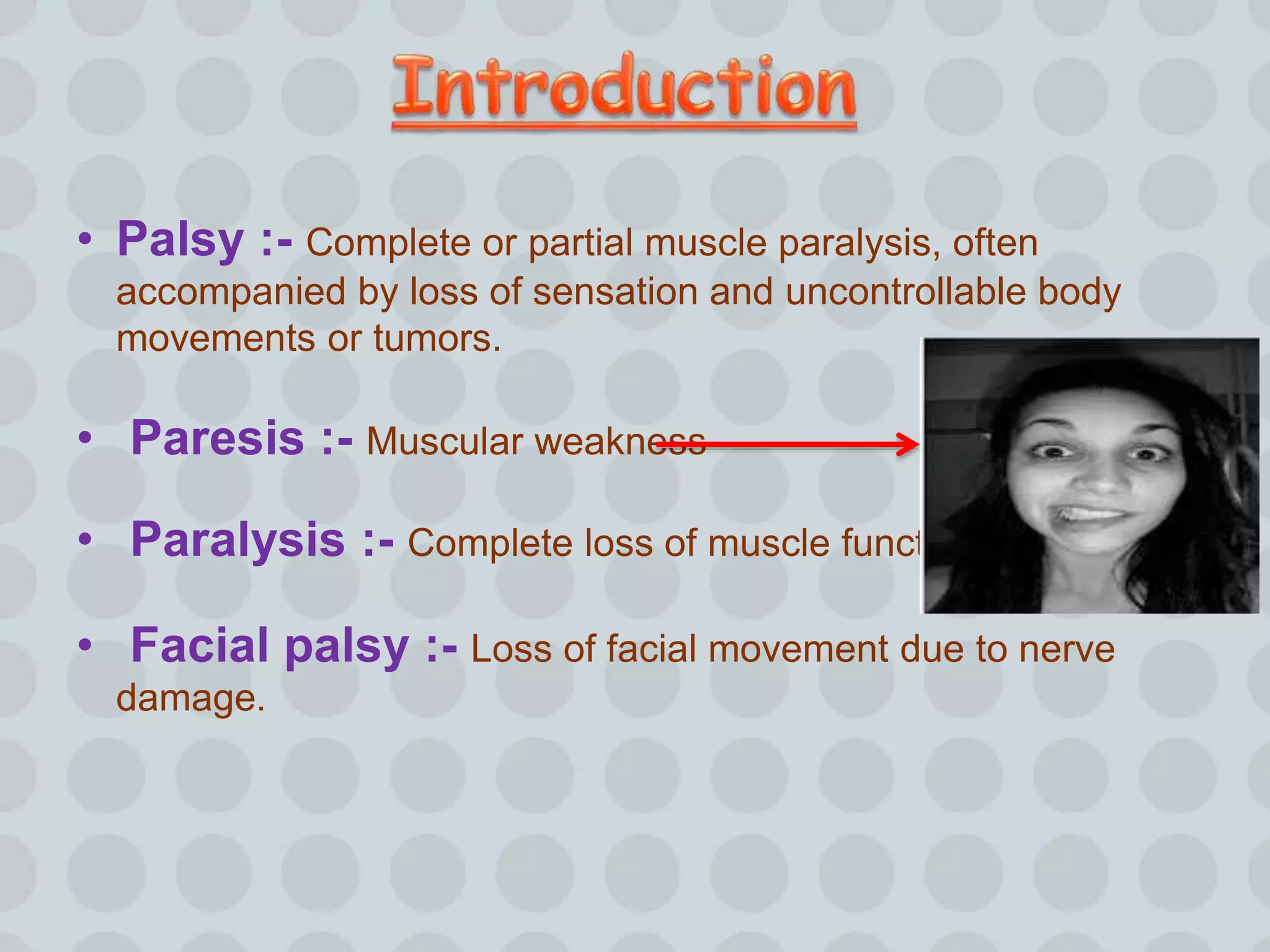
• Paresis :- Muscular weakness
• Paralysis :- Complete loss of muscle function
• Facial palsy :- Loss of facial movement due to nerve
damage.
• It is a neurological condition in which function
of facial nerve (cranial nerve VII) is partially or
completely lost.
• It may appear to droop to become weak.
• Affect one or both side of face.
Types
of facial
palsy
Central
facial
palsy
Peripher
al facial
palsy
• Lesion occurs between
cortex and nuclei in the
brain stem.
• Manifest with
impairment of the lower
contralateral mimic
musculature.
• Lesion occurs between
nuclei in the brainstem
and peripheral organs. It
leads to impairment of the
ipsilateral mimic muscles
and also affects the
eyelids and forehead.
• Cause various sensory
and autonomic disorders (
depending on the exact
location of the lesion).
 Idiopathic (50% of cases) – acute idiopathic
peripheral facial palsy- known as Bell palsy.
 Secondary :-
• Trauma – Temporal bone fracture
• Infection :- HZV (Herpes zoster virus), borreliosis, HSV
(Herpes simplex virus), HIV infection
• Tumors
• Pregnancy
• Diabetes mellitus
• Guillain – Barre syndrome
• Sarcoidosis
• Amyloidosis
• Stroke
Sign & Symptoms
• Sudden onset symptoms usually in hours, maximal weakness
in 48 hrs.
• Unilateral
• Eyebrow sagging
• Inability to close eye
• Loss of nasolabial fold
• Decreased tearing
• Hyperacusis
• Loss of taste to anterior 2/3 tongue.
• Mouth droop
Eyebrow sagging
Nasolabial fold
 Physical examination :- To move facial muscles by closing
eyes, lifting brow, showing teeth and frowning and other
movements.
 EMG ( Electromyography) :-
 To confirm the presence of nerve damage and determine its
severity.
 It measures the electrical activity of a muscle in response to
stimulation and the nature and the speed of the conduction of
electrical impulses along a nerve.
 Imaging – CT , MRI
 To rule out other possible sources pressure on the facial nerve,
such as tumor or skull fracture.
EMG
CT MRI
 Corticosteroids – Prednisone
• powerful anti-inflammatory agent
• Reduce the swelling of the facial nerve.
 Anti-viral drugs
• It added to steroids are possibly beneficial for some people with
Bell’s palsy, but this is still unproved.
 In severe cases
 Valacyclovir- for 1 week
 Eye care with – artificial tears
 Traumatic facial nerve palsy
 surgical decompression or nerve repair
 In the past, Decompression surgery was used to relieve the
pressure on the facial nerve by opening the bony passage that
the nerve passes through.
 Today isn’t recommended.
 Facial nerve injury and permanent hearing loss are possible
risks associated with this surgery.
• Idiopathic facial palsy- complete recovery in-
85%of cases( within 3 weeks)
• If motor nerve conduction studies show evidence
of denervation after 10 days indicates prolonged
recovery of – 3 months and possible incomplete
recovery.
• Dural tears
• Conductive or sensory neural hearing loss
• Vestibular function loss
• Persistent CSF leaks
• Meningitis
• Injury to the anterior inferior cerebellar artery
(AICA) or its branches.
Facial palsy

Facial palsy

  • 3.
    • Palsy :-Complete or partial muscle paralysis, often accompanied by loss of sensation and uncontrollable body movements or tumors. • Paresis :- Muscular weakness • Paralysis :- Complete loss of muscle function • Facial palsy :- Loss of facial movement due to nerve damage.
  • 4.
    • It isa neurological condition in which function of facial nerve (cranial nerve VII) is partially or completely lost. • It may appear to droop to become weak. • Affect one or both side of face.
  • 7.
  • 9.
    • Lesion occursbetween cortex and nuclei in the brain stem. • Manifest with impairment of the lower contralateral mimic musculature.
  • 10.
    • Lesion occursbetween nuclei in the brainstem and peripheral organs. It leads to impairment of the ipsilateral mimic muscles and also affects the eyelids and forehead. • Cause various sensory and autonomic disorders ( depending on the exact location of the lesion).
  • 12.
     Idiopathic (50%of cases) – acute idiopathic peripheral facial palsy- known as Bell palsy.  Secondary :- • Trauma – Temporal bone fracture • Infection :- HZV (Herpes zoster virus), borreliosis, HSV (Herpes simplex virus), HIV infection • Tumors • Pregnancy • Diabetes mellitus • Guillain – Barre syndrome • Sarcoidosis • Amyloidosis • Stroke
  • 15.
    Sign & Symptoms •Sudden onset symptoms usually in hours, maximal weakness in 48 hrs. • Unilateral • Eyebrow sagging • Inability to close eye • Loss of nasolabial fold • Decreased tearing • Hyperacusis • Loss of taste to anterior 2/3 tongue. • Mouth droop
  • 16.
  • 17.
     Physical examination:- To move facial muscles by closing eyes, lifting brow, showing teeth and frowning and other movements.  EMG ( Electromyography) :-  To confirm the presence of nerve damage and determine its severity.  It measures the electrical activity of a muscle in response to stimulation and the nature and the speed of the conduction of electrical impulses along a nerve.  Imaging – CT , MRI  To rule out other possible sources pressure on the facial nerve, such as tumor or skull fracture.
  • 19.
  • 20.
     Corticosteroids –Prednisone • powerful anti-inflammatory agent • Reduce the swelling of the facial nerve.  Anti-viral drugs • It added to steroids are possibly beneficial for some people with Bell’s palsy, but this is still unproved.  In severe cases  Valacyclovir- for 1 week  Eye care with – artificial tears
  • 21.
     Traumatic facialnerve palsy  surgical decompression or nerve repair  In the past, Decompression surgery was used to relieve the pressure on the facial nerve by opening the bony passage that the nerve passes through.  Today isn’t recommended.  Facial nerve injury and permanent hearing loss are possible risks associated with this surgery.
  • 22.
    • Idiopathic facialpalsy- complete recovery in- 85%of cases( within 3 weeks) • If motor nerve conduction studies show evidence of denervation after 10 days indicates prolonged recovery of – 3 months and possible incomplete recovery.
  • 23.
    • Dural tears •Conductive or sensory neural hearing loss • Vestibular function loss • Persistent CSF leaks • Meningitis • Injury to the anterior inferior cerebellar artery (AICA) or its branches.