Content1-Anatomy of the facial nerve
2-Facial palsy: introduction
3- Historical background
4-Types
5-Causes
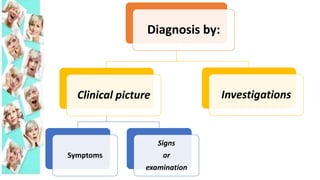
6-Diagnosis
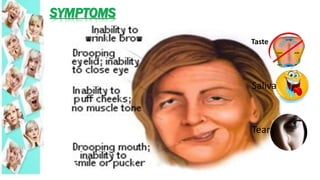
- symptoms
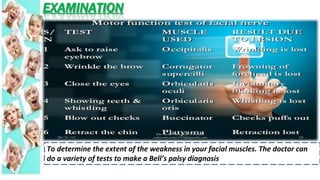
Signs or examination
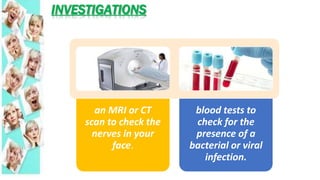
investigation
7- Treatment
8-Complications
9-Prognosis
Akram Mohamed
Elsaid hussin
Esraa Fathy
Aya Gamal
Aya Salah eldeen.
Aya Elmorshdy
Esraa Mohamed
Shrook Elfeshawi
Rania Roshdy
Gehad Mohamed
Prof. Dr .
Hanaa Nooh
Dr. Lobna
Taher
Dr. Engy Abd
El- Azeem
Project team Supervisors
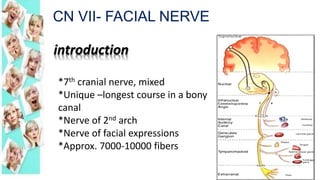
*7th cranial nerve, mixed
*Unique –longest course in a bony
canal
*Nerve of 2nd arch
*Nerve of facial expressions
*Approx. 7000-10000 fibers
introduction
CN VII- FACIAL NERVE
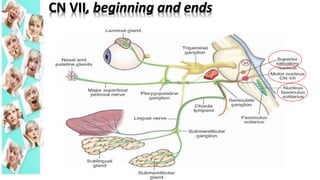
CN VII, beginning and ends
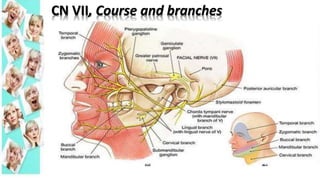
CN VII, Course and branches
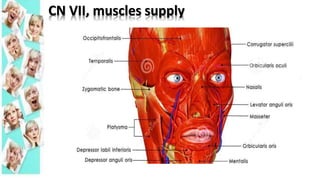
CN VII, muscles supply
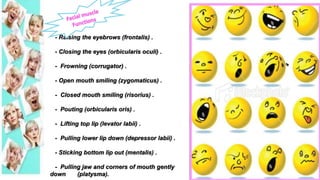
- Raising the eyebrows (frontalis) .
- Closing the eyes (orbicularis oculi) .
- Frowning (corrugator) .
- Open mouth smiling (zygomaticus) .
- Closed mouth smiling (risorius) .
- Pouting (orbicularis oris) .
- Lifting top lip (levator labii) .
- Pulling lower lip down (depressor labii) .
- Sticking bottom lip out (mentalis) .
- Pulling jaw and corners of mouth gently
down (platysma).
Introduction
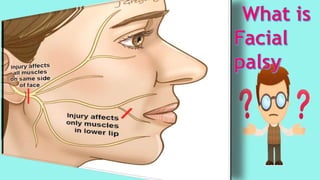
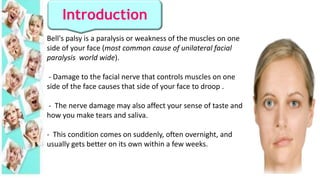
Bell's palsy is a paralysis or weakness of the muscles on one
side of your face (most common cause of unilateral facial
paralysis world wide).
- Damage to the facial nerve that controls muscles on one
side of the face causes that side of your face to droop .
- The nerve damage may also affect your sense of taste and
how you make tears and saliva.
- This condition comes on suddenly, often overnight, and
usually gets better on its own within a few weeks.
Historical
background
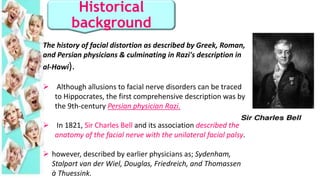
The history of facial distortion as described by Greek, Roman,
and Persian physicians & culminating in Razi's description in
al-Hawi).
 Although allusions to facial nerve disorders can be traced
to Hippocrates, the first comprehensive description was by
the 9th-century Persian physician Razi.
 In 1821, Sir Charles Bell and its association described the
anatomy of the facial nerve with the unilateral facial palsy.
 however, described by earlier physicians as; Sydenham,
Stalpart van der Wiel, Douglas, Friedreich, and Thomassen
à Thuessink.
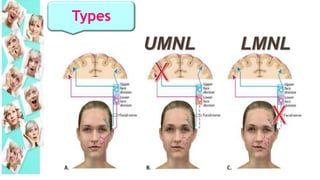
Types
UMNL LMNL
Causes
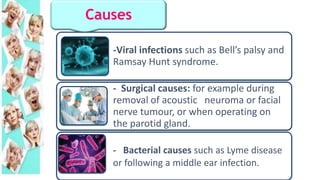
-Viral infections such as Bell’s palsy and
Ramsay Hunt syndrome.
- Surgical causes: for example during
removal of acoustic neuroma or facial
nerve tumour, or when operating on
the parotid gland.
- Bacterial causes such as Lyme disease
or following a middle ear infection.
Diagnosis by:
Clinical picture
Symptoms
Signs
or
examination
Investigations
Taste
Saliva
Tears
SYMPTOMS
EXAMINATION
To determine the extent of the weakness in your facial muscles. The doctor can
do a variety of tests to make a Bell’s palsy diagnosis
INVESTIGATIONS
an MRI or CT
scan to check the
nerves in your
face.
blood tests to
check for the
presence of a
bacterial or viral
infection.
treatment
Medical Physical Surgical others
Treatment with corticosteroid
medicines (such as prednisone)
Sometimes antiviral medicines
(such as acyclovir
Most people who have Bell's palsy
recover completely, without treatment,
in 1 to 2 months
Medical
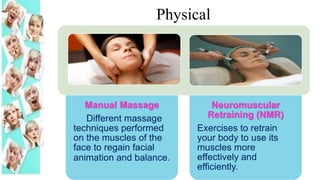
Manual Massage
Different massage
techniques performed
on the muscles of the
face to regain facial
animation and balance.
Neuromuscular
Retraining (NMR)
Exercises to retrain
your body to use its
muscles more
effectively and
efficiently.
Physical
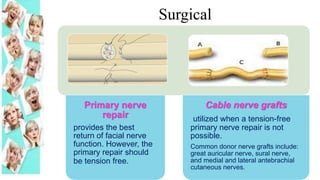
Primary nerve
repair
provides the best
return of facial nerve
function. However, the
primary repair should
be tension free.
Cable nerve grafts
utilized when a tension-free
primary nerve repair is not
possible.
Common donor nerve grafts include:
great auricular nerve, sural nerve,
and medial and lateral antebrachial
cutaneous nerves.
Surgical
If you have no feeling and little
saliva on one side of your
tongue, food may get stuck
there, leading to gum disease
or tooth decay. Brush and floss
your teeth often and well to
help prevent these problems.
To prevent swallowing
problems, eat slowly and chew
your food well. Eating soft,
smooth foods, such as yogurt,
may also help.
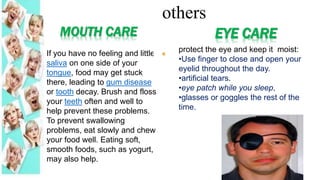
MOUTH CARE EYE CARE
protect the eye and keep it moist:
•Use finger to close and open your
eyelid throughout the day.
•artificial tears.
•eye patch while you sleep,
•glasses or goggles the rest of the
time.
others
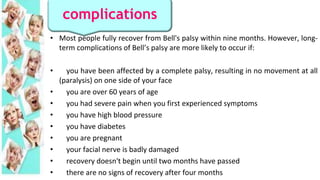
• Most people fully recover from Bell's palsy within nine months. However, long-
term complications of Bell’s palsy are more likely to occur if:
• you have been affected by a complete palsy, resulting in no movement at all
(paralysis) on one side of your face
• you are over 60 years of age
• you had severe pain when you first experienced symptoms
• you have high blood pressure
• you have diabetes
• you are pregnant
• your facial nerve is badly damaged
• recovery doesn't begin until two months have passed
• there are no signs of recovery after four months
complications
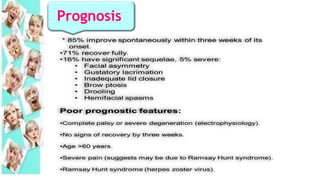
Prognosis
Refrences
1 - Gupta, Sachin; Francine Mends; Mari Hagiwara; Girish Fatterpekar; Pamela C.
Roehm (2013). "Imaging the Facial Nerve: A Contemporary Review". Radiology
Research and Practice. 2013: –248039. doi:10.1155/2013/248039. ISSN 2090-1941.
Retrieved 2015-02-07.
2 - PhD, Richard S. Snell MD (2011). Clinical Anatomy by Regions (Ninth ed.).
Philadelphia, Pa.; London: LWW. ISBN 9781451110326.
3 - Singh, Vishram. Textbook of Clinical Neuroanatomy (2nd ed.). p. 104.
4 - Dudek, Ronald W. (2014). BRS Embryology (Sixth ed.). LWW. ISBN
9781451190380.
5 - Moore, Keith L.; T. V. N. Persaud; Mark G. Torchia (2011). The Developing
Human: Clinically Oriented Embryology with Student Consult Online Access, 9th
Edition (9th ed.). Philadelphia, PA: Saunders. ISBN 9781437720020.
6 - Kliniska Färdigheter: Informationsutbytet Mellan Patient Och Läkare, LINDGREN,
STEFAN, ISBN 91-44-37271-X
Facial nerve paralysis

Facial nerve paralysis

  • 2.
    Content1-Anatomy of thefacial nerve 2-Facial palsy: introduction 3- Historical background 4-Types 5-Causes 6-Diagnosis - symptoms Signs or examination investigation 7- Treatment 8-Complications 9-Prognosis
  • 3.
    Akram Mohamed Elsaid hussin EsraaFathy Aya Gamal Aya Salah eldeen. Aya Elmorshdy Esraa Mohamed Shrook Elfeshawi Rania Roshdy Gehad Mohamed Prof. Dr . Hanaa Nooh Dr. Lobna Taher Dr. Engy Abd El- Azeem Project team Supervisors
  • 4.
    *7th cranial nerve,mixed *Unique –longest course in a bony canal *Nerve of 2nd arch *Nerve of facial expressions *Approx. 7000-10000 fibers introduction CN VII- FACIAL NERVE
  • 5.
  • 6.
    CN VII, Courseand branches
  • 7.
  • 8.
    - Raising theeyebrows (frontalis) . - Closing the eyes (orbicularis oculi) . - Frowning (corrugator) . - Open mouth smiling (zygomaticus) . - Closed mouth smiling (risorius) . - Pouting (orbicularis oris) . - Lifting top lip (levator labii) . - Pulling lower lip down (depressor labii) . - Sticking bottom lip out (mentalis) . - Pulling jaw and corners of mouth gently down (platysma).
  • 10.
    Introduction Bell's palsy isa paralysis or weakness of the muscles on one side of your face (most common cause of unilateral facial paralysis world wide). - Damage to the facial nerve that controls muscles on one side of the face causes that side of your face to droop . - The nerve damage may also affect your sense of taste and how you make tears and saliva. - This condition comes on suddenly, often overnight, and usually gets better on its own within a few weeks.
  • 11.
    Historical background The history offacial distortion as described by Greek, Roman, and Persian physicians & culminating in Razi's description in al-Hawi).  Although allusions to facial nerve disorders can be traced to Hippocrates, the first comprehensive description was by the 9th-century Persian physician Razi.  In 1821, Sir Charles Bell and its association described the anatomy of the facial nerve with the unilateral facial palsy.  however, described by earlier physicians as; Sydenham, Stalpart van der Wiel, Douglas, Friedreich, and Thomassen à Thuessink.
  • 12.
  • 13.
    Causes -Viral infections suchas Bell’s palsy and Ramsay Hunt syndrome. - Surgical causes: for example during removal of acoustic neuroma or facial nerve tumour, or when operating on the parotid gland. - Bacterial causes such as Lyme disease or following a middle ear infection.
  • 15.
  • 16.
  • 17.
    EXAMINATION To determine theextent of the weakness in your facial muscles. The doctor can do a variety of tests to make a Bell’s palsy diagnosis
  • 18.
    INVESTIGATIONS an MRI orCT scan to check the nerves in your face. blood tests to check for the presence of a bacterial or viral infection.
  • 19.
  • 20.
    Treatment with corticosteroid medicines(such as prednisone) Sometimes antiviral medicines (such as acyclovir Most people who have Bell's palsy recover completely, without treatment, in 1 to 2 months Medical
  • 21.
    Manual Massage Different massage techniquesperformed on the muscles of the face to regain facial animation and balance. Neuromuscular Retraining (NMR) Exercises to retrain your body to use its muscles more effectively and efficiently. Physical
  • 22.
    Primary nerve repair provides thebest return of facial nerve function. However, the primary repair should be tension free. Cable nerve grafts utilized when a tension-free primary nerve repair is not possible. Common donor nerve grafts include: great auricular nerve, sural nerve, and medial and lateral antebrachial cutaneous nerves. Surgical
  • 23.
    If you haveno feeling and little saliva on one side of your tongue, food may get stuck there, leading to gum disease or tooth decay. Brush and floss your teeth often and well to help prevent these problems. To prevent swallowing problems, eat slowly and chew your food well. Eating soft, smooth foods, such as yogurt, may also help. MOUTH CARE EYE CARE protect the eye and keep it moist: •Use finger to close and open your eyelid throughout the day. •artificial tears. •eye patch while you sleep, •glasses or goggles the rest of the time. others
  • 24.
    • Most peoplefully recover from Bell's palsy within nine months. However, long- term complications of Bell’s palsy are more likely to occur if: • you have been affected by a complete palsy, resulting in no movement at all (paralysis) on one side of your face • you are over 60 years of age • you had severe pain when you first experienced symptoms • you have high blood pressure • you have diabetes • you are pregnant • your facial nerve is badly damaged • recovery doesn't begin until two months have passed • there are no signs of recovery after four months complications
  • 25.
  • 26.
    Refrences 1 - Gupta,Sachin; Francine Mends; Mari Hagiwara; Girish Fatterpekar; Pamela C. Roehm (2013). "Imaging the Facial Nerve: A Contemporary Review". Radiology Research and Practice. 2013: –248039. doi:10.1155/2013/248039. ISSN 2090-1941. Retrieved 2015-02-07. 2 - PhD, Richard S. Snell MD (2011). Clinical Anatomy by Regions (Ninth ed.). Philadelphia, Pa.; London: LWW. ISBN 9781451110326. 3 - Singh, Vishram. Textbook of Clinical Neuroanatomy (2nd ed.). p. 104. 4 - Dudek, Ronald W. (2014). BRS Embryology (Sixth ed.). LWW. ISBN 9781451190380. 5 - Moore, Keith L.; T. V. N. Persaud; Mark G. Torchia (2011). The Developing Human: Clinically Oriented Embryology with Student Consult Online Access, 9th Edition (9th ed.). Philadelphia, PA: Saunders. ISBN 9781437720020. 6 - Kliniska Färdigheter: Informationsutbytet Mellan Patient Och Läkare, LINDGREN, STEFAN, ISBN 91-44-37271-X