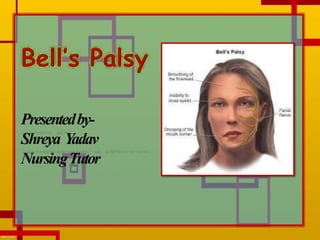
Presentedby-
Shreya Yadav
NursingTutor
Bell's palsy causes sudden
weakness in your facial
muscles. This makes half of
your face appear to droop.
Your smile is one-sided, and
your eye on that side resists
closing.
The exact cause is unknown,
but it's believed to be the
result of swelling and
inflammation of the nerve that
controls the muscles on one
side of your face. It may be a
reaction that occurs after a
viral infection.
Bell's palsy is temporary.
Symptoms usually start to
improve within a few weeks,
with complete recovery in
about six months. sometimes it
continue to have Bell's palsy
symptoms for life. Rarely, Bell's
palsy can recur.
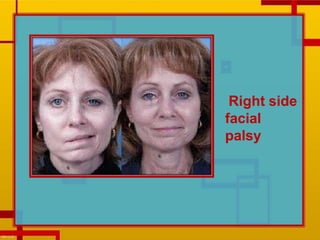
Right side
facial
palsy
Although the exact reason
Bell's palsy occurs isn't clear,
it's often linked to exposure to
a viral infection.
 Cold sores and genital herpes (herpes
simplex)
 Chickenpox and shingles (herpes
zoster)
 Mononucleosis (Epstein-Barr)
 Cytomegalovirus infections
 Respiratory illnesses (adenovirus)
 German measles (rubella)
 Mumps (mumps virus)
 Flu (influenza B)
 Hand-foot-and-mouth disease
(coxsackievirus)
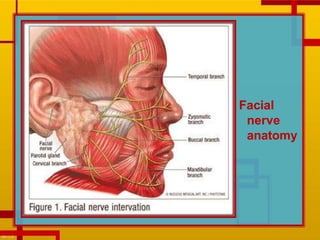
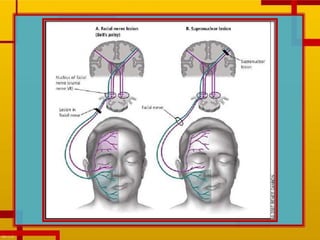
With Bell's palsy, the nerve that
controls your facial muscles,
which passes through a narrow
corridor of bone on its way to
your face, becomes inflamed and
swollen —usually related to a
viral infection. Besides facial
muscles, the nerve affects tears,
saliva, taste and a small bone in
the middle of your ear.
Facial
nerve
anatomy
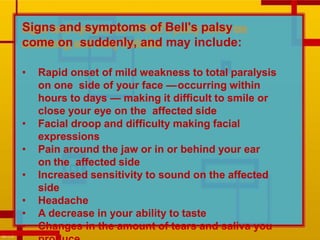
Signs and symptoms of Bell's palsy
come on suddenly, and may include:
• Rapid onset of mild weakness to total paralysis
on one side of your face —occurring within
hours to days — making it difficult to smile or
close your eye on the affected side
• Facial droop and difficulty making facial
expressions
• Pain around the jaw or in or behind your ear
on the affected side
• Increased sensitivity to sound on the affected
side
• Headache
• A decrease in your ability to taste
• Changes in the amount of tears and saliva you
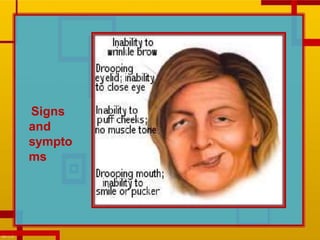
Signs
and
sympto
ms
In rare cases, Bell's
palsy can affect the
nerves on both
sides of your face
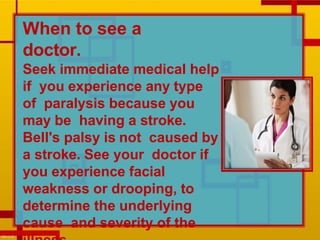
When to see a
doctor.
Seek immediate medical help
if you experience any type
of paralysis because you
may be having a stroke.
Bell's palsy is not caused by
a stroke. See your doctor if
you experience facial
weakness or drooping, to
determine the underlying
cause and severity of the
There's no specific test for Bell's
palsy. Your doctor will look at your
face and ask you to move your facial
muscles by closing your eyes, lifting
your brow, showing your teeth and
frowning, among other movements.
Test and
diagnosis.
Other conditions —such as a stroke,
infections, Lyme disease and tumors
—can also cause facial muscle
weakness, mimicking Bell's palsy. If
it's not clear why you're having the
symptoms you are
your doctor may recommend other
tests, including:
Electromyography (EMG). This test can confirm
the presence of nerve damage and determine its
severity. An EMG measures the electrical activity
of a muscle in response to stimulation and the
nature and speed of the conduction of electrical
impulses along a nerve.
Imaging scans. X-ray imaging, magnetic resonance
imaging (MRI) or computerized tomography (CT)
may be needed on occasion to rule out other
possible sources of pressure on the facial nerve,
such as a tumor or skull fracture.
Although a mild case of Bell's palsy normally
disappears within a month, recovery from a
case involving total paralysis varies.
Complications may include:
• Irreversible damage to your facial nerve
• Misdirected regrowth of nerve fibers, resulting
in involuntary contraction of certain muscles
when you're trying to move others (synkinesis)
—for example, when you smile, the eye on the
affected side may close
• Partial or complete blindness of the eye that
won't close, due to excessive dryness and
scratching of the
cornea, the clear protective covering of the eye
Complicatio
ns
Medications :
Commonly used medications to treat Bell's palsy
include:
• Corticosteroids, such as prednisone, are
powerful anti- inflammatory agents. If they can
reduce the swelling of the facial nerve, it will fit
more comfortably within the bony corridor that
surrounds it. Corticosteroids may work best if
they're started within several days of when your
symptoms started.
• Antiviral drugs, such as acyclovir (Zovirax) or
valacyclovir (Valtrex), may stop the progression
of the infection if a virus is known to have
caused it. This treatment may be offered only if
your facial paralysis is severe.
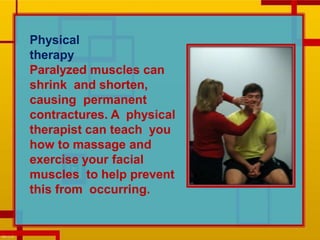
Physical
therapy
Paralyzed muscles can
shrink and shorten,
causing permanent
contractures. A physical
therapist can teach you
how to massage and
exercise your facial
muscles to help prevent
this from occurring.
Surgery
In the past, decompression surgery was
used to relieve the pressure on the
facial nerve by opening the bony
passage that the nerve passes through.
Today, decompression surgery isn't
recommended. Facial nerve injury and
permanent hearing loss are possible
risks associated with this surgery.
In rare cases, plastic surgery may be
needed to correct lasting facial nerve
problems.
Bellspalsy 130915141951-phpapp02-converted

Bellspalsy 130915141951-phpapp02-converted

  • 1.
  • 2.
    Bell's palsy causessudden weakness in your facial muscles. This makes half of your face appear to droop. Your smile is one-sided, and your eye on that side resists closing.
  • 3.
    The exact causeis unknown, but it's believed to be the result of swelling and inflammation of the nerve that controls the muscles on one side of your face. It may be a reaction that occurs after a viral infection.
  • 4.
    Bell's palsy istemporary. Symptoms usually start to improve within a few weeks, with complete recovery in about six months. sometimes it continue to have Bell's palsy symptoms for life. Rarely, Bell's palsy can recur.
  • 5.
  • 6.
    Although the exactreason Bell's palsy occurs isn't clear, it's often linked to exposure to a viral infection.
  • 7.
     Cold soresand genital herpes (herpes simplex)  Chickenpox and shingles (herpes zoster)  Mononucleosis (Epstein-Barr)  Cytomegalovirus infections  Respiratory illnesses (adenovirus)  German measles (rubella)  Mumps (mumps virus)  Flu (influenza B)  Hand-foot-and-mouth disease (coxsackievirus)
  • 8.
    With Bell's palsy,the nerve that controls your facial muscles, which passes through a narrow corridor of bone on its way to your face, becomes inflamed and swollen —usually related to a viral infection. Besides facial muscles, the nerve affects tears, saliva, taste and a small bone in the middle of your ear.
  • 9.
  • 11.
    Signs and symptomsof Bell's palsy come on suddenly, and may include: • Rapid onset of mild weakness to total paralysis on one side of your face —occurring within hours to days — making it difficult to smile or close your eye on the affected side • Facial droop and difficulty making facial expressions • Pain around the jaw or in or behind your ear on the affected side • Increased sensitivity to sound on the affected side • Headache • A decrease in your ability to taste • Changes in the amount of tears and saliva you
  • 12.
  • 13.
    In rare cases,Bell's palsy can affect the nerves on both sides of your face
  • 14.
    When to seea doctor. Seek immediate medical help if you experience any type of paralysis because you may be having a stroke. Bell's palsy is not caused by a stroke. See your doctor if you experience facial weakness or drooping, to determine the underlying cause and severity of the
  • 15.
    There's no specifictest for Bell's palsy. Your doctor will look at your face and ask you to move your facial muscles by closing your eyes, lifting your brow, showing your teeth and frowning, among other movements. Test and diagnosis.
  • 16.
    Other conditions —suchas a stroke, infections, Lyme disease and tumors —can also cause facial muscle weakness, mimicking Bell's palsy. If it's not clear why you're having the symptoms you are
  • 17.
    your doctor mayrecommend other tests, including: Electromyography (EMG). This test can confirm the presence of nerve damage and determine its severity. An EMG measures the electrical activity of a muscle in response to stimulation and the nature and speed of the conduction of electrical impulses along a nerve. Imaging scans. X-ray imaging, magnetic resonance imaging (MRI) or computerized tomography (CT) may be needed on occasion to rule out other possible sources of pressure on the facial nerve, such as a tumor or skull fracture.
  • 18.
    Although a mildcase of Bell's palsy normally disappears within a month, recovery from a case involving total paralysis varies. Complications may include: • Irreversible damage to your facial nerve • Misdirected regrowth of nerve fibers, resulting in involuntary contraction of certain muscles when you're trying to move others (synkinesis) —for example, when you smile, the eye on the affected side may close • Partial or complete blindness of the eye that won't close, due to excessive dryness and scratching of the cornea, the clear protective covering of the eye Complicatio ns
  • 19.
    Medications : Commonly usedmedications to treat Bell's palsy include: • Corticosteroids, such as prednisone, are powerful anti- inflammatory agents. If they can reduce the swelling of the facial nerve, it will fit more comfortably within the bony corridor that surrounds it. Corticosteroids may work best if they're started within several days of when your symptoms started.
  • 20.
    • Antiviral drugs,such as acyclovir (Zovirax) or valacyclovir (Valtrex), may stop the progression of the infection if a virus is known to have caused it. This treatment may be offered only if your facial paralysis is severe.
  • 21.
    Physical therapy Paralyzed muscles can shrinkand shorten, causing permanent contractures. A physical therapist can teach you how to massage and exercise your facial muscles to help prevent this from occurring.
  • 22.
    Surgery In the past,decompression surgery was used to relieve the pressure on the facial nerve by opening the bony passage that the nerve passes through. Today, decompression surgery isn't recommended. Facial nerve injury and permanent hearing loss are possible risks associated with this surgery. In rare cases, plastic surgery may be needed to correct lasting facial nerve problems.