1-Ola Khaled Ahmed Taha
2-Mai Bahi Eldeen Mohamed
3-Myada Ashraf Mahmoud
Hashem
4-Mai Saed Mostafa Heshhesh
5-Nagham Abd El Naby Saed
Mohamed
6-Mona Ahmed Hassan Daby
7-Moshera Ashraf Antar Farag
8-Nada Abd El_azez Mahmoud
Habib
9-Esraa Hussien Yousry
Ghoneim
10-Noha Mohamed Ahmed
Omara
Team work Supervisor
Prof. Dr/Hanaa Zakaria
Nooh
Dr/Lubna Taher
Dr/Engy Abd El_azeem
Contents
1-Anatomy of the gland
2-thyroid tumor
3-Epidemilogy
4-Causes
5-Risk factors
5-Types
7-Diagnosis
8-Treatment
Anatomy of thyroid gland
●Thyroid gland located in
the anterior neck
,between C5 and T1
vertebrae.
●It’s devided into 2 lobes
connected by an isthmus
“Butterfly shape” .
●.It’s inferior to thyroid
cartilage of larynx .
●It’s in visceral
compartment of the
neck, bound by
pretracheal fascia.
●Blood supply to the
thyroid gland is achieved by
two main arteries; Superior,
inferior thyroid& 10%
thyroida Ima artery.
●Venous drainage
is carried out by
the superior,
middle and
inferior thyroid
veins.
Microscopic picture of the thyroid gland
 Thyroid epithelial
cells - the cells
responsible for
synthesis of
thyroid hormones -
are arranged in
spheres
called thyroid
follicles.
 Follicles are filled
with colloid.
 Nestled in spaces
between thyroid
follicles
are parafollicular or
C cells, which
Definition
Thyroid cancer is a disease in which the cells of the
thyroid gland become abnormal, grow uncontrollably and
form a mass of cells called a tumor.
Epidemiology
 It has long been known that the
incidence of thyroid cancer in women is
significantly higher than that in men.
 although more common in women,
thyroid cancer typically presents at a
more advanced stage and with a worse
disease prognosis in men
Papillary and follicular cancers are rare in
children and adolescents, and their
incidence increases with age in adults.
The median age at diagnosis is 45 to 50
years.
3
1
Causes
The main is still
unknown.
Changes
in DNA“
 Clinical evidence on the impact of estrogen and other sex hormones
on thyroid cancer has remained inconclusive, although numerous
experimental studies have suggested that these hormones and their
receptors may play a role in tumor genesis and tumor progression.
radiation
exposure
older age
iodine
deficiency
Does not
arise from
preexisting
adenoma
•Risk factors:
Types
Thyroid
tumor
Benign
Follicular fibro adenoma
Malignant
A. Primary:
2-Papillary carcinoma
Malignant
1-Follicular carcinoma
6-Medullary carcinoma
5-Anaplastic carcinoma
4-Malignant lymphoma
B. Secondary
arise from local infiltration from
near by malignancy or blood born.
3-Papillary-follicular carcinoma
The genetic basis for these cancers
is not totally clear
Several inherited conditions
have been linked to different
types of thyroid cancer, 1st
degree family history. Ex:
Medullary thyroid cancer;
nonmedullary papillary
Ccarcinoma(seen at an earlier
age), owden and Carney
complex, type I syndromes with
benign and malignant liability
1-history
Lump in the neck
Difficulty swallowing or breathing
Hoarse voice
Swollen lymph node
Neck pain
Frequent cough that is not related to cold
2-Clinical picture
♦U/S :solitary nodule
shows the size of thyroid gland and specific information about any nodules
whether a nodule is solid or fluid-filled sac
♦Thyroid scan :
Cold nodule
♦blood tests :
eg; -Thyriod hormones (↑T3-T4↑ )
- TSH↓
♦biopsy:
only test that makes a definite diagnosis , and examined by a
cytopathologenic define whether a nodule is cancerous or benign .
♦Fine Needle Aspiration Biopsy Cytology :(FNABC)
important to find out if a thyroid nodules is benign or cancerous
2-investigation io
♦85% of patients with DTC :disease-free after
initial treatment
♦10–15% : recurrent disease
♦5%: distant metastases
♦Distant metastases :lungs (50%), bones (25%),
lungs and bones (20%) ,10-year-survival rates
ranging from 25% to 42%
♦Overall 20-year- survival 95%
3-Prognosis
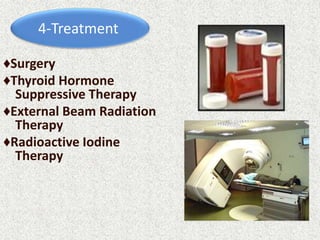
4-Treatment
♦Surgery
♦Thyroid Hormone
Suppressive Therapy
♦External Beam Radiation
Therapy
♦Radioactive Iodine
Therapy
Treatment Options by Stage
♦Papillary and follicular Thyroid Cancer includes
Treatment of stage I and II papillary and follicular thyroid cancer may
include the following:
1-Total or near-total thyroidectomy, with or without radioactive iodine therapy.
2-Lobectomy and removal of lymph nodes that contain cancer, followed by hormone
therapy.
3-Radioactive iodine therapy may be given following surgery.
Stage III Papillary and Follicular Thyroid Cancer
1-Treatment of stage III papillary and follicular thyroid cancer is usually total
thyroidectomy.
2-Cancer that has spread outside the thyroid, as well as any lymph nodes that have
cancer in them, will also be removed.
3-Radioactive iodine therapy or external radiation therapy may be given after
surgery.
Stage IV Papillary and Follicular Thyroid Cancer
spread only to the lymph nodes can often be cured. When cancer has spread to other
places in the body, such as the lungs and bone, treatment usually does not cure the
cancer, but can relieve symptoms and improve the quality of life.
For tumors that take up iodine
-Radioactive iodine therapy.
For tumors that do not take up iodine
1-Hormone therapy.
2-Targeted therapy with a tyrosine kinase inhibitor.
3-Surgery to remove cancer from areas where it has spread.
4-External-beam radiation therapy.
♦Medullary Thyroid Cancer includes :
1-Total thyroidectomy if the cancer has not spread to other parts of the body.
2-Removal of lymph nodes that contain cancer.
3-External radiation therapy as palliative therapy to relieve symptoms and improve the
quality of life for patients whose cancer has recurred in the thyroid.
4-Targeted therapy with a tyrosine kinase inhibitor for cancer that has spread to other
parts of the body.
5-Chemotherapy as palliative therapy to relieve symptoms and improve the quality of
life for patients whose cancer has spread to other parts of the body.
♦Anaplastic Thyroid Cancer
1-Tracheostomy as palliative therapy to relieve symptoms and improve the quality of
life.
2-Total thyroidectomy as palliative therapy to relieve symptoms and improve the
quality of life for patients whose cancer has not spread away from the thyroid.
3-External radiation therapy.
4-Chemotherapy.
5-complications of
thyroidectomy
Hemorrhage
Respiratory obstruction
Paralysis of vocal cords
Removal of parathyroid
Take home
messages• DTC should be treated by a
multidisciplinary team including thyroid
surgeon, nuclear medicine specialist,
endocrinologist, medical oncologist and
radiation oncologist.
• DTC is a curable disease with long high
survival rates
• RAI131 therapy is a cheap, available and
highly effective treatment.
• Surgery is the main station in treatment
of DTC.
The End
Thyroid tumor

Thyroid tumor

  • 2.
    1-Ola Khaled AhmedTaha 2-Mai Bahi Eldeen Mohamed 3-Myada Ashraf Mahmoud Hashem 4-Mai Saed Mostafa Heshhesh 5-Nagham Abd El Naby Saed Mohamed 6-Mona Ahmed Hassan Daby 7-Moshera Ashraf Antar Farag 8-Nada Abd El_azez Mahmoud Habib 9-Esraa Hussien Yousry Ghoneim 10-Noha Mohamed Ahmed Omara Team work Supervisor Prof. Dr/Hanaa Zakaria Nooh Dr/Lubna Taher Dr/Engy Abd El_azeem
  • 3.
    Contents 1-Anatomy of thegland 2-thyroid tumor 3-Epidemilogy 4-Causes 5-Risk factors 5-Types 7-Diagnosis 8-Treatment
  • 4.
    Anatomy of thyroidgland ●Thyroid gland located in the anterior neck ,between C5 and T1 vertebrae. ●It’s devided into 2 lobes connected by an isthmus “Butterfly shape” . ●.It’s inferior to thyroid cartilage of larynx . ●It’s in visceral compartment of the neck, bound by pretracheal fascia.
  • 5.
    ●Blood supply tothe thyroid gland is achieved by two main arteries; Superior, inferior thyroid& 10% thyroida Ima artery. ●Venous drainage is carried out by the superior, middle and inferior thyroid veins.
  • 6.
    Microscopic picture ofthe thyroid gland  Thyroid epithelial cells - the cells responsible for synthesis of thyroid hormones - are arranged in spheres called thyroid follicles.  Follicles are filled with colloid.  Nestled in spaces between thyroid follicles are parafollicular or C cells, which
  • 8.
    Definition Thyroid cancer isa disease in which the cells of the thyroid gland become abnormal, grow uncontrollably and form a mass of cells called a tumor.
  • 9.
    Epidemiology  It haslong been known that the incidence of thyroid cancer in women is significantly higher than that in men.  although more common in women, thyroid cancer typically presents at a more advanced stage and with a worse disease prognosis in men Papillary and follicular cancers are rare in children and adolescents, and their incidence increases with age in adults. The median age at diagnosis is 45 to 50 years. 3 1
  • 10.
    Causes The main isstill unknown. Changes in DNA“  Clinical evidence on the impact of estrogen and other sex hormones on thyroid cancer has remained inconclusive, although numerous experimental studies have suggested that these hormones and their receptors may play a role in tumor genesis and tumor progression.
  • 11.
    radiation exposure older age iodine deficiency Does not arisefrom preexisting adenoma •Risk factors:
  • 12.
  • 13.
  • 14.
    A. Primary: 2-Papillary carcinoma Malignant 1-Follicularcarcinoma 6-Medullary carcinoma 5-Anaplastic carcinoma 4-Malignant lymphoma B. Secondary arise from local infiltration from near by malignancy or blood born. 3-Papillary-follicular carcinoma
  • 16.
    The genetic basisfor these cancers is not totally clear Several inherited conditions have been linked to different types of thyroid cancer, 1st degree family history. Ex: Medullary thyroid cancer; nonmedullary papillary Ccarcinoma(seen at an earlier age), owden and Carney complex, type I syndromes with benign and malignant liability 1-history
  • 17.
    Lump in theneck Difficulty swallowing or breathing Hoarse voice Swollen lymph node Neck pain Frequent cough that is not related to cold 2-Clinical picture
  • 18.
    ♦U/S :solitary nodule showsthe size of thyroid gland and specific information about any nodules whether a nodule is solid or fluid-filled sac ♦Thyroid scan : Cold nodule ♦blood tests : eg; -Thyriod hormones (↑T3-T4↑ ) - TSH↓ ♦biopsy: only test that makes a definite diagnosis , and examined by a cytopathologenic define whether a nodule is cancerous or benign . ♦Fine Needle Aspiration Biopsy Cytology :(FNABC) important to find out if a thyroid nodules is benign or cancerous 2-investigation io
  • 19.
    ♦85% of patientswith DTC :disease-free after initial treatment ♦10–15% : recurrent disease ♦5%: distant metastases ♦Distant metastases :lungs (50%), bones (25%), lungs and bones (20%) ,10-year-survival rates ranging from 25% to 42% ♦Overall 20-year- survival 95% 3-Prognosis
  • 20.
    4-Treatment ♦Surgery ♦Thyroid Hormone Suppressive Therapy ♦ExternalBeam Radiation Therapy ♦Radioactive Iodine Therapy
  • 21.
    Treatment Options byStage ♦Papillary and follicular Thyroid Cancer includes Treatment of stage I and II papillary and follicular thyroid cancer may include the following: 1-Total or near-total thyroidectomy, with or without radioactive iodine therapy. 2-Lobectomy and removal of lymph nodes that contain cancer, followed by hormone therapy. 3-Radioactive iodine therapy may be given following surgery. Stage III Papillary and Follicular Thyroid Cancer 1-Treatment of stage III papillary and follicular thyroid cancer is usually total thyroidectomy. 2-Cancer that has spread outside the thyroid, as well as any lymph nodes that have cancer in them, will also be removed. 3-Radioactive iodine therapy or external radiation therapy may be given after surgery.
  • 22.
    Stage IV Papillaryand Follicular Thyroid Cancer spread only to the lymph nodes can often be cured. When cancer has spread to other places in the body, such as the lungs and bone, treatment usually does not cure the cancer, but can relieve symptoms and improve the quality of life. For tumors that take up iodine -Radioactive iodine therapy. For tumors that do not take up iodine 1-Hormone therapy. 2-Targeted therapy with a tyrosine kinase inhibitor. 3-Surgery to remove cancer from areas where it has spread. 4-External-beam radiation therapy. ♦Medullary Thyroid Cancer includes : 1-Total thyroidectomy if the cancer has not spread to other parts of the body. 2-Removal of lymph nodes that contain cancer. 3-External radiation therapy as palliative therapy to relieve symptoms and improve the quality of life for patients whose cancer has recurred in the thyroid. 4-Targeted therapy with a tyrosine kinase inhibitor for cancer that has spread to other parts of the body. 5-Chemotherapy as palliative therapy to relieve symptoms and improve the quality of life for patients whose cancer has spread to other parts of the body.
  • 23.
    ♦Anaplastic Thyroid Cancer 1-Tracheostomyas palliative therapy to relieve symptoms and improve the quality of life. 2-Total thyroidectomy as palliative therapy to relieve symptoms and improve the quality of life for patients whose cancer has not spread away from the thyroid. 3-External radiation therapy. 4-Chemotherapy.
  • 25.
  • 26.
    Take home messages• DTCshould be treated by a multidisciplinary team including thyroid surgeon, nuclear medicine specialist, endocrinologist, medical oncologist and radiation oncologist. • DTC is a curable disease with long high survival rates • RAI131 therapy is a cheap, available and highly effective treatment. • Surgery is the main station in treatment of DTC.
  • 27.