


Fabric Innovation


                      By
             Nikitha Jain
Fur
Chamba Rumal
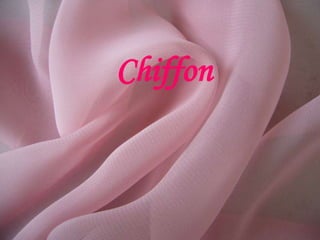
Chiffon
Organza
Pashmina
Fur
Fake fur is a type of textile fabric fashioned to simulate genuine animal fur. It is
     known as a pile fabric and is typically made from polymeric fibers that are
 processed, dyed, and cut to match a specific fur texture and color. First introduced
   in 1929, advances in polymer technology have tremendously improved fake fur
quality. Today's fake furs can be nearly indistinguishable from the natural furs they
                                      intimate.
Fur is one of the oldest known forms of clothing, and has
 been worn by men and women for a variety of reasons
 throughout history. These early attempts at imitation fur
 were made using hair from the alpaca, a South American
 mammal.
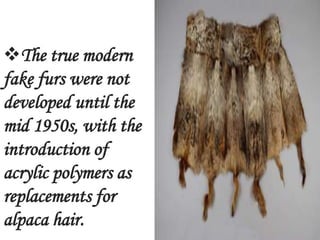
The true modern
fake furs were not
developed until the
mid 1950s, with the
introduction of
acrylic polymers as
replacements for
alpaca hair.
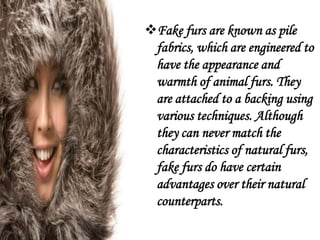
Fake furs are known as pile
 fabrics, which are engineered to
 have the appearance and
 warmth of animal furs. They
 are attached to a backing using
 various techniques. Although
 they can never match the
 characteristics of natural furs,
 fake furs do have certain
 advantages over their natural
 counterparts.
They are also highly resistant to
 heat, sunlight, soot, and smoke,
 are strong and resilient, and
 show good stability during
 laundering. Since they are
 thermoplastic polymers, they can
 be heat set. They resist mildew
 and are not susceptible to attack
 from insects. These polymers also
 have very low moisture
 absorbency and will dry quickly.
Naturally occurring fabrics are
 also used to make fake furs and
 improve the look and feel of the
 overall garment. These include
 materials such as silk, wool, and
 mohair. Cotton or wool, along
 with polypropylene, are typically
 used to make the backings to
 which the fibers are attached.
 Rayon, a semi synthetic fiber made
 from cellulose and cotton linters, is
 used to supplement acrylic and
 modacrylic fibers on the garment,
 as are polyester and nylon.
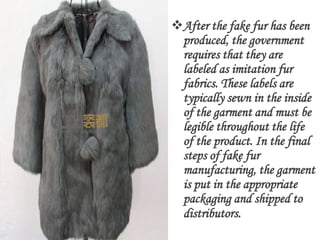
After the fake fur has been
 produced, the government
 requires that they are
 labeled as imitation fur
 fabrics. These labels are
 typically sewn in the inside
 of the garment and must be
 legible throughout the life
 of the product. In the final
 steps of fake fur
 manufacturing, the garment
 is put in the appropriate
 packaging and shipped to
 distributors.
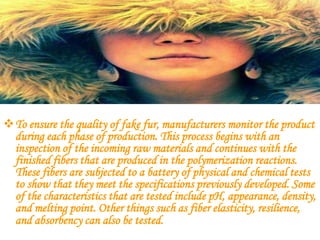
To ensure the quality of fake fur, manufacturers monitor the product
 during each phase of production. This process begins with an
 inspection of the incoming raw materials and continues with the
 finished fibers that are produced in the polymerization reactions.
 These fibers are subjected to a battery of physical and chemical tests
 to show that they meet the specifications previously developed. Some
 of the characteristics that are tested include pH, appearance, density,
 and melting point. Other things such as fiber elasticity, resilience,
 and absorbency can also be tested.
The technology of producing fake furs has
 improved greatly since the early twentieth
 century. Future research will focus on
 developing new fibers and finishes. These
 polymeric fibers will have improved feel, look,
 and a lower cost.
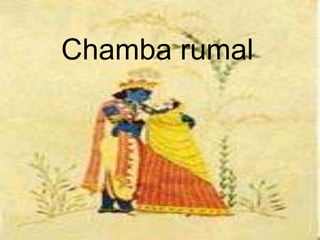
Chamba rumal
• Chamba rumal
The Himachal
 Pradesh government
 has started a
 training centre in
 this historic town on
 the banks of the
 Ravi river. In a bid
 to revive and
 preserve the famed
 Chamba Rumal and
 to revive its fading
 style of embroidery.
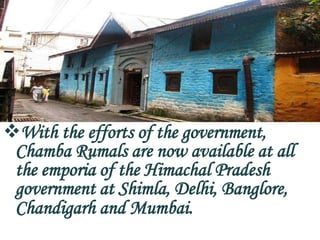
With the efforts of the government,
 Chamba Rumals are now available at all
 the emporia of the Himachal Pradesh
 government at Shimla, Delhi, Banglore,
 Chandigarh and Mumbai.
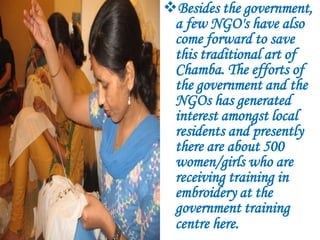
Besides the government,
 a few NGO's have also
 come forward to save
 this traditional art of
 Chamba. The efforts of
 the government and the
 NGOs has generated
 interest amongst local
 residents and presently
 there are about 500
 women/girls who are
 receiving training in
 embroidery at the
 government training
 centre here.
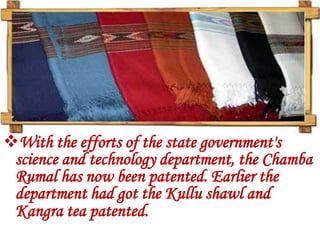
With the efforts of the state government's
 science and technology department, the Chamba
 Rumal has now been patented. Earlier the
 department had got the Kullu shawl and
 Kangra tea patented.
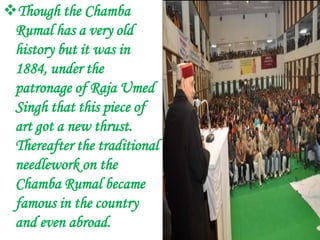
Though the Chamba
 Rumal has a very old
 history but it was in
 1884, under the
 patronage of Raja Umed
 Singh that this piece of
 art got a new thrust.
 Thereafter the traditional
 needlework on the
 Chamba Rumal became
 famous in the country
 and even abroad.
Some of the best
 Chamba Rumals can still
 be seen at the Victoria
 and Albert Museums in
 London. One such
 'Rumal' at one of the
 two museums is in the
 form of a wall hanging
 which depicts scenes
 from the Mahabharata.
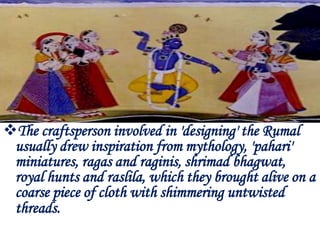
The craftsperson involved in 'designing' the Rumal
 usually drew inspiration from mythology, 'pahari'
 miniatures, ragas and raginis, shrimad bhagwat,
 royal hunts and raslila, which they brought alive on a
 coarse piece of cloth with shimmering untwisted
 threads.
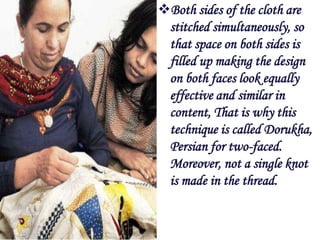
Both sides of the cloth are
 stitched simultaneously, so
 that space on both sides is
 filled up making the design
 on both faces look equally
 effective and similar in
 content, That is why this
 technique is called Dorukha,
 Persian for two-faced.
 Moreover, not a single knot
 is made in the thread.
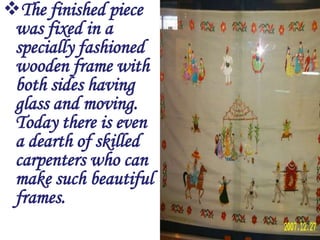
The finished piece
 was fixed in a
 specially fashioned
 wooden frame with
 both sides having
 glass and moving.
 Today there is even
 a dearth of skilled
 carpenters who can
 make such beautiful
 frames.
In the year 1974, a master
 craftsman award was given
 to Maheshi Devi known as
 Adhyapika Jee by the then
 President of India and in
 1993, Mrs. Lalita Vakil
 also received the award for
 the Chamba Rumal.
 Thereafter Chhimbi Devi
 and Kamla Nayar also
 received the state awards
 and recommendations of
 the Government of India
 for the rumal.
• pics
Chiffon
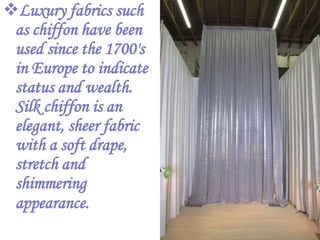
Luxury fabrics such
 as chiffon have been
 used since the 1700's
 in Europe to indicate
 status and wealth.
 Silk chiffon is an
 elegant, sheer fabric
 with a soft drape,
 stretch and
 shimmering
 appearance.
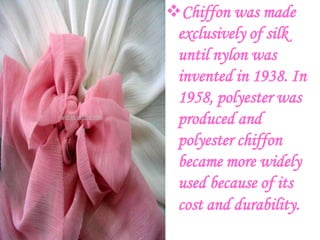
Chiffon was made
 exclusively of silk
 until nylon was
 invented in 1938. In
 1958, polyester was
 produced and
 polyester chiffon
 became more widely
 used because of its
 cost and durability.
The word chiffon comes from
 the French word "chiffe,"
 meaning "rag," and the fabric
 has a soft flowing texture.
 The S- or Z-twist of the
 threads is what gives the
 fabric its "stretch." Silk
 chiffon was once worn only
 by the wealthy as a sign of
 status. Now it is used in
 wedding dresses and evening
 gowns and for window
 treatments or on lampshades.
Because polyester chiffon
 costs less and is easier to care
 for, it is now more frequently
 used than silk in both bridal
 gowns and prom dresses. In
 cases where cost and practical
 concerns are not an issue, silk
 is still the fabric designers
 most often choose. While
 polyester is more durable than
 silk, it is harder to dye.
 Unlike silk, you may wash
 polyester chiffon, although
 hand washing is the
 preferable method.
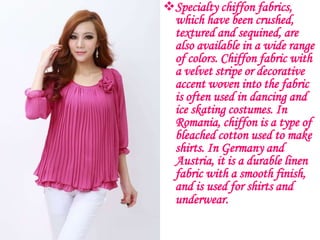
Specialty chiffon fabrics,
 which have been crushed,
 textured and sequined, are
 also available in a wide range
 of colors. Chiffon fabric with
 a velvet stripe or decorative
 accent woven into the fabric
 is often used in dancing and
 ice skating costumes. In
 Romania, chiffon is a type of
 bleached cotton used to make
 shirts. In Germany and
 Austria, it is a durable linen
 fabric with a smooth finish,
 and is used for shirts and
 underwear.
Traditionally, silk chiffon
 has been used around the
 world. In 1986 the Textile
 Museum in Washington,
 D.C., displayed traditional,
 embroidered chiffon caftans
 from Saudi Arabia worn by
 townswomen in the privacy
 of their homes,
 demonstrating the
 worldwide appeal of the
 fabric.
• pics
Organza
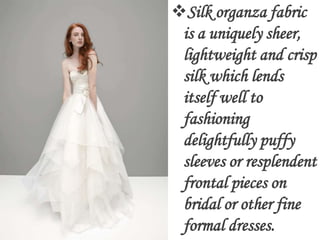
Silk organza fabric
 is a uniquely sheer,
 lightweight and crisp
 silk which lends
 itself well to
 fashioning
 delightfully puffy
 sleeves or resplendent
 frontal pieces on
 bridal or other fine
 formal dresses.
Silk organza
 fabric is also
 exceptional when
 used as a stylish
 foil to the fabrics
 of other garments,
 whether worn
 under or over
 them.
The material is
 woven from lustrous
 silk yarn which has
 been given a
 somewhat more
 pronounced twist in
 its manufacture,
 thereby producing a
 silken fabric.
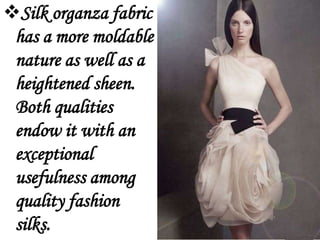
Silk organza fabric
 has a more moldable
 nature as well as a
 heightened sheen.
 Both qualities
 endow it with an
 exceptional
 usefulness among
 quality fashion
 silks.
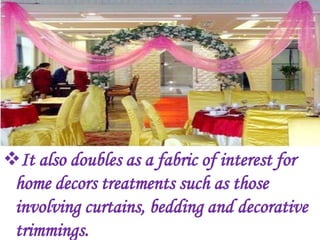
It also doubles as a fabric of interest for
 home decors treatments such as those
 involving curtains, bedding and decorative
 trimmings.
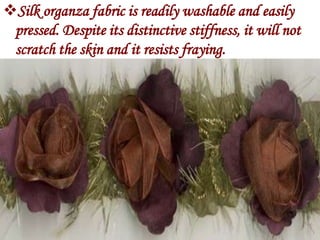
Silk organza fabric is readily washable and easily
 pressed. Despite its distinctive stiffness, it will not
 scratch the skin and it resists fraying.
• pics
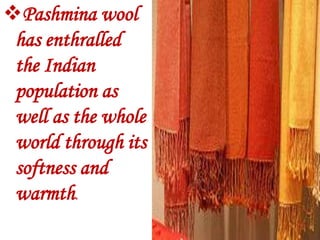
Pashmina wool
 has enthralled
 the Indian
 population as
 well as the whole
 world through its
 softness and
 warmth.
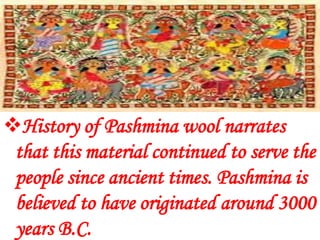
History of Pashmina wool narrates
 that this material continued to serve the
 people since ancient times. Pashmina is
 believed to have originated around 3000
 years B.C.
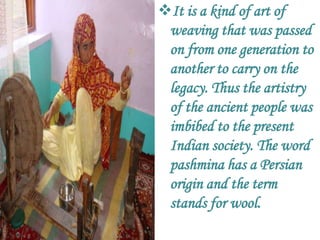
It is a kind of art of
 weaving that was passed
 on from one generation to
 another to carry on the
 legacy. Thus the artistry
 of the ancient people was
 imbibed to the present
 Indian society. The word
 pashmina has a Persian
 origin and the term
 stands for wool.
Today the term
 "pashmina" can mean
 many different things in
 the Western world.
 Often "pashmina" simply
 describes the style of a
 soft wool shawl. Almost
 all pashminas found
 today are made with
 wool blends, cashmere
 and silk being the most
 popular.
• According to the History of Pashmina wool, the
  origination of the wool can be traced to Nepal many
  years back. The people of Nepal started weaving the
  fabrics for their warmth and especially for survival.
  Thus the threads of Pashmina began to comfort the
  people living in the temperate regions of India.
According to
 historical records,
 soft, intricately
 made cloth was
 used for the kings,
 emperors, and the
 aristocracy in
 ancient India.
Kashmir was the only place in
 India for over a period where the
 fiber could be woven into shawls.
 In addition to that Pashmina
 was supplied from Tibet to India.
 During the medieval period of
 India, production of Pashmina
 also reached a height from the
 benefaction of the Mughal rulers
 like Akbar and his successors,
 and also because of the patronage
 of the local government.
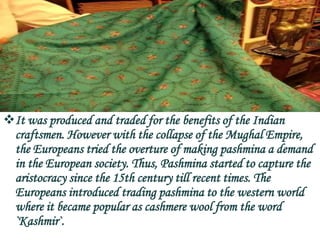
It was produced and traded for the benefits of the Indian
 craftsmen. However with the collapse of the Mughal Empire,
 the Europeans tried the overture of making pashmina a demand
 in the European society. Thus, Pashmina started to capture the
 aristocracy since the 15th century till recent times. The
 Europeans introduced trading pashmina to the western world
 where it became popular as cashmere wool from the word
 `Kashmir`.
In the modern times
 Pashmina wool has
 gained popularity all over
 the world. The material is
 exported as a finished
 product as the western
 market has created a
 great demand for this
 exquisite fabric. The
 textile became popular in
 the West in the late
 1990s.
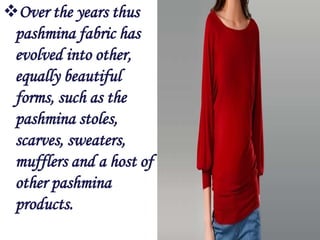
Over the years thus
 pashmina fabric has
 evolved into other,
 equally beautiful
 forms, such as the
 pashmina stoles,
 scarves, sweaters,
 mufflers and a host of
 other pashmina
 products.
 At present Pashmina is
 available in quite a
 reasonable price, the
 garments made from it is
 presented with
 wonderful motifs and
 designs. Most of the
 dresses from Pashmina
 wool are woven on spun
 silk, giving it more
 suppleness and
 durability.
• pics
• Thank u

Fabric innovation

  • 1.
    Fabric Innovation By Nikitha Jain
  • 2.
  • 3.
  • 4.
    Fake fur isa type of textile fabric fashioned to simulate genuine animal fur. It is known as a pile fabric and is typically made from polymeric fibers that are processed, dyed, and cut to match a specific fur texture and color. First introduced in 1929, advances in polymer technology have tremendously improved fake fur quality. Today's fake furs can be nearly indistinguishable from the natural furs they intimate.
  • 5.
    Fur is oneof the oldest known forms of clothing, and has been worn by men and women for a variety of reasons throughout history. These early attempts at imitation fur were made using hair from the alpaca, a South American mammal.
  • 6.
    The true modern fakefurs were not developed until the mid 1950s, with the introduction of acrylic polymers as replacements for alpaca hair.
  • 7.
    Fake furs areknown as pile fabrics, which are engineered to have the appearance and warmth of animal furs. They are attached to a backing using various techniques. Although they can never match the characteristics of natural furs, fake furs do have certain advantages over their natural counterparts.
  • 8.
    They are alsohighly resistant to heat, sunlight, soot, and smoke, are strong and resilient, and show good stability during laundering. Since they are thermoplastic polymers, they can be heat set. They resist mildew and are not susceptible to attack from insects. These polymers also have very low moisture absorbency and will dry quickly.
  • 9.
    Naturally occurring fabricsare also used to make fake furs and improve the look and feel of the overall garment. These include materials such as silk, wool, and mohair. Cotton or wool, along with polypropylene, are typically used to make the backings to which the fibers are attached. Rayon, a semi synthetic fiber made from cellulose and cotton linters, is used to supplement acrylic and modacrylic fibers on the garment, as are polyester and nylon.
  • 10.
    After the fakefur has been produced, the government requires that they are labeled as imitation fur fabrics. These labels are typically sewn in the inside of the garment and must be legible throughout the life of the product. In the final steps of fake fur manufacturing, the garment is put in the appropriate packaging and shipped to distributors.
  • 11.
    To ensure thequality of fake fur, manufacturers monitor the product during each phase of production. This process begins with an inspection of the incoming raw materials and continues with the finished fibers that are produced in the polymerization reactions. These fibers are subjected to a battery of physical and chemical tests to show that they meet the specifications previously developed. Some of the characteristics that are tested include pH, appearance, density, and melting point. Other things such as fiber elasticity, resilience, and absorbency can also be tested.
  • 12.
    The technology ofproducing fake furs has improved greatly since the early twentieth century. Future research will focus on developing new fibers and finishes. These polymeric fibers will have improved feel, look, and a lower cost.
  • 14.
  • 15.
    The Himachal Pradeshgovernment has started a training centre in this historic town on the banks of the Ravi river. In a bid to revive and preserve the famed Chamba Rumal and to revive its fading style of embroidery.
  • 16.
    With the effortsof the government, Chamba Rumals are now available at all the emporia of the Himachal Pradesh government at Shimla, Delhi, Banglore, Chandigarh and Mumbai.
  • 17.
    Besides the government, a few NGO's have also come forward to save this traditional art of Chamba. The efforts of the government and the NGOs has generated interest amongst local residents and presently there are about 500 women/girls who are receiving training in embroidery at the government training centre here.
  • 18.
    With the effortsof the state government's science and technology department, the Chamba Rumal has now been patented. Earlier the department had got the Kullu shawl and Kangra tea patented.
  • 19.
    Though the Chamba Rumal has a very old history but it was in 1884, under the patronage of Raja Umed Singh that this piece of art got a new thrust. Thereafter the traditional needlework on the Chamba Rumal became famous in the country and even abroad.
  • 20.
    Some of thebest Chamba Rumals can still be seen at the Victoria and Albert Museums in London. One such 'Rumal' at one of the two museums is in the form of a wall hanging which depicts scenes from the Mahabharata.
  • 21.
    The craftsperson involvedin 'designing' the Rumal usually drew inspiration from mythology, 'pahari' miniatures, ragas and raginis, shrimad bhagwat, royal hunts and raslila, which they brought alive on a coarse piece of cloth with shimmering untwisted threads.
  • 22.
    Both sides ofthe cloth are stitched simultaneously, so that space on both sides is filled up making the design on both faces look equally effective and similar in content, That is why this technique is called Dorukha, Persian for two-faced. Moreover, not a single knot is made in the thread.
  • 23.
    The finished piece was fixed in a specially fashioned wooden frame with both sides having glass and moving. Today there is even a dearth of skilled carpenters who can make such beautiful frames.
  • 24.
    In the year1974, a master craftsman award was given to Maheshi Devi known as Adhyapika Jee by the then President of India and in 1993, Mrs. Lalita Vakil also received the award for the Chamba Rumal. Thereafter Chhimbi Devi and Kamla Nayar also received the state awards and recommendations of the Government of India for the rumal.
  • 25.
  • 26.
  • 27.
    Luxury fabrics such as chiffon have been used since the 1700's in Europe to indicate status and wealth. Silk chiffon is an elegant, sheer fabric with a soft drape, stretch and shimmering appearance.
  • 28.
    Chiffon was made exclusively of silk until nylon was invented in 1938. In 1958, polyester was produced and polyester chiffon became more widely used because of its cost and durability.
  • 29.
    The word chiffoncomes from the French word "chiffe," meaning "rag," and the fabric has a soft flowing texture. The S- or Z-twist of the threads is what gives the fabric its "stretch." Silk chiffon was once worn only by the wealthy as a sign of status. Now it is used in wedding dresses and evening gowns and for window treatments or on lampshades.
  • 30.
    Because polyester chiffon costs less and is easier to care for, it is now more frequently used than silk in both bridal gowns and prom dresses. In cases where cost and practical concerns are not an issue, silk is still the fabric designers most often choose. While polyester is more durable than silk, it is harder to dye. Unlike silk, you may wash polyester chiffon, although hand washing is the preferable method.
  • 31.
    Specialty chiffon fabrics, which have been crushed, textured and sequined, are also available in a wide range of colors. Chiffon fabric with a velvet stripe or decorative accent woven into the fabric is often used in dancing and ice skating costumes. In Romania, chiffon is a type of bleached cotton used to make shirts. In Germany and Austria, it is a durable linen fabric with a smooth finish, and is used for shirts and underwear.
  • 32.
    Traditionally, silk chiffon has been used around the world. In 1986 the Textile Museum in Washington, D.C., displayed traditional, embroidered chiffon caftans from Saudi Arabia worn by townswomen in the privacy of their homes, demonstrating the worldwide appeal of the fabric.
  • 33.
  • 34.
  • 35.
    Silk organza fabric is a uniquely sheer, lightweight and crisp silk which lends itself well to fashioning delightfully puffy sleeves or resplendent frontal pieces on bridal or other fine formal dresses.
  • 36.
    Silk organza fabricis also exceptional when used as a stylish foil to the fabrics of other garments, whether worn under or over them.
  • 37.
    The material is woven from lustrous silk yarn which has been given a somewhat more pronounced twist in its manufacture, thereby producing a silken fabric.
  • 38.
    Silk organza fabric has a more moldable nature as well as a heightened sheen. Both qualities endow it with an exceptional usefulness among quality fashion silks.
  • 39.
    It also doublesas a fabric of interest for home decors treatments such as those involving curtains, bedding and decorative trimmings.
  • 40.
    Silk organza fabricis readily washable and easily pressed. Despite its distinctive stiffness, it will not scratch the skin and it resists fraying.
  • 41.
  • 43.
    Pashmina wool hasenthralled the Indian population as well as the whole world through its softness and warmth.
  • 44.
    History of Pashminawool narrates that this material continued to serve the people since ancient times. Pashmina is believed to have originated around 3000 years B.C.
  • 45.
    It is akind of art of weaving that was passed on from one generation to another to carry on the legacy. Thus the artistry of the ancient people was imbibed to the present Indian society. The word pashmina has a Persian origin and the term stands for wool.
  • 46.
    Today the term "pashmina" can mean many different things in the Western world. Often "pashmina" simply describes the style of a soft wool shawl. Almost all pashminas found today are made with wool blends, cashmere and silk being the most popular.
  • 47.
    • According tothe History of Pashmina wool, the origination of the wool can be traced to Nepal many years back. The people of Nepal started weaving the fabrics for their warmth and especially for survival. Thus the threads of Pashmina began to comfort the people living in the temperate regions of India.
  • 48.
    According to historicalrecords, soft, intricately made cloth was used for the kings, emperors, and the aristocracy in ancient India.
  • 49.
    Kashmir was theonly place in India for over a period where the fiber could be woven into shawls. In addition to that Pashmina was supplied from Tibet to India. During the medieval period of India, production of Pashmina also reached a height from the benefaction of the Mughal rulers like Akbar and his successors, and also because of the patronage of the local government.
  • 50.
    It was producedand traded for the benefits of the Indian craftsmen. However with the collapse of the Mughal Empire, the Europeans tried the overture of making pashmina a demand in the European society. Thus, Pashmina started to capture the aristocracy since the 15th century till recent times. The Europeans introduced trading pashmina to the western world where it became popular as cashmere wool from the word `Kashmir`.
  • 51.
    In the moderntimes Pashmina wool has gained popularity all over the world. The material is exported as a finished product as the western market has created a great demand for this exquisite fabric. The textile became popular in the West in the late 1990s.
  • 52.
    Over the yearsthus pashmina fabric has evolved into other, equally beautiful forms, such as the pashmina stoles, scarves, sweaters, mufflers and a host of other pashmina products.
  • 53.
     At presentPashmina is available in quite a reasonable price, the garments made from it is presented with wonderful motifs and designs. Most of the dresses from Pashmina wool are woven on spun silk, giving it more suppleness and durability.
  • 54.
  • 55.