FABRIC TERMINOLOGY
WARP
the direction along the
length of fabric
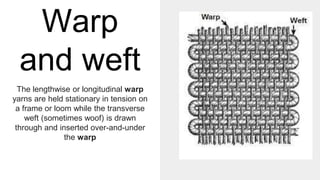
Warp
and weft
The lengthwise or longitudinal warp
yarns are held stationary in tension on
a frame or loom while the transverse
weft (sometimes woof) is drawn
through and inserted over-and-under
the warp
WEAVE
Weaving is a method of
textile production in which
two distinct sets of yarns or
threads are interlaced at
right angles to form afabric
or cloth
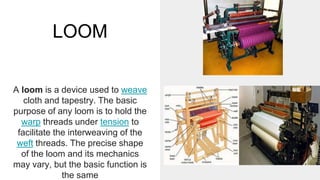
LOOM
A loom is a device used to weave
cloth and tapestry. The basic
purpose of any loom is to hold the
warp threads under tension to
facilitate the interweaving of the
weft threads. The precise shape
of the loom and its mechanics
may vary, but the basic function is
the same
HEDDLE
A heddle is an integral part
of a loom. Each thread in
the warp passes through a
heddle,[1] which is used to
separate the warp threads
for the passage of the weft.
COUNT
Thread count. Thread count or
threads per inch (TPI) is a measure of
the coarseness or fineness of fabric.
It is measured by counting the
number of threads contained in one
square inch of fabric or one square
centimeter, including both the length
(warp) and width (weft) threads.
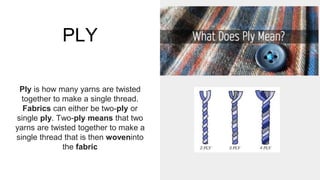
PLY
Ply is how many yarns are twisted
together to make a single thread.
Fabrics can either be two-ply or
single ply. Two-ply means that two
yarns are twisted together to make a
single thread that is then woveninto
the fabric
BIAS
The bias of a piece of woven fabric is
at 45 degrees to its warp and weft
threads. ... When cut on the bias,
woven fabric is more elastic as well
as more fluid in movement, compared
to the on-grain direction.
PINKED EDGE
Pinking shears are designed to cut
cloth or paper with a zigzag edge, to
lessen fraying. ... Woven fabric cloth
usually frays at the edges, unless
techniques are used to counter it,
such as the use of pinking shears or
hemming.
HEMMING
A hem in sewing is a
garment finishing method,
where the edge of a piece of
cloth is folded narrowly and
sewn to prevent unravelling
of the fabric.
SELVAGE EDGE
A selvage is the tightly
woven edge of a fabric. It
prevents the side edges of
the fabric from raveling or
fraying.
RAVELING
If something such as a rope
or wire ravels, or if you
ravel it, it becomes tangled
or twisted together.
GREIGE
Greige is an unfinished woven or
knitted fabric that hasn't been
bleached or dyed. It can be used for
upholstery, window treatments,
clothes and more.
Condition of polyester fabric upon
completion of the production process
before being heat shrunk
TEXTILES
A textile is a flexible material consisting of a network of natural or
artificial fibers. Yarn is produced by spinning raw fibres of wool,
flax, cotton, hemp, or other materials to produce long strands.
Textiles are formed by weaving, knitting, crocheting, knotting,
felting, or braiding
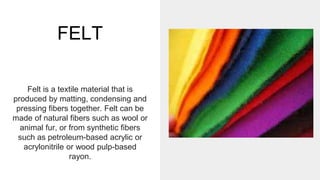
FELT
Felt is a textile material that is
produced by matting, condensing and
pressing fibers together. Felt can be
made of natural fibers such as wool or
animal fur, or from synthetic fibers
such as petroleum-based acrylic or
acrylonitrile or wood pulp-based
rayon.
TERRYCLOTH
Terrycloth, terry cloth, terry
cotton, terry towelling, terry,
terry towel or simply
towelling is a fabric with
loops that can absorb large
amounts of water. It can be
manufactured by weaving or
knitting.
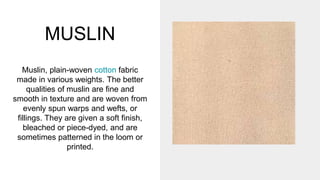
MUSLIN
Muslin, plain-woven cotton fabric
made in various weights. The better
qualities of muslin are fine and
smooth in texture and are woven from
evenly spun warps and wefts, or
fillings. They are given a soft finish,
bleached or piece-dyed, and are
sometimes patterned in the loom or
printed.
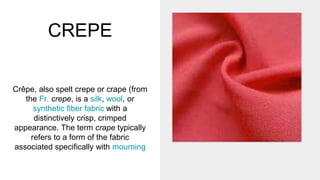
CREPE
Crêpe, also spelt crepe or crape (from
the Fr. crepe, is a silk, wool, or
synthetic fiber fabric with a
distinctively crisp, crimped
appearance. The term crape typically
refers to a form of the fabric
associated specifically with mourning
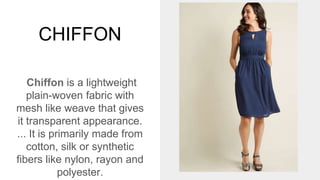
CHIFFON
Chiffon is a lightweight
plain-woven fabric with
mesh like weave that gives
it transparent appearance.
... It is primarily made from
cotton, silk or synthetic
fibers like nylon, rayon and
polyester.
GEORGETTE
It is a light-weight, crinkled and sheer
fabric, displaying an overall bouncy
look. A strong absorbent, Georgette is
easy to dye and has dull-rough
texture. Georgette is woven in highly
twisted yarns of S & Z, in both warp
and weft. Is woven in two forms: Pure
and Faux. Pure Georgette is woven
out of Silk yarns, while the Faux
Georgette is woven from Rayon and
Polyester.
VELVET
Velvet is woven on a special loom
that weaves two thicknesses of the
material at the same time. The two
pieces are then cut apart to create the
pile effect, and the two lengths of
fabric are wound on separate take-up
rolls.
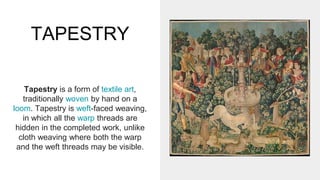
TAPESTRY
Tapestry is a form of textile art,
traditionally woven by hand on a
loom. Tapestry is weft-faced weaving,
in which all the warp threads are
hidden in the completed work, unlike
cloth weaving where both the warp
and the weft threads may be visible.
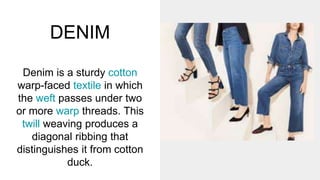
DENIM
Denim is a sturdy cotton
warp-faced textile in which
the weft passes under two
or more warp threads. This
twill weaving produces a
diagonal ribbing that
distinguishes it from cotton
duck.
FLANNEL
Flannel is a soft woven
fabric, of various fineness.
Flannel was originally made
from carded wool or worsted
yarn, but is now often made
from either wool, cotton, or
synthetic fiber.
RAYON
Rayon is a manufactured
fiber made from
regenerated cellulose fiber.
The many types and grades
of rayon can imitate the feel
and texture of natural fibers
such as silk, wool, cotton,
and linen.
POLYESTER
Polyester is a category of
polymers that contain the
ester functional group in
their main chain. As a
specific material, it most
commonly refers to a type
called polyethylene
terephthalate
SILK
Silk is a natural protein fiber, some
forms of which can be woven into
textiles. The protein fiber of silk is
composed mainly of fibroin and is
produced by certain insect larvae to
form cocoons. The best-known silk is
obtained from the cocoons of the
larvae of the mulberry silkworm
Bombyx mori reared in captivity.
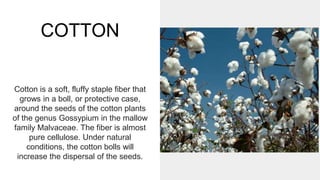
COTTON
Cotton is a soft, fluffy staple fiber that
grows in a boll, or protective case,
around the seeds of the cotton plants
of the genus Gossypium in the mallow
family Malvaceae. The fiber is almost
pure cellulose. Under natural
conditions, the cotton bolls will
increase the dispersal of the seeds.
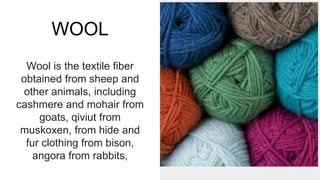
WOOL
Wool is the textile fiber
obtained from sheep and
other animals, including
cashmere and mohair from
goats, qiviut from
muskoxen, from hide and
fur clothing from bison,
angora from rabbits,
LINEN
Linen /ˈlɪnɪn/ is a textile made from
the fibers of the flax plant. Linen is
laborious to manufacture, but the fiber
is very strong, absorbent and dries
faster than cotton. Garments made of
linen are valued for their exceptional
coolness and freshness in hot and
humid weather.
HEMP
As a fabric, hemp provides all the
warmth and softness of a natural
textile but with a superior durability
seldom found in other materials.
Hemp is extremely versatile and can
be used for countless products such
as apparel, accessories, shoes,
furniture, and home furnishings.
VOILE
Voile is a soft, sheer fabric, usually
made of 100% cotton or cotton
blended with linen or polyester. The
term is French for veil. Because of its
light weight, the fabric is mostly used
in soft furnishing. In tropical climates,
voile is used for window treatments
and mosquito nets.
BATISTE
Batiste is a fine cloth made
from cotton, wool, polyester,
or a blend, and the softest
of the lightweight opaque
fabrics
GAUZE
Gauze is a thin, translucent fabric
with a loose open weave. In technical
terms "gauze" is a weave structure in
which the weft yarns are arranged in
pairs and are crossed before and
after each warp yarn keeping the weft
firmly in place.[1] This weave structure
is used to add stability to fabric, which
is important when using fine yarns
loosely spaced.
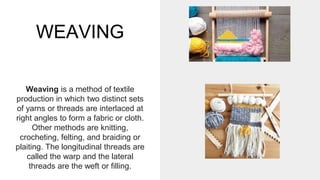
WEAVING
Weaving is a method of textile
production in which two distinct sets
of yarns or threads are interlaced at
right angles to form a fabric or cloth.
Other methods are knitting,
crocheting, felting, and braiding or
plaiting. The longitudinal threads are
called the warp and the lateral
threads are the weft or filling.
KNITTING
Knitting is a method by which yarn is
manipulated to create a textile or
fabric, often used in many types of
garments. Knitting creates multiple
loops of yarn, called stitches, in a line
or tube. Knitting has multiple active
stitches on the needle at one time
CROCHETING
Crochet is a process of creating fabric
by interlocking loops of yarn, thread,
or strands of other materials using a
crochet hook. The name is derived
from the French term crochet,
meaning 'small hook'
KNOTTING
A knot is an intentional complication
in cordage which may be useful or
decorative. Practical knots may be
classified as hitches, bends, splices,
or knots. A hitch fastens a rope to
another object; a bend unites two
rope ends; a splice is a multi-strand
bend or loop.
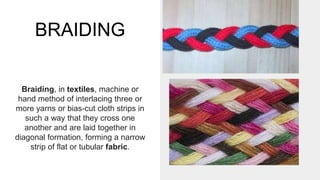
BRAIDING
Braiding, in textiles, machine or
hand method of interlacing three or
more yarns or bias-cut cloth strips in
such a way that they cross one
another and are laid together in
diagonal formation, forming a narrow
strip of flat or tubular fabric.
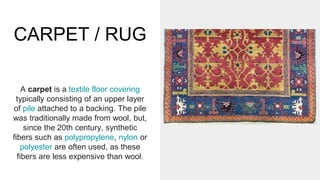
CARPET / RUG
A carpet is a textile floor covering
typically consisting of an upper layer
of pile attached to a backing. The pile
was traditionally made from wool, but,
since the 20th century, synthetic
fibers such as polypropylene, nylon or
polyester are often used, as these
fibers are less expensive than wool.
SATIN
Satin is a weave that typically has a
glossy surface and a dull back, one of
three fundamental types of textile
weaves along with plain weaveand
twill. The satin weave is characterized
by four or more fill or weft yarns
floating over a warp yarn, four warp
yarns floating over a single weft yarn.
TWILL
Twill is a type of textile weave with a
pattern of diagonal parallel ribs (in
contrast with a satin and plain
weave). This is done by passing the
weftthread over one or more warp
threads then under two or more warp
threads and so on, with a "step," or
offset, between rows to create the
characteristic diagonal pattern.[1]
Because of this structure, twill
generally drapes well.
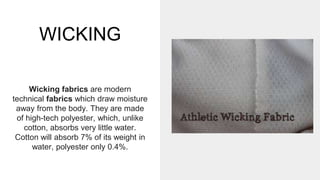
WICKING
Wicking fabrics are modern
technical fabrics which draw moisture
away from the body. They are made
of high-tech polyester, which, unlike
cotton, absorbs very little water.
Cotton will absorb 7% of its weight in
water, polyester only 0.4%.
TICKING
Ticking is a cotton or linen
textile that is tightly woven
for durability and to prevent
down feathers from poking
through the fabric,[1] and
used to cover mattresses
and bed pillows.[
THANKS
Prashant Suri
Fabric terminology
Fabric terminology
Fabric terminology

Fabric terminology

  • 1.
  • 2.
    WARP the direction alongthe length of fabric
  • 3.
    Warp and weft The lengthwiseor longitudinal warp yarns are held stationary in tension on a frame or loom while the transverse weft (sometimes woof) is drawn through and inserted over-and-under the warp
  • 4.
    WEAVE Weaving is amethod of textile production in which two distinct sets of yarns or threads are interlaced at right angles to form afabric or cloth
  • 5.
    LOOM A loom isa device used to weave cloth and tapestry. The basic purpose of any loom is to hold the warp threads under tension to facilitate the interweaving of the weft threads. The precise shape of the loom and its mechanics may vary, but the basic function is the same
  • 6.
    HEDDLE A heddle isan integral part of a loom. Each thread in the warp passes through a heddle,[1] which is used to separate the warp threads for the passage of the weft.
  • 7.
    COUNT Thread count. Threadcount or threads per inch (TPI) is a measure of the coarseness or fineness of fabric. It is measured by counting the number of threads contained in one square inch of fabric or one square centimeter, including both the length (warp) and width (weft) threads.
  • 8.
    PLY Ply is howmany yarns are twisted together to make a single thread. Fabrics can either be two-ply or single ply. Two-ply means that two yarns are twisted together to make a single thread that is then woveninto the fabric
  • 9.
    BIAS The bias ofa piece of woven fabric is at 45 degrees to its warp and weft threads. ... When cut on the bias, woven fabric is more elastic as well as more fluid in movement, compared to the on-grain direction.
  • 10.
    PINKED EDGE Pinking shearsare designed to cut cloth or paper with a zigzag edge, to lessen fraying. ... Woven fabric cloth usually frays at the edges, unless techniques are used to counter it, such as the use of pinking shears or hemming.
  • 11.
    HEMMING A hem insewing is a garment finishing method, where the edge of a piece of cloth is folded narrowly and sewn to prevent unravelling of the fabric.
  • 12.
    SELVAGE EDGE A selvageis the tightly woven edge of a fabric. It prevents the side edges of the fabric from raveling or fraying.
  • 13.
    RAVELING If something suchas a rope or wire ravels, or if you ravel it, it becomes tangled or twisted together.
  • 14.
    GREIGE Greige is anunfinished woven or knitted fabric that hasn't been bleached or dyed. It can be used for upholstery, window treatments, clothes and more. Condition of polyester fabric upon completion of the production process before being heat shrunk
  • 15.
    TEXTILES A textile isa flexible material consisting of a network of natural or artificial fibers. Yarn is produced by spinning raw fibres of wool, flax, cotton, hemp, or other materials to produce long strands. Textiles are formed by weaving, knitting, crocheting, knotting, felting, or braiding
  • 16.
    FELT Felt is atextile material that is produced by matting, condensing and pressing fibers together. Felt can be made of natural fibers such as wool or animal fur, or from synthetic fibers such as petroleum-based acrylic or acrylonitrile or wood pulp-based rayon.
  • 17.
    TERRYCLOTH Terrycloth, terry cloth,terry cotton, terry towelling, terry, terry towel or simply towelling is a fabric with loops that can absorb large amounts of water. It can be manufactured by weaving or knitting.
  • 18.
    MUSLIN Muslin, plain-woven cottonfabric made in various weights. The better qualities of muslin are fine and smooth in texture and are woven from evenly spun warps and wefts, or fillings. They are given a soft finish, bleached or piece-dyed, and are sometimes patterned in the loom or printed.
  • 19.
    CREPE Crêpe, also speltcrepe or crape (from the Fr. crepe, is a silk, wool, or synthetic fiber fabric with a distinctively crisp, crimped appearance. The term crape typically refers to a form of the fabric associated specifically with mourning
  • 20.
    CHIFFON Chiffon is alightweight plain-woven fabric with mesh like weave that gives it transparent appearance. ... It is primarily made from cotton, silk or synthetic fibers like nylon, rayon and polyester.
  • 21.
    GEORGETTE It is alight-weight, crinkled and sheer fabric, displaying an overall bouncy look. A strong absorbent, Georgette is easy to dye and has dull-rough texture. Georgette is woven in highly twisted yarns of S & Z, in both warp and weft. Is woven in two forms: Pure and Faux. Pure Georgette is woven out of Silk yarns, while the Faux Georgette is woven from Rayon and Polyester.
  • 22.
    VELVET Velvet is wovenon a special loom that weaves two thicknesses of the material at the same time. The two pieces are then cut apart to create the pile effect, and the two lengths of fabric are wound on separate take-up rolls.
  • 23.
    TAPESTRY Tapestry is aform of textile art, traditionally woven by hand on a loom. Tapestry is weft-faced weaving, in which all the warp threads are hidden in the completed work, unlike cloth weaving where both the warp and the weft threads may be visible.
  • 24.
    DENIM Denim is asturdy cotton warp-faced textile in which the weft passes under two or more warp threads. This twill weaving produces a diagonal ribbing that distinguishes it from cotton duck.
  • 25.
    FLANNEL Flannel is asoft woven fabric, of various fineness. Flannel was originally made from carded wool or worsted yarn, but is now often made from either wool, cotton, or synthetic fiber.
  • 26.
    RAYON Rayon is amanufactured fiber made from regenerated cellulose fiber. The many types and grades of rayon can imitate the feel and texture of natural fibers such as silk, wool, cotton, and linen.
  • 27.
    POLYESTER Polyester is acategory of polymers that contain the ester functional group in their main chain. As a specific material, it most commonly refers to a type called polyethylene terephthalate
  • 28.
    SILK Silk is anatural protein fiber, some forms of which can be woven into textiles. The protein fiber of silk is composed mainly of fibroin and is produced by certain insect larvae to form cocoons. The best-known silk is obtained from the cocoons of the larvae of the mulberry silkworm Bombyx mori reared in captivity.
  • 29.
    COTTON Cotton is asoft, fluffy staple fiber that grows in a boll, or protective case, around the seeds of the cotton plants of the genus Gossypium in the mallow family Malvaceae. The fiber is almost pure cellulose. Under natural conditions, the cotton bolls will increase the dispersal of the seeds.
  • 30.
    WOOL Wool is thetextile fiber obtained from sheep and other animals, including cashmere and mohair from goats, qiviut from muskoxen, from hide and fur clothing from bison, angora from rabbits,
  • 31.
    LINEN Linen /ˈlɪnɪn/ isa textile made from the fibers of the flax plant. Linen is laborious to manufacture, but the fiber is very strong, absorbent and dries faster than cotton. Garments made of linen are valued for their exceptional coolness and freshness in hot and humid weather.
  • 32.
    HEMP As a fabric,hemp provides all the warmth and softness of a natural textile but with a superior durability seldom found in other materials. Hemp is extremely versatile and can be used for countless products such as apparel, accessories, shoes, furniture, and home furnishings.
  • 33.
    VOILE Voile is asoft, sheer fabric, usually made of 100% cotton or cotton blended with linen or polyester. The term is French for veil. Because of its light weight, the fabric is mostly used in soft furnishing. In tropical climates, voile is used for window treatments and mosquito nets.
  • 34.
    BATISTE Batiste is afine cloth made from cotton, wool, polyester, or a blend, and the softest of the lightweight opaque fabrics
  • 35.
    GAUZE Gauze is athin, translucent fabric with a loose open weave. In technical terms "gauze" is a weave structure in which the weft yarns are arranged in pairs and are crossed before and after each warp yarn keeping the weft firmly in place.[1] This weave structure is used to add stability to fabric, which is important when using fine yarns loosely spaced.
  • 36.
    WEAVING Weaving is amethod of textile production in which two distinct sets of yarns or threads are interlaced at right angles to form a fabric or cloth. Other methods are knitting, crocheting, felting, and braiding or plaiting. The longitudinal threads are called the warp and the lateral threads are the weft or filling.
  • 37.
    KNITTING Knitting is amethod by which yarn is manipulated to create a textile or fabric, often used in many types of garments. Knitting creates multiple loops of yarn, called stitches, in a line or tube. Knitting has multiple active stitches on the needle at one time
  • 38.
    CROCHETING Crochet is aprocess of creating fabric by interlocking loops of yarn, thread, or strands of other materials using a crochet hook. The name is derived from the French term crochet, meaning 'small hook'
  • 39.
    KNOTTING A knot isan intentional complication in cordage which may be useful or decorative. Practical knots may be classified as hitches, bends, splices, or knots. A hitch fastens a rope to another object; a bend unites two rope ends; a splice is a multi-strand bend or loop.
  • 40.
    BRAIDING Braiding, in textiles,machine or hand method of interlacing three or more yarns or bias-cut cloth strips in such a way that they cross one another and are laid together in diagonal formation, forming a narrow strip of flat or tubular fabric.
  • 41.
    CARPET / RUG Acarpet is a textile floor covering typically consisting of an upper layer of pile attached to a backing. The pile was traditionally made from wool, but, since the 20th century, synthetic fibers such as polypropylene, nylon or polyester are often used, as these fibers are less expensive than wool.
  • 42.
    SATIN Satin is aweave that typically has a glossy surface and a dull back, one of three fundamental types of textile weaves along with plain weaveand twill. The satin weave is characterized by four or more fill or weft yarns floating over a warp yarn, four warp yarns floating over a single weft yarn.
  • 43.
    TWILL Twill is atype of textile weave with a pattern of diagonal parallel ribs (in contrast with a satin and plain weave). This is done by passing the weftthread over one or more warp threads then under two or more warp threads and so on, with a "step," or offset, between rows to create the characteristic diagonal pattern.[1] Because of this structure, twill generally drapes well.
  • 44.
    WICKING Wicking fabrics aremodern technical fabrics which draw moisture away from the body. They are made of high-tech polyester, which, unlike cotton, absorbs very little water. Cotton will absorb 7% of its weight in water, polyester only 0.4%.
  • 45.
    TICKING Ticking is acotton or linen textile that is tightly woven for durability and to prevent down feathers from poking through the fabric,[1] and used to cover mattresses and bed pillows.[
  • 46.