117 International Journal for Modern Trends in Science and Technology
Volume: 2 | Issue: 07 | July 2016 | ISSN: 2455-3778IJMTST
Correlation Analysis of Electromyogram
Signals
Sanjyot Burhade1
| Asst. Prof. A. B.Kanwade2
1M.E. Stud Dept.of E&TC Engg Sinhgad Institute of Technology and Science Pune India
2 Asst. Prof, Dept. E&TC Engg. Sinhgad Institute of Technology and Science Pune, India
An inability to adapt myoelectric interfaces to a user’s unique style of hand motion. The system also adapts
the motion style of an opposite limb. These are the important factors inhibiting the practical application of
myoelectric interfaces. This is mainly attributed to the individual differences in the exhibited electromyogram
(EMG) signals generated by the muscles of different limbs. In this project myoelectric interface easily adapts
the signal from the users and maintains good movement recognition performance. At the initial stage the
myoelectric signal is extracted from the user by using the data acquisition system. A new set of features
describing the movements of user’s is extracted and the user’s features are classifed using SVM
classification. The given signal is then compared with the database signal with the accuracy of 90.910 %
across all the EMG signals.
KEYWORDS: Electromyogram (EMG), Discrete Wavelet Transform (DWT), Support Vector Machine (SVM).
Copyright © 2016 International Journal for Modern Trends in Science and Technology
All rights reserved.
I. INTRODUCTION
Now a days electromyoghrapy signals are broadly
used for a various applications especially in the
field of myoelectric controls and prosthesis. The
electrical manifestation of the muscle contractions
is called EMG, which is sent from the spinal cord to
control the muscles which contain the various
information about the neural signals [3]. The power
of the EMG signals are somewhat related to the
intensity of the motor neural which is used to drive
muscle of the limb’s [4].This property has been
used in various application of bio-medical and
practical applications, which includes myoelectric
controlled prosthesis, where the surface EMG is
recorded from the muscle of the limb’s and after
processing they are used for the activating certain
prosthetic functions of the prosthesis like the close
or open operation of the hands. A myoelectric
controller usually consists of three main steps:1)
Transformation 2) Feature Extraction and 3)
Classification and then the results are compared
with the normal subject’s data.
In [5] may 2014, Al-Timemy in his proposed work
he studied about the use of the multichannel
sEMG signals to distinguish between the individual
and the combined finger movements for the
dexterous prosthetic control. Offline processing
was used to evaluate the classification procedure
which recorded the sEMG signals from the ten
intact-limbed and six below-elbow amputee
persons. It has been observed from the results that
the high accuracies have been obtained from
orthogonal fuzzy neighborhood discriminate
analysis for feature reduction and for the
classification Linear Discriminate Analysis (LDA) is
used. However, the main limitations here are the
participants are able to demonstrate in real time
using a virtual environment. Another limitation is
that this proposed system can only examine the
figure movements irrespective of the hand
movements. Also increase into the number of
movements might increase the confusion between
the movements.
In [6] December 2011, Englehart. K. & Hudgins.
B, to extract suitable features from a myoelectric
signals they use a combination of the principal
component analysis and a wavelet packet to
classify the six classes of hand motions. To control
the myoelectric signals of four classes of hand
motion they developed a wavelet-based system
with a high accuracy more than 85%, low response
ABSTRACT
118 International Journal for Modern Trends in Science and Technology
Correlation Analysis of Electromyogram Signals
time and a user interface control system.
In 2013 [7], Ganesh R. Naik, S. Easter Selvan
and Hung T. Nguyen signals for the neuromuscular
disorder, prosthesis and other real time
applications they had done analysis of the EMG. In
this the measured signals are the combinations of
the electric potentials that get added from the
surrounding muscles. Independent Component
Analysis (ICA) is used is used for this EMG signal
processing. However, the limitations are the ICA is
unable to compute with the single channel EMG
measurement which is used for the extraction. ICA
algorithm separates the empirical mode
decomposition algorithm which is used for the
single-channel EMG signal to a set of
noise-canceled intrinsic mode functions then this
is further used for the classification purpose.
In 2015 [10] Pu Liu, Meera Dasog, Clancy and
Edward A. the EMG pattern recognition was
developed to study the different functional
movements and how they actually perform, their
performance was latter on interpreted. Different
features of hand movements like elbow movement,
wrist and arm movement was extracted in the time
domain with the help of pair of Ag/Agcl surface
electrodes on both the right and left hands. The
accuracy of the proposed was more than 95% for
the same hand movements and 93%-97% for the
different hand movements.
In 2014[8] S.A. Fattah and A.B.M.S.U Doulah for
the neuromuscular diseases which are obtained
from the EMG signals they used two schemes. And
also this proposed system is based on Discrete
Wavelet Transform (DWT) for feature extraction. A
few high energy DWT coefficients with the
maximum value were extracted from the EMG
signals in the first scheme. And later on in the
second scheme, motor unit action potentials
(MUAPs) were extracted by decomposition method.
Based on the statically properties of the DWT
coefficients the feature extraction was performed.
In the next stage i.e. for the classification the
K-nearest neighborhood (KNN) was used.
II. METHODOLOGY
The proposed system is used for the analysis of
the EMG signals which are obtained from the
muscles of the different limbs. In bio-medical to
extract the useful information from the EMG
signals, feature extraction is the most significant
method used and also used on a large scale.
Hidden information can be obtained with the help
of feature extraction without containing any noise.
There is a possibility that many noise signals may
get add to the EMG signals as the amplitude of
these signals is very low.
The EMG sensors are used for acquire the EMG
signals from the muscles of the subject. Here we
have used only two electrodes to get the EMG
signals from the subject’s muscles, for this surface
EMG is used. The first step before insertion of the
needle electrode is skin preparation. This typically
involves simply cleaning the skin with an alcohol
pad. Skin above the muscles under investigation
was scrubbed with an alcohol wipe. In one study, a
small bead of electrode gel was also massaged into
the skin. Three EMG electrodes were placed
transversely across each of the biceps and triceps
muscles, midway between the elbow and the
midpoint of the upper arm, centered on the muscle
midline. Each electrode-amplifier had a pair of
4-mm (or 8-mm) diameter, stainless steel,
hemispherical contacts separated by 10
mm(edge-to-edge),oriented along the muscle’s long
axis. The distance between adjacent
electrode-amplifiers was approximately 1.75cm.
Figure1.-Flow Chart of the System
Further, this EMG signal is then converted into
digital form with the help of the LPC2148. Then,
the pre-processing of the EMG signals is done.
Here, in this system the Discrete Wavelet
Transform (DWT) technique is used for the feature
extraction. As DWT gives a good frequency
resolution at a high frequency and a time
resolution at a low frequency which is most
importantly required in a bio-medical field. To
approximate the behavior of the continuous
wavelet transform filter banks are used. The signal
is composed of the high pass and a low pass filter.
119 International Journal for Modern Trends in Science and Technology
Volume: 2 | Issue: 07 | July 2016 | ISSN: 2455-3778IJMTST
The coefficients of these signals are obtained with
the help of which we are able to obtain various
signals. In our system we had use low pass signal
for further processing. As the coefficients of the low
pass signals are large, accurate and available with
good stability, good range of features are obtained
from this low pass signals. Further for
pre-processing of the signals the Haar wavelet is
used. Haar wavelet is a sequence of rescaled
"square-shaped" functions is the basics of the
wavelet. Amongst all the types of wavelet the Haar
is the simplest type of wavelet. However, the
limitation of the Haar wavelet is that it is not
continuous in nature and hence cannot be used for
differentiation. Hence is it very useful to use Haar
wavelet for the analysis of signals with sudden
transitions. Hence, we had used Haar Wavelet.
Features which are obtained in this system
are:-
1) Mean- It is the average value of all the EMG
signlas in the database.
2) Minimum level- Minimum amplitude (Min) is
defined as the minimum amplitude of the signal.
For different signals the minimum level of the
signal is calculated.
3) Maximum level- Maximum amplitude (MAX) is
defined as the peak amplitude of a signal. It is often
used in areas where the measure of a signal that is
not sinusoidal, it is the signal that swings above
and below a zero value.
4) Varience- The variance is the mean value of the
square of the deviation of that variable of EMG
signal. Generally it uses power of EMG signal.
5) Standard Deviation- It is used to find out the
threshold level of muscle contraction activity. It is
the amplitude of the EMG signal. Standard
deviation (SD) measures the spread of data from
the mean. In signal processing, SD represents
noise and other interference. It is used in
comparison to the mean. This leads to the term:
signal-to-noise ratio (SNR), which is equal to the
mean divided by the standard deviation. Better
data means a higher value for the SNR.
After this the next stage is the classification ,
so for the classification the Support Vector
Machine (SVM) is used.For the classification and
regression analysis the SVM is used.SVM are the
supervized learing models which are associated
learning algorithms. In addition to the linear
analysis SVM can also perform the non-linear
analysis.Also SVM gives a very good accuracy. After
the completion of all this process the test EMG
signal is compared with the data base signal if it
matches the test signal then the given signal is
normaol otherwise the signal is abnormal.
III. RESULTS
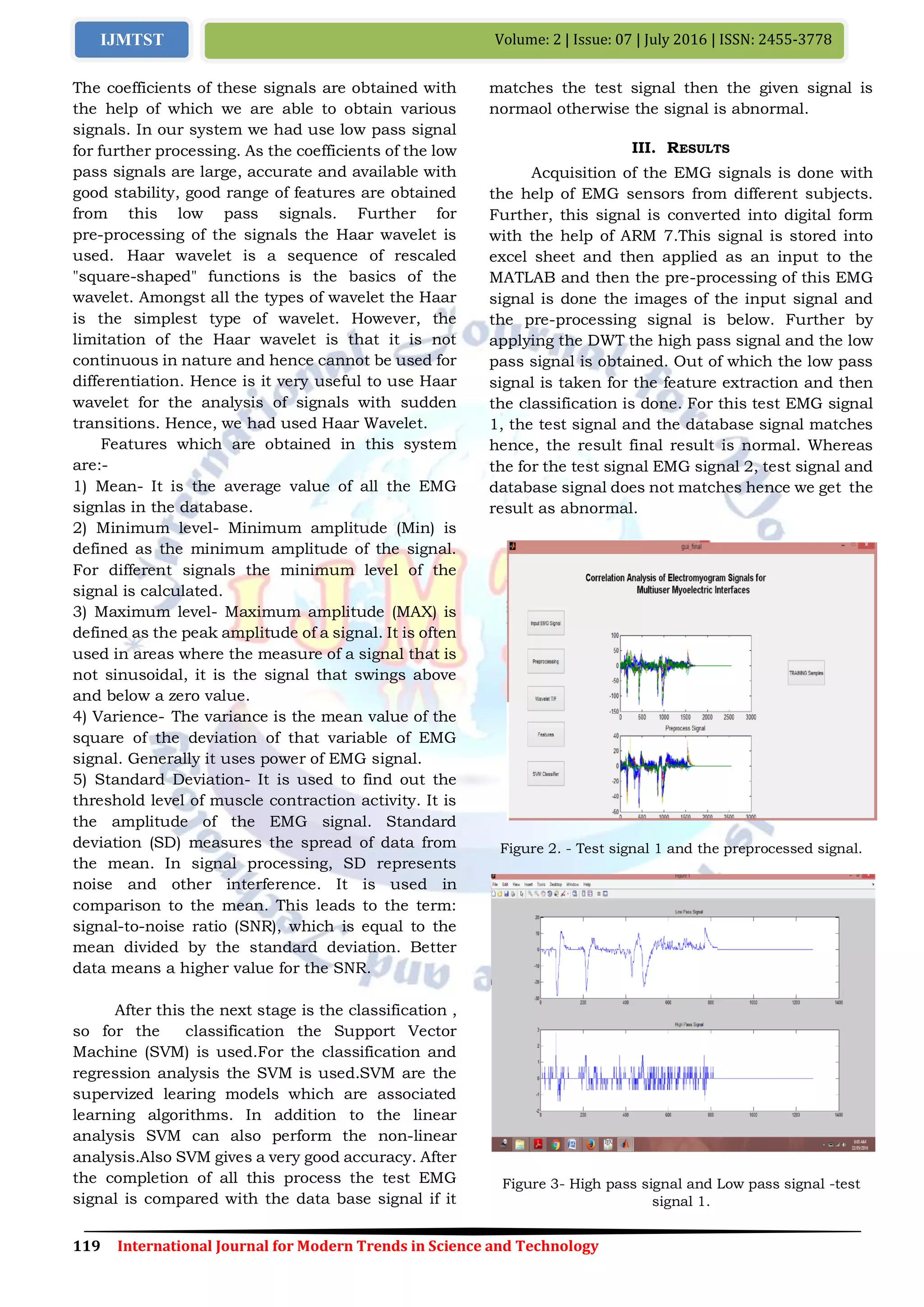
Acquisition of the EMG signals is done with
the help of EMG sensors from different subjects.
Further, this signal is converted into digital form
with the help of ARM 7.This signal is stored into
excel sheet and then applied as an input to the
MATLAB and then the pre-processing of this EMG
signal is done the images of the input signal and
the pre-processing signal is below. Further by
applying the DWT the high pass signal and the low
pass signal is obtained. Out of which the low pass
signal is taken for the feature extraction and then
the classification is done. For this test EMG signal
1, the test signal and the database signal matches
hence, the result final result is normal. Whereas
the for the test signal EMG signal 2, test signal and
database signal does not matches hence we get the
result as abnormal.
Figure 2. - Test signal 1 and the preprocessed signal.
Figure 3- High pass signal and Low pass signal -test
signal 1.
120 International Journal for Modern Trends in Science and Technology
Correlation Analysis of Electromyogram Signals
Figure 4 - Final output of the signal.
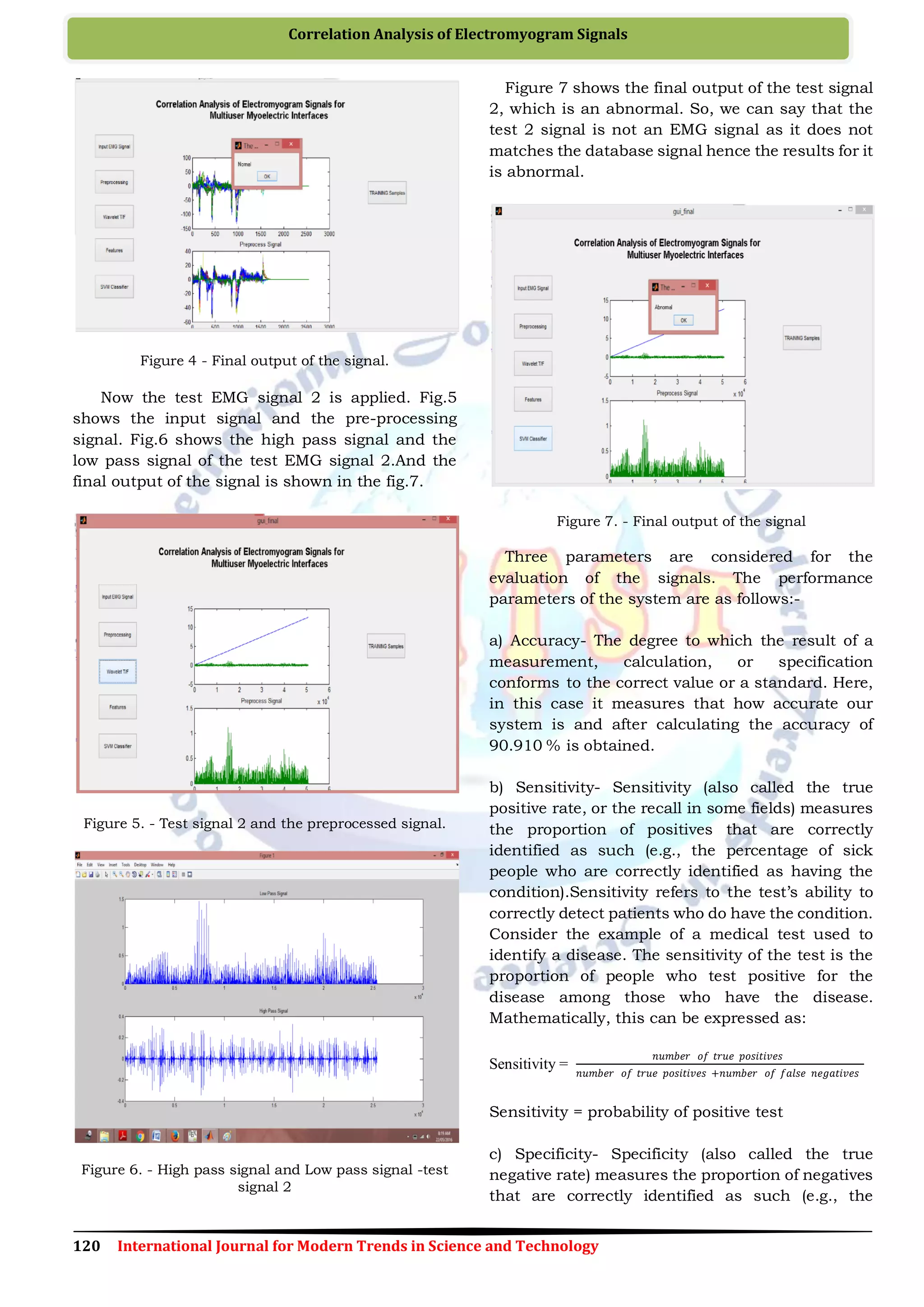
Now the test EMG signal 2 is applied. Fig.5
shows the input signal and the pre-processing
signal. Fig.6 shows the high pass signal and the
low pass signal of the test EMG signal 2.And the
final output of the signal is shown in the fig.7.
Figure 5. - Test signal 2 and the preprocessed signal.
Figure 6. - High pass signal and Low pass signal -test
signal 2
Figure 7 shows the final output of the test signal
2, which is an abnormal. So, we can say that the
test 2 signal is not an EMG signal as it does not
matches the database signal hence the results for it
is abnormal.
Figure 7. - Final output of the signal
Three parameters are considered for the
evaluation of the signals. The performance
parameters of the system are as follows:-
a) Accuracy- The degree to which the result of a
measurement, calculation, or specification
conforms to the correct value or a standard. Here,
in this case it measures that how accurate our
system is and after calculating the accuracy of
90.910 % is obtained.
b) Sensitivity- Sensitivity (also called the true
positive rate, or the recall in some fields) measures
the proportion of positives that are correctly
identified as such (e.g., the percentage of sick
people who are correctly identified as having the
condition).Sensitivity refers to the test’s ability to
correctly detect patients who do have the condition.
Consider the example of a medical test used to
identify a disease. The sensitivity of the test is the
proportion of people who test positive for the
disease among those who have the disease.
Mathematically, this can be expressed as:
Sensitivity =
𝑛𝑢𝑚𝑏𝑒𝑟 𝑜𝑓 𝑡𝑟𝑢𝑒 𝑝𝑜𝑠𝑖𝑡𝑖𝑣𝑒𝑠
𝑛𝑢𝑚𝑏𝑒𝑟 𝑜𝑓 𝑡𝑟𝑢𝑒 𝑝𝑜𝑠𝑖𝑡𝑖𝑣𝑒𝑠 +𝑛𝑢𝑚𝑏𝑒𝑟 𝑜𝑓 𝑓𝑎𝑙𝑠𝑒 𝑛𝑒𝑔𝑎𝑡𝑖𝑣𝑒𝑠
Sensitivity = probability of positive test
c) Specificity- Specificity (also called the true
negative rate) measures the proportion of negatives
that are correctly identified as such (e.g., the
121 International Journal for Modern Trends in Science and Technology
Volume: 2 | Issue: 07 | July 2016 | ISSN: 2455-3778IJMTST
percentage of healthy people who are correctly
identified as not having the condition).Specificity
relates to the test’s ability to correctly detect
patients without a condition. Consider the example
of a medical test for diagnosing a disease.
Specificity of a test is the proportion of healthy
patients known not to have the disease, who will
test negative for it. Mathematically, this can also be
written as:
Specificity =
𝑛𝑢𝑚𝑏𝑒𝑟 𝑜𝑓 𝑡𝑟𝑢𝑒 𝑛𝑒𝑔𝑎𝑡𝑖𝑣𝑒𝑠
𝑛𝑢𝑚𝑏𝑒𝑟 𝑜𝑓 𝑡𝑟𝑢𝑒 𝑛𝑒𝑔𝑎𝑡𝑖𝑣𝑒𝑠 +𝑛𝑢𝑚𝑏𝑒𝑟 𝑜𝑓 𝑓𝑎𝑙𝑠𝑒 𝑝𝑜𝑠𝑖𝑡𝑖𝑣𝑒𝑠
Specificity = probability of negative tests
SVM classification is then compared with the
Probabilistic Neural Network (PNN). PNN is often
used in classification problems. When an input is
present, the first layer computes the distance from
the input vector to the training input vectors. This
produces a vector where its elements indicate how
close the input is to the training input. The second
layer sums the contribution for each class of inputs
and produces its net output as a vector of
probabilities. Finally, a compete transfer function
on the output of the second layer picks the
maximum of these probabilities, and produces a 1
(positive identification) for that class and a 0
(negative identification) for non-targeted classes.
The comparison of both the classification is
represented in the graphical form.
Figure 8- Comparison with PNN
IV. CONCLUSION
In this system, an approach for developing
multiuser myoelectric interfaces using a DWT has
been proposed. Firstly, in this system with the help
of the EMG sensors EMG signals are adapted from
the subjects. Then, pre-processing of the signals is
done. The possibility of training the classifier on
EMG features has performed. And this is then
compared with the database signal with the
accuracy of 90.910% across all the EMG signals is
obtained. This method was able to overcome the
limitations of the previous methods. And with the
help of SVM classifier the classification is done.
From this proposed system we were able to find out
the applied signal is EMG as it matches the
database signal. If the given signal does not match
then the signal is abnormal.
ACKNOWLEDGMENT
I am grateful for the support of Smt. Kashibai
Navale hospital Pune and Dr. Rahul Baviskar
Cardiologist from Nashik for providing me the EMG
database.And my guide Prof. A.B .Kanwade for
continuous support and guidance.
REFERENCES
[1] Ms. Patil S. and Prof.C.G.Patil “Feature Extraction of
Forearm SEMG Signal”, International Journal of
Enchansed Research in Science Technology &
Engineering, Vol.2 Issue 3, March 2013
[2] Angkoon Phinyomarka,b, Franck Quainea, Sylvie
Charbonniera, Christine Servierea, “EMG Feature
Evakution for Improving Myoelectric Pattern
Recogniction Robustness”,Vol.3 April 2011
[3] Ning Jiang,Strahinja Dosen,Klaus-Robert Muller
and Dario Farina “Myoelectric Control of Artificial
Limbs-Is ther a Need to Change Focus?” Vol.3 20
August 2012.
[4] D. Farina, A. Holobar, R. Merletti, and R. M.
Enoka,“Decoding the neural drive to muscles from
the surface electromyogram,” Clin. Neurophysiol.,
vol. 121, no. 10,pp. 1616–1623, Oct. 2010.
[5] Ali H. Al-Timemy, Student Member, IEEE, Guido
Bugmann, Javier Escudero, Member, IEEE, and
Nicholas Outram“Classification of Finger Movements
for the Dexterous Hand Prosthesis Control With
Surface Electromyography”,
[6] Englehart.K & Hudgins.B, “ A robust real time
control scheme for multifunction myoelectric
conrol”,IEEE transcation on Bio-medical
Engineering, December 2011.
[7] Ganesh R. Naik, S. Easter Selvan, and Hung T.
Nguyen “Single-Channel EMG Classification With
Ensemble-Empirical-Mode-Decomposition-Based
ICA for Diagnosing Neuromuscular Disorders”, IEEE
Transaction on Neural System and Rehabilitation
Engineering, VOL. 22, NO. 5, SEPTEMBER 2015
[8] Kishor Koirala, Meera Dasog, Pu Liu, and Edward A.
Clancy, “Using the Electromyogram to Anticipate
Torques about the Elbow”, IEEE Transaction on
Neural System and Rehabilitation Engineering.
[9] A. B. M. S. U. Doulah, Student Member, IEEE, S. A.
Fattah, Member, IEEE, W.-P. Zhu, Senior Member,
IEEE, and M. O. Ahmad, Fellow, “Wavelet Domain
Feature Extraction Scheme Based on Dominant
122 International Journal for Modern Trends in Science and Technology
Correlation Analysis of Electromyogram Signals
Motor Unit Action Potential of EMG Signal for
Neuromuscular Disease Classification”, IEEE
Transaction on Biomedical Circuits and Systems,
VOL. 8, NO. 2, APRIL 2014.
[10]A. B. M. S. U. Doulah, Student Member, IEEE, S. A.
Fattah, Member, IEEE, W.-P. Zhu, Senior Member,
IEEE, and M. O. Ahmad, Fellow, “Wavelet Domain
Feature Extraction Scheme Based on Dominant
Motor Unit Action Potential of EMG Signal for
Neuromuscular Disease Classification”, IEEE
Transaction on Biomedical Circuits and Systems,
VOL. 8, NO. 2, APRIL 2014.

Correlation Analysis of Electromyogram Signals

  • 1.
    117 International Journalfor Modern Trends in Science and Technology Volume: 2 | Issue: 07 | July 2016 | ISSN: 2455-3778IJMTST Correlation Analysis of Electromyogram Signals Sanjyot Burhade1 | Asst. Prof. A. B.Kanwade2 1M.E. Stud Dept.of E&TC Engg Sinhgad Institute of Technology and Science Pune India 2 Asst. Prof, Dept. E&TC Engg. Sinhgad Institute of Technology and Science Pune, India An inability to adapt myoelectric interfaces to a user’s unique style of hand motion. The system also adapts the motion style of an opposite limb. These are the important factors inhibiting the practical application of myoelectric interfaces. This is mainly attributed to the individual differences in the exhibited electromyogram (EMG) signals generated by the muscles of different limbs. In this project myoelectric interface easily adapts the signal from the users and maintains good movement recognition performance. At the initial stage the myoelectric signal is extracted from the user by using the data acquisition system. A new set of features describing the movements of user’s is extracted and the user’s features are classifed using SVM classification. The given signal is then compared with the database signal with the accuracy of 90.910 % across all the EMG signals. KEYWORDS: Electromyogram (EMG), Discrete Wavelet Transform (DWT), Support Vector Machine (SVM). Copyright © 2016 International Journal for Modern Trends in Science and Technology All rights reserved. I. INTRODUCTION Now a days electromyoghrapy signals are broadly used for a various applications especially in the field of myoelectric controls and prosthesis. The electrical manifestation of the muscle contractions is called EMG, which is sent from the spinal cord to control the muscles which contain the various information about the neural signals [3]. The power of the EMG signals are somewhat related to the intensity of the motor neural which is used to drive muscle of the limb’s [4].This property has been used in various application of bio-medical and practical applications, which includes myoelectric controlled prosthesis, where the surface EMG is recorded from the muscle of the limb’s and after processing they are used for the activating certain prosthetic functions of the prosthesis like the close or open operation of the hands. A myoelectric controller usually consists of three main steps:1) Transformation 2) Feature Extraction and 3) Classification and then the results are compared with the normal subject’s data. In [5] may 2014, Al-Timemy in his proposed work he studied about the use of the multichannel sEMG signals to distinguish between the individual and the combined finger movements for the dexterous prosthetic control. Offline processing was used to evaluate the classification procedure which recorded the sEMG signals from the ten intact-limbed and six below-elbow amputee persons. It has been observed from the results that the high accuracies have been obtained from orthogonal fuzzy neighborhood discriminate analysis for feature reduction and for the classification Linear Discriminate Analysis (LDA) is used. However, the main limitations here are the participants are able to demonstrate in real time using a virtual environment. Another limitation is that this proposed system can only examine the figure movements irrespective of the hand movements. Also increase into the number of movements might increase the confusion between the movements. In [6] December 2011, Englehart. K. & Hudgins. B, to extract suitable features from a myoelectric signals they use a combination of the principal component analysis and a wavelet packet to classify the six classes of hand motions. To control the myoelectric signals of four classes of hand motion they developed a wavelet-based system with a high accuracy more than 85%, low response ABSTRACT
  • 2.
    118 International Journalfor Modern Trends in Science and Technology Correlation Analysis of Electromyogram Signals time and a user interface control system. In 2013 [7], Ganesh R. Naik, S. Easter Selvan and Hung T. Nguyen signals for the neuromuscular disorder, prosthesis and other real time applications they had done analysis of the EMG. In this the measured signals are the combinations of the electric potentials that get added from the surrounding muscles. Independent Component Analysis (ICA) is used is used for this EMG signal processing. However, the limitations are the ICA is unable to compute with the single channel EMG measurement which is used for the extraction. ICA algorithm separates the empirical mode decomposition algorithm which is used for the single-channel EMG signal to a set of noise-canceled intrinsic mode functions then this is further used for the classification purpose. In 2015 [10] Pu Liu, Meera Dasog, Clancy and Edward A. the EMG pattern recognition was developed to study the different functional movements and how they actually perform, their performance was latter on interpreted. Different features of hand movements like elbow movement, wrist and arm movement was extracted in the time domain with the help of pair of Ag/Agcl surface electrodes on both the right and left hands. The accuracy of the proposed was more than 95% for the same hand movements and 93%-97% for the different hand movements. In 2014[8] S.A. Fattah and A.B.M.S.U Doulah for the neuromuscular diseases which are obtained from the EMG signals they used two schemes. And also this proposed system is based on Discrete Wavelet Transform (DWT) for feature extraction. A few high energy DWT coefficients with the maximum value were extracted from the EMG signals in the first scheme. And later on in the second scheme, motor unit action potentials (MUAPs) were extracted by decomposition method. Based on the statically properties of the DWT coefficients the feature extraction was performed. In the next stage i.e. for the classification the K-nearest neighborhood (KNN) was used. II. METHODOLOGY The proposed system is used for the analysis of the EMG signals which are obtained from the muscles of the different limbs. In bio-medical to extract the useful information from the EMG signals, feature extraction is the most significant method used and also used on a large scale. Hidden information can be obtained with the help of feature extraction without containing any noise. There is a possibility that many noise signals may get add to the EMG signals as the amplitude of these signals is very low. The EMG sensors are used for acquire the EMG signals from the muscles of the subject. Here we have used only two electrodes to get the EMG signals from the subject’s muscles, for this surface EMG is used. The first step before insertion of the needle electrode is skin preparation. This typically involves simply cleaning the skin with an alcohol pad. Skin above the muscles under investigation was scrubbed with an alcohol wipe. In one study, a small bead of electrode gel was also massaged into the skin. Three EMG electrodes were placed transversely across each of the biceps and triceps muscles, midway between the elbow and the midpoint of the upper arm, centered on the muscle midline. Each electrode-amplifier had a pair of 4-mm (or 8-mm) diameter, stainless steel, hemispherical contacts separated by 10 mm(edge-to-edge),oriented along the muscle’s long axis. The distance between adjacent electrode-amplifiers was approximately 1.75cm. Figure1.-Flow Chart of the System Further, this EMG signal is then converted into digital form with the help of the LPC2148. Then, the pre-processing of the EMG signals is done. Here, in this system the Discrete Wavelet Transform (DWT) technique is used for the feature extraction. As DWT gives a good frequency resolution at a high frequency and a time resolution at a low frequency which is most importantly required in a bio-medical field. To approximate the behavior of the continuous wavelet transform filter banks are used. The signal is composed of the high pass and a low pass filter.
  • 3.
    119 International Journalfor Modern Trends in Science and Technology Volume: 2 | Issue: 07 | July 2016 | ISSN: 2455-3778IJMTST The coefficients of these signals are obtained with the help of which we are able to obtain various signals. In our system we had use low pass signal for further processing. As the coefficients of the low pass signals are large, accurate and available with good stability, good range of features are obtained from this low pass signals. Further for pre-processing of the signals the Haar wavelet is used. Haar wavelet is a sequence of rescaled "square-shaped" functions is the basics of the wavelet. Amongst all the types of wavelet the Haar is the simplest type of wavelet. However, the limitation of the Haar wavelet is that it is not continuous in nature and hence cannot be used for differentiation. Hence is it very useful to use Haar wavelet for the analysis of signals with sudden transitions. Hence, we had used Haar Wavelet. Features which are obtained in this system are:- 1) Mean- It is the average value of all the EMG signlas in the database. 2) Minimum level- Minimum amplitude (Min) is defined as the minimum amplitude of the signal. For different signals the minimum level of the signal is calculated. 3) Maximum level- Maximum amplitude (MAX) is defined as the peak amplitude of a signal. It is often used in areas where the measure of a signal that is not sinusoidal, it is the signal that swings above and below a zero value. 4) Varience- The variance is the mean value of the square of the deviation of that variable of EMG signal. Generally it uses power of EMG signal. 5) Standard Deviation- It is used to find out the threshold level of muscle contraction activity. It is the amplitude of the EMG signal. Standard deviation (SD) measures the spread of data from the mean. In signal processing, SD represents noise and other interference. It is used in comparison to the mean. This leads to the term: signal-to-noise ratio (SNR), which is equal to the mean divided by the standard deviation. Better data means a higher value for the SNR. After this the next stage is the classification , so for the classification the Support Vector Machine (SVM) is used.For the classification and regression analysis the SVM is used.SVM are the supervized learing models which are associated learning algorithms. In addition to the linear analysis SVM can also perform the non-linear analysis.Also SVM gives a very good accuracy. After the completion of all this process the test EMG signal is compared with the data base signal if it matches the test signal then the given signal is normaol otherwise the signal is abnormal. III. RESULTS Acquisition of the EMG signals is done with the help of EMG sensors from different subjects. Further, this signal is converted into digital form with the help of ARM 7.This signal is stored into excel sheet and then applied as an input to the MATLAB and then the pre-processing of this EMG signal is done the images of the input signal and the pre-processing signal is below. Further by applying the DWT the high pass signal and the low pass signal is obtained. Out of which the low pass signal is taken for the feature extraction and then the classification is done. For this test EMG signal 1, the test signal and the database signal matches hence, the result final result is normal. Whereas the for the test signal EMG signal 2, test signal and database signal does not matches hence we get the result as abnormal. Figure 2. - Test signal 1 and the preprocessed signal. Figure 3- High pass signal and Low pass signal -test signal 1.
  • 4.
    120 International Journalfor Modern Trends in Science and Technology Correlation Analysis of Electromyogram Signals Figure 4 - Final output of the signal. Now the test EMG signal 2 is applied. Fig.5 shows the input signal and the pre-processing signal. Fig.6 shows the high pass signal and the low pass signal of the test EMG signal 2.And the final output of the signal is shown in the fig.7. Figure 5. - Test signal 2 and the preprocessed signal. Figure 6. - High pass signal and Low pass signal -test signal 2 Figure 7 shows the final output of the test signal 2, which is an abnormal. So, we can say that the test 2 signal is not an EMG signal as it does not matches the database signal hence the results for it is abnormal. Figure 7. - Final output of the signal Three parameters are considered for the evaluation of the signals. The performance parameters of the system are as follows:- a) Accuracy- The degree to which the result of a measurement, calculation, or specification conforms to the correct value or a standard. Here, in this case it measures that how accurate our system is and after calculating the accuracy of 90.910 % is obtained. b) Sensitivity- Sensitivity (also called the true positive rate, or the recall in some fields) measures the proportion of positives that are correctly identified as such (e.g., the percentage of sick people who are correctly identified as having the condition).Sensitivity refers to the test’s ability to correctly detect patients who do have the condition. Consider the example of a medical test used to identify a disease. The sensitivity of the test is the proportion of people who test positive for the disease among those who have the disease. Mathematically, this can be expressed as: Sensitivity = 𝑛𝑢𝑚𝑏𝑒𝑟 𝑜𝑓 𝑡𝑟𝑢𝑒 𝑝𝑜𝑠𝑖𝑡𝑖𝑣𝑒𝑠 𝑛𝑢𝑚𝑏𝑒𝑟 𝑜𝑓 𝑡𝑟𝑢𝑒 𝑝𝑜𝑠𝑖𝑡𝑖𝑣𝑒𝑠 +𝑛𝑢𝑚𝑏𝑒𝑟 𝑜𝑓 𝑓𝑎𝑙𝑠𝑒 𝑛𝑒𝑔𝑎𝑡𝑖𝑣𝑒𝑠 Sensitivity = probability of positive test c) Specificity- Specificity (also called the true negative rate) measures the proportion of negatives that are correctly identified as such (e.g., the
  • 5.
    121 International Journalfor Modern Trends in Science and Technology Volume: 2 | Issue: 07 | July 2016 | ISSN: 2455-3778IJMTST percentage of healthy people who are correctly identified as not having the condition).Specificity relates to the test’s ability to correctly detect patients without a condition. Consider the example of a medical test for diagnosing a disease. Specificity of a test is the proportion of healthy patients known not to have the disease, who will test negative for it. Mathematically, this can also be written as: Specificity = 𝑛𝑢𝑚𝑏𝑒𝑟 𝑜𝑓 𝑡𝑟𝑢𝑒 𝑛𝑒𝑔𝑎𝑡𝑖𝑣𝑒𝑠 𝑛𝑢𝑚𝑏𝑒𝑟 𝑜𝑓 𝑡𝑟𝑢𝑒 𝑛𝑒𝑔𝑎𝑡𝑖𝑣𝑒𝑠 +𝑛𝑢𝑚𝑏𝑒𝑟 𝑜𝑓 𝑓𝑎𝑙𝑠𝑒 𝑝𝑜𝑠𝑖𝑡𝑖𝑣𝑒𝑠 Specificity = probability of negative tests SVM classification is then compared with the Probabilistic Neural Network (PNN). PNN is often used in classification problems. When an input is present, the first layer computes the distance from the input vector to the training input vectors. This produces a vector where its elements indicate how close the input is to the training input. The second layer sums the contribution for each class of inputs and produces its net output as a vector of probabilities. Finally, a compete transfer function on the output of the second layer picks the maximum of these probabilities, and produces a 1 (positive identification) for that class and a 0 (negative identification) for non-targeted classes. The comparison of both the classification is represented in the graphical form. Figure 8- Comparison with PNN IV. CONCLUSION In this system, an approach for developing multiuser myoelectric interfaces using a DWT has been proposed. Firstly, in this system with the help of the EMG sensors EMG signals are adapted from the subjects. Then, pre-processing of the signals is done. The possibility of training the classifier on EMG features has performed. And this is then compared with the database signal with the accuracy of 90.910% across all the EMG signals is obtained. This method was able to overcome the limitations of the previous methods. And with the help of SVM classifier the classification is done. From this proposed system we were able to find out the applied signal is EMG as it matches the database signal. If the given signal does not match then the signal is abnormal. ACKNOWLEDGMENT I am grateful for the support of Smt. Kashibai Navale hospital Pune and Dr. Rahul Baviskar Cardiologist from Nashik for providing me the EMG database.And my guide Prof. A.B .Kanwade for continuous support and guidance. REFERENCES [1] Ms. Patil S. and Prof.C.G.Patil “Feature Extraction of Forearm SEMG Signal”, International Journal of Enchansed Research in Science Technology & Engineering, Vol.2 Issue 3, March 2013 [2] Angkoon Phinyomarka,b, Franck Quainea, Sylvie Charbonniera, Christine Servierea, “EMG Feature Evakution for Improving Myoelectric Pattern Recogniction Robustness”,Vol.3 April 2011 [3] Ning Jiang,Strahinja Dosen,Klaus-Robert Muller and Dario Farina “Myoelectric Control of Artificial Limbs-Is ther a Need to Change Focus?” Vol.3 20 August 2012. [4] D. Farina, A. Holobar, R. Merletti, and R. M. Enoka,“Decoding the neural drive to muscles from the surface electromyogram,” Clin. Neurophysiol., vol. 121, no. 10,pp. 1616–1623, Oct. 2010. [5] Ali H. Al-Timemy, Student Member, IEEE, Guido Bugmann, Javier Escudero, Member, IEEE, and Nicholas Outram“Classification of Finger Movements for the Dexterous Hand Prosthesis Control With Surface Electromyography”, [6] Englehart.K & Hudgins.B, “ A robust real time control scheme for multifunction myoelectric conrol”,IEEE transcation on Bio-medical Engineering, December 2011. [7] Ganesh R. Naik, S. Easter Selvan, and Hung T. Nguyen “Single-Channel EMG Classification With Ensemble-Empirical-Mode-Decomposition-Based ICA for Diagnosing Neuromuscular Disorders”, IEEE Transaction on Neural System and Rehabilitation Engineering, VOL. 22, NO. 5, SEPTEMBER 2015 [8] Kishor Koirala, Meera Dasog, Pu Liu, and Edward A. Clancy, “Using the Electromyogram to Anticipate Torques about the Elbow”, IEEE Transaction on Neural System and Rehabilitation Engineering. [9] A. B. M. S. U. Doulah, Student Member, IEEE, S. A. Fattah, Member, IEEE, W.-P. Zhu, Senior Member, IEEE, and M. O. Ahmad, Fellow, “Wavelet Domain Feature Extraction Scheme Based on Dominant
  • 6.
    122 International Journalfor Modern Trends in Science and Technology Correlation Analysis of Electromyogram Signals Motor Unit Action Potential of EMG Signal for Neuromuscular Disease Classification”, IEEE Transaction on Biomedical Circuits and Systems, VOL. 8, NO. 2, APRIL 2014. [10]A. B. M. S. U. Doulah, Student Member, IEEE, S. A. Fattah, Member, IEEE, W.-P. Zhu, Senior Member, IEEE, and M. O. Ahmad, Fellow, “Wavelet Domain Feature Extraction Scheme Based on Dominant Motor Unit Action Potential of EMG Signal for Neuromuscular Disease Classification”, IEEE Transaction on Biomedical Circuits and Systems, VOL. 8, NO. 2, APRIL 2014.