International Journal of Engineering Science Invention 
ISSN (Online): 2319 – 6734, ISSN (Print): 2319 – 6726 
www.ijesi.org Volume 3 Issue 8 ǁ August 2014 ǁ PP.37-43 
www.ijesi.org 37 | Page 
Static and Normal Mode Analysis of Aircraft Avionics Compartment Door Veerbhadrappa prabhushetty1, Sunil Mangshetty2 1. Post graduate student, Department of Mechanical Engineering, PDA College of Engineering, Gulbarga, Karnataka, India. 2. Associate Professor, Department of Mechanical Engineering, PDA College of Engineering, Gulbarga, Karnataka, India ABSTRACT : The aircraft has the following fuselage doors like Passenger door, Galley service door two overawing emergency exits, Flight compartment overhead escape hatch, Cargo door, Avionics compartment door, aft equipment compartment door. The avionics compartment door is used to gain access to the equipment in the avionics Compartment. It is located on the centerline of the lower forward fuselage. The door opens inward and moves up on four spring--loaded roller arms. The door is an important part of the airplane, and the reliability of opening the door has a great effect on flight safety. The inadvertent opening could lead to terrible consequence during flight. In this present work a conceptual design of aircraft door is done using cad software meshing using FEM and analysis using MSc Nastran. The static and normal mode analysis of aircraft door frame and stiffeners is done using aluminum material. KEYWORDS: Aircraft door, Static Analysis, Normal Analysis, Finite Element Model 
I. INTRODUCTION 
Passenger door 
The passenger door is located at the forward left side of the fuselage and is the main entrance and exit to the cabin area The passenger door incorporates integral stairs with a retractable lower step and folding handrails. The door is hinged at the cabin floor level and opens outward. A counter--balance mechanism with gas springs is used to take the weight of the door and to dampen the door movement at the fully open position, the door rests on a support wheel. Handrails are provided to assist passengers in boarding and disembarking. Mechanical linkages raise the handrails when the door is opened and collapse them when the door is closed. When a jet way is used, the handrails must be collapsed. Collapsing of the handrails is done by removing the forward and aft handrail quick--release pins (Refer to Lowering the Stair Handrails).Closing the passenger door from inside the aircraft is normally accomplished using the power assist system which is controlled from a DOOR ASSIST switch light on the forward flight attendants panel. The passenger door status is displayed on the EICAS primary page in the form of warning and caution messages and on the DOOR synoptic page. The DOOR synoptic page is displayed when selected from the EICAS control panel [1]. A. Static Analysis A static analysis calculates the effects of steady loading conditions on a structure, while ignoring inertia and damping effects, such as those caused by time-varying loads. A static analysis can, however, include steady inertia loads (such as gravity and rotational velocity), and time-varying loads that can be approximated as static equivalent loads (such as the static equivalent wind and seismic loads commonly defined in many building codes).Static analysis is used to determine the displacements, stresses, strains, and forces in structures or components caused by loads that do not induce significant inertia and damping effects. 
B. Normal Mode Analysis 
We use Normal mode analysis to determine the vibration characteristics (natural frequencies and mode shapes) of a structure or a machine component while it is being designed. It also can be a starting point for another, more detailed, dynamic analysis, such as a transient dynamic analysis, a harmonic response analysis, or a spectrum analysis. The natural frequencies and mode shapes are important parameters in the design of a structure for dynamic loading conditions,
Static And Normal Mode Analysis… 
www.ijesi.org 38 | Page 
II. METHODOLOGY AND MATERIAL 
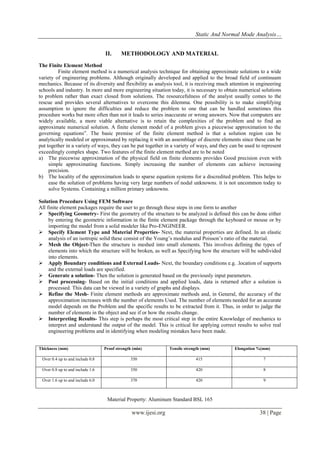
The Finite Element Method Finite element method is a numerical analysis technique for obtaining approximate solutions to a wide variety of engineering problems. Although originally developed and applied to the broad field of continuum mechanics. Because of its diversity and flexibility as analysis tool, it is receiving much attention in engineering schools and industry. In more and more engineering situation today, it is necessary to obtain numerical solutions to problem rather than exact closed from solutions. The resourcefulness of the analyst usually comes to the rescue and provides several alternatives to overcome this dilemma. One possibility is to make simplifying assumption to ignore the difficulties and reduce the problem to one that can be handled sometimes this procedure works but more often than not it leads to series inaccurate or wrong answers. Now that computers are widely available, a more viable alternative is to retain the complexities of the problem and to find an approximate numerical solution. A finite element model of a problem gives a piecewise approximation to the governing equations‟. The basic premise of the finite element method is that a solution region can be analytically modeled or approximated by replacing it with an assemblage of discrete elements since these can be put together in a variety of ways, they can be put together in a variety of ways, and they can be used to represent exceedingly complex shape. Two features of the finite element method are to be noted 
a) The piecewise approximation of the physical field on finite elements provides Good precision even with simple approximating functions. Simply increasing the number of elements can achieve increasing precision. 
b) The locality of the approximation leads to sparse equation systems for a discredited problem. This helps to ease the solution of problems having very large numbers of nodal unknowns. it is not uncommon today to solve Systems. Containing a million primary unknowns. 
Solution Procedure Using FEM Software All finite element packages require the user to go through these steps in one form to another 
 Specifying Geometry- First the geometry of the structure to be analyzed is defined this can be done either by entering the geometric information in the finite element package through the keyboard or mouse or by importing the model from a solid modeler like Pro-ENGINEER. 
 Specify Element Type and Material Properties- Next, the material properties are defined. In an elastic analysis of an isotropic solid these consist of the Young‟s modulus and Poisson‟s ratio of the material. 
 Mesh the Object-Then the structure is meshed into small elements. This involves defining the types of elements into which the structure will be broken, as well as Specifying how the structure will be subdivided into elements. 
 Apply Boundary conditions and External Loads- Next, the boundary conditions e.g. .location of supports and the external loads are specified. 
 Generate a solution- Then the solution is generated based on the previously input parameters. 
 Post processing- Based on the initial conditions and applied loads, data is returned after a solution is processed. This data can be viewed in a variety of graphs and displays. 
 Refine the Mesh- Finite element methods are approximate methods and, in General, the accuracy of the approximation increases with the number of elements Used. The number of elements needed for an accurate model depends on the Problem and the specific results to be extracted from it. Thus, in order to judge the number of elements in the object and see if or how the results change. 
 Interpreting Results- This step is perhaps the most critical step in the entire Knowledge of mechanics to interpret and understand the output of the model. This is critical for applying correct results to solve real engineering problems and in identifying when modeling mistakes have been made. 
Thickness (mm) 
Proof strength (min) 
Tensile strength (mm) 
Elongation %(mm) 
Over 0.4 up to and include 0.8 
350 
415 
7 
Over 0.8 up to and include 1.6 
350 
420 
8 
Over 1.6 up to and include 6.0 
370 
420 
9 
Material Property: Aluminum Standard BSL 165
Static And Normal Mode Analysis… 
www.ijesi.org 39 | Page 
Physical property 
Value 
Density 
2.80 g/cm3 
Melting point 
640 
Thermal expansion 
22.8*10-6 k 
Modulus of elasticity 
73Gpa 
Thermal conductivity 
155 w/m.k 
Electrical resistivity 
40%IACS 
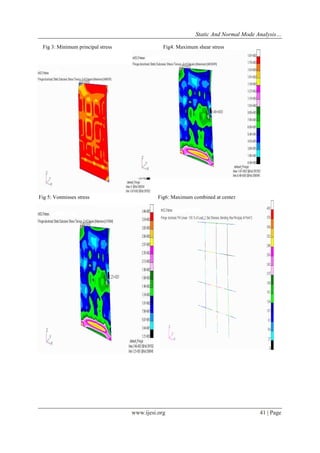
Physical Property: Aluminum Standard BSL 165 III. RESULT AND DISCUSSION In this present work the door is analyzed by following iterations. In iteration 1 the door skin sheet is analyzed without any stiffeners and the result obtained are not in allowable range, so the work is further proceeded for iteration 2 by providing 4Z shape stiffeners placed horizontally along with the door skin sheet and the results obtained are above the allowable limit, so the work is further proceeded to iteration3 by providing 2Z shape stiffeners vertically along with 4Z shape stiffeners horizontally. By analyzing with these provided stiffeners the door results are well below the allowable limit. Stiffeners provided were well enough to withstand the applied loads. But still there was a chance of heavy displacement so the work is further proceeded to iteration 4 by providing one more additional vertical stiffeners at the center and the door is analyzed the results are well below allowable limit and the displacement is also less and the reserve factor is greater than one (RF>1) as shown in table 1 In this present work if the aircraft frequency matches with the obtained frequency then there is a cause of resonance formation .so to avoid this we have performed normal analysis .Generally the aircraft frequency is in the range of 10 to 15 hz, in this present work obtained frequency are well below the aircraft normal frequency so there is a no chance of forming resonance as shown in table 2 results IV. FIGURE AND TABLES
Static And Normal Mode Analysis… 
www.ijesi.org 40 | Page 
Door skin with Z shape stiffeners 
Final analysis result (iteration 4) 
Fig 1: Displacement of color plot Fig 2: Maximum principal stress
Static And Normal Mode Analysis… 
www.ijesi.org 41 | Page 
Fig 3: Minimum principal stress Fig4: Maximum shear stress 
Fig 5: Vonmisses stress Fig6: Maximum combined at center
Static And Normal Mode Analysis… 
www.ijesi.org 42 | Page 
Table1: Conclusion for static analysis 
Table 2: Conclusion for normal mode analysis 
MODE 
FREQUENCY 
DISPLACEMENT 
1 
2.9881 
0.655 
2 
4.05 
1.23 
3 
4.27 
1.35 
4 
4.86 
1.16 
5 
5.04 
1.62 
V. CONCLUSION From the above static and normal mode analysis we have seen that stress, displacement and frequency are within the limit. In static analysis Z-shape stiffeners are provided for the door skin to provide resistance to the door and import strength to the door for the applied forces and pressure and for the normal mode analysis we have seen that the obtained frequency is in the range of 2-6 Hz less than that of the normal aircraft frequency i.e. 10-15 Hz. So there is no resonance which will not cause heavy vibration and catastrophic failure of the door structure. VI. FUTURE SCOPE OF THE PROJECT In this project the door skin and stiffeners are analyzed using the metallic material .In order to reduce the cost of the door assembly and weight .further the door skin along with stiffeners are made of composite so that there is an overall cost reduction and weight of the door structure. 
REFERENCES 
[1] Bombardier CRJ-200; WWW2. Bombardie.com 
[2] MICHAEL CHUN-YUNG NIU “Airframe structural design” practical design information and data on aircraft structures. 
[3] Muniyasamy Kalanchiam and Baskar Mannai “Topology Optimization of Aircraft Fuselage Structure”. 
SL.No 
Structure component 
Material Specification 
Type of stress 
Developed Stress(Mpa) 
Allowable stress(Mpa) 
Reserve Factor (RF) 
Remarks 
1 
Door skin with stiffeners 
Aluminum Standard: BSL 165 
Max Principal Stress 
334 
415 
1.24 
RF>1 structure is safe 
Minimum principal Stress 
367 
415 
1.13 
RF>1 structure is safe 
Max shear stress 
187 
247 
1.32 
RF>1 structure is safe 
Vonmises stress 
346 
415 
1.19 
RF>1 structure is safe 
Max combined at center 
403 
415 
1.02 
RF>1 structure is safe
Static And Normal Mode Analysis… 
www.ijesi.org 43 | Page 
[4] KHAIRI YUSUF, NUKMAN Y., S. Z. DAWAL,DEVI CHANDRA, N. SOFIA Conceptual Design of Fuselage Structure of Very Light Jet Aircraft”. 
[5] KANG JIANXIONG, GAO HANGSHAN, WANG FUSHENG, AND YUE ZHUFENG “Effect of Detail Design on Fatigue Performance of Aircraft Door Frame” Department of Engineering Mechanics, Northwestern Polytechnical University, Xi'an 710129, China [6] UKADGAONKER, VG; AWASARE, PJ; GADE, SV “Stress analysis of door and window of a passenger aircraft” 
[7] Z K Awad1, F Gonzalez2 and T Aravinthan “Advanced robust design optimization of FRP sandwich floor panels”. 1 Centre of Excellence in Engineering Fibre Composite (CEEFC), University of Southern Queensland (USQ), Toowoomba QLD 4350, AU 2 Faculty of Built Environment & Engineering, Queensland University of Technology (QUT), Brisbane, AU [8] SHAH, K., KANG, H., AND DESHMUKH, U., "Design of Dual Sliding Door for a Small-size Car and Its Validation Using CAE Tools," SAE Technical Paper 2007-01-0889, 2007, doi:10.4271/2007-01-0889. [9] DARYL GRUAR “AUTOMATION PROCESS OF „KING AIR‟ AIRCRAFT - CARGO DOOR DESIGN” C/o- Vaughn College of Aeronautics and Technology 86-01 23rd Ave Flushing, NY 11369 [10] BONNIE ROGERS, CHRIS HAMBLIN, & ALEX CHAPARRO “A Comparison of Two Evaluation Techniques for Technical Documentation” National Institute for Aviation

Static and Normal Mode Analysis of Aircraft Avionics Compartment Door

  • 1.
    International Journal ofEngineering Science Invention ISSN (Online): 2319 – 6734, ISSN (Print): 2319 – 6726 www.ijesi.org Volume 3 Issue 8 ǁ August 2014 ǁ PP.37-43 www.ijesi.org 37 | Page Static and Normal Mode Analysis of Aircraft Avionics Compartment Door Veerbhadrappa prabhushetty1, Sunil Mangshetty2 1. Post graduate student, Department of Mechanical Engineering, PDA College of Engineering, Gulbarga, Karnataka, India. 2. Associate Professor, Department of Mechanical Engineering, PDA College of Engineering, Gulbarga, Karnataka, India ABSTRACT : The aircraft has the following fuselage doors like Passenger door, Galley service door two overawing emergency exits, Flight compartment overhead escape hatch, Cargo door, Avionics compartment door, aft equipment compartment door. The avionics compartment door is used to gain access to the equipment in the avionics Compartment. It is located on the centerline of the lower forward fuselage. The door opens inward and moves up on four spring--loaded roller arms. The door is an important part of the airplane, and the reliability of opening the door has a great effect on flight safety. The inadvertent opening could lead to terrible consequence during flight. In this present work a conceptual design of aircraft door is done using cad software meshing using FEM and analysis using MSc Nastran. The static and normal mode analysis of aircraft door frame and stiffeners is done using aluminum material. KEYWORDS: Aircraft door, Static Analysis, Normal Analysis, Finite Element Model I. INTRODUCTION Passenger door The passenger door is located at the forward left side of the fuselage and is the main entrance and exit to the cabin area The passenger door incorporates integral stairs with a retractable lower step and folding handrails. The door is hinged at the cabin floor level and opens outward. A counter--balance mechanism with gas springs is used to take the weight of the door and to dampen the door movement at the fully open position, the door rests on a support wheel. Handrails are provided to assist passengers in boarding and disembarking. Mechanical linkages raise the handrails when the door is opened and collapse them when the door is closed. When a jet way is used, the handrails must be collapsed. Collapsing of the handrails is done by removing the forward and aft handrail quick--release pins (Refer to Lowering the Stair Handrails).Closing the passenger door from inside the aircraft is normally accomplished using the power assist system which is controlled from a DOOR ASSIST switch light on the forward flight attendants panel. The passenger door status is displayed on the EICAS primary page in the form of warning and caution messages and on the DOOR synoptic page. The DOOR synoptic page is displayed when selected from the EICAS control panel [1]. A. Static Analysis A static analysis calculates the effects of steady loading conditions on a structure, while ignoring inertia and damping effects, such as those caused by time-varying loads. A static analysis can, however, include steady inertia loads (such as gravity and rotational velocity), and time-varying loads that can be approximated as static equivalent loads (such as the static equivalent wind and seismic loads commonly defined in many building codes).Static analysis is used to determine the displacements, stresses, strains, and forces in structures or components caused by loads that do not induce significant inertia and damping effects. B. Normal Mode Analysis We use Normal mode analysis to determine the vibration characteristics (natural frequencies and mode shapes) of a structure or a machine component while it is being designed. It also can be a starting point for another, more detailed, dynamic analysis, such as a transient dynamic analysis, a harmonic response analysis, or a spectrum analysis. The natural frequencies and mode shapes are important parameters in the design of a structure for dynamic loading conditions,
  • 2.
    Static And NormalMode Analysis… www.ijesi.org 38 | Page II. METHODOLOGY AND MATERIAL The Finite Element Method Finite element method is a numerical analysis technique for obtaining approximate solutions to a wide variety of engineering problems. Although originally developed and applied to the broad field of continuum mechanics. Because of its diversity and flexibility as analysis tool, it is receiving much attention in engineering schools and industry. In more and more engineering situation today, it is necessary to obtain numerical solutions to problem rather than exact closed from solutions. The resourcefulness of the analyst usually comes to the rescue and provides several alternatives to overcome this dilemma. One possibility is to make simplifying assumption to ignore the difficulties and reduce the problem to one that can be handled sometimes this procedure works but more often than not it leads to series inaccurate or wrong answers. Now that computers are widely available, a more viable alternative is to retain the complexities of the problem and to find an approximate numerical solution. A finite element model of a problem gives a piecewise approximation to the governing equations‟. The basic premise of the finite element method is that a solution region can be analytically modeled or approximated by replacing it with an assemblage of discrete elements since these can be put together in a variety of ways, they can be put together in a variety of ways, and they can be used to represent exceedingly complex shape. Two features of the finite element method are to be noted a) The piecewise approximation of the physical field on finite elements provides Good precision even with simple approximating functions. Simply increasing the number of elements can achieve increasing precision. b) The locality of the approximation leads to sparse equation systems for a discredited problem. This helps to ease the solution of problems having very large numbers of nodal unknowns. it is not uncommon today to solve Systems. Containing a million primary unknowns. Solution Procedure Using FEM Software All finite element packages require the user to go through these steps in one form to another  Specifying Geometry- First the geometry of the structure to be analyzed is defined this can be done either by entering the geometric information in the finite element package through the keyboard or mouse or by importing the model from a solid modeler like Pro-ENGINEER.  Specify Element Type and Material Properties- Next, the material properties are defined. In an elastic analysis of an isotropic solid these consist of the Young‟s modulus and Poisson‟s ratio of the material.  Mesh the Object-Then the structure is meshed into small elements. This involves defining the types of elements into which the structure will be broken, as well as Specifying how the structure will be subdivided into elements.  Apply Boundary conditions and External Loads- Next, the boundary conditions e.g. .location of supports and the external loads are specified.  Generate a solution- Then the solution is generated based on the previously input parameters.  Post processing- Based on the initial conditions and applied loads, data is returned after a solution is processed. This data can be viewed in a variety of graphs and displays.  Refine the Mesh- Finite element methods are approximate methods and, in General, the accuracy of the approximation increases with the number of elements Used. The number of elements needed for an accurate model depends on the Problem and the specific results to be extracted from it. Thus, in order to judge the number of elements in the object and see if or how the results change.  Interpreting Results- This step is perhaps the most critical step in the entire Knowledge of mechanics to interpret and understand the output of the model. This is critical for applying correct results to solve real engineering problems and in identifying when modeling mistakes have been made. Thickness (mm) Proof strength (min) Tensile strength (mm) Elongation %(mm) Over 0.4 up to and include 0.8 350 415 7 Over 0.8 up to and include 1.6 350 420 8 Over 1.6 up to and include 6.0 370 420 9 Material Property: Aluminum Standard BSL 165
  • 3.
    Static And NormalMode Analysis… www.ijesi.org 39 | Page Physical property Value Density 2.80 g/cm3 Melting point 640 Thermal expansion 22.8*10-6 k Modulus of elasticity 73Gpa Thermal conductivity 155 w/m.k Electrical resistivity 40%IACS Physical Property: Aluminum Standard BSL 165 III. RESULT AND DISCUSSION In this present work the door is analyzed by following iterations. In iteration 1 the door skin sheet is analyzed without any stiffeners and the result obtained are not in allowable range, so the work is further proceeded for iteration 2 by providing 4Z shape stiffeners placed horizontally along with the door skin sheet and the results obtained are above the allowable limit, so the work is further proceeded to iteration3 by providing 2Z shape stiffeners vertically along with 4Z shape stiffeners horizontally. By analyzing with these provided stiffeners the door results are well below the allowable limit. Stiffeners provided were well enough to withstand the applied loads. But still there was a chance of heavy displacement so the work is further proceeded to iteration 4 by providing one more additional vertical stiffeners at the center and the door is analyzed the results are well below allowable limit and the displacement is also less and the reserve factor is greater than one (RF>1) as shown in table 1 In this present work if the aircraft frequency matches with the obtained frequency then there is a cause of resonance formation .so to avoid this we have performed normal analysis .Generally the aircraft frequency is in the range of 10 to 15 hz, in this present work obtained frequency are well below the aircraft normal frequency so there is a no chance of forming resonance as shown in table 2 results IV. FIGURE AND TABLES
  • 4.
    Static And NormalMode Analysis… www.ijesi.org 40 | Page Door skin with Z shape stiffeners Final analysis result (iteration 4) Fig 1: Displacement of color plot Fig 2: Maximum principal stress
  • 5.
    Static And NormalMode Analysis… www.ijesi.org 41 | Page Fig 3: Minimum principal stress Fig4: Maximum shear stress Fig 5: Vonmisses stress Fig6: Maximum combined at center
  • 6.
    Static And NormalMode Analysis… www.ijesi.org 42 | Page Table1: Conclusion for static analysis Table 2: Conclusion for normal mode analysis MODE FREQUENCY DISPLACEMENT 1 2.9881 0.655 2 4.05 1.23 3 4.27 1.35 4 4.86 1.16 5 5.04 1.62 V. CONCLUSION From the above static and normal mode analysis we have seen that stress, displacement and frequency are within the limit. In static analysis Z-shape stiffeners are provided for the door skin to provide resistance to the door and import strength to the door for the applied forces and pressure and for the normal mode analysis we have seen that the obtained frequency is in the range of 2-6 Hz less than that of the normal aircraft frequency i.e. 10-15 Hz. So there is no resonance which will not cause heavy vibration and catastrophic failure of the door structure. VI. FUTURE SCOPE OF THE PROJECT In this project the door skin and stiffeners are analyzed using the metallic material .In order to reduce the cost of the door assembly and weight .further the door skin along with stiffeners are made of composite so that there is an overall cost reduction and weight of the door structure. REFERENCES [1] Bombardier CRJ-200; WWW2. Bombardie.com [2] MICHAEL CHUN-YUNG NIU “Airframe structural design” practical design information and data on aircraft structures. [3] Muniyasamy Kalanchiam and Baskar Mannai “Topology Optimization of Aircraft Fuselage Structure”. SL.No Structure component Material Specification Type of stress Developed Stress(Mpa) Allowable stress(Mpa) Reserve Factor (RF) Remarks 1 Door skin with stiffeners Aluminum Standard: BSL 165 Max Principal Stress 334 415 1.24 RF>1 structure is safe Minimum principal Stress 367 415 1.13 RF>1 structure is safe Max shear stress 187 247 1.32 RF>1 structure is safe Vonmises stress 346 415 1.19 RF>1 structure is safe Max combined at center 403 415 1.02 RF>1 structure is safe
  • 7.
    Static And NormalMode Analysis… www.ijesi.org 43 | Page [4] KHAIRI YUSUF, NUKMAN Y., S. Z. DAWAL,DEVI CHANDRA, N. SOFIA Conceptual Design of Fuselage Structure of Very Light Jet Aircraft”. [5] KANG JIANXIONG, GAO HANGSHAN, WANG FUSHENG, AND YUE ZHUFENG “Effect of Detail Design on Fatigue Performance of Aircraft Door Frame” Department of Engineering Mechanics, Northwestern Polytechnical University, Xi'an 710129, China [6] UKADGAONKER, VG; AWASARE, PJ; GADE, SV “Stress analysis of door and window of a passenger aircraft” [7] Z K Awad1, F Gonzalez2 and T Aravinthan “Advanced robust design optimization of FRP sandwich floor panels”. 1 Centre of Excellence in Engineering Fibre Composite (CEEFC), University of Southern Queensland (USQ), Toowoomba QLD 4350, AU 2 Faculty of Built Environment & Engineering, Queensland University of Technology (QUT), Brisbane, AU [8] SHAH, K., KANG, H., AND DESHMUKH, U., "Design of Dual Sliding Door for a Small-size Car and Its Validation Using CAE Tools," SAE Technical Paper 2007-01-0889, 2007, doi:10.4271/2007-01-0889. [9] DARYL GRUAR “AUTOMATION PROCESS OF „KING AIR‟ AIRCRAFT - CARGO DOOR DESIGN” C/o- Vaughn College of Aeronautics and Technology 86-01 23rd Ave Flushing, NY 11369 [10] BONNIE ROGERS, CHRIS HAMBLIN, & ALEX CHAPARRO “A Comparison of Two Evaluation Techniques for Technical Documentation” National Institute for Aviation