Modeling of Silicon Nanowire For Electrical
Mobility and Resistance
By Praveen Dwivedi
M.Tech In VLSI Systems & Technology (V.S.T.)
Under the Guidance of
Dr. Sitangshu Bhattacharya
Assistant Professor
Shiv Nadar University
Tuesday, May 27, 2014 1
School of Engineering, Department of Electrical Engineering
Shiv Nadar University
Final Presentation Of M.Tech Thesis
Contents
 Introduction of nanoelectronics.
 Physics of Nanoelectronics.
 My work of M.Tech thesis and Future work.
 References.
Tuesday, May 27, 2014 2
School of Engineering, Department of Electrical Engineering
Shiv Nadar University
1.Introduction of Nanoelectronics.
Nanoelectronics refers to the use of nanotechnology in
electronics components. The term covers a diverse set of
devices and materials which have the common characteristic
that they are very small and the range of this technology lies
between 100 nm to 1nm.
Tuesday, May 27, 2014 3
School of Engineering, Department of Electrical Engineering
Shiv Nadar University
Why we are going beyond CMOS technology or
interested in Nanoelectronics
Problem in nanoscale MOSFET due to Scaling are given below-
1. Sub threshold leakage current.
2. Hot carrier effects.
3. Direct source to drain tunneling.
4. Direct tunneling , gate leakage current.
5. Parasitic resistance, parasitic capacitance.
6. Reverse –biased junction leakage current.
Tuesday, May 27, 2014 4
School of Engineering, Department of Electrical Engineering
Shiv Nadar University
Solution for these given problem
1. New materials , new device architectures and new design are
possible solution to CMOS scaling issue.
2. Noval device and novel material are considered as promising
candidate for beyond technology nodes, including, Planner
DG MOSFET, FINFET, vertical DG MOSFET, Trigate
MOSFET and gate all around devices.
3. New material Si nanowire, Graphene, carbon nanotube.
4. However which device , material will be final winner for
future circuit is still unclear.
Tuesday, May 27, 2014 5
School of Engineering, Department of Electrical Engineering
Shiv Nadar University
Advantages of Nanodevice
1. These nanodevice take the advantage of quantum mechanical
phenomena and ballistic transport characteristics under the
lower supply voltage hence low power consumption.
2. These device offered ultra high density integrated electronics
due to their extremely small size.
Problem- It also increase the defects and variations both during
manufacture and chip operations.
Tuesday, May 27, 2014 6
School of Engineering, Department of Electrical Engineering
Shiv Nadar University
Description of Silicon nanowire according to ITRS
[2,3]
 Potential Value of Material
 Low surface scattering due to one dimensional.
 High control of Leakage by Gate.
 Key challenges
 Nanowires has key challenge to grow in desired location and
desired direction.
 Nanowires has challenge of catalyst compatible with CMOS
processing.
 Challenge for dope nanowires channel and source/ drain regions.
 Challenge to achieve the high, electron and hole mobility on
silicon.
 Challenge in pattern surround gate structure .
[Source-ITRS]
Tuesday, May 27, 2014 7
School of Engineering, Department of Electrical Engineering
Shiv Nadar University
Key Factors (advantages) of Silicon Nanowires
 Cost -effective bottom-up fabrication
 Higher carrier mobility by reduction of scattering due to
crystalline structure.
 Smooth surface and ability to produce radial and axial
nanowires heterostructure.
 Better scalability resulting from the fact that diameter of
nanowires can be controlled down to below 10nm.
[Refe-3]
Tuesday, May 27, 2014 8
School of Engineering, Department of Electrical Engineering
Shiv Nadar University
Physics of Nanoelectronics
 General model of a nanodevice.
 The ballistic and Scattering.
 My work of M.Tech Thesis and future work.
Tuesday, May 27, 2014 9
School of Engineering, Department of Electrical Engineering
Shiv Nadar University
General model of a nanodevice by Landauer-Datta
Tuesday, May 27, 2014 10
School of Engineering, Department of Electrical Engineering
Shiv Nadar University
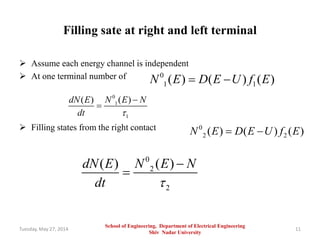
Filling sate at right and left terminal
 Assume each energy channel is independent
 At one terminal number of
 Filling states from the right contact
Tuesday, May 27, 2014 11
0
1 1( ) ( ) ( )N E D E U f E 
0
2 2( ) ( ) ( )N E D E U f E 
0
2
2
( )( ) N E NdN E
dt 


0
1
1
( )( ) N E NdN E
dt 


School of Engineering, Department of Electrical Engineering
Shiv Nadar University
Steady State
Tuesday, May 27, 2014 12
0
1 2
1 2
( )
0
N N N NdN E
dt  
 
  
       0 0
1 1 2 2 2 21 1 1 1 0N N N N      
 
   
 
   
1 20 0
1 2
1 2 1 2
1 1
( ) ( ) ( )
1 1 1 1
N E N E N E
 
   
 
 
1
1
h


 2
2
h



School of Engineering, Department of Electrical Engineering
Shiv Nadar University
Physics Of Nanoelectronics
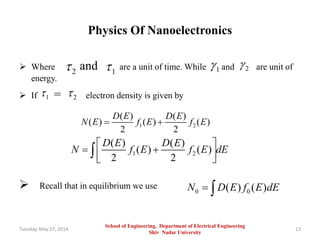
 Where and are a unit of time. While and are unit of
energy.
 If = electron density is given by
 Recall that in equilibrium we use
Tuesday, May 27, 2014 13
2 1 1 2
1 2
1 2
( ) ( )
( ) ( ) ( )
2 2
D E D E
N E f E f E 
1 2
( ) ( )
( ) ( )
2 2
D E D E
N f E f E dE
 
   

0 0( ) ( )N D E f E dE 
School of Engineering, Department of Electrical Engineering
Shiv Nadar University
Steady-State Current, I
Tuesday, May 27, 2014 14
Contact 1 tries to fill up the
device according to its
Fermi level
Contact 2 tries to fill up
the device according to
its Fermi level
1 2 0F F  Total flux
1 2I qF qF   Current
School of Engineering, Department of Electrical Engineering
Shiv Nadar University
Physics Of Nanoelectronics
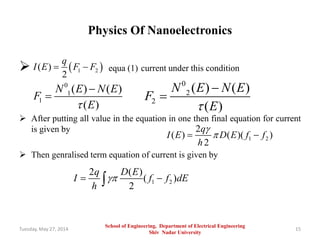
 equa (1) current under this condition
 After putting all value in the equation in one then final equation for current
is given by
 Then genralised term equation of current is given by
Tuesday, May 27, 2014 15
 1 2( )
2
q
I E F F 
0
1
1
( ) ( )
( )
N E N E
F
E


0
2
2
( ) ( )
( )
N E N E
F
E


1 2
2
( ) ( )( )
2
q
I E D E f f
h

 
1 2
2 ( )
( )
2
q D E
I f f dE
h
 
School of Engineering, Department of Electrical Engineering
Shiv Nadar University
Physics Of Nanoelectronics
 Transmission coefficient is given by
T(E) is decide the types of transport.
 λ=mean free path or Carrier backscattering length.
 L=channel length
 Diffusive L>>λ then
 Ballistic L<<λ then T=1
 Quasi Ballistic then T<1.
Tuesday, May 27, 2014 16
1 2
1 2
2 ( )
( ) ( )
2
2
( ) ( )( )
q D E
I E f f dE
h
q
I T E M E f f dE
h
  
 

 ( )
( )
( )
E
T E
E L




T
L


L 
School of Engineering, Department of Electrical Engineering
Shiv Nadar University
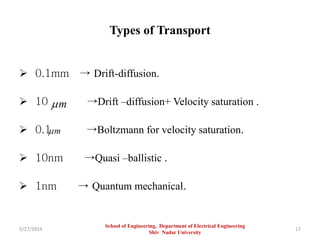
Types of Transport
 0.1mm → Drift-diffusion.
 10 →Drift –diffusion+ Velocity saturation .
 0.1 →Boltzmann for velocity saturation.
 10nm →Quasi –ballistic .
 1nm → Quantum mechanical.
5/27/2014 17
m
m
School of Engineering, Department of Electrical Engineering
Shiv Nadar University
Conductance and Resistance of Ballistic and
Diffusive case
 Ballistic conductance is given by
 According to relation
 After solving above equation then ballistic conductance is
given by
 Then ballistic resistance is given by
5/27/2014 18
2
02
( ) ( )
q f
G T E M E dEV
h E


 
  
 

2
2
( ) ( )ball
q
G M E T E
h

2
1 12.8
( ) 2
ball
F
h K
R
M E q M

 
School of Engineering, Department of Electrical Engineering
Shiv Nadar University
0
( )F
f
E
E




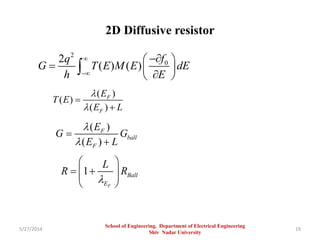
2D Diffusive resistor
5/27/2014 19
2
02
( ) ( )
fq
G T E M E dE
h E


 
  
 

( )
( )
( )
F
F
E
T E
E L




( )
( )
F
ball
F
E
G G
E L




1
F
Ball
E
L
R R

 
   
 
School of Engineering, Department of Electrical Engineering
Shiv Nadar University
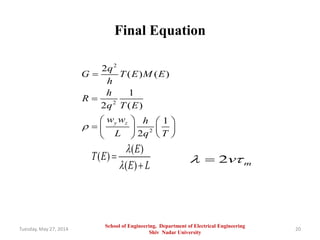
Final Equation
Tuesday, May 27, 2014 20
2
2
2
2
( ) ( )
1
2 ( )
1
2
y z
q
G T E M E
h
h
R
q T E
w w h
L q T



   
    
  
( )
( )
( )
E
T E
E L




School of Engineering, Department of Electrical Engineering
Shiv Nadar University
2 mv 
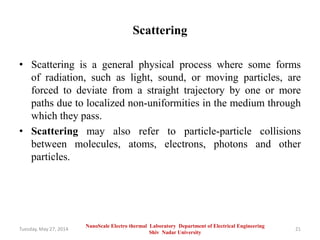
Scattering
• Scattering is a general physical process where some forms
of radiation, such as light, sound, or moving particles, are
forced to deviate from a straight trajectory by one or more
paths due to localized non-uniformities in the medium through
which they pass.
• Scattering may also refer to particle-particle collisions
between molecules, atoms, electrons, photons and other
particles.
Tuesday, May 27, 2014 21
NanoScale Electro thermal Laboratory Department of Electrical Engineering
Shiv Nadar University
Tuesday, May 27, 2014 22
School of Engineering, Department of Electrical Engineering
Shiv Nadar University
Lattice Scattering
• Because much of the scattering in semiconductor is due to
lattice vibrations, it is important that we understand their basic
properties. If an atom is displaced from its equilibrium
position , the bonding forces tend to push it back , so it
oscillates about its equilibrium site.
Tuesday, May 27, 2014 23
School of Engineering, Department of Electrical Engineering
Shiv Nadar University
Tuesday, May 27, 2014 24
School of Engineering, Department of Electrical Engineering
Shiv Nadar University
Tuesday, May 27, 2014 25
School of Engineering, Department of Electrical Engineering
Shiv Nadar University
Tuesday, May 27, 2014 26
School of Engineering, Department of Electrical Engineering
Shiv Nadar University
Tuesday, May 27, 2014 27
School of Engineering, Department of Electrical Engineering
Shiv Nadar University
Tuesday, May 27, 2014 28
School of Engineering, Department of Electrical Engineering
Shiv Nadar University
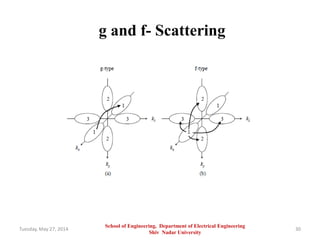
Types of Scattering
• Intravalley Scattering –This types scattering assume that the
initial and final states of electron are within the same valley.
• Intervalley scattering - An electron can be scattered from
one valley to another one both by acoustic and optical
phonons.
This scattering process is subdivided into
f -type and g-type process .
 A process is refereed to as f-type if the initial and final
orientation are different otherwise as g-type process.
Tuesday, May 27, 2014 29
School of Engineering, Department of Electrical Engineering
Shiv Nadar University
g and f- Scattering
Tuesday, May 27, 2014 30
School of Engineering, Department of Electrical Engineering
Shiv Nadar University
Calculation of Electrical Resistance & Mobility
• We address a physics based analytical model of electrical resistance and
mobility in an n-silicon nanowire (sinw) under influence of intra
and intervalleyscattering (IVS) to detremine Role of First Order Intervalley
Scattering in Determining Electrical Resistance of Silicon Nanowire.
• Transmission coefficient under the scattering is given by
• G= Scattering contribution due to g-type scattering.
• F= Scattering contribution due to f-type scattering.
• A=Intravalley scattering contribution by acoustic phonons.
Tuesday, May 27, 2014 31
1
1
T
G F A

  
2
1
2
y zw w h
L q T

   
    
   2
1
2 ( )
h
R
q T E

1
2
D
L qT
n h
 
School of Engineering, Department of Electrical Engineering
Shiv Nadar University
Fig.1 Resistance vs Width
Tuesday, May 27, 2014 32
School of Engineering, Department of Electrical Engineering
Shiv Nadar University
Fig.2 Resistivity vs Temperature
Tuesday, May 27, 2014 33
School of Engineering, Department of Electrical Engineering
Shiv Nadar University
Fig.3 Resistance vs length
Tuesday, May 27, 2014 34
School of Engineering, Department of Electrical Engineering
Shiv Nadar University
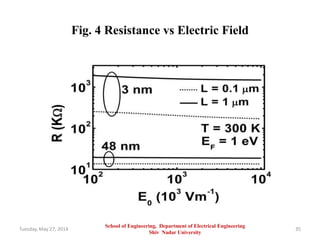
Fig. 4 Resistance vs Electric Field
Tuesday, May 27, 2014 35
School of Engineering, Department of Electrical Engineering
Shiv Nadar University
Fig.5 Resistance vs Temperature
Tuesday, May 27, 2014 36
School of Engineering, Department of Electrical Engineering
Shiv Nadar University
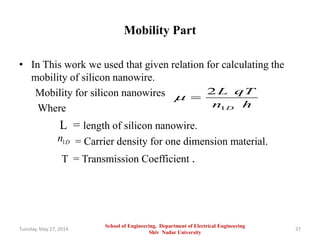
Mobility Part
• In This work we used that given relation for calculating the
mobility of silicon nanowire.
Mobility for silicon nanowires
Where
L = length of silicon nanowire.
= Carrier density for one dimension material.
T = Transmission Coefficient .
Tuesday, May 27, 2014 37
1
2
D
L qT
n h
 
1Dn
School of Engineering, Department of Electrical Engineering
Shiv Nadar University
Fig. 1. Variation of mobility over temperature under three different
scattering conditions
Tuesday, May 27, 2014 38
School of Engineering, Department of Electrical Engineering
Shiv Nadar University
Fig. 2 Variation of mobility over length of silicon nanowires under the
scattering of intervalley+intravalley, intervalley, intravallley scattering
Tuesday, May 27, 2014 39
• .
School of Engineering, Department of Electrical Engineering
Shiv Nadar University
Fig. 3 Variation of mobility over electric filed under the three scattering
Tuesday, May 27, 2014 40
School of Engineering, Department of Electrical Engineering
Shiv Nadar University
Conclusion
• Scattering is an important phenomenon in a MOSFET which affects the
device performance. Mobility strongly dependents on both intervalley and
intravalley scattering and increase in a parabolic manner under the variation
of gate length. Mobility decreases as the temperature increases and
mobility decreases more rapidly under the influence of intravalley
scattering under the variation of temperature.
• We find that the resistivity in the presence of an external longitudinal
electric field is more dominated by f-processes with allowed first order TA
and TO interactions which suggests that there are electron repopulation
From to the valleys. However for higher cross-sectional dimensions,
the resistance starts to weakly Depending on the electric field.
Tuesday, May 27, 2014 41
School of Engineering, Department of Electrical Engineering
Shiv Nadar University
2
4
Future work
• Based on my M.Tech thesis work I am interested in Non
equilibrium Green’s Function (NEGF) method to calculate the
various electrical parameters of silicon nanowire.
Tuesday, May 27, 2014 42
School of Engineering, Department of Electrical Engineering
Shiv Nadar University
References
1. Jing Wang, “Device Physics and Simulation of Silicon Nanowire Transistors", Ph.D. dissertation, Purdue
University August 2005.
2. Runsheng Wang, Jing Zhuge, Ru Huang, Tao Yu, JibinZou, Dong-Won Kim, Dungun Park, and Yangyuan
Wang, “Investigation on Variability in Metal-Gate Si Nanowire MOSFETs: Analysis of Variation Sources
and Experimental Characterization” IEEE Transactions On Electron Devices, Vol. 58, No. 8,pp.2317-2318,
August 2011.
3. Yong-Bin Kim, “Review Paper: Challenges for Nanoscale MOSFETs and Emerging Nanoelectronics”,
Trans. Electr. Electron.Mater.10(1) 21 (2009), G.-D.Hong et al.
4. Huang R, Wu H M, Kang J F, et al. Challenges of 22 nm and beyond CMOS technology. Sci China Ser F-
InfSci, 2009, 52(9):1491–1533, doi: 10.1007/s11432-009-0167-9.
5. International Technology Roadmap for Semiconductors 2011 Edition Emerging Research Materials pp. 1-
15.
6. International Technology Roadmap for Semiconductors 2011 Edition Emerging Research Devices pp. 1-16.
7. Yuting Wan, Jian Sha, Bo Chen, Yanjun Fang, Zongli Wang, and Yewu Wang “Nanodevices Based on
Silicon Nanowires” Recent Patents on Nanotechnology,pp.1-4,2009 Bentham Science Publishers Ltd.
Tuesday, May 27, 2014 43
School of Engineering, Department of Electrical Engineering
Shiv Nadar University
References
8. Soshi Sato, “A Study on Electrical Characteristics of Silicon Nanowire Field Effect Transistors” Ph.D.
dissertation Tokyo institute of technology, 2008.
9. Allon I. Hochbaum, Renkun Chen, Raul Diaz Delgado, Wenjie Liang, Erik C. Garnett, Mark Najarian3,Arun
Majumdar&Peidong Yang “Enhanced thermoelectric performance of rough silicon nanowires”Vol 451| 10
January 2008|,pp.163-167, doi:10.1038/nature06381.
10. Yonatan Calahorra, “Electrical and Mechanical Propertiesof Silicon Nanowires”, Master of Science
dissertation, Israel Institute of Technology February 2010 pp. 5-30.
11. “Intel reinvents transistors using new 3-D structure” , Available online.
12. Y. Li, K. Buddharaju, B. C. Tinh, N. Singh, and S. J. Lee, “Improvedvertical silicon nanowire based
thermoelectric power generator with polyimide filling”, IEEE Electron Dev. Lett., vol.33, pp. 715-717,
(2012).
13. A. K. Buin, A. Verma, A. Svizhenko and M. P. Anantram, “Significant Enhancement of Hole Mobility in
[110] Silicon Nanowires, Compared to Electrons and Bulk Silicon”, Nano Lett., vol. 8, pp. 760-765, (2008).
14. E. B. Ramayya, D. Vasileska, S. M. Goodnick and I. Knezevic, “Electron transport in silicon nanowires:
The role of acoustic phonon confinement and surface roughness scattering”, J. Appl. Phys., vol. 104, pp.
063711 (1)-(12), (2008).
Tuesday, May 27, 2014 44
School of Engineering, Department of Electrical Engineering
Shiv Nadar University
References
15. D. Yu, Y. Zhang and F. Liu, “First-principles study of electronic properties of biaxially strained silicon:
Effects on charge carrier mobility”, Phys. Rev. B, vol. 78, pp. 245204 (1)-(8), (2008).
16. M. Frey, A. Esposito and A. Schenk, “Computational comparison of conductivity and mobility models for
silicon nanowire devices”, J Appl. Phys., vol. 109, pp. 083707(1)-(6), (2011).
17. S. Jin, Y. J. Park and H. S. Min, “A three-dimensional simulation of quantum transport in silicon nanowire
transistor in the presence of electron-phonon interactions”, J. Appl. Phys.,vol. 99, 123719 (1)-(10),
(2006).
18. A. I. Hochbaum, R. Chen, R. D. Delgado, W. Liang, E. C. Garnett, M. Najarian, A. Majumdar and P. Yang,
“Enhanced thermoelectric performance of rough silicon nanowires”, Nature Lett., vol. 451, pp. 163-
167,(2007).
Tuesday, May 27, 2014 45
School of Engineering, Department of Electrical Engineering
Shiv Nadar University
Credit for M.Tech Degree
• First Credit to Shiv Nadar University.
• Major Credit to Sitangshu Sir and his motivation for Ph.D.
• Third Credit to My all Faculty and All friends.
Tuesday, May 27, 2014 46
School of Engineering, Department of Electrical Engineering
Shiv Nadar University
Tuesday, May 27, 2014 47
School of Engineering, Department of Electrical Engineering
Shiv Nadar University
Tuesday, May 27, 2014 48
School of Engineering, Department of Electrical Engineering
Shiv Nadar University
Tuesday, May 27, 2014 49
School of Engineering, Department of Electrical Engineering
Shiv Nadar University
Tuesday, May 27, 2014 50
School of Engineering, Department of Electrical Engineering
Shiv Nadar University
Tuesday, May 27, 2014
NanoScale Electro thermal Laboratory
Department of Electrical Engineering
Shiv Nadar University
51
Tuesday, May 27, 2014
NanoScale Electro thermal Laboratory
Department of Electrical Engineering
Shiv Nadar University
52
Part I
• We determining the mobility of silicon nanowires under the influence of
intra & intervalley scattering has been presented. The relationship of
Landauer transmission coefficient with scattering process has been
derived. This transmission coefficient has been used to determine the
mobility of silicon nanowires. The effect of longitudinal electric field,
temperature and length of silicon nanowire on the mobility of silicon
nanowires has been shown. This study has been done under the influence
of intra+intervalley, intervalley and intravalley scattering. The core aim of
this paper is to show the affects of scattering on the mobility of silicon
nanowire.
Tuesday, May 27, 2014 53
NanoScale Electro thermal Laboratory Department of Electrical Engineering
Shiv Nadar University
Tuesday, May 27, 2014 54
NanoScale Electro thermal Laboratory
Department of Electrical Engineering
Shiv Nadar University
My Work for 4th Semester
• In Part 1 We Calculated the mobility of silicon nanowires under the
influence of intra & intervalley scattering has been presented.
• In part 2 we Calculated the current for [100] Oriented silicon Nanowire by
Non equilibrium Green’s Function (NEGF) and Atomistix ToolKit (ATK).
Tuesday, May 27, 2014 55
NanoScale Electro thermal Laboratory Department of Electrical Engineering
Shiv Nadar University
Tuesday, May 27, 2014 56
School of Engineering, Department of Electrical Engineering
Shiv Nadar University
Tuesday, May 27, 2014
NanoScale Electro thermal Laboratory
Department of Electrical Engineering
Shiv Nadar University
57
Tuesday, May 27, 2014
NanoScale Electro thermal Laboratory
Department of Electrical Engineering
Shiv Nadar University
58
Tuesday, May 27, 2014
NanoScale Electro thermal Laboratory
Department of Electrical Engineering
Shiv Nadar University
59
Part II
• Under this work we calculated the Electrical current [100]
Oriented Silicon Nanowire by the Non-equilibrium Green’s
Function Method (NEGF) and Atomistix Tool Kit(ATK).
Tuesday, May 27, 2014 60
NanoScale Electro thermal Laboratory Department of Electrical Engineering
Shiv Nadar University
What is NEGF
• Non equilibrium Green function method which being widely
used in the analysis and design of nanoscale device it provide
a unified description for all kind of device from molecular to
carbon nanotube to silicon nanowire transistor in term of the
Hamiltonian describing the energy level of channel, the self
energy describing the connection to the contact and
describing the interaction inside the channel.
• The NEFG formalism provides a sound conceptual basis for
the development Of quantitative model for quantum transport .
Tuesday, May 27, 2014 61
NanoScale Electro thermal Laboratory Department of Electrical Engineering
Shiv Nadar University
Motivation
 Calculation of current in nanoscale devices
 Scale too small to apply drift-diffusion
 Current is a non-equilibrium quantity
 Schrodinger-Poisson only applicable in equilibrium
 Need a method which can handle:
1. Non-equilibrium conditions
2. Scattering mechanisms
3. 2D/3D and approximate many-body problems
Tuesday, May 27, 2014 62
NanoScale Electro thermal Laboratory Department of Electrical Engineering
Shiv Nadar University
What are our options
:
 Self-consistent quantum drift-diffusion model (complicated)
 Monte Carlo methods (expensive)
 Non-equilibrium Green's function formalism (this is option)
Tuesday, May 27, 2014 63
NanoScale Electro thermal Laboratory Department of Electrical Engineering
Shiv Nadar University
Advantages of Non-Equilibrium Green’s Function
Method
: Incorporation of quantum interference effects such as
tunnelling and diffraction, not possible through the Boltzmann
equation.
 Mathematically accurate approach to include rigorous
scattering (electron-phonon scattering, surface scattering etc).
 Eliminates periodic boundary conditions as outgoing waves
are planar.
 Multiscale formulation: Can be used to solve atomistic
systems to mesoscopic systems.
Tuesday, May 27, 2014 64
NanoScale Electro thermal Laboratory Department of Electrical Engineering
Shiv Nadar University
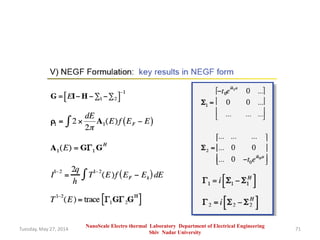
Nonequilibrium Green’s Function Method
:
Tuesday, May 27, 2014 65
NanoScale Electro thermal Laboratory Department of Electrical Engineering
Shiv Nadar University
Tuesday, May 27, 2014 66
NanoScale Electro thermal Laboratory Department of Electrical Engineering
Shiv Nadar University
Tuesday, May 27, 2014 67
NanoScale Electro thermal Laboratory Department of Electrical Engineering
Shiv Nadar University
Tuesday, May 27, 2014 68
NanoScale Electro thermal Laboratory Department of Electrical Engineering
Shiv Nadar University
Tuesday, May 27, 2014 69
NanoScale Electro thermal Laboratory Department of Electrical Engineering
Shiv Nadar University
Tuesday, May 27, 2014 70
NanoScale Electro thermal Laboratory Department of Electrical Engineering
Shiv Nadar University
Tuesday, May 27, 2014 71
NanoScale Electro thermal Laboratory Department of Electrical Engineering
Shiv Nadar University
Tuesday, May 27, 2014 72
NanoScale Electro thermal Laboratory Department of Electrical Engineering
Shiv Nadar University
Fig.1 Current vs Voltage
Tuesday, May 27, 2014 73
NanoScale Electro thermal Laboratory Department of Electrical Engineering
Shiv Nadar University
Fig.2 Resistance vs Voltage
Tuesday, May 27, 2014 74
NanoScale Electro thermal Laboratory Department of Electrical Engineering
Shiv Nadar University
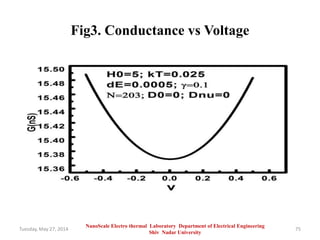
Fig3. Conductance vs Voltage
Tuesday, May 27, 2014 75
NanoScale Electro thermal Laboratory Department of Electrical Engineering
Shiv Nadar University
Reference
1. NANOSCALE TRANSISTORS Device Physics, Modeling and Simulation by
Mark Lundstrom & Jing Guo.
2. International technology roadmap for semiconductors 2011 edition
emerging research devices.
3. International technology roadmap for semiconductors 2011 edition
emerging research materials.
4. Review Paper: Challenges for Nanoscale MOSFETs and Emerging
Nanoelectronics by gone-Bin Kim.
Tuesday, May 27, 2014 76
NanoScale Electro thermal Laboratory Department of Electrical Engineering
Shiv Nadar University
Tuesday, May 27, 2014
NanoScale Electro thermal Laboratory
Department of Electrical Engineering
Shiv Nadar University
77
My Result
• Thank You
Tuesday, May 27, 2014 78
NanoScale Electro thermal Laboratory Department of Electrical Engineering
Shiv Nadar University
Content
• Introduction
• Solving the Wave Equation
• Computing n(x)
• Computing ID
• NEGF Formulation
• Scattering
• Summary
Tuesday, May 27, 2014 79
NanoScale Electro thermal Laboratory Department of Electrical Engineering
Shiv Nadar University
Tuesday, May 27, 2014
NanoScale Electro thermal Laboratory
Department of Electrical Engineering
Shiv Nadar University
80
2
2
2
2
( ) ( )
1
2 ( )
1
2
y z
q
G T E M E
h
h
R
q T E
w w h
L q T



   
    
  
Proposed work for next Semester
• My proposed work for next semester will be determine the
electrical current in an n-silicon nanowire (sinw) under
influence of intra and intervalleyscattering (IVS).
• Current in linear region
• Current under saturation region
Tuesday, May 27, 2014 81
( )
2
T
D el ox GS T DS
B L
v
I T WC V V V
k T
q
 
 
 
 
( )
2
el
D ox T GS T
el
T
I WC v V V
T
 
  
 
NanoScale Electro thermal Laboratory Department of Electrical Engineering
Shiv Nadar University
• Transmission coefficient under the scattering is given by
• G= Scattering contribution due to g-type scattering.
• F= Scattering contribution due to f-type scattering.
• A=Intravalley scattering by acoustic phonons.
Tuesday, May 27, 2014
NanoScale Electro thermal Laboratory Department of Electrical Engineering Shiv Nadar
University
82
1
1
T
G F A

  
2
1
2
y zw w h
L q T

   
    
  
2
1
2 ( )
h
R
q T E


Final m.tech ppt_praveen

  • 1.
    Modeling of SiliconNanowire For Electrical Mobility and Resistance By Praveen Dwivedi M.Tech In VLSI Systems & Technology (V.S.T.) Under the Guidance of Dr. Sitangshu Bhattacharya Assistant Professor Shiv Nadar University Tuesday, May 27, 2014 1 School of Engineering, Department of Electrical Engineering Shiv Nadar University Final Presentation Of M.Tech Thesis
  • 2.
    Contents  Introduction ofnanoelectronics.  Physics of Nanoelectronics.  My work of M.Tech thesis and Future work.  References. Tuesday, May 27, 2014 2 School of Engineering, Department of Electrical Engineering Shiv Nadar University
  • 3.
    1.Introduction of Nanoelectronics. Nanoelectronicsrefers to the use of nanotechnology in electronics components. The term covers a diverse set of devices and materials which have the common characteristic that they are very small and the range of this technology lies between 100 nm to 1nm. Tuesday, May 27, 2014 3 School of Engineering, Department of Electrical Engineering Shiv Nadar University
  • 4.
    Why we aregoing beyond CMOS technology or interested in Nanoelectronics Problem in nanoscale MOSFET due to Scaling are given below- 1. Sub threshold leakage current. 2. Hot carrier effects. 3. Direct source to drain tunneling. 4. Direct tunneling , gate leakage current. 5. Parasitic resistance, parasitic capacitance. 6. Reverse –biased junction leakage current. Tuesday, May 27, 2014 4 School of Engineering, Department of Electrical Engineering Shiv Nadar University
  • 5.
    Solution for thesegiven problem 1. New materials , new device architectures and new design are possible solution to CMOS scaling issue. 2. Noval device and novel material are considered as promising candidate for beyond technology nodes, including, Planner DG MOSFET, FINFET, vertical DG MOSFET, Trigate MOSFET and gate all around devices. 3. New material Si nanowire, Graphene, carbon nanotube. 4. However which device , material will be final winner for future circuit is still unclear. Tuesday, May 27, 2014 5 School of Engineering, Department of Electrical Engineering Shiv Nadar University
  • 6.
    Advantages of Nanodevice 1.These nanodevice take the advantage of quantum mechanical phenomena and ballistic transport characteristics under the lower supply voltage hence low power consumption. 2. These device offered ultra high density integrated electronics due to their extremely small size. Problem- It also increase the defects and variations both during manufacture and chip operations. Tuesday, May 27, 2014 6 School of Engineering, Department of Electrical Engineering Shiv Nadar University
  • 7.
    Description of Siliconnanowire according to ITRS [2,3]  Potential Value of Material  Low surface scattering due to one dimensional.  High control of Leakage by Gate.  Key challenges  Nanowires has key challenge to grow in desired location and desired direction.  Nanowires has challenge of catalyst compatible with CMOS processing.  Challenge for dope nanowires channel and source/ drain regions.  Challenge to achieve the high, electron and hole mobility on silicon.  Challenge in pattern surround gate structure . [Source-ITRS] Tuesday, May 27, 2014 7 School of Engineering, Department of Electrical Engineering Shiv Nadar University
  • 8.
    Key Factors (advantages)of Silicon Nanowires  Cost -effective bottom-up fabrication  Higher carrier mobility by reduction of scattering due to crystalline structure.  Smooth surface and ability to produce radial and axial nanowires heterostructure.  Better scalability resulting from the fact that diameter of nanowires can be controlled down to below 10nm. [Refe-3] Tuesday, May 27, 2014 8 School of Engineering, Department of Electrical Engineering Shiv Nadar University
  • 9.
    Physics of Nanoelectronics General model of a nanodevice.  The ballistic and Scattering.  My work of M.Tech Thesis and future work. Tuesday, May 27, 2014 9 School of Engineering, Department of Electrical Engineering Shiv Nadar University
  • 10.
    General model ofa nanodevice by Landauer-Datta Tuesday, May 27, 2014 10 School of Engineering, Department of Electrical Engineering Shiv Nadar University
  • 11.
    Filling sate atright and left terminal  Assume each energy channel is independent  At one terminal number of  Filling states from the right contact Tuesday, May 27, 2014 11 0 1 1( ) ( ) ( )N E D E U f E  0 2 2( ) ( ) ( )N E D E U f E  0 2 2 ( )( ) N E NdN E dt    0 1 1 ( )( ) N E NdN E dt    School of Engineering, Department of Electrical Engineering Shiv Nadar University
  • 12.
    Steady State Tuesday, May27, 2014 12 0 1 2 1 2 ( ) 0 N N N NdN E dt               0 0 1 1 2 2 2 21 1 1 1 0N N N N                   1 20 0 1 2 1 2 1 2 1 1 ( ) ( ) ( ) 1 1 1 1 N E N E N E           1 1 h    2 2 h    School of Engineering, Department of Electrical Engineering Shiv Nadar University
  • 13.
    Physics Of Nanoelectronics Where and are a unit of time. While and are unit of energy.  If = electron density is given by  Recall that in equilibrium we use Tuesday, May 27, 2014 13 2 1 1 2 1 2 1 2 ( ) ( ) ( ) ( ) ( ) 2 2 D E D E N E f E f E  1 2 ( ) ( ) ( ) ( ) 2 2 D E D E N f E f E dE        0 0( ) ( )N D E f E dE  School of Engineering, Department of Electrical Engineering Shiv Nadar University
  • 14.
    Steady-State Current, I Tuesday,May 27, 2014 14 Contact 1 tries to fill up the device according to its Fermi level Contact 2 tries to fill up the device according to its Fermi level 1 2 0F F  Total flux 1 2I qF qF   Current School of Engineering, Department of Electrical Engineering Shiv Nadar University
  • 15.
    Physics Of Nanoelectronics equa (1) current under this condition  After putting all value in the equation in one then final equation for current is given by  Then genralised term equation of current is given by Tuesday, May 27, 2014 15  1 2( ) 2 q I E F F  0 1 1 ( ) ( ) ( ) N E N E F E   0 2 2 ( ) ( ) ( ) N E N E F E   1 2 2 ( ) ( )( ) 2 q I E D E f f h    1 2 2 ( ) ( ) 2 q D E I f f dE h   School of Engineering, Department of Electrical Engineering Shiv Nadar University
  • 16.
    Physics Of Nanoelectronics Transmission coefficient is given by T(E) is decide the types of transport.  λ=mean free path or Carrier backscattering length.  L=channel length  Diffusive L>>λ then  Ballistic L<<λ then T=1  Quasi Ballistic then T<1. Tuesday, May 27, 2014 16 1 2 1 2 2 ( ) ( ) ( ) 2 2 ( ) ( )( ) q D E I E f f dE h q I T E M E f f dE h        ( ) ( ) ( ) E T E E L     T L   L  School of Engineering, Department of Electrical Engineering Shiv Nadar University
  • 17.
    Types of Transport 0.1mm → Drift-diffusion.  10 →Drift –diffusion+ Velocity saturation .  0.1 →Boltzmann for velocity saturation.  10nm →Quasi –ballistic .  1nm → Quantum mechanical. 5/27/2014 17 m m School of Engineering, Department of Electrical Engineering Shiv Nadar University
  • 18.
    Conductance and Resistanceof Ballistic and Diffusive case  Ballistic conductance is given by  According to relation  After solving above equation then ballistic conductance is given by  Then ballistic resistance is given by 5/27/2014 18 2 02 ( ) ( ) q f G T E M E dEV h E           2 2 ( ) ( )ball q G M E T E h  2 1 12.8 ( ) 2 ball F h K R M E q M    School of Engineering, Department of Electrical Engineering Shiv Nadar University 0 ( )F f E E    
  • 19.
    2D Diffusive resistor 5/27/201419 2 02 ( ) ( ) fq G T E M E dE h E           ( ) ( ) ( ) F F E T E E L     ( ) ( ) F ball F E G G E L     1 F Ball E L R R          School of Engineering, Department of Electrical Engineering Shiv Nadar University
  • 20.
    Final Equation Tuesday, May27, 2014 20 2 2 2 2 ( ) ( ) 1 2 ( ) 1 2 y z q G T E M E h h R q T E w w h L q T                ( ) ( ) ( ) E T E E L     School of Engineering, Department of Electrical Engineering Shiv Nadar University 2 mv 
  • 21.
    Scattering • Scattering isa general physical process where some forms of radiation, such as light, sound, or moving particles, are forced to deviate from a straight trajectory by one or more paths due to localized non-uniformities in the medium through which they pass. • Scattering may also refer to particle-particle collisions between molecules, atoms, electrons, photons and other particles. Tuesday, May 27, 2014 21 NanoScale Electro thermal Laboratory Department of Electrical Engineering Shiv Nadar University
  • 22.
    Tuesday, May 27,2014 22 School of Engineering, Department of Electrical Engineering Shiv Nadar University
  • 23.
    Lattice Scattering • Becausemuch of the scattering in semiconductor is due to lattice vibrations, it is important that we understand their basic properties. If an atom is displaced from its equilibrium position , the bonding forces tend to push it back , so it oscillates about its equilibrium site. Tuesday, May 27, 2014 23 School of Engineering, Department of Electrical Engineering Shiv Nadar University
  • 24.
    Tuesday, May 27,2014 24 School of Engineering, Department of Electrical Engineering Shiv Nadar University
  • 25.
    Tuesday, May 27,2014 25 School of Engineering, Department of Electrical Engineering Shiv Nadar University
  • 26.
    Tuesday, May 27,2014 26 School of Engineering, Department of Electrical Engineering Shiv Nadar University
  • 27.
    Tuesday, May 27,2014 27 School of Engineering, Department of Electrical Engineering Shiv Nadar University
  • 28.
    Tuesday, May 27,2014 28 School of Engineering, Department of Electrical Engineering Shiv Nadar University
  • 29.
    Types of Scattering •Intravalley Scattering –This types scattering assume that the initial and final states of electron are within the same valley. • Intervalley scattering - An electron can be scattered from one valley to another one both by acoustic and optical phonons. This scattering process is subdivided into f -type and g-type process .  A process is refereed to as f-type if the initial and final orientation are different otherwise as g-type process. Tuesday, May 27, 2014 29 School of Engineering, Department of Electrical Engineering Shiv Nadar University
  • 30.
    g and f-Scattering Tuesday, May 27, 2014 30 School of Engineering, Department of Electrical Engineering Shiv Nadar University
  • 31.
    Calculation of ElectricalResistance & Mobility • We address a physics based analytical model of electrical resistance and mobility in an n-silicon nanowire (sinw) under influence of intra and intervalleyscattering (IVS) to detremine Role of First Order Intervalley Scattering in Determining Electrical Resistance of Silicon Nanowire. • Transmission coefficient under the scattering is given by • G= Scattering contribution due to g-type scattering. • F= Scattering contribution due to f-type scattering. • A=Intravalley scattering contribution by acoustic phonons. Tuesday, May 27, 2014 31 1 1 T G F A     2 1 2 y zw w h L q T              2 1 2 ( ) h R q T E  1 2 D L qT n h   School of Engineering, Department of Electrical Engineering Shiv Nadar University
  • 32.
    Fig.1 Resistance vsWidth Tuesday, May 27, 2014 32 School of Engineering, Department of Electrical Engineering Shiv Nadar University
  • 33.
    Fig.2 Resistivity vsTemperature Tuesday, May 27, 2014 33 School of Engineering, Department of Electrical Engineering Shiv Nadar University
  • 34.
    Fig.3 Resistance vslength Tuesday, May 27, 2014 34 School of Engineering, Department of Electrical Engineering Shiv Nadar University
  • 35.
    Fig. 4 Resistancevs Electric Field Tuesday, May 27, 2014 35 School of Engineering, Department of Electrical Engineering Shiv Nadar University
  • 36.
    Fig.5 Resistance vsTemperature Tuesday, May 27, 2014 36 School of Engineering, Department of Electrical Engineering Shiv Nadar University
  • 37.
    Mobility Part • InThis work we used that given relation for calculating the mobility of silicon nanowire. Mobility for silicon nanowires Where L = length of silicon nanowire. = Carrier density for one dimension material. T = Transmission Coefficient . Tuesday, May 27, 2014 37 1 2 D L qT n h   1Dn School of Engineering, Department of Electrical Engineering Shiv Nadar University
  • 38.
    Fig. 1. Variationof mobility over temperature under three different scattering conditions Tuesday, May 27, 2014 38 School of Engineering, Department of Electrical Engineering Shiv Nadar University
  • 39.
    Fig. 2 Variationof mobility over length of silicon nanowires under the scattering of intervalley+intravalley, intervalley, intravallley scattering Tuesday, May 27, 2014 39 • . School of Engineering, Department of Electrical Engineering Shiv Nadar University
  • 40.
    Fig. 3 Variationof mobility over electric filed under the three scattering Tuesday, May 27, 2014 40 School of Engineering, Department of Electrical Engineering Shiv Nadar University
  • 41.
    Conclusion • Scattering isan important phenomenon in a MOSFET which affects the device performance. Mobility strongly dependents on both intervalley and intravalley scattering and increase in a parabolic manner under the variation of gate length. Mobility decreases as the temperature increases and mobility decreases more rapidly under the influence of intravalley scattering under the variation of temperature. • We find that the resistivity in the presence of an external longitudinal electric field is more dominated by f-processes with allowed first order TA and TO interactions which suggests that there are electron repopulation From to the valleys. However for higher cross-sectional dimensions, the resistance starts to weakly Depending on the electric field. Tuesday, May 27, 2014 41 School of Engineering, Department of Electrical Engineering Shiv Nadar University 2 4
  • 42.
    Future work • Basedon my M.Tech thesis work I am interested in Non equilibrium Green’s Function (NEGF) method to calculate the various electrical parameters of silicon nanowire. Tuesday, May 27, 2014 42 School of Engineering, Department of Electrical Engineering Shiv Nadar University
  • 43.
    References 1. Jing Wang,“Device Physics and Simulation of Silicon Nanowire Transistors", Ph.D. dissertation, Purdue University August 2005. 2. Runsheng Wang, Jing Zhuge, Ru Huang, Tao Yu, JibinZou, Dong-Won Kim, Dungun Park, and Yangyuan Wang, “Investigation on Variability in Metal-Gate Si Nanowire MOSFETs: Analysis of Variation Sources and Experimental Characterization” IEEE Transactions On Electron Devices, Vol. 58, No. 8,pp.2317-2318, August 2011. 3. Yong-Bin Kim, “Review Paper: Challenges for Nanoscale MOSFETs and Emerging Nanoelectronics”, Trans. Electr. Electron.Mater.10(1) 21 (2009), G.-D.Hong et al. 4. Huang R, Wu H M, Kang J F, et al. Challenges of 22 nm and beyond CMOS technology. Sci China Ser F- InfSci, 2009, 52(9):1491–1533, doi: 10.1007/s11432-009-0167-9. 5. International Technology Roadmap for Semiconductors 2011 Edition Emerging Research Materials pp. 1- 15. 6. International Technology Roadmap for Semiconductors 2011 Edition Emerging Research Devices pp. 1-16. 7. Yuting Wan, Jian Sha, Bo Chen, Yanjun Fang, Zongli Wang, and Yewu Wang “Nanodevices Based on Silicon Nanowires” Recent Patents on Nanotechnology,pp.1-4,2009 Bentham Science Publishers Ltd. Tuesday, May 27, 2014 43 School of Engineering, Department of Electrical Engineering Shiv Nadar University
  • 44.
    References 8. Soshi Sato,“A Study on Electrical Characteristics of Silicon Nanowire Field Effect Transistors” Ph.D. dissertation Tokyo institute of technology, 2008. 9. Allon I. Hochbaum, Renkun Chen, Raul Diaz Delgado, Wenjie Liang, Erik C. Garnett, Mark Najarian3,Arun Majumdar&Peidong Yang “Enhanced thermoelectric performance of rough silicon nanowires”Vol 451| 10 January 2008|,pp.163-167, doi:10.1038/nature06381. 10. Yonatan Calahorra, “Electrical and Mechanical Propertiesof Silicon Nanowires”, Master of Science dissertation, Israel Institute of Technology February 2010 pp. 5-30. 11. “Intel reinvents transistors using new 3-D structure” , Available online. 12. Y. Li, K. Buddharaju, B. C. Tinh, N. Singh, and S. J. Lee, “Improvedvertical silicon nanowire based thermoelectric power generator with polyimide filling”, IEEE Electron Dev. Lett., vol.33, pp. 715-717, (2012). 13. A. K. Buin, A. Verma, A. Svizhenko and M. P. Anantram, “Significant Enhancement of Hole Mobility in [110] Silicon Nanowires, Compared to Electrons and Bulk Silicon”, Nano Lett., vol. 8, pp. 760-765, (2008). 14. E. B. Ramayya, D. Vasileska, S. M. Goodnick and I. Knezevic, “Electron transport in silicon nanowires: The role of acoustic phonon confinement and surface roughness scattering”, J. Appl. Phys., vol. 104, pp. 063711 (1)-(12), (2008). Tuesday, May 27, 2014 44 School of Engineering, Department of Electrical Engineering Shiv Nadar University
  • 45.
    References 15. D. Yu,Y. Zhang and F. Liu, “First-principles study of electronic properties of biaxially strained silicon: Effects on charge carrier mobility”, Phys. Rev. B, vol. 78, pp. 245204 (1)-(8), (2008). 16. M. Frey, A. Esposito and A. Schenk, “Computational comparison of conductivity and mobility models for silicon nanowire devices”, J Appl. Phys., vol. 109, pp. 083707(1)-(6), (2011). 17. S. Jin, Y. J. Park and H. S. Min, “A three-dimensional simulation of quantum transport in silicon nanowire transistor in the presence of electron-phonon interactions”, J. Appl. Phys.,vol. 99, 123719 (1)-(10), (2006). 18. A. I. Hochbaum, R. Chen, R. D. Delgado, W. Liang, E. C. Garnett, M. Najarian, A. Majumdar and P. Yang, “Enhanced thermoelectric performance of rough silicon nanowires”, Nature Lett., vol. 451, pp. 163- 167,(2007). Tuesday, May 27, 2014 45 School of Engineering, Department of Electrical Engineering Shiv Nadar University
  • 46.
    Credit for M.TechDegree • First Credit to Shiv Nadar University. • Major Credit to Sitangshu Sir and his motivation for Ph.D. • Third Credit to My all Faculty and All friends. Tuesday, May 27, 2014 46 School of Engineering, Department of Electrical Engineering Shiv Nadar University
  • 47.
    Tuesday, May 27,2014 47 School of Engineering, Department of Electrical Engineering Shiv Nadar University
  • 48.
    Tuesday, May 27,2014 48 School of Engineering, Department of Electrical Engineering Shiv Nadar University
  • 49.
    Tuesday, May 27,2014 49 School of Engineering, Department of Electrical Engineering Shiv Nadar University
  • 50.
    Tuesday, May 27,2014 50 School of Engineering, Department of Electrical Engineering Shiv Nadar University
  • 51.
    Tuesday, May 27,2014 NanoScale Electro thermal Laboratory Department of Electrical Engineering Shiv Nadar University 51
  • 52.
    Tuesday, May 27,2014 NanoScale Electro thermal Laboratory Department of Electrical Engineering Shiv Nadar University 52
  • 53.
    Part I • Wedetermining the mobility of silicon nanowires under the influence of intra & intervalley scattering has been presented. The relationship of Landauer transmission coefficient with scattering process has been derived. This transmission coefficient has been used to determine the mobility of silicon nanowires. The effect of longitudinal electric field, temperature and length of silicon nanowire on the mobility of silicon nanowires has been shown. This study has been done under the influence of intra+intervalley, intervalley and intravalley scattering. The core aim of this paper is to show the affects of scattering on the mobility of silicon nanowire. Tuesday, May 27, 2014 53 NanoScale Electro thermal Laboratory Department of Electrical Engineering Shiv Nadar University
  • 54.
    Tuesday, May 27,2014 54 NanoScale Electro thermal Laboratory Department of Electrical Engineering Shiv Nadar University
  • 55.
    My Work for4th Semester • In Part 1 We Calculated the mobility of silicon nanowires under the influence of intra & intervalley scattering has been presented. • In part 2 we Calculated the current for [100] Oriented silicon Nanowire by Non equilibrium Green’s Function (NEGF) and Atomistix ToolKit (ATK). Tuesday, May 27, 2014 55 NanoScale Electro thermal Laboratory Department of Electrical Engineering Shiv Nadar University
  • 56.
    Tuesday, May 27,2014 56 School of Engineering, Department of Electrical Engineering Shiv Nadar University
  • 57.
    Tuesday, May 27,2014 NanoScale Electro thermal Laboratory Department of Electrical Engineering Shiv Nadar University 57
  • 58.
    Tuesday, May 27,2014 NanoScale Electro thermal Laboratory Department of Electrical Engineering Shiv Nadar University 58
  • 59.
    Tuesday, May 27,2014 NanoScale Electro thermal Laboratory Department of Electrical Engineering Shiv Nadar University 59
  • 60.
    Part II • Underthis work we calculated the Electrical current [100] Oriented Silicon Nanowire by the Non-equilibrium Green’s Function Method (NEGF) and Atomistix Tool Kit(ATK). Tuesday, May 27, 2014 60 NanoScale Electro thermal Laboratory Department of Electrical Engineering Shiv Nadar University
  • 61.
    What is NEGF •Non equilibrium Green function method which being widely used in the analysis and design of nanoscale device it provide a unified description for all kind of device from molecular to carbon nanotube to silicon nanowire transistor in term of the Hamiltonian describing the energy level of channel, the self energy describing the connection to the contact and describing the interaction inside the channel. • The NEFG formalism provides a sound conceptual basis for the development Of quantitative model for quantum transport . Tuesday, May 27, 2014 61 NanoScale Electro thermal Laboratory Department of Electrical Engineering Shiv Nadar University
  • 62.
    Motivation  Calculation ofcurrent in nanoscale devices  Scale too small to apply drift-diffusion  Current is a non-equilibrium quantity  Schrodinger-Poisson only applicable in equilibrium  Need a method which can handle: 1. Non-equilibrium conditions 2. Scattering mechanisms 3. 2D/3D and approximate many-body problems Tuesday, May 27, 2014 62 NanoScale Electro thermal Laboratory Department of Electrical Engineering Shiv Nadar University
  • 63.
    What are ouroptions :  Self-consistent quantum drift-diffusion model (complicated)  Monte Carlo methods (expensive)  Non-equilibrium Green's function formalism (this is option) Tuesday, May 27, 2014 63 NanoScale Electro thermal Laboratory Department of Electrical Engineering Shiv Nadar University
  • 64.
    Advantages of Non-EquilibriumGreen’s Function Method : Incorporation of quantum interference effects such as tunnelling and diffraction, not possible through the Boltzmann equation.  Mathematically accurate approach to include rigorous scattering (electron-phonon scattering, surface scattering etc).  Eliminates periodic boundary conditions as outgoing waves are planar.  Multiscale formulation: Can be used to solve atomistic systems to mesoscopic systems. Tuesday, May 27, 2014 64 NanoScale Electro thermal Laboratory Department of Electrical Engineering Shiv Nadar University
  • 65.
    Nonequilibrium Green’s FunctionMethod : Tuesday, May 27, 2014 65 NanoScale Electro thermal Laboratory Department of Electrical Engineering Shiv Nadar University
  • 66.
    Tuesday, May 27,2014 66 NanoScale Electro thermal Laboratory Department of Electrical Engineering Shiv Nadar University
  • 67.
    Tuesday, May 27,2014 67 NanoScale Electro thermal Laboratory Department of Electrical Engineering Shiv Nadar University
  • 68.
    Tuesday, May 27,2014 68 NanoScale Electro thermal Laboratory Department of Electrical Engineering Shiv Nadar University
  • 69.
    Tuesday, May 27,2014 69 NanoScale Electro thermal Laboratory Department of Electrical Engineering Shiv Nadar University
  • 70.
    Tuesday, May 27,2014 70 NanoScale Electro thermal Laboratory Department of Electrical Engineering Shiv Nadar University
  • 71.
    Tuesday, May 27,2014 71 NanoScale Electro thermal Laboratory Department of Electrical Engineering Shiv Nadar University
  • 72.
    Tuesday, May 27,2014 72 NanoScale Electro thermal Laboratory Department of Electrical Engineering Shiv Nadar University
  • 73.
    Fig.1 Current vsVoltage Tuesday, May 27, 2014 73 NanoScale Electro thermal Laboratory Department of Electrical Engineering Shiv Nadar University
  • 74.
    Fig.2 Resistance vsVoltage Tuesday, May 27, 2014 74 NanoScale Electro thermal Laboratory Department of Electrical Engineering Shiv Nadar University
  • 75.
    Fig3. Conductance vsVoltage Tuesday, May 27, 2014 75 NanoScale Electro thermal Laboratory Department of Electrical Engineering Shiv Nadar University
  • 76.
    Reference 1. NANOSCALE TRANSISTORSDevice Physics, Modeling and Simulation by Mark Lundstrom & Jing Guo. 2. International technology roadmap for semiconductors 2011 edition emerging research devices. 3. International technology roadmap for semiconductors 2011 edition emerging research materials. 4. Review Paper: Challenges for Nanoscale MOSFETs and Emerging Nanoelectronics by gone-Bin Kim. Tuesday, May 27, 2014 76 NanoScale Electro thermal Laboratory Department of Electrical Engineering Shiv Nadar University
  • 77.
    Tuesday, May 27,2014 NanoScale Electro thermal Laboratory Department of Electrical Engineering Shiv Nadar University 77
  • 78.
    My Result • ThankYou Tuesday, May 27, 2014 78 NanoScale Electro thermal Laboratory Department of Electrical Engineering Shiv Nadar University
  • 79.
    Content • Introduction • Solvingthe Wave Equation • Computing n(x) • Computing ID • NEGF Formulation • Scattering • Summary Tuesday, May 27, 2014 79 NanoScale Electro thermal Laboratory Department of Electrical Engineering Shiv Nadar University
  • 80.
    Tuesday, May 27,2014 NanoScale Electro thermal Laboratory Department of Electrical Engineering Shiv Nadar University 80 2 2 2 2 ( ) ( ) 1 2 ( ) 1 2 y z q G T E M E h h R q T E w w h L q T               
  • 81.
    Proposed work fornext Semester • My proposed work for next semester will be determine the electrical current in an n-silicon nanowire (sinw) under influence of intra and intervalleyscattering (IVS). • Current in linear region • Current under saturation region Tuesday, May 27, 2014 81 ( ) 2 T D el ox GS T DS B L v I T WC V V V k T q         ( ) 2 el D ox T GS T el T I WC v V V T        NanoScale Electro thermal Laboratory Department of Electrical Engineering Shiv Nadar University
  • 82.
    • Transmission coefficientunder the scattering is given by • G= Scattering contribution due to g-type scattering. • F= Scattering contribution due to f-type scattering. • A=Intravalley scattering by acoustic phonons. Tuesday, May 27, 2014 NanoScale Electro thermal Laboratory Department of Electrical Engineering Shiv Nadar University 82 1 1 T G F A     2 1 2 y zw w h L q T              2 1 2 ( ) h R q T E 