Download to read offline
![IOSR Journal of Electrical and Electronics Engineering (IOSR-JEEE)
e-ISSN: 2278-1676,p-ISSN: 2320-3331, Volume 10, Issue 4 Ver. III (July – Aug. 2015), PP 41-47
www.iosrjournals.org
DOI: 10.9790/1676-10434147 www.iosrjournals.org 41 | Page
Fuzzy controller for Load Frequency Control
P.B.Khedkar1
, R.M.Nagarale2
1
(P.G.Department, M.B.E.S’s College of Engineering, Ambajogai, India)
2
(P.G.Department, M.B.E.S’s College of Engineering, Ambajogai, India)
Abstract : In an interconnected area system for Automatic Generation Control (AGC) of power system various
control aspects concerning the problems. The load on the power system is always varying with respect to time
which results in the variation of frequency, thus leading to load frequency control problem (LFC).The variation
in the frequency is highly undesirable and maximum acceptable variation in the frequency is ± 0.5Hz.The
conventional controller such as PI, PID are slow and do not allow the controller designer to take into account
possible changes in operating conditions and nonlinearities in the generator unit. In order to overcome these
drawbacks a new intelligent controller such as fuzzy controller is presented in this paper to quench the
deviations in the frequency and the tie line power due to different load disturbances. The effectiveness of the
proposed controller is confirmed using MATLAB/SIMULINK software. The results shows that fuzzy controller
provides fast response, very less undershoot and negligible peak overshoots with having small state transfer
time to reach the final steady state.
Keywords: Load Frequency Control (LFC), PID controller, Fuzzy Logic Controller (FLC), Inter-connected
Two Area system, Tie-line power Deviation.
I. Introduction
Classical control techniques of power systems are based on mathematical models. These techniques
have difficulties in achieving the control objectives in the presence of uncertainties, changing of operating
points under which the mathematical model is derived, and worn out of system components. In order to
overcome these limitations, applications of intelligent technologies such as fuzzy systems, artificial neural
networks, and genetic algorithms have been investigated. In the last two decades, applications of such intelligent
techniques to various aspects of power systems, such as operation, planning, control, and management have
witnessed increasing attention [1]. The load frequency control (LFC) of a multi-area power system is the
mechanism that balances between power generation and the demand regardless of the load fluctuations to
maintain the frequency deviations within acceptable limits. The basic means of controlling prime-mover power
to match variations in system load is through control of the load reference set points of selected generating units
[2].A survey of different control schemes of LFC and strategies of automatic generation control (AGC) can be
found in [3],[4]. A unified PID LFC controller tuning using internal model control is presented in [4].A new
systematic tuning method with a new structure to design a robust PID load frequency controller for multi
machine power systems based on maximum peak resonance specification is presented in [5].Based on the active
disturbance rejection control concept, a robust decentralized LFC scheme is proposed in [6] for an
interconnected three-area power system. The approximation capabilities of the fuzzy logic systems [7] are
exploited in the present work to design an adaptive fuzzy logic LFC.
II. Two area load frequency control
An extended power system can be divided into a number of load frequency control areas inter-
connected by means of tie lines. Let us consider a two-area case connected by a single tie-line. The control
objective is now to regulate the frequency of each area and to simultaneously regulate the tie-line power as per
inter-area power contracts.](https://image.slidesharecdn.com/f010434147-160706045928/85/F010434147-1-320.jpg)
![IOSR Journal of Electrical and Electronics Engineering (IOSR-JEEE)
e-ISSN: 2278-1676,p-ISSN: 2320-3331, Volume 10, Issue 4 Ver. III (July – Aug. 2015), PP 41-47
www.iosrjournals.org
DOI: 10.9790/1676-10434147 www.iosrjournals.org 41 | Page
Fuzzy controller for Load Frequency Control
P.B.Khedkar1
, R.M.Nagarale2
1
(P.G.Department, M.B.E.S’s College of Engineering, Ambajogai, India)
2
(P.G.Department, M.B.E.S’s College of Engineering, Ambajogai, India)
Abstract : In an interconnected area system for Automatic Generation Control (AGC) of power system various
control aspects concerning the problems. The load on the power system is always varying with respect to time
which results in the variation of frequency, thus leading to load frequency control problem (LFC).The variation
in the frequency is highly undesirable and maximum acceptable variation in the frequency is ± 0.5Hz.The
conventional controller such as PI, PID are slow and do not allow the controller designer to take into account
possible changes in operating conditions and nonlinearities in the generator unit. In order to overcome these
drawbacks a new intelligent controller such as fuzzy controller is presented in this paper to quench the
deviations in the frequency and the tie line power due to different load disturbances. The effectiveness of the
proposed controller is confirmed using MATLAB/SIMULINK software. The results shows that fuzzy controller
provides fast response, very less undershoot and negligible peak overshoots with having small state transfer
time to reach the final steady state.
Keywords: Load Frequency Control (LFC), PID controller, Fuzzy Logic Controller (FLC), Inter-connected
Two Area system, Tie-line power Deviation.
I. Introduction
Classical control techniques of power systems are based on mathematical models. These techniques
have difficulties in achieving the control objectives in the presence of uncertainties, changing of operating
points under which the mathematical model is derived, and worn out of system components. In order to
overcome these limitations, applications of intelligent technologies such as fuzzy systems, artificial neural
networks, and genetic algorithms have been investigated. In the last two decades, applications of such intelligent
techniques to various aspects of power systems, such as operation, planning, control, and management have
witnessed increasing attention [1]. The load frequency control (LFC) of a multi-area power system is the
mechanism that balances between power generation and the demand regardless of the load fluctuations to
maintain the frequency deviations within acceptable limits. The basic means of controlling prime-mover power
to match variations in system load is through control of the load reference set points of selected generating units
[2].A survey of different control schemes of LFC and strategies of automatic generation control (AGC) can be
found in [3],[4]. A unified PID LFC controller tuning using internal model control is presented in [4].A new
systematic tuning method with a new structure to design a robust PID load frequency controller for multi
machine power systems based on maximum peak resonance specification is presented in [5].Based on the active
disturbance rejection control concept, a robust decentralized LFC scheme is proposed in [6] for an
interconnected three-area power system. The approximation capabilities of the fuzzy logic systems [7] are
exploited in the present work to design an adaptive fuzzy logic LFC.
II. Two area load frequency control
An extended power system can be divided into a number of load frequency control areas inter-
connected by means of tie lines. Let us consider a two-area case connected by a single tie-line. The control
objective is now to regulate the frequency of each area and to simultaneously regulate the tie-line power as per
inter-area power contracts.](https://image.slidesharecdn.com/f010434147-160706045928/75/F010434147-1-2048.jpg)
![Fuzzy controller for Load Frequency Control
DOI: 10.9790/1676-10434147 www.iosrjournals.org 42 | Page
Fig.1 Complete block diagram of Two Area LFC
Each control area can be represented by an equivalent turbine, generator and governor system. Symbols
with suffix 1 refer to area 1 and those with suffix 2 refer to area 2. In an isolated control area case the
incremental power (ΔPG-ΔPD) was accounted for by the rate of increase of stored kinetic energy and increase in
area load caused by increase in frequency. Since a tie-line transports power in or out of an area, this must be
accounted for in the incremental power balance equation of each area.
Let's design two area power systems mathematically as below:
Power transported out of area 1 is given by
Ptie=|V1||V2| /X12 *sin (δ1 – δ2)……………………………………………………………………………………3.1
[7] Where δ1 and δ2 are power angles of equivalent machines of two areas .For incremental changes in δ1 and δ2,
the incremental tie line power can be expressed as
ΔPtie (pu) =T12 (Δδ1- Δδ2)………………………………………………………………………………………..3.2
Where
T12=V1V2/Pr1X12 *sin (δ1 – δ2)……………………………………………………………………………………3.3
is a synchronizing coefficient.
ΔPtie1=2πT12 (∫Δf1 dt-∫Δf2 dt)……………………………………………………………………………………..3.4
Similarly, the incremental tie-line power out of area 2 is given by
ΔPtie2=2πT21 (∫Δf2 dt-∫Δf1 dt)
………………………………………………………………………………………….3.5](https://image.slidesharecdn.com/f010434147-160706045928/85/F010434147-2-320.jpg)
![Fuzzy controller for Load Frequency Control
DOI: 10.9790/1676-10434147 www.iosrjournals.org 43 | Page
Where
T21= (Pr1/Pr2) T12=a12T12…
………………………………………………………………………………………….3.6
The power balance equation for area 1 is given by,
ΔPG1-ΔPG2=2H1/f0 d/dt (Δf1) +BΔf +ΔPtie1 …… ………………………………………………………………..3.7
Taking the Laplace form of the above equation and arranging them we get, Let
ΔF = [ΔPG1(s)-ΔPG2(s)-ΔPtie(s)]*Kps1/1+Tps1…………………………………………………………………….3.8
Let,
Kps, 1 =1/B1 and Tps, 1 =2H1/B1 f
ΔPtie1=2πT12/s * [ΔF1 (s) - ΔF2(s)]…………………………………………………………………………….3.9
ΔPtie2=-2πa12 T12/s * [ΔF2 (s) - ΔF1(s)]……………………………………………………………………...3.10
For control area 1,
ACE1=ΔPtie1 +b1Δf1…………………………… ……………………………………………………………………………3.11
Taking the Laplace transform of the above equation, we get
ACE1 (s) =ΔPtie1 +b1Δf1(s)…………………………….……………………………………………………………….....3.12
Similarly for control area 2,
ACE2 (s) =ΔPtie1 +b2Δf2(s)………………………………………………………………………………………………… 3.13
III. Fuzzy logic controller
Fuzzy logic control is a range-to-point or range-to-range control. The output of a fuzzy controller is
derived from fuzzifications of both inputs and outputs using the associated membership functions. A crisp input
will be converted to the different members of the associated membership functions based on its value. From this
point of view, the output of a fuzzy logic controller is based on its memberships of the different membership
functions, which can be considered as a range of inputs. To implement fuzzy logic technique to a real
application requires the following three steps:
1) Fuzzification: Convert classical data or crisp data into fuzzy data or Membership Functions (MFs).
2) Fuzzy Inference Process: Combine membership functions with the control rules to derive the fuzzy output.
3) Defuzzification: Use different methods to calculate each associated output and put them into a table: the
lookup table. Pick up the output from the lookup table based on the current input during an application.
1.1 Fuzzy sets
The fuzzy set is actually a fundamentally broader set compared with the classical or crisp set. The
fuzzy set uses a universe of discourse as its base and it considers an infinite number of degrees of membership
in a set.
1.1.1 Fuzzy sets and operation
A fuzzy set contains elements which have varying degrees of membership in the set, and this is
contrasted with the classical or crisp sets because members of a classical set cannot be members unless their
membership is full or complete in that set. A fuzzy set allows a member to have a partial degree of membership
and this partial degree membership can be mapped into a function or a universe of membership values. Assume
that we have a fuzzy set A, and if an element x is a member of this fuzzy set A, this mapping can be denoted as
µA(x) € [0, 1] (A = (x, µA(x)) |x € X) ……………………………….3.14
A fuzzy subset A with an element x has a membership function of µA(x).](https://image.slidesharecdn.com/f010434147-160706045928/85/F010434147-3-320.jpg)
![Fuzzy controller for Load Frequency Control
DOI: 10.9790/1676-10434147 www.iosrjournals.org 45 | Page
Table 1.IF-THEN rules for Fuzzy Logic Controller
IV. Simulation Results Of Two Area LFC
The two-area LFC is also implemented using MATLAB/SIMULINK FUZZY controller. The
following are the specifications of simulation:
For Control Area 1
Gain of speed governor Ksg = 1
Gain of turbine Kt = 1
Gain of generator load Kps = 120
Time-constant of governer Tsg = 0.08
Time-constant of turbine Tt = 0.28
Time-constant of generator load Tps = 18
For Control Area 2
Gain of speed governor Ksg = 1
Gain of turbine Kt = 1
Gain of generator load Kps = 100
Time-constant of governor Tsg = 0.1
Time-constant of turbine Tt = 0.28
Time-constant of generator load Tps = 20
Finally the results of Fuzzy controller are compared with that of the PID controller and without
controller [8] and [9].
The simulation results are as follows: The simulation results of two area system area are shown below.
In this three cases are considered based on the values used for LFC parameters.
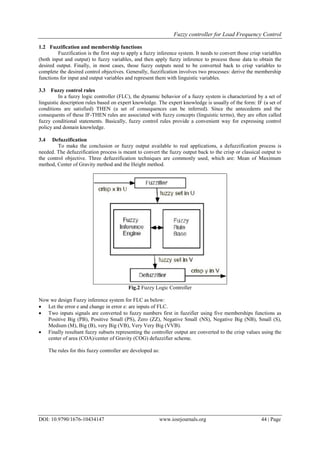
Case 1: In this case we consider the parameters of deviation of area 1 shown in Fig.3.
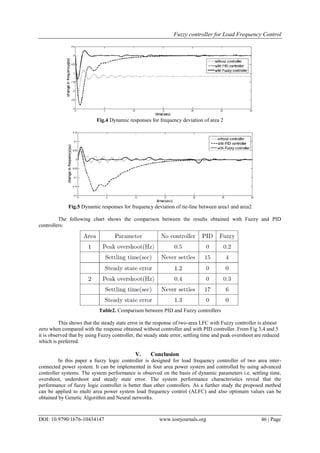
Case 2: In this case we consider the parameters of deviation of area 2 shown in Fig.4.
Case 3: In this case we consider the parameters of deviation of area for tie-line shown in Fig.5
.
Fig.3 Dynamic responses for frequency deviation of area 1](https://image.slidesharecdn.com/f010434147-160706045928/85/F010434147-5-320.jpg)
![Fuzzy controller for Load Frequency Control
DOI: 10.9790/1676-10434147 www.iosrjournals.org 47 | Page
References
Journal Papers:
[1]. H. Bevrani and T. Hiyama, “Load Intelligent Automatic Generation Control," Boca Raton, FL, USA: CRC press, 2011.
[2]. P. Kundur, Power System Stability and Control. New York, NY, USA: McGraw Hill, 1994
[3]. H. Shayeghi, H. A. Shayanfar, and A. Jalili, “Load frequency control strategies: A state-of-the-art survey for the researcher,"
Energy Convers. Manage vol. 50, pp. 344-353, 2009.
[4]. Ibraheem, P. Kumar, and D. P. Kothari, “Recent philosophies of automatic generation control strategies in power systems," IEEE
Trans. Power Syst., vol. 20, No. 1, Feb.2005.
[5]. A. Khodabakhshian and M. Edrisi, “A new robust PID load frequency controller," Control Eng. Practice, vol. 16, pp. 1069-
1080,2008 L.Dong, Y. Zhang, and Z.Gao,”A robust decentralized load frequency controller for interconnected power systems," ISA
Trans., vol. 51, pp. 410-419, 2012.
[6]. L. X. Wang, “Fuzzy System and Control: Design and Stability Analysis," Englewood Cli_s, NJ, USA: Prentice-Hall, 1994.
[7]. Atul Ikhe and Anant Kulkarni,Load Frequency Control For Two Area Power System Using Different Controllers, International
Journal of Advances in Engineering Technology, Sept.2013
[8]. Sateesh Kumar Vavilala et al Int. Journal of Engineering Research and Applications www.ijera.com ISSN: 2248-9622, vol. 4,
pp.156-160, January 2014.](https://image.slidesharecdn.com/f010434147-160706045928/85/F010434147-7-320.jpg)

This document presents a fuzzy logic controller for load frequency control of a two-area interconnected power system. It begins with background on load frequency control and conventional controllers. It then describes modeling a two-area system and developing a fuzzy logic controller with membership functions and rules. Simulation results in MATLAB/Simulink show that the fuzzy controller provides better performance than a PID controller in terms of settling time, overshoot, undershoot and steady state error. The fuzzy controller reduces deviations in frequency and tie-line power for different load disturbances with fast response and minimal error.


