Download to read offline
![IOSR Journal of Computer Engineering (IOSR-JCE)
e-ISSN: 2278-0661,p-ISSN: 2278-8727, Volume 17, Issue 3, Ver. 1 (May – Jun. 2015), PP 06-12
www.iosrjournals.org
DOI: 10.9790/0661-17310612 www.iosrjournals.org 6 | Page
A New Skin Color Based Face Detection Algorithm by Combining
Three Color Model Algorithms
Hewa Majeed Zangana1
1
(Department of Computer Science, College of Computer Science and IT/ Nawroz University, Kurdistan Region
of Iraq)
Abstract: Human face recognition systems have gained a considerable attention during last decade due to its
vast applications in the field of computer and advantages over previous biometric methods. There are many
applications with respect to security, sensitivity and secrecy. Face detection is the most important and first step
of recognition system. Human face detection suffers from various challenges due to variation regarding image
conditions, size, resolution, poses and rotation. Its accurate and robust detection has been a great task for the
researchers. There exist various numbers of methods and techniques for face detection but none can guarantee
successful in all conditions for all kinds of faces and images. Some methods are exhibiting good results in
certain conditions and others are good with different kinds of images. Face detection based on skin color is
found to be more effective technique because of the properties of skin color which is unique and can be easily
separated from the other objects present in the image and background.
This paper introduces a new approach to face detection systems using the skin color of a subject. This system
can detect a face regardless of the background of the picture, which is an important phase for face
identification. The images used in this system are color images which give additional information about the
images than the gray images provide.
In face detection, the two respective classes are the "face area" and the "non-face area". This new approach to
face detection is based on color tone values specially defined for skin area detection within the image frame.
Keywords: Color Space, Face detection, Skin Color.
I. Introduction
When you are talking to a person, you usually look at his face; the expression of a person‟s face plays a
very important role when communicating with other people. Due to its uniqueness, the face is also the most
important and effective characteristics for recognizing a person.
Compared with fingerprints or retinas, taking a face image from a person is very easy. Therefore face
recognition has become one of the most popular applications in the field of computer vision [1]. With the recent
major terrorist attacks in the civil world, there have been increasingly substantial interests in the development of
intelligent surveillance cameras that can automatically detect and recognize known criminals as well as
suspicious characters. Due to such uncertain times, humans are beginning to seek support from computer
systems to aid in the process of identification and location of faces in everyday scenes [2].
Images of faces vary considerably depending on lightning, occlusion, pose, facial expression, and
identity. Color transforms must be implemented to deal with all remaining variation in distinguishing face skin
color.
In this paper a face detection system is proposed and implemented using a skin region analysis method,
within the image according to YCbCr color, where in each pixel is precisely classified as being either skin or
non-skin. This system will detect the face from any background. This system is implemented using the scientific
language which is efficient to deal with matrices mathematic operation and image processing.
For detecting face there are various algorithms including skin color based algorithms. Color is an
important feature of human faces. Using skin-color as a feature for tracking a face has several advantages. Color
processing is much faster than processing other facial features. Under certain lighting conditions, color is
orientation invariant. This property makes motion estimation much easier because only a translation model is
needed for motion estimation. However, color is not a physical phenomenon; it is a perceptual phenomenon that
is related to the spectral characteristics of electromagnetic radiation in the visible wavelengths striking the
retina. Tracking human faces using color as a feature has several problems like the color representation of a face
obtained by a camera which is influenced by many factors (ambient light, object movement, etc.), different
cameras produce significantly different color values even for the same person under the same lighting conditions
and skin color differs from person to person. In order to use color as a feature for face tracking, we have to solve
these problems. It is also robust towards changes in orientation and scaling and can tolerate occlusion well. A
disadvantage of the color cue is its sensitivity to illumination color changes and, especially in the case of RGB,
sensitivity to illumination intensity. One way to increase tolerance towards intensity changes in images is to](https://image.slidesharecdn.com/b017310612-160701040203/85/B017310612-1-320.jpg)
![IOSR Journal of Computer Engineering (IOSR-JCE)
e-ISSN: 2278-0661,p-ISSN: 2278-8727, Volume 17, Issue 3, Ver. 1 (May – Jun. 2015), PP 06-12
www.iosrjournals.org
DOI: 10.9790/0661-17310612 www.iosrjournals.org 6 | Page
A New Skin Color Based Face Detection Algorithm by Combining
Three Color Model Algorithms
Hewa Majeed Zangana1
1
(Department of Computer Science, College of Computer Science and IT/ Nawroz University, Kurdistan Region
of Iraq)
Abstract: Human face recognition systems have gained a considerable attention during last decade due to its
vast applications in the field of computer and advantages over previous biometric methods. There are many
applications with respect to security, sensitivity and secrecy. Face detection is the most important and first step
of recognition system. Human face detection suffers from various challenges due to variation regarding image
conditions, size, resolution, poses and rotation. Its accurate and robust detection has been a great task for the
researchers. There exist various numbers of methods and techniques for face detection but none can guarantee
successful in all conditions for all kinds of faces and images. Some methods are exhibiting good results in
certain conditions and others are good with different kinds of images. Face detection based on skin color is
found to be more effective technique because of the properties of skin color which is unique and can be easily
separated from the other objects present in the image and background.
This paper introduces a new approach to face detection systems using the skin color of a subject. This system
can detect a face regardless of the background of the picture, which is an important phase for face
identification. The images used in this system are color images which give additional information about the
images than the gray images provide.
In face detection, the two respective classes are the "face area" and the "non-face area". This new approach to
face detection is based on color tone values specially defined for skin area detection within the image frame.
Keywords: Color Space, Face detection, Skin Color.
I. Introduction
When you are talking to a person, you usually look at his face; the expression of a person‟s face plays a
very important role when communicating with other people. Due to its uniqueness, the face is also the most
important and effective characteristics for recognizing a person.
Compared with fingerprints or retinas, taking a face image from a person is very easy. Therefore face
recognition has become one of the most popular applications in the field of computer vision [1]. With the recent
major terrorist attacks in the civil world, there have been increasingly substantial interests in the development of
intelligent surveillance cameras that can automatically detect and recognize known criminals as well as
suspicious characters. Due to such uncertain times, humans are beginning to seek support from computer
systems to aid in the process of identification and location of faces in everyday scenes [2].
Images of faces vary considerably depending on lightning, occlusion, pose, facial expression, and
identity. Color transforms must be implemented to deal with all remaining variation in distinguishing face skin
color.
In this paper a face detection system is proposed and implemented using a skin region analysis method,
within the image according to YCbCr color, where in each pixel is precisely classified as being either skin or
non-skin. This system will detect the face from any background. This system is implemented using the scientific
language which is efficient to deal with matrices mathematic operation and image processing.
For detecting face there are various algorithms including skin color based algorithms. Color is an
important feature of human faces. Using skin-color as a feature for tracking a face has several advantages. Color
processing is much faster than processing other facial features. Under certain lighting conditions, color is
orientation invariant. This property makes motion estimation much easier because only a translation model is
needed for motion estimation. However, color is not a physical phenomenon; it is a perceptual phenomenon that
is related to the spectral characteristics of electromagnetic radiation in the visible wavelengths striking the
retina. Tracking human faces using color as a feature has several problems like the color representation of a face
obtained by a camera which is influenced by many factors (ambient light, object movement, etc.), different
cameras produce significantly different color values even for the same person under the same lighting conditions
and skin color differs from person to person. In order to use color as a feature for face tracking, we have to solve
these problems. It is also robust towards changes in orientation and scaling and can tolerate occlusion well. A
disadvantage of the color cue is its sensitivity to illumination color changes and, especially in the case of RGB,
sensitivity to illumination intensity. One way to increase tolerance towards intensity changes in images is to](https://image.slidesharecdn.com/b017310612-160701040203/75/B017310612-1-2048.jpg)
![A New Skin Color Based Face Detection Algorithm by Combining Three Color Models Algorithms
DOI: 10.9790/0661-17310612 www.iosrjournals.org 7 | Page
transform the RGB image into a color space whose intensity and chromaticity are separate and use only
chromaticity part for detection.
In this paper we have presented a comparative study of three well known skin color face
localization/detection algorithms and have produced a new algorithm based on skin color classification in
YCbCr color model. Our results show that we can localize the face more effectively by using the proposed
algorithm.
II. Color Models for Skin Color Classification
The study on skin color classification has gained increasing attention in recent years due to the active
research in content-based image representation. For instance, the ability to locate image object as a face can be
exploited for image coding, editing, indexing or other user interactivity purposes.
Moreover, face localization also provides a good stepping stone in facial expression studies. It would
be fair to say that the most popular algorithm to face localization is the use of color information, whereby
estimating areas with skin color is often the first vital step of such strategy. Hence, skin color classification has
become an important task. Much of the research in skin color based face localization and detection is based on
RGB, YCbCr and HSI color spaces. In this section the color spaces are being described.
2.1 RGB Color Space
RGB is based on the Cartesian coordinate system which is an aid cube as shown in Figure 1. The cube
has the RGB values in the three corners - colors like cyan, magenta and yellow and the other three corners - the
black and white at the origin is at the corner farthest from the origin. The gray scale is located on the line joining
black and white. They are called additive ''primary'' because the colors are summed to produce the desired color.
Due to the high correlation between color components: red, green and blue, as each component is subject to the
effect of luminance of the light intensity of the environment, so that suffers dissatisfaction on the part of many
image processing applications. In practical, this model is not well suited to describe colors in terms of human
interpretation [3].
2.1.1 Algorithm of Skin Color Based Face Detection in RGB Color Space
Skin color is the most important feature of the face and is unique because of its color ingredients. Skin
color pixels can be easily detected using standard color histogram which is normalized for every future change
in the intensity of luminance of the division. And thus RGB vector is transformed into a vector [r, g] color
standard which in turn provides a rapid means of detecting the skin. This gives the skin color region, which
localizes face. As indicated early RGB suffers from the effect of luminance but is still able to allow us to
eliminate some colors which are clearly outside the scope of normal skin color. After review and analysis of
different levels of the RGB color space, it was found that the following rule works well in eliminating some
redundant pixels that are labeled as non-face [4].
0.836G - 14 <B <0.836G + 44 => Skin ……………………………. (1)
0.79 g - 67 <B <0.78 g + 42 => Skin ………………………….…… (2)
Fig. 1: RGB Color Cube
2.2 YCbCr Color Space
This color space was defined to meet the growing demand of digital processing algorithms of video
information and has become widely used color space in digital videos. It has three components, two of them are
the chrominance and luminance is one. This model comes in the family of television transmission color space
along with YUC and YIQ and is designed for space analogue PAL and NTSC [4].
YCbCr color model has been developed to allow the transmission of color information on televisions
keeping in mind that the existing television in black and white still displays images in shades of gray, has the
characteristic of luminance and isolate color information, and is used in many applications such as compression.](https://image.slidesharecdn.com/b017310612-160701040203/85/B017310612-2-320.jpg)
![A New Skin Color Based Face Detection Algorithm by Combining Three Color Models Algorithms
DOI: 10.9790/0661-17310612 www.iosrjournals.org 8 | Page
2.2.1 Algorithm of Skin Color Based Face Detection in YCbCr Color Space
In this model, the skin color pixels belonging to the region exhibit similar Cb and Cr values as it is the
skin color model based on the Cr and Cb values which can provide good coverage of human races. YCbCr
signals that are created from the corresponding gamma adjusted RGB source using two defined constants KB
and KR.
After gamma correction and before scaling and offsets YCbCr signals are called Y1, PB, and PR and
are defined as indicated below.
Y' = KR * R' + (1 – KR – KB) * G'+ KB * B' …………………….. (3)
PB = ½ * ((B' - Y') / (1 – KB)) ……………………………………. (4)
PR = ½ * ((R' - Y') / (1 – KR)) ……………………………………. (5)
Here, the prime „ symbols mean gamma correction is being used, thus R‟, G‟ and B‟ nominally range
from 0 to 1, with 0 representing the minimum intensity (e.g., for display of the color black) and 1 the maximum
(e.g., for display of the color white). From this the resulting luminance signal (Y) value will then have a nominal
range from 0 to 1. And the chrominance value (PB and PB) values will then have a nominal range from -0.5 to
+0.5.
For representing signals in digital form, rounding off and scaling and offsets are added. For instance
scaling and offset applied to the Y‟ component per specification results in the value of 16 for black and the
value of 235 for white when using an 8-bit representation. The standard has 8-bit digitized versions of CB and
CR scaled to a different range of 16 to 240. As a result, rescaling by the fraction (235-16)/(240-16) = 219/224 is
mandatory when doing color matrixing or processing in YCbCr space, leading quantization distortions when the
successive processing is not executed using higher bit depths.
The form of Y‟CbCr that was defined for standard-definition television use in the ITU-R BT.601
(formerly CCIR 601) standard for use with digital component video is derived from the corresponding RGB
space as follows:
KB = 0.114
KR = 0.299
From the above constants and formulas, the following can be derived for ITU-R BT.601. Analog
YPbPr from analogue R'G'B' is derived as follows:
Y' = 0.299 * R' + 0.587 * G' + 0.114 * B' ……………………….. (6)
PB = -0.168739 * R' – 0.331264 * G' + 0.5 * B' ………………… (7)
PR = 0.5 * R' – 0.418688 * G' – 0.81312 * B' ………………….... (8)
Digital Y‟CbCr (8 bits per sample) is derived from analogue R'G'B' as follows:
Y' = 16 + (65.481 * R' + 128.553 * G' + 24.966 * B') ……………. (9)
PB = 128 + (-37.797 * R' – 74.203 * G' + 112.0 * B') ……………. (10)
PR = 128 + (112.0 * R' – 93.786 * G' + 18.214 * B') …………….. (11)
Note that the resultant signals range from 16 to 235; the values from 0 to 15 are called foot room, while
the values from 236 to 255 are called head room.
Alternatively, digital Y‟CbCr is derived from digital Rd Gd Bd (8 bits per sample) according to the
following equations:
Y' = 16 + (65.481 * Rd + 128.553 * Gd + 24.966 * Bd) / 256 …………………. (12)
PB = 128 + (-37.797 * Rd – 74.203 * Gd + 112.0 * B'd) / 256 ………………… (13)
PR = 128 + (112.0 * Rd – 93.786 * Gd – 18.214 * Bd) / 256 ………………….. (14)
Y' = 16 + (0.255 * Rd + 0.5021 * Gd + 0.0975 * Bd) ………………………..… (15)
PB = 128 + (-0.148 * Rd – 0.368 * Gd + 0.439 * B'd) …………………………. (16)
PR = 128 + (0.439 * Rd – 0.368 * Gd – 0.071 * Bd) …………………………... (17)
The above equations are used in the coding part of the proposed algorithm. Cr and Cb are used instead
of PB and PR. After studying and experimenting with various thresholds, it was finally found that the best
results were found by using the following decree and otherwise assume that it is NOT skin and may be removed
from further consideration [5].
102 < Cb < 128 = > Skin ……………………………………………………….. (18)
2.3 HSI Color Space
This color model is ideal for hardware implementation. Human practice interpretation is described in
terms of Hue Saturation and Intensity (Brightness). HSI model separates the intensity component of the color
information-bearing and is an ideal tool for development processing algorithm based on the image description of
the colors that are natural and intuitive to human health. HSI is based on the cylindrical coordinate, hue (H) is
shown with a 0 angle, varying from 0 to 360, the saturation (S) corresponds to a radius ranging from 0 to 1 and
finally the intensity (I) varies along the z-axis with 0 being black and white is 1. When the value of S is 0, the
color is a gray value of intensity. When the value of S is 1, color is the limit of the cone tope. More saturation,](https://image.slidesharecdn.com/b017310612-160701040203/85/B017310612-3-320.jpg)
![A New Skin Color Based Face Detection Algorithm by Combining Three Color Models Algorithms
DOI: 10.9790/0661-17310612 www.iosrjournals.org 9 | Page
the color is white / gray / black. Changing the value of the color will change the color of red that is to 00 to
green which is 1200, 2400 and blue to red black in 3600. And when I = 0, the color is black and therefore H is
undefined. By varying the value of I, a color can be is darker or lighter. Shaded color comes out when the value
of I is adjusted while S = 1 hold.
Fig. 2: Cone Model Of HSV Color Space
2.3.1 Algorithm of Skin Color Based Face Detection in HSI Color Space
The HSI color space is more intuitive and provides color information in the same manner that the
humans think of colors and how artists mix colors in general. Dyed with saturation provides useful information
regarding selective skin. Range for non-Hue face region is considered as shown below and it is also assumed to
be the skin. HSI color model is represented using the following equation:
19 < H < 240 => Not Skin ……………………………………………………………….. (19)
HSI color space is defined by using the RGB as scale as transformation from RGB space to and HSI
space [6]
H= 360° - a / 360° if b > g ………………………………………………………………. (20)
= a / 360° otherwise …………………………………………………………………... (21)
Where a = cosˉ¹ 2R - G – B / (R² + G² + B² - RG – GB – BR) ^ ½ …………………….. (22)
S = 1 – [min (R, G, B)] / I ……………………………………………………………...… (23)
I = (R + G + B) / 3 ………………………………………………………………………... (24)
The colors are given a set of RGB color cube. The color cube is oriented so that the value component is
oriented along the axis of gray, ranging from black to white. HSV are defined solely by reference to the RGB
color space, they are not absolute color spaces: to specify a color precisely requires reporting not only the HSV
values, but also the characteristics of the RGB space they are based, including gamma correction in use it.
Computer offers some poor cousins of these perceptual spaces which can also be found in the software
interface, such as HSV. They are easy mathematical transformations RGB, and they seem to be perception
systems because they use the color lightness / saturation value terminology. But take a look around, do not be
fooled. Perceptual dimensions of color are poorly scaled by the color specifications that are provided in these
and other systems. For example, saturation and brightness are combined, so that saturation scale may also
contain a wide range of light (for example, it can evolve from white to green, which is a combination of both
brightness and saturation). Similarly, the color and lightness are confounded if, for example, a saturated blue
and yellow can be saturated designated as the same "lightness", but have large differences in the perceived
lightness. These defects make the systems difficult to use to control the appearance of a color in a systematic
approach manner. If more tweaking is needed to get the desired effect, the system offers little benefit more
struggling with raw RGB specifications [7].
III. Proposed Face Detection System
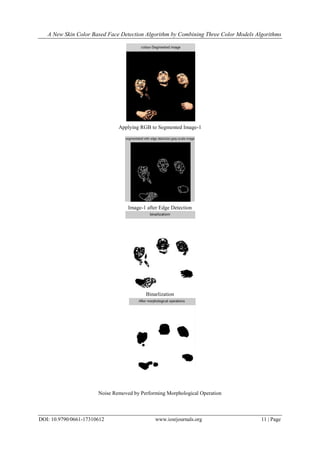
In the proposed algorithm, it is assumed that by combining the detected region from the entire three
algorithms, skin region is extracted. After combining the three algorithms and extracting skin color, following
this face is detected by edges using edge detection which draws boundary across the face region. It is something
like if one algorithm detects the skin color for an image and others two algorithms fails and gives the false
result; even then the face is extracted by using the combination algorithm. This supposition of combining
algorithm is based on the basic idea of Venn diagram from set theory. Suppose the result from RGB color is
„‟A‟‟, results from YCbCr color space is „‟B‟‟ and the result from HIS color space is „‟C‟‟ and if any of the
result contains a skin image then the union of the three will surely be a skin image. This can be understood by
the following example:: let, A = {a, b, c, d}, B = {b, e} and C = {b, f}. If “a” = “skin image” then skin image is](https://image.slidesharecdn.com/b017310612-160701040203/85/B017310612-4-320.jpg)

![A New Skin Color Based Face Detection Algorithm by Combining Three Color Models Algorithms
DOI: 10.9790/0661-17310612 www.iosrjournals.org 12 | Page
Output of Image-1 (Face Detected)
V. Conclusions
From the work carried out on this thesis, it is concluded that it is very difficult and still a challenging
task to build up an automatic face detection method that is works effectively in all situation whether the image
consists of different face poses, bad image condition or image affected by illumination. Researchers are still
struggling hard to find out the perfect solution to this complicated problem. But their exist, the different face
detection method to overcome different problems of face detection. For instance to overcome the problem of
lighting (illumination) RGB color space is not used instead HSV or YCrCb are used. Some methods or
techniques shows good result for particular problem or application and others shows good result for different
application. So it may not be insane to say, that researchers still have lot of work to do under face detection.
References
[1]. Hong, S. and al, e, "Facial feature detection using Geometrical face model: An efficient approach," journal of pattern recognition,
Vols. 31, No. 3, pp. 273-282, 1998.
[2]. Leung, C, "Real Time Face Recognition," B. Sc. Project, School of Information Technology and Electrical Engineering. University
of Queesland, 2001.
[3]. Sanjay Kr, Singh, D. S. Chauhan, Mayank Vatsa and Richa Singh, "A Robust Skin Color Based Face Detection Algorithm,"
Tamkang Journal of Science and Engineering, vol. 6 (4), pp. 227-234, 2003.
[4]. Muhammad Tariq Mahmood, "Face Detection by Image Discriminating," 2006. [Online]. Available:
http://www.bth.se/fou/cuppsats.nsf/all/6c509ae86a297ca4c12571d300512cac/$file/DVD009-MasterThesisReport.pdf..
[5]. Michael Padilla and Zihong Fan, "Automatic Face Detection Using Color Based Segmentation and Template / Energy
Thresholding," 2003. [Online]. Available: http://www.stanford.edu/class/ee368/Project_03/Project/reports/ee368group16.pdf.
[6]. Rafael C. Gonzalez and Richard E. Woods, Digital Image Processing. 2nded, New Jersey: Prentice-Hall, 2001, pp. 75-103.
[7]. C. A. Brewer, Color Use Guidelines for Data Representation, Alexandria: American Statistical Association, 1999, pp. P55-56.
[8]. Sangwine, S. J. and Horne, R. E. N, The Color Image Processing Handbook, Chapman & Hall, 1st Edition, 1998.
[9]. Raghuvanshi, D. S. and Agrawal, D., "Human Face Detection by using Skin Color Segmentation, Face Features and Regions
Properties," International Journal of Computer Applications, vol. 38– No.9, 2012.
[10]. H. H. Khaung Tin, "Robust Algorithm for Face Detection in Color Images," I.J.Modern Education and Computer Science, pp. 31-
37, 2012.
[11]. Tripathi, S., Sharma V. and Sharma S., "Face Detection using Combined Skin Color Detector," International Journal of Computer
Applications (0975 – 8887), vol. 26– No.7, 2011.
[12]. Wagner and Andrew et al, "Toward a practical face recognition system: Robust alignment and illumination by sparse
representation," Pattern Analysis and Machine Intelligence, IEEE Transactions on 34.2, pp. 372-386, 2012.](https://image.slidesharecdn.com/b017310612-160701040203/85/B017310612-7-320.jpg)

This document introduces a new skin color-based algorithm for face detection that combines three different color models: RGB, YCbCr, and HSI. Face detection is the first step in face recognition systems and is challenging due to variations in images like lighting, size, and pose. Existing face detection methods have limitations, but skin color is a useful feature since it is unique and can separate the face from the background. The proposed algorithm aims to more effectively localize faces by classifying skin color pixels in the YCbCr color space. It provides equations for detecting skin pixels in the RGB and YCbCr color spaces and discusses advantages and limitations of different color models for skin color classification and face detection.


