What is XP? 
Extreme Programming (also termed as XP) is an agile software development methodology. 
XP focuses on coding of the software. XP has four core values and fourteen principles. 
XP has four core values:- 
 Communication: - Team should communicate on a regular basis, share 
information, discuss solutions and so on. Teams who communicate very often are 
able to solve problems more efficiently. For instance any kind of issues which are 
resolved in a cryptic fashion send an email to the whole team. This ensures that 
knowledge is shared with every one and in your absence some other developer can 
solve the problem. 
 Simplicity: - Keep things simple. Either it's from a process angle, technical angle or 
from a documentation point of view. An over complicated process or a technical 
architecture is only calling for problems. 
 Feedback: - Regular feedback from end user helps us to keep the project on track. 
So regular feedbacks should be enabled from end user and testing team. 
 Courage: - To bring change or to try something new, needs courage. When you try 
to bring change in an organization you are faced with huge resistance. Especially 
when your company is following traditional methodologies applying XP will always be 
resisted. 
From the above four core values 14 principles are derived. Values give a broader level view 
while the 14 principles go deep in to how to implement XP. 
 Rapid feedbacks: - Developers should receive rapid feedbacks from the end user. 
This avoids confusion in the last minute of delivery. In water fall model feedbacks are 
received in late intervals. This is minimized in XP. 
 Keep it Simple: - Encourage simplicity in project design and process. For instance 
rather than using complex tools probably simple handwritten flowcharts on board can 
solve the problem. 
 Give incremental changes: - Whenever you update patches and updates, release 
it in small pieces. If you are updating numerous patches in one go and if there is a 
defect, it will be difficult to track the same. 
 Embrace Change: - Do not be rigid with the customer saying that we have already 
signed the requirement so we can not change the architecture. End customer or 
users are finally human beings so they can change as the project moves 
ahead....Accept it if it's logical. 
 Light Weight: - Keep documentation and process as simple as possible. Do not 
overdose the developer with unnecessary documentation. Developer's main work is 
coding and ensuring that the code is defect free, so he should be more concentrating 
on the code rather than documentation. 
 Deliver Quality: - Any code you deliver should be defect free. Be committed to your 
work and deliver defect free code. 
 Start small and grow big: - Many times the end customer wants to start with a big 
bang theory. He can start with a big team, wants all the functionalities at the first 
roll out and so on. Start with small team and the "must have" features to be 
delivered. As we add features and the work load increases gradually increase your 
team strength. 
 Play to win: - Take all steps which are needed to make a project success. Any type 
of deadline and commitment try to meet the same with true spirit.
 Encourage honest communication: - Promote honest communication. If 
communication happens face to face then there is less leakage of requirement. 
Encourage end user to sit with developers and give feedbacks; this makes your 
project stronger. 
 Conduct testing honestly: - Test plans should not be created for the sake of 
creation. Test plan should prove actually that you are on track record. 
 Adapt according to situation: - No two projects are same, no two organization are 
same and behavior of people from person to person. So it's very essential that our 
approach also adapts according to situations. 
 Metric honesty: - Do not gather metrics for the sake of gathering or showing off to 
external people how many metrics your project derives. Pick metrics which makes 
sense to your project and helps you measure your project health. 
 Accept responsibility: - Do not impose or assign people on task which they do not 
like. Rather question the resource once which tasks he likes and assign accordingly. 
This will increase productivity to a huge level and maintains your project enthusiasm 
high. 
 Work with people's instincts: - Normally in a project team there are highly 
motivated people, moderately motivated and people with less motivation. So give 
power to your motivated team members and encourage them. 
What are User Stories in XP and how different are they from 
requirement? 
Use story is nothing but end users requirement. What differentiates a user story from a 
requirement is that they are short and sweet. In one sentence they are just enough and 
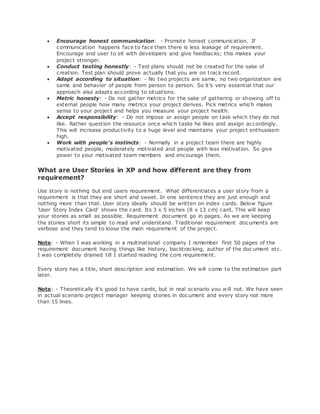
nothing more than that. User story ideally should be written on index cards. Below figure 
'User Story Index Card' shows the card. Its 3 x 5 inches (8 x 13 cm) card. This will keep 
your stories as small as possible. Requirement document go in pages. As we are keeping 
the stories short its simple to read and understand. Traditional requirement documents are 
verbose and they tend to loose the main requirement of the project. 
Note: - When I was working in a multinational company I remember first 50 pages of the 
requirement document having things like history, backtracking, author of the doc ument etc. 
I was completely drained till I started reading the core requirement. 
Every story has a title, short description and estimation. We will come to the estimation part 
later. 
Note: - Theoretically it's good to have cards, but in real scenario you will not. We have seen 
in actual scenario project manager keeping stories in document and every story not more 
than 15 lines.
Figure: - User Story Index Card 
Can you explain the XP development life cycle? 
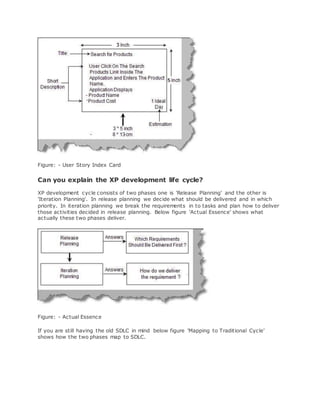
XP development cycle consists of two phases one is 'Release Planning' and the other is 
'Iteration Planning'. In release planning we decide what should be delivered and in which 
priority. In iteration planning we break the requirements in to tasks and plan how to deliver 
those activities decided in release planning. Below figure 'Actual Essence' shows what 
actually these two phases deliver. 
Figure: - Actual Essence 
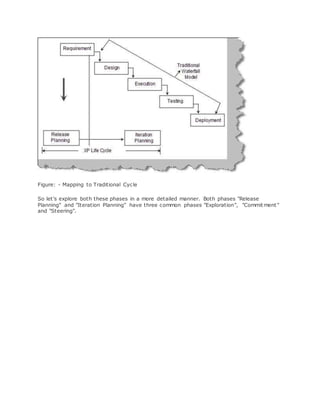
If you are still having the old SDLC in mind below figure 'Mapping to Traditional Cycle' 
shows how the two phases map to SDLC.
Figure: - Mapping to Traditional Cycle 
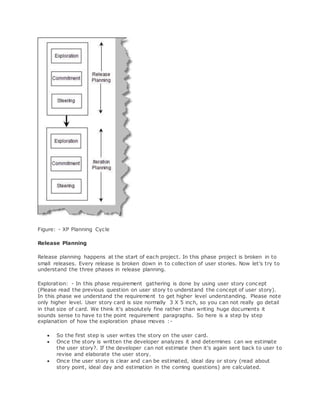
So let's explore both these phases in a more detailed manner. Both phases "Release 
Planning" and "Iteration Planning" have three common phases "Exploration", "Commitment " 
and "Steering".
Figure: - XP Planning Cycle 
Release Planning 
Release planning happens at the start of each project. In this phase project is broken in to 
small releases. Every release is broken down in to collection of user stories. Now let's try to 
understand the three phases in release planning. 
Exploration: - In this phase requirement gathering is done by using user story concept 
(Please read the previous question on user story to understand the concept of user story). 
In this phase we understand the requirement to get higher level understanding. Please note 
only higher level. User story card is size normally 3 X 5 inch, so you can not really go detail 
in that size of card. We think it's absolutely fine rather than writing huge documents it 
sounds sense to have to the point requirement paragraphs. So here is a step by step 
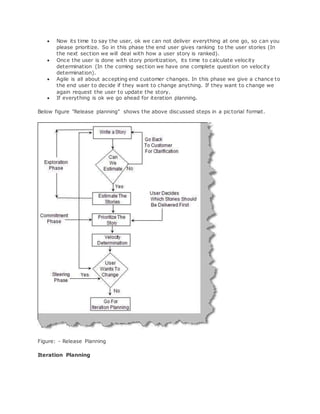
explanation of how the exploration phase moves :- 
 So the first step is user writes the story on the user card. 
 Once the story is written the developer analyzes it and determines can we estimate 
the user story?. If the developer can not estimate then it's again sent back to user to 
revise and elaborate the user story. 
 Once the user story is clear and can be estimated, ideal day or story (read about 
story point, ideal day and estimation in the coming questions) are calculated.
 Now its time to say the user, ok we can not deliver everything at one go, so can you 
please prioritize. So in this phase the end user gives ranking to the user stories (In 
the next section we will deal with how a user story is ranked). 
 Once the user is done with story prioritization, its time to calculate velocity 
determination (In the coming section we have one complete question on velocity 
determination). 
 Agile is all about accepting end customer changes. In this phase we give a chance to 
the end user to decide if they want to change anything. If they want to change we 
again request the user to update the story. 
 If everything is ok we go ahead for iteration planning. 
Below figure "Release planning" shows the above discussed steps in a pictorial format. 
Figure: - Release Planning 
Iteration Planning
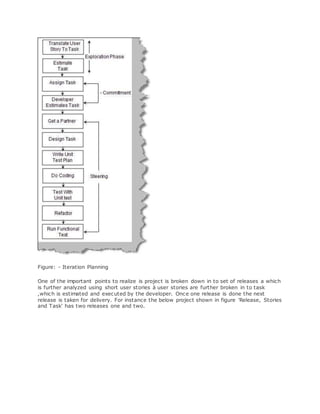
Iteration planning is all about going deep in to every user story and breaking the same in to 
tasks. This phase can also be termed as detailing of every user story. Iteration planning is 
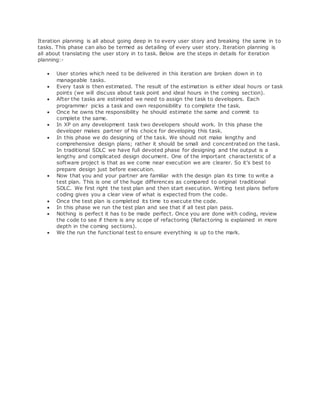
all about translating the user story in to task. Below are the steps in details for iteration 
planning:- 
 User stories which need to be delivered in this iteration are broken down in to 
manageable tasks. 
 Every task is then estimated. The result of the estimation is either ideal hours or task 
points (we will discuss about task point and ideal hours in the coming section). 
 After the tasks are estimated we need to assign the task to developers. Each 
programmer picks a task and own responsibility to complete the task. 
 Once he owns the responsibility he should estimate the same and commit to 
complete the same. 
 In XP on any development task two developers should work. In this phase the 
developer makes partner of his choice for developing this task. 
 In this phase we do designing of the task. We should not make lengthy and 
comprehensive design plans; rather it should be small and concentrated on the task. 
In traditional SDLC we have full devoted phase for designing and the output is a 
lengthy and complicated design document. One of the important characteristic of a 
software project is that as we come near execution we are clearer. So it's best to 
prepare design just before execution. 
 Now that you and your partner are familiar with the design plan its time to write a 
test plan. This is one of the huge differences as compared to original traditional 
SDLC. We first right the test plan and then start execution. Writing test plans before 
coding gives you a clear view of what is expected from the code. 
 Once the test plan is completed its time to execute the code. 
 In this phase we run the test plan and see that if all test plan pass. 
 Nothing is perfect it has to be made perfect. Once you are done with coding, review 
the code to see if there is any scope of refactoring (Refactoring is explained in more 
depth in the coming sections). 
 We the run the functional test to ensure everything is up to the mark.
Figure: - Iteration Planning 
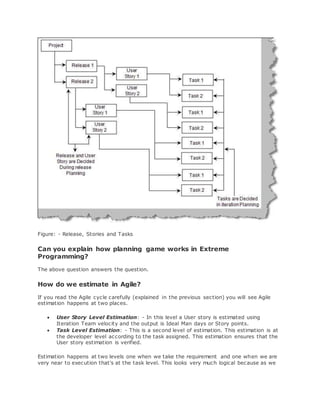
One of the important points to realize is project is broken down in to set of releases a which 
is further analyzed using short user stories à user stories are further broken in to task 
,which is estimated and executed by the developer. Once one release is done the next 
release is taken for delivery. For instance the below project shown in figure 'Release, Stories 
and Task' has two releases one and two.
Figure: - Release, Stories and Tasks 
Can you explain how planning game works in Extreme 
Programming? 
The above question answers the question. 
How do we estimate in Agile? 
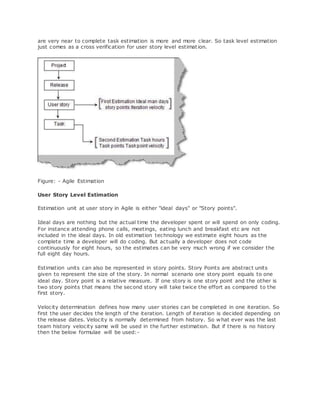
If you read the Agile cycle carefully (explained in the previous section) you will see Agile 
estimation happens at two places. 
 User Story Level Estimation: - In this level a User story is estimated using 
Iteration Team velocity and the output is Ideal Man days or Story points. 
 Task Level Estimation: - This is a second level of estimation. This estimation is at 
the developer level according to the task assigned. This estimation ensures that the 
User story estimation is verified. 
Estimation happens at two levels one when we take the requirement and one when we are 
very near to execution that's at the task level. This looks very much logical because as we
are very near to complete task estimation is more and more clear. So task level estimation 
just comes as a cross verification for user story level estimat ion. 
Figure: - Agile Estimation 
User Story Level Estimation 
Estimation unit at user story in Agile is either "ideal days" or "Story points". 
Ideal days are nothing but the actual time the developer spent or will spend on only coding. 
For instance attending phone calls, meetings, eating lunch and breakfast etc are not 
included in the ideal days. In old estimation technology we estimate eight hours as the 
complete time a developer will do coding. But actually a developer does not code 
continuously for eight hours, so the estimates can be very much wrong if we consider the 
full eight day hours. 
Estimation units can also be represented in story points. Story Points are abstract units 
given to represent the size of the story. In normal scenario one story point equals to one 
ideal day. Story point is a relative measure. If one story is one story point and the other is 
two story points that means the second story will take twice the effort as compared to the 
first story. 
Velocity determination defines how many user stories can be completed in one iteration. So 
first the user decides the length of the iteration. Length of iteration is decided depending on 
the release dates. Velocity is normally determined from history. So what ever was the last 
team history velocity same will be used in the further estimation. But if there is no history 
then the below formulae will be used:-
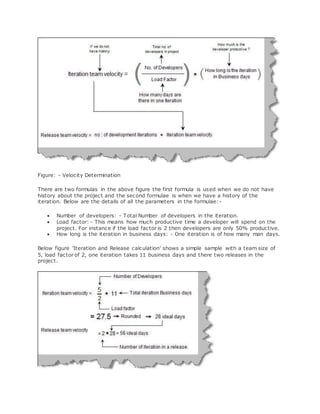
Figure: - Velocity Determination 
There are two formulas in the above figure the first formula is used when we do not have 
history about the project and the second formulae is when we have a history of the 
iteration. Below are the details of all the parameters in the formulae:- 
 Number of developers: - Total Number of developers in the iteration. 
 Load factor: - This means how much productive time a developer will spend on the 
project. For instance if the load factor is 2 then developers are only 50% productive. 
 How long is the iteration in business days: - One iteration is of how many man days. 
Below figure 'Iteration and Release calculation' shows a simple sample with a team size of 
5, load factor of 2, one iteration takes 11 business days and there two releases in the 
project.
Figure: - Iteration and Release calculation 
Task Level Estimation 
As the Agile cycle moves ahead user story is broken down in to task and assigned to each 
developer. Level of effort at the task level is a form of Task points or Ideal hours. Ideally 
one task point represents one ideal hour. Ideal hour is the time when developer spends only 
on coding and nothing else. 
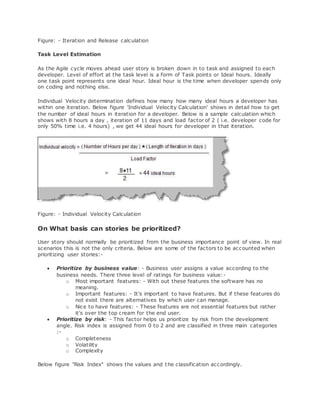
Individual Velocity determination defines how many how many ideal hours a developer has 
within one iteration. Below figure 'Individual Velocity Calculation' shows in detail how to get 
the number of ideal hours in iteration for a developer. Below is a sample calculation which 
shows with 8 hours a day , iteration of 11 days and load factor of 2 ( i.e. developer code for 
only 50% time i.e. 4 hours) , we get 44 ideal hours for developer in that iteration. 
Figure: - Individual Velocity Calculation 
On What basis can stories be prioritized? 
User story should normally be prioritized from the business importance point of view. In real 
scenarios this is not the only criteria. Below are some of the factors to be accounted when 
prioritizing user stories:- 
 Prioritize by business value: - Business user assigns a value according to the 
business needs. There three level of ratings for business value:- 
o Most important features: - With out these features the software has no 
meaning. 
o Important features: - It's important to have features. But if these features do 
not exist there are alternatives by which user can manage. 
o Nice to have features: - These features are not essential features but rather 
it's over the top cream for the end user. 
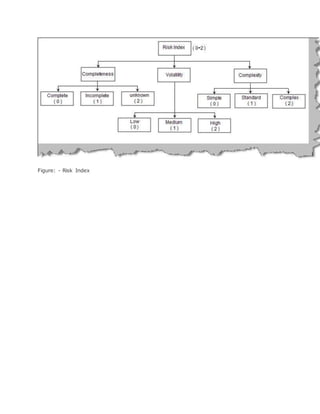
 Prioritize by risk: - This factor helps us prioritize by risk from the development 
angle. Risk index is assigned from 0 to 2 and are classified in three main categories 
:- 
o Completeness 
o Volatility 
o Complexity 
Below figure "Risk Index" shows the values and the classification accordingly.
Figure: - Risk Index

Extreme programming

  • 1.
    What is XP? Extreme Programming (also termed as XP) is an agile software development methodology. XP focuses on coding of the software. XP has four core values and fourteen principles. XP has four core values:-  Communication: - Team should communicate on a regular basis, share information, discuss solutions and so on. Teams who communicate very often are able to solve problems more efficiently. For instance any kind of issues which are resolved in a cryptic fashion send an email to the whole team. This ensures that knowledge is shared with every one and in your absence some other developer can solve the problem.  Simplicity: - Keep things simple. Either it's from a process angle, technical angle or from a documentation point of view. An over complicated process or a technical architecture is only calling for problems.  Feedback: - Regular feedback from end user helps us to keep the project on track. So regular feedbacks should be enabled from end user and testing team.  Courage: - To bring change or to try something new, needs courage. When you try to bring change in an organization you are faced with huge resistance. Especially when your company is following traditional methodologies applying XP will always be resisted. From the above four core values 14 principles are derived. Values give a broader level view while the 14 principles go deep in to how to implement XP.  Rapid feedbacks: - Developers should receive rapid feedbacks from the end user. This avoids confusion in the last minute of delivery. In water fall model feedbacks are received in late intervals. This is minimized in XP.  Keep it Simple: - Encourage simplicity in project design and process. For instance rather than using complex tools probably simple handwritten flowcharts on board can solve the problem.  Give incremental changes: - Whenever you update patches and updates, release it in small pieces. If you are updating numerous patches in one go and if there is a defect, it will be difficult to track the same.  Embrace Change: - Do not be rigid with the customer saying that we have already signed the requirement so we can not change the architecture. End customer or users are finally human beings so they can change as the project moves ahead....Accept it if it's logical.  Light Weight: - Keep documentation and process as simple as possible. Do not overdose the developer with unnecessary documentation. Developer's main work is coding and ensuring that the code is defect free, so he should be more concentrating on the code rather than documentation.  Deliver Quality: - Any code you deliver should be defect free. Be committed to your work and deliver defect free code.  Start small and grow big: - Many times the end customer wants to start with a big bang theory. He can start with a big team, wants all the functionalities at the first roll out and so on. Start with small team and the "must have" features to be delivered. As we add features and the work load increases gradually increase your team strength.  Play to win: - Take all steps which are needed to make a project success. Any type of deadline and commitment try to meet the same with true spirit.
  • 2.
     Encourage honestcommunication: - Promote honest communication. If communication happens face to face then there is less leakage of requirement. Encourage end user to sit with developers and give feedbacks; this makes your project stronger.  Conduct testing honestly: - Test plans should not be created for the sake of creation. Test plan should prove actually that you are on track record.  Adapt according to situation: - No two projects are same, no two organization are same and behavior of people from person to person. So it's very essential that our approach also adapts according to situations.  Metric honesty: - Do not gather metrics for the sake of gathering or showing off to external people how many metrics your project derives. Pick metrics which makes sense to your project and helps you measure your project health.  Accept responsibility: - Do not impose or assign people on task which they do not like. Rather question the resource once which tasks he likes and assign accordingly. This will increase productivity to a huge level and maintains your project enthusiasm high.  Work with people's instincts: - Normally in a project team there are highly motivated people, moderately motivated and people with less motivation. So give power to your motivated team members and encourage them. What are User Stories in XP and how different are they from requirement? Use story is nothing but end users requirement. What differentiates a user story from a requirement is that they are short and sweet. In one sentence they are just enough and nothing more than that. User story ideally should be written on index cards. Below figure 'User Story Index Card' shows the card. Its 3 x 5 inches (8 x 13 cm) card. This will keep your stories as small as possible. Requirement document go in pages. As we are keeping the stories short its simple to read and understand. Traditional requirement documents are verbose and they tend to loose the main requirement of the project. Note: - When I was working in a multinational company I remember first 50 pages of the requirement document having things like history, backtracking, author of the doc ument etc. I was completely drained till I started reading the core requirement. Every story has a title, short description and estimation. We will come to the estimation part later. Note: - Theoretically it's good to have cards, but in real scenario you will not. We have seen in actual scenario project manager keeping stories in document and every story not more than 15 lines.
  • 3.
    Figure: - UserStory Index Card Can you explain the XP development life cycle? XP development cycle consists of two phases one is 'Release Planning' and the other is 'Iteration Planning'. In release planning we decide what should be delivered and in which priority. In iteration planning we break the requirements in to tasks and plan how to deliver those activities decided in release planning. Below figure 'Actual Essence' shows what actually these two phases deliver. Figure: - Actual Essence If you are still having the old SDLC in mind below figure 'Mapping to Traditional Cycle' shows how the two phases map to SDLC.
  • 4.
    Figure: - Mappingto Traditional Cycle So let's explore both these phases in a more detailed manner. Both phases "Release Planning" and "Iteration Planning" have three common phases "Exploration", "Commitment " and "Steering".
  • 5.
    Figure: - XPPlanning Cycle Release Planning Release planning happens at the start of each project. In this phase project is broken in to small releases. Every release is broken down in to collection of user stories. Now let's try to understand the three phases in release planning. Exploration: - In this phase requirement gathering is done by using user story concept (Please read the previous question on user story to understand the concept of user story). In this phase we understand the requirement to get higher level understanding. Please note only higher level. User story card is size normally 3 X 5 inch, so you can not really go detail in that size of card. We think it's absolutely fine rather than writing huge documents it sounds sense to have to the point requirement paragraphs. So here is a step by step explanation of how the exploration phase moves :-  So the first step is user writes the story on the user card.  Once the story is written the developer analyzes it and determines can we estimate the user story?. If the developer can not estimate then it's again sent back to user to revise and elaborate the user story.  Once the user story is clear and can be estimated, ideal day or story (read about story point, ideal day and estimation in the coming questions) are calculated.
  • 6.
     Now itstime to say the user, ok we can not deliver everything at one go, so can you please prioritize. So in this phase the end user gives ranking to the user stories (In the next section we will deal with how a user story is ranked).  Once the user is done with story prioritization, its time to calculate velocity determination (In the coming section we have one complete question on velocity determination).  Agile is all about accepting end customer changes. In this phase we give a chance to the end user to decide if they want to change anything. If they want to change we again request the user to update the story.  If everything is ok we go ahead for iteration planning. Below figure "Release planning" shows the above discussed steps in a pictorial format. Figure: - Release Planning Iteration Planning
  • 7.
    Iteration planning isall about going deep in to every user story and breaking the same in to tasks. This phase can also be termed as detailing of every user story. Iteration planning is all about translating the user story in to task. Below are the steps in details for iteration planning:-  User stories which need to be delivered in this iteration are broken down in to manageable tasks.  Every task is then estimated. The result of the estimation is either ideal hours or task points (we will discuss about task point and ideal hours in the coming section).  After the tasks are estimated we need to assign the task to developers. Each programmer picks a task and own responsibility to complete the task.  Once he owns the responsibility he should estimate the same and commit to complete the same.  In XP on any development task two developers should work. In this phase the developer makes partner of his choice for developing this task.  In this phase we do designing of the task. We should not make lengthy and comprehensive design plans; rather it should be small and concentrated on the task. In traditional SDLC we have full devoted phase for designing and the output is a lengthy and complicated design document. One of the important characteristic of a software project is that as we come near execution we are clearer. So it's best to prepare design just before execution.  Now that you and your partner are familiar with the design plan its time to write a test plan. This is one of the huge differences as compared to original traditional SDLC. We first right the test plan and then start execution. Writing test plans before coding gives you a clear view of what is expected from the code.  Once the test plan is completed its time to execute the code.  In this phase we run the test plan and see that if all test plan pass.  Nothing is perfect it has to be made perfect. Once you are done with coding, review the code to see if there is any scope of refactoring (Refactoring is explained in more depth in the coming sections).  We the run the functional test to ensure everything is up to the mark.
  • 8.
    Figure: - IterationPlanning One of the important points to realize is project is broken down in to set of releases a which is further analyzed using short user stories à user stories are further broken in to task ,which is estimated and executed by the developer. Once one release is done the next release is taken for delivery. For instance the below project shown in figure 'Release, Stories and Task' has two releases one and two.
  • 9.
    Figure: - Release,Stories and Tasks Can you explain how planning game works in Extreme Programming? The above question answers the question. How do we estimate in Agile? If you read the Agile cycle carefully (explained in the previous section) you will see Agile estimation happens at two places.  User Story Level Estimation: - In this level a User story is estimated using Iteration Team velocity and the output is Ideal Man days or Story points.  Task Level Estimation: - This is a second level of estimation. This estimation is at the developer level according to the task assigned. This estimation ensures that the User story estimation is verified. Estimation happens at two levels one when we take the requirement and one when we are very near to execution that's at the task level. This looks very much logical because as we
  • 10.
    are very nearto complete task estimation is more and more clear. So task level estimation just comes as a cross verification for user story level estimat ion. Figure: - Agile Estimation User Story Level Estimation Estimation unit at user story in Agile is either "ideal days" or "Story points". Ideal days are nothing but the actual time the developer spent or will spend on only coding. For instance attending phone calls, meetings, eating lunch and breakfast etc are not included in the ideal days. In old estimation technology we estimate eight hours as the complete time a developer will do coding. But actually a developer does not code continuously for eight hours, so the estimates can be very much wrong if we consider the full eight day hours. Estimation units can also be represented in story points. Story Points are abstract units given to represent the size of the story. In normal scenario one story point equals to one ideal day. Story point is a relative measure. If one story is one story point and the other is two story points that means the second story will take twice the effort as compared to the first story. Velocity determination defines how many user stories can be completed in one iteration. So first the user decides the length of the iteration. Length of iteration is decided depending on the release dates. Velocity is normally determined from history. So what ever was the last team history velocity same will be used in the further estimation. But if there is no history then the below formulae will be used:-
  • 11.
    Figure: - VelocityDetermination There are two formulas in the above figure the first formula is used when we do not have history about the project and the second formulae is when we have a history of the iteration. Below are the details of all the parameters in the formulae:-  Number of developers: - Total Number of developers in the iteration.  Load factor: - This means how much productive time a developer will spend on the project. For instance if the load factor is 2 then developers are only 50% productive.  How long is the iteration in business days: - One iteration is of how many man days. Below figure 'Iteration and Release calculation' shows a simple sample with a team size of 5, load factor of 2, one iteration takes 11 business days and there two releases in the project.
  • 12.
    Figure: - Iterationand Release calculation Task Level Estimation As the Agile cycle moves ahead user story is broken down in to task and assigned to each developer. Level of effort at the task level is a form of Task points or Ideal hours. Ideally one task point represents one ideal hour. Ideal hour is the time when developer spends only on coding and nothing else. Individual Velocity determination defines how many how many ideal hours a developer has within one iteration. Below figure 'Individual Velocity Calculation' shows in detail how to get the number of ideal hours in iteration for a developer. Below is a sample calculation which shows with 8 hours a day , iteration of 11 days and load factor of 2 ( i.e. developer code for only 50% time i.e. 4 hours) , we get 44 ideal hours for developer in that iteration. Figure: - Individual Velocity Calculation On What basis can stories be prioritized? User story should normally be prioritized from the business importance point of view. In real scenarios this is not the only criteria. Below are some of the factors to be accounted when prioritizing user stories:-  Prioritize by business value: - Business user assigns a value according to the business needs. There three level of ratings for business value:- o Most important features: - With out these features the software has no meaning. o Important features: - It's important to have features. But if these features do not exist there are alternatives by which user can manage. o Nice to have features: - These features are not essential features but rather it's over the top cream for the end user.  Prioritize by risk: - This factor helps us prioritize by risk from the development angle. Risk index is assigned from 0 to 2 and are classified in three main categories :- o Completeness o Volatility o Complexity Below figure "Risk Index" shows the values and the classification accordingly.
  • 13.