Constructors
 Constructor is a special method of a class which will invoke 
automatically whenever instance or object of class is created. 
 Constructor name should be same as class name. If we want to 
create constructor in a class we need to create a constructor 
method name same as class name. 
ex: 
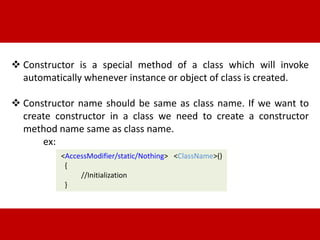
<AccessModifier/static/Nothing> <ClassName>() 
{ 
//Initialization 
}
 class can have any number of constructors and constructors 
don’t have any return type, not even void 
 Constructors are responsible for object initialization and memory 
allocation of its class. 
 There is always at least one constructor in every class.
Types of Constructors 
1. Default Constructor 
2. Parameterless Constructor 
3. Parameterized Constructor 
4. Copy Constructor 
5. Private Constructor 
6. Static Constructor
Default Constructor: 
Default constructor will be added by compiler, if we do not 
write any constructor in a class. Default constructor does not have any 
parameters . 
Parameterless Constructor: 
If we do not write any parameters in a constructor is called as 
parameterless constructor. 
Parameterized Constructor: 
A constructor with at least one parameter is called as 
parameterized constructor.
Copy Constructor: 
A parameterized constructor that contains a parameter of 
same class type is called as copy constructor. 
Main purpose of copy constructor is to initialize new instance 
to the values of an existing instance. 
Ex: 
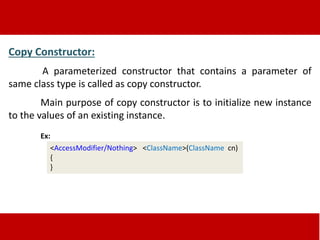
<AccessModifier/Nothing> <ClassName>(ClassName cn) 
{ 
}
Private Constructor: 
A private constructor is a special instance constructor. 
The main purpose of creating private constructor is used to 
restrict the class from being instantiated. 
Ex: 
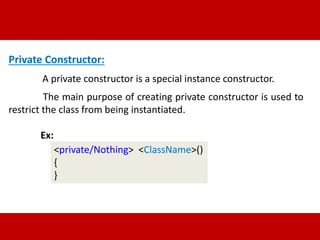
<private/Nothing> <ClassName>() 
{ 
}
Static Constructor: 
 When we declared constructor as static it will be invoked only 
once for any number of instances of the class. 
 Static constructor is used to initialize static fields of the class and 
to write the code that needs to be executed only once. 
 Static constructor will not accept any parameters because it is 
automatically called by CLR. 
 Static constructor will not have any access modifiers. 
 Static constructor will execute automatically whenever we create 
first instance of class. 
 Only one static constructor will allowed.

Constructors

  • 1.
  • 2.
     Constructor isa special method of a class which will invoke automatically whenever instance or object of class is created.  Constructor name should be same as class name. If we want to create constructor in a class we need to create a constructor method name same as class name. ex: <AccessModifier/static/Nothing> <ClassName>() { //Initialization }
  • 3.
     class canhave any number of constructors and constructors don’t have any return type, not even void  Constructors are responsible for object initialization and memory allocation of its class.  There is always at least one constructor in every class.
  • 4.
    Types of Constructors 1. Default Constructor 2. Parameterless Constructor 3. Parameterized Constructor 4. Copy Constructor 5. Private Constructor 6. Static Constructor
  • 5.
    Default Constructor: Defaultconstructor will be added by compiler, if we do not write any constructor in a class. Default constructor does not have any parameters . Parameterless Constructor: If we do not write any parameters in a constructor is called as parameterless constructor. Parameterized Constructor: A constructor with at least one parameter is called as parameterized constructor.
  • 6.
    Copy Constructor: Aparameterized constructor that contains a parameter of same class type is called as copy constructor. Main purpose of copy constructor is to initialize new instance to the values of an existing instance. Ex: <AccessModifier/Nothing> <ClassName>(ClassName cn) { }
  • 7.
    Private Constructor: Aprivate constructor is a special instance constructor. The main purpose of creating private constructor is used to restrict the class from being instantiated. Ex: <private/Nothing> <ClassName>() { }
  • 8.
    Static Constructor: When we declared constructor as static it will be invoked only once for any number of instances of the class.  Static constructor is used to initialize static fields of the class and to write the code that needs to be executed only once.  Static constructor will not accept any parameters because it is automatically called by CLR.  Static constructor will not have any access modifiers.  Static constructor will execute automatically whenever we create first instance of class.  Only one static constructor will allowed.