



www.persistent.com
© 2015 Persistent Systems Ltd
Impediments: Silent killer of agile
teams
Pooja Wandile
© 2015 Persistent Systems Ltd
2
© 2015 Persistent Systems Ltd
3
© 2015 Persistent Systems Ltd
4
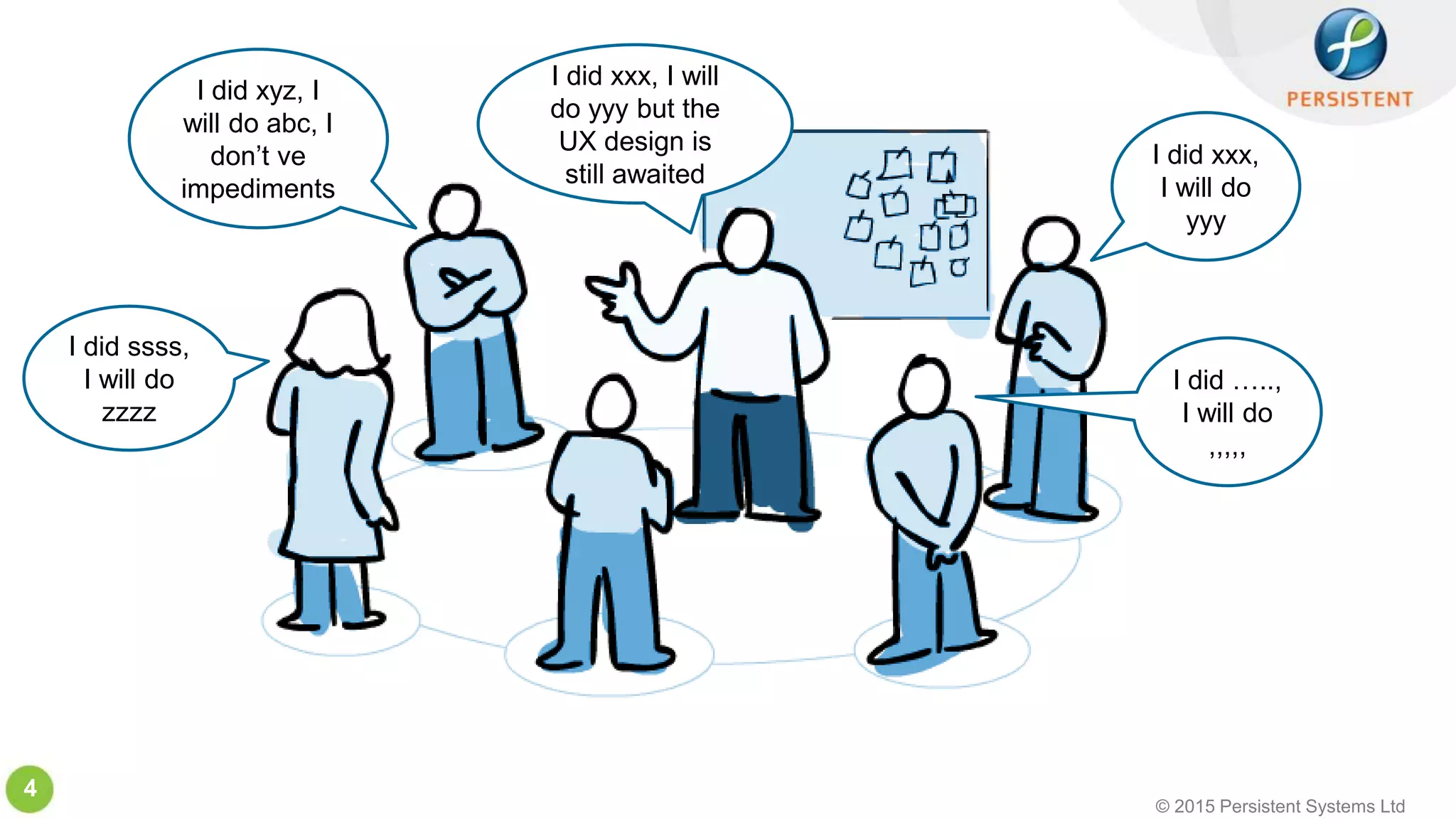
I did xxx,
I will do
yyy
I did xyz, I
will do abc, I
don’t ve
impediments
I did ssss,
I will do
zzzz
I did xxx, I will
do yyy but the
UX design is
still awaited
I did …..,
I will do
,,,,,
© 2015 Persistent Systems Ltd
5
© 2015 Persistent Systems Ltd
6
So, what is an
Impediment?
© 2015 Persistent Systems Ltd
7
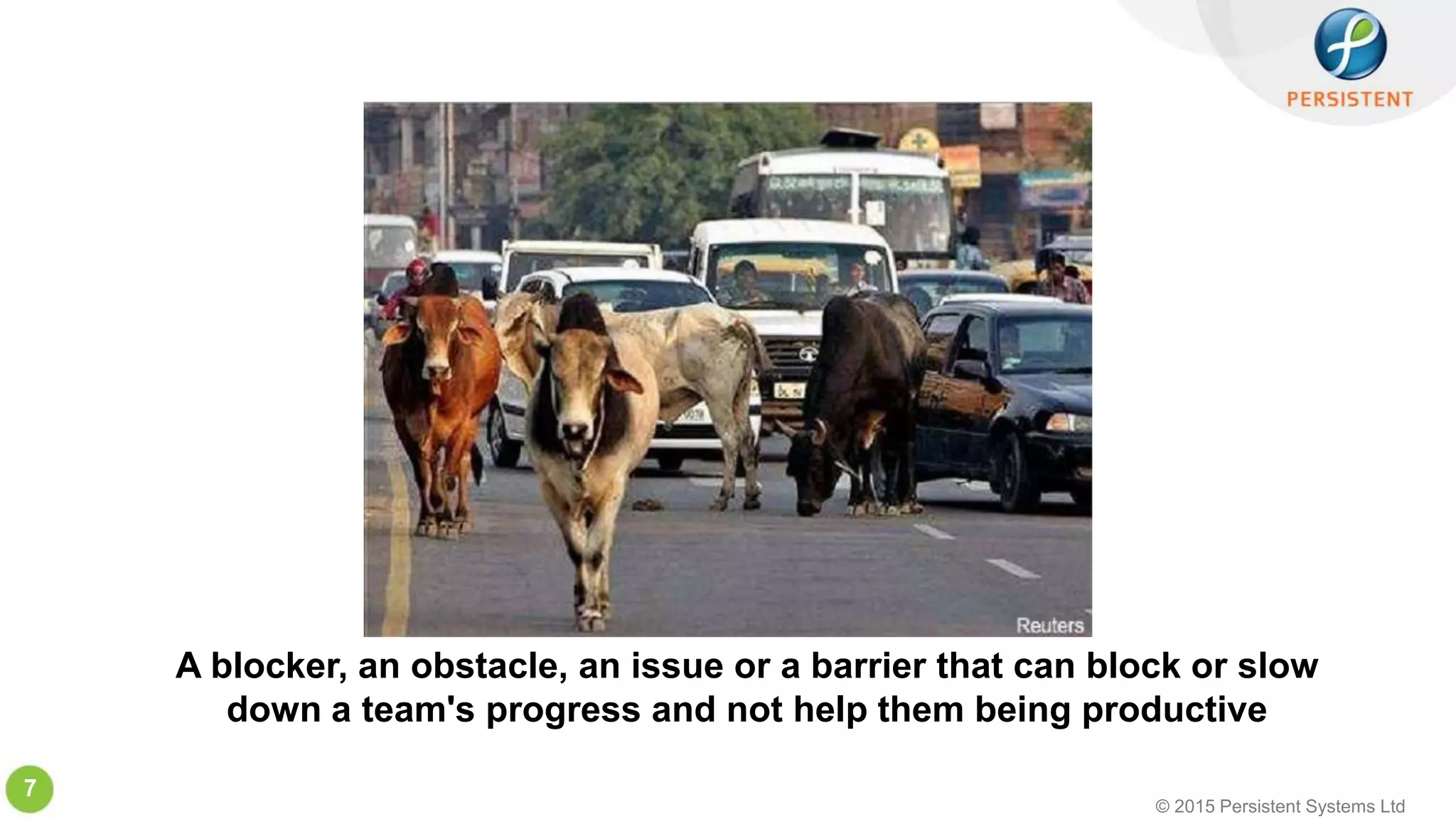
A blocker, an obstacle, an issue or a barrier that can block or slow
down a team's progress and not help them being productive
© 2015 Persistent Systems Ltd
8
 Local impediments
 Inadequate skills
 Slow or unstable builds
 High tech debt
 Third party dependency
 Ineffective tools integration
 Global/organization impediments
 Insufficient training
 Appraisal policies
 Conflicts and politics
 Delayed decisions
 Inadequate infrastructure
Types/Examples of impediments
© 2015 Persistent Systems Ltd
9
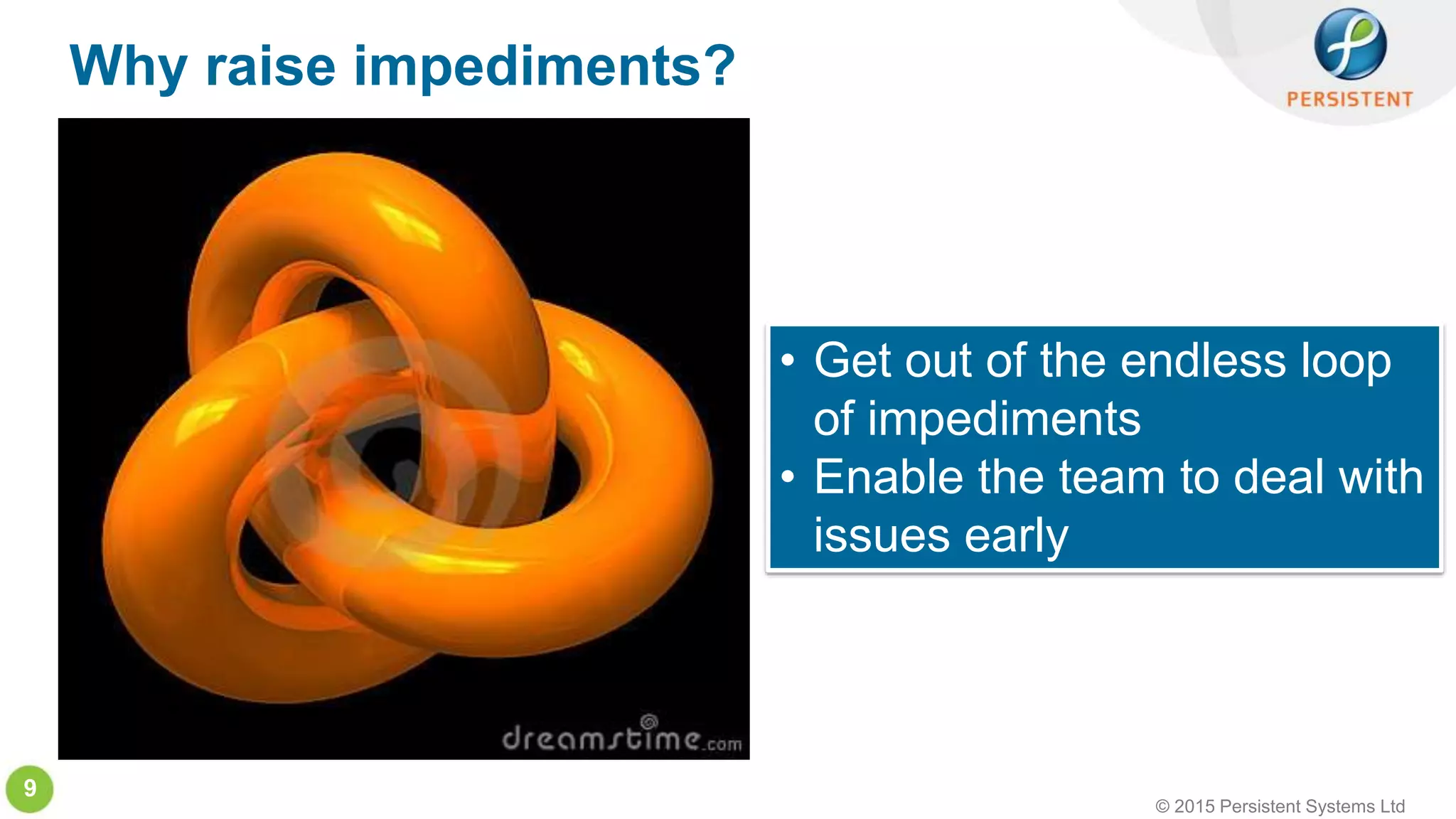
Why raise impediments?
• Get out of the endless loop
of impediments
• Enable the team to deal with
issues early
© 2015 Persistent Systems Ltd
10
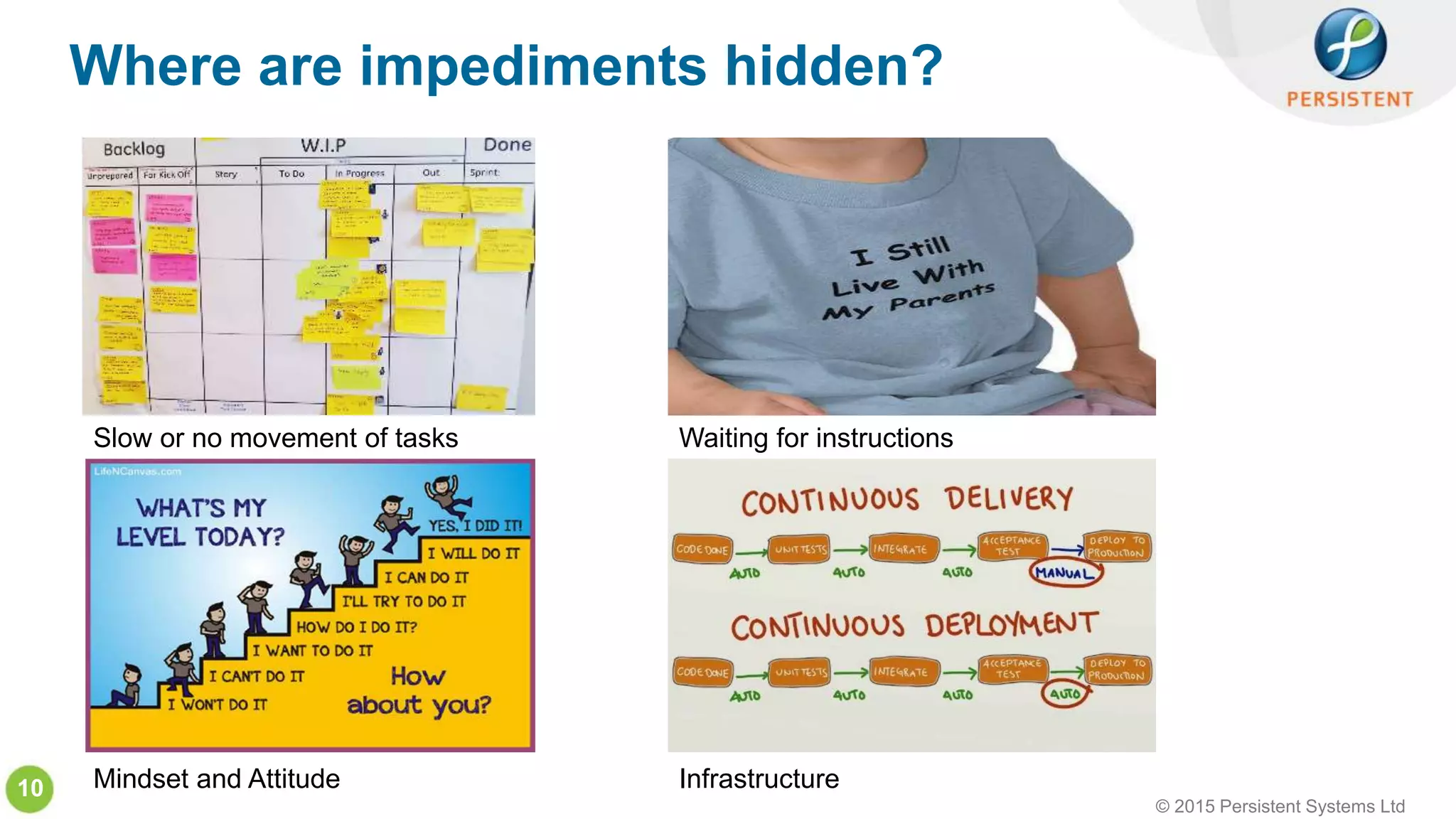
Where are impediments hidden?
Slow or no movement of tasks Waiting for instructions
Mindset and Attitude Infrastructure
© 2015 Persistent Systems Ltd
11
 Unable to realize ‘something’ as an impediment. You cannot fix problems until you
know they exist.
 ‘Culture fabric’ of the team
 Fear of being perceived as ineffective/incompetent
 ‘Working on it, No need to discuss’
 Behavior issue
 Not serious enough to become an impediment
 Waterfall to agile transformation
Difficulty in raising impediments
© 2015 Persistent Systems Ltd
12
Hunting ground
• Daily Scrum
• Sprint Reviews
• Scrum of Scrums
• Sprint Retrospectives
• Agile Maturity Assessment
• Metrics
© 2015 Persistent Systems Ltd
13
© 2015 Persistent Systems Ltd
14
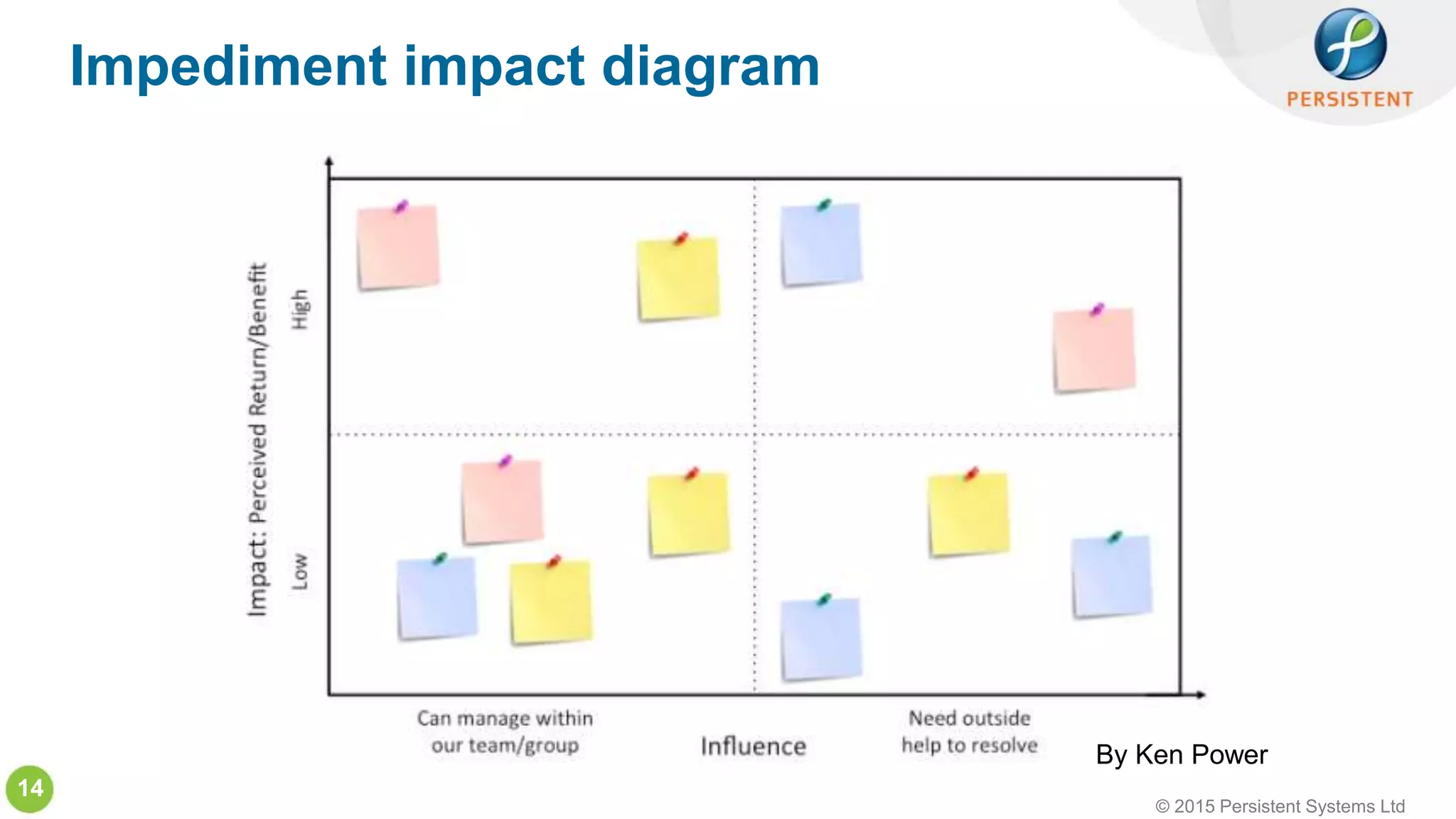
Impediment impact diagram
By Ken Power
© 2015 Persistent Systems Ltd
15
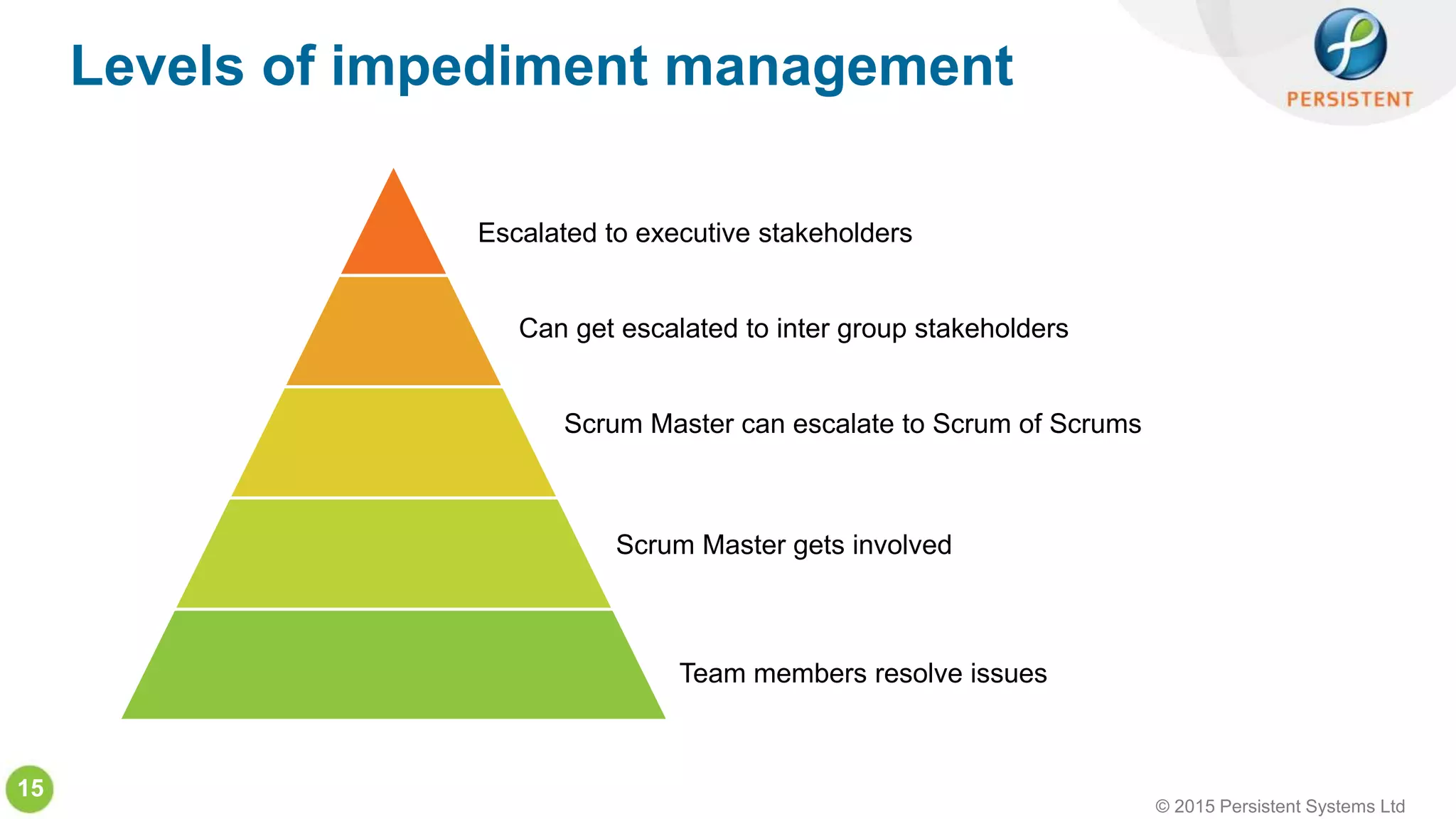
Levels of impediment management
Team members resolve issues
Scrum Master gets involved
Scrum Master can escalate to Scrum of Scrums
Escalated to executive stakeholders
Can get escalated to inter group stakeholders
© 2015 Persistent Systems Ltd
16
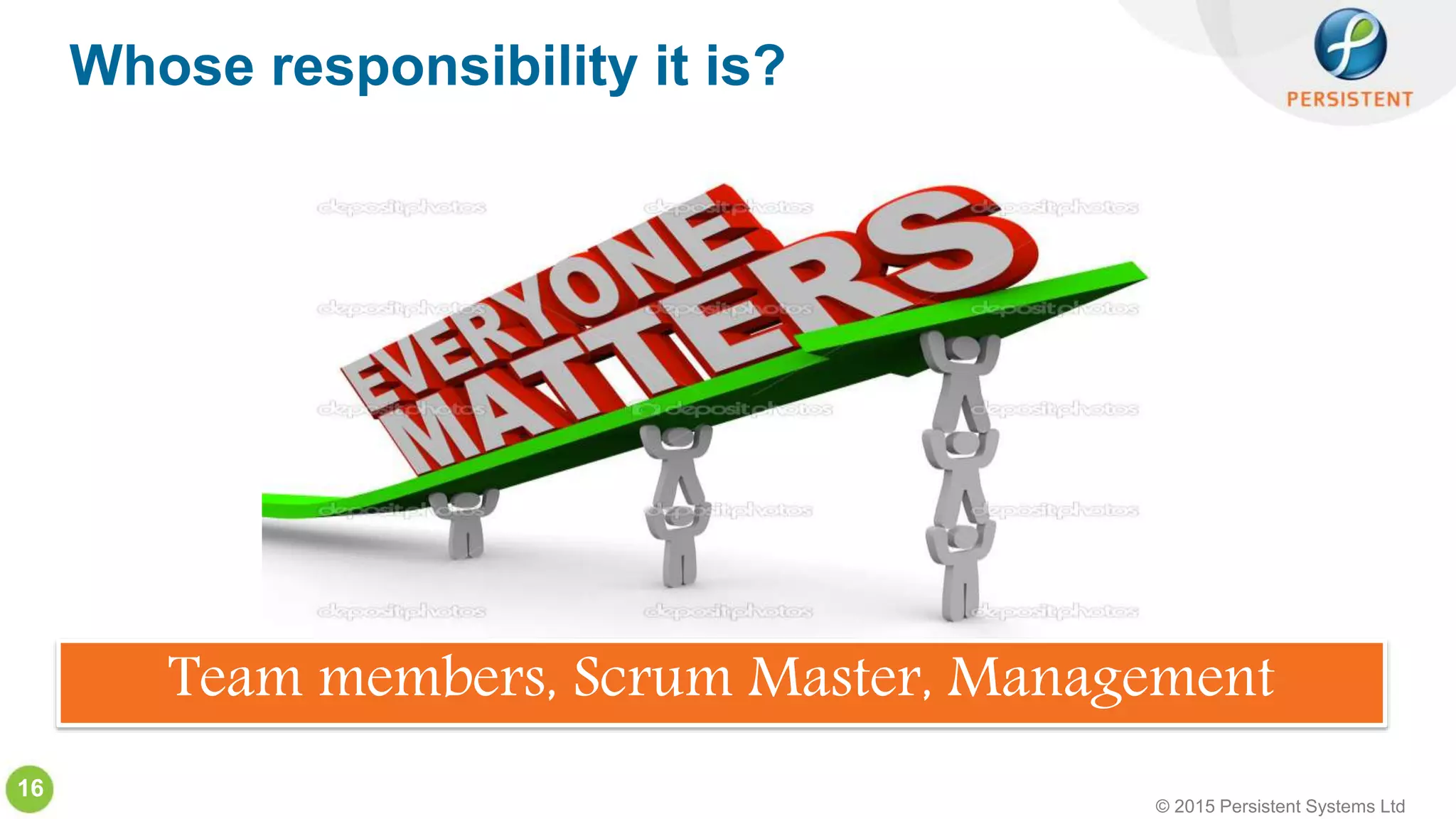
Whose responsibility it is?
Team members, Scrum Master, Management
© 2015 Persistent Systems Ltd
17
 Speak out
 Trust is important
 Prioritize issues by impact on value
 Be sympathetic, especially with new teams
 Impediments are real, don’t turn a blind eye
 Escalate early
 Put a process in place
 Define and track impediment metrics
Lessons learned
© 2015 Persistent Systems Ltd
18
 Never hide impediments, escalate if not resolved in 1 working day
 Importantly, make the impediments visible using impediment board
 Don’t let the impediment backlog grow
 Discuss the root cause of the impediment during retrospection meeting
 Differentiate between local and global impediments, some impediments
are beyond your control
 Don't always depend on the Scrum master to resolve the impediment
 Effectively manage impediments by logging, prioritizing and
systematically addressing them
 Use metrics such as turnaround time for managing impediments
Few tips
© 2015 Persistent Systems Ltd
1919
Thank You!!!
@poojawk
https://in.linkedin.com/in/pooja-wandile

Impediments: Silent killer of agile teams

  • 1.
    www.persistent.com © 2015 PersistentSystems Ltd Impediments: Silent killer of agile teams Pooja Wandile
  • 2.
    © 2015 PersistentSystems Ltd 2
  • 3.
    © 2015 PersistentSystems Ltd 3
  • 4.
    © 2015 PersistentSystems Ltd 4 I did xxx, I will do yyy I did xyz, I will do abc, I don’t ve impediments I did ssss, I will do zzzz I did xxx, I will do yyy but the UX design is still awaited I did ….., I will do ,,,,,
  • 5.
    © 2015 PersistentSystems Ltd 5
  • 6.
    © 2015 PersistentSystems Ltd 6 So, what is an Impediment?
  • 7.
    © 2015 PersistentSystems Ltd 7 A blocker, an obstacle, an issue or a barrier that can block or slow down a team's progress and not help them being productive
  • 8.
    © 2015 PersistentSystems Ltd 8  Local impediments  Inadequate skills  Slow or unstable builds  High tech debt  Third party dependency  Ineffective tools integration  Global/organization impediments  Insufficient training  Appraisal policies  Conflicts and politics  Delayed decisions  Inadequate infrastructure Types/Examples of impediments
  • 9.
    © 2015 PersistentSystems Ltd 9 Why raise impediments? • Get out of the endless loop of impediments • Enable the team to deal with issues early
  • 10.
    © 2015 PersistentSystems Ltd 10 Where are impediments hidden? Slow or no movement of tasks Waiting for instructions Mindset and Attitude Infrastructure
  • 11.
    © 2015 PersistentSystems Ltd 11  Unable to realize ‘something’ as an impediment. You cannot fix problems until you know they exist.  ‘Culture fabric’ of the team  Fear of being perceived as ineffective/incompetent  ‘Working on it, No need to discuss’  Behavior issue  Not serious enough to become an impediment  Waterfall to agile transformation Difficulty in raising impediments
  • 12.
    © 2015 PersistentSystems Ltd 12 Hunting ground • Daily Scrum • Sprint Reviews • Scrum of Scrums • Sprint Retrospectives • Agile Maturity Assessment • Metrics
  • 13.
    © 2015 PersistentSystems Ltd 13
  • 14.
    © 2015 PersistentSystems Ltd 14 Impediment impact diagram By Ken Power
  • 15.
    © 2015 PersistentSystems Ltd 15 Levels of impediment management Team members resolve issues Scrum Master gets involved Scrum Master can escalate to Scrum of Scrums Escalated to executive stakeholders Can get escalated to inter group stakeholders
  • 16.
    © 2015 PersistentSystems Ltd 16 Whose responsibility it is? Team members, Scrum Master, Management
  • 17.
    © 2015 PersistentSystems Ltd 17  Speak out  Trust is important  Prioritize issues by impact on value  Be sympathetic, especially with new teams  Impediments are real, don’t turn a blind eye  Escalate early  Put a process in place  Define and track impediment metrics Lessons learned
  • 18.
    © 2015 PersistentSystems Ltd 18  Never hide impediments, escalate if not resolved in 1 working day  Importantly, make the impediments visible using impediment board  Don’t let the impediment backlog grow  Discuss the root cause of the impediment during retrospection meeting  Differentiate between local and global impediments, some impediments are beyond your control  Don't always depend on the Scrum master to resolve the impediment  Effectively manage impediments by logging, prioritizing and systematically addressing them  Use metrics such as turnaround time for managing impediments Few tips
  • 19.
    © 2015 PersistentSystems Ltd 1919 Thank You!!! @poojawk https://in.linkedin.com/in/pooja-wandile

Editor's Notes

  • #2 The Scrum agile software framework doesn't eliminate the problems in your organization, but rather, makes them large, obvious and impossible to ignore. You can then choose to change ineffective processes and conditions or live with them. Here, Knowledge Center contributor Angela Druckman explains how your company can remove its organizational impediments to realize the full benefits of Scrum. Scrum, they learn that an important benefit these methods offer is the ability to expose organizational impediments
  • #8 An impediment is a blocker, an obstacle, an issue or a barrier that can block or slow down a team's progress and not help them being productive be within the team, outside the team or within the organization be technical, non-technical keep the scrum master and team busy for a long time if not addressed soon
  • #9 Large or small, one thing all impediments have in common is that they adversely affect the team's (and, therefore, the organization's) ability to deliver value.
  • #10 It can get you into an endless loop of impediments that prevents the team from achieving its potential velocity By communicating impediments as they occur on a daily basis at the Scrum, the team puts itself in a position to deal with these issues early, before they have an adverse reaction to the sprint
  • #11 There is no such thing as a team without impediments -- every team could perform faster. If you as the ScrumMaster aren't aware of impediments you are not doing your job. Inexperienced Scrum teams may not mention impediments by themselves so you must actively search for them. For example: - See more at: https://www.scrumalliance.org/community/articles/2011/september/five-tips-for-impediment-resolution-with-scrum#sthash.64qZzLg1.dpuf lack of belief in the self-organizing capability of a team
  • #12 Or, sometimes, developers don't raise issues because they know they can sort them out themselves, so they don't see the need to discuss them in front of their colleagues Leadership/coaching issue
  • #18 remember to pick your battles. ScrumMasters and their teams often uncover a flood of impediments in the early days of the first pilot projects. Trying to resolve them all at once can be overwhelming. Instead, consider generating some quick wins by removing a few smaller impediments first. Doing so creates a pattern of success, makes management more open to hearing about issues and prepares the organization for dealing with thornier issues in the future.
  • #19 "I have no impediments." It's the most common sign-off for every team member in the daily Scrum. It's also a lie. We've all been there. Standing in a little circle of people, listening to the carousel of "This is what I did yesterday, this is what I am going to do tomorrow, I have no impediments" from each of the team members. The reality is, most teams will suffer some sort of impediment each and every day. The difficulty lies in getting teams to discuss these issues. For individuals and teams new to Scrum in particular, it takes time to understand the importance of raising impediments and to feel confident enough to raise them in front of peers. - See more at: https://www.scrumalliance.org/community/articles/2012/march/i-have-no-impediments#sthash.ckJsgGad.dpuf