EXTRACTION IN
ORTHODONTICS
DR CHANDRIKA KATTI
Reader, Dept Of Orthodontics.
Navodaya Dental College,
Raichur.
HISTORY
 Great extraction controversy in 1920’s :
Edward H. Angle & Calvin Case.
 Extractions was reintroduced in 1940’s by
Charles Tweed.
 Extractions were popular in 1960’s.
Why do we need extractions as a part of
orthodontic treatment procedure :
1. Arch length –tooth material discrepancy
2. Correction of sagittal interarch relationship
3. Abnormal size and form of tooth
4. Skeletal jaw malrelations
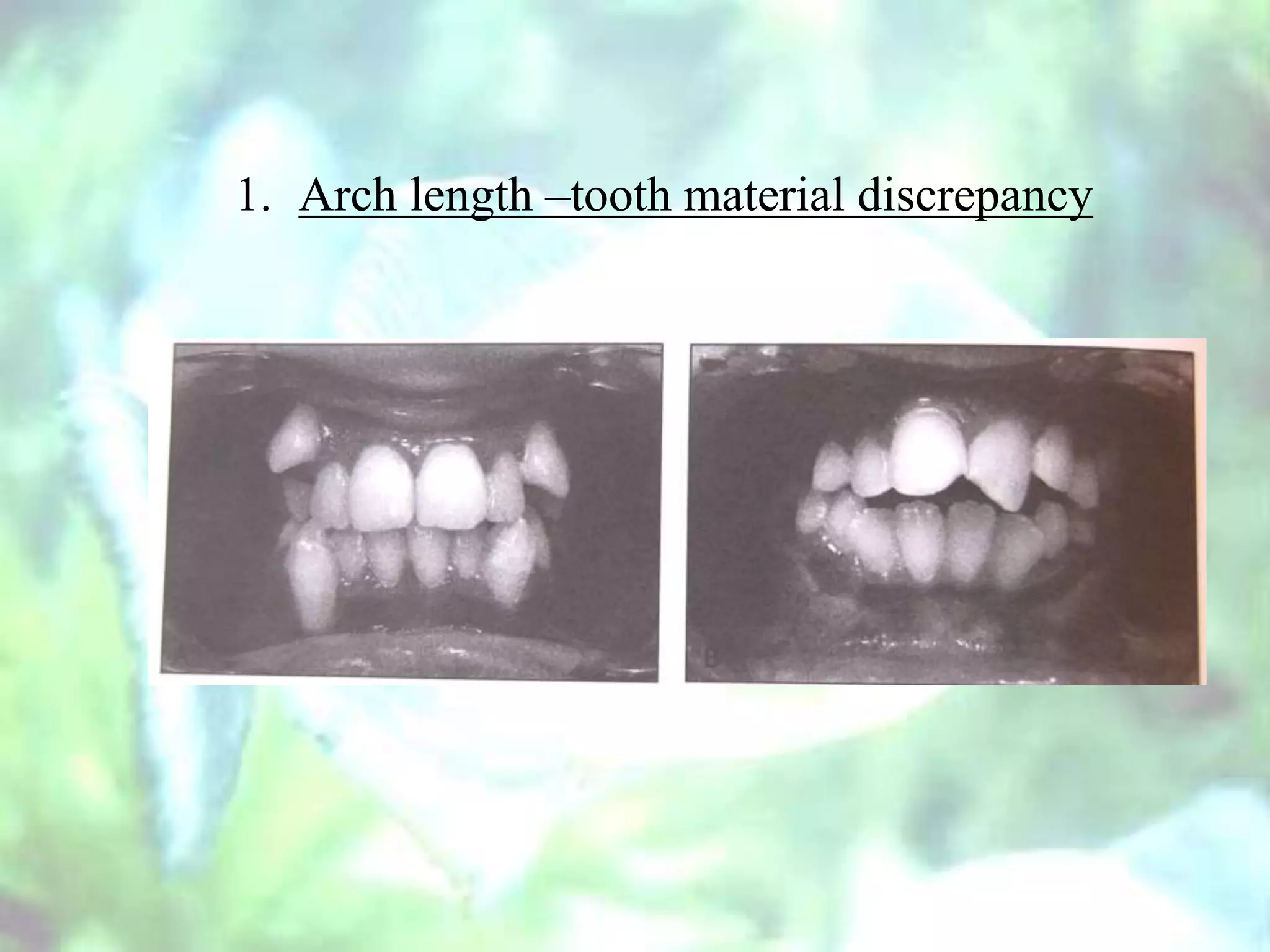
1. Arch length –tooth material discrepancy
2. Correction of sagittal interarch relationship
3. Abnormal size and form of tooth
4. Skeletal jaw malrelations
In case of surgeries
Choice of teeth for extraction
1. Extraction of upper incisors
a) Unfavorably impacted teeth
b) Buccally / lingually impacted laterals
c) If one side lateral is congenitally missing
extract on the contralateral side
d) Grossly carious teeth
e) Malformed teeth
f) Trauma
g) Incisor with dilacerated root
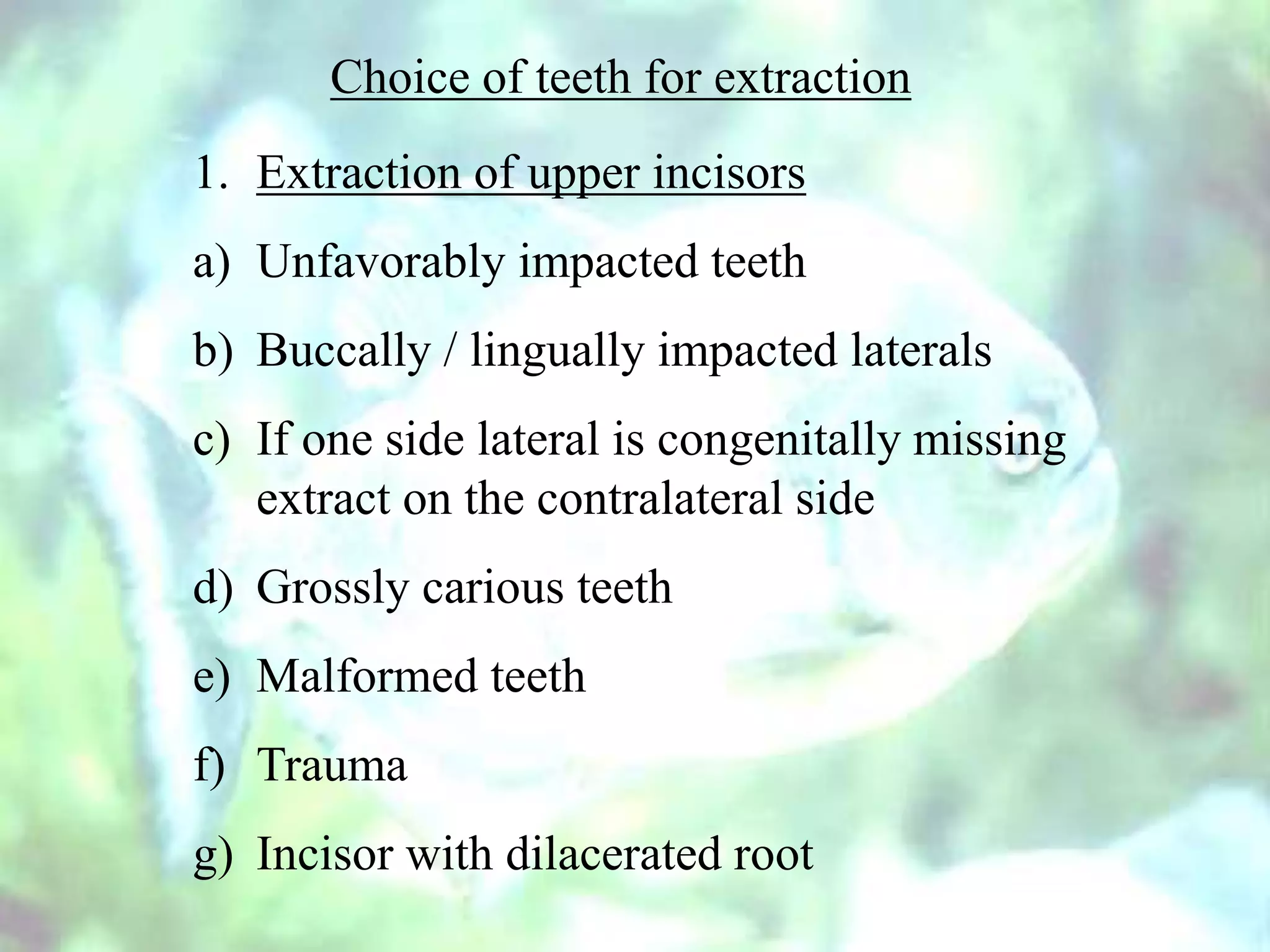
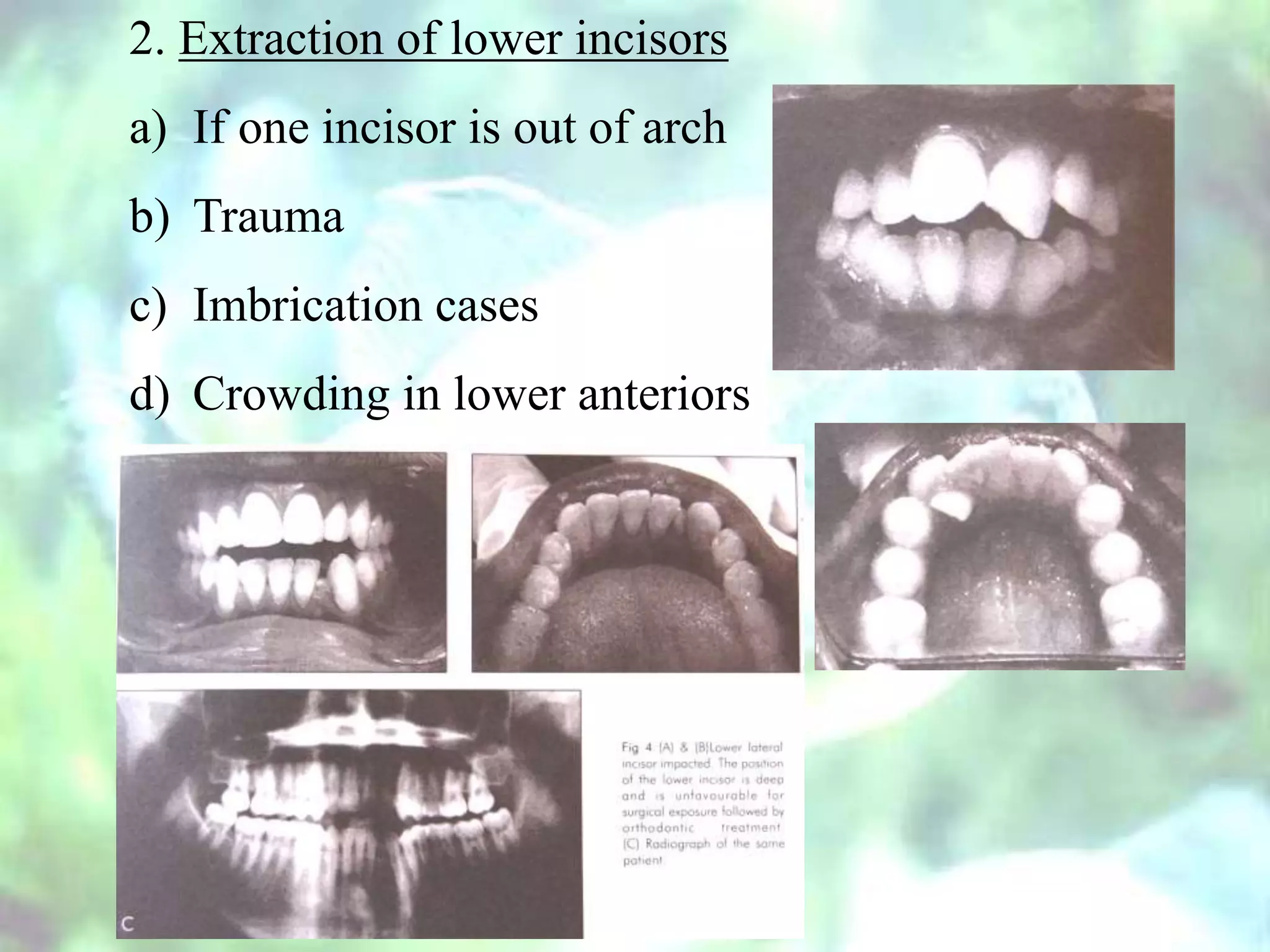
2. Extraction of lower incisors
a) If one incisor is out of arch
b) Trauma
c) Imbrication cases
d) Crowding in lower anteriors
3. Extraction of canines
a) Unfavorably impacted teeth
b) Buccally / lingually impacted canines with
good contact between laterals and premolars
c) If one side deciduous canine is congenitally
missing extract on the contralateral side
d) As a part of serial extraction
e) In class-II cases if lower decd canines are shed
earlier, upper decd canines should be extracted
f) In class-III cases if upper decd canines are
shed earlier, lower decd canines should be
extracted
4. Extraction of first premolars
a) Moderate to severe anterior teeth crowding
cases
b) Class-I bimax cases, Class-II div-1 cases
5. Extraction of second premolars
a) Minimal anchorage cases
b) Mild crowding cases
c) Unfavorably impacted
d) Open bite cases
e) Grossly carious teeth
f) Completely out of arch
6. Extraction of first molars
a) open bite cases
b) Grossly decayed tooth
c) Mild crowding or mild proclination
Wilkinsons extraction
Extraction of all first molars at the age of 8.5-
9.5 years.
Advantages:
1. Eases third molar eruption
2. Lower risk of caries
Drawbacks:
1. Offers limited space to relieve crowding
2. 2nd premolars & 2nd molars tip
3. No anchor support
7. Extraction of second molars
a) To prevent 3rd molar impactions
b) To relieve impaction of 2nd premolars
c) To relieve lower incisor crowding
d) Distalization of molars
e) Open bite cases
8. Extraction of third molars
a) Grossly carious teeth
b) Malformed tooth
c) To prevent late anterior crowding
Balancing extractions (in same arch)
Compensating extractions (in opposite arches)
DRIFTODONTICS
Extractions in Orthodontics O.ppt

Extractions in Orthodontics O.ppt

  • 1.
    EXTRACTION IN ORTHODONTICS DR CHANDRIKAKATTI Reader, Dept Of Orthodontics. Navodaya Dental College, Raichur.
  • 2.
    HISTORY  Great extractioncontroversy in 1920’s : Edward H. Angle & Calvin Case.  Extractions was reintroduced in 1940’s by Charles Tweed.  Extractions were popular in 1960’s.
  • 3.
    Why do weneed extractions as a part of orthodontic treatment procedure : 1. Arch length –tooth material discrepancy 2. Correction of sagittal interarch relationship 3. Abnormal size and form of tooth 4. Skeletal jaw malrelations
  • 4.
    1. Arch length–tooth material discrepancy
  • 5.
    2. Correction ofsagittal interarch relationship
  • 6.
    3. Abnormal sizeand form of tooth
  • 7.
    4. Skeletal jawmalrelations In case of surgeries
  • 8.
    Choice of teethfor extraction 1. Extraction of upper incisors a) Unfavorably impacted teeth b) Buccally / lingually impacted laterals c) If one side lateral is congenitally missing extract on the contralateral side d) Grossly carious teeth e) Malformed teeth f) Trauma g) Incisor with dilacerated root
  • 9.
    2. Extraction oflower incisors a) If one incisor is out of arch b) Trauma c) Imbrication cases d) Crowding in lower anteriors
  • 10.
    3. Extraction ofcanines a) Unfavorably impacted teeth b) Buccally / lingually impacted canines with good contact between laterals and premolars c) If one side deciduous canine is congenitally missing extract on the contralateral side d) As a part of serial extraction e) In class-II cases if lower decd canines are shed earlier, upper decd canines should be extracted f) In class-III cases if upper decd canines are shed earlier, lower decd canines should be extracted
  • 12.
    4. Extraction offirst premolars a) Moderate to severe anterior teeth crowding cases b) Class-I bimax cases, Class-II div-1 cases
  • 14.
    5. Extraction ofsecond premolars a) Minimal anchorage cases b) Mild crowding cases c) Unfavorably impacted d) Open bite cases e) Grossly carious teeth f) Completely out of arch
  • 16.
    6. Extraction offirst molars a) open bite cases b) Grossly decayed tooth c) Mild crowding or mild proclination
  • 17.
    Wilkinsons extraction Extraction ofall first molars at the age of 8.5- 9.5 years. Advantages: 1. Eases third molar eruption 2. Lower risk of caries Drawbacks: 1. Offers limited space to relieve crowding 2. 2nd premolars & 2nd molars tip 3. No anchor support
  • 18.
    7. Extraction ofsecond molars a) To prevent 3rd molar impactions b) To relieve impaction of 2nd premolars c) To relieve lower incisor crowding d) Distalization of molars e) Open bite cases
  • 19.
    8. Extraction ofthird molars a) Grossly carious teeth b) Malformed tooth c) To prevent late anterior crowding
  • 20.
    Balancing extractions (insame arch) Compensating extractions (in opposite arches) DRIFTODONTICS