OCCLUSION IN DENTISTRY
PRESENTED BY – DR. ANAMIKA ABRAHAM
GUIDED BY – DR. DESHRAJ JAIN
TABLE OF CONTENTS
DEFINITIONS
THERAPEUTIC AND PHYSIOLOGIC OCCLUSION
IDEAL OCCLUSION
CONCEPTS OF OCCLUSION
 BILATERAL BALANCED
 UNILATERAL BALANCED/ GROUP FUNCTION
 CANINE GUIDED
OCCLUSION BASICS FROM DENTAL ANATOMY
IMPORTANCE OF OCCLUSION IN
 PEDODONTICS
 ORTHODONTICS
 ORAL SURGERY
 RESTORATIVE DENTISTRY
 PERIODONTICS
 PROSTHODONTICS
TYPES OF OCCLUSAL ERROR AND ITS CORRECTION
PATHOGENIC OCCLUSION
CONCLUSION
REFERENCES
Key terms & Definitions
Occlusion: is derived from the Latin word
“Occlusio” meaning act of closure or being
closed.
According to ANGLE “occlusion is a normal
relation of occlusal inclined planes of the teeth
when jaw is closed.
GPT: static relation between incising and
masticating surfaces of maxillary & mandibular
teeth or tooth analogues.
“Occlusion is the act or process of closure or
of being closed or shut off”
• Ramfjord and Ash: Occlusion = Contacts
between teeth
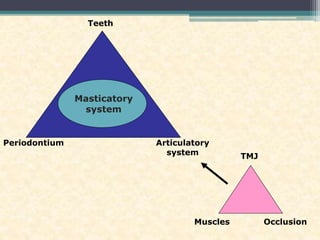
• “Multifactorial functional relationship
between the teeth and other components
of the masticatory system as well as with
other areas of the head and neck that
directly or indirectly relate to function,
parafunction or dysfunction of the
masticatory system’’
Masticatory
system
Teeth
Periodontium Articulatory
system TMJ
Muscles Occlusion
A therapeutic occlusion is one in which the
arrangement of teeth and their opposing
surfaces satisfy functional and esthetic
requirements while distributing and directing
forces of occlusion over as many teeth as
possible during functions of the mandible.
Physiologic occlusion- Occlusion that deviates in
one or more ways from ideal, yet it is well
adapted to that particular environment, is
esthetic and shows no pathologic manifestation
Ideal Occlusion
Guichet(1970) described standards for ideal occlusion
and said that there was no one ideal occlusion pattern
for all individuals but an appropriate pattern can be
found based on these criteria.
 Criteria I- Incorporate into the occlusion those factors which have to do
with the reduction of vertical forces.
 Criteria II- Provide a maximum intercuspation of teeth with the condyles in
centric relation position.
 Criteria III- Provide for horizontal movement of the mandible from the
centric position
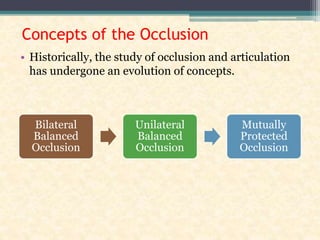
Concepts of the Occlusion
• Historically, the study of occlusion and articulation
has undergone an evolution of concepts.
Bilateral
Balanced
Occlusion
Unilateral
Balanced
Occlusion
Mutually
Protected
Occlusion
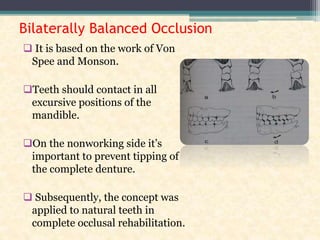
Bilaterally Balanced Occlusion
 It is based on the work of Von
Spee and Monson.
Teeth should contact in all
excursive positions of the
mandible.
On the nonworking side it’s
important to prevent tipping of
the complete denture.
 Subsequently, the concept was
applied to natural teeth in
complete occlusal rehabilitation.
Definition :
• The simultaneous contacting of the maxillary
and the mandibular teeth on the right and left
side and in the posterior and anterior occlusal
areas in centric and eccentric positions,
developed to lessen or limit the tipping or
rotating of the denture base in relation to the
supporting structures.
 An attempt was made to reduce the load on
individual teeth by sharing the stress among as
many teeth as possible.
It was soon discovered, however, that this was a
very difficult type of arrangement to achieve.
 As a result of the multiple tooth contacts that
occurred as the mandible moved through its
various excursions, there was excessive frictional
wear on the teeth
The Demise Of Balanced Occlusion In
Restoring Natural Dentition
Bilateral balanced occlusion
Fixed Prosthodontics
High rate of failure
Failure was due to
 Increased occlusal
wear.
 Increased/accelerated
periodontal breakdown.
 TMJ and
neuromuscular
disturbances.
Unilateral Balanced / Group
Function Occlusion
 In a unilaterally balanced occlusion , excursive
contact occurs between all opposing posterior teeth
on the laterotrusive (working) side only.
 This concept had its origin in the work of Schuyler
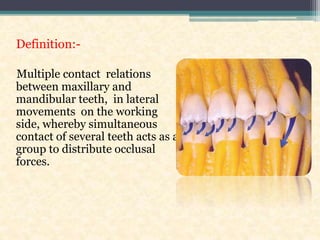
Definition:-
Multiple contact relations
between maxillary and
mandibular teeth, in lateral
movements on the working
side, whereby simultaneous
contact of several teeth acts as a
group to distribute occlusal
forces.
The most desirable group function occlusion
consists of contact of canine,premolar and
mesiobuccal cusp of first molar.
 Any laterotrusive contact more posterior than
mesial portion of first molar are not desirable
because of the increased amount of force that can
be placed as its near the fulcrum and force
vectors .
Advantages
 Group function of the teeth on the working side
distributes the occlusal load .
 The absence of contact on the nonworking side
prevents those from getting subjected to destructive
,obliquely directed forces found in nonworking
interferences.
 It also saves centric holding cusps that is
mandibular buccal cusps and maxillary palatal cusps
from excessive wear.
 Group function was felt to be goal for occlusal
adjustments and has easy application.
 In the presence of anterior bone loss or missing
canines, mouth should be restored to group
function.
Disadvantages:-
Group Function Occlusion doesn’t fulfill criteria for
ideal occlusion
Characteristics of Group Function Given by
BEYRON (1954)
 Teeth should receive stress along the tooth long axis
.
 Total stress should be distributed among the tooth
segment in lateral movement.
 No interferences occur from closure into intercuspal
position
Mutually Protected Occlusion
 During the early 1960s, this occlusal scheme was
advocated by Stuart and Stallard, based on
earlier work by D’Amico.
 In this arrangement, centric relation coincides with
the maximum intercuspation position.
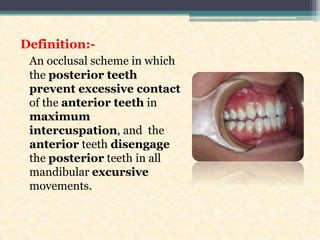
Definition:-
An occlusal scheme in which
the posterior teeth
prevent excessive contact
of the anterior teeth in
maximum
intercuspation, and the
anterior teeth disengage
the posterior teeth in all
mandibular excursive
movements.
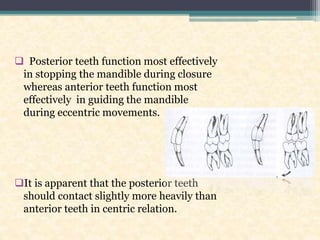
 Posterior teeth function most effectively
in stopping the mandible during closure
whereas anterior teeth function most
effectively in guiding the mandible
during eccentric movements.
It is apparent that the posterior teeth
should contact slightly more heavily than
anterior teeth in centric relation.
Lucia in 1961- Advantages
Minimum amount of tooth contact is involved –therefore
better penetration of food.
 A cusp to fossa relationship produces an interlocking of
upper and lower components- giving a maximum support
in centric relation in all directions.
The force is clearly closer to the long axis of each tooth.
 The arrangement of the marginal,transverse and oblique
ridges have a shearing action -make a more efficient
OCCLUSION
BASICS FROM DENTAL ANATOMY
Based on arrangement of teeth
Type of occlusal contact:
1. Cusp-fossa occlusion
2. Cusp-embrasure occlusion
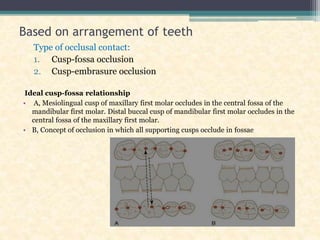
Ideal cusp-fossa relationship
• A, Mesiolingual cusp of maxillary first molar occludes in the central fossa of the
mandibular first molar. Distal buccal cusp of mandibular first molar occludes in the
central fossa of the maxillary first molar.
• B, Concept of occlusion in which all supporting cusps occlude in fossae
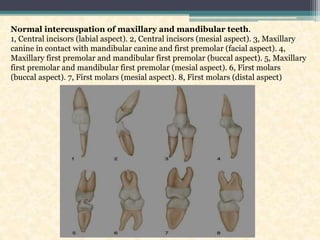
Normal intercuspation of maxillary and mandibular teeth.
1, Central incisors (labial aspect). 2, Central incisors (mesial aspect). 3, Maxillary
canine in contact with mandibular canine and first premolar (facial aspect). 4,
Maxillary first premolar and mandibular first premolar (buccal aspect). 5, Maxillary
first premolar and mandibular first premolar (mesial aspect). 6, First molars
(buccal aspect). 7, First molars (mesial aspect). 8, First molars (distal aspect)
Types Of Cusps
Centric holding cusps
 The buccal cusps of the mandibular posterior teeth and the lingual cusps of
the maxillary posterior teeth occlude with the opposing CF areas.
Non supporting cusp
 The buccal cusps of the maxillary posterior teeth and the lingual cusps of
the mandibular posterior teeth are called the guiding or noncentric cusps.
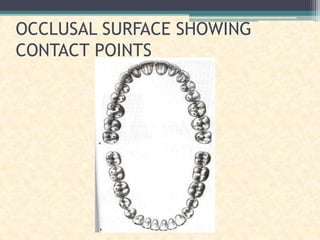
OCCLUSAL SURFACE SHOWING
CONTACT POINTS
IMPORTANCE OF OCCLUSION
PEDODONTICS
• The development of occlusion is the most
dynamic phenomenon in the mouth.
• Development of normal dentition and occlusion
depends upon dentoalveolar , skeletal and the
neuromuscular factors.
• The emergence (eruption) of the primary
dentition into the oral cavity is an important
time for the development of oral motor behavior
and the acquisition of masticatory skills.
STAGES OF OCCLUSAL DEVLOPMENT
• NEONATAL PERIOD
• PRIMARY DENTITION
• MIXED DENTITION
• PERMANENT DENTITION
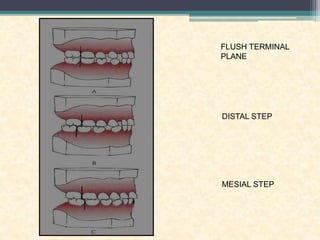
FLUSH TERMINAL
PLANE
DISTAL STEP
MESIAL STEP
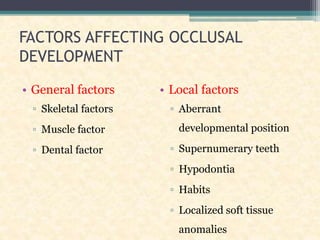
FACTORS AFFECTING OCCLUSAL
DEVELOPMENT
• General factors
▫ Skeletal factors
▫ Muscle factor
▫ Dental factor
• Local factors
▫ Aberrant
developmental position
▫ Supernumerary teeth
▫ Hypodontia
▫ Habits
▫ Localized soft tissue
anomalies
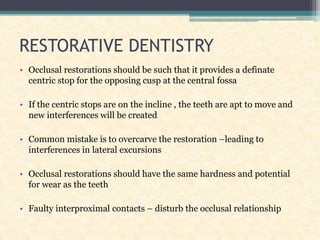
RESTORATIVE DENTISTRY
• Occlusal restorations should be such that it provides a definate
centric stop for the opposing cusp at the central fossa
• If the centric stops are on the incline , the teeth are apt to move and
new interferences will be created
• Common mistake is to overcarve the restoration –leading to
interferences in lateral excursions
• Occlusal restorations should have the same hardness and potential
for wear as the teeth
• Faulty interproximal contacts – disturb the occlusal relationship
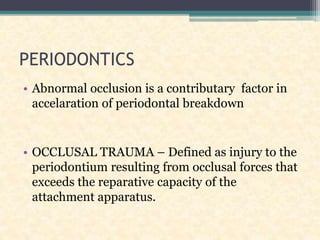
PERIODONTICS
• Abnormal occlusion is a contributary factor in
accelaration of periodontal breakdown
• OCCLUSAL TRAUMA – Defined as injury to the
periodontium resulting from occlusal forces that
exceeds the reparative capacity of the
attachment apparatus.
• Occlusion becomes a factor for consideration when the
occlusal forces acting on a tooth produce displacement of
the root in the socket which results in an injury to the
supporting periodontal ligament. This periodontal tissue
injury from occlusal forces has been defined as the lesion
of trauma from occlusion
• The essential requirements for the co-destructive factor
effect are the production of a traumatic lesion
immediately subjacent to an established marginal
periodontitis
ORAL SURGERY
• The treatment of maxillofacial fractures usually
requires control of dental occlusion with the
application of wires/arch bars for interdental
wiring to orient and stabilize the fracture
• Important principle which is followed
‘RESTORATION OF PREINJURY OCCLUSION’
ORTHODONTICS
Andrews , in 1972, observed the presence of six common
characteristics, known as “six keys to normal occlusion”:
• Molar relationship
• Mesiodistal crown angulation
• Labiolingual crown inclination
• Absence of rotation
• Tight contacts
• Curve of spee
In 1976, Roth presented the following functional
aspects of the occlusion as being fundamental for
completion of the orthodontic cases:
1. Teeth must present maximum intercuspal (MI) position with the jaw in
centric relation (CR);
2. In centric relation, all posterior teeth must present axial occlusal
contacts, and the anterior teeth must maintain a distance of 0.0005
inches between them;
3. During laterotrusion, the canines must disocclude the posterior teeth
(canine guidance);
4. During protrusion, the upper anterior teeth must occlude with the
lower anterior teeth and the first premolar or the second premolar (in
extraction cases), aiming at disoccluding all posterior teeth (immediate
anterior guidance);
5. No interference must be present on the balancing side
WHY?? canine guidance at orthodontic
completion
1. the strategic positioning of the canine in the arch
2. the favorable root anatomy
3. presence of a better crownroot proportion
4. the presence of dense and compact bone around the root, which better
tolerates the occlusal forces compared with the medullar bone of the
posterior teeth
5. the sensorial pulse that activates less muscles when the canine teeth are
in contact than when posterior teeth contact each other
• Therefore, when the jaw is in a right or left laterotrusive
movement, the upper and lower canines are the appropriate
teeth to contact and to dissipate the horizontal forces, while
promoting the disocclusion of the posterior teeth.
• The occlusion school- According to Kingsley,
proper occlusion is a key factor in determining
the stability of newly moved teeth.
THEORIES OF RETENTION - By REIDEL
Theorum 4 – Proper occlusion is a potent factor in
holding teeth in their corrected positions.
Aim of orthodontic treatment is to achieve good
functional occlusion i.e. Harmonious occlusal
contacts during functional movements of the
jaws.
CONCEPTS OF COMPLETE DENTURE
OCCLUSION
Static concept
The static relations in occlusion include centric
occlusion, protrusive occlusion, right and left lateral
occlusion. All of these relations must be balanced
with the simultaneous contacts of all the teeth on
both sides of the arch at their very first contact.
The cuspal inclines should be developed so that the
teeth can glide from a more centric occlusion to
eccentric positions without interference and without
the introduction of rotating or tipping forces.
Dynamic concept
The dynamic concept of occlusion is primarily
concerned with opening and closing movements
involved in mastication. Jaw movements and
tooth contacts are made, as the teeth of one
jaw glide over the teeth of the opposing jaw.
Movements of the mandible which occur when
the teeth are not in contact are termed as free
movements.
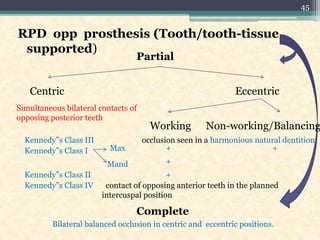
RPD opp prosthesis (Tooth/tooth-tissue
supported)
45
Partial
Complete
Centric Eccentric
Working Non-working/Balancing
Simultaneous bilateral contacts of
opposing posterior teeth
Kennedy”s Class III
Kennedy”s Class I
Kennedy”s Class II
Kennedy”s Class IV
Bilateral balanced occlusion in centric and eccentric positions.
Max
Mand
+
+
+
+
contact of opposing anterior teeth in the planned
intercuspal position
occlusion seen in a harmonious natural dentition
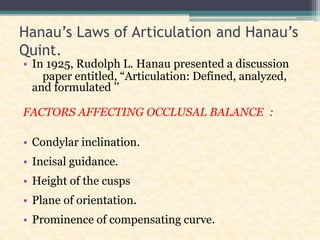
Hanau’s Laws of Articulation and Hanau’s
Quint.
• In 1925, Rudolph L. Hanau presented a discussion
paper entitled, “Articulation: Defined, analyzed,
and formulated ’’
FACTORS AFFECTING OCCLUSAL BALANCE :
• Condylar inclination.
• Incisal guidance.
• Height of the cusps
• Plane of orientation.
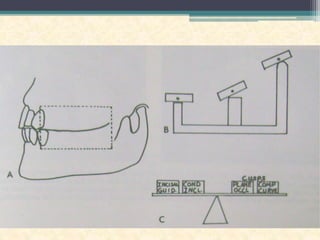
• Prominence of compensating curve.
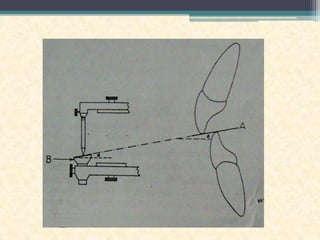
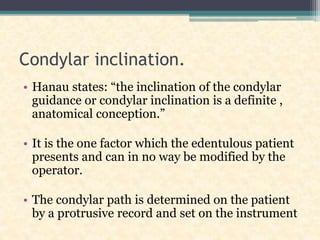
Condylar inclination.
• Hanau states: “the inclination of the condylar
guidance or condylar inclination is a definite ,
anatomical conception.”
• It is the one factor which the edentulous patient
presents and can in no way be modified by the
operator.
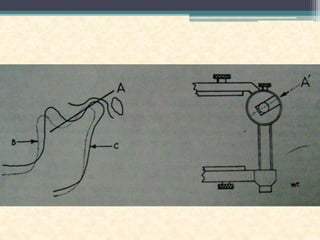
• The condylar path is determined on the patient
by a protrusive record and set on the instrument
The degree of condylar inclination
registered results from:
1. The incline of the articular eminence of the TMJ.
2. Action of muscles in mandibular movement.
3. Limitations of movements effected by the attaching
ligaments.
Among all the factors condylar inclination is most
important in securing balanced articulation and form
one of the end-controlling factor.
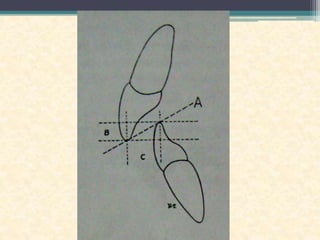
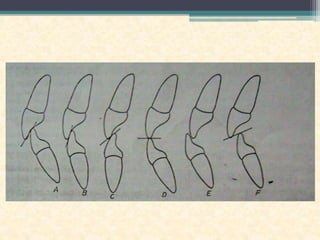
Incisal guidance.
• Second end- controlling factor formed by the
inclination of the incisal guide angle.
• Hanau stated “the inclination of the incisal
guidance is given by the angle of the lingual
surface of the incisors with the horizontal plane
of reference”.
INCISAL GUIDE ANGLE [GPT9]
1: anatomically, the angle formed by the
intersection of the plane of occlusion and a line
within the sagittal plane determined by the
incisal edges of the maxillary and mandibular
central incisors when the teeth are in maximum
intercuspation
2: on an articulator, that angle formed, in the
sagittal plane, between the plane of reference
and the slope of the anterior guide table, as
viewed in the sagittal plane
• With the establishment of two end-controlling
factors, a balanced articulation is obtained when
a harmonious relationship is established
between these two angles and cusp angles.
HEIGHT OF THE CUSP
• Hanau states “ The change of the cusp height in
comparison with the masticatory surface
formation as a whole is an auxiliary magnitude”.
• “In the establishment of the balanced
articulation , we are primarily interested in the
length and the inclination of the effective cusp
inclines.”
• Cusp height exerts its influence by determining
the range of tooth contact during eccentric
movements.
• The higher the cusp, the longer the effective
tooth incline, and therefore greater range of
tooth contact during eccentric movements.
Plane of orientation.
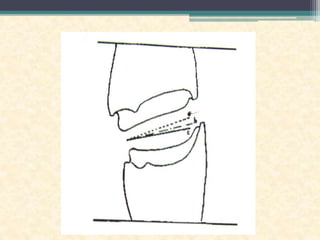
• Hanau states that “ plane of orientation is purely
a geometrical factor. It is a plane assumed to
pass through three dental landmarks or points;
namely, the central incisal contact point and
summits of the mesiobuccal cusps of the
molars”.
Compensating curve.
• It is determined by the inclination of the
posterior teeth and their vertical relationships to
the occlusal plane so that the occlusal surface
results in a curve that is in harmony with the
movement of the mandible as guided posteriorly
by the condylar path.
COMPENSATING CURVE
1. The anteroposterior curving (in the median plane) and the
mediolateral curving (in the frontal plane) within the alignment of
the occluding surfaces and incisal edges of artificial teeth that is
used to develop balanced occlusion
2. The arc introduced in the construction of complete removable
dental prostheses to compensate for the opening influences
produced by the condylar and incisal guidance’s during lateral and
protrusive mandibular excursive movements
• A steep condylar path requires a steep
compensating curve for occlusal balance.
• A lesser compensating curve for the same
condylar guidance would result in a steeper
incisal guidance, which would cause loss of
balance.
Occlusion in Implant supported
prosthesis
Factors that give rise to occlusal overloading
• excessive crown-to-implant length ratio
• over-sized occlusal surfaces
• unfavourable direction of axial forces
• cantilever effects
Single-tooth implants
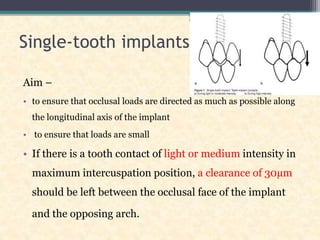
Aim –
• to ensure that occlusal loads are directed as much as possible along
the longitudinal axis of the implant
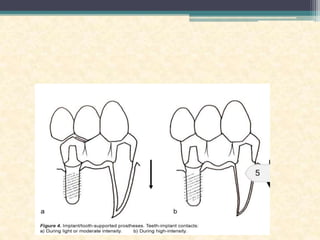
• to ensure that loads are small
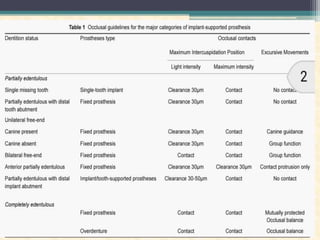
• If there is a tooth contact of light or medium intensity in
maximum intercuspation position, a clearance of 30µm
should be left between the occlusal face of the implant
and the opposing arch.
• This clearance aims to compensate for the different biomechanics of
the tooth and the implant and to avoid overloading of the implant,
since under heavy loads the tooth may intrude into the alveolus,
whereas the implant-borne prosthesis will not intrude into the bone.
• In protrusive and lateral movements the occlusal face of the implant
should not be loaded, in order to minimise the transverse forces that
can act on implants
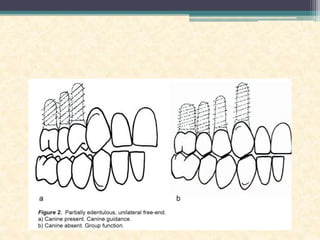
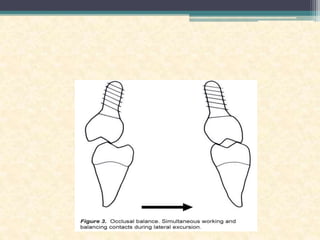
IMPLANT supported Fixed partial dentures
Occlusion goals will vary depending on
• location (anterior or posterior) and
• on whether it has a unilateral- or bilateral free end
IMPLANT PROTECTED OCCLUSION
Given by Misch
Methods to reduce implant overloading :
• narrowed occlusal table,
• reduced cuspal inclination,
• correction of load direction,
• reduced non-axial loading,
• reduced length of the cantilever
• lighter occlusal contacts on implant prostheses
FULL MOUTH REHABILITATION
OBJECTIVE
• reconstruction and restoration of the worn out dentition
• maintenance of the health of the entire stomatognathic
system.
Full mouth rehabilitation should re-establish a
state of functional as well as biological efficiency
where teeth and their periodontal structures, the
muscles of mastication, and the
temporomandibular joint (TMJ) mechanisms all
function together in synchronous harmony.
The first step before any restorative
treatment is to decide on which occlusal
scheme there are two approaches:
1. Conformative approach
• Indicated when original occlusion is not to be changed and the same patient's
MIP will be used.
• It is recommended when a small restoration or bridge will be constructed or
when there is no need to restore the entire occlusion at once.
• Advised when unprepared teeth provide the MIP and vertical stop. It is the
favoured approach, because it is simple, predictable and safe, as little or no
adaptation of the patient's neuro-muscular system is needed.
• This is true even in the presence of a slight discrepancy between the MIP and
CR.
2.Reorganised approach
• Indicated when construction of a new occlusal scheme is needed.
• The patient's occlusion is altered to a new occlusal scheme using the
CR as a starting point for the treatment position.
• Aim- simultaneous occlusal contacts on both sides of the jaws when
the mandible is in the CR. The occlusion is also designed to achieve
an MIP that coincides with the CR position.
It is considered in the following situations:
■ when the MIP is not satisfactory;
■ when an increase in vertical dimension is required;
■ when full mouth rehabilitation is required to reconstruct a severely
damaged dentition;
■ when a large fixed prosthesis is needed to replace multiple missing
teeth.
Sequence of ‘Occlusal Rehabilitation’
1.Quadrant arch technique—
one quadrant is treated at a time. Advantage - the vertical
dimension can be maintained and lengthy appointments are
avoided.
2. Simultaneous arch technique—
maxillary and mandibular arches are reconstructed simultaneously.
The occlusion can be better established, aesthetics achieved is better,
and number of appointments is reduced.
However, this is more complicated, requires a skilled operator and
technician, and may be difficult for beginners.
3. Segmented simultaneous arch technique—
has advantages of the both the above techniques and is able to provide
the best alternative.
TYPES OF OCCLUSAL ERROR
IN CENTRIC RELATION -3 TYPES
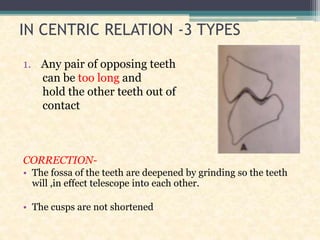
1. Any pair of opposing teeth
can be too long and
hold the other teeth out of
contact
CORRECTION-
• The fossa of the teeth are deepened by grinding so the teeth
will ,in effect telescope into each other.
• The cusps are not shortened
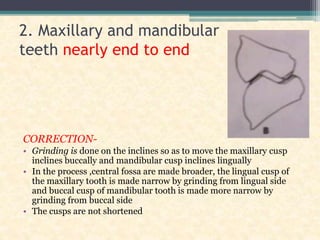
2. Maxillary and mandibular
teeth nearly end to end
CORRECTION-
• Grinding is done on the inclines so as to move the maxillary cusp
inclines buccally and mandibular cusp inclines lingually
• In the process ,central fossa are made broader, the lingual cusp of
the maxillary tooth is made narrow by grinding from lingual side
and buccal cusp of mandibular tooth is made more narrow by
grinding from buccal side
• The cusps are not shortened
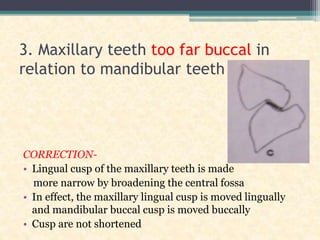
3. Maxillary teeth too far buccal in
relation to mandibular teeth
CORRECTION-
• Lingual cusp of the maxillary teeth is made
more narrow by broadening the central fossa
• In effect, the maxillary lingual cusp is moved lingually
and mandibular buccal cusp is moved buccally
• Cusp are not shortened
TYPES OF WORKING SIDE OCCLUSAL
ERRORS – 6 TYPES
1. Both the maxillary buccal cusp and lower lingual
cusp are too long
2. The buccal cusp make contact but lingual cusp do
not.
3. The lingual cusp make contact but buccal cusp do
not.
4. Maxillary buccal or lingual cusp are mesial to their
intercuspating position
5. Maxillary buccal or lingual cusp are distal to their
intercuspating position
6. Teeth on the working side may not contact
TYPES OF BALANCING SIDE ERRORS –
2TYPES
1. Balancing side contact is so heavy that working
side teeth are held out of contact
2. There is no contact on the balancing side
Pathogenic Occlusion
 A pathogenic occlusion is defined as an occlusal
relationship capable of producing pathologic
changes in the stomatognathic system.
 In such occlusions, sufficient disharmony exists
between the teeth and the TMJs to result in
symptoms that necessitate intervention.
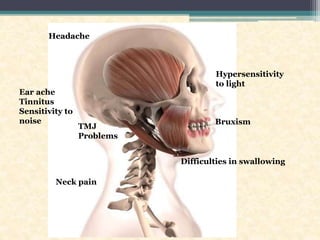
Hypersensitivity
to light
Headache
Ear ache
Tinnitus
Sensitivity to
noise
TMJ
Problems
Neck pain
Difficulties in swallowing
Bruxism
CONCLUSION
The perfection of skill required to provide
sophisticated yet an ideal treatment of
complex occlusal problems may take years to
acquire. However, the minimum expectation of
the competent practitioner is the ability to
diagnose and treat simple occlusal
disharmonies.
85
REFERENCE
• Occlusion – Ramjford and Ash
• Textbook of dental anatomy – Wheelers
• Orthodontics The Art and Science – Bhalajhi
• Fundamentals of fixed prosthodontics – Shillingburg
• Contemporary Fixed Prosthodontics – Rosensteil
• Prosthodontic Treatment of Edentulous patients – Zarb Bolender
• Guidelines for occlusion strategy in implant-borne prostheses. A review International Dental
Journal (2008) 58, 139-145
• Present Status of Occlusion and Occlusal Therapy in Periodontics
• Fundamentals of occlusion and restorative dentistry. Part II: occlusal contacts, interferences and
occlusal considerations in implant patients
• Rehabilitation strategies for partially edentulous - prosthodontic principles and current trends
• Implant protected occlusion: A comprehensive review
• Occlusal Concepts in Full Mouth Rehabilitation: An Overview
Occlusion in dentistry

Occlusion in dentistry

  • 1.
    OCCLUSION IN DENTISTRY PRESENTEDBY – DR. ANAMIKA ABRAHAM GUIDED BY – DR. DESHRAJ JAIN
  • 2.
    TABLE OF CONTENTS DEFINITIONS THERAPEUTICAND PHYSIOLOGIC OCCLUSION IDEAL OCCLUSION CONCEPTS OF OCCLUSION  BILATERAL BALANCED  UNILATERAL BALANCED/ GROUP FUNCTION  CANINE GUIDED OCCLUSION BASICS FROM DENTAL ANATOMY IMPORTANCE OF OCCLUSION IN  PEDODONTICS  ORTHODONTICS  ORAL SURGERY  RESTORATIVE DENTISTRY  PERIODONTICS  PROSTHODONTICS TYPES OF OCCLUSAL ERROR AND ITS CORRECTION PATHOGENIC OCCLUSION CONCLUSION REFERENCES
  • 3.
    Key terms &Definitions Occlusion: is derived from the Latin word “Occlusio” meaning act of closure or being closed. According to ANGLE “occlusion is a normal relation of occlusal inclined planes of the teeth when jaw is closed. GPT: static relation between incising and masticating surfaces of maxillary & mandibular teeth or tooth analogues.
  • 4.
    “Occlusion is theact or process of closure or of being closed or shut off” • Ramfjord and Ash: Occlusion = Contacts between teeth • “Multifactorial functional relationship between the teeth and other components of the masticatory system as well as with other areas of the head and neck that directly or indirectly relate to function, parafunction or dysfunction of the masticatory system’’
  • 5.
  • 6.
    A therapeutic occlusionis one in which the arrangement of teeth and their opposing surfaces satisfy functional and esthetic requirements while distributing and directing forces of occlusion over as many teeth as possible during functions of the mandible. Physiologic occlusion- Occlusion that deviates in one or more ways from ideal, yet it is well adapted to that particular environment, is esthetic and shows no pathologic manifestation
  • 7.
    Ideal Occlusion Guichet(1970) describedstandards for ideal occlusion and said that there was no one ideal occlusion pattern for all individuals but an appropriate pattern can be found based on these criteria.  Criteria I- Incorporate into the occlusion those factors which have to do with the reduction of vertical forces.  Criteria II- Provide a maximum intercuspation of teeth with the condyles in centric relation position.  Criteria III- Provide for horizontal movement of the mandible from the centric position
  • 8.
    Concepts of theOcclusion • Historically, the study of occlusion and articulation has undergone an evolution of concepts. Bilateral Balanced Occlusion Unilateral Balanced Occlusion Mutually Protected Occlusion
  • 9.
    Bilaterally Balanced Occlusion It is based on the work of Von Spee and Monson. Teeth should contact in all excursive positions of the mandible. On the nonworking side it’s important to prevent tipping of the complete denture.  Subsequently, the concept was applied to natural teeth in complete occlusal rehabilitation.
  • 10.
    Definition : • Thesimultaneous contacting of the maxillary and the mandibular teeth on the right and left side and in the posterior and anterior occlusal areas in centric and eccentric positions, developed to lessen or limit the tipping or rotating of the denture base in relation to the supporting structures.
  • 11.
     An attemptwas made to reduce the load on individual teeth by sharing the stress among as many teeth as possible. It was soon discovered, however, that this was a very difficult type of arrangement to achieve.  As a result of the multiple tooth contacts that occurred as the mandible moved through its various excursions, there was excessive frictional wear on the teeth
  • 12.
    The Demise OfBalanced Occlusion In Restoring Natural Dentition Bilateral balanced occlusion Fixed Prosthodontics High rate of failure Failure was due to  Increased occlusal wear.  Increased/accelerated periodontal breakdown.  TMJ and neuromuscular disturbances.
  • 13.
    Unilateral Balanced /Group Function Occlusion  In a unilaterally balanced occlusion , excursive contact occurs between all opposing posterior teeth on the laterotrusive (working) side only.  This concept had its origin in the work of Schuyler
  • 14.
    Definition:- Multiple contact relations betweenmaxillary and mandibular teeth, in lateral movements on the working side, whereby simultaneous contact of several teeth acts as a group to distribute occlusal forces.
  • 15.
    The most desirablegroup function occlusion consists of contact of canine,premolar and mesiobuccal cusp of first molar.  Any laterotrusive contact more posterior than mesial portion of first molar are not desirable because of the increased amount of force that can be placed as its near the fulcrum and force vectors .
  • 16.
    Advantages  Group functionof the teeth on the working side distributes the occlusal load .  The absence of contact on the nonworking side prevents those from getting subjected to destructive ,obliquely directed forces found in nonworking interferences.
  • 17.
     It alsosaves centric holding cusps that is mandibular buccal cusps and maxillary palatal cusps from excessive wear.  Group function was felt to be goal for occlusal adjustments and has easy application.  In the presence of anterior bone loss or missing canines, mouth should be restored to group function.
  • 18.
    Disadvantages:- Group Function Occlusiondoesn’t fulfill criteria for ideal occlusion
  • 19.
    Characteristics of GroupFunction Given by BEYRON (1954)  Teeth should receive stress along the tooth long axis .  Total stress should be distributed among the tooth segment in lateral movement.  No interferences occur from closure into intercuspal position
  • 20.
    Mutually Protected Occlusion During the early 1960s, this occlusal scheme was advocated by Stuart and Stallard, based on earlier work by D’Amico.  In this arrangement, centric relation coincides with the maximum intercuspation position.
  • 21.
    Definition:- An occlusal schemein which the posterior teeth prevent excessive contact of the anterior teeth in maximum intercuspation, and the anterior teeth disengage the posterior teeth in all mandibular excursive movements.
  • 22.
     Posterior teethfunction most effectively in stopping the mandible during closure whereas anterior teeth function most effectively in guiding the mandible during eccentric movements. It is apparent that the posterior teeth should contact slightly more heavily than anterior teeth in centric relation.
  • 23.
    Lucia in 1961-Advantages Minimum amount of tooth contact is involved –therefore better penetration of food.  A cusp to fossa relationship produces an interlocking of upper and lower components- giving a maximum support in centric relation in all directions. The force is clearly closer to the long axis of each tooth.  The arrangement of the marginal,transverse and oblique ridges have a shearing action -make a more efficient
  • 24.
  • 25.
    Based on arrangementof teeth Type of occlusal contact: 1. Cusp-fossa occlusion 2. Cusp-embrasure occlusion Ideal cusp-fossa relationship • A, Mesiolingual cusp of maxillary first molar occludes in the central fossa of the mandibular first molar. Distal buccal cusp of mandibular first molar occludes in the central fossa of the maxillary first molar. • B, Concept of occlusion in which all supporting cusps occlude in fossae
  • 26.
    Normal intercuspation ofmaxillary and mandibular teeth. 1, Central incisors (labial aspect). 2, Central incisors (mesial aspect). 3, Maxillary canine in contact with mandibular canine and first premolar (facial aspect). 4, Maxillary first premolar and mandibular first premolar (buccal aspect). 5, Maxillary first premolar and mandibular first premolar (mesial aspect). 6, First molars (buccal aspect). 7, First molars (mesial aspect). 8, First molars (distal aspect)
  • 27.
    Types Of Cusps Centricholding cusps  The buccal cusps of the mandibular posterior teeth and the lingual cusps of the maxillary posterior teeth occlude with the opposing CF areas. Non supporting cusp  The buccal cusps of the maxillary posterior teeth and the lingual cusps of the mandibular posterior teeth are called the guiding or noncentric cusps.
  • 29.
  • 30.
  • 31.
    PEDODONTICS • The developmentof occlusion is the most dynamic phenomenon in the mouth. • Development of normal dentition and occlusion depends upon dentoalveolar , skeletal and the neuromuscular factors. • The emergence (eruption) of the primary dentition into the oral cavity is an important time for the development of oral motor behavior and the acquisition of masticatory skills.
  • 32.
    STAGES OF OCCLUSALDEVLOPMENT • NEONATAL PERIOD • PRIMARY DENTITION • MIXED DENTITION • PERMANENT DENTITION
  • 33.
  • 34.
    FACTORS AFFECTING OCCLUSAL DEVELOPMENT •General factors ▫ Skeletal factors ▫ Muscle factor ▫ Dental factor • Local factors ▫ Aberrant developmental position ▫ Supernumerary teeth ▫ Hypodontia ▫ Habits ▫ Localized soft tissue anomalies
  • 35.
    RESTORATIVE DENTISTRY • Occlusalrestorations should be such that it provides a definate centric stop for the opposing cusp at the central fossa • If the centric stops are on the incline , the teeth are apt to move and new interferences will be created • Common mistake is to overcarve the restoration –leading to interferences in lateral excursions • Occlusal restorations should have the same hardness and potential for wear as the teeth • Faulty interproximal contacts – disturb the occlusal relationship
  • 36.
    PERIODONTICS • Abnormal occlusionis a contributary factor in accelaration of periodontal breakdown • OCCLUSAL TRAUMA – Defined as injury to the periodontium resulting from occlusal forces that exceeds the reparative capacity of the attachment apparatus.
  • 37.
    • Occlusion becomesa factor for consideration when the occlusal forces acting on a tooth produce displacement of the root in the socket which results in an injury to the supporting periodontal ligament. This periodontal tissue injury from occlusal forces has been defined as the lesion of trauma from occlusion • The essential requirements for the co-destructive factor effect are the production of a traumatic lesion immediately subjacent to an established marginal periodontitis
  • 38.
    ORAL SURGERY • Thetreatment of maxillofacial fractures usually requires control of dental occlusion with the application of wires/arch bars for interdental wiring to orient and stabilize the fracture • Important principle which is followed ‘RESTORATION OF PREINJURY OCCLUSION’
  • 39.
    ORTHODONTICS Andrews , in1972, observed the presence of six common characteristics, known as “six keys to normal occlusion”: • Molar relationship • Mesiodistal crown angulation • Labiolingual crown inclination • Absence of rotation • Tight contacts • Curve of spee
  • 40.
    In 1976, Rothpresented the following functional aspects of the occlusion as being fundamental for completion of the orthodontic cases: 1. Teeth must present maximum intercuspal (MI) position with the jaw in centric relation (CR); 2. In centric relation, all posterior teeth must present axial occlusal contacts, and the anterior teeth must maintain a distance of 0.0005 inches between them; 3. During laterotrusion, the canines must disocclude the posterior teeth (canine guidance); 4. During protrusion, the upper anterior teeth must occlude with the lower anterior teeth and the first premolar or the second premolar (in extraction cases), aiming at disoccluding all posterior teeth (immediate anterior guidance); 5. No interference must be present on the balancing side
  • 41.
    WHY?? canine guidanceat orthodontic completion 1. the strategic positioning of the canine in the arch 2. the favorable root anatomy 3. presence of a better crownroot proportion 4. the presence of dense and compact bone around the root, which better tolerates the occlusal forces compared with the medullar bone of the posterior teeth 5. the sensorial pulse that activates less muscles when the canine teeth are in contact than when posterior teeth contact each other • Therefore, when the jaw is in a right or left laterotrusive movement, the upper and lower canines are the appropriate teeth to contact and to dissipate the horizontal forces, while promoting the disocclusion of the posterior teeth.
  • 42.
    • The occlusionschool- According to Kingsley, proper occlusion is a key factor in determining the stability of newly moved teeth. THEORIES OF RETENTION - By REIDEL Theorum 4 – Proper occlusion is a potent factor in holding teeth in their corrected positions. Aim of orthodontic treatment is to achieve good functional occlusion i.e. Harmonious occlusal contacts during functional movements of the jaws.
  • 43.
    CONCEPTS OF COMPLETEDENTURE OCCLUSION Static concept The static relations in occlusion include centric occlusion, protrusive occlusion, right and left lateral occlusion. All of these relations must be balanced with the simultaneous contacts of all the teeth on both sides of the arch at their very first contact. The cuspal inclines should be developed so that the teeth can glide from a more centric occlusion to eccentric positions without interference and without the introduction of rotating or tipping forces.
  • 44.
    Dynamic concept The dynamicconcept of occlusion is primarily concerned with opening and closing movements involved in mastication. Jaw movements and tooth contacts are made, as the teeth of one jaw glide over the teeth of the opposing jaw. Movements of the mandible which occur when the teeth are not in contact are termed as free movements.
  • 45.
    RPD opp prosthesis(Tooth/tooth-tissue supported) 45 Partial Complete Centric Eccentric Working Non-working/Balancing Simultaneous bilateral contacts of opposing posterior teeth Kennedy”s Class III Kennedy”s Class I Kennedy”s Class II Kennedy”s Class IV Bilateral balanced occlusion in centric and eccentric positions. Max Mand + + + + contact of opposing anterior teeth in the planned intercuspal position occlusion seen in a harmonious natural dentition
  • 46.
    Hanau’s Laws ofArticulation and Hanau’s Quint. • In 1925, Rudolph L. Hanau presented a discussion paper entitled, “Articulation: Defined, analyzed, and formulated ’’ FACTORS AFFECTING OCCLUSAL BALANCE : • Condylar inclination. • Incisal guidance. • Height of the cusps • Plane of orientation. • Prominence of compensating curve.
  • 47.
    Condylar inclination. • Hanaustates: “the inclination of the condylar guidance or condylar inclination is a definite , anatomical conception.” • It is the one factor which the edentulous patient presents and can in no way be modified by the operator. • The condylar path is determined on the patient by a protrusive record and set on the instrument
  • 49.
    The degree ofcondylar inclination registered results from: 1. The incline of the articular eminence of the TMJ. 2. Action of muscles in mandibular movement. 3. Limitations of movements effected by the attaching ligaments. Among all the factors condylar inclination is most important in securing balanced articulation and form one of the end-controlling factor.
  • 50.
    Incisal guidance. • Secondend- controlling factor formed by the inclination of the incisal guide angle. • Hanau stated “the inclination of the incisal guidance is given by the angle of the lingual surface of the incisors with the horizontal plane of reference”.
  • 51.
    INCISAL GUIDE ANGLE[GPT9] 1: anatomically, the angle formed by the intersection of the plane of occlusion and a line within the sagittal plane determined by the incisal edges of the maxillary and mandibular central incisors when the teeth are in maximum intercuspation 2: on an articulator, that angle formed, in the sagittal plane, between the plane of reference and the slope of the anterior guide table, as viewed in the sagittal plane
  • 55.
    • With theestablishment of two end-controlling factors, a balanced articulation is obtained when a harmonious relationship is established between these two angles and cusp angles.
  • 56.
    HEIGHT OF THECUSP • Hanau states “ The change of the cusp height in comparison with the masticatory surface formation as a whole is an auxiliary magnitude”. • “In the establishment of the balanced articulation , we are primarily interested in the length and the inclination of the effective cusp inclines.”
  • 57.
    • Cusp heightexerts its influence by determining the range of tooth contact during eccentric movements. • The higher the cusp, the longer the effective tooth incline, and therefore greater range of tooth contact during eccentric movements.
  • 58.
    Plane of orientation. •Hanau states that “ plane of orientation is purely a geometrical factor. It is a plane assumed to pass through three dental landmarks or points; namely, the central incisal contact point and summits of the mesiobuccal cusps of the molars”.
  • 60.
    Compensating curve. • Itis determined by the inclination of the posterior teeth and their vertical relationships to the occlusal plane so that the occlusal surface results in a curve that is in harmony with the movement of the mandible as guided posteriorly by the condylar path.
  • 61.
    COMPENSATING CURVE 1. Theanteroposterior curving (in the median plane) and the mediolateral curving (in the frontal plane) within the alignment of the occluding surfaces and incisal edges of artificial teeth that is used to develop balanced occlusion 2. The arc introduced in the construction of complete removable dental prostheses to compensate for the opening influences produced by the condylar and incisal guidance’s during lateral and protrusive mandibular excursive movements
  • 62.
    • A steepcondylar path requires a steep compensating curve for occlusal balance. • A lesser compensating curve for the same condylar guidance would result in a steeper incisal guidance, which would cause loss of balance.
  • 64.
    Occlusion in Implantsupported prosthesis Factors that give rise to occlusal overloading • excessive crown-to-implant length ratio • over-sized occlusal surfaces • unfavourable direction of axial forces • cantilever effects
  • 66.
    Single-tooth implants Aim – •to ensure that occlusal loads are directed as much as possible along the longitudinal axis of the implant • to ensure that loads are small • If there is a tooth contact of light or medium intensity in maximum intercuspation position, a clearance of 30µm should be left between the occlusal face of the implant and the opposing arch.
  • 67.
    • This clearanceaims to compensate for the different biomechanics of the tooth and the implant and to avoid overloading of the implant, since under heavy loads the tooth may intrude into the alveolus, whereas the implant-borne prosthesis will not intrude into the bone. • In protrusive and lateral movements the occlusal face of the implant should not be loaded, in order to minimise the transverse forces that can act on implants
  • 68.
    IMPLANT supported Fixedpartial dentures Occlusion goals will vary depending on • location (anterior or posterior) and • on whether it has a unilateral- or bilateral free end
  • 72.
    IMPLANT PROTECTED OCCLUSION Givenby Misch Methods to reduce implant overloading : • narrowed occlusal table, • reduced cuspal inclination, • correction of load direction, • reduced non-axial loading, • reduced length of the cantilever • lighter occlusal contacts on implant prostheses
  • 73.
    FULL MOUTH REHABILITATION OBJECTIVE •reconstruction and restoration of the worn out dentition • maintenance of the health of the entire stomatognathic system. Full mouth rehabilitation should re-establish a state of functional as well as biological efficiency where teeth and their periodontal structures, the muscles of mastication, and the temporomandibular joint (TMJ) mechanisms all function together in synchronous harmony.
  • 74.
    The first stepbefore any restorative treatment is to decide on which occlusal scheme there are two approaches: 1. Conformative approach • Indicated when original occlusion is not to be changed and the same patient's MIP will be used. • It is recommended when a small restoration or bridge will be constructed or when there is no need to restore the entire occlusion at once. • Advised when unprepared teeth provide the MIP and vertical stop. It is the favoured approach, because it is simple, predictable and safe, as little or no adaptation of the patient's neuro-muscular system is needed. • This is true even in the presence of a slight discrepancy between the MIP and CR.
  • 75.
    2.Reorganised approach • Indicatedwhen construction of a new occlusal scheme is needed. • The patient's occlusion is altered to a new occlusal scheme using the CR as a starting point for the treatment position. • Aim- simultaneous occlusal contacts on both sides of the jaws when the mandible is in the CR. The occlusion is also designed to achieve an MIP that coincides with the CR position. It is considered in the following situations: ■ when the MIP is not satisfactory; ■ when an increase in vertical dimension is required; ■ when full mouth rehabilitation is required to reconstruct a severely damaged dentition; ■ when a large fixed prosthesis is needed to replace multiple missing teeth.
  • 76.
    Sequence of ‘OcclusalRehabilitation’ 1.Quadrant arch technique— one quadrant is treated at a time. Advantage - the vertical dimension can be maintained and lengthy appointments are avoided. 2. Simultaneous arch technique— maxillary and mandibular arches are reconstructed simultaneously. The occlusion can be better established, aesthetics achieved is better, and number of appointments is reduced. However, this is more complicated, requires a skilled operator and technician, and may be difficult for beginners. 3. Segmented simultaneous arch technique— has advantages of the both the above techniques and is able to provide the best alternative.
  • 77.
  • 78.
    IN CENTRIC RELATION-3 TYPES 1. Any pair of opposing teeth can be too long and hold the other teeth out of contact CORRECTION- • The fossa of the teeth are deepened by grinding so the teeth will ,in effect telescope into each other. • The cusps are not shortened
  • 79.
    2. Maxillary andmandibular teeth nearly end to end CORRECTION- • Grinding is done on the inclines so as to move the maxillary cusp inclines buccally and mandibular cusp inclines lingually • In the process ,central fossa are made broader, the lingual cusp of the maxillary tooth is made narrow by grinding from lingual side and buccal cusp of mandibular tooth is made more narrow by grinding from buccal side • The cusps are not shortened
  • 80.
    3. Maxillary teethtoo far buccal in relation to mandibular teeth CORRECTION- • Lingual cusp of the maxillary teeth is made more narrow by broadening the central fossa • In effect, the maxillary lingual cusp is moved lingually and mandibular buccal cusp is moved buccally • Cusp are not shortened
  • 81.
    TYPES OF WORKINGSIDE OCCLUSAL ERRORS – 6 TYPES 1. Both the maxillary buccal cusp and lower lingual cusp are too long 2. The buccal cusp make contact but lingual cusp do not. 3. The lingual cusp make contact but buccal cusp do not. 4. Maxillary buccal or lingual cusp are mesial to their intercuspating position 5. Maxillary buccal or lingual cusp are distal to their intercuspating position 6. Teeth on the working side may not contact
  • 82.
    TYPES OF BALANCINGSIDE ERRORS – 2TYPES 1. Balancing side contact is so heavy that working side teeth are held out of contact 2. There is no contact on the balancing side
  • 83.
    Pathogenic Occlusion  Apathogenic occlusion is defined as an occlusal relationship capable of producing pathologic changes in the stomatognathic system.  In such occlusions, sufficient disharmony exists between the teeth and the TMJs to result in symptoms that necessitate intervention.
  • 84.
    Hypersensitivity to light Headache Ear ache Tinnitus Sensitivityto noise TMJ Problems Neck pain Difficulties in swallowing Bruxism
  • 85.
    CONCLUSION The perfection ofskill required to provide sophisticated yet an ideal treatment of complex occlusal problems may take years to acquire. However, the minimum expectation of the competent practitioner is the ability to diagnose and treat simple occlusal disharmonies. 85
  • 86.
    REFERENCE • Occlusion –Ramjford and Ash • Textbook of dental anatomy – Wheelers • Orthodontics The Art and Science – Bhalajhi • Fundamentals of fixed prosthodontics – Shillingburg • Contemporary Fixed Prosthodontics – Rosensteil • Prosthodontic Treatment of Edentulous patients – Zarb Bolender • Guidelines for occlusion strategy in implant-borne prostheses. A review International Dental Journal (2008) 58, 139-145 • Present Status of Occlusion and Occlusal Therapy in Periodontics • Fundamentals of occlusion and restorative dentistry. Part II: occlusal contacts, interferences and occlusal considerations in implant patients • Rehabilitation strategies for partially edentulous - prosthodontic principles and current trends • Implant protected occlusion: A comprehensive review • Occlusal Concepts in Full Mouth Rehabilitation: An Overview