UNDER THE GUIDANCE OF:
Dr. D.K JAIPURIA
Dr. JAIDEEP SINGH
Dr. AKANSHA SINGH
PRESENTED BY:
SWECHCHHA GUPTA
BDS FINAL YEAR
INTRODUCTION
The philosophy of extraction in
conjunction with orthodontic treatment is
not new.
Establishment of normal functional
occlusion in balance with supporting
structures occasionally requires the
reduction of one or more teeth.
Most extractions are performed as part of
a general plan of treatment that also
involves the use of an appliance.
The nature of malocclusion and the age of
the patient may be important factors in
deciding whether or not to resort to
extraction.
Extractions in orthodontia include serial
extraction carried out as an interceptive
procedure during the mixed dentition
period and therapeutic extractions
carried out as a treatment procedure for
gaining space.
THE NEED FOR EXTRACTION
There are a number of circumstances
that necessitate extraction of teeth as a
part of routine orthodontic treatment.
They are listed as follows:
•Arch length - tooth material discrepancy
Ideally the arch length and tooth material
should be in harmony with each other. The
sizes of the dentition and arch length are
usually genetically determined.
The presence of tooth material in excess
of the arch length can result in crowding
of teeth or proclination of anteriors
In many cases the tooth material-arch
length disproportion cannot be treated by
increasing the arch length. Hence
reduction of tooth material is the only
alternative.
•Correction of sagittal inter-arch
relationship
Abnormal sagittal mal relationships such
as Class II or Class III malocclusion may
require extraction of teeth to achieve
normal sagitial inter-arch relation. The
extraction of teeth in such cases helps in
establishing normal incisor and molar
relationship.Extraction of teeth impairs
the forward development of the dental
arches and the alveolar process.
Angle's Class 1: These patients are
characterized by a normal sagittal inter-
arch relation. Thus it is not advisable to
discourage the development of one dental
arch more than the other. Hence in
Angle's Class I cases, it is preferable to
extract in both the arches
Angle's Class II: In most Class II cases,
the upper dental arch is forwardly placed
or the lower arch placed back.
Thus by extracting only in the upper arch
it is possible to reduce the abnormal
upper proclination and also to discourage
the forward development of the upper
arch In Angle's Class II cases, where there
is lower arch crowding or the molars are
not in full Class II occlusion, it may be
necessary to extract in both the upper as
well as the lower arches to achieve proper
inter-arch relation and to correct the
crowding.
Angle's Class III: It is beneficial to avoid
extraction in the upper arch as it may
affect the forward development of the
maxilla. Angle's Class III cases are
preferably treated by extraction only in
the lower arch or by extraction in both
arches
•Abnormal size and form of teeth
Teeth that are abnormal in size or form
may necessitate their extraction in order
to achieve satisfactory occlusion. Such
anomalies include macrodontia, severely
hypoplastic teeth, dilaceration and
abnormal crown morphology.
•Skeletal jaw malrelations
Severe skeletal mal relationship of the
jaws may not be satisfactorily treated
using orthodontic appliances alone.
Surgical resective procedures along with
extraction maybe required.
THE CHOICE OF TEETH FOR
EXTRACTION
The decision to extract teeth during
orthodontic therapy should be based on a
sound diagnostic exercise. The choice of
teeth for extraction is based on a number
of factors including the amount of arch
length - tooth material discrepancy, the
direction and amount of jaw growth, the
facial profile, the state and position of the
teeth in particular and the entire dentition
and finally the age of the patient.
EXTRACTION OF FIRST PREMOLARS
The first premolars are the most
commonly extracted teeth as part of
orthodontic treatment.
The reason for their extraction is as
follows:
• Their location in the arch is such that
the space gained by their extraction can
be utilized for correction both in the
anterior as well as the posterior region.
The contact that results between the
canine and second premolar is
satisfactory.
• The extraction of the first premolar
leaves behind a posterior segment that
offers adequate anchorage for the
retraction of the six anterior teeth.
The following are some of the indications
for first premolar extraction:
• They are the teeth of choice for
extraction to relieve moderate to severe
anterior crowding of the upper or lower
arch
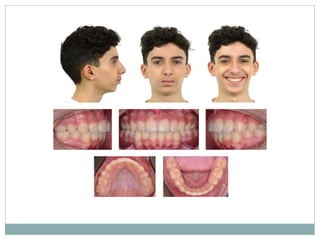
• The first premolars are extracted for
correction of moderate to severe
anterior proclination as in a Class II,
division 1 malocclusion or a Class I
bidental protrusion.
EXTRACTION OF LOWER INCISORS
Extraction of lower incisors should as far
as possible be avoided. The extraction of
a lower incisor to relieve lower anterior
crowding is often followed by the
narrowing of lower inter canine width,
retroclination of lower incisors, deep bite
and re- appearance of crowding. This
leads to a collapse of the lower arch
Some conditions where lower arch has to
be extracted are:
• If one of the incisors is completely out of
the arch with good inter-dental contact
between the rest of the teeth
• A lower incisor that was traumatized, or
exhibiting severe caries, gingival
recession or bone loss may have a poor
prognosis.
• Presence of severe arch length deficiency
is often characterized by the presence of
fan - shaped flaring out of the lower
incisor crowns.
• In mild Class III cases with lower incisor
crowding, one of the lower incisors may
be extracted to achieve normal overjet,
overbite and to relieve crowding
• Cases where a tooth size discrepancy
exists, for example upper peg shaped
laterals or upper lateral incisors, it may
be of benefit to extract a lower incisor.
• Treatment of Class I cases with
moderate lower labial I segment
crowding of up to 5 mm
• Extraction of one lower incisor can be
considered in adults who have had
previous loss of premolars in each
quadrant and present with late lower
labial segment crowding.
EXTRACTION OF UPPER INCISORS
The maxillary incisors are rarely extracted
as a part of orthodontic therapy. However,
the upper labial segment is particularly at
risk from trauma, especially in Class II
Division 1 cases with large overjets. There
are certain conditions when one or more
of the upper incisors may have to be
sacrificed.
The following conditions are:
• An unfavourably impacted upper incisor
that cannot be brought to normal
alignment.
• A buccally/lingually blocked out lateral
incisor with good contact between the
central incisor and canine can be
extracted
• If one of the lateral incisors is
congenitally missing, the opposite
lateral may have to be extracted in order
to maintain arch symmetry.
• A grossly carious incisor that cannot be
restored may have to be sacrificed.
• Trauma or irreparable damage to
incisors by fracture may indicate their
removal.
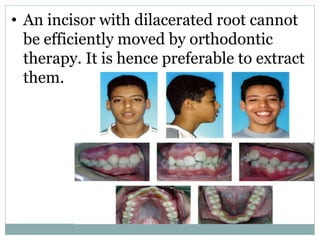
• An incisor with dilacerated root cannot
be efficiently moved by orthodontic
therapy. It is hence preferable to extract
them.
EXTRACTION OF CANINES
Canines are not frequently extracted as a
part of orthodontic treatment.
The extraction of canines is said to cause
flattening of face, altered facial balance
and change in facial expression. The loss
of a canine makes canine guidance
impossible and may compromise a good
functional occlusal result.
Some of conditions for extraction are:
• The canine develop far away from their
final location. In addition they have a
long path of eruption from their site of
development to their final position in
the oral cavity. Thus the canines are
highly susceptible to ectopic eruption
and impaction
• A canine that is completely out the arch
with reasonably good contact between
the lateral incisor and first premolar is
an indication for its extraction.
• Premature shedding of a deciduous
canine usually indicates the extraction of
its fellow on the opposite side of the arch
to restore symmetry.
• In Class II cases if the lower deciduous
canines are shed early, the upper
deciduous canines should also be
removed so as to avoid worsening of the
post-normalcy (Class II tendency).
• In Class III cases if the upper deciduous
canines are shed early, it may necessitate
the extraction of the lower deciduous
canines to avoid worsening of the pre-
normalcy (Class III tendency).
• Deciduous canines may be extracted as a
part of serial extraction procedure.
EXTRACTION OF SECOND
PREMOLARS
The indications for extraction of second
premolars are:
• The extraction of second premolars
instead of the first premolars results in
the anchorage of the anterior segment
being strengthened
• The second premolars are usually
extracted when 4-5 mm of anchorage
loss is deliberately desired.
• Whenever the second premolars are
unfavourably impacted, it is preferred to
extract them rather than the first
premolars
• If extractions are to be undertaken in
open bite cases, it is preferable to extract
the second premolars as their extraction
encourages deepening of the bite.
• In case of grossly carious or deeply
filled second premolars, it is wise to
extract them and preserve the first
premolars.
• Early loss of a deciduous molar may
cause forward movement of the first
permanent molar leaving
inadequate space for the second
premolar to erupt
EXTRACTION OF FIRST MOLARS
The first molars are not commonly
extracted in conjunction with orthodontic
therapy.
The first permanent molars are often the
first permanent teeth molars should be
considered for removal over other non-
carious teeth.
First molars extraction requires careful
planning.
Their position in the arch means that
whilst relief of premolar crowding is
achieved the space created is far from the
site of any incisor crowding or overjet
reduction.
Extraction of the first permanent molars
is avoided for the following reasons:
• The extraction of the first molar does not
give adequate space in the incisor
region.
• The extraction of the first molar results
in deepening of the bite.
• The second premolar and molar may tip
into the extraction space.
• Mastication may be affected.
The indications for first molar extraction
areas follows:
• Minimal space requirement for
correction ofmild anterior crowding or
mild proclination.
•Grossly decayed molar or heavily filled
teeth.
• Molars that are extruded or with marked
periodontal involvement.
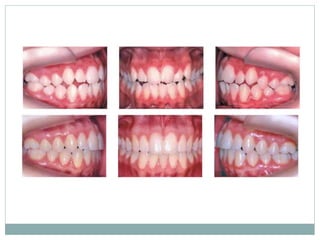
•Open bite cases can benefit from
extraction of first molar, as there is a
tendency for the bite to deepen after
extraction of first molars.
• Orthodontically retreated cases
presenting withAngle Class II
malocclusion where the first premolars
have already been extracted
The following are the contraindications
for extractionof first molars as part of
orthodontic treatment.
• These extractions are not indicated for
patients who do not present with
crowding and featurea decreased lower
face height.
• Neither are these extractions indicated
in non compliant patients due to a
lengthy treatment time or in patients
who have already undergone previous
orthodontic treatment and present with
root resorption and or short roots.
In patients with bruxism, molar
extractions should be avoided due to
occlusal interferences that occur during
space closure, causing an overload of
forces on posterior teeth.
Wilkinson extraction
Wilkinson advocated extraction of all
the four first permanent molars
between the ages of 8 1/2 - 91/2 years.
The basis for such extractions is the fact
that the first permanent molars are
highly susceptible to caries.
The other benefits of extracting the first
molars at an early age are:
A.Their extraction provides additional
space for eruption of the third molars.
Thus impaction ofthird molars can be
avoided.
B.In general, crowding of the arch is
minimized. Thus the other teeth have a
lower risk of caries.
Wilkinson's extraction has a number
ofdrawbacks.
The following are some of them:
A. The extraction of first molars offers
limited space to relieve crowding.
B. The second bicuspids and second
molars rotate and may tip into the
extraction space.
C. The removal of the first molars deprives
the orthodontist of adequate anchorage
for any orthodontic appliance.
EXTRACTION OF SECOND PERMANENT
MOLARS
The extraction of second permanent molars
although not common, is advocated for a
number of reasons, as follows:
A.To prevent third molar impaction
B.To relieve impaction of second premolar
C.Lower incisor crowding
D.To enable distalization of first molars
E.Open bite cases
EXTRACTION OF THIRD MOLARS
Extraction of third molars during
orthodontic treatment does not yield
space that can be used for decrowding or
reduction of proclination.
Third molars are extracted for other
reasons as follows:
A.Grossly impacted third molars that are
unable to erupt into ideal position are
usually extracted.
B. The erupting third molars have been
implicated to be the cause for late lower
anterior crowding. Although this theory
has not been confirmed it nevertheless
may have some role in lower anterior
crowding.
C. Malformed third molars that interfere
with normal occlusion.
BALANCING EXTRACTIONS
Removal of a tooth from one side of a dental
arch results in a tendency for the rest of the
teeth to move towards the extraction space. The
teeth distal to the extraction space move into
the space while the teeth mesial to the
extraction space can also move distally into the
space. Thus the midlines of the arch may shift
to the side of the extraction space. To avoid
such unaesthetic shifts of the dental arch,
balancing extractions are advocated. Balancing
extraction refers to removal of another tooth on
the opposite side of the same arch.
COMPENSATING EXTRACTIONS
Compensating extraction refers to
extraction of teeth in opposite jaws,
Compensating extractions are carried out
to preserve the buccal occlusal relationship.
In a Class I relation it is usually advisable
to extract in both the arches to preserve the
buccal occlusal relationship.
extraction orthodontics.pptx

extraction orthodontics.pptx

  • 1.
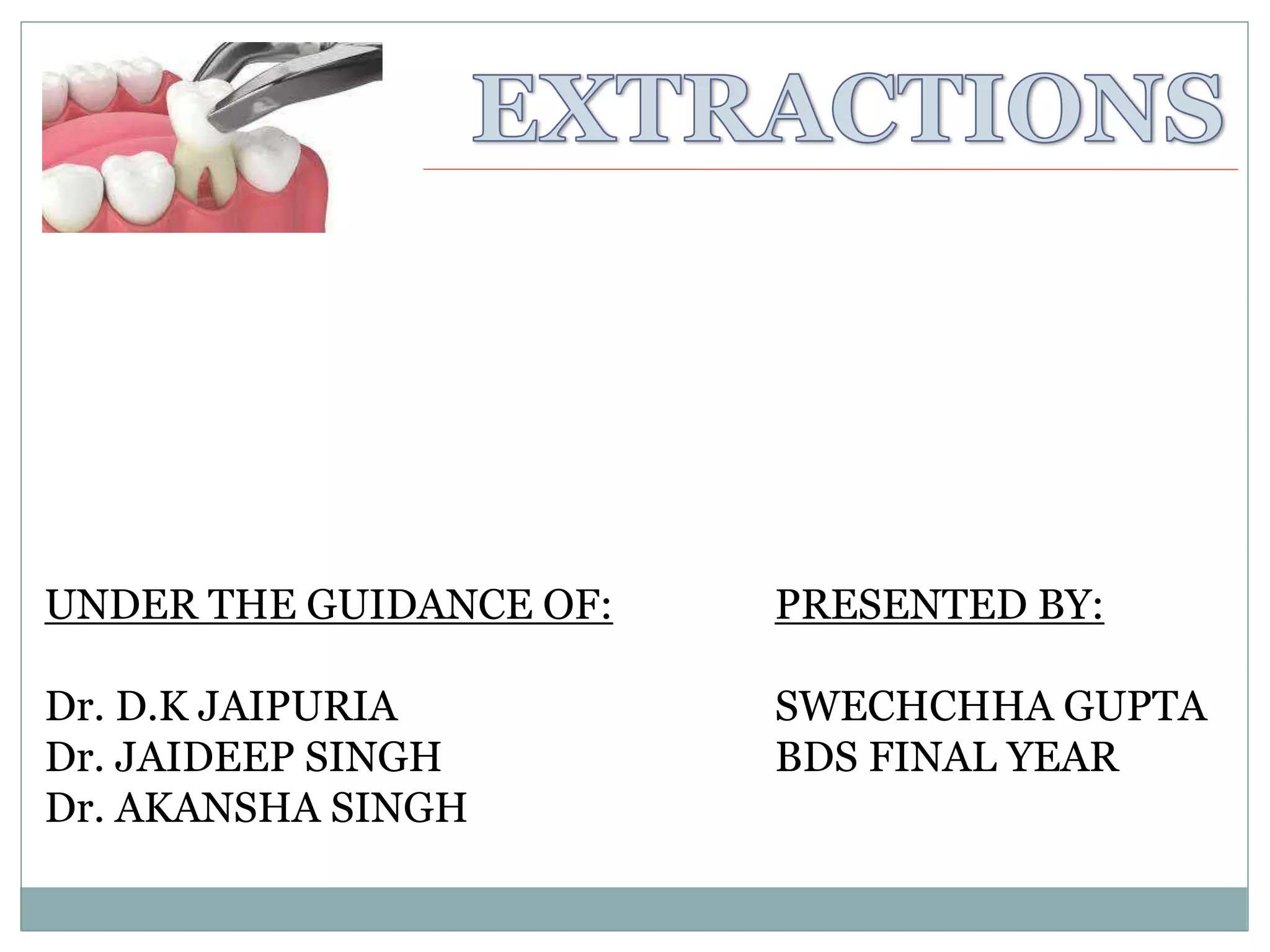
    UNDER THE GUIDANCEOF: Dr. D.K JAIPURIA Dr. JAIDEEP SINGH Dr. AKANSHA SINGH PRESENTED BY: SWECHCHHA GUPTA BDS FINAL YEAR
  • 2.
    INTRODUCTION The philosophy ofextraction in conjunction with orthodontic treatment is not new. Establishment of normal functional occlusion in balance with supporting structures occasionally requires the reduction of one or more teeth. Most extractions are performed as part of a general plan of treatment that also involves the use of an appliance.
  • 3.
    The nature ofmalocclusion and the age of the patient may be important factors in deciding whether or not to resort to extraction. Extractions in orthodontia include serial extraction carried out as an interceptive procedure during the mixed dentition period and therapeutic extractions carried out as a treatment procedure for gaining space.
  • 4.
    THE NEED FOREXTRACTION There are a number of circumstances that necessitate extraction of teeth as a part of routine orthodontic treatment. They are listed as follows: •Arch length - tooth material discrepancy Ideally the arch length and tooth material should be in harmony with each other. The sizes of the dentition and arch length are usually genetically determined.
  • 5.
    The presence oftooth material in excess of the arch length can result in crowding of teeth or proclination of anteriors In many cases the tooth material-arch length disproportion cannot be treated by increasing the arch length. Hence reduction of tooth material is the only alternative.
  • 6.
    •Correction of sagittalinter-arch relationship Abnormal sagittal mal relationships such as Class II or Class III malocclusion may require extraction of teeth to achieve normal sagitial inter-arch relation. The extraction of teeth in such cases helps in establishing normal incisor and molar relationship.Extraction of teeth impairs the forward development of the dental arches and the alveolar process.
  • 7.
    Angle's Class 1:These patients are characterized by a normal sagittal inter- arch relation. Thus it is not advisable to discourage the development of one dental arch more than the other. Hence in Angle's Class I cases, it is preferable to extract in both the arches Angle's Class II: In most Class II cases, the upper dental arch is forwardly placed or the lower arch placed back.
  • 8.
    Thus by extractingonly in the upper arch it is possible to reduce the abnormal upper proclination and also to discourage the forward development of the upper arch In Angle's Class II cases, where there is lower arch crowding or the molars are not in full Class II occlusion, it may be necessary to extract in both the upper as well as the lower arches to achieve proper inter-arch relation and to correct the crowding.
  • 9.
    Angle's Class III:It is beneficial to avoid extraction in the upper arch as it may affect the forward development of the maxilla. Angle's Class III cases are preferably treated by extraction only in the lower arch or by extraction in both arches
  • 10.
    •Abnormal size andform of teeth Teeth that are abnormal in size or form may necessitate their extraction in order to achieve satisfactory occlusion. Such anomalies include macrodontia, severely hypoplastic teeth, dilaceration and abnormal crown morphology.
  • 11.
    •Skeletal jaw malrelations Severeskeletal mal relationship of the jaws may not be satisfactorily treated using orthodontic appliances alone. Surgical resective procedures along with extraction maybe required.
  • 12.
    THE CHOICE OFTEETH FOR EXTRACTION The decision to extract teeth during orthodontic therapy should be based on a sound diagnostic exercise. The choice of teeth for extraction is based on a number of factors including the amount of arch length - tooth material discrepancy, the direction and amount of jaw growth, the facial profile, the state and position of the teeth in particular and the entire dentition and finally the age of the patient.
  • 13.
    EXTRACTION OF FIRSTPREMOLARS The first premolars are the most commonly extracted teeth as part of orthodontic treatment. The reason for their extraction is as follows: • Their location in the arch is such that the space gained by their extraction can be utilized for correction both in the anterior as well as the posterior region.
  • 14.
    The contact thatresults between the canine and second premolar is satisfactory. • The extraction of the first premolar leaves behind a posterior segment that offers adequate anchorage for the retraction of the six anterior teeth.
  • 15.
    The following aresome of the indications for first premolar extraction: • They are the teeth of choice for extraction to relieve moderate to severe anterior crowding of the upper or lower arch • The first premolars are extracted for correction of moderate to severe anterior proclination as in a Class II, division 1 malocclusion or a Class I bidental protrusion.
  • 17.
    EXTRACTION OF LOWERINCISORS Extraction of lower incisors should as far as possible be avoided. The extraction of a lower incisor to relieve lower anterior crowding is often followed by the narrowing of lower inter canine width, retroclination of lower incisors, deep bite and re- appearance of crowding. This leads to a collapse of the lower arch
  • 18.
    Some conditions wherelower arch has to be extracted are: • If one of the incisors is completely out of the arch with good inter-dental contact between the rest of the teeth • A lower incisor that was traumatized, or exhibiting severe caries, gingival recession or bone loss may have a poor prognosis.
  • 19.
    • Presence ofsevere arch length deficiency is often characterized by the presence of fan - shaped flaring out of the lower incisor crowns. • In mild Class III cases with lower incisor crowding, one of the lower incisors may be extracted to achieve normal overjet, overbite and to relieve crowding • Cases where a tooth size discrepancy exists, for example upper peg shaped laterals or upper lateral incisors, it may be of benefit to extract a lower incisor.
  • 20.
    • Treatment ofClass I cases with moderate lower labial I segment crowding of up to 5 mm • Extraction of one lower incisor can be considered in adults who have had previous loss of premolars in each quadrant and present with late lower labial segment crowding.
  • 22.
    EXTRACTION OF UPPERINCISORS The maxillary incisors are rarely extracted as a part of orthodontic therapy. However, the upper labial segment is particularly at risk from trauma, especially in Class II Division 1 cases with large overjets. There are certain conditions when one or more of the upper incisors may have to be sacrificed.
  • 23.
    The following conditionsare: • An unfavourably impacted upper incisor that cannot be brought to normal alignment. • A buccally/lingually blocked out lateral incisor with good contact between the central incisor and canine can be extracted
  • 24.
    • If oneof the lateral incisors is congenitally missing, the opposite lateral may have to be extracted in order to maintain arch symmetry. • A grossly carious incisor that cannot be restored may have to be sacrificed. • Trauma or irreparable damage to incisors by fracture may indicate their removal.
  • 25.
    • An incisorwith dilacerated root cannot be efficiently moved by orthodontic therapy. It is hence preferable to extract them.
  • 26.
    EXTRACTION OF CANINES Caninesare not frequently extracted as a part of orthodontic treatment. The extraction of canines is said to cause flattening of face, altered facial balance and change in facial expression. The loss of a canine makes canine guidance impossible and may compromise a good functional occlusal result.
  • 27.
    Some of conditionsfor extraction are: • The canine develop far away from their final location. In addition they have a long path of eruption from their site of development to their final position in the oral cavity. Thus the canines are highly susceptible to ectopic eruption and impaction • A canine that is completely out the arch with reasonably good contact between
  • 28.
    the lateral incisorand first premolar is an indication for its extraction. • Premature shedding of a deciduous canine usually indicates the extraction of its fellow on the opposite side of the arch to restore symmetry. • In Class II cases if the lower deciduous canines are shed early, the upper deciduous canines should also be removed so as to avoid worsening of the
  • 29.
    post-normalcy (Class IItendency). • In Class III cases if the upper deciduous canines are shed early, it may necessitate the extraction of the lower deciduous canines to avoid worsening of the pre- normalcy (Class III tendency). • Deciduous canines may be extracted as a part of serial extraction procedure.
  • 31.
    EXTRACTION OF SECOND PREMOLARS Theindications for extraction of second premolars are: • The extraction of second premolars instead of the first premolars results in the anchorage of the anterior segment being strengthened • The second premolars are usually extracted when 4-5 mm of anchorage loss is deliberately desired.
  • 32.
    • Whenever thesecond premolars are unfavourably impacted, it is preferred to extract them rather than the first premolars • If extractions are to be undertaken in open bite cases, it is preferable to extract the second premolars as their extraction encourages deepening of the bite.
  • 33.
    • In caseof grossly carious or deeply filled second premolars, it is wise to extract them and preserve the first premolars. • Early loss of a deciduous molar may cause forward movement of the first permanent molar leaving inadequate space for the second premolar to erupt
  • 35.
    EXTRACTION OF FIRSTMOLARS The first molars are not commonly extracted in conjunction with orthodontic therapy. The first permanent molars are often the first permanent teeth molars should be considered for removal over other non- carious teeth. First molars extraction requires careful planning.
  • 36.
    Their position inthe arch means that whilst relief of premolar crowding is achieved the space created is far from the site of any incisor crowding or overjet reduction. Extraction of the first permanent molars is avoided for the following reasons: • The extraction of the first molar does not give adequate space in the incisor region.
  • 37.
    • The extractionof the first molar results in deepening of the bite. • The second premolar and molar may tip into the extraction space. • Mastication may be affected.
  • 38.
    The indications forfirst molar extraction areas follows: • Minimal space requirement for correction ofmild anterior crowding or mild proclination. •Grossly decayed molar or heavily filled teeth. • Molars that are extruded or with marked periodontal involvement.
  • 39.
    •Open bite casescan benefit from extraction of first molar, as there is a tendency for the bite to deepen after extraction of first molars. • Orthodontically retreated cases presenting withAngle Class II malocclusion where the first premolars have already been extracted
  • 40.
    The following arethe contraindications for extractionof first molars as part of orthodontic treatment. • These extractions are not indicated for patients who do not present with crowding and featurea decreased lower face height. • Neither are these extractions indicated in non compliant patients due to a lengthy treatment time or in patients
  • 41.
    who have alreadyundergone previous orthodontic treatment and present with root resorption and or short roots. In patients with bruxism, molar extractions should be avoided due to occlusal interferences that occur during space closure, causing an overload of forces on posterior teeth.
  • 42.
    Wilkinson extraction Wilkinson advocatedextraction of all the four first permanent molars between the ages of 8 1/2 - 91/2 years. The basis for such extractions is the fact that the first permanent molars are highly susceptible to caries.
  • 43.
    The other benefitsof extracting the first molars at an early age are: A.Their extraction provides additional space for eruption of the third molars. Thus impaction ofthird molars can be avoided. B.In general, crowding of the arch is minimized. Thus the other teeth have a lower risk of caries.
  • 44.
    Wilkinson's extraction hasa number ofdrawbacks. The following are some of them: A. The extraction of first molars offers limited space to relieve crowding. B. The second bicuspids and second molars rotate and may tip into the extraction space. C. The removal of the first molars deprives the orthodontist of adequate anchorage for any orthodontic appliance.
  • 45.
    EXTRACTION OF SECONDPERMANENT MOLARS The extraction of second permanent molars although not common, is advocated for a number of reasons, as follows: A.To prevent third molar impaction B.To relieve impaction of second premolar C.Lower incisor crowding D.To enable distalization of first molars E.Open bite cases
  • 46.
    EXTRACTION OF THIRDMOLARS Extraction of third molars during orthodontic treatment does not yield space that can be used for decrowding or reduction of proclination. Third molars are extracted for other reasons as follows: A.Grossly impacted third molars that are unable to erupt into ideal position are usually extracted.
  • 47.
    B. The eruptingthird molars have been implicated to be the cause for late lower anterior crowding. Although this theory has not been confirmed it nevertheless may have some role in lower anterior crowding. C. Malformed third molars that interfere with normal occlusion.
  • 48.
    BALANCING EXTRACTIONS Removal ofa tooth from one side of a dental arch results in a tendency for the rest of the teeth to move towards the extraction space. The teeth distal to the extraction space move into the space while the teeth mesial to the extraction space can also move distally into the space. Thus the midlines of the arch may shift to the side of the extraction space. To avoid such unaesthetic shifts of the dental arch, balancing extractions are advocated. Balancing extraction refers to removal of another tooth on the opposite side of the same arch.
  • 49.
    COMPENSATING EXTRACTIONS Compensating extractionrefers to extraction of teeth in opposite jaws, Compensating extractions are carried out to preserve the buccal occlusal relationship. In a Class I relation it is usually advisable to extract in both the arches to preserve the buccal occlusal relationship.