EXTRACTION IN
ORTHODONTICS
INTRODUCTION
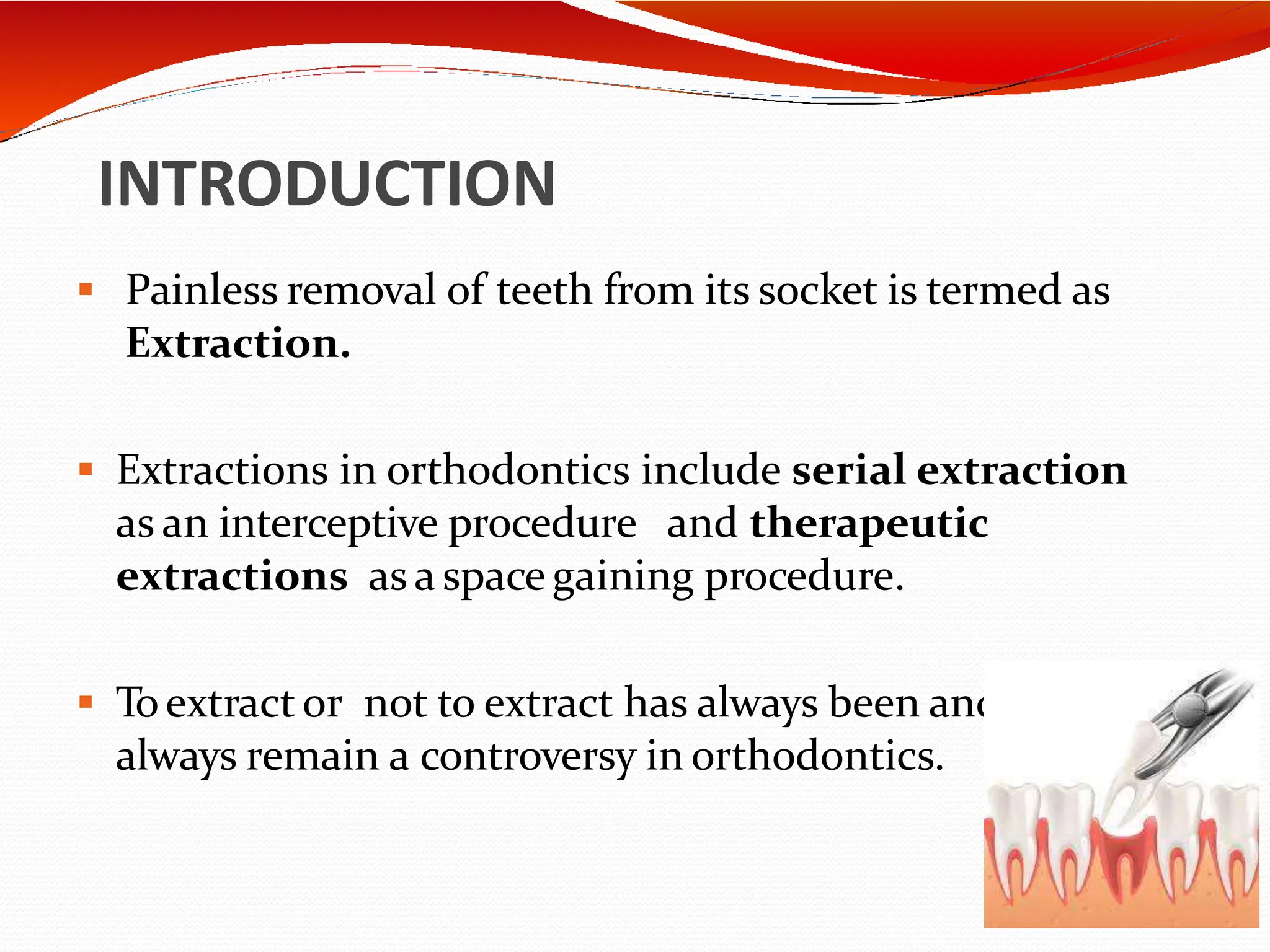
 Painless removal of teeth from its socket is termed as
Extraction.
 Extractions in orthodontics include serial extraction
as an interceptive procedure and therapeutic
extractions as a space gaining procedure.
 Toextract or not to extract has always been and will
always remain a controversy in orthodontics.
THE NEED FOR EXTRACTION
Arch length tooth material
discrepancy
Correction of sagittal interarch
relationship
Abnormal size and form of teeth
Skeletal jaw malrelations
• Ideally the arch length and tooth material should be in
harmonywith each other..
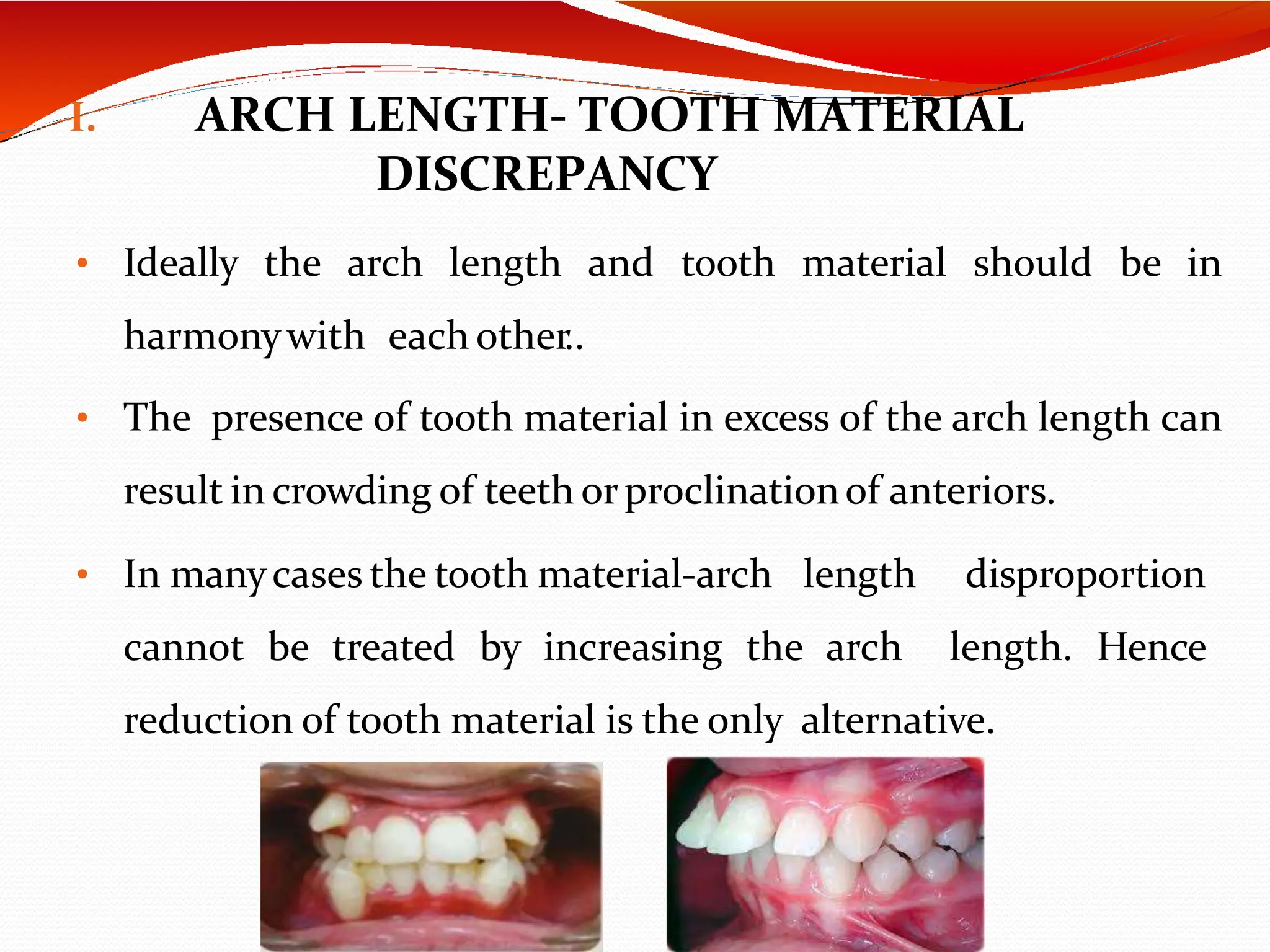
• The presence of tooth material in excess of the arch length can
result in crowding of teeth orproclinationof anteriors.
• In manycases the tooth material-arch length disproportion
cannot be treated by increasing the arch length. Hence
reduction of tooth material is the only alternative.
I. ARCH LENGTH- TOOTH MATERIAL
DISCREPANCY
Absence of physiologic spacing in the primary dentition
Ectopic eruption of teeth
Localized gingival recession in the lower anterior
Impacted or malpositioned lateral incisors that erupt palatally out of the arch.
Irregular or crowded upper and lower anteriors
Lower anterior flaring
Unilateral or bilateral premature loss of deciduous canine with midline shift
Signs of arch length deficiency
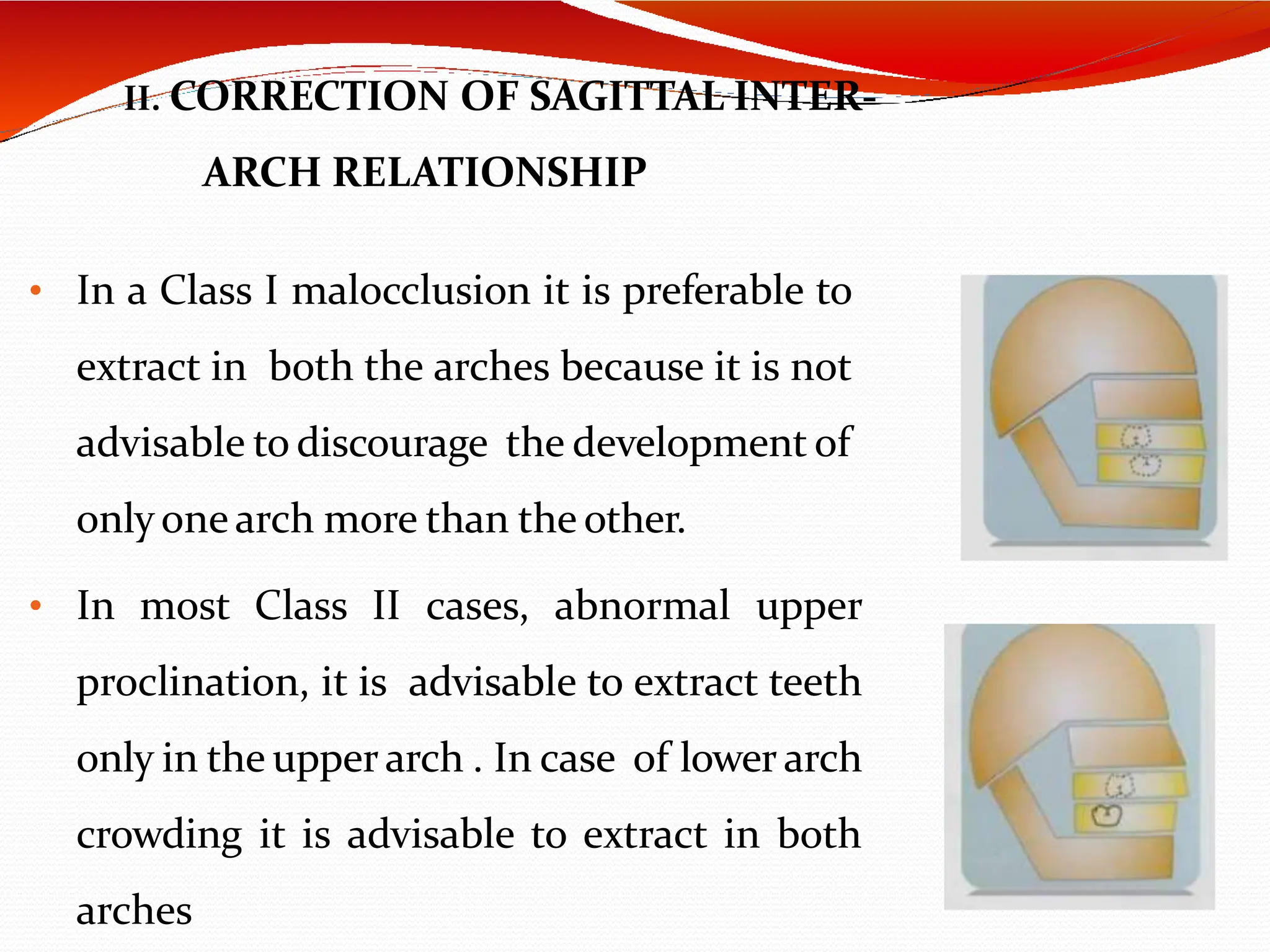
• In a Class I malocclusion it is preferable to
extract in both the arches because it is not
advisable to discourage the development of
onlyone arch more than the other.
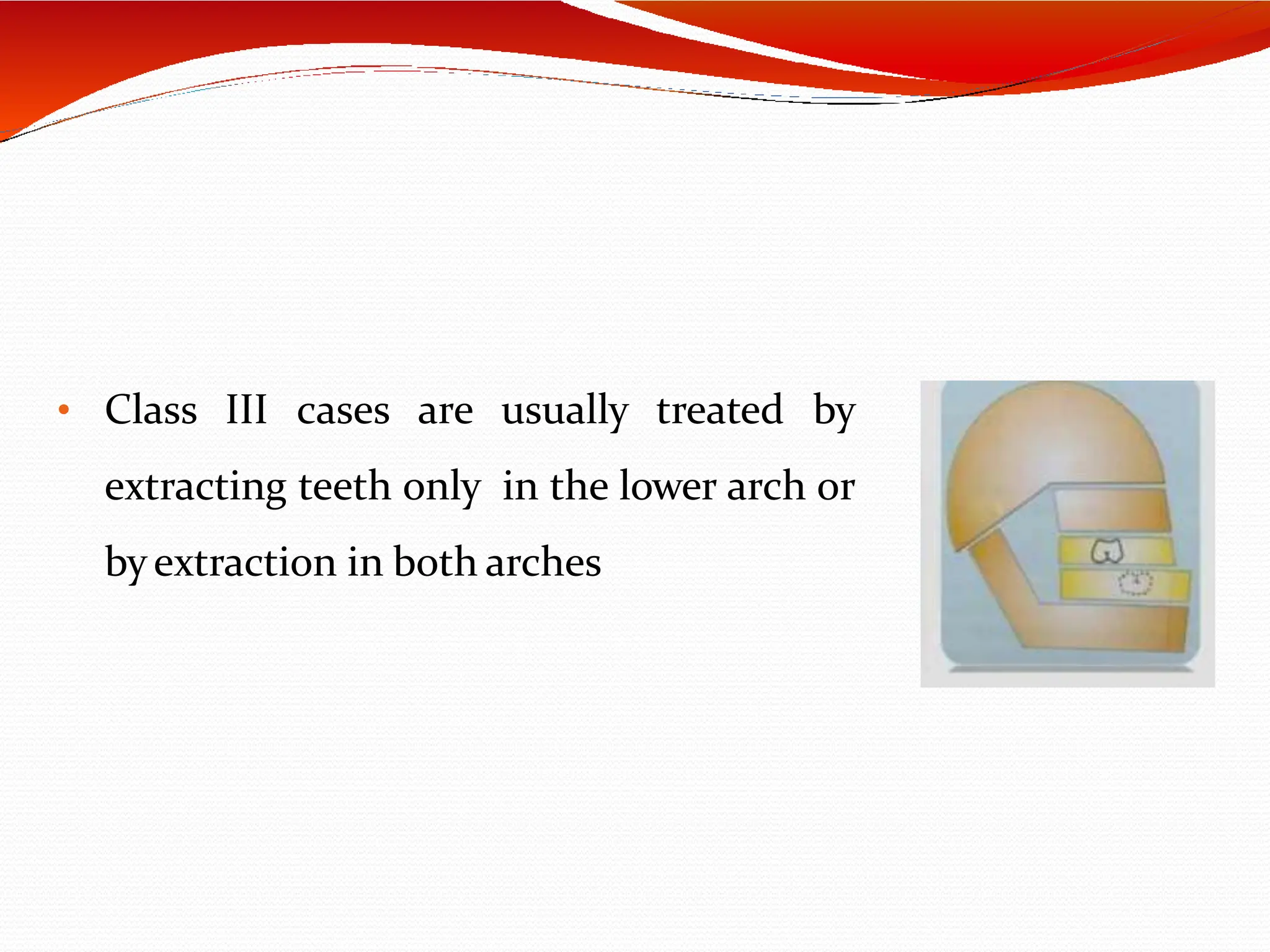
• In most Class II cases, abnormal upper
proclination, it is advisable to extract teeth
only in the upper arch . In case of lower arch
crowding it is advisable to extract in both
arches
II. CORRECTION OF SAGITTAL INTER-
ARCH RELATIONSHIP
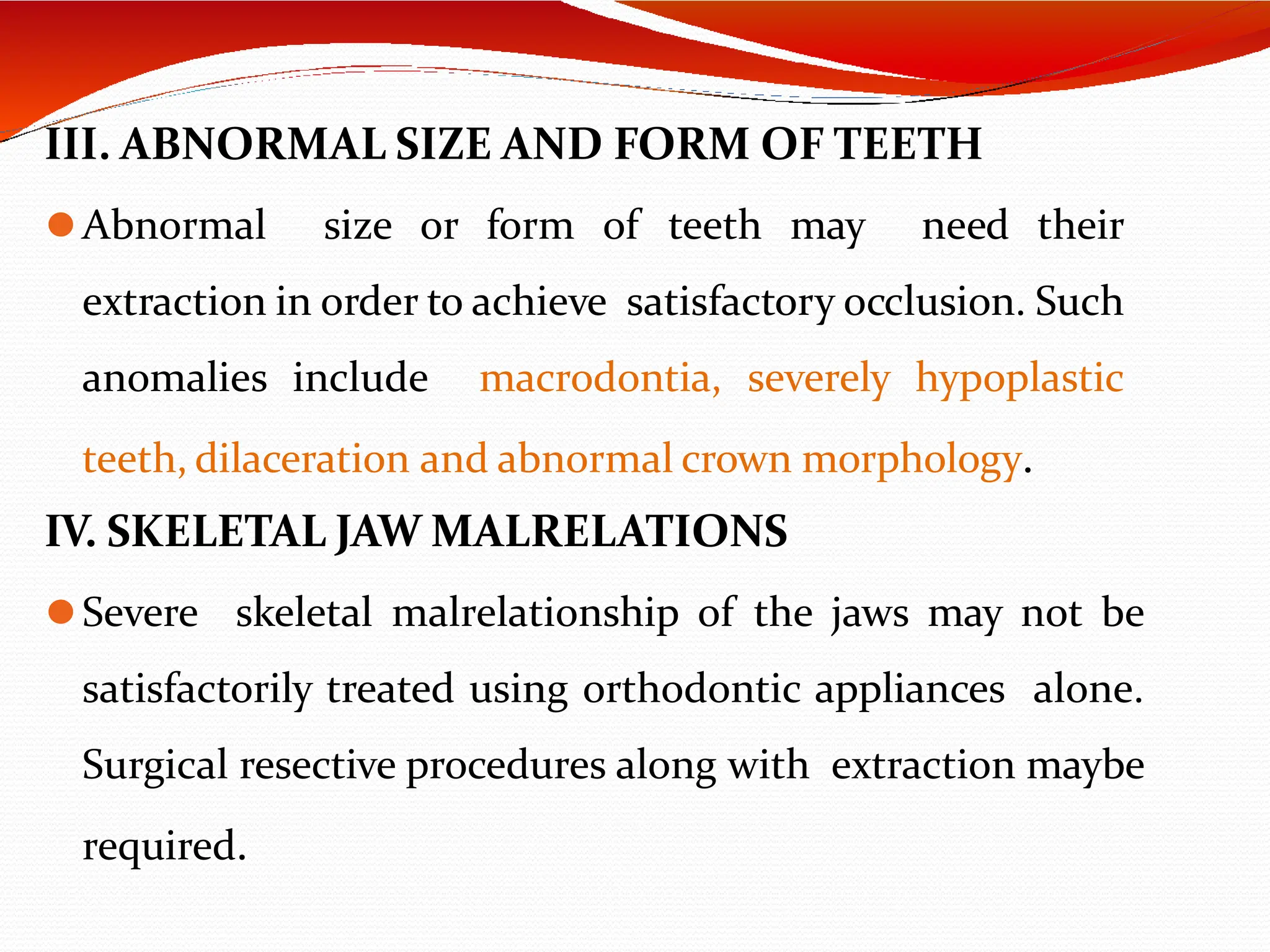
• Class III cases are usually treated by
extracting teeth only in the lower arch or
byextraction in both arches
III. ABNORMAL SIZE AND FORM OF TEETH
⚫Abnormal size or form of teeth may need their
extraction in order to achieve satisfactory occlusion. Such
anomalies include macrodontia, severely hypoplastic
teeth, dilaceration and abnormal crown morphology.
IV. SKELETAL JAW MALRELATIONS
⚫Severe skeletal malrelationship of the jaws may not be
satisfactorily treated using orthodontic appliances alone.
Surgical resective procedures along with extraction maybe
required.
DIFFERENT EXTRACTION PROCEDURE
Balancing
extractions
Compensating
extractions
Enforced
extractions
Wilkinson
extractions
Balancing Extractions
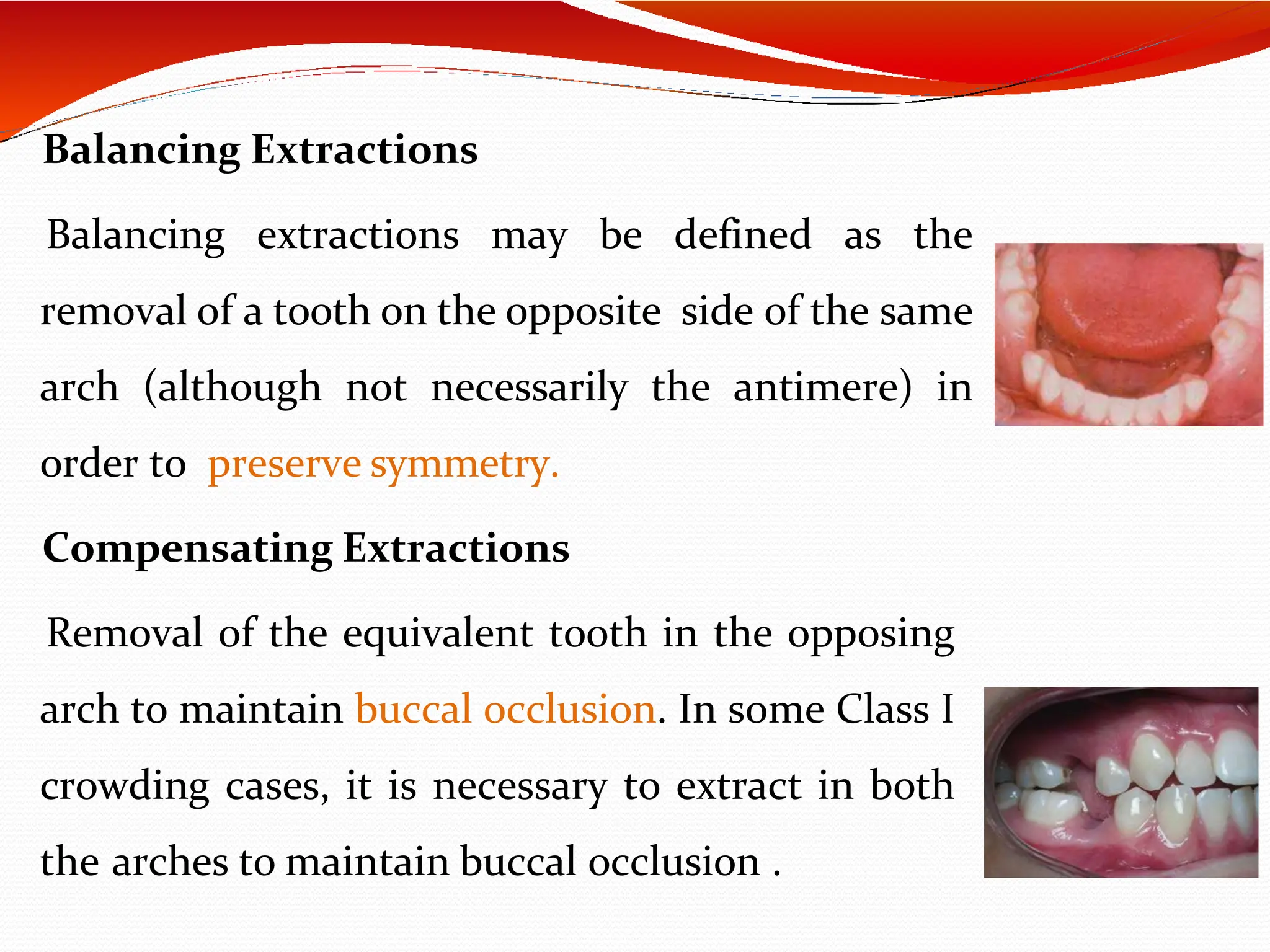
Balancing extractions may be defined as the
removal of a tooth on the opposite side of the same
arch (although not necessarily the antimere) in
order to preserve symmetry.
Compensating Extractions
Removal of the equivalent tooth in the opposing
arch to maintain buccal occlusion. In some Class I
crowding cases, it is necessary to extract in both
the arches to maintain buccal occlusion .
Compensating extractions preserve interarch relationship
Enforced Extractions
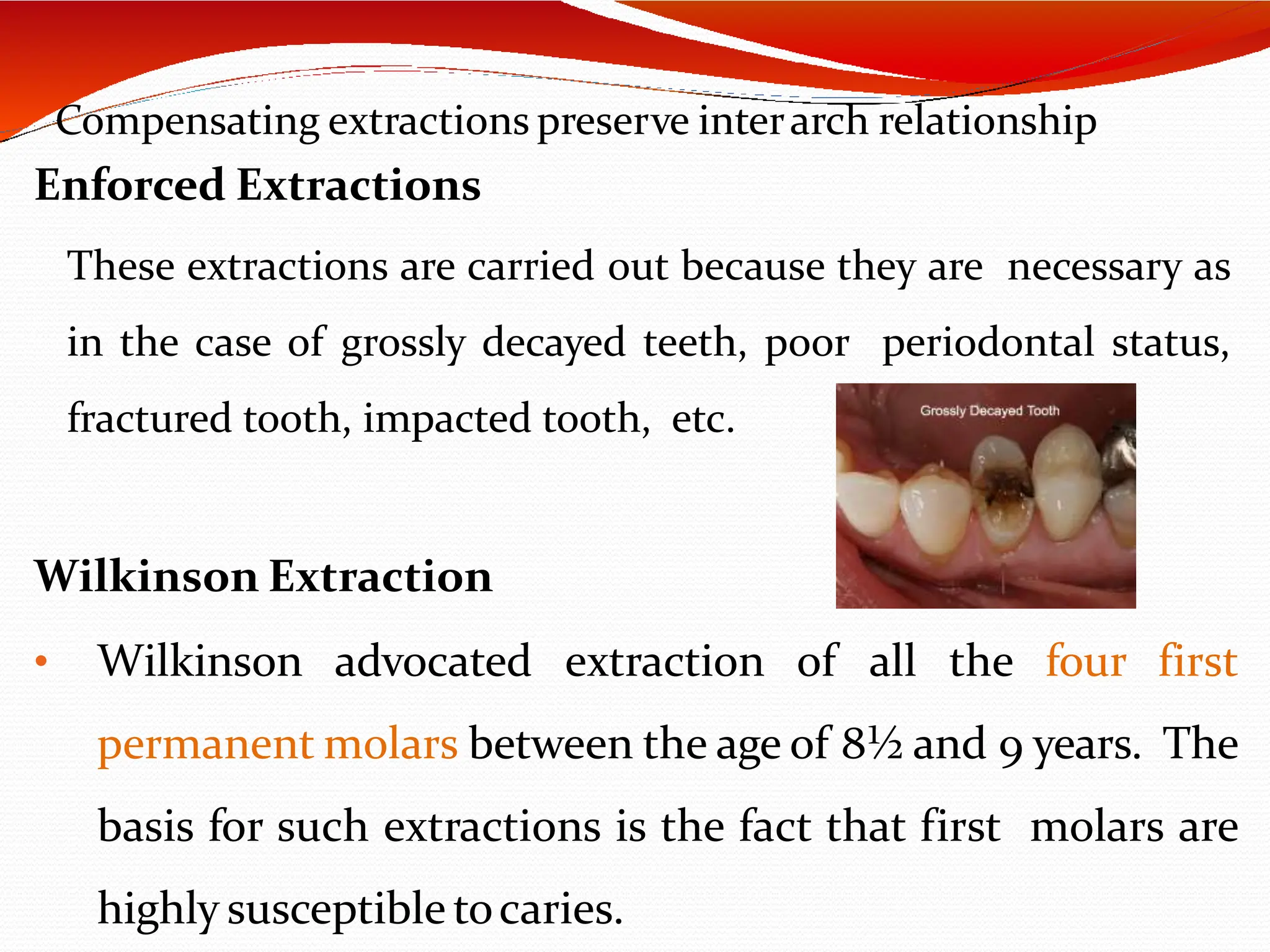
These extractions are carried out because they are necessary as
in the case of grossly decayed teeth, poor periodontal status,
fractured tooth, impacted tooth, etc.
Wilkinson Extraction
• Wilkinson advocated extraction of all the four first
permanent molars between the age of 8½ and 9 years. The
basis for such extractions is the fact that first molars are
highly susceptible tocaries.
Theother benefits of extracting first molarsatan earlyage
are:
o Toavoid third molar impactions by providing
additional space for theireruption.
o To reduce crowding in thearch
Wilkinson's extractions are not usually carried out because of
variousdrawbacks as
o Offers limited space for anterior crowding correction
o Adjacent teeth tip into theextraction space
o No adequate anchorage for orthodontic treatment
CHOICE OF TEETH FOR EXTRACTION
• Direction and amountof jawgrowth
• Arch length tooth material discrepancy
• Stateof soundness, positionand eruptionof
teeth
• Facial profile
• Ageof patient
EXTRACTION OF UPPER INCISORS
⚫ Unfavorably impacted upper incisor
⚫ A buccally/lingually blocked out lateral incisorwith good
contact between thecentral incisorand caninecan beextracted
⚫If one of the lateral incisors is congenitally missing, the
opposite lateral may be extracted in order to maintain arch
symmetry.
⚫ A grossly carious or malformed incisor
⚫Traumaor irreparabledamage to incisors
⚫An incisor with dilacerated root cannot be efficiently moved by
orthodontic therapy.
II EXTRACTION OF LOWER INCISORS
Extractionof lower incisors should beavoidedas faras
possible.
o Narrowing of lower inter-canine width
o Retroclination of lower incisors
o Deep bite
o Re-appearanceof crowding.
o The reduction in lower inter-canine width often leads to a
secondary reduction in upper inter-canine width resulting
in upperanteriorcrowding
INDICATIONS
⚫If one of the incisors is completely blocked out .
⚫A incisor that was traumatized, grossly carious, gingival
recession or bone loss may havea poor prognosis.
⚫Severe arch length deficiency is with fan shaped flaring out of
the lower incisor
⚫Mild Class III cases with lower incisor crowding, one of the
lower incisors may be extracted to achieve normal overjet,
overbiteand to relievecrowding.
⚫Class I cases with moderate lower labial segment crowding of up
to 5 mm (i.e. the size of a lower incisor) may be treated with loss
of a lower incisor.
III EXTRACTION OF CANINES
⚫Not frequently extracted
Extractionof caninecauses
- Flattening of face
- Altered facial balance
- Change in expression
- Contact between the premolarand lateral incisor is rarely
satisfactory.
INDICATIONS
• Ectopically erupted or Unfavorably impacted canines
• A canine that is completely out of the arch
• Premature shedding of a deciduous canine usually indicates
the extraction of its fellow on the opposite side of the arch to
restore symmetry.
• In Class II cases if the lowerdeciduous canines are shed
early, the upper deciduous canines should also be removed
so as toavoid worsening of the post-normalcy (Class II
tendency).
• In Class III cases if the upper deciduous canines are
shed early, it may necessitate the extraction of the lower
deciduous canines to avoid worsening of the pre
normalcy (Class III tendency)
• Deciduous canines may be extracted as a part of serial
extraction
IV EXTRACTION OF FIRST PREMOLARS
⚫The first premolarsare the mostcommonlyextracted teeth
The reason for theirextraction isas follows:
• Location in the arch is such that the space gained by their
extraction can be utilized for correction both in the anterior
and posterior region.
• The contact that results between the canine and second
premolar is satisfactory.
• Extraction of the first premolar leaves behind a posterior
segment that offers adequate anchorage for the retraction of
the six anteriorteeth.
The following aresomeof the indications for first premolar
extraction:
• Relieve moderate tosevereanteriorcrowding of the upperor
lowerarch
• The first premolars are extracted forcorrection of moderate
tosevereanterior proclination as in a Class II, division 1
malocclusionora Class I bidental protrusion
INDICATIONS OF FIRST PREMOLAR
EXTRACTION
V EXTRACTION OF SECOND PREMOLARS
INDICATIONS
• The extraction of second premolars instead of the first
premolars results in the anchorage of the anterior segment
being strengthened.
• The second premolars are usually extracted when 4-5 mm of
anchorage loss is deliberatelydesired.
• Unfavorably impacted second premolars is preferred over the
first premolars
• Open bite cases, it is preferable to extract the second
premolars as their extraction encourages deepening of the
• In case of grossly carious or deeply filled second
premolars, it iswise toextract them and preserve the first
premolars.
VI EXTRACTION OF FIRST MOLARS
⚫Extraction of the first permanent molars is avoided for
the following reasons:
• Theextraction of the first molardoes not give
adequate space in the incisorregion.
• The extraction of the first molar results in deepening of
the bite.
• Thesecond premolarand molar may tip into the
extraction space.
• Mastication may beaffected.
INDICATIONS
⚫Minimal space requirement forcorrection of mild anterior
crowding or mild proclination.
⚫Grossly decayed molaror heavily filled teeth.
⚫Open bite cases can benefit from extraction of first molar, as
there is a tendency for the bite todeepen after extraction of
first molars
VII EXTRACTION OF SECOND MOLARS
INDICATIONS
• To prevent third molar impaction: The cases that benefit from
such extractions are those where the third molars are upright
or not tipped mesially more than 30°.
• To relieve impaction of second premolar: The premature loss
of second deciduous molars is usually followed by forward
drift of the first permanent molars leaving inadequate space
for the second bicuspids to erupt. The extraction of second
molars in such cases may allow the distal movement of the
first permanent molars .
• Lower incisorcrowding: Very mild crowding in the
anterior partof thearch can be relieved byextraction of
the second molars.
• Toenable distalizationof first molars: In cases where the
first permanent molarsare to bedistalized, the extraction
of second molars can benefit the procedure.
• Open bite cases
VIII EXTRACTION OF THIRD MOLARS
⚫Extraction of third molars during orthodontic
treatment does not yield space that can be used for
decrowding or reductionof proclination.
⚫Third molarsareextracted forotherreasonsas follows:
I. Grossly impacted
II. Grossly malformed
III. Eruption of third molars cause late lower anterior
crowding.
Additional factors to consider during orthodontic
tooth extraction include:
• Quality of teeth
• Abnormalities of tooth form
• Medical history
Thank you

UG CLASS EXTRACTION IN ORTHODONTICS.pptx

  • 1.
  • 2.
    INTRODUCTION  Painless removalof teeth from its socket is termed as Extraction.  Extractions in orthodontics include serial extraction as an interceptive procedure and therapeutic extractions as a space gaining procedure.  Toextract or not to extract has always been and will always remain a controversy in orthodontics.
  • 3.
    THE NEED FOREXTRACTION Arch length tooth material discrepancy Correction of sagittal interarch relationship Abnormal size and form of teeth Skeletal jaw malrelations
  • 4.
    • Ideally thearch length and tooth material should be in harmonywith each other.. • The presence of tooth material in excess of the arch length can result in crowding of teeth orproclinationof anteriors. • In manycases the tooth material-arch length disproportion cannot be treated by increasing the arch length. Hence reduction of tooth material is the only alternative. I. ARCH LENGTH- TOOTH MATERIAL DISCREPANCY
  • 5.
    Absence of physiologicspacing in the primary dentition Ectopic eruption of teeth Localized gingival recession in the lower anterior Impacted or malpositioned lateral incisors that erupt palatally out of the arch. Irregular or crowded upper and lower anteriors Lower anterior flaring Unilateral or bilateral premature loss of deciduous canine with midline shift Signs of arch length deficiency
  • 6.
    • In aClass I malocclusion it is preferable to extract in both the arches because it is not advisable to discourage the development of onlyone arch more than the other. • In most Class II cases, abnormal upper proclination, it is advisable to extract teeth only in the upper arch . In case of lower arch crowding it is advisable to extract in both arches II. CORRECTION OF SAGITTAL INTER- ARCH RELATIONSHIP
  • 7.
    • Class IIIcases are usually treated by extracting teeth only in the lower arch or byextraction in both arches
  • 8.
    III. ABNORMAL SIZEAND FORM OF TEETH ⚫Abnormal size or form of teeth may need their extraction in order to achieve satisfactory occlusion. Such anomalies include macrodontia, severely hypoplastic teeth, dilaceration and abnormal crown morphology. IV. SKELETAL JAW MALRELATIONS ⚫Severe skeletal malrelationship of the jaws may not be satisfactorily treated using orthodontic appliances alone. Surgical resective procedures along with extraction maybe required.
  • 9.
  • 10.
    Balancing Extractions Balancing extractionsmay be defined as the removal of a tooth on the opposite side of the same arch (although not necessarily the antimere) in order to preserve symmetry. Compensating Extractions Removal of the equivalent tooth in the opposing arch to maintain buccal occlusion. In some Class I crowding cases, it is necessary to extract in both the arches to maintain buccal occlusion .
  • 11.
    Compensating extractions preserveinterarch relationship Enforced Extractions These extractions are carried out because they are necessary as in the case of grossly decayed teeth, poor periodontal status, fractured tooth, impacted tooth, etc. Wilkinson Extraction • Wilkinson advocated extraction of all the four first permanent molars between the age of 8½ and 9 years. The basis for such extractions is the fact that first molars are highly susceptible tocaries.
  • 12.
    Theother benefits ofextracting first molarsatan earlyage are: o Toavoid third molar impactions by providing additional space for theireruption. o To reduce crowding in thearch Wilkinson's extractions are not usually carried out because of variousdrawbacks as o Offers limited space for anterior crowding correction o Adjacent teeth tip into theextraction space o No adequate anchorage for orthodontic treatment
  • 13.
    CHOICE OF TEETHFOR EXTRACTION • Direction and amountof jawgrowth • Arch length tooth material discrepancy • Stateof soundness, positionand eruptionof teeth • Facial profile • Ageof patient
  • 14.
    EXTRACTION OF UPPERINCISORS ⚫ Unfavorably impacted upper incisor ⚫ A buccally/lingually blocked out lateral incisorwith good contact between thecentral incisorand caninecan beextracted ⚫If one of the lateral incisors is congenitally missing, the opposite lateral may be extracted in order to maintain arch symmetry. ⚫ A grossly carious or malformed incisor ⚫Traumaor irreparabledamage to incisors ⚫An incisor with dilacerated root cannot be efficiently moved by orthodontic therapy.
  • 16.
    II EXTRACTION OFLOWER INCISORS Extractionof lower incisors should beavoidedas faras possible. o Narrowing of lower inter-canine width o Retroclination of lower incisors o Deep bite o Re-appearanceof crowding. o The reduction in lower inter-canine width often leads to a secondary reduction in upper inter-canine width resulting in upperanteriorcrowding
  • 17.
    INDICATIONS ⚫If one ofthe incisors is completely blocked out . ⚫A incisor that was traumatized, grossly carious, gingival recession or bone loss may havea poor prognosis. ⚫Severe arch length deficiency is with fan shaped flaring out of the lower incisor ⚫Mild Class III cases with lower incisor crowding, one of the lower incisors may be extracted to achieve normal overjet, overbiteand to relievecrowding. ⚫Class I cases with moderate lower labial segment crowding of up to 5 mm (i.e. the size of a lower incisor) may be treated with loss of a lower incisor.
  • 19.
    III EXTRACTION OFCANINES ⚫Not frequently extracted Extractionof caninecauses - Flattening of face - Altered facial balance - Change in expression - Contact between the premolarand lateral incisor is rarely satisfactory.
  • 20.
    INDICATIONS • Ectopically eruptedor Unfavorably impacted canines • A canine that is completely out of the arch • Premature shedding of a deciduous canine usually indicates the extraction of its fellow on the opposite side of the arch to restore symmetry. • In Class II cases if the lowerdeciduous canines are shed early, the upper deciduous canines should also be removed so as toavoid worsening of the post-normalcy (Class II tendency).
  • 21.
    • In ClassIII cases if the upper deciduous canines are shed early, it may necessitate the extraction of the lower deciduous canines to avoid worsening of the pre normalcy (Class III tendency) • Deciduous canines may be extracted as a part of serial extraction
  • 22.
    IV EXTRACTION OFFIRST PREMOLARS ⚫The first premolarsare the mostcommonlyextracted teeth The reason for theirextraction isas follows: • Location in the arch is such that the space gained by their extraction can be utilized for correction both in the anterior and posterior region. • The contact that results between the canine and second premolar is satisfactory. • Extraction of the first premolar leaves behind a posterior segment that offers adequate anchorage for the retraction of the six anteriorteeth.
  • 23.
    The following aresomeofthe indications for first premolar extraction: • Relieve moderate tosevereanteriorcrowding of the upperor lowerarch • The first premolars are extracted forcorrection of moderate tosevereanterior proclination as in a Class II, division 1 malocclusionora Class I bidental protrusion INDICATIONS OF FIRST PREMOLAR EXTRACTION
  • 25.
    V EXTRACTION OFSECOND PREMOLARS INDICATIONS • The extraction of second premolars instead of the first premolars results in the anchorage of the anterior segment being strengthened. • The second premolars are usually extracted when 4-5 mm of anchorage loss is deliberatelydesired. • Unfavorably impacted second premolars is preferred over the first premolars • Open bite cases, it is preferable to extract the second premolars as their extraction encourages deepening of the
  • 26.
    • In caseof grossly carious or deeply filled second premolars, it iswise toextract them and preserve the first premolars.
  • 27.
    VI EXTRACTION OFFIRST MOLARS ⚫Extraction of the first permanent molars is avoided for the following reasons: • Theextraction of the first molardoes not give adequate space in the incisorregion. • The extraction of the first molar results in deepening of the bite. • Thesecond premolarand molar may tip into the extraction space. • Mastication may beaffected.
  • 28.
    INDICATIONS ⚫Minimal space requirementforcorrection of mild anterior crowding or mild proclination. ⚫Grossly decayed molaror heavily filled teeth. ⚫Open bite cases can benefit from extraction of first molar, as there is a tendency for the bite todeepen after extraction of first molars
  • 29.
    VII EXTRACTION OFSECOND MOLARS INDICATIONS • To prevent third molar impaction: The cases that benefit from such extractions are those where the third molars are upright or not tipped mesially more than 30°. • To relieve impaction of second premolar: The premature loss of second deciduous molars is usually followed by forward drift of the first permanent molars leaving inadequate space for the second bicuspids to erupt. The extraction of second molars in such cases may allow the distal movement of the first permanent molars .
  • 30.
    • Lower incisorcrowding:Very mild crowding in the anterior partof thearch can be relieved byextraction of the second molars. • Toenable distalizationof first molars: In cases where the first permanent molarsare to bedistalized, the extraction of second molars can benefit the procedure. • Open bite cases
  • 31.
    VIII EXTRACTION OFTHIRD MOLARS ⚫Extraction of third molars during orthodontic treatment does not yield space that can be used for decrowding or reductionof proclination. ⚫Third molarsareextracted forotherreasonsas follows: I. Grossly impacted II. Grossly malformed III. Eruption of third molars cause late lower anterior crowding.
  • 32.
    Additional factors toconsider during orthodontic tooth extraction include: • Quality of teeth • Abnormalities of tooth form • Medical history
  • 33.

Editor's Notes

  • #5 The sizes of the dentition and arch length are usually genetically determined Extraction of one or more teeth is required in case of severe tooth material - arch length discrepancy.
  • #7 Extraction of teeth impare the forward development of alveolar process and dental arch
  • #26 Thus an environment is created that favours mesial movement of the posterior teeth. The second premolars are usually extracted to treat mild anterior crowding. The remaining space can be closed by controlled mesial movement of the molars.