NADYA SAFITRI DONGORAN
SISTEM INFORMASI
UNIVERSITAS ISLAM NEGERI SULTAN
SYARIF KASIM RIAU
External Analysis - Porter’s five-force Model
Porter’s Five-
Force Model
Source: Adapted with
the permission of The
Free Press, a Division
of Simon & Schuster
Adult Publishing Group,
from Competitive
Strategy: Techniques
for Analyzing Industries
and Competitors,
by Michael E. Porter.
Copyright © 1980,
1998 by The Free
Press. All rights
reserved.
Porter’s Five-Force Model
In this model, the attractiveness of an industry and a firm’s opportunities
and threats are identified by analyzing five forces.
The five forces are:
1. The degree of existing rivalry.
An industry’s degree of rivalry is influenced by a Number of factors. First,
the number and relative size of competitors will shape the nature of rivalry.
In general, the more firms competing that are of comparable size, the more
competitive the industry will be. There are, however, exceptions to this
generality. For example, oligopolistic industries (those that have a few
large competitors) can be fiercely competitive if firms choose to engage in
price wars (as happened in the personal digital assistant industry). On the
other hand, oligopolistic industries can have a low degree of rivalry if the
competitors choose to avoid competing head-to-head in the same market
segments, or if they engage in tacit price collusion. Rivalry is also influenced
by the degree to which competitors are differentiated from each other.
2. Threat of potential entrants.
The threat of potential entrants is influenced by both the degree to
which the industry is likely to attract new entrants (i.e., is it profitable,
growing, or otherwise alluring?) and the height of entry barriers. Entry
barriers can include such factors as large start-up costs, brand loyalty,
difficulty in gaining access to suppliers or distributors, government
regulation, threat of retaliation by existing competitors, and many
others. While profitability and growth may attract new entrants, entry
barriers will deter them. For example, while high projected growth in
the smart phone market attracts potential entrants to this market, the
challenge of competing against large, well-established, and efficient
competitors such as Nokia and Ericsson deters many entrants. To
effectively compete against these companies requires that an entrant
be able to manufacture, advertise, and distribute on a large scale,
suggesting significant start-up costs for an entrant to achieve a
competitive position. However, some of these capabilities could be
obtained through partnerships with other firms, such as having
contract manufacturers handle production and having mobile phone
service providers handle distribution, thereby lowering start-up costs.
3. Bargaining power of suppliers.
The degree to which the firm relies on one or a few suppliers will influence its ability to
negotiate good terms. If there are few suppliers or suppliers are highly differentiated, the
firm may have little choice in its buying decision, and thus have little leverage over the
supplier to negotiate prices, delivery schedules, or other terms. On the other hand, if
suppliers are very abundant and/or are not highly differentiated, the firm may be able to
force the suppliers to bid against one another for the sale. The amount the firm purchases
from the supplier is also relevant. If the firm’s purchases constitute the bulk of a supplier’s
sales, the supplier will be heavily reliant upon the firm and the supplier will have little
bargaining power. Likewise, if the supplier’s sales constitute a large portion of the firm’s
purchases, the firm will be heavily reliant upon the supplier and the supplier will have more
bargaining power. For example, manufacturers that sell to Walmart often have little
bargaining power because Walmart’s enormous volume often makes its purchases a
significant portion of a manufacturer’s yearly sales. Walmart’s suppliers typically have little
bargaining power. When Intel sells to personal computer manufacturers, on the other hand,
it typically wields considerable supplier bargaining power. When computer manufacturers
consider potential suppliers for microprocessors, they often have little choice but to go with
Intel—many consumers demand that their systems include Intel microprocessors, and the
majority of personal computer hardware.
4. Bargaining power of buyers.
Many of the same factors that influence the bargaining power
of suppliers have an analogous role with the bargaining power
of buyers. The degree to which the firm is reliant on a few
customers will increase the customer’s bargaining power, and
vice versa. If the firm’s product is highly differentiated, buyers
will typically experience less bargaining power, and if the
firm’s product is undifferentiated, buyers will typically
experience greater bargaining power. If buyers face switching
costs, this is likely to lower their bargaining power, and if the
firm faces switching costs to work with other buyers, this will
increase the buyer’s bargaining power. Finally, if the buyers
can threaten to backward vertically integrate, this will increase
their bargainingpower, and if the firm can threaten to forward
vertically integrate, it will lower customer bargaining power.
5. Threat of substitutes.
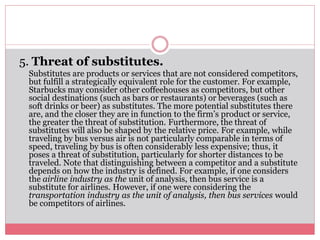
Substitutes are products or services that are not considered competitors,
but fulfill a strategically equivalent role for the customer. For example,
Starbucks may consider other coffeehouses as competitors, but other
social destinations (such as bars or restaurants) or beverages (such as
soft drinks or beer) as substitutes. The more potential substitutes there
are, and the closer they are in function to the firm’s product or service,
the greater the threat of substitution. Furthermore, the threat of
substitutes will also be shaped by the relative price. For example, while
traveling by bus versus air is not particularly comparable in terms of
speed, traveling by bus is often considerably less expensive; thus, it
poses a threat of substitution, particularly for shorter distances to be
traveled. Note that distinguishing between a competitor and a substitute
depends on how the industry is defined. For example, if one considers
the airline industry as the unit of analysis, then bus service is a
substitute for airlines. However, if one were considering the
transportation industry as the unit of analysis, then bus services would
be competitors of airlines.
Reference
 M. A. Porter, Competitive Strategy. (New York: Free
Press, 1980).
 Michael Porter is fully supportive of both ways of
applying the five-force model. Personal
communication with Michael Porter, March 25,
2006.
 M. A. Porter, “Strategy and the Internet,” Harvard
Business Review 79, no. 3 (2001), pp. 62–78; and
personal communication, March 13, 2006.

External Analysis - Porter’s five-force Model

  • 1.
    NADYA SAFITRI DONGORAN SISTEMINFORMASI UNIVERSITAS ISLAM NEGERI SULTAN SYARIF KASIM RIAU External Analysis - Porter’s five-force Model
  • 2.
    Porter’s Five- Force Model Source:Adapted with the permission of The Free Press, a Division of Simon & Schuster Adult Publishing Group, from Competitive Strategy: Techniques for Analyzing Industries and Competitors, by Michael E. Porter. Copyright © 1980, 1998 by The Free Press. All rights reserved. Porter’s Five-Force Model
  • 3.
    Porter’s Five-Force Model Inthis model, the attractiveness of an industry and a firm’s opportunities and threats are identified by analyzing five forces. The five forces are: 1. The degree of existing rivalry. An industry’s degree of rivalry is influenced by a Number of factors. First, the number and relative size of competitors will shape the nature of rivalry. In general, the more firms competing that are of comparable size, the more competitive the industry will be. There are, however, exceptions to this generality. For example, oligopolistic industries (those that have a few large competitors) can be fiercely competitive if firms choose to engage in price wars (as happened in the personal digital assistant industry). On the other hand, oligopolistic industries can have a low degree of rivalry if the competitors choose to avoid competing head-to-head in the same market segments, or if they engage in tacit price collusion. Rivalry is also influenced by the degree to which competitors are differentiated from each other.
  • 4.
    2. Threat ofpotential entrants. The threat of potential entrants is influenced by both the degree to which the industry is likely to attract new entrants (i.e., is it profitable, growing, or otherwise alluring?) and the height of entry barriers. Entry barriers can include such factors as large start-up costs, brand loyalty, difficulty in gaining access to suppliers or distributors, government regulation, threat of retaliation by existing competitors, and many others. While profitability and growth may attract new entrants, entry barriers will deter them. For example, while high projected growth in the smart phone market attracts potential entrants to this market, the challenge of competing against large, well-established, and efficient competitors such as Nokia and Ericsson deters many entrants. To effectively compete against these companies requires that an entrant be able to manufacture, advertise, and distribute on a large scale, suggesting significant start-up costs for an entrant to achieve a competitive position. However, some of these capabilities could be obtained through partnerships with other firms, such as having contract manufacturers handle production and having mobile phone service providers handle distribution, thereby lowering start-up costs.
  • 5.
    3. Bargaining powerof suppliers. The degree to which the firm relies on one or a few suppliers will influence its ability to negotiate good terms. If there are few suppliers or suppliers are highly differentiated, the firm may have little choice in its buying decision, and thus have little leverage over the supplier to negotiate prices, delivery schedules, or other terms. On the other hand, if suppliers are very abundant and/or are not highly differentiated, the firm may be able to force the suppliers to bid against one another for the sale. The amount the firm purchases from the supplier is also relevant. If the firm’s purchases constitute the bulk of a supplier’s sales, the supplier will be heavily reliant upon the firm and the supplier will have little bargaining power. Likewise, if the supplier’s sales constitute a large portion of the firm’s purchases, the firm will be heavily reliant upon the supplier and the supplier will have more bargaining power. For example, manufacturers that sell to Walmart often have little bargaining power because Walmart’s enormous volume often makes its purchases a significant portion of a manufacturer’s yearly sales. Walmart’s suppliers typically have little bargaining power. When Intel sells to personal computer manufacturers, on the other hand, it typically wields considerable supplier bargaining power. When computer manufacturers consider potential suppliers for microprocessors, they often have little choice but to go with Intel—many consumers demand that their systems include Intel microprocessors, and the majority of personal computer hardware.
  • 6.
    4. Bargaining powerof buyers. Many of the same factors that influence the bargaining power of suppliers have an analogous role with the bargaining power of buyers. The degree to which the firm is reliant on a few customers will increase the customer’s bargaining power, and vice versa. If the firm’s product is highly differentiated, buyers will typically experience less bargaining power, and if the firm’s product is undifferentiated, buyers will typically experience greater bargaining power. If buyers face switching costs, this is likely to lower their bargaining power, and if the firm faces switching costs to work with other buyers, this will increase the buyer’s bargaining power. Finally, if the buyers can threaten to backward vertically integrate, this will increase their bargainingpower, and if the firm can threaten to forward vertically integrate, it will lower customer bargaining power.
  • 7.
    5. Threat ofsubstitutes. Substitutes are products or services that are not considered competitors, but fulfill a strategically equivalent role for the customer. For example, Starbucks may consider other coffeehouses as competitors, but other social destinations (such as bars or restaurants) or beverages (such as soft drinks or beer) as substitutes. The more potential substitutes there are, and the closer they are in function to the firm’s product or service, the greater the threat of substitution. Furthermore, the threat of substitutes will also be shaped by the relative price. For example, while traveling by bus versus air is not particularly comparable in terms of speed, traveling by bus is often considerably less expensive; thus, it poses a threat of substitution, particularly for shorter distances to be traveled. Note that distinguishing between a competitor and a substitute depends on how the industry is defined. For example, if one considers the airline industry as the unit of analysis, then bus service is a substitute for airlines. However, if one were considering the transportation industry as the unit of analysis, then bus services would be competitors of airlines.
  • 8.
    Reference  M. A.Porter, Competitive Strategy. (New York: Free Press, 1980).  Michael Porter is fully supportive of both ways of applying the five-force model. Personal communication with Michael Porter, March 25, 2006.  M. A. Porter, “Strategy and the Internet,” Harvard Business Review 79, no. 3 (2001), pp. 62–78; and personal communication, March 13, 2006.