Management, Eleventh Edition by Stephen P. Robbins & Mary Coulter ©2012 Pearson Education, Inc. publishing as Prentice Hall
1-1
Management, Eleventh Edition by Stephen P. Robbins & Mary Coulter ©2012 Pearson Education, Inc. publishing as Prentice Hall
1-2
Who Are Managers?
• Manager
– Someone who
coordinates and
oversees the work of
other people so that
organizational goals can
be accomplished.
Management, Eleventh Edition by Stephen P. Robbins & Mary Coulter ©2012 Pearson Education, Inc. publishing as Prentice Hall
1-3
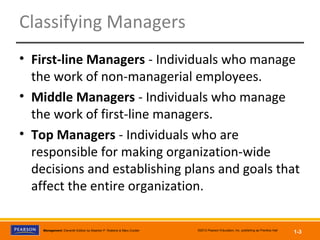
Classifying Managers
• First-line Managers - Individuals who manage
the work of non-managerial employees.
• Middle Managers - Individuals who manage
the work of first-line managers.
• Top Managers - Individuals who are
responsible for making organization-wide
decisions and establishing plans and goals that
affect the entire organization.
Management, Eleventh Edition by Stephen P. Robbins & Mary Coulter ©2012 Pearson Education, Inc. publishing as Prentice Hall
1-4
Exhibit 1-1: Levels of Management
Management, Eleventh Edition by Stephen P. Robbins & Mary Coulter ©2012 Pearson Education, Inc. publishing as Prentice Hall
1-5
Where Do Managers Work?
• Organization - A deliberate arrangement of
people assembled to accomplish some specific
purpose (that individuals independently could
not accomplish alone).
• Common Characteristics of Organizations
– Have a distinct purpose (goal)
– Are composed of people
– Have a deliberate structure
Management, Eleventh Edition by Stephen P. Robbins & Mary Coulter ©2012 Pearson Education, Inc. publishing as Prentice Hall
1-6
Exhibit 1-2: Characteristics of
Organizations
Management, Eleventh Edition by Stephen P. Robbins & Mary Coulter ©2012 Pearson Education, Inc. publishing as Prentice Hall
1-7
What Do Managers Do?
• Management involves coordinating and
overseeing the work activities of others so
that their activities are completed efficiently
and effectively.
Management, Eleventh Edition by Stephen P. Robbins & Mary Coulter ©2012 Pearson Education, Inc. publishing as Prentice Hall
1-8
Effectiveness and Efficiency
• Efficiency
– “Doing things right”
– Getting the most output
for the least inputs
• Effectiveness
– “Doing the right things”
– Attaining organizational
goals
Management, Eleventh Edition by Stephen P. Robbins & Mary Coulter ©2012 Pearson Education, Inc. publishing as Prentice Hall
1-9
Exhibit 1-3: Efficiency and Effectiveness
in Management
Management, Eleventh Edition by Stephen P. Robbins & Mary Coulter ©2012 Pearson Education, Inc. publishing as Prentice Hall
1-10
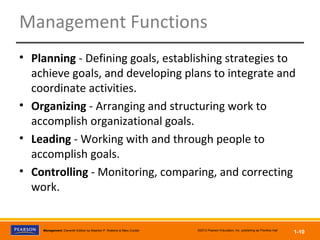
Management Functions
• Planning - Defining goals, establishing strategies to
achieve goals, and developing plans to integrate and
coordinate activities.
• Organizing - Arranging and structuring work to
accomplish organizational goals.
• Leading - Working with and through people to
accomplish goals.
• Controlling - Monitoring, comparing, and correcting
work.
Management, Eleventh Edition by Stephen P. Robbins & Mary Coulter ©2012 Pearson Education, Inc. publishing as Prentice Hall
1-11
Exhibit 1-4: Four Functions of Management
Management, Eleventh Edition by Stephen P. Robbins & Mary Coulter ©2012 Pearson Education, Inc. publishing as Prentice Hall
1-12
Management Roles
• Roles are specific actions or behaviors
expected of a manager.
• Mintzberg identified 10 roles grouped around
interpersonal relationships, the transfer of
information, and decision making.
Management, Eleventh Edition by Stephen P. Robbins & Mary Coulter ©2012 Pearson Education, Inc. publishing as Prentice Hall
1-13
Management Roles
• Interpersonal roles
– Figurehead, leader, liaison
• Informational roles
– Monitor, disseminator, spokesperson
• Decisional roles
– Entrepreneur, disturbance handler, resource
allocator, negotiator
Management, Eleventh Edition by Stephen P. Robbins & Mary Coulter ©2012 Pearson Education, Inc. publishing as Prentice Hall
1-14
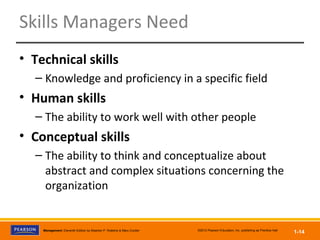
Skills Managers Need
• Technical skills
– Knowledge and proficiency in a specific field
• Human skills
– The ability to work well with other people
• Conceptual skills
– The ability to think and conceptualize about
abstract and complex situations concerning the
organization
Management, Eleventh Edition by Stephen P. Robbins & Mary Coulter ©2012 Pearson Education, Inc. publishing as Prentice Hall
1-15
Exhibit 1-6: Skills Needed at Different
Managerial Levels
Management, Eleventh Edition by Stephen P. Robbins & Mary Coulter ©2012 Pearson Education, Inc. publishing as Prentice Hall
1-16
The Importance of Customers
• Customers: the reason that organizations
exist
– Managing customer relationships is the
responsibility of all managers and employees.
– Consistent high quality customer service is
essential for survival.
Management, Eleventh Edition by Stephen P. Robbins & Mary Coulter ©2012 Pearson Education, Inc. publishing as Prentice Hall
1-17
The Importance of Innovation
• Innovation
– Doing things differently, exploring new territory,
and taking risks.
– Managers should encourage employees to be
aware of and act on opportunities for innovation.
Management, Eleventh Edition by Stephen P. Robbins & Mary Coulter ©2012 Pearson Education, Inc. publishing as Prentice Hall
1-18
Why Study Management?
• Universality of Management
– The reality that management is needed
• in all types and sizes of organizations
• at all organizational levels
• in all organizational areas
• in all organizations, regardless of location
Management, Eleventh Edition by Stephen P. Robbins & Mary Coulter ©2012 Pearson Education, Inc. publishing as Prentice Hall
1-19
Exhibit 1-9: Universal Need for
Management

Management

  • 1.
    Management, Eleventh Editionby Stephen P. Robbins & Mary Coulter ©2012 Pearson Education, Inc. publishing as Prentice Hall 1-1
  • 2.
    Management, Eleventh Editionby Stephen P. Robbins & Mary Coulter ©2012 Pearson Education, Inc. publishing as Prentice Hall 1-2 Who Are Managers? • Manager – Someone who coordinates and oversees the work of other people so that organizational goals can be accomplished.
  • 3.
    Management, Eleventh Editionby Stephen P. Robbins & Mary Coulter ©2012 Pearson Education, Inc. publishing as Prentice Hall 1-3 Classifying Managers • First-line Managers - Individuals who manage the work of non-managerial employees. • Middle Managers - Individuals who manage the work of first-line managers. • Top Managers - Individuals who are responsible for making organization-wide decisions and establishing plans and goals that affect the entire organization.
  • 4.
    Management, Eleventh Editionby Stephen P. Robbins & Mary Coulter ©2012 Pearson Education, Inc. publishing as Prentice Hall 1-4 Exhibit 1-1: Levels of Management
  • 5.
    Management, Eleventh Editionby Stephen P. Robbins & Mary Coulter ©2012 Pearson Education, Inc. publishing as Prentice Hall 1-5 Where Do Managers Work? • Organization - A deliberate arrangement of people assembled to accomplish some specific purpose (that individuals independently could not accomplish alone). • Common Characteristics of Organizations – Have a distinct purpose (goal) – Are composed of people – Have a deliberate structure
  • 6.
    Management, Eleventh Editionby Stephen P. Robbins & Mary Coulter ©2012 Pearson Education, Inc. publishing as Prentice Hall 1-6 Exhibit 1-2: Characteristics of Organizations
  • 7.
    Management, Eleventh Editionby Stephen P. Robbins & Mary Coulter ©2012 Pearson Education, Inc. publishing as Prentice Hall 1-7 What Do Managers Do? • Management involves coordinating and overseeing the work activities of others so that their activities are completed efficiently and effectively.
  • 8.
    Management, Eleventh Editionby Stephen P. Robbins & Mary Coulter ©2012 Pearson Education, Inc. publishing as Prentice Hall 1-8 Effectiveness and Efficiency • Efficiency – “Doing things right” – Getting the most output for the least inputs • Effectiveness – “Doing the right things” – Attaining organizational goals
  • 9.
    Management, Eleventh Editionby Stephen P. Robbins & Mary Coulter ©2012 Pearson Education, Inc. publishing as Prentice Hall 1-9 Exhibit 1-3: Efficiency and Effectiveness in Management
  • 10.
    Management, Eleventh Editionby Stephen P. Robbins & Mary Coulter ©2012 Pearson Education, Inc. publishing as Prentice Hall 1-10 Management Functions • Planning - Defining goals, establishing strategies to achieve goals, and developing plans to integrate and coordinate activities. • Organizing - Arranging and structuring work to accomplish organizational goals. • Leading - Working with and through people to accomplish goals. • Controlling - Monitoring, comparing, and correcting work.
  • 11.
    Management, Eleventh Editionby Stephen P. Robbins & Mary Coulter ©2012 Pearson Education, Inc. publishing as Prentice Hall 1-11 Exhibit 1-4: Four Functions of Management
  • 12.
    Management, Eleventh Editionby Stephen P. Robbins & Mary Coulter ©2012 Pearson Education, Inc. publishing as Prentice Hall 1-12 Management Roles • Roles are specific actions or behaviors expected of a manager. • Mintzberg identified 10 roles grouped around interpersonal relationships, the transfer of information, and decision making.
  • 13.
    Management, Eleventh Editionby Stephen P. Robbins & Mary Coulter ©2012 Pearson Education, Inc. publishing as Prentice Hall 1-13 Management Roles • Interpersonal roles – Figurehead, leader, liaison • Informational roles – Monitor, disseminator, spokesperson • Decisional roles – Entrepreneur, disturbance handler, resource allocator, negotiator
  • 14.
    Management, Eleventh Editionby Stephen P. Robbins & Mary Coulter ©2012 Pearson Education, Inc. publishing as Prentice Hall 1-14 Skills Managers Need • Technical skills – Knowledge and proficiency in a specific field • Human skills – The ability to work well with other people • Conceptual skills – The ability to think and conceptualize about abstract and complex situations concerning the organization
  • 15.
    Management, Eleventh Editionby Stephen P. Robbins & Mary Coulter ©2012 Pearson Education, Inc. publishing as Prentice Hall 1-15 Exhibit 1-6: Skills Needed at Different Managerial Levels
  • 16.
    Management, Eleventh Editionby Stephen P. Robbins & Mary Coulter ©2012 Pearson Education, Inc. publishing as Prentice Hall 1-16 The Importance of Customers • Customers: the reason that organizations exist – Managing customer relationships is the responsibility of all managers and employees. – Consistent high quality customer service is essential for survival.
  • 17.
    Management, Eleventh Editionby Stephen P. Robbins & Mary Coulter ©2012 Pearson Education, Inc. publishing as Prentice Hall 1-17 The Importance of Innovation • Innovation – Doing things differently, exploring new territory, and taking risks. – Managers should encourage employees to be aware of and act on opportunities for innovation.
  • 18.
    Management, Eleventh Editionby Stephen P. Robbins & Mary Coulter ©2012 Pearson Education, Inc. publishing as Prentice Hall 1-18 Why Study Management? • Universality of Management – The reality that management is needed • in all types and sizes of organizations • at all organizational levels • in all organizational areas • in all organizations, regardless of location
  • 19.
    Management, Eleventh Editionby Stephen P. Robbins & Mary Coulter ©2012 Pearson Education, Inc. publishing as Prentice Hall 1-19 Exhibit 1-9: Universal Need for Management