1| 0 0 0 1 6 6 - 0 1 1 2
Extended Essay:
Chemistry
The effect of different tablet coatings on the dissolution of aspirin tablets in various
intestinal pH levels.
Brian Oh
Candidate Number: 000166-0112
Seoul Foreign School, South Korea
Word Count: 3335
May 2015 Exam Session
2| 0 0 0 1 6 6 - 0 1 1 2
CONTENTS
TITLE
Abstract
1.1 - Introduction
1.2 – Research Question
1.3 – Context for Investigation
1.4 – Chemical Mechanism
2.1 – Preparation of pH Solutions
2.2 – Standardization of 1M NaOH
2.3 – Preparation of Aspirin Solutions
2.4 Determination of Acetylsalicylic Acid
3.1-2 – Results & Analysis for the
Standardization of 1M NaOH
4.1-8 –Results & Analysis for the
Determination of ASA
5– Discussion
6.1 – Random Error
6.2 – Systematic Error
6.3 – Source Evaluation
6.4 – Future Improvements
7 – Conclusion
8 - Bibliography
Appendix
1.1 - Materials
1.2 – Procedures
1.3 – Sample Data Collection Sheet
& Raw Data
3
4
4
4
5
6
6
6
6
8
9
15
16
16
17
17
17
18
19
20
23
3| 0 0 0 1 6 6 - 0 1 1 2
ABSTRACT
My investigation was focused on the research question “How do different pill coatings affect
the dissolution of acetylsalicylic acid (Aspirin) in various intestinal pH levels?”
Acetylsalicylic acid (ASA), otherwise known as aspirin, is a very common analgesic
painkiller. My investigation studied how aspirin tablets with different types of coatings
responded to certain intestinal pH levels. Those pH levels were set at 1.28, 3.05, 5.11, 7.00,
and 9.55 to replicate the increase of pH from the stomach to the small intestine. Specific
masses of each type of aspirin tablet were then dissolved in the pH solutions for 1 hour. The
sold aspirin that remained in the solution was then separated, and any un-hydrolyzed aspirin
was then titrated against hydrochloric acid. The sum of the masses of the un-hydrolyzed
aspirin and the separated aspirin were then subtracted from the initial mass added to calculate
the mass of aspirin hydrolyzed by the pH solutions. The determined masses were then
converted into percentage values.
The pH vs. % hydrolyzed graph showed that there were no significant differences in the
percentage hydrolyzed of the uncoated and buffered aspirin tablets. Enteric coated tablets had
significantly lower percentages, between 2.049% and 6.023%, where both uncoated and
buffered tablets had percentages between ~6.698% and ~32.839%. The low amount of enteric
coated aspirin hydrolysis was attributed to the ability of the enteric coatings, shellac,
methacrylic acid copolymer C, and hydroxypropyl methylcellulose, to withstand breaking
down in the lower pH levels and break down in higher ones. The enteric coated tablets
proved effective in preventing dissolution in pH levels under ~9. The uncoated and buffered
tablets proved to show no real effect on the dissolution rate of the aspirin. The enteric coated
tablets offered protection through pH levels of 1~7, while disintegrating at a pH of around 9.
Word Count: 289
4| 0 0 0 1 6 6 - 0 1 1 2
1.1 - INTRODUCTION
Aspirin (acetylsalicylic acid) is a very common over-the-counter drug that can be used to
treat pain and reduce fever. It is also commonly used as a preventive measure for heart
attacks, as it can act as a blood thinner.1 Growing up, I never had a shortage of aspirin in my
household. Having a father with high blood pressure and a mother with arthritis meant that
medicinal tablets were abundant in my household. Initially, I was planning on focusing my
investigation on the neutralization capacities of antacids, for both my mother and I are
frequent victims of heartburn. However, after reflecting on the amount of tablets I have
ingested in my lifetime, I switched the focus of my investigation. As my knowledge of the
human gastrointestinal tract increased I began to realize that tablets must be more complex
than just a compressed pill of chemicals. Tablets must have the capability to withstand
salivary enzymes, and in some cases corrosive hydrochloric acid in the stomach. This
capability may be to protect the stomach from acidity that results from the dissolution of a
medicine with acidic qualities, or it delay the dissolution of the medicine so that it occurs
inside the small intestine. Enteric coated tablets, derived from the Greek word enteron, which
means intestines, protect tablets from the corrosive acid found in the stomach.2 My
experiment focuses on the effect of tablet coatings on the dissolution of uncoated, buffered,
and enteric coated aspirin.
1.2 - RESEARCH QUESTION
How do different pill coatings affect the dissolution of acetylsalicylic acid (Aspirin) in
various intestinal pHs?
1.3 - CONTEXT FOR INVESTIGATION
1. Aspirin is an NSAID, or non-steroidal anti-inflammatory drug. It directly inhibits
COX-1 and COX-2(Cyclooxygenase), enzymes that produce substances such as
prostaglandins that promote the sensation of pain.3 Unfortunately COX-1 and COX-2
are responsible for creating substances that aid the mucus lining of the stomach. Daily
usage of aspirin has been known to result in stomach ulcers as the result of the
absence of the mucus layer. In addition to this, Aspirin has also been known to cause
upset stomach and discomfort. Aspirin is a weak acid, lowering the pH of the stomach
as it dissolves. Enteric coated, or safety coated aspirin, allows for the aspirin tablet to
safely pass through the stomach and into the small intestine where dissolution takes
place. Where there may be studies that show that enteric coatings do not affect the
COX-1 inhibition, enteric coatings still prevent aspirin from dissolving inside the
stomach.4 Enteric coatings on aspirin are often found low dosage tablets that are taken
daily. Buffers are also inserted into some aspirin tablets to help reduce the change in
pH inside the stomach. This prevents any discomfort from the lowering of stomach
pH.
1
Aspirin:MedlinePlus Drug Information." U.S National Libraryof Medicine. U.S. National Library of Medicine, n.d. Web.
16 Sept. 2014. <http://www.nlm.nih.gov/medlineplus/druginfo/meds/a682878.html>.
2
"Enteric." Dictionary.com. Dictionary.com, n.d. Web. 28 Aug. 2014.
<http://dictionary.reference.com/browse/non+enteric>.
3
"New Releases." Gastrointestinal bleeding from coated aspirin. N.p., n.d. Web. 16 Sept. 2014.
<http://www.health.harvard.edu/press_releases/gastrointestinal-bleeding-from-coated-aspirin>.
5| 0 0 0 1 6 6 - 0 1 1 2
Enteric Coating Mechanism
This type of coating is made up of polymers that are stable in lower
pHs. These polymers usually break down at higher pHs. The aspirin
used in my investigation contained enteric coating composed of shellac,
methacrylic acid copolymer C, and hydroxypropyl methylcellulose.4
Buffering Mechanism
In the aspirin I chose to use, Calcium Carbonate was used as a buffer
to reduce the acidity of the stomach. This is present in order to prevent
any irritation that occurs from the acidity of the stomach and the
acidity of the acetylsalicylic acid.5
2. To calculate the mass of aspirin dissolved, a back titration will be used. Back titration
allows us to calculate an unknown amount of a compound using a known volume and
concentration.6 Back titration works by adding a known volume of a solution with a
known concentration. After that solution reacts with the unknown, the excess is then
titrated against a known solution. In my investigation, back titration will, along with a
calculation of a change in mass will be used to calculate the amount of aspirin that is
not hydrolyzed by the pH solution. An amount of aspirin will be hydrolyzed by the
pH solution. Any remaining aspirin that is not hydrolyzed will be either filtered out
and weighed or calculated by using back titration. This value subtracted from the
known added value of the aspirin will give the amount of aspirin hydrolyzed by the
pH solution.
1.4 - CHEMICAL MECHANISM
In the presence of water, acetylsalicylic acid (ASA) is hydrolyzed into salicylic acid and
acetic acid.
The figure above shows the hydrolysis of acetylsalicylic acid into salicylic acid and acetic
acid. (Flatworldknowledge.com)
The process shown usually occurs more often as pH increases, as the acid is neutralized by
NaOH or other strong bases.6
4
"Bayer Low-Dose81mg." Bayer Care. N.p., n.d. Web. 17 Sept. 2014. <http://labeling.bayercare.com/omr//aspirin-
regimen-bayer-low-dose-81-mg.pdf >.
5
"Bayer Aspirin Plus." Bayer Care. N.p., n.d. Web. 17 Sept. 2014. <http://labeling.bayercare.com/omr/online/bayer-aspirin-
plus.pdf>.
6
Green, John, International Baccalaureate Chemistry Third Edition, Quail Crescent, IBID Press, 2007, Print.
6| 0 0 0 1 6 6 - 0 1 1 2
NaOH reacts with HCl in a neutralization reaction. This mechanism occurs in the back
titration of excess NaOH.
2 - METHODS
2.1 - Preparation of various pH solutions
In order to create solutions that replicate the pH levels of various locations of the alimentary
canal, 5.00 liters of 1.0moldm-3
Sodium chloride solution was prepared by measuring 58.44g
of NaCl and dissolving it in 1 liter of distilled water. 5.00 liters of this solution were prepared
in 5 standard 1000.00 cm3
flasks. Solutions of NaOH and HCl with a given concentration of
1.0moldm-3
were used to prepare the different pH solutions. 1.0moldm-3
HCl was added drop
by drop using a 10.00 cm3
volumetric pipette to produce pH solutions of 1, 3 and 5. NaOH
was added in the same manner to produce pH solutions of 7 and 9. A Vernier pH probe was
used to measure the pH to the nearest 0.01.7
2.2 – Standardization of 1M NaOH Solution8
Exactly 25.0cm3
of 1.0moldm-3
Sodium hydroxide solution was pipetted into a 250.0cm3
volumetric flask.9 The flask was then filled up to the mark with distilled water. A 25.0cm3
aliquot of this solution was then titrated against a hydrochloric acid solution with a given
concentration of 0.1moldm-3
using 3-4 drops of phenolphthalein indicator. The volume of the
hydrochloric acid added was recorded.
2.3 - Preparation of Aspirin solutions
200.00cm3
of each pH solution was carefully transferred into five 250.00cm3
beakers. These
beakers were then placed in a water bath and warmed to approximately 37 degrees celsius.
3.18g of the designated aspirin type was then placed inside a stainless steel infuser, which
was placed in each of the beakers. The tablets were then left to dissolve for 1 hour, being
stirred in 10 minute intervals. During this period, filter papers were weighed and their masses
noted. The infusers were removed and dried. Solutions were then filtered into 5 different
250.00cm3
beakers. The filter papers that contained the solid aspirin were then left to dry
overnight. The aspirin filtered out was then weighed to determine the mass of aspirin that was
not dissolved by the pH solution.
2.4 - Determination of Acetylsalicylic acid
50.00cm3
of 1.00moldm-3
(~0.856moldm-3
) Sodium hydroxide solution was added to each
solution in the 250.00cm3
beakers. The solution in the beaker was then transferred into a
250.00cm3
volumetric flask and was then filled to the mark with distilled water. This was
7
Method for creating pH Solutions created in correspondence with Janie. S. Brooks, Ph.D.
8 Full method derived from “The analysis of aspirin tablets”,Class Handout.Modified in correspondence with
Dr. Janie S. Brooks, Ph.D.
9
The same stock of 1M NaOH was used for all three replicates of the experiment.
7| 0 0 0 1 6 6 - 0 1 1 2
done for all for all of the pH solutions. 25.00cm3
aliquots were then titrated using 3- 4 drops
of phenolphthalein as an indicator. Phenolphthalein is colorless in acidic solutions and purple
in basic solutions. At a pH of around 7.00, a color change from purple to colorless occurs.
When all excess NaOH is reacted, the solution will change from purple to colorless. One
rough and two accurate titrations were carried out against 0.10moldm-3
HCl. The volume of
0.10moldm-3
HCl added is recorded. This value was then used to calculate the mass of aspirin
in the pH solution that was not hydrolyzed. This mass added with the mass of the aspirin
from the infuser and the filter paper to calculate the total mass of aspirin not hydrolyzed by
the pH solution. This value subtracted from the initial mass of aspirin to determine the exact
value of aspirin hydrolyzed by each pH solution.
Word Count: 1288
8| 0 0 0 1 6 6 - 0 1 1 2
3.1 - RESULTS FOR THE STANDARDIZATION OF 1M NaOH
Data Collection for the Standardization of 1M NaOH
The following table shows the volumes of 0.1M HCl used to neutralize the 1M NaOH.
Rough Accurate #1 Accurate #2
Initial Reading
(+ 0.05 cm3)
0.00 22.50 18.00
Final Reading
(+ 0.05 cm3)
22.50 43.90 39.40
Volume of 0.1M
HCl Added
(+ 0.1 cm3)
22.50 21.40 21.40
Observations Started clear and
colorless. Turned clear
dark pink at end point
Started clear and
colorless. Turned clear
dark pink at end point
Started clear and
colorless. Turned clear
dark pink at end point
Final Titre (+ 0.1 cm3) 21.40
3.2 - ANALYSIS OF RESULTS
Example Calculations for the Standardization of 1M NaOH
In order to be able to determine the exact amount of acetylsalicylic acid dissolved, the
exact concentration of the 1M NaOH was calculated. 1M NaOH was titrated against 0.1M
HCl. The volume of 0.1M HCl added was then used to calculate the moles of 1M NaOH
present in the titrated aliquot.
C=n/V
Concentration is equal to the number of moles in a solution over the volume of the solution.
C = 0.100moldm-3 HCl
V = 21.400cm3 HCl → 0.0214dm3 ionHCl
n = 0.100moldm-3 HCl 0.0214dm3 HCl → 0.00214mol HCl
n = 2.14 x 10⁻³ mol HCl reacted with 25.00cm3 NaOH solution.
HCl(aq) + NaOH(aq) → NaCl(aq) + H2O(l)
Hydrochloric acid and Sodium hydroxide have a 1:1 molar ratio. Therefore 2.14 x
10-3 mol of NaOH was present in the 25.00cm3 aliquot of NaOH solution.
A dilution of 1 to 10 was carried out initially. Therefore:
2.14 x 10⁻³ mol 250.00cm/25.00cm → 2.14 x 10⁻² mol NaOH in 25.00cm3 1M NaOH.
2.14 x 10⁻² mol NaOH/0.025dm-3 = 0.856moldm-3 in 1liter of 1M NaOH
Concentration of 1M NaOH
= 0.856moldm-
9| 0 0 0 1 6 6 - 0 1 1 2
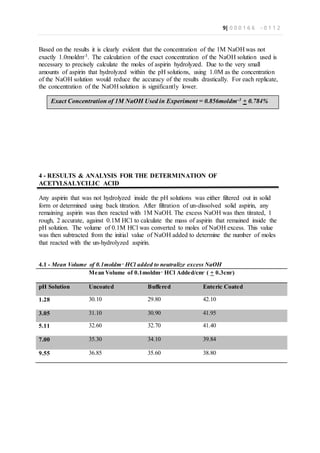
Based on the results it is clearly evident that the concentration of the 1M NaOH was not
exactly 1.0moldm-3. The calculation of the exact concentration of the NaOH solution used is
necessary to precisely calculate the moles of aspirin hydrolyzed. Due to the very small
amounts of aspirin that hydrolyzed within the pH solutions, using 1.0M as the concentration
of the NaOH solution would reduce the accuracy of the results drastically. For each replicate,
the concentration of the NaOH solution is significantly lower.
4 - RESULTS & ANALYSIS FOR THE DETERMINATION OF
ACETYLSALYCILIC ACID
Any aspirin that was not hydrolyzed inside the pH solutions was either filtered out in solid
form or determined using back titration. After filtration of un-dissolved solid aspirin, any
remaining aspirin was then reacted with 1M NaOH. The excess NaOH was then titrated, 1
rough, 2 accurate, against 0.1M HCl to calculate the mass of aspirin that remained inside the
pH solution. The volume of 0.1M HCl was converted to moles of NaOH excess. This value
was then subtracted from the initial value of NaOH added to determine the number of moles
that reacted with the un-hydrolyzed aspirin.
4.1 - Mean Volume of 0.1moldm-3
HCl added to neutralize excess NaOH
Mean Volume of 0.1moldm-3
HCl Added/cm3
( + 0.3cm3
)
pH Solution Uncoated Buffered Enteric Coated
1.28 30.10 29.80 42.10
3.05 31.10 30.90 41.95
5.11 32.60 32.70 41.40
7.00 35.30 34.10 39.84
9.55 36.85 35.60 38.80
Exact Concentration of 1M NaOH Used in Experiment = 0.856moldm-3 + 0.784%
10| 0 0 0 1 6 6 - 0 1 1 2
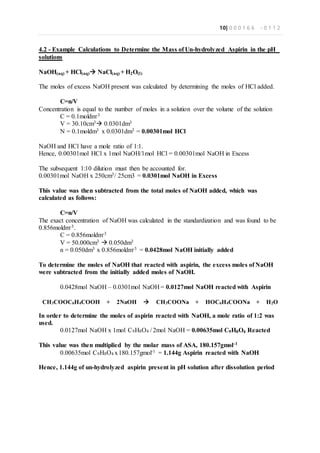
4.2 - Example Calculations to Determine the Mass of Un-hydrolyzed Aspirin in the pH
solutions
NaOH(aq) + HCl(aq) NaCl(aq) + H2O(l)
The moles of excess NaOH present was calculated by determining the moles of HCl added.
C=n/V
Concentration is equal to the number of moles in a solution over the volume of the solution
C = 0.1moldm-3
V = 30.10cm3 0.0301dm3
N = 0.1moldm3 x 0.0301dm3 = 0.00301mol HCl
NaOH and HCl have a mole ratio of 1:1.
Hence, 0.00301mol HCl x 1mol NaOH/1mol HCl = 0.00301mol NaOH in Excess
The subsequent 1:10 dilution must then be accounted for.
0.00301mol NaOH x 250cm3/ 25cm3 = 0.0301mol NaOH in Excess
This value was then subtracted from the total moles of NaOH added, which was
calculated as follows:
C=n/V
The exact concentration of NaOH was calculated in the standardization and was found to be
0.856moldm-3.
C = 0.856moldm-3
V = 50.000cm3  0.050dm3
n = 0.050dm3 x 0.856moldm-3 = 0.0428mol NaOH initially added
To determine the moles of NaOH that reacted with aspirin, the excess moles of NaOH
were subtracted from the initially added moles of NaOH.
0.0428mol NaOH – 0.0301mol NaOH = 0.0127mol NaOH reacted with Aspirin
CH3COOC6H4COOH + 2NaOH  CH3COONa + HOC6H4COONa + H2O
In order to determine the moles of aspirin reacted with NaOH, a mole ratio of 1:2 was
used.
0.0127mol NaOH x 1mol C9H8O4 / 2mol NaOH = 0.00635mol C9H8O4 Reacted
This value was then multiplied by the molar mass of ASA, 180.157gmol-1
0.00635mol C9H8O4 x180.157gmol-1 = 1.144g Aspirin reacted with NaOH
Hence, 1.144g of un-hydrolyzed aspirin present in pH solution after dissolution period
11| 0 0 0 1 6 6 - 0 1 1 2
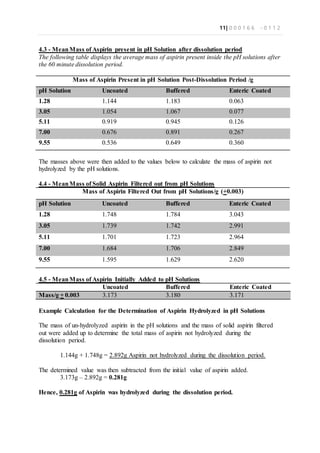
4.3 - MeanMass of Aspirin present in pH Solution after dissolution period
The following table displays the average mass of aspirin present inside the pH solutions after
the 60 minute dissolution period.
Mass of Aspirin Present in pH Solution Post-Dissolution Period /g
pH Solution Uncoated Buffered Enteric Coated
1.28 1.144 1.183 0.063
3.05 1.054 1.067 0.077
5.11 0.919 0.945 0.126
7.00 0.676 0.891 0.267
9.55 0.536 0.649 0.360
The masses above were then added to the values below to calculate the mass of aspirin not
hydrolyzed by the pH solutions.
4.4 - MeanMass of Solid Aspirin Filtered out from pH Solutions
Mass of Aspirin Filtered Out from pH Solutions/g (+0.003)
pH Solution Uncoated Buffered Enteric Coated
1.28 1.748 1.784 3.043
3.05 1.739 1.742 2.991
5.11 1.701 1.723 2.964
7.00 1.684 1.706 2.849
9.55 1.595 1.629 2.620
4.5 - MeanMass of Aspirin Initially Added to pH Solutions
Uncoated Buffered Enteric Coated
Mass/g + 0.003 3.173 3.180 3.171
Example Calculation for the Determination of Aspirin Hydrolyzed in pH Solutions
The mass of un-hydrolyzed aspirin in the pH solutions and the mass of solid aspirin filtered
out were added up to determine the total mass of aspirin not hydrolyzed during the
dissolution period.
1.144g + 1.748g = 2.892g Aspirin not hydrolyzed during the dissolution period.
The determined value was then subtracted from the initial value of aspirin added.
3.173g – 2.892g = 0.281g
Hence, 0.281g of Aspirin was hydrolyzed during the dissolution period.
12| 0 0 0 1 6 6 - 0 1 1 2
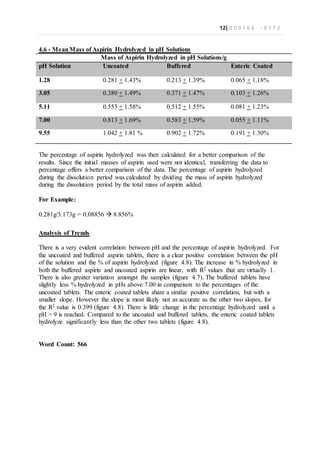
4.6 - MeanMass of Aspirin Hydrolyzed in pH Solutions
Mass of Aspirin Hydrolyzed in pH Solutions/g
pH Solution Uncoated Buffered Enteric Coated
1.28 0.281 + 1.43% 0.213 + 1.39% 0.065 + 1.18%
3.05 0.380 + 1.49% 0.371 + 1.47% 0.103 + 1.26%
5.11 0.553 + 1.58% 0.512 + 1.55% 0.081 + 1.23%
7.00 0.813 + 1.69% 0.583 + 1.59% 0.055 + 1.11%
9.55 1.042 + 1.81 % 0.902 + 1.72% 0.191 + 1.30%
The percentage of aspirin hydrolyzed was then calculated for a better comparison of the
results. Since the initial masses of aspirin used were not identical, transferring the data to
percentage offers a better comparison of the data. The percentage of aspirin hydrolyzed
during the dissolution period was calculated by dividing the mass of aspirin hydrolyzed
during the dissolution period by the total mass of aspirin added.
For Example:
0.281g/3.173g = 0.08856  8.856%
Analysis of Trends
There is a very evident correlation between pH and the percentage of aspirin hydrolyzed. For
the uncoated and buffered aspirin tablets, there is a clear positive correlation between the pH
of the solution and the % of aspirin hydrolyzed (figure 4.8). The increase in % hydrolyzed in
both the buffered aspirin and uncoated aspirin are linear, with R2 values that are virtually 1.
There is also greater variation amongst the samples (figure 4.7). The buffered tablets have
slightly less % hydrolyzed in pHs above 7.00 in comparison to the percentages of the
uncoated tablets. The enteric coated tablets share a similar positive correlation, but with a
smaller slope. However the slope is most likely not as accurate as the other two slopes, for
the R2 value is 0.399 (figure 4.8). There is little change in the percentage hydrolyzed until a
pH > 9 is reached. Compared to the uncoated and buffered tablets, the enteric coated tablets
hydrolyze significantly less than the other two tablets (figure 4.8).
Word Count: 566
13| 0 0 0 1 6 6 - 0 1 1 2
4.7 – MeanPercentage of Aspirin Hydrolyzed in pH Solutions10
10 Uncertainties were rounded to 1 significant figure.
Uncoated Aspirin Buffered Aspirin Enteric Coated Aspirin
pH Level %
Dissolution
%
Uncertainty
(+ %)
Standard
Deviation
%
Dissolution
%
Uncertainty
(+ %)1
Standard
Deviation
%
Dissolution
%
Uncertainty
(+ %)1
Standard
Deviation
1.28 8.856 1 0.385 6.698 1 0.392 2.049 1 0.229
3.05 11. 976 1 0.283 11.667 1 0.317 3.248 1 0.139
5.11 17.428 2 0.324 16.101 2 0.398 2.554 1 0.203
7.00 25.622 2 0.594 18.333 2 0.425 1.734 1 0.441
9.55 32.839 2 0.710 28.365 2 0.471 6.023 1 0.694
14| 0 0 0 1 6 6 - 0 1 1 2
Figure 4.811
11 Error bars represent standard deviation of the replicates.
15| 0 0 0 1 6 6 - 0 1 1 2
5 – DISCUSSION
The following section will interpret and suggest the reasons for the trends shown in figures
4.7 and 4.8. The trends shown for the hydrolysis of aspirin will be compared to theory and
examined one by one. Figure 4.7 shows the uncertainties and standard deviations of the
percentages, while figure 4.8 shows a more visual presentation of the trends.
I will begin with discussing the trends of the uncoated aspirin tablets. The uncoated aspirin
tablets had the highest overall percentage dissolved, at 32.839%. They also showed the
highest increase over the increasing pH levels, at 23.983%. This relatively high increase can
most likely be attributed to the fact that the uncoated tablets only contained a thin cellulose
coating to prevent disintegration in the mouth. This allows for easier swallowing, but offers
no real protection against the stomach and intestines. In the presence of water and a base,
aspirin breaks down into salicylic acid and acetic acid. Hence, as the amount of base
increases, so should the rate in which the ASA is broken down into salicylic acid and acetic
acid.12 The increase in aspirin neutralized shown in figure 4.8 was virtually linear, with an R2
value of 0.9843. This verifies the theory that aspirin becomes gradually neutralized as the
amount of base increases.
The buffered tablets show a very similar trend of dissolution. The buffered tablets also
showed high levels of percentage aspirin hydrolyzed at 28.365%. However the buffered
tablets showed slightly lower amounts of hydrolysis, specifically at the pH levels > 7. These
lower percentages are a deviation of theory. The presence of the buffer calcium carbonate
inside the buffered tablets should theoretically hinder pH change in solutions. As ASA is
hydrolyzed, salicylic acid is a product, causing the pH of the environment to become more
acidic. This is one of the reasons that aspirin has been known to cause irritation in the
stomach. The purpose of the buffer is to inhibit this lowering of pH, ideally stopping the
irritation from being a problem.13 The presence of a buffer also suggests that the pH of the
solution may be higher, resulting in more hydrolysis of the ASA. The values shown at pH
levels > 7 for the buffered tablets in table 4.8 show some deviation from theory. Theoretically,
the percentage of aspirin hydrolyzed for the buffered tablets should equal, or slightly higher
than the uncoated tablets. However, it is notable that the 500mg buffered tablets that were
used contained 140mg of calcium carbonate.14 This suggests that the lower percentage of
aspirin hydrolyzed was due to the lower initial mass of ASA present in each tablet. The
differences between the types of aspirin used are discussed later in the evaluation.
Both the uncoated and buffered tablets showed relatively high levels of ASA hydrolysis. Both
showed almost linear relationships between percentage hydrolyzed and pH. (R2 = 0.9843 and
R2 = 0.9696). The trends verified the theory that ASA hydrolyzes more readily as pH
increases due to the presence of more OH- ions.15 However some systematic problems were
made apparent by the trends of the buffered tablets, which showed a lower percentage of
aspirin hydrolyzed. This was attributed to the lower percent composition of ASA present in
the buffered tablets.
12
Green, John, International Baccalaureate Chemistry Third Edition, Quail Crescent, IBID Press, 2007, Print.
13
"Buffers." Chemistry 112. N.p., n.d. Web. 2 Oct. 2014.
14
"Bayer Aspirin Plus." Bayer Care. N.p., n.d. Web. 17 Sept. 2014. <http://labeling.bayercare.com/omr/online/bayer-aspirin-
plus.pdf>.
15 "Kinetics of Hydrolysis of Acetylsalicylicacid, Aspirin." ASELL. N.p., 14 Apr. 2006. Web. 7 Oct. 2014.
<http://www.asell.org/chemistry/experiments/experiments-database/kinetics-of-hydrolysis-of-acetylsalicylic-
acid--aspirin#top>.
16| 0 0 0 1 6 6 - 0 1 1 2
The enteric coated tablets presented fairly different trends. Figure 4.8 shows how there was
significantly less aspirin hydrolyzed from the enteric coated tablets. In pH levels between 1
and 7, the level of aspirin hydrolysis was virtually similar. Little change is observed in these
trends until a pH level of ~9 is reached. This supports the theory that enteric coatings are
stable in lower pH levels, while breaking down when basic conditions are reached. The main
enteric coating of the tablet used was methacrylic acid copolymer c, a product of Eudragit®.
They state that the dissolution point of this copolymer is a level > than 5.5.16 Figure 4.8
shows that the increase in aspirin hydrolysis occurred some point between the pH of 7 and 9,
when basic conditions are released. This verifies the theory that enteric coated tablets’
dissolutions occur at the basic conditions found in the small intestines. The regression line
shown on figure 4.8 was not used to measure amount of aspirin hydrolyzed. This was because
there were most likely two trends present: a constant trend from pH levels 1-7, and a positive
linear trend from pH levels above 7. The overall lower percentages of hydrolysis shown can
most likely be attributed to the fact that the tablet used was delayed action, meaning that
dissolution within hours of ingestion.17 The tablets were only in the solutions for a period of
60 minutes, which most likely attributes the lower percentages shown.
Trends for all of the tablets showed that there was a general trend of increase in standard
deviation as the pH levels increased. This can most likely be attributed to the higher levels of
aspirin hydrolyzed as pH levels increase. The higher masses of hydrolyzed aspirin resulted in
more variance amongst trials. Although there were no significant outliers among the data
points, some anomalies were present that did not agree to theory. I attributed these to specific
difference amongst the tablets used.
Word Count: 868
6 – EVALUATION OF INVESTIGATION
6.1 – Random Error
The measurements of the quantities used contain random errors from the instruments used.
The uncertainties of the glassware and the balance used may have been the cause of some of
the variance shown in the trials. Also, the given solution of 0.1M HCl was never standardized
for its exact concentration. This could have caused inaccuracies in the titration data sets, and
ultimately the entire processed data.
6.2 – Systematic Error
There were some systematic errors apparent in my procedure. The primary issue was that I
assumed that 1 night (`16 hours) was enough time for the solid aspirin filtered out to dry
completely. Any presence of water inside the solid aspirin filtered out, ideally, should have
dissolved within that time. However, in the case that there would be water remaining in the
16
"EUDRAGIT® L100-55." - EUDRAGIT®. N.p., n.d. Web. 2 Oct. 2014.
<http://eudragit.evonik.com/product/eudragit/en/products-services/eudragit-products/enteric-formulations/l-100-
55/pages/default.aspx>.
17
"Bayer Low-Dose81mg." Bayer Care. N.p., n.d. Web. 17 Sept. 2014. <http://labeling.bayercare.com/omr//aspirin-
regimen-bayer-low-dose-81-mg.pdf >.
17| 0 0 0 1 6 6 - 0 1 1 2
solid aspirin, the data would become skewed. Since my method greatly depends on the mass
of solid aspirin remaining, the presence of water inside the filtered aspirin may have resulted
in the skewing of my data. Also, I allowed for my tablets to dissolve in the pH solutions for
60 minutes. This time may not have been sufficient for the delayed release enteric coating
tablets. The result was significantly lower percentage hydrolysis for all pH levels for all 3
replicates. Also, the tablets I used in my experiment resulted in some theoretical anomalies
shown in the trends. (figure 4.7 and 4.8). Each tablet was slightly different in aspirin
composition, with the buffered tablet having a significant amount of calcium inside it. Since
the percentage mass of the aspirin tablets used was not initially calculated, the data produced
from the tablets used is subject to, possibly severe, systematic error.
6.3 – Evaluation of Sources
The main sources I used were my textbook, and discussions with my teacher. Some theory
points about types of coatings and buffers were brought in from websites. My procedure was
developed by using a class handout practical lab, along with teacher help to modify the lab to
suit my research question. I tried to use websites with proper citations and credibility.
However, since this was not always possible, some sources’ reliability may be questionable.
6.4 – Future Improvements
The experiment could have been altered to reduce confounding variables and increase the
accuracy of the trends shown. I would calculate the percent composition of ASA for each
tablet so that I can accurately calculate and evaluate my results. Also, the time of dissolution
would be extended to 120 minutes, for it would allow for the aspirin to hydrolyze more
readily. The stainless steel infusers may not have been necessary, for solid aspirin was still in
the solution after their removal. Simply filtering the solutions would save time and result in
less uncertainties. Also, I would add 1 more pH level. This way the trend for the enteric
coated tablets would be more visible. A pH level of 12~13 would be added to the trials to
give a more complete pH range.
7 – CONCLUSION
My investigation was based off the question “How do different pill coatings affect the
dissolution of acetylsalicylic acid (Aspirin) in various intestinal pHs?” The results showed
that uncoated and buffered tablets have virtually the same effect on the dissolution of ASA.
Their trends verified the theory that ASA hydrolyzes more readily in higher pH levels. The
enteric coated tablets showed that enteric coatings effectively inhibit aspirin dissolution until
a pH of ~9 is reached. From my results, I was able to derive that uncoated and buffered
tablets show no real effect on changing the dissolution of ASA, while enteric coated tablets
effectively inhibit the dissolution of ASA at pH levels below ~9.
Word Count: 1,481
18| 0 0 0 1 6 6 - 0 1 1 2
BIBLIOGRAPHY
"Aspirin: MedlinePlus Drug Information." U.S National Library of Medicine. U.S. National
Library of Medicine, n.d. Web. 16 Sept. 2014.
<http://www.nlm.nih.gov/medlineplus/druginfo/meds/a682878.html>.
"Bayer Aspirin Plus." Bayer Care. N.p., n.d. Web. 17 Sept. 2014.
<http://labeling.bayercare.com/omr/online/bayer-aspirin-plus.pdf>.
"Bayer Low-Dose 81mg." Bayer Care. N.p., n.d. Web. 17 Sept. 2014.
<http://labeling.bayercare.com/omr//aspirin-regimen-bayer-low-dose-81-mg.pdf >.
"Buffers." Chemistry 112. N.p., n.d. Web. 2 Oct. 2014.
<http://bilbo.chm.uri.edu/CHM112/lectures/lecture22.htm>.
"EUDRAGIT® L 100-55." - EUDRAGIT®. N.p., n.d. Web. 2 Oct. 2014.
<http://eudragit.evonik.com/product/eudragit/en/products-services/eudragit-
products/enteric-formulations/l-100-55/pages/default.aspx>.
"Enteric." Dictionary.com. Dictionary.com, n.d. Web. 28 Aug. 2014.
<http://dictionary.reference.com/browse/non+enteric>.
Green, John, International Baccalaureate Chemistry Third Edition, Quail Crescent, IBID
Press, 2007, Print.
"Is Enteric-Coated Aspirin Safer?." @berkeleywellness. N.p., 18 Apr. 2013. Web. 2 Oct.
2014. <http://www.berkeleywellness.com/self-care/over-counter-
products/article/enteric-coated-aspirin-safer>.
"Kinetics of Hydrolysis of Acetylsalicylic acid, Aspirin." ASELL. N.p., 14 Apr. 2006. Web. 7
Oct. 2014. <http://www.asell.org/chemistry/experiments/experiments-
database/kinetics-of-hydrolysis-of-acetylsalicylic-acid--aspirin#top>.
"New Releases." Gastrointestinal bleeding from coated aspirin. N.p., n.d. Web. 16 Sept.
2014. <http://www.health.harvard.edu/press_releases/gastrointestinal-bleeding-from-
coated-aspirin>.
“The Analysis of Aspirin Tablet”, Class Handout, Dr. Janie S. Brooks, Ph.D
19| 0 0 0 1 6 6 - 0 1 1 2
APPENDIX
1.1 – Materials
Part A – Preparation of pH Solutions:
1.0L Volumetric Flask
1.0L Conical Flask
Vernier™ pH Probe
Magnetic stirring bead
Hot plate with magnetic stirrer
Funnel
260.0g solid NaCl
Weighing boat
50.0mL 1.0M NaOH
50.0mL 0.1M HCl
Teat Pipettes (x5)
Electric Scale (0.001g specific)
Watch glass
Heat proof mat
Heat resistant gloves
Part B – Standardization of 1M NaOH:
50.0mL Standard Burette
25.0mL Volumetric Pipette
250.0mL Volumetric Flask
Funnel
100.0mL Conical Flask
5.0mL Phenolphthalein Indicator
Teat Pipette
Distilled Water
Burette Stand
White paper
1.0M NaOH
0.1M HCl
Part C – Preparation of Aspirin Solutions
250.0mL Standard Beaker (x10)
100.0mL Volumetric Flask
Water bath @ 37 degrees Celsius
Electric Scale (0.001g specific)
Stainless steel infuser
Glass stirring rod (x5)
Stopwatch
Filter paper
Alcohol Thermometer
Metal Spatula
pH solutions
Aspirin (ASA) (Bayer Back and
Body, Bayer Plus, Bayer Safety
Coated)
Weighing boat
Part D – Determination of ASA
50.0mL Volumetric Pipette
25.0mL Volumetric Pipette
50.0mL Standard Burette
Teat Pipette
100.0mL Conical flask
Funnel
5.0mL Phenolphthalein Indicator
White Paper
Burette Stand
1.0M NaOH
0.1M HCl
20| 0 0 0 1 6 6 - 0 1 1 2
1.2 -Full Procedures18
Part A – Preparation of pH Solutions
1. Fill the 1.0L conical flask with
approximately 400ml-500mL of
distilled water.
2. Measure exactly 58.45g of solid
NaCl and add to 1.0L conical flask.
3. Heat the 1.0L conical flask and stir
the solution until the NaCl is
completely dissolved.
4. Allow the flask to cool, then
transfer the NaCl solution to the
1.0L volumetric pipette.
5. Carry out 3 distilled water rinses of
the conical flask, transferring any
remains into the volumetric flask.
Fill the 1.0L volumetric flask to the
mark with distilled water.
6. Transfer the solution of NaCl back
to the conical flask.
7. Calibrate the pH sensor probe, then
insert into the solution.
8. Slowly add 1M NaOH or 0.1M HCl
drop by drop until desired pH is
used. (Match pH levels close to 1, 3,
5, 7, and 10).
Part B – Standardization of 1M NaOH
1. Pipette exactly 25.0mL of 1M
NaOH into a 250.0mL volumetric
flask.
2. Fill up to the mark with distilled
water.
3. Transfer the 250.0mL solution to a
conical flask.
4. Using a 25.0mL volumetric pipette,
transfer exactly 25.0mL of the
solution to a 100.0mL conical flask.
5. Add 3-4 drops of phenolphthalein
indicator.
6. Set up the 50.0mL burette, complete
a distilled water rinse and an acid
rinse. Fill up to the 0.0mL mark
with 0.1M HCl.
18
“The Analysis of Aspirin Tablet”, Class Handout,
Dr. Janie S. Brooks, Ph.D
7. Titrate the 25.0mL aliquot against
the 0.1M HCl.
8. Carry out 1 rough and 2 accurate
A. titrations.
Part C – Preparation of Aspirin Solutions
1. Distribute 200.0mL of each pH
solution to a separate 250.0mL
beaker using a volumetric flask.
2. Place the solution filled beakers into
the water bath and heat them to ~37
degrees Celsius.
3. Using the electric scale, weigh out
approximately 3.15g x 5 of 1 type
of aspirin tablet. *DO NOT
CRUSH THE TABLETS*
4. Place the tablets inside the stainless
steel infusers and hang them into
the pH solutions. (see image on
page 22)
5. Let the aspirin rest in the solutions
for 60 minutes, stirring the solutions
every 10 minutes.
6. Remove the infusers and hang them
to dry. Filter the remaining aspirin
solutions into 5 separate 250.0mL
beakers. Leave the filtered remains
and the infusers to dry overnight.
(see image of page 22)
7. Measure the dry mass of the solid
aspirin from the filter paper and the
infuser and record.
8. Repeat steps 1-7 for the remaining
two types of aspirin tablets.
Part C – Determination of ASA
1. Pipette exactly 50.0mL of 1M
sodium hydroxide into a selected
pH level solution.
2. Transfer the solution carefully to a
250.0mL volumetric flask and fill
up to the mark with distilled water.
3. Take a 25.0mL aliquot of the
solution using a 25.0mL volumetric
pipette. Transfer it to a 100.0mL
conical flask.
4. Add 3-4 drops of phenolphthalein
21| 0 0 0 1 6 6 - 0 1 1 2
indicator.
5. Set up the 50.0ml burette and carry
out a distilled water rinse and an
acid rinse.
6. Titrate the 25.0mL aliquot of the
aspirin solution against 0.1M HCl.
Carry out 1 rough and 2 accurate
titrations.
7. Repeat steps 1-7 for each of the pH
levels.
22| 0 0 0 1 6 6 - 0 1 1 2
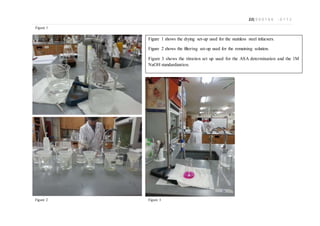
Figure 1
Figure 1 shows the drying set-up used for the stainless steel infuesers.
Figure 2 shows the filtering set-up used for the remaining solution.
Figure 3 shows the titration set up used for the ASA determination and the 1M
NaOH standardization.
Figure 2 Figure 3
23| 0 0 0 1 6 6 - 0 1 1 2
1.3 – Example Data Collection Sheet & Raw Data
Titration of ASA
Rough Accurate #1 Accurate #2
Initial Burette
Reading/cm3 +0.05
Final Burette
Reading/ cm3 +0.05
Volume of 0.1M
HCl Added/ cm3
+0.1
Mean Titre/ cm3 +0.1
Mass of Aspirin Added
pH of Solution Initial Mass/g +0.001 Final Mass g +0.001
1.28
3.05
5.11
7.00
9.55
24| 0 0 0 1 6 6 - 0 1 1 2
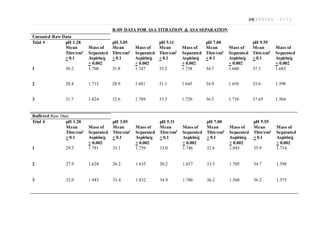
Uncoated Raw Data
Trial # pH 1.28 pH 3.05 pH 5.11 pH 7.00 pH 9.55
Mean
Titre/cm3
+ 0.1
Mass of
Separated
Aspirin/g
+ 0.002
Mean
Titre/cm3
+ 0.1
Mass of
Separated
Aspirin/g
+ 0.002
Mean
Titre/cm3
+ 0.1
Mass of
Separated
Aspirin/g
+ 0.002
Mean
Titre/cm3
+ 0.1
Mass of
Separated
Aspirin/g
+ 0.002
Mean
Titre/cm3
+ 0.1
Mass of
Separated
Aspirin/g
+ 0.002
1 30.2 1.708 31.8 1.747 33.2 1.738 34.7 1.660 37.3 1.683
2 28.4 1.712 28.9 1.681 31.1 1.645 34.9 1.656 35.6 1.598
3 31.7 1.824 32.6 1.789 33.5 1.720 36.3 1.736 37.65 1.504
Buffered Raw Data
Trial # pH 1.28 pH 3.05 pH 5.11 pH 7.00 pH 9.55
Mean
Titre/cm3
+ 0.1
Mass of
Separated
Aspirin/g
+ 0.002
Mean
Titre/cm3
+ 0.1
Mass of
Separated
Aspirin/g
+ 0.002
Mean
Titre/cm3
+ 0.1
Mass of
Separated
Aspirin/g
+ 0.002
Mean
Titre/cm3
+ 0.1
Mass of
Separated
Aspirin/g
+ 0.002
Mean
Titre/cm3
+ 0.1
Mass of
Separated
Aspirin/g
+ 0.002
1 29.5 1.781 33.1 1.759 33.0 1.746 32.6 1.845 35.9 1.714
2 27.9 1.628 26.2 1.635 30.2 1.637 33.5 1.705 34.7 1.598
3 32.0 1.943 33.4 1.832 34.9 1.786 36.2 1.568 36.2 1.575
RAW DATA FOR ASA TITRATION & ASA SEPARATION
25| 0 0 0 1 6 6 - 0 1 1 2
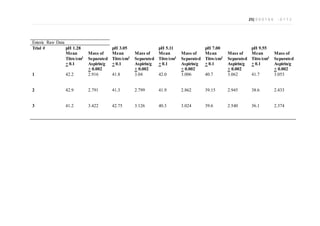
Enteric Raw Data
Trial # pH 1.28 pH 3.05 pH 5.11 pH 7.00 pH 9.55
Mean
Titre/cm3
+ 0.1
Mass of
Separated
Aspirin/g
+ 0.002
Mean
Titre/cm3
+ 0.1
Mass of
Separated
Aspirin/g
+ 0.002
Mean
Titre/cm3
+ 0.1
Mass of
Separated
Aspirin/g
+ 0.002
Mean
Titre/cm3
+ 0.1
Mass of
Separated
Aspirin/g
+ 0.002
Mean
Titre/cm3
+ 0.1
Mass of
Separated
Aspirin/g
+ 0.002
1 42.2 2.916 41.8 3.04 42.0 3.006 40.7 3.062 41.7 3.053
2 42.9 2.791 41.3 2.799 41.9 2.862 39.15 2.945 38.6 2.433
3 41.2 3.422 42.75 3.126 40.3 3.024 39.6 2.540 36.1 2.374

Extended Essay Chemistry HL

  • 1.
    1| 0 00 1 6 6 - 0 1 1 2 Extended Essay: Chemistry The effect of different tablet coatings on the dissolution of aspirin tablets in various intestinal pH levels. Brian Oh Candidate Number: 000166-0112 Seoul Foreign School, South Korea Word Count: 3335 May 2015 Exam Session
  • 2.
    2| 0 00 1 6 6 - 0 1 1 2 CONTENTS TITLE Abstract 1.1 - Introduction 1.2 – Research Question 1.3 – Context for Investigation 1.4 – Chemical Mechanism 2.1 – Preparation of pH Solutions 2.2 – Standardization of 1M NaOH 2.3 – Preparation of Aspirin Solutions 2.4 Determination of Acetylsalicylic Acid 3.1-2 – Results & Analysis for the Standardization of 1M NaOH 4.1-8 –Results & Analysis for the Determination of ASA 5– Discussion 6.1 – Random Error 6.2 – Systematic Error 6.3 – Source Evaluation 6.4 – Future Improvements 7 – Conclusion 8 - Bibliography Appendix 1.1 - Materials 1.2 – Procedures 1.3 – Sample Data Collection Sheet & Raw Data 3 4 4 4 5 6 6 6 6 8 9 15 16 16 17 17 17 18 19 20 23
  • 3.
    3| 0 00 1 6 6 - 0 1 1 2 ABSTRACT My investigation was focused on the research question “How do different pill coatings affect the dissolution of acetylsalicylic acid (Aspirin) in various intestinal pH levels?” Acetylsalicylic acid (ASA), otherwise known as aspirin, is a very common analgesic painkiller. My investigation studied how aspirin tablets with different types of coatings responded to certain intestinal pH levels. Those pH levels were set at 1.28, 3.05, 5.11, 7.00, and 9.55 to replicate the increase of pH from the stomach to the small intestine. Specific masses of each type of aspirin tablet were then dissolved in the pH solutions for 1 hour. The sold aspirin that remained in the solution was then separated, and any un-hydrolyzed aspirin was then titrated against hydrochloric acid. The sum of the masses of the un-hydrolyzed aspirin and the separated aspirin were then subtracted from the initial mass added to calculate the mass of aspirin hydrolyzed by the pH solutions. The determined masses were then converted into percentage values. The pH vs. % hydrolyzed graph showed that there were no significant differences in the percentage hydrolyzed of the uncoated and buffered aspirin tablets. Enteric coated tablets had significantly lower percentages, between 2.049% and 6.023%, where both uncoated and buffered tablets had percentages between ~6.698% and ~32.839%. The low amount of enteric coated aspirin hydrolysis was attributed to the ability of the enteric coatings, shellac, methacrylic acid copolymer C, and hydroxypropyl methylcellulose, to withstand breaking down in the lower pH levels and break down in higher ones. The enteric coated tablets proved effective in preventing dissolution in pH levels under ~9. The uncoated and buffered tablets proved to show no real effect on the dissolution rate of the aspirin. The enteric coated tablets offered protection through pH levels of 1~7, while disintegrating at a pH of around 9. Word Count: 289
  • 4.
    4| 0 00 1 6 6 - 0 1 1 2 1.1 - INTRODUCTION Aspirin (acetylsalicylic acid) is a very common over-the-counter drug that can be used to treat pain and reduce fever. It is also commonly used as a preventive measure for heart attacks, as it can act as a blood thinner.1 Growing up, I never had a shortage of aspirin in my household. Having a father with high blood pressure and a mother with arthritis meant that medicinal tablets were abundant in my household. Initially, I was planning on focusing my investigation on the neutralization capacities of antacids, for both my mother and I are frequent victims of heartburn. However, after reflecting on the amount of tablets I have ingested in my lifetime, I switched the focus of my investigation. As my knowledge of the human gastrointestinal tract increased I began to realize that tablets must be more complex than just a compressed pill of chemicals. Tablets must have the capability to withstand salivary enzymes, and in some cases corrosive hydrochloric acid in the stomach. This capability may be to protect the stomach from acidity that results from the dissolution of a medicine with acidic qualities, or it delay the dissolution of the medicine so that it occurs inside the small intestine. Enteric coated tablets, derived from the Greek word enteron, which means intestines, protect tablets from the corrosive acid found in the stomach.2 My experiment focuses on the effect of tablet coatings on the dissolution of uncoated, buffered, and enteric coated aspirin. 1.2 - RESEARCH QUESTION How do different pill coatings affect the dissolution of acetylsalicylic acid (Aspirin) in various intestinal pHs? 1.3 - CONTEXT FOR INVESTIGATION 1. Aspirin is an NSAID, or non-steroidal anti-inflammatory drug. It directly inhibits COX-1 and COX-2(Cyclooxygenase), enzymes that produce substances such as prostaglandins that promote the sensation of pain.3 Unfortunately COX-1 and COX-2 are responsible for creating substances that aid the mucus lining of the stomach. Daily usage of aspirin has been known to result in stomach ulcers as the result of the absence of the mucus layer. In addition to this, Aspirin has also been known to cause upset stomach and discomfort. Aspirin is a weak acid, lowering the pH of the stomach as it dissolves. Enteric coated, or safety coated aspirin, allows for the aspirin tablet to safely pass through the stomach and into the small intestine where dissolution takes place. Where there may be studies that show that enteric coatings do not affect the COX-1 inhibition, enteric coatings still prevent aspirin from dissolving inside the stomach.4 Enteric coatings on aspirin are often found low dosage tablets that are taken daily. Buffers are also inserted into some aspirin tablets to help reduce the change in pH inside the stomach. This prevents any discomfort from the lowering of stomach pH. 1 Aspirin:MedlinePlus Drug Information." U.S National Libraryof Medicine. U.S. National Library of Medicine, n.d. Web. 16 Sept. 2014. <http://www.nlm.nih.gov/medlineplus/druginfo/meds/a682878.html>. 2 "Enteric." Dictionary.com. Dictionary.com, n.d. Web. 28 Aug. 2014. <http://dictionary.reference.com/browse/non+enteric>. 3 "New Releases." Gastrointestinal bleeding from coated aspirin. N.p., n.d. Web. 16 Sept. 2014. <http://www.health.harvard.edu/press_releases/gastrointestinal-bleeding-from-coated-aspirin>.
  • 5.
    5| 0 00 1 6 6 - 0 1 1 2 Enteric Coating Mechanism This type of coating is made up of polymers that are stable in lower pHs. These polymers usually break down at higher pHs. The aspirin used in my investigation contained enteric coating composed of shellac, methacrylic acid copolymer C, and hydroxypropyl methylcellulose.4 Buffering Mechanism In the aspirin I chose to use, Calcium Carbonate was used as a buffer to reduce the acidity of the stomach. This is present in order to prevent any irritation that occurs from the acidity of the stomach and the acidity of the acetylsalicylic acid.5 2. To calculate the mass of aspirin dissolved, a back titration will be used. Back titration allows us to calculate an unknown amount of a compound using a known volume and concentration.6 Back titration works by adding a known volume of a solution with a known concentration. After that solution reacts with the unknown, the excess is then titrated against a known solution. In my investigation, back titration will, along with a calculation of a change in mass will be used to calculate the amount of aspirin that is not hydrolyzed by the pH solution. An amount of aspirin will be hydrolyzed by the pH solution. Any remaining aspirin that is not hydrolyzed will be either filtered out and weighed or calculated by using back titration. This value subtracted from the known added value of the aspirin will give the amount of aspirin hydrolyzed by the pH solution. 1.4 - CHEMICAL MECHANISM In the presence of water, acetylsalicylic acid (ASA) is hydrolyzed into salicylic acid and acetic acid. The figure above shows the hydrolysis of acetylsalicylic acid into salicylic acid and acetic acid. (Flatworldknowledge.com) The process shown usually occurs more often as pH increases, as the acid is neutralized by NaOH or other strong bases.6 4 "Bayer Low-Dose81mg." Bayer Care. N.p., n.d. Web. 17 Sept. 2014. <http://labeling.bayercare.com/omr//aspirin- regimen-bayer-low-dose-81-mg.pdf >. 5 "Bayer Aspirin Plus." Bayer Care. N.p., n.d. Web. 17 Sept. 2014. <http://labeling.bayercare.com/omr/online/bayer-aspirin- plus.pdf>. 6 Green, John, International Baccalaureate Chemistry Third Edition, Quail Crescent, IBID Press, 2007, Print.
  • 6.
    6| 0 00 1 6 6 - 0 1 1 2 NaOH reacts with HCl in a neutralization reaction. This mechanism occurs in the back titration of excess NaOH. 2 - METHODS 2.1 - Preparation of various pH solutions In order to create solutions that replicate the pH levels of various locations of the alimentary canal, 5.00 liters of 1.0moldm-3 Sodium chloride solution was prepared by measuring 58.44g of NaCl and dissolving it in 1 liter of distilled water. 5.00 liters of this solution were prepared in 5 standard 1000.00 cm3 flasks. Solutions of NaOH and HCl with a given concentration of 1.0moldm-3 were used to prepare the different pH solutions. 1.0moldm-3 HCl was added drop by drop using a 10.00 cm3 volumetric pipette to produce pH solutions of 1, 3 and 5. NaOH was added in the same manner to produce pH solutions of 7 and 9. A Vernier pH probe was used to measure the pH to the nearest 0.01.7 2.2 – Standardization of 1M NaOH Solution8 Exactly 25.0cm3 of 1.0moldm-3 Sodium hydroxide solution was pipetted into a 250.0cm3 volumetric flask.9 The flask was then filled up to the mark with distilled water. A 25.0cm3 aliquot of this solution was then titrated against a hydrochloric acid solution with a given concentration of 0.1moldm-3 using 3-4 drops of phenolphthalein indicator. The volume of the hydrochloric acid added was recorded. 2.3 - Preparation of Aspirin solutions 200.00cm3 of each pH solution was carefully transferred into five 250.00cm3 beakers. These beakers were then placed in a water bath and warmed to approximately 37 degrees celsius. 3.18g of the designated aspirin type was then placed inside a stainless steel infuser, which was placed in each of the beakers. The tablets were then left to dissolve for 1 hour, being stirred in 10 minute intervals. During this period, filter papers were weighed and their masses noted. The infusers were removed and dried. Solutions were then filtered into 5 different 250.00cm3 beakers. The filter papers that contained the solid aspirin were then left to dry overnight. The aspirin filtered out was then weighed to determine the mass of aspirin that was not dissolved by the pH solution. 2.4 - Determination of Acetylsalicylic acid 50.00cm3 of 1.00moldm-3 (~0.856moldm-3 ) Sodium hydroxide solution was added to each solution in the 250.00cm3 beakers. The solution in the beaker was then transferred into a 250.00cm3 volumetric flask and was then filled to the mark with distilled water. This was 7 Method for creating pH Solutions created in correspondence with Janie. S. Brooks, Ph.D. 8 Full method derived from “The analysis of aspirin tablets”,Class Handout.Modified in correspondence with Dr. Janie S. Brooks, Ph.D. 9 The same stock of 1M NaOH was used for all three replicates of the experiment.
  • 7.
    7| 0 00 1 6 6 - 0 1 1 2 done for all for all of the pH solutions. 25.00cm3 aliquots were then titrated using 3- 4 drops of phenolphthalein as an indicator. Phenolphthalein is colorless in acidic solutions and purple in basic solutions. At a pH of around 7.00, a color change from purple to colorless occurs. When all excess NaOH is reacted, the solution will change from purple to colorless. One rough and two accurate titrations were carried out against 0.10moldm-3 HCl. The volume of 0.10moldm-3 HCl added is recorded. This value was then used to calculate the mass of aspirin in the pH solution that was not hydrolyzed. This mass added with the mass of the aspirin from the infuser and the filter paper to calculate the total mass of aspirin not hydrolyzed by the pH solution. This value subtracted from the initial mass of aspirin to determine the exact value of aspirin hydrolyzed by each pH solution. Word Count: 1288
  • 8.
    8| 0 00 1 6 6 - 0 1 1 2 3.1 - RESULTS FOR THE STANDARDIZATION OF 1M NaOH Data Collection for the Standardization of 1M NaOH The following table shows the volumes of 0.1M HCl used to neutralize the 1M NaOH. Rough Accurate #1 Accurate #2 Initial Reading (+ 0.05 cm3) 0.00 22.50 18.00 Final Reading (+ 0.05 cm3) 22.50 43.90 39.40 Volume of 0.1M HCl Added (+ 0.1 cm3) 22.50 21.40 21.40 Observations Started clear and colorless. Turned clear dark pink at end point Started clear and colorless. Turned clear dark pink at end point Started clear and colorless. Turned clear dark pink at end point Final Titre (+ 0.1 cm3) 21.40 3.2 - ANALYSIS OF RESULTS Example Calculations for the Standardization of 1M NaOH In order to be able to determine the exact amount of acetylsalicylic acid dissolved, the exact concentration of the 1M NaOH was calculated. 1M NaOH was titrated against 0.1M HCl. The volume of 0.1M HCl added was then used to calculate the moles of 1M NaOH present in the titrated aliquot. C=n/V Concentration is equal to the number of moles in a solution over the volume of the solution. C = 0.100moldm-3 HCl V = 21.400cm3 HCl → 0.0214dm3 ionHCl n = 0.100moldm-3 HCl 0.0214dm3 HCl → 0.00214mol HCl n = 2.14 x 10⁻³ mol HCl reacted with 25.00cm3 NaOH solution. HCl(aq) + NaOH(aq) → NaCl(aq) + H2O(l) Hydrochloric acid and Sodium hydroxide have a 1:1 molar ratio. Therefore 2.14 x 10⁻³ mol of NaOH was present in the 25.00cm3 aliquot of NaOH solution. A dilution of 1 to 10 was carried out initially. Therefore: 2.14 x 10⁻³ mol 250.00cm/25.00cm → 2.14 x 10⁻² mol NaOH in 25.00cm3 1M NaOH. 2.14 x 10⁻² mol NaOH/0.025dm-3 = 0.856moldm-3 in 1liter of 1M NaOH Concentration of 1M NaOH = 0.856moldm-
  • 9.
    9| 0 00 1 6 6 - 0 1 1 2 Based on the results it is clearly evident that the concentration of the 1M NaOH was not exactly 1.0moldm-3. The calculation of the exact concentration of the NaOH solution used is necessary to precisely calculate the moles of aspirin hydrolyzed. Due to the very small amounts of aspirin that hydrolyzed within the pH solutions, using 1.0M as the concentration of the NaOH solution would reduce the accuracy of the results drastically. For each replicate, the concentration of the NaOH solution is significantly lower. 4 - RESULTS & ANALYSIS FOR THE DETERMINATION OF ACETYLSALYCILIC ACID Any aspirin that was not hydrolyzed inside the pH solutions was either filtered out in solid form or determined using back titration. After filtration of un-dissolved solid aspirin, any remaining aspirin was then reacted with 1M NaOH. The excess NaOH was then titrated, 1 rough, 2 accurate, against 0.1M HCl to calculate the mass of aspirin that remained inside the pH solution. The volume of 0.1M HCl was converted to moles of NaOH excess. This value was then subtracted from the initial value of NaOH added to determine the number of moles that reacted with the un-hydrolyzed aspirin. 4.1 - Mean Volume of 0.1moldm-3 HCl added to neutralize excess NaOH Mean Volume of 0.1moldm-3 HCl Added/cm3 ( + 0.3cm3 ) pH Solution Uncoated Buffered Enteric Coated 1.28 30.10 29.80 42.10 3.05 31.10 30.90 41.95 5.11 32.60 32.70 41.40 7.00 35.30 34.10 39.84 9.55 36.85 35.60 38.80 Exact Concentration of 1M NaOH Used in Experiment = 0.856moldm-3 + 0.784%
  • 10.
    10| 0 00 1 6 6 - 0 1 1 2 4.2 - Example Calculations to Determine the Mass of Un-hydrolyzed Aspirin in the pH solutions NaOH(aq) + HCl(aq) NaCl(aq) + H2O(l) The moles of excess NaOH present was calculated by determining the moles of HCl added. C=n/V Concentration is equal to the number of moles in a solution over the volume of the solution C = 0.1moldm-3 V = 30.10cm3 0.0301dm3 N = 0.1moldm3 x 0.0301dm3 = 0.00301mol HCl NaOH and HCl have a mole ratio of 1:1. Hence, 0.00301mol HCl x 1mol NaOH/1mol HCl = 0.00301mol NaOH in Excess The subsequent 1:10 dilution must then be accounted for. 0.00301mol NaOH x 250cm3/ 25cm3 = 0.0301mol NaOH in Excess This value was then subtracted from the total moles of NaOH added, which was calculated as follows: C=n/V The exact concentration of NaOH was calculated in the standardization and was found to be 0.856moldm-3. C = 0.856moldm-3 V = 50.000cm3  0.050dm3 n = 0.050dm3 x 0.856moldm-3 = 0.0428mol NaOH initially added To determine the moles of NaOH that reacted with aspirin, the excess moles of NaOH were subtracted from the initially added moles of NaOH. 0.0428mol NaOH – 0.0301mol NaOH = 0.0127mol NaOH reacted with Aspirin CH3COOC6H4COOH + 2NaOH  CH3COONa + HOC6H4COONa + H2O In order to determine the moles of aspirin reacted with NaOH, a mole ratio of 1:2 was used. 0.0127mol NaOH x 1mol C9H8O4 / 2mol NaOH = 0.00635mol C9H8O4 Reacted This value was then multiplied by the molar mass of ASA, 180.157gmol-1 0.00635mol C9H8O4 x180.157gmol-1 = 1.144g Aspirin reacted with NaOH Hence, 1.144g of un-hydrolyzed aspirin present in pH solution after dissolution period
  • 11.
    11| 0 00 1 6 6 - 0 1 1 2 4.3 - MeanMass of Aspirin present in pH Solution after dissolution period The following table displays the average mass of aspirin present inside the pH solutions after the 60 minute dissolution period. Mass of Aspirin Present in pH Solution Post-Dissolution Period /g pH Solution Uncoated Buffered Enteric Coated 1.28 1.144 1.183 0.063 3.05 1.054 1.067 0.077 5.11 0.919 0.945 0.126 7.00 0.676 0.891 0.267 9.55 0.536 0.649 0.360 The masses above were then added to the values below to calculate the mass of aspirin not hydrolyzed by the pH solutions. 4.4 - MeanMass of Solid Aspirin Filtered out from pH Solutions Mass of Aspirin Filtered Out from pH Solutions/g (+0.003) pH Solution Uncoated Buffered Enteric Coated 1.28 1.748 1.784 3.043 3.05 1.739 1.742 2.991 5.11 1.701 1.723 2.964 7.00 1.684 1.706 2.849 9.55 1.595 1.629 2.620 4.5 - MeanMass of Aspirin Initially Added to pH Solutions Uncoated Buffered Enteric Coated Mass/g + 0.003 3.173 3.180 3.171 Example Calculation for the Determination of Aspirin Hydrolyzed in pH Solutions The mass of un-hydrolyzed aspirin in the pH solutions and the mass of solid aspirin filtered out were added up to determine the total mass of aspirin not hydrolyzed during the dissolution period. 1.144g + 1.748g = 2.892g Aspirin not hydrolyzed during the dissolution period. The determined value was then subtracted from the initial value of aspirin added. 3.173g – 2.892g = 0.281g Hence, 0.281g of Aspirin was hydrolyzed during the dissolution period.
  • 12.
    12| 0 00 1 6 6 - 0 1 1 2 4.6 - MeanMass of Aspirin Hydrolyzed in pH Solutions Mass of Aspirin Hydrolyzed in pH Solutions/g pH Solution Uncoated Buffered Enteric Coated 1.28 0.281 + 1.43% 0.213 + 1.39% 0.065 + 1.18% 3.05 0.380 + 1.49% 0.371 + 1.47% 0.103 + 1.26% 5.11 0.553 + 1.58% 0.512 + 1.55% 0.081 + 1.23% 7.00 0.813 + 1.69% 0.583 + 1.59% 0.055 + 1.11% 9.55 1.042 + 1.81 % 0.902 + 1.72% 0.191 + 1.30% The percentage of aspirin hydrolyzed was then calculated for a better comparison of the results. Since the initial masses of aspirin used were not identical, transferring the data to percentage offers a better comparison of the data. The percentage of aspirin hydrolyzed during the dissolution period was calculated by dividing the mass of aspirin hydrolyzed during the dissolution period by the total mass of aspirin added. For Example: 0.281g/3.173g = 0.08856  8.856% Analysis of Trends There is a very evident correlation between pH and the percentage of aspirin hydrolyzed. For the uncoated and buffered aspirin tablets, there is a clear positive correlation between the pH of the solution and the % of aspirin hydrolyzed (figure 4.8). The increase in % hydrolyzed in both the buffered aspirin and uncoated aspirin are linear, with R2 values that are virtually 1. There is also greater variation amongst the samples (figure 4.7). The buffered tablets have slightly less % hydrolyzed in pHs above 7.00 in comparison to the percentages of the uncoated tablets. The enteric coated tablets share a similar positive correlation, but with a smaller slope. However the slope is most likely not as accurate as the other two slopes, for the R2 value is 0.399 (figure 4.8). There is little change in the percentage hydrolyzed until a pH > 9 is reached. Compared to the uncoated and buffered tablets, the enteric coated tablets hydrolyze significantly less than the other two tablets (figure 4.8). Word Count: 566
  • 13.
    13| 0 00 1 6 6 - 0 1 1 2 4.7 – MeanPercentage of Aspirin Hydrolyzed in pH Solutions10 10 Uncertainties were rounded to 1 significant figure. Uncoated Aspirin Buffered Aspirin Enteric Coated Aspirin pH Level % Dissolution % Uncertainty (+ %) Standard Deviation % Dissolution % Uncertainty (+ %)1 Standard Deviation % Dissolution % Uncertainty (+ %)1 Standard Deviation 1.28 8.856 1 0.385 6.698 1 0.392 2.049 1 0.229 3.05 11. 976 1 0.283 11.667 1 0.317 3.248 1 0.139 5.11 17.428 2 0.324 16.101 2 0.398 2.554 1 0.203 7.00 25.622 2 0.594 18.333 2 0.425 1.734 1 0.441 9.55 32.839 2 0.710 28.365 2 0.471 6.023 1 0.694
  • 14.
    14| 0 00 1 6 6 - 0 1 1 2 Figure 4.811 11 Error bars represent standard deviation of the replicates.
  • 15.
    15| 0 00 1 6 6 - 0 1 1 2 5 – DISCUSSION The following section will interpret and suggest the reasons for the trends shown in figures 4.7 and 4.8. The trends shown for the hydrolysis of aspirin will be compared to theory and examined one by one. Figure 4.7 shows the uncertainties and standard deviations of the percentages, while figure 4.8 shows a more visual presentation of the trends. I will begin with discussing the trends of the uncoated aspirin tablets. The uncoated aspirin tablets had the highest overall percentage dissolved, at 32.839%. They also showed the highest increase over the increasing pH levels, at 23.983%. This relatively high increase can most likely be attributed to the fact that the uncoated tablets only contained a thin cellulose coating to prevent disintegration in the mouth. This allows for easier swallowing, but offers no real protection against the stomach and intestines. In the presence of water and a base, aspirin breaks down into salicylic acid and acetic acid. Hence, as the amount of base increases, so should the rate in which the ASA is broken down into salicylic acid and acetic acid.12 The increase in aspirin neutralized shown in figure 4.8 was virtually linear, with an R2 value of 0.9843. This verifies the theory that aspirin becomes gradually neutralized as the amount of base increases. The buffered tablets show a very similar trend of dissolution. The buffered tablets also showed high levels of percentage aspirin hydrolyzed at 28.365%. However the buffered tablets showed slightly lower amounts of hydrolysis, specifically at the pH levels > 7. These lower percentages are a deviation of theory. The presence of the buffer calcium carbonate inside the buffered tablets should theoretically hinder pH change in solutions. As ASA is hydrolyzed, salicylic acid is a product, causing the pH of the environment to become more acidic. This is one of the reasons that aspirin has been known to cause irritation in the stomach. The purpose of the buffer is to inhibit this lowering of pH, ideally stopping the irritation from being a problem.13 The presence of a buffer also suggests that the pH of the solution may be higher, resulting in more hydrolysis of the ASA. The values shown at pH levels > 7 for the buffered tablets in table 4.8 show some deviation from theory. Theoretically, the percentage of aspirin hydrolyzed for the buffered tablets should equal, or slightly higher than the uncoated tablets. However, it is notable that the 500mg buffered tablets that were used contained 140mg of calcium carbonate.14 This suggests that the lower percentage of aspirin hydrolyzed was due to the lower initial mass of ASA present in each tablet. The differences between the types of aspirin used are discussed later in the evaluation. Both the uncoated and buffered tablets showed relatively high levels of ASA hydrolysis. Both showed almost linear relationships between percentage hydrolyzed and pH. (R2 = 0.9843 and R2 = 0.9696). The trends verified the theory that ASA hydrolyzes more readily as pH increases due to the presence of more OH- ions.15 However some systematic problems were made apparent by the trends of the buffered tablets, which showed a lower percentage of aspirin hydrolyzed. This was attributed to the lower percent composition of ASA present in the buffered tablets. 12 Green, John, International Baccalaureate Chemistry Third Edition, Quail Crescent, IBID Press, 2007, Print. 13 "Buffers." Chemistry 112. N.p., n.d. Web. 2 Oct. 2014. 14 "Bayer Aspirin Plus." Bayer Care. N.p., n.d. Web. 17 Sept. 2014. <http://labeling.bayercare.com/omr/online/bayer-aspirin- plus.pdf>. 15 "Kinetics of Hydrolysis of Acetylsalicylicacid, Aspirin." ASELL. N.p., 14 Apr. 2006. Web. 7 Oct. 2014. <http://www.asell.org/chemistry/experiments/experiments-database/kinetics-of-hydrolysis-of-acetylsalicylic- acid--aspirin#top>.
  • 16.
    16| 0 00 1 6 6 - 0 1 1 2 The enteric coated tablets presented fairly different trends. Figure 4.8 shows how there was significantly less aspirin hydrolyzed from the enteric coated tablets. In pH levels between 1 and 7, the level of aspirin hydrolysis was virtually similar. Little change is observed in these trends until a pH level of ~9 is reached. This supports the theory that enteric coatings are stable in lower pH levels, while breaking down when basic conditions are reached. The main enteric coating of the tablet used was methacrylic acid copolymer c, a product of Eudragit®. They state that the dissolution point of this copolymer is a level > than 5.5.16 Figure 4.8 shows that the increase in aspirin hydrolysis occurred some point between the pH of 7 and 9, when basic conditions are released. This verifies the theory that enteric coated tablets’ dissolutions occur at the basic conditions found in the small intestines. The regression line shown on figure 4.8 was not used to measure amount of aspirin hydrolyzed. This was because there were most likely two trends present: a constant trend from pH levels 1-7, and a positive linear trend from pH levels above 7. The overall lower percentages of hydrolysis shown can most likely be attributed to the fact that the tablet used was delayed action, meaning that dissolution within hours of ingestion.17 The tablets were only in the solutions for a period of 60 minutes, which most likely attributes the lower percentages shown. Trends for all of the tablets showed that there was a general trend of increase in standard deviation as the pH levels increased. This can most likely be attributed to the higher levels of aspirin hydrolyzed as pH levels increase. The higher masses of hydrolyzed aspirin resulted in more variance amongst trials. Although there were no significant outliers among the data points, some anomalies were present that did not agree to theory. I attributed these to specific difference amongst the tablets used. Word Count: 868 6 – EVALUATION OF INVESTIGATION 6.1 – Random Error The measurements of the quantities used contain random errors from the instruments used. The uncertainties of the glassware and the balance used may have been the cause of some of the variance shown in the trials. Also, the given solution of 0.1M HCl was never standardized for its exact concentration. This could have caused inaccuracies in the titration data sets, and ultimately the entire processed data. 6.2 – Systematic Error There were some systematic errors apparent in my procedure. The primary issue was that I assumed that 1 night (`16 hours) was enough time for the solid aspirin filtered out to dry completely. Any presence of water inside the solid aspirin filtered out, ideally, should have dissolved within that time. However, in the case that there would be water remaining in the 16 "EUDRAGIT® L100-55." - EUDRAGIT®. N.p., n.d. Web. 2 Oct. 2014. <http://eudragit.evonik.com/product/eudragit/en/products-services/eudragit-products/enteric-formulations/l-100- 55/pages/default.aspx>. 17 "Bayer Low-Dose81mg." Bayer Care. N.p., n.d. Web. 17 Sept. 2014. <http://labeling.bayercare.com/omr//aspirin- regimen-bayer-low-dose-81-mg.pdf >.
  • 17.
    17| 0 00 1 6 6 - 0 1 1 2 solid aspirin, the data would become skewed. Since my method greatly depends on the mass of solid aspirin remaining, the presence of water inside the filtered aspirin may have resulted in the skewing of my data. Also, I allowed for my tablets to dissolve in the pH solutions for 60 minutes. This time may not have been sufficient for the delayed release enteric coating tablets. The result was significantly lower percentage hydrolysis for all pH levels for all 3 replicates. Also, the tablets I used in my experiment resulted in some theoretical anomalies shown in the trends. (figure 4.7 and 4.8). Each tablet was slightly different in aspirin composition, with the buffered tablet having a significant amount of calcium inside it. Since the percentage mass of the aspirin tablets used was not initially calculated, the data produced from the tablets used is subject to, possibly severe, systematic error. 6.3 – Evaluation of Sources The main sources I used were my textbook, and discussions with my teacher. Some theory points about types of coatings and buffers were brought in from websites. My procedure was developed by using a class handout practical lab, along with teacher help to modify the lab to suit my research question. I tried to use websites with proper citations and credibility. However, since this was not always possible, some sources’ reliability may be questionable. 6.4 – Future Improvements The experiment could have been altered to reduce confounding variables and increase the accuracy of the trends shown. I would calculate the percent composition of ASA for each tablet so that I can accurately calculate and evaluate my results. Also, the time of dissolution would be extended to 120 minutes, for it would allow for the aspirin to hydrolyze more readily. The stainless steel infusers may not have been necessary, for solid aspirin was still in the solution after their removal. Simply filtering the solutions would save time and result in less uncertainties. Also, I would add 1 more pH level. This way the trend for the enteric coated tablets would be more visible. A pH level of 12~13 would be added to the trials to give a more complete pH range. 7 – CONCLUSION My investigation was based off the question “How do different pill coatings affect the dissolution of acetylsalicylic acid (Aspirin) in various intestinal pHs?” The results showed that uncoated and buffered tablets have virtually the same effect on the dissolution of ASA. Their trends verified the theory that ASA hydrolyzes more readily in higher pH levels. The enteric coated tablets showed that enteric coatings effectively inhibit aspirin dissolution until a pH of ~9 is reached. From my results, I was able to derive that uncoated and buffered tablets show no real effect on changing the dissolution of ASA, while enteric coated tablets effectively inhibit the dissolution of ASA at pH levels below ~9. Word Count: 1,481
  • 18.
    18| 0 00 1 6 6 - 0 1 1 2 BIBLIOGRAPHY "Aspirin: MedlinePlus Drug Information." U.S National Library of Medicine. U.S. National Library of Medicine, n.d. Web. 16 Sept. 2014. <http://www.nlm.nih.gov/medlineplus/druginfo/meds/a682878.html>. "Bayer Aspirin Plus." Bayer Care. N.p., n.d. Web. 17 Sept. 2014. <http://labeling.bayercare.com/omr/online/bayer-aspirin-plus.pdf>. "Bayer Low-Dose 81mg." Bayer Care. N.p., n.d. Web. 17 Sept. 2014. <http://labeling.bayercare.com/omr//aspirin-regimen-bayer-low-dose-81-mg.pdf >. "Buffers." Chemistry 112. N.p., n.d. Web. 2 Oct. 2014. <http://bilbo.chm.uri.edu/CHM112/lectures/lecture22.htm>. "EUDRAGIT® L 100-55." - EUDRAGIT®. N.p., n.d. Web. 2 Oct. 2014. <http://eudragit.evonik.com/product/eudragit/en/products-services/eudragit- products/enteric-formulations/l-100-55/pages/default.aspx>. "Enteric." Dictionary.com. Dictionary.com, n.d. Web. 28 Aug. 2014. <http://dictionary.reference.com/browse/non+enteric>. Green, John, International Baccalaureate Chemistry Third Edition, Quail Crescent, IBID Press, 2007, Print. "Is Enteric-Coated Aspirin Safer?." @berkeleywellness. N.p., 18 Apr. 2013. Web. 2 Oct. 2014. <http://www.berkeleywellness.com/self-care/over-counter- products/article/enteric-coated-aspirin-safer>. "Kinetics of Hydrolysis of Acetylsalicylic acid, Aspirin." ASELL. N.p., 14 Apr. 2006. Web. 7 Oct. 2014. <http://www.asell.org/chemistry/experiments/experiments- database/kinetics-of-hydrolysis-of-acetylsalicylic-acid--aspirin#top>. "New Releases." Gastrointestinal bleeding from coated aspirin. N.p., n.d. Web. 16 Sept. 2014. <http://www.health.harvard.edu/press_releases/gastrointestinal-bleeding-from- coated-aspirin>. “The Analysis of Aspirin Tablet”, Class Handout, Dr. Janie S. Brooks, Ph.D
  • 19.
    19| 0 00 1 6 6 - 0 1 1 2 APPENDIX 1.1 – Materials Part A – Preparation of pH Solutions: 1.0L Volumetric Flask 1.0L Conical Flask Vernier™ pH Probe Magnetic stirring bead Hot plate with magnetic stirrer Funnel 260.0g solid NaCl Weighing boat 50.0mL 1.0M NaOH 50.0mL 0.1M HCl Teat Pipettes (x5) Electric Scale (0.001g specific) Watch glass Heat proof mat Heat resistant gloves Part B – Standardization of 1M NaOH: 50.0mL Standard Burette 25.0mL Volumetric Pipette 250.0mL Volumetric Flask Funnel 100.0mL Conical Flask 5.0mL Phenolphthalein Indicator Teat Pipette Distilled Water Burette Stand White paper 1.0M NaOH 0.1M HCl Part C – Preparation of Aspirin Solutions 250.0mL Standard Beaker (x10) 100.0mL Volumetric Flask Water bath @ 37 degrees Celsius Electric Scale (0.001g specific) Stainless steel infuser Glass stirring rod (x5) Stopwatch Filter paper Alcohol Thermometer Metal Spatula pH solutions Aspirin (ASA) (Bayer Back and Body, Bayer Plus, Bayer Safety Coated) Weighing boat Part D – Determination of ASA 50.0mL Volumetric Pipette 25.0mL Volumetric Pipette 50.0mL Standard Burette Teat Pipette 100.0mL Conical flask Funnel 5.0mL Phenolphthalein Indicator White Paper Burette Stand 1.0M NaOH 0.1M HCl
  • 20.
    20| 0 00 1 6 6 - 0 1 1 2 1.2 -Full Procedures18 Part A – Preparation of pH Solutions 1. Fill the 1.0L conical flask with approximately 400ml-500mL of distilled water. 2. Measure exactly 58.45g of solid NaCl and add to 1.0L conical flask. 3. Heat the 1.0L conical flask and stir the solution until the NaCl is completely dissolved. 4. Allow the flask to cool, then transfer the NaCl solution to the 1.0L volumetric pipette. 5. Carry out 3 distilled water rinses of the conical flask, transferring any remains into the volumetric flask. Fill the 1.0L volumetric flask to the mark with distilled water. 6. Transfer the solution of NaCl back to the conical flask. 7. Calibrate the pH sensor probe, then insert into the solution. 8. Slowly add 1M NaOH or 0.1M HCl drop by drop until desired pH is used. (Match pH levels close to 1, 3, 5, 7, and 10). Part B – Standardization of 1M NaOH 1. Pipette exactly 25.0mL of 1M NaOH into a 250.0mL volumetric flask. 2. Fill up to the mark with distilled water. 3. Transfer the 250.0mL solution to a conical flask. 4. Using a 25.0mL volumetric pipette, transfer exactly 25.0mL of the solution to a 100.0mL conical flask. 5. Add 3-4 drops of phenolphthalein indicator. 6. Set up the 50.0mL burette, complete a distilled water rinse and an acid rinse. Fill up to the 0.0mL mark with 0.1M HCl. 18 “The Analysis of Aspirin Tablet”, Class Handout, Dr. Janie S. Brooks, Ph.D 7. Titrate the 25.0mL aliquot against the 0.1M HCl. 8. Carry out 1 rough and 2 accurate A. titrations. Part C – Preparation of Aspirin Solutions 1. Distribute 200.0mL of each pH solution to a separate 250.0mL beaker using a volumetric flask. 2. Place the solution filled beakers into the water bath and heat them to ~37 degrees Celsius. 3. Using the electric scale, weigh out approximately 3.15g x 5 of 1 type of aspirin tablet. *DO NOT CRUSH THE TABLETS* 4. Place the tablets inside the stainless steel infusers and hang them into the pH solutions. (see image on page 22) 5. Let the aspirin rest in the solutions for 60 minutes, stirring the solutions every 10 minutes. 6. Remove the infusers and hang them to dry. Filter the remaining aspirin solutions into 5 separate 250.0mL beakers. Leave the filtered remains and the infusers to dry overnight. (see image of page 22) 7. Measure the dry mass of the solid aspirin from the filter paper and the infuser and record. 8. Repeat steps 1-7 for the remaining two types of aspirin tablets. Part C – Determination of ASA 1. Pipette exactly 50.0mL of 1M sodium hydroxide into a selected pH level solution. 2. Transfer the solution carefully to a 250.0mL volumetric flask and fill up to the mark with distilled water. 3. Take a 25.0mL aliquot of the solution using a 25.0mL volumetric pipette. Transfer it to a 100.0mL conical flask. 4. Add 3-4 drops of phenolphthalein
  • 21.
    21| 0 00 1 6 6 - 0 1 1 2 indicator. 5. Set up the 50.0ml burette and carry out a distilled water rinse and an acid rinse. 6. Titrate the 25.0mL aliquot of the aspirin solution against 0.1M HCl. Carry out 1 rough and 2 accurate titrations. 7. Repeat steps 1-7 for each of the pH levels.
  • 22.
    22| 0 00 1 6 6 - 0 1 1 2 Figure 1 Figure 1 shows the drying set-up used for the stainless steel infuesers. Figure 2 shows the filtering set-up used for the remaining solution. Figure 3 shows the titration set up used for the ASA determination and the 1M NaOH standardization. Figure 2 Figure 3
  • 23.
    23| 0 00 1 6 6 - 0 1 1 2 1.3 – Example Data Collection Sheet & Raw Data Titration of ASA Rough Accurate #1 Accurate #2 Initial Burette Reading/cm3 +0.05 Final Burette Reading/ cm3 +0.05 Volume of 0.1M HCl Added/ cm3 +0.1 Mean Titre/ cm3 +0.1 Mass of Aspirin Added pH of Solution Initial Mass/g +0.001 Final Mass g +0.001 1.28 3.05 5.11 7.00 9.55
  • 24.
    24| 0 00 1 6 6 - 0 1 1 2 Uncoated Raw Data Trial # pH 1.28 pH 3.05 pH 5.11 pH 7.00 pH 9.55 Mean Titre/cm3 + 0.1 Mass of Separated Aspirin/g + 0.002 Mean Titre/cm3 + 0.1 Mass of Separated Aspirin/g + 0.002 Mean Titre/cm3 + 0.1 Mass of Separated Aspirin/g + 0.002 Mean Titre/cm3 + 0.1 Mass of Separated Aspirin/g + 0.002 Mean Titre/cm3 + 0.1 Mass of Separated Aspirin/g + 0.002 1 30.2 1.708 31.8 1.747 33.2 1.738 34.7 1.660 37.3 1.683 2 28.4 1.712 28.9 1.681 31.1 1.645 34.9 1.656 35.6 1.598 3 31.7 1.824 32.6 1.789 33.5 1.720 36.3 1.736 37.65 1.504 Buffered Raw Data Trial # pH 1.28 pH 3.05 pH 5.11 pH 7.00 pH 9.55 Mean Titre/cm3 + 0.1 Mass of Separated Aspirin/g + 0.002 Mean Titre/cm3 + 0.1 Mass of Separated Aspirin/g + 0.002 Mean Titre/cm3 + 0.1 Mass of Separated Aspirin/g + 0.002 Mean Titre/cm3 + 0.1 Mass of Separated Aspirin/g + 0.002 Mean Titre/cm3 + 0.1 Mass of Separated Aspirin/g + 0.002 1 29.5 1.781 33.1 1.759 33.0 1.746 32.6 1.845 35.9 1.714 2 27.9 1.628 26.2 1.635 30.2 1.637 33.5 1.705 34.7 1.598 3 32.0 1.943 33.4 1.832 34.9 1.786 36.2 1.568 36.2 1.575 RAW DATA FOR ASA TITRATION & ASA SEPARATION
  • 25.
    25| 0 00 1 6 6 - 0 1 1 2 Enteric Raw Data Trial # pH 1.28 pH 3.05 pH 5.11 pH 7.00 pH 9.55 Mean Titre/cm3 + 0.1 Mass of Separated Aspirin/g + 0.002 Mean Titre/cm3 + 0.1 Mass of Separated Aspirin/g + 0.002 Mean Titre/cm3 + 0.1 Mass of Separated Aspirin/g + 0.002 Mean Titre/cm3 + 0.1 Mass of Separated Aspirin/g + 0.002 Mean Titre/cm3 + 0.1 Mass of Separated Aspirin/g + 0.002 1 42.2 2.916 41.8 3.04 42.0 3.006 40.7 3.062 41.7 3.053 2 42.9 2.791 41.3 2.799 41.9 2.862 39.15 2.945 38.6 2.433 3 41.2 3.422 42.75 3.126 40.3 3.024 39.6 2.540 36.1 2.374