Name : Muhammad Hamad Qureshi
Subject : Chemical product design
Roll number : D-19-CH-61
Topic : Disprin tablet patent and its economic potential
Department : chemical engineering DUET, Karachi.
Teacher : Sir Shaukat Mazari
Introduction to disprin
The compound from which the aspirin was first derived is salicylic acid.
This chemical was originally found in the bark of willow trees.
The brand name came from “a” for acetyl, “spir” from the spirea plant (a source of salicin) and the
suffix “in,” commonly used for medications.
Disprin contains the active ingredient asprin about 300g, which works by blocking the action of an
enzyme in the body called cyclo-oxygenase (COX).
Aspirin was available in tablet form and without a prescription in 1915. Two years later, when Bayer’s
patent expired during the first world war the company lost the trademark rights to aspirin in various
countries.
Today, Americans alone consume 16,000 tons of aspirin tablets a year, equaling 80 million pills, and we
spend about $2 billion a year for non-prescription pain relievers, many of which contain aspirin or similar
drugs.
Background
The German company Bayer patents aspirin on March 6, 1899. Now it is the most common drug
that is used to treat pain, fever, inflammation, arthritis, and reducing the risk of major adverse
cardiovascular events.
During the 1800s, various scientists extracted salicylic acid from willow bark and produced the
compound synthetically. Then, in 1853, French chemist Charles F. Gerhardt synthesized a
primitive form of aspirin, a derivative of salicylic acid. In 1897 Felix Hoffmann, a German chemist
working at the Bayer division of I.G. Farber, discovered a better method for synthesizing the
drug. Though sometimes Hoffmann is improperly given credit for the discovery of aspirin, he did
understand that aspirin was an effective pain reliever that did not have the side effects of
salicylic acid (it burned throats and upset stomachs).
A novel approach to providing nutrients to overcome or replace the natural deficits in mucosal
resistance, caused by malnutrition of the drug-intoxicated mucosa induced by aspirin,
indomethacin and azapropazone, has been discovered by K. D. Rainsford and M. W.
Whitehouse (Patents: US Patent 4,440,762 (1984); US Patent 4,885,279 (1989), and US Patent
5,034,379 (1991).
It has been surprisingly discovered that the use of disodium or calcium succinate, in place of
sodium or calcium salts or citric acid or acetic acid, allows formulation of a tablet or granular
aspirin product which is soluble in water, and which requires much lower molar quantities of
succinate and D-glucose than were claimed in US Patent 4,440,762.
Manufacturing process
Aspirin tablets are manufactured in different shapes. Their weight, size, thickness, and
hardness may vary depending on the amount of the dosage. The upper and lower surfaces of
the tablets may be flat, round, concave, or convex to various degrees. The tablets may also
have a line scored down the middle of the outer surface, so the tablets can be broken in half, if
desired.
Raw material
❖ Phenol C6H5-OH
❖ Sodium Hydroxide [NaOH]
❖ Carbon Dioxide [CO2
❖ Acetic Anhydride [CH3COOCOCH3
❖ Hydrogen
The procedure for manufacturing hard aspirin tablets, is known as dry-granulation or slugging.
It involves following steps.
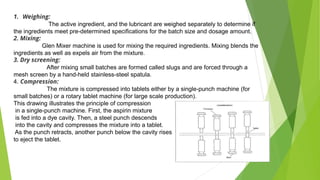
1. Weighing:
The active ingredient, and the lubricant are weighed separately to determine if
the ingredients meet pre-determined specifications for the batch size and dosage amount.
2. Mixing:
Glen Mixer machine is used for mixing the required ingredients. Mixing blends the
ingredients as well as expels air from the mixture.
3. Dry screening:
After mixing small batches are formed called slugs and are forced through a
mesh screen by a hand-held stainless-steel spatula.
4. Compression:
The mixture is compressed into tablets either by a single-punch machine (for
small batches) or a rotary tablet machine (for large scale production).
This drawing illustrates the principle of compression
in a single-punch machine. First, the aspirin mixture
is fed into a dye cavity. Then, a steel punch descends
into the cavity and compresses the mixture into a tablet.
As the punch retracts, another punch below the cavity rises
to eject the tablet.
5. Testing :
Maintaining a high degree of quality control is extremely important in the
pharmaceutical manufacturing industry, as well as required by the Food and Drug
Administration (FDA).
After compressing, then the compressed tablets are subjected to a tablet hardness and
friability test, as well as a tablet disintegration test.
6. Bottling and packaging:
The tablets are transferred to an automated bottling assembly line where they are
dispensed into clear or color-coated polyethylene or polypropylene plastic bottles or glass
bottles. The bottles are topped with cotton packing, sealed with a sheer aluminum top, and
then sealed with a plastic and rubber child-proof lid. The bottles are then labeled with
product information and an expiration date is affixed.
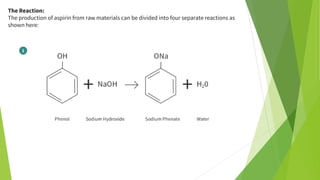
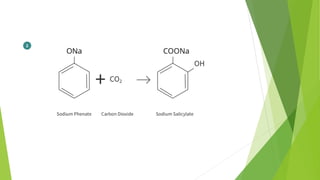
The Reaction:
The production of aspirin from raw materials can be divided into four separate reactions as
shown here:
Economic potential:
Chemicals [kg/kg] used in Disprin Cost [$/kg ]
Silicyclic acid 0.138 60
Acetic anhydride 0.102 1000
Corban dioxide 0.009 100
Purchase Sales
0.138*60 8.28
0.102*1000 102
0.009*100
Balance
0.9
111.18/kg Disprin
Alternatives For Disprin
Following are some of the alternatives of
Disprin Tablet, containing the same drug:
❖ Acetaminophen: It is a pain relief medicine
and can be used in the form of Injection,
Oral Drops, Oral Gel and pills.
❖ Panadol: It can be used for relieving of
pain, fever and tooth ache.
❖ Ibuprofen: It is also available in the form of
pill, gel and injection.
Thank you!

CPD presentation pdf.pdf

  • 1.
    Name : MuhammadHamad Qureshi Subject : Chemical product design Roll number : D-19-CH-61 Topic : Disprin tablet patent and its economic potential Department : chemical engineering DUET, Karachi. Teacher : Sir Shaukat Mazari
  • 2.
    Introduction to disprin Thecompound from which the aspirin was first derived is salicylic acid. This chemical was originally found in the bark of willow trees. The brand name came from “a” for acetyl, “spir” from the spirea plant (a source of salicin) and the suffix “in,” commonly used for medications. Disprin contains the active ingredient asprin about 300g, which works by blocking the action of an enzyme in the body called cyclo-oxygenase (COX). Aspirin was available in tablet form and without a prescription in 1915. Two years later, when Bayer’s patent expired during the first world war the company lost the trademark rights to aspirin in various countries. Today, Americans alone consume 16,000 tons of aspirin tablets a year, equaling 80 million pills, and we spend about $2 billion a year for non-prescription pain relievers, many of which contain aspirin or similar drugs.
  • 3.
    Background The German companyBayer patents aspirin on March 6, 1899. Now it is the most common drug that is used to treat pain, fever, inflammation, arthritis, and reducing the risk of major adverse cardiovascular events. During the 1800s, various scientists extracted salicylic acid from willow bark and produced the compound synthetically. Then, in 1853, French chemist Charles F. Gerhardt synthesized a primitive form of aspirin, a derivative of salicylic acid. In 1897 Felix Hoffmann, a German chemist working at the Bayer division of I.G. Farber, discovered a better method for synthesizing the drug. Though sometimes Hoffmann is improperly given credit for the discovery of aspirin, he did understand that aspirin was an effective pain reliever that did not have the side effects of salicylic acid (it burned throats and upset stomachs). A novel approach to providing nutrients to overcome or replace the natural deficits in mucosal resistance, caused by malnutrition of the drug-intoxicated mucosa induced by aspirin, indomethacin and azapropazone, has been discovered by K. D. Rainsford and M. W. Whitehouse (Patents: US Patent 4,440,762 (1984); US Patent 4,885,279 (1989), and US Patent 5,034,379 (1991). It has been surprisingly discovered that the use of disodium or calcium succinate, in place of sodium or calcium salts or citric acid or acetic acid, allows formulation of a tablet or granular aspirin product which is soluble in water, and which requires much lower molar quantities of succinate and D-glucose than were claimed in US Patent 4,440,762.
  • 4.
    Manufacturing process Aspirin tabletsare manufactured in different shapes. Their weight, size, thickness, and hardness may vary depending on the amount of the dosage. The upper and lower surfaces of the tablets may be flat, round, concave, or convex to various degrees. The tablets may also have a line scored down the middle of the outer surface, so the tablets can be broken in half, if desired. Raw material ❖ Phenol C6H5-OH ❖ Sodium Hydroxide [NaOH] ❖ Carbon Dioxide [CO2 ❖ Acetic Anhydride [CH3COOCOCH3 ❖ Hydrogen The procedure for manufacturing hard aspirin tablets, is known as dry-granulation or slugging. It involves following steps.
  • 5.
    1. Weighing: The activeingredient, and the lubricant are weighed separately to determine if the ingredients meet pre-determined specifications for the batch size and dosage amount. 2. Mixing: Glen Mixer machine is used for mixing the required ingredients. Mixing blends the ingredients as well as expels air from the mixture. 3. Dry screening: After mixing small batches are formed called slugs and are forced through a mesh screen by a hand-held stainless-steel spatula. 4. Compression: The mixture is compressed into tablets either by a single-punch machine (for small batches) or a rotary tablet machine (for large scale production). This drawing illustrates the principle of compression in a single-punch machine. First, the aspirin mixture is fed into a dye cavity. Then, a steel punch descends into the cavity and compresses the mixture into a tablet. As the punch retracts, another punch below the cavity rises to eject the tablet.
  • 6.
    5. Testing : Maintaininga high degree of quality control is extremely important in the pharmaceutical manufacturing industry, as well as required by the Food and Drug Administration (FDA). After compressing, then the compressed tablets are subjected to a tablet hardness and friability test, as well as a tablet disintegration test. 6. Bottling and packaging: The tablets are transferred to an automated bottling assembly line where they are dispensed into clear or color-coated polyethylene or polypropylene plastic bottles or glass bottles. The bottles are topped with cotton packing, sealed with a sheer aluminum top, and then sealed with a plastic and rubber child-proof lid. The bottles are then labeled with product information and an expiration date is affixed.
  • 7.
    The Reaction: The productionof aspirin from raw materials can be divided into four separate reactions as shown here:
  • 11.
    Economic potential: Chemicals [kg/kg]used in Disprin Cost [$/kg ] Silicyclic acid 0.138 60 Acetic anhydride 0.102 1000 Corban dioxide 0.009 100 Purchase Sales 0.138*60 8.28 0.102*1000 102 0.009*100 Balance 0.9 111.18/kg Disprin
  • 12.
    Alternatives For Disprin Followingare some of the alternatives of Disprin Tablet, containing the same drug: ❖ Acetaminophen: It is a pain relief medicine and can be used in the form of Injection, Oral Drops, Oral Gel and pills. ❖ Panadol: It can be used for relieving of pain, fever and tooth ache. ❖ Ibuprofen: It is also available in the form of pill, gel and injection.
  • 13.