BY :
A SHIVA PRASAD REDDY
2010A5PS593H
•
•
•
•
•

INTRODUCTION
PHYSICAL PROPERTIES
PREPARATION
REACTION MECHANISM
USES AND MECHANISM OF ACTION
ON BODY
• SIDE EFFECTS
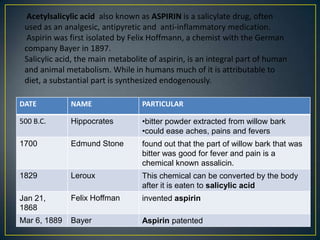
Acetylsalicylic acid also known as ASPIRIN is a salicylate drug, often
used as an analgesic, antipyretic and anti-inflammatory medication.
Aspirin was first isolated by Felix Hoffmann, a chemist with the German
company Bayer in 1897.
Salicylic acid, the main metabolite of aspirin, is an integral part of human
and animal metabolism. While in humans much of it is attributable to
diet, a substantial part is synthesized endogenously.
DATE

NAME

PARTICULAR

500 B.C.

Hippocrates

•bitter powder extracted from willow bark
•could ease aches, pains and fevers

1700

Edmund Stone

found out that the part of willow bark that was
bitter was good for fever and pain is a
chemical known assalicin.

1829

Leroux

This chemical can be converted by the body
after it is eaten to salicylic acid

Jan 21,
1868

Felix Hoffman

invented aspirin

Mar 6, 1889

Bayer

Aspirin patented
•
•
•
•
•
•
•

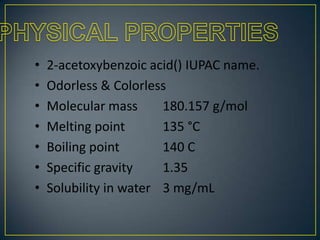
2-acetoxybenzoic acid() IUPAC name.
Odorless & Colorless
Molecular mass
180.157 g/mol
Melting point
135 °C
Boiling point
140 C
Specific gravity
1.35
Solubility in water 3 mg/mL
• Place 2.5 g of salicylic acid and 2.5 mL of acetic anhydride in a dry 50 mL round bottom
flask and add 2.5 mL acetic acid.
• Measure the acetic acid and acetic anhydride in a measuring cylinder filled from the
reagent bottles using 2 different clean droppers.
• Heat under reflux for 30 minutes being careful to use a dry condenser. Do not leave the
experiment unattended during this time.
• Allow the solution to cool, remove the condenser and precipitate the product add by
pouring slowly into 50 mL of water in a 250 mL beaker cooled in ice, holding the hot
flask with tongs.
• Press the filtered solid into a cake over the bottom of the funnel and dry by suction.
• Recrystallize from a mixture of equal volumes of glacial acetic and water in a 50 mL
conical flask, heating on the electrical hot plates provided in the fume cupboards,
making sure the heater controls are on their lowest setting.
• Except for initiation (if necessary) allow crystallisation to occur undisturbed, in an icewater bath, or overnight at room temperature.
• Filter off the crystals, dry by suction, and complete drying by leaving overnight in a
desiccator.
• Aspirin may be effective at preventing certain
types of cancer, particularly colorectal cancer
• Reduces risk of hear attacks.
Aspirin synthesis ppt

Aspirin synthesis ppt

  • 1.
    BY : A SHIVAPRASAD REDDY 2010A5PS593H
  • 2.
  • 3.
    Acetylsalicylic acid alsoknown as ASPIRIN is a salicylate drug, often used as an analgesic, antipyretic and anti-inflammatory medication. Aspirin was first isolated by Felix Hoffmann, a chemist with the German company Bayer in 1897. Salicylic acid, the main metabolite of aspirin, is an integral part of human and animal metabolism. While in humans much of it is attributable to diet, a substantial part is synthesized endogenously. DATE NAME PARTICULAR 500 B.C. Hippocrates •bitter powder extracted from willow bark •could ease aches, pains and fevers 1700 Edmund Stone found out that the part of willow bark that was bitter was good for fever and pain is a chemical known assalicin. 1829 Leroux This chemical can be converted by the body after it is eaten to salicylic acid Jan 21, 1868 Felix Hoffman invented aspirin Mar 6, 1889 Bayer Aspirin patented
  • 4.
    • • • • • • • 2-acetoxybenzoic acid() IUPACname. Odorless & Colorless Molecular mass 180.157 g/mol Melting point 135 °C Boiling point 140 C Specific gravity 1.35 Solubility in water 3 mg/mL
  • 5.
    • Place 2.5g of salicylic acid and 2.5 mL of acetic anhydride in a dry 50 mL round bottom flask and add 2.5 mL acetic acid. • Measure the acetic acid and acetic anhydride in a measuring cylinder filled from the reagent bottles using 2 different clean droppers. • Heat under reflux for 30 minutes being careful to use a dry condenser. Do not leave the experiment unattended during this time. • Allow the solution to cool, remove the condenser and precipitate the product add by pouring slowly into 50 mL of water in a 250 mL beaker cooled in ice, holding the hot flask with tongs. • Press the filtered solid into a cake over the bottom of the funnel and dry by suction. • Recrystallize from a mixture of equal volumes of glacial acetic and water in a 50 mL conical flask, heating on the electrical hot plates provided in the fume cupboards, making sure the heater controls are on their lowest setting. • Except for initiation (if necessary) allow crystallisation to occur undisturbed, in an icewater bath, or overnight at room temperature. • Filter off the crystals, dry by suction, and complete drying by leaving overnight in a desiccator.
  • 8.
    • Aspirin maybe effective at preventing certain types of cancer, particularly colorectal cancer • Reduces risk of hear attacks.