Chemical Process Industr ies 
Topic: Preparation of Aspirin 
Prepared By:
Details of aspirin: 
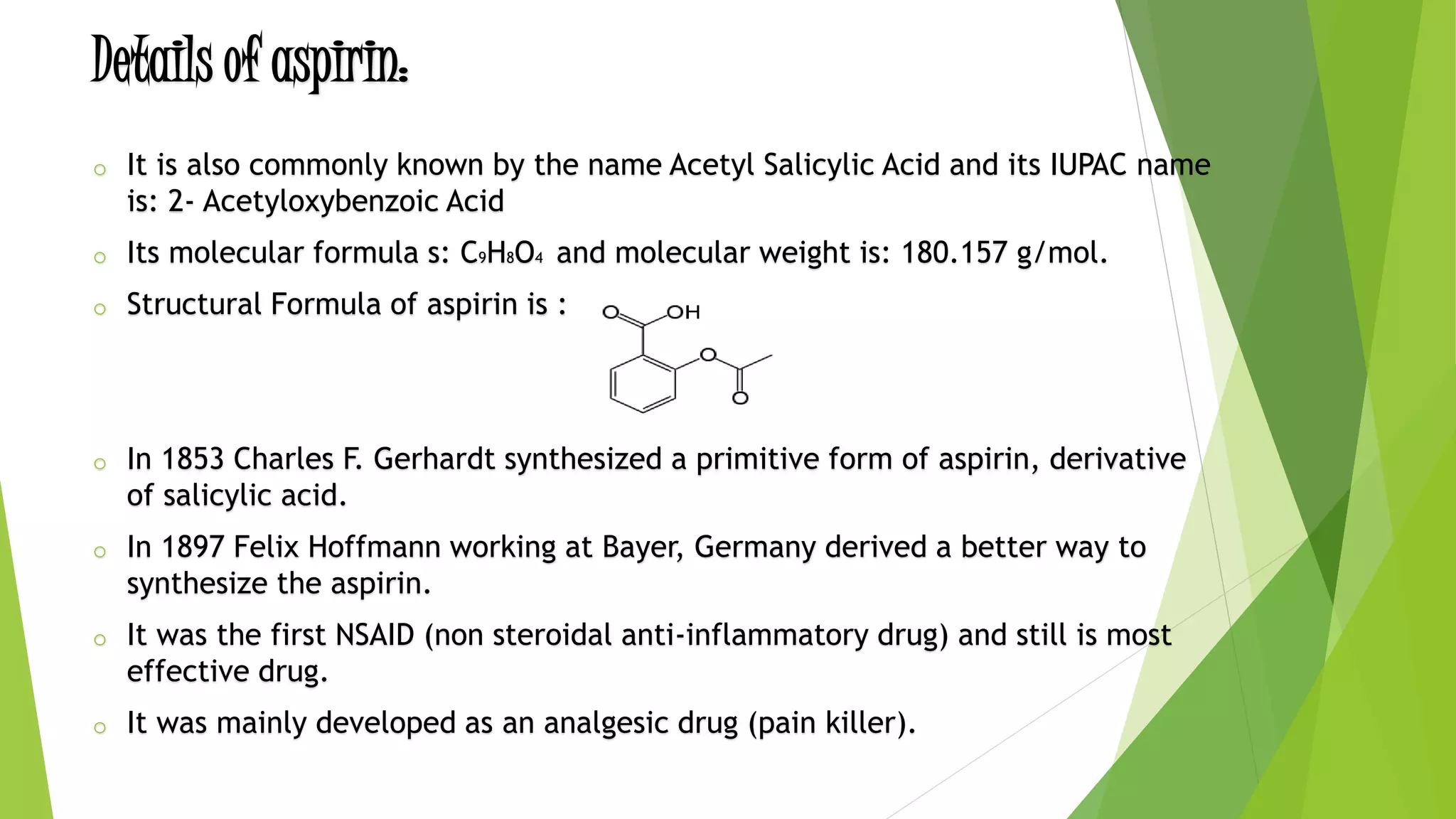
o It is also commonly known by the name Acetyl Salicylic Acid and its IUPAC name 
is: 2- Acetyloxybenzoic Acid 
o Its molecular formula s: C9H8O4 and molecular weight is: 180.157 g/mol. 
o Structural Formula of aspirin is : 
o In 1853 Charles F. Gerhardt synthesized a primitive form of aspirin, derivative 
of salicylic acid. 
o In 1897 Felix Hoffmann working at Bayer, Germany derived a better way to 
synthesize the aspirin. 
o It was the first NSAID (non steroidal anti-inflammatory drug) and still is most 
effective drug. 
o It was mainly developed as an analgesic drug (pain killer).
Synthesis of aspirin: 
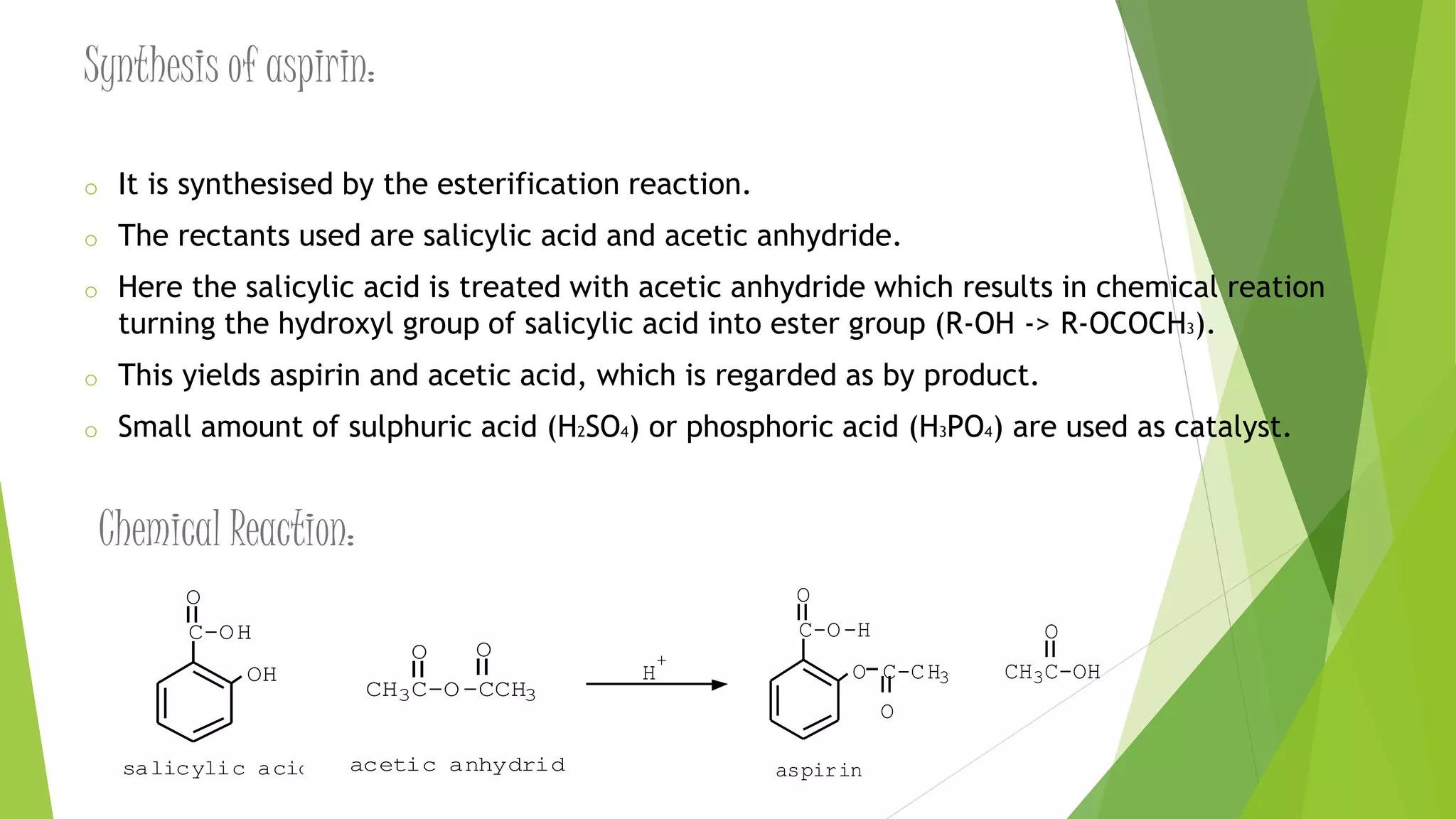
o It is synthesised by the esterification reaction. 
o The rectants used are salicylic acid and acetic anhydride. 
o Here the salicylic acid is treated with acetic anhydride which results in chemical reation 
turning the hydroxyl group of salicylic acid into ester group (R-OH -> R-OCOCH3). 
o This yields aspirin and acetic acid, which is regarded as by product. 
o Small amount of sulphuric acid (H2SO4) or phosphoric acid (H3PO4) are used as catalyst. 
Chemical Reaction: 
O 
C-OH 
OH 
salicylic acid 
O O 
CH3C-O-CCH3 
acetic anhydride 
O 
C-O-H 
O C-CH3 
O 
aspirin 
O 
CH3C-OH 
+ 
H
MECHANISM 
•• 
•• 
•• 
•• 
O O 
•• 
CH3C-O-CCH3 
•• 
+ 
H 
H 
 
•• 
•• 
•• 
O O 
•• 
•• 
CH3C-O-CCH3 
H 
•• 
•• 
•• 
•• 
O O 
•• 
CH3C-O-CCH3 
 •• 
H 
•• 
•• 
•• 
•• 
O O 
•• 
CH3C-O-CCH3 
 
H 
•• 
•• 
•• 
•• 
O O 
•• 
CH3C-O-CCH3 
 •• 
O 
C-OH 
•• C-OH 
OH 
•• 
O 
H 
•• 
•• 
•• 
•• 
CH3C-O-CCH3 
OH 
O O 
 
•• 
•• 
•• 
O 
C-OH 
H 
•• 
 
CH3C-O-CCH3 
O 
O O 
H 
•• 
•• 
•• 
•• 
•• 
•• 
O 
C-OH 
O 
H 
 
O 
CCH3 
•• 
•• 
•• 
O 
C-OH 
O 
O 
H 
CCH3 
 
•• 
•• 
•• 
•• 
O 
C-OH 
H 
•• 
 
CH3C-O-CCH3 
O 
O O 
H 
•• 
•• 
•• 
•• 
•• 
•• 
•• 
O 
•• 
HO-CCH3 
•• 
•• 
O 
C-O-H 
O C-CH3 
O
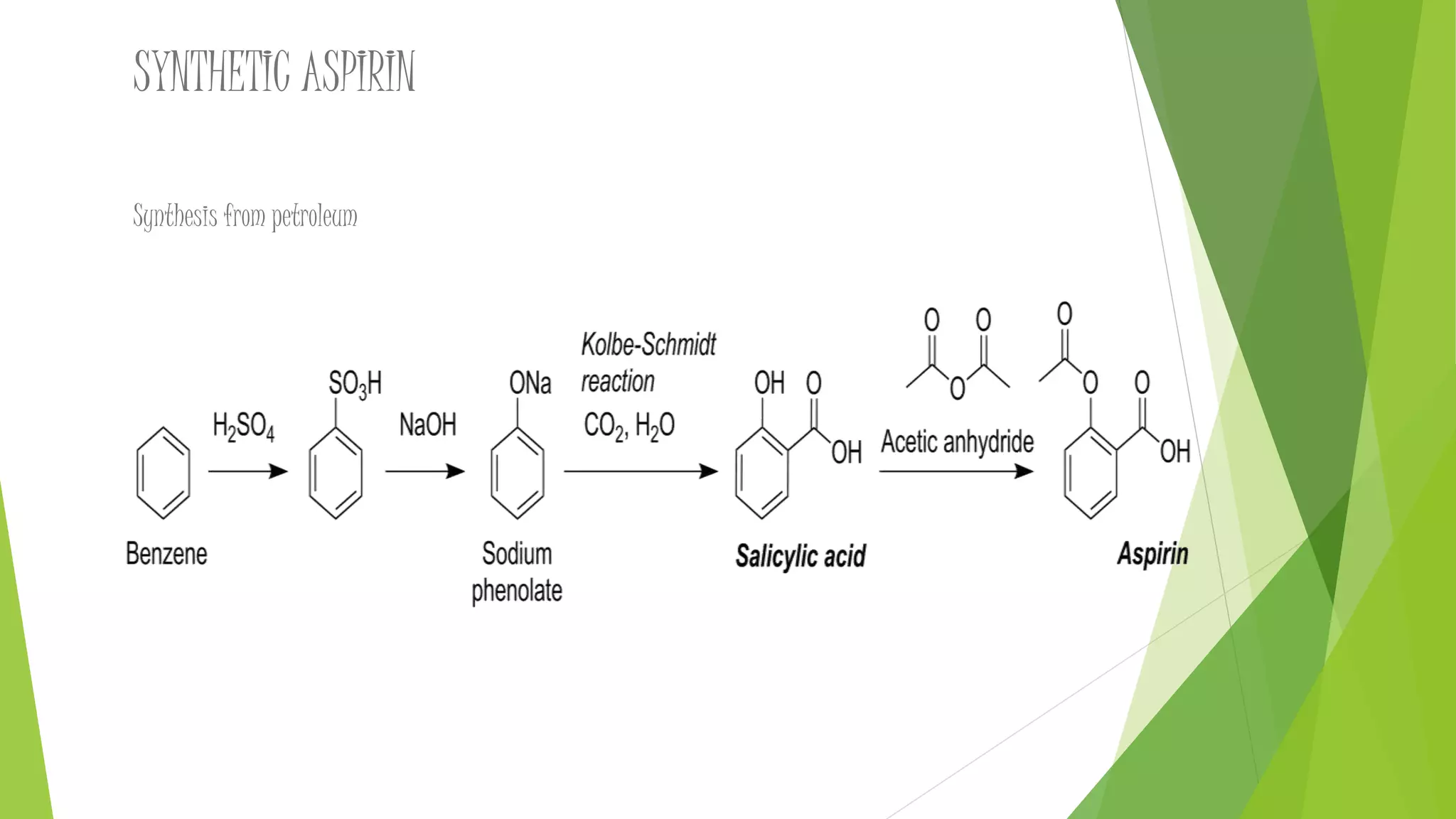
SYNTHETIC ASPIRIN 
Synthesis from petroleum
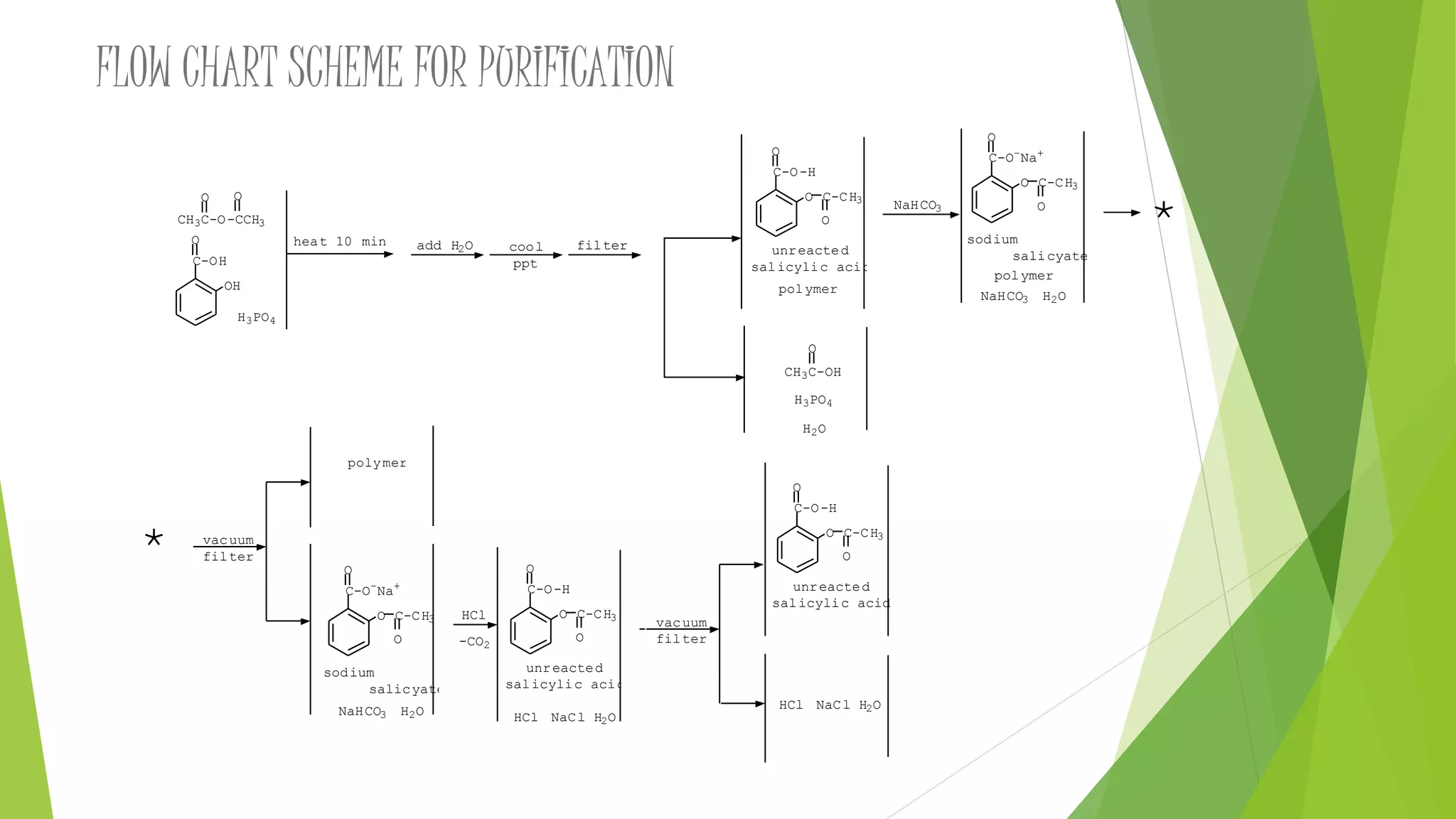
FLOW CHART SCHEME FOR PURIFICATION 
O O 
CH3C-O-CCH3 
O 
C-OH 
OH 
H3PO4 
heat 10 min add H2O cool 
ppt 
filter 
O 
C-O-H 
O C-CH3 
O 
unreacted 
salicylic acid 
polymer 
O 
CH3C-OH 
H3PO4 
H2O 
O 
C-O–Na+ 
O C-CH3 
NaHCO3 O 
* 
sodium 
salicyate 
polymer 
NaHCO3 H2O 
vacuum 
filter * 
polymer 
O 
C-O–Na+ 
O C-CH3 
O 
sodium 
salicyate 
NaHCO3 H2O 
HCl 
-CO2 
O 
C-O-H 
O C-CH3 
O 
unreacted 
salicylic acid 
HCl NaCl H2O 
O 
C-O-H 
O C-CH3 
O 
vacuum 
filter 
unreacted 
salicylic acid 
HCl NaCl H2O
Final Recrystallization of Crude Aspirin 
O 
C-O-H 
O C-CH3 
O 
unreacted 
salicylic acid 
recytal. 
ethyl 
acetate 
vacuum 
filter 
dry 
O 
C-O-H 
O C-CH3 
O 
mp 135°C 
unreacted 
salicylic acid 
ethyl 
acetate
Industrial Scale Production of aspirin
Uses of aspirin: 
o Over-the-counter pain relief, especially for headaches. 
o Reduction of swelling and inflammation in arthritis and 
injuries. 
o Anti-coagulant given to sufferers of heart attack. 
o Can reduce severity of heart attack if taken at first symptoms. 
o Recovery after cardiovascular surgery. 
o Treatment of rheumatoid arthritis, osteoarthritis and other 
rheumatoid diseases
SIDE Effects: 
o Risk of increase in gastrointestinal bleeding. 
o It inhibits the ability of kidney to excrete uric acid and 
exacerbate these conditions. 
o Large dosages results in tinnitus (ringing in ears). 
o May result in fatty liver and acute encephalopathy. 
o May cause swelling of skin tissues. 
o It increases the risk of cerebral microbleed.
Thank you

preparation of aspirin

  • 1.
    Chemical Process Industries Topic: Preparation of Aspirin Prepared By:
  • 2.
    Details of aspirin: o It is also commonly known by the name Acetyl Salicylic Acid and its IUPAC name is: 2- Acetyloxybenzoic Acid o Its molecular formula s: C9H8O4 and molecular weight is: 180.157 g/mol. o Structural Formula of aspirin is : o In 1853 Charles F. Gerhardt synthesized a primitive form of aspirin, derivative of salicylic acid. o In 1897 Felix Hoffmann working at Bayer, Germany derived a better way to synthesize the aspirin. o It was the first NSAID (non steroidal anti-inflammatory drug) and still is most effective drug. o It was mainly developed as an analgesic drug (pain killer).
  • 3.
    Synthesis of aspirin: o It is synthesised by the esterification reaction. o The rectants used are salicylic acid and acetic anhydride. o Here the salicylic acid is treated with acetic anhydride which results in chemical reation turning the hydroxyl group of salicylic acid into ester group (R-OH -> R-OCOCH3). o This yields aspirin and acetic acid, which is regarded as by product. o Small amount of sulphuric acid (H2SO4) or phosphoric acid (H3PO4) are used as catalyst. Chemical Reaction: O C-OH OH salicylic acid O O CH3C-O-CCH3 acetic anhydride O C-O-H O C-CH3 O aspirin O CH3C-OH + H
  • 4.
    MECHANISM •• •• •• •• O O •• CH3C-O-CCH3 •• + H H  •• •• •• O O •• •• CH3C-O-CCH3 H •• •• •• •• O O •• CH3C-O-CCH3  •• H •• •• •• •• O O •• CH3C-O-CCH3  H •• •• •• •• O O •• CH3C-O-CCH3  •• O C-OH •• C-OH OH •• O H •• •• •• •• CH3C-O-CCH3 OH O O  •• •• •• O C-OH H ••  CH3C-O-CCH3 O O O H •• •• •• •• •• •• O C-OH O H  O CCH3 •• •• •• O C-OH O O H CCH3  •• •• •• •• O C-OH H ••  CH3C-O-CCH3 O O O H •• •• •• •• •• •• •• O •• HO-CCH3 •• •• O C-O-H O C-CH3 O
  • 5.
  • 6.
    FLOW CHART SCHEMEFOR PURIFICATION O O CH3C-O-CCH3 O C-OH OH H3PO4 heat 10 min add H2O cool ppt filter O C-O-H O C-CH3 O unreacted salicylic acid polymer O CH3C-OH H3PO4 H2O O C-O–Na+ O C-CH3 NaHCO3 O * sodium salicyate polymer NaHCO3 H2O vacuum filter * polymer O C-O–Na+ O C-CH3 O sodium salicyate NaHCO3 H2O HCl -CO2 O C-O-H O C-CH3 O unreacted salicylic acid HCl NaCl H2O O C-O-H O C-CH3 O vacuum filter unreacted salicylic acid HCl NaCl H2O
  • 7.
    Final Recrystallization ofCrude Aspirin O C-O-H O C-CH3 O unreacted salicylic acid recytal. ethyl acetate vacuum filter dry O C-O-H O C-CH3 O mp 135°C unreacted salicylic acid ethyl acetate
  • 8.
  • 9.
    Uses of aspirin: o Over-the-counter pain relief, especially for headaches. o Reduction of swelling and inflammation in arthritis and injuries. o Anti-coagulant given to sufferers of heart attack. o Can reduce severity of heart attack if taken at first symptoms. o Recovery after cardiovascular surgery. o Treatment of rheumatoid arthritis, osteoarthritis and other rheumatoid diseases
  • 10.
    SIDE Effects: oRisk of increase in gastrointestinal bleeding. o It inhibits the ability of kidney to excrete uric acid and exacerbate these conditions. o Large dosages results in tinnitus (ringing in ears). o May result in fatty liver and acute encephalopathy. o May cause swelling of skin tissues. o It increases the risk of cerebral microbleed.
  • 11.