Chemical Reactions
of the Benzene
1
• Electrophilic substiution
Reactions
• Addition Reactions
• Oxidation Reactions
2
Substitution Reactions of Benzene
• Benzene does not undergo electrophilic
addition
• It undergoes electrophilic aromatic
substitution maintaining the aromatic core
• Electrophilic aromatic substitution replaces
a proton on benzene with another
electrophile
3
4
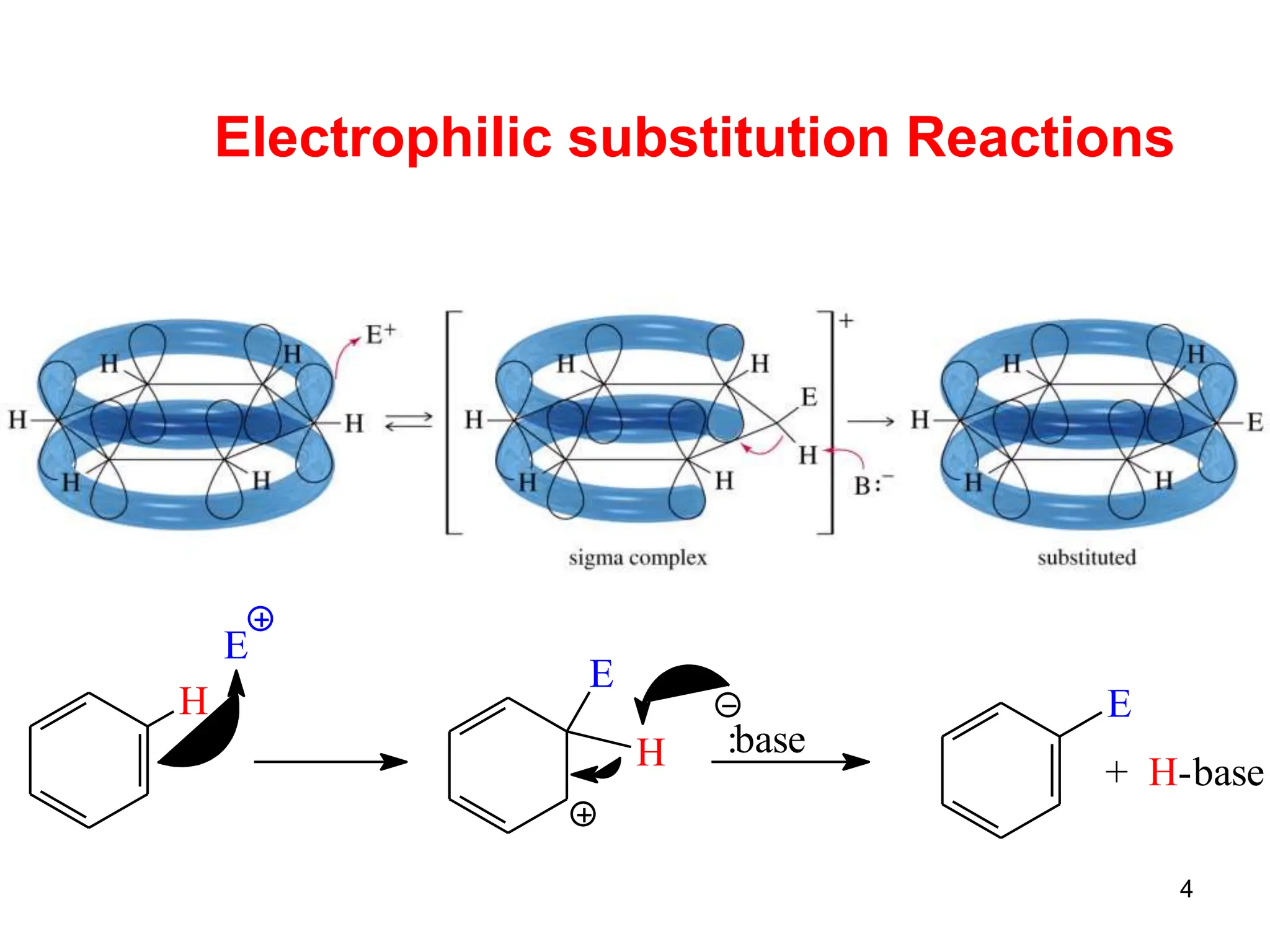
Electrophilic substitution Reactions
H
E
E
H
E
+ H-base
:base
Electrophilic Aromatic Substitution
5
1. Halogenation of Benzene
• Benzene’s  electrons participate as a Lewis
base in reactions with Lewis acids
– Lewis acid: electron pair acceptor
– Lewis base: electron pair donor
• The product is formed by loss of a proton, which
is replaced by a halogen
6
Bromination of Aromatic Rings
• Benzene’s  electrons participate as a Lewis
base in reactions with Lewis acids
• The product is formed by loss of a proton, which
is replaced by bromine
• FeBr3 is added as a catalyst to polarize the
bromine reagent
+ Br2
Br
+ HBr
FeBr3
7
8
Bromine Polarization
Bromination Mechanism
9
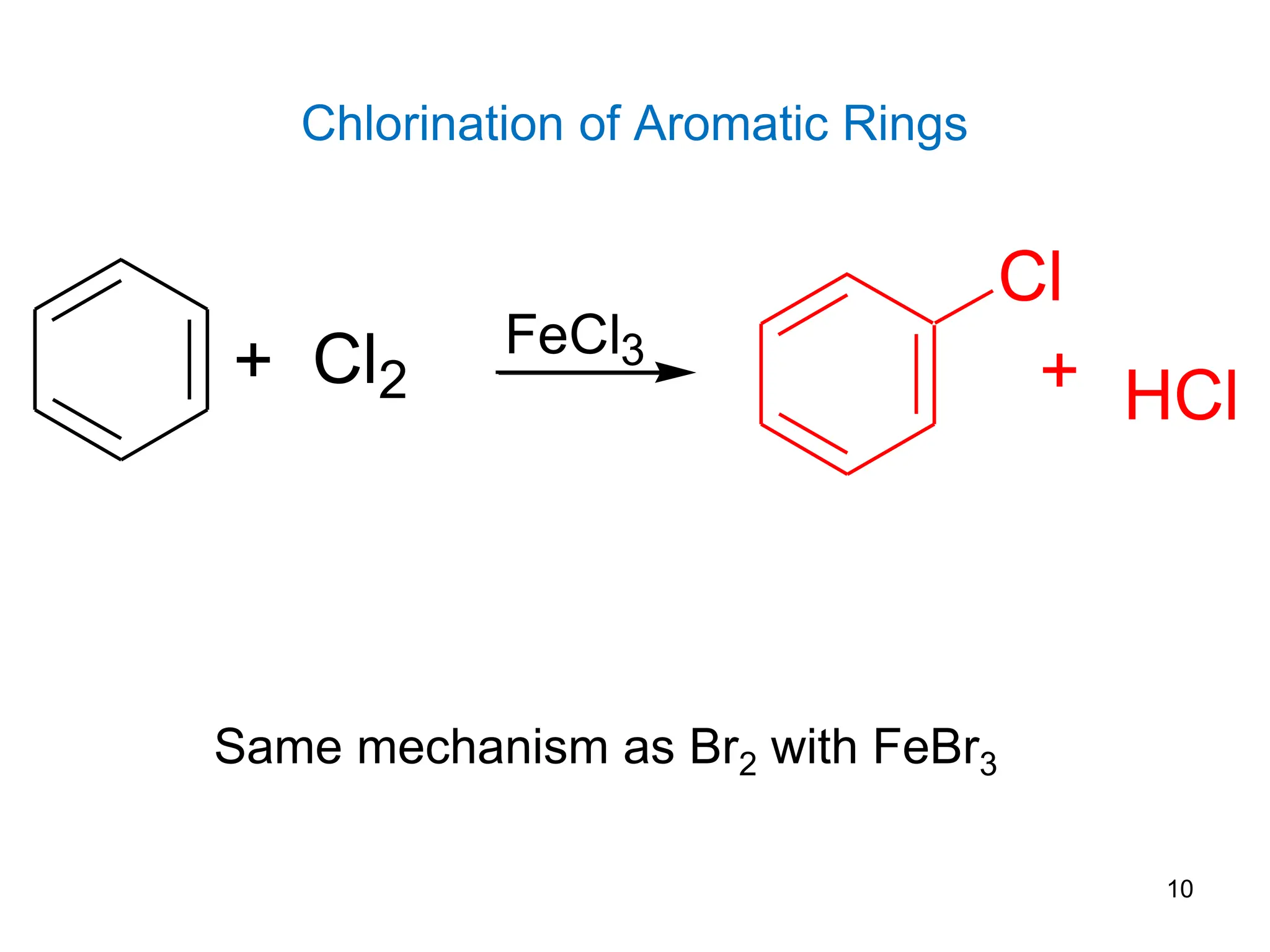
Chlorination of Aromatic Rings
+ Cl2
Cl
+ HCl
FeCl3
Same mechanism as Br2 with FeBr3
10
Iodination of Aromatic Rings
I
HI
I2
+
CuCl2
•Iodine is unreactive towards aromatic rings
•Oxidizing agents must be added to make
reaction go (H2O2 or CuCl2)
•Oxidizing agents oxidize I2 to a usable form
(electrohphillic) that reacts as if it were I+
11
2. Nitration of Aromatic Rings
Electrophile is the nitronium ion (NO2
+)
Generated from HNO3 by protonation and
loss of water
12
HNO3
H2SO4
NO2
H2O
HNO3
H2SO4
NO2
H2O
Mechanism : Nitration of Aromatic Rings
• An electrophile must first be generated by
treating concentrated nitric acid with
concentrated sulfuric acid
H O NO2 + H2SO4 H O
H
NO2 + HSO4
NO2
H2O
nitronium ion 13
Mechanism: Nitration of Aromatic Rings
• The nitronium electrophile is attacked by the
benzene ring (nucleophile)
14
NO2
+
H2SO4
NO2 NO2
NO2
+
H2SO4
NO2 NO2
3. Sulfonation of Aromatic Rings
SO3
H2SO4
SO2OH
+ H2O
Fuming sulfuric acid – combination of SO3 and H2SO4
Electrophile is HSO3
+ or SO3
Reaction is reversible
Favored in forward direction with strong acid
Favored in reverse direction with hot dilute
aqueous acid
15
Mechanism : Sulfonation of Aromatic Rings
S
+
O
O
O
S
O
O
OH
O
H
S
+
O
O
O
H
S
O
O
OH
O
S
+
O
O
O
H
S
O
O
OH
H
S
O
O
OH
O
SO3H
+ +
+
+
+ H2SO4
16
4. Friedel-Crafts Reaction
+ CH3CHCH3
Cl
AlCl3
CHCH3
CH3
+ HCl
benzene 2-chloropropane isopropylbenzene
17
Mechanism 5: Friedel-Crafts Reaction
18
Cl--AlCl3
-
HCl
Cl--AlCl3
-
Cl
H
AlCl3
AlCl3
+
+
+
+
+
+
+
+
Cl--AlCl3
-
HCl
Cl--AlCl3
-
Cl
H
AlCl3
AlCl3
+
+
+
+
+
+
+
+
HCl
Cl AlCl3
+ + HCl
Cl AlCl3
+ +
Friedel-Crafts Reaction (Alkylation of Aromatic Rings)
• the electrophile is a carbocation, R+
• only alkyl halides can be used
– aryl halides and vinylic halides do not react.
• will not occur on aromatic rings substituted by
electron withdrawing substituents
• can’t eat just one! It’s hard to stop after one
substitution
• skeletal rearrangements of the alkyl group often
occur when using primary alkyl halides
19
Friedel-Crafts Reaction
• Skeletal rearrangements in Friedel-Crafts
reactions (hydride shift):
– Will rearrange to form more stable carbocation
intermediates
20
AlCl3
+
Major
product
CH3CH2CH2CH2Cl
CHCH2CH3
CH3
CH2CH2CH2CH3
sec-Butylbenzene
Butylbenzene
HCl
HCl
Friedel-Crafts Alkylation Summary
• Only alkyl halides can be used!!
• Will not occur on aromatic rings substituted by
electron withdrawing substituents
– Carbonyl and amino groups
• Will have polyalkylation
• Will have rearrangement to form more stable
carbocation intermediate
– Hydride shift or methyl shift
21
Friedel-Crafts Acylation
• Reaction of benzene with a carboxylic acid
chloride, RCOCl in the presence of AlCl3
• Note: the acyl cation does not undergo
rearrangement. It also is not prone to multiple
substitutions.
+ AlCl3
CH3CH2CCl
O C
O
CH2CH3
22
HCl
HCl
Friedel-Crafts Acylation
• After acylation we can do a hydrogenation to get
desired alkylated product
23
HCl
AlCl3
H2
Pd
HCl
AlCl3
H2
Pd
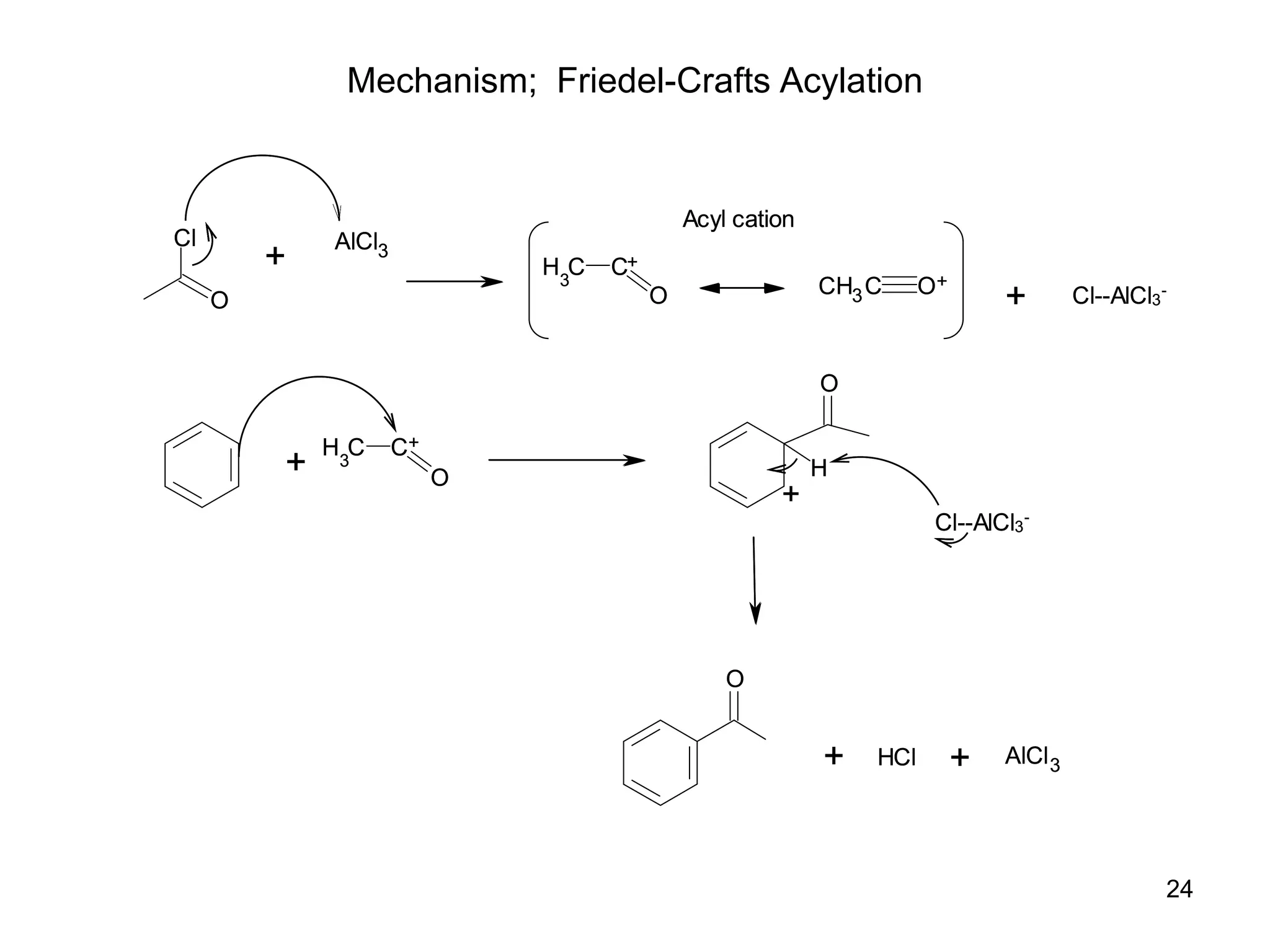
Mechanism; Friedel-Crafts Acylation
24
Cl--AlCl3
-
HCl
Acyl cation
Cl--AlCl3
-
C
H3
C+
O O+
O
C
H3
C+
O
O
H
O
Cl
CH3C
AlCl3
AlCl3
+
+
+
+
+
+ Cl--AlCl3
-
HCl
Acyl cation
Cl--AlCl3
-
C
H3
C+
O O+
O
C
H3
C+
O
O
H
O
Cl
CH3C
AlCl3
AlCl3
+
+
+
+
+
+
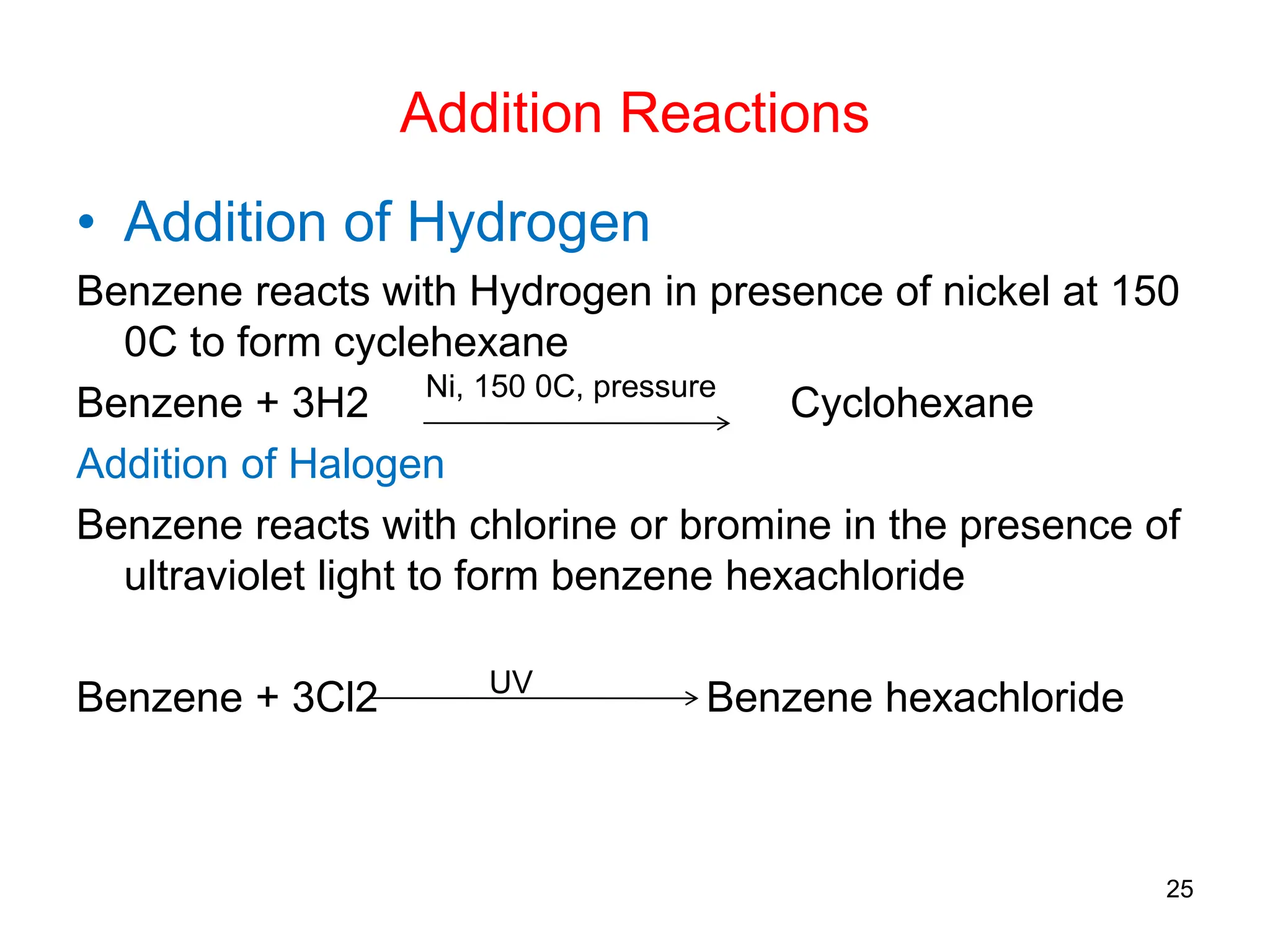
Addition Reactions
• Addition of Hydrogen
Benzene reacts with Hydrogen in presence of nickel at 150
0C to form cyclehexane
Benzene + 3H2 Cyclohexane
Addition of Halogen
Benzene reacts with chlorine or bromine in the presence of
ultraviolet light to form benzene hexachloride
Benzene + 3Cl2 Benzene hexachloride
25
Ni, 150 0C, pressure
UV
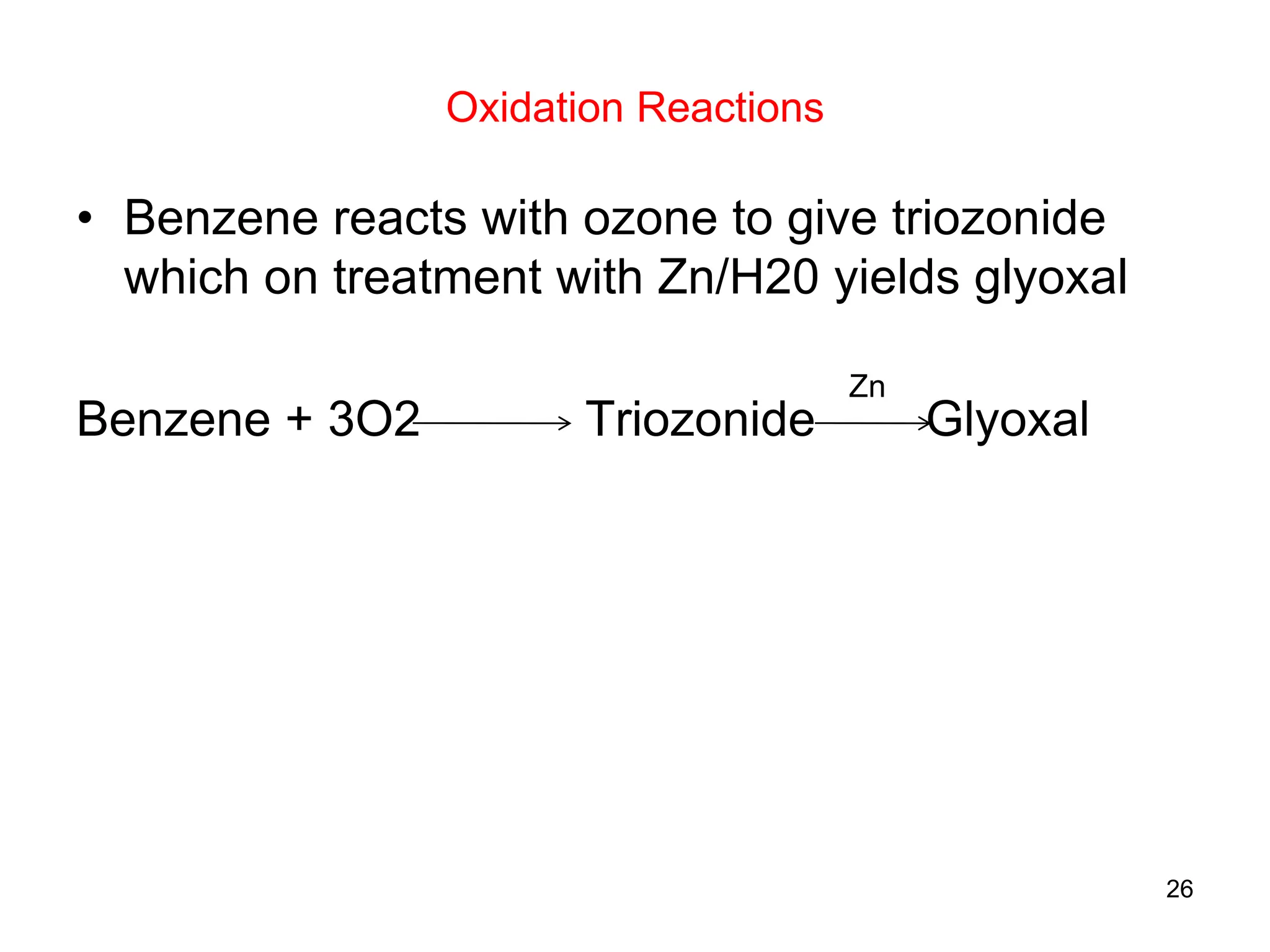
Oxidation Reactions
• Benzene reacts with ozone to give triozonide
which on treatment with Zn/H20 yields glyoxal
Benzene + 3O2 Triozonide Glyoxal
26
Zn

Chemical properties of the benzene...ppt

  • 1.
  • 2.
    • Electrophilic substiution Reactions •Addition Reactions • Oxidation Reactions 2
  • 3.
    Substitution Reactions ofBenzene • Benzene does not undergo electrophilic addition • It undergoes electrophilic aromatic substitution maintaining the aromatic core • Electrophilic aromatic substitution replaces a proton on benzene with another electrophile 3
  • 4.
  • 5.
  • 6.
    1. Halogenation ofBenzene • Benzene’s  electrons participate as a Lewis base in reactions with Lewis acids – Lewis acid: electron pair acceptor – Lewis base: electron pair donor • The product is formed by loss of a proton, which is replaced by a halogen 6
  • 7.
    Bromination of AromaticRings • Benzene’s  electrons participate as a Lewis base in reactions with Lewis acids • The product is formed by loss of a proton, which is replaced by bromine • FeBr3 is added as a catalyst to polarize the bromine reagent + Br2 Br + HBr FeBr3 7
  • 8.
  • 9.
  • 10.
    Chlorination of AromaticRings + Cl2 Cl + HCl FeCl3 Same mechanism as Br2 with FeBr3 10
  • 11.
    Iodination of AromaticRings I HI I2 + CuCl2 •Iodine is unreactive towards aromatic rings •Oxidizing agents must be added to make reaction go (H2O2 or CuCl2) •Oxidizing agents oxidize I2 to a usable form (electrohphillic) that reacts as if it were I+ 11
  • 12.
    2. Nitration ofAromatic Rings Electrophile is the nitronium ion (NO2 +) Generated from HNO3 by protonation and loss of water 12 HNO3 H2SO4 NO2 H2O HNO3 H2SO4 NO2 H2O
  • 13.
    Mechanism : Nitrationof Aromatic Rings • An electrophile must first be generated by treating concentrated nitric acid with concentrated sulfuric acid H O NO2 + H2SO4 H O H NO2 + HSO4 NO2 H2O nitronium ion 13
  • 14.
    Mechanism: Nitration ofAromatic Rings • The nitronium electrophile is attacked by the benzene ring (nucleophile) 14 NO2 + H2SO4 NO2 NO2 NO2 + H2SO4 NO2 NO2
  • 15.
    3. Sulfonation ofAromatic Rings SO3 H2SO4 SO2OH + H2O Fuming sulfuric acid – combination of SO3 and H2SO4 Electrophile is HSO3 + or SO3 Reaction is reversible Favored in forward direction with strong acid Favored in reverse direction with hot dilute aqueous acid 15
  • 16.
    Mechanism : Sulfonationof Aromatic Rings S + O O O S O O OH O H S + O O O H S O O OH O S + O O O H S O O OH H S O O OH O SO3H + + + + + H2SO4 16
  • 17.
    4. Friedel-Crafts Reaction +CH3CHCH3 Cl AlCl3 CHCH3 CH3 + HCl benzene 2-chloropropane isopropylbenzene 17
  • 18.
    Mechanism 5: Friedel-CraftsReaction 18 Cl--AlCl3 - HCl Cl--AlCl3 - Cl H AlCl3 AlCl3 + + + + + + + + Cl--AlCl3 - HCl Cl--AlCl3 - Cl H AlCl3 AlCl3 + + + + + + + + HCl Cl AlCl3 + + HCl Cl AlCl3 + +
  • 19.
    Friedel-Crafts Reaction (Alkylationof Aromatic Rings) • the electrophile is a carbocation, R+ • only alkyl halides can be used – aryl halides and vinylic halides do not react. • will not occur on aromatic rings substituted by electron withdrawing substituents • can’t eat just one! It’s hard to stop after one substitution • skeletal rearrangements of the alkyl group often occur when using primary alkyl halides 19
  • 20.
    Friedel-Crafts Reaction • Skeletalrearrangements in Friedel-Crafts reactions (hydride shift): – Will rearrange to form more stable carbocation intermediates 20 AlCl3 + Major product CH3CH2CH2CH2Cl CHCH2CH3 CH3 CH2CH2CH2CH3 sec-Butylbenzene Butylbenzene HCl HCl
  • 21.
    Friedel-Crafts Alkylation Summary •Only alkyl halides can be used!! • Will not occur on aromatic rings substituted by electron withdrawing substituents – Carbonyl and amino groups • Will have polyalkylation • Will have rearrangement to form more stable carbocation intermediate – Hydride shift or methyl shift 21
  • 22.
    Friedel-Crafts Acylation • Reactionof benzene with a carboxylic acid chloride, RCOCl in the presence of AlCl3 • Note: the acyl cation does not undergo rearrangement. It also is not prone to multiple substitutions. + AlCl3 CH3CH2CCl O C O CH2CH3 22 HCl HCl
  • 23.
    Friedel-Crafts Acylation • Afteracylation we can do a hydrogenation to get desired alkylated product 23 HCl AlCl3 H2 Pd HCl AlCl3 H2 Pd
  • 24.
    Mechanism; Friedel-Crafts Acylation 24 Cl--AlCl3 - HCl Acylcation Cl--AlCl3 - C H3 C+ O O+ O C H3 C+ O O H O Cl CH3C AlCl3 AlCl3 + + + + + + Cl--AlCl3 - HCl Acyl cation Cl--AlCl3 - C H3 C+ O O+ O C H3 C+ O O H O Cl CH3C AlCl3 AlCl3 + + + + + +
  • 25.
    Addition Reactions • Additionof Hydrogen Benzene reacts with Hydrogen in presence of nickel at 150 0C to form cyclehexane Benzene + 3H2 Cyclohexane Addition of Halogen Benzene reacts with chlorine or bromine in the presence of ultraviolet light to form benzene hexachloride Benzene + 3Cl2 Benzene hexachloride 25 Ni, 150 0C, pressure UV
  • 26.
    Oxidation Reactions • Benzenereacts with ozone to give triozonide which on treatment with Zn/H20 yields glyoxal Benzene + 3O2 Triozonide Glyoxal 26 Zn