EXPORTING
TO STL
WHAT IS AN STL FILE FORMAT AND HOW
WE CAN CONVERT OUR CAD INTO STL

                               Greta D’Angelo
                               Martí Bertran
                               Thomas J. Howard
STL FILES
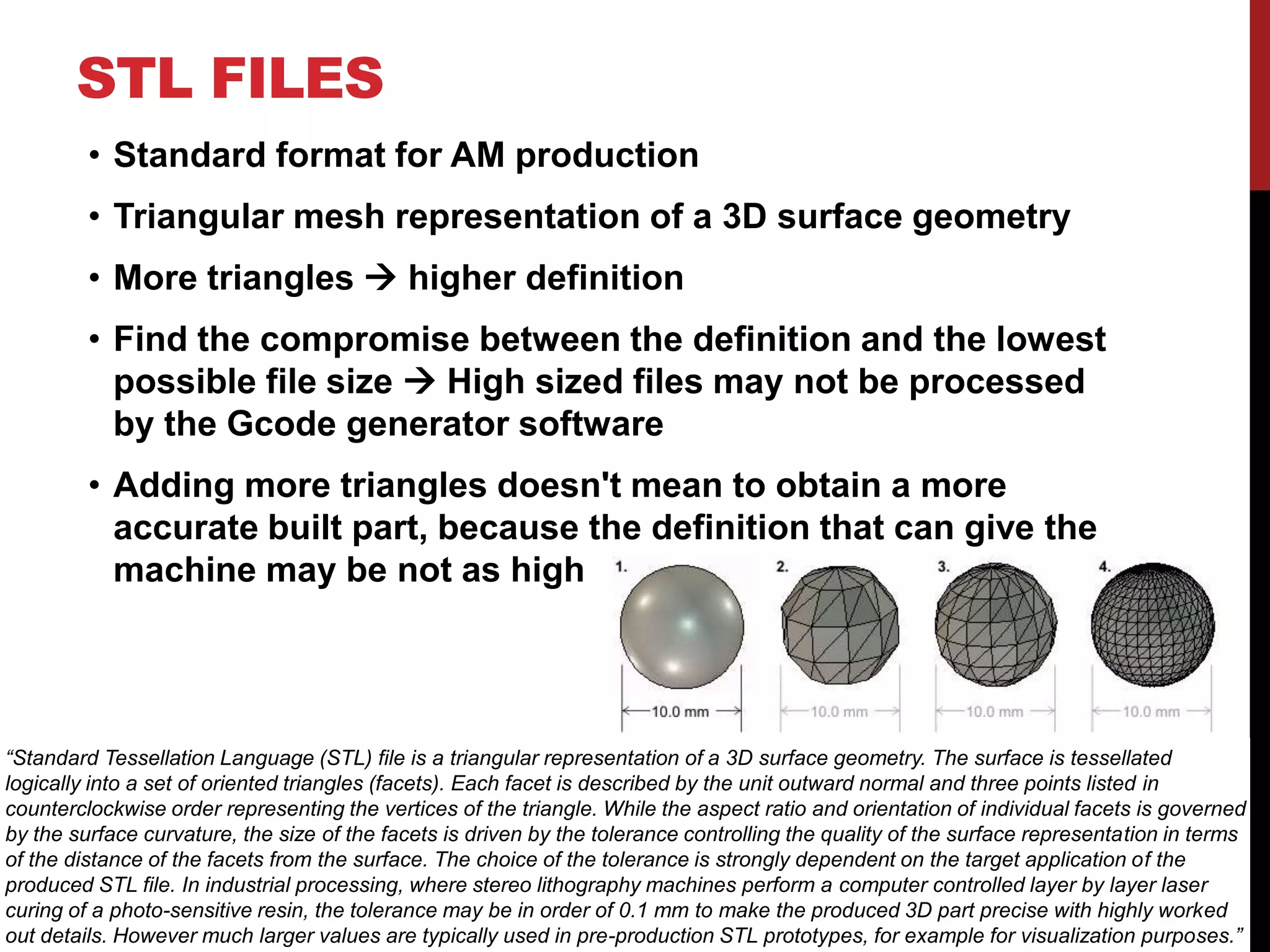
         • Standard format for AM production
         • Triangular mesh representation of a 3D surface geometry
         • More triangles  higher definition
         • Find the compromise between the definition and the lowest
           possible file size  High sized files may not be processed
           by the Gcode generator software
         • Adding more triangles doesn't mean to obtain a more
           accurate built part, because the definition that can give the
           machine may be not as high


“Standard Tessellation Language (STL) file is a triangular representation of a 3D surface geometry. The surface is tessellated
logically into a set of oriented triangles (facets). Each facet is described by the unit outward normal and three points listed in
counterclockwise order representing the vertices of the triangle. While the aspect ratio and orientation of individual facets is governed
by the surface curvature, the size of the facets is driven by the tolerance controlling the quality of the surface representation in terms
of the distance of the facets from the surface. The choice of the tolerance is strongly dependent on the target application of the
produced STL file. In industrial processing, where stereo lithography machines perform a computer controlled layer by layer laser
curing of a photo-sensitive resin, the tolerance may be in order of 0.1 mm to make the produced 3D part precise with highly worked
out details. However much larger values are typically used in pre-production STL prototypes, for example for visualization purposes.”
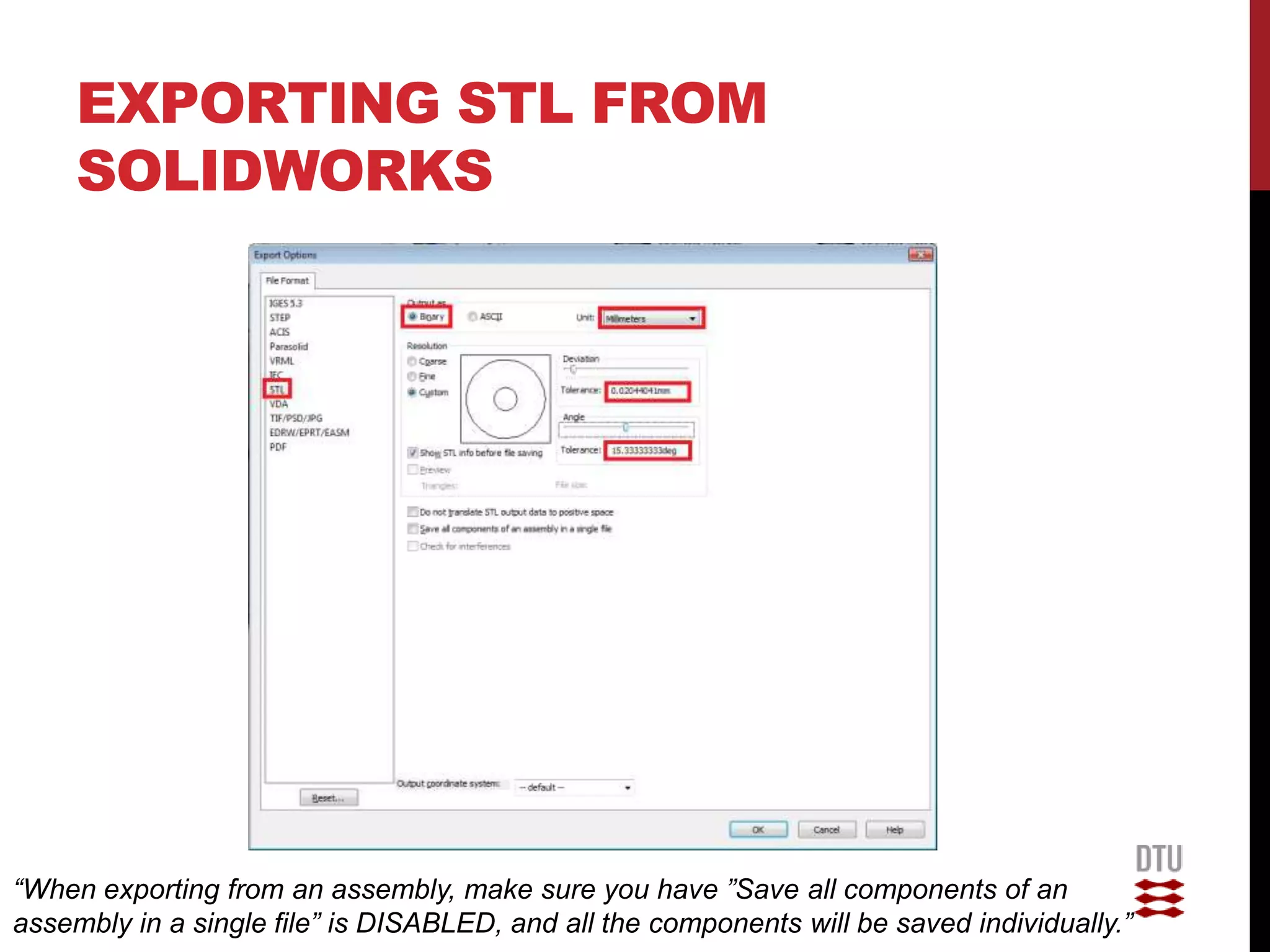
EXPORTING STL FROM
    SOLIDWORKS
    The orientation of the building platform is the XY plane
    (FRONT PLANE in solidworks)
    Steps:
    • Click “Save as”
    • In “Save as type” list select: “STL (*.stl)”
    • Click “Options”
    • Output: Binary
       • Unit: Millimetres
    • Resolution: Custom
       • Deviation: 0,02 - 0,05
       • Angle: 15º - 20º
    “Deviation and angle default values for “Coarse” and “Fine” depends on the
    surfaces and size of the model we want to export, the optimised values will always
3   be between these two values.”
EXPORTING STL FROM
    SOLIDWORKS
    Steps for Solidworks Student Design Kit
    • File  Save As …
    • Set type to “eDrawings(*.eprt)”
    • Click “Options...”
    • Enable “Allow export to STL for Parts & Assemblies”
    • Click OK
    • Enter Filename  Save
    • Open part in Solidworks eDrawings
    • File  Save as…  select type STL Files (*.stl)
    • Save
    “With this way, you can’t choose the resolution of the output STL file, and it’s not
    the best. So avoid this system if your model has characteristic curved surfaces.
    Solidworks Edition on DTU Databar PC’s let you to export direcly to STL from
4   solidworks. So only use that method if you have the Student design kit.”
EXPORTING STL FROM
     SOLIDWORKS


“When exporting from an assembly, make sure you have ”Save all components of an
assembly in a single file” is DISABLED, and all the components will be saved individually.”
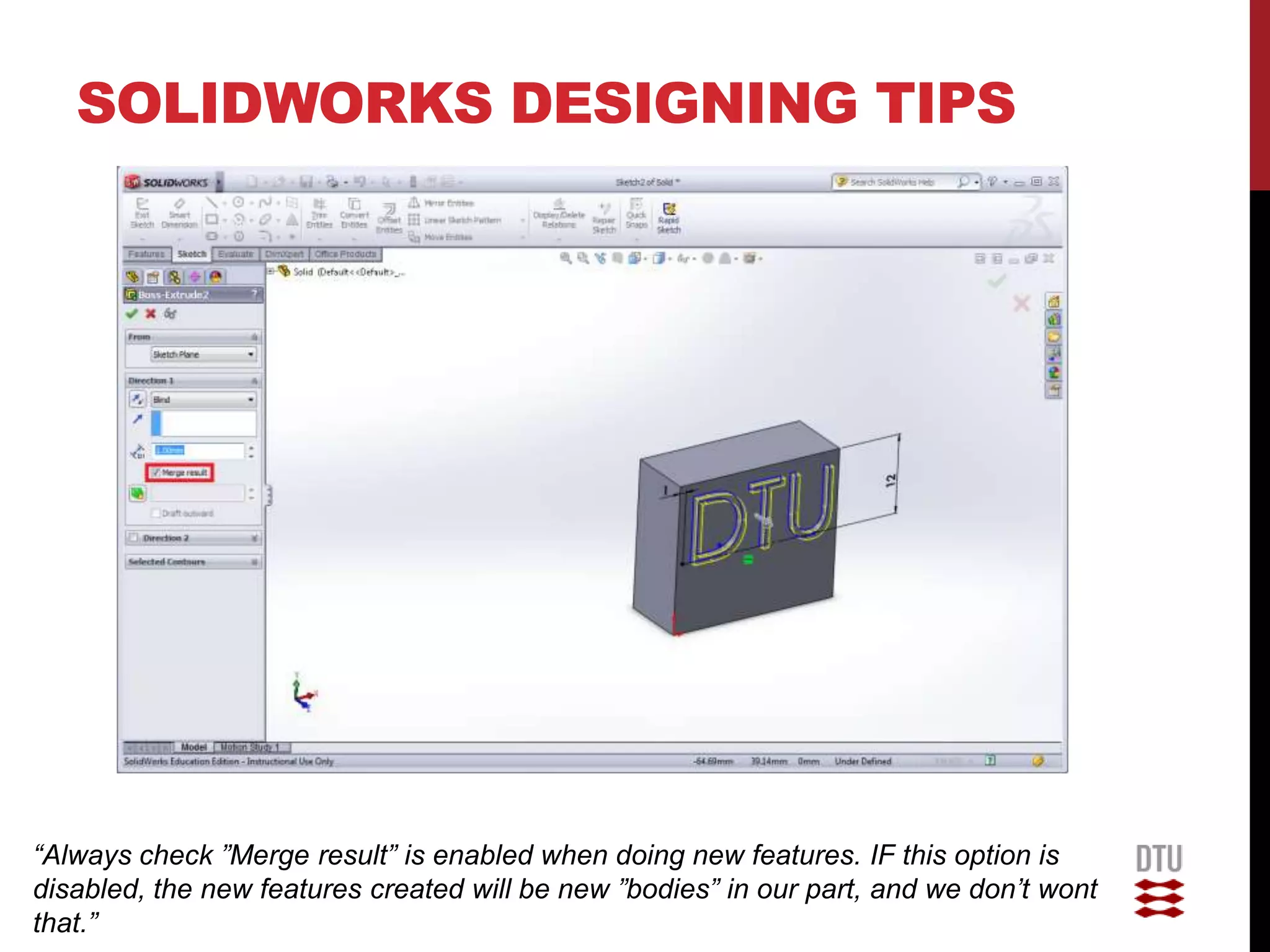
SOLIDWORKS DESIGNING TIPS


“Always check ”Merge result” is enabled when doing new features. IF this option is
disabled, the new features created will be new ”bodies” in our part, and we don’t wont
that.”
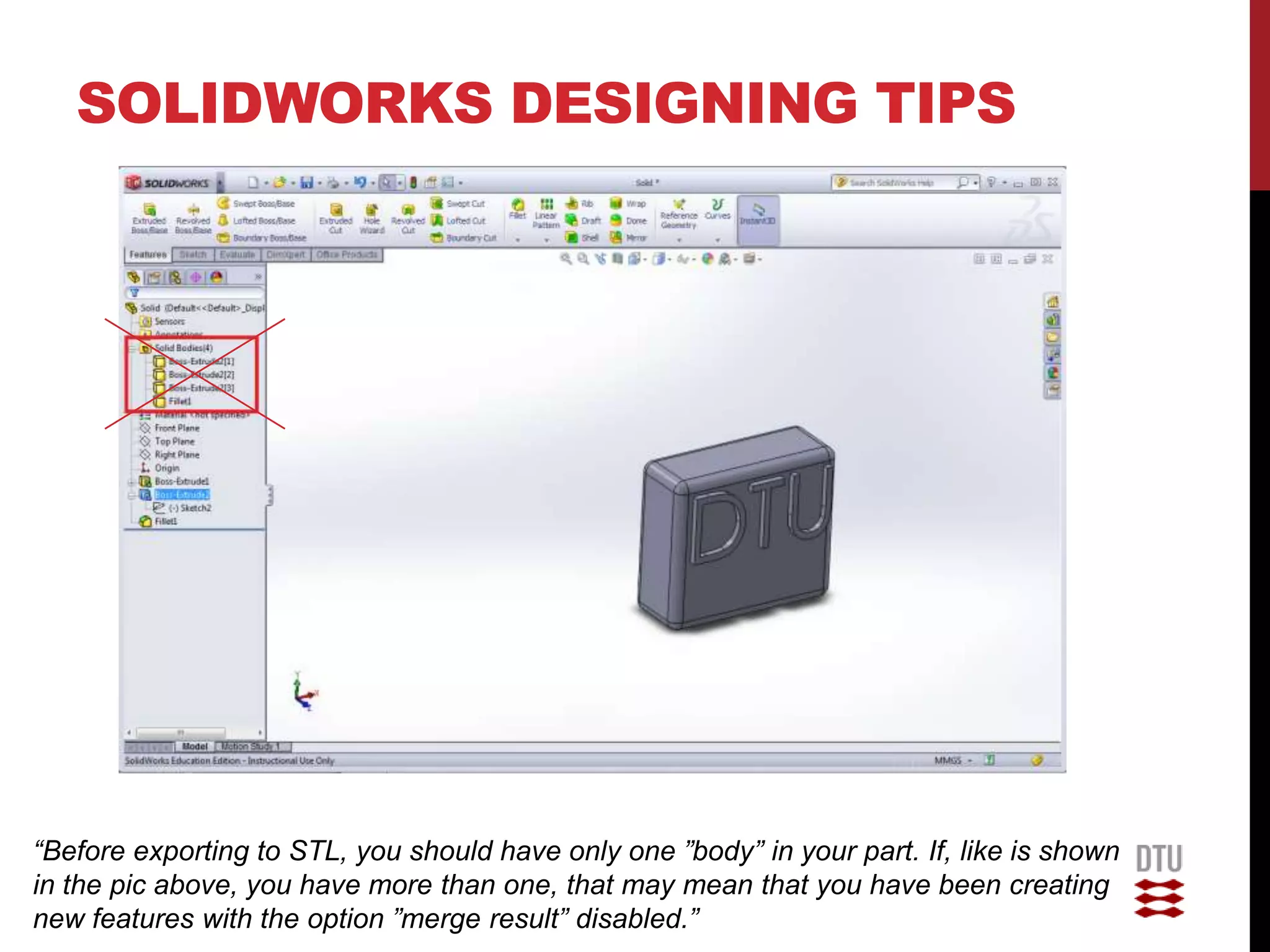
SOLIDWORKS DESIGNING TIPS


“Before exporting to STL, you should have only one ”body” in your part. If, like is shown
in the pic above, you have more than one, that may mean that you have been creating
new features with the option ”merge result” disabled.”
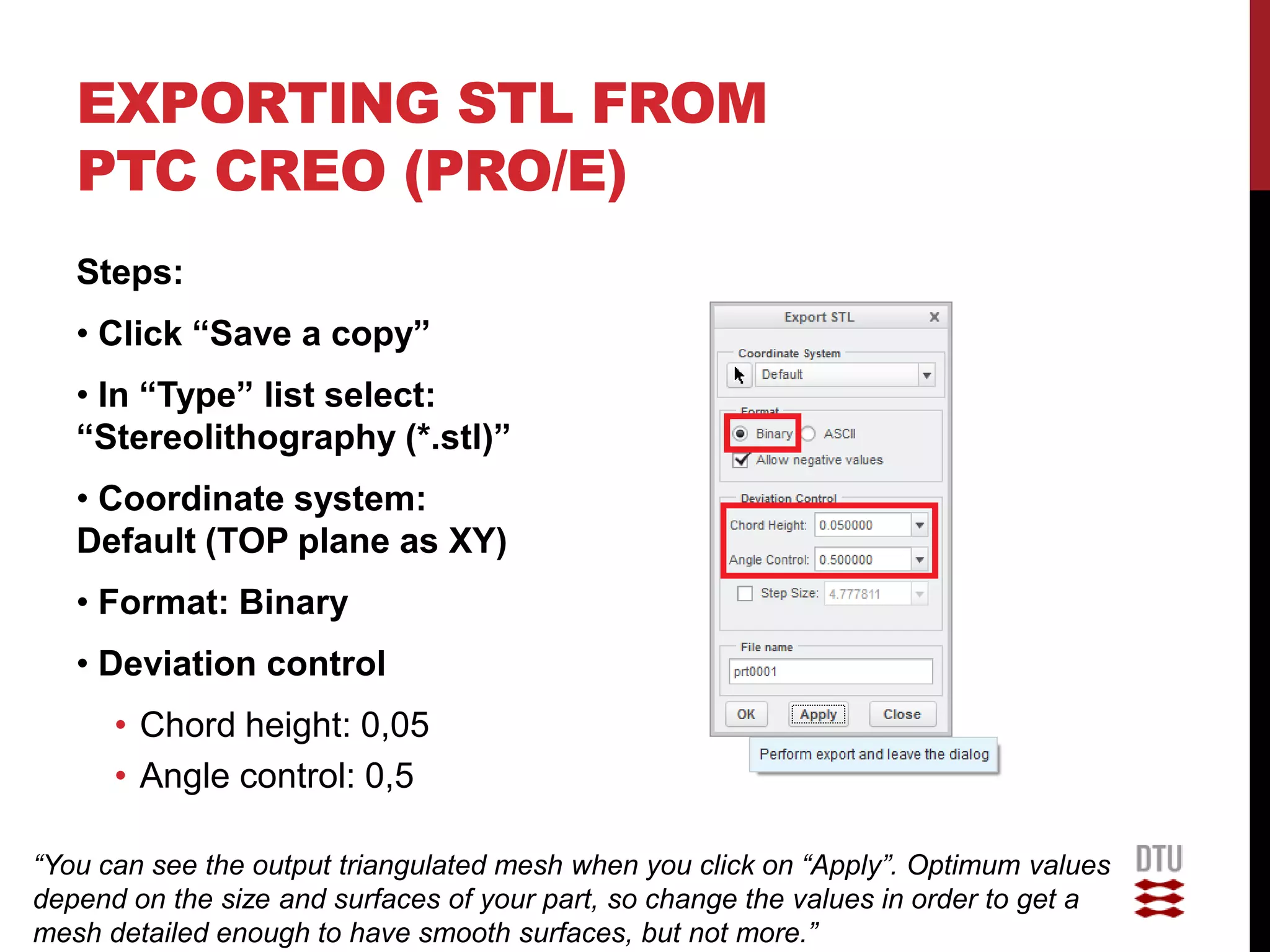
EXPORTING STL FROM
   PTC CREO (PRO/E)
   Steps:
   • Click “Save a copy”
   • In “Type” list select:
   “Stereolithography (*.stl)”
   • Coordinate system:
   Default (TOP plane as XY)
   • Format: Binary
   • Deviation control
      • Chord height: 0,05
      • Angle control: 0,5

“You can see the output triangulated mesh when you click on “Apply”. Optimum values
depend on the size and surfaces of your part, so change the values in order to get a
mesh detailed enough to have smooth surfaces, but not more.”
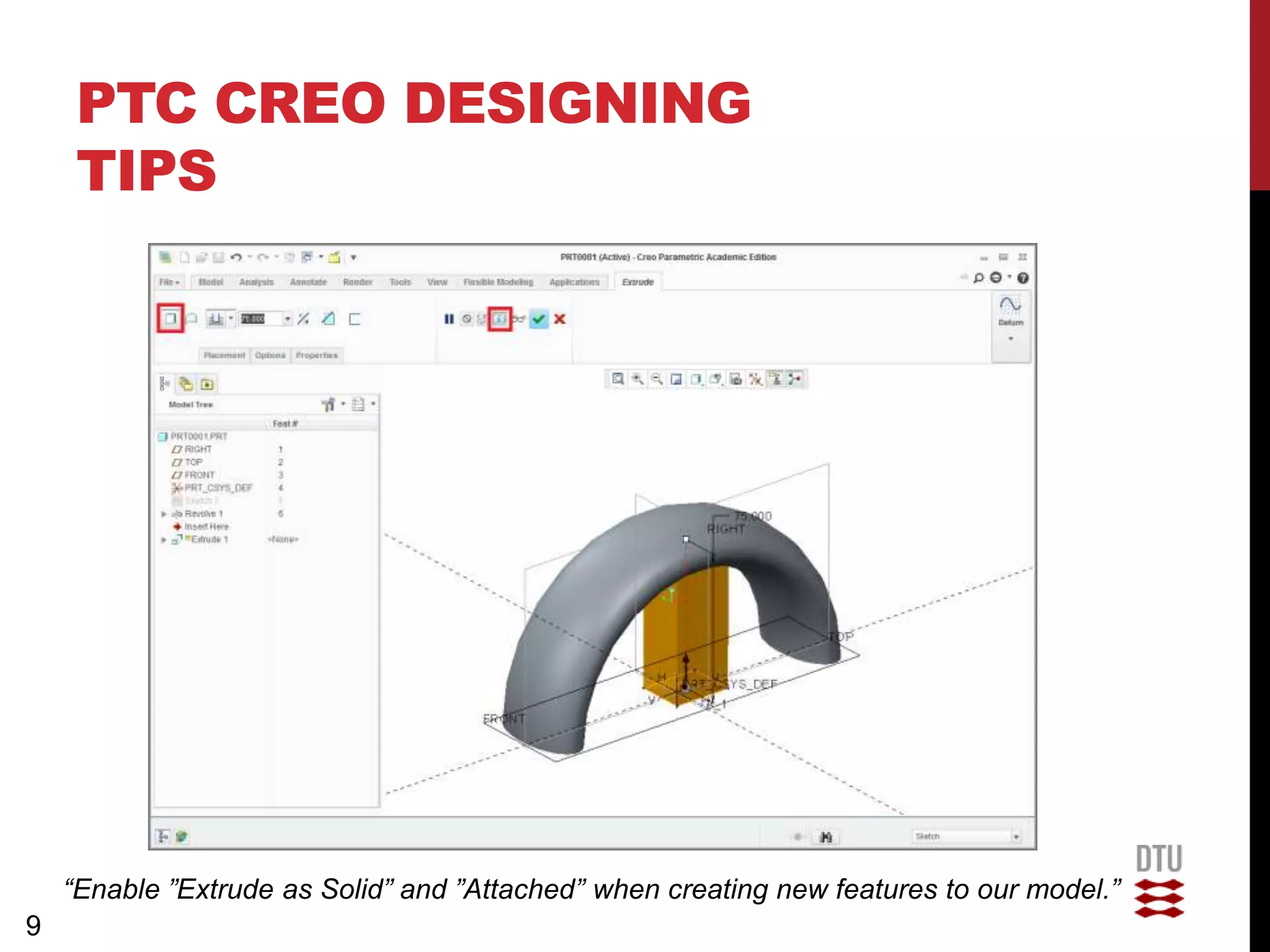
PTC CREO DESIGNING
     TIPS


    “Enable ”Extrude as Solid” and ”Attached” when creating new features to our model.”
9

Exporting to stl

  • 1.
    EXPORTING TO STL WHAT ISAN STL FILE FORMAT AND HOW WE CAN CONVERT OUR CAD INTO STL Greta D’Angelo Martí Bertran Thomas J. Howard
  • 2.
    STL FILES • Standard format for AM production • Triangular mesh representation of a 3D surface geometry • More triangles  higher definition • Find the compromise between the definition and the lowest possible file size  High sized files may not be processed by the Gcode generator software • Adding more triangles doesn't mean to obtain a more accurate built part, because the definition that can give the machine may be not as high “Standard Tessellation Language (STL) file is a triangular representation of a 3D surface geometry. The surface is tessellated logically into a set of oriented triangles (facets). Each facet is described by the unit outward normal and three points listed in counterclockwise order representing the vertices of the triangle. While the aspect ratio and orientation of individual facets is governed by the surface curvature, the size of the facets is driven by the tolerance controlling the quality of the surface representation in terms of the distance of the facets from the surface. The choice of the tolerance is strongly dependent on the target application of the produced STL file. In industrial processing, where stereo lithography machines perform a computer controlled layer by layer laser curing of a photo-sensitive resin, the tolerance may be in order of 0.1 mm to make the produced 3D part precise with highly worked out details. However much larger values are typically used in pre-production STL prototypes, for example for visualization purposes.”
  • 3.
    EXPORTING STL FROM SOLIDWORKS The orientation of the building platform is the XY plane (FRONT PLANE in solidworks) Steps: • Click “Save as” • In “Save as type” list select: “STL (*.stl)” • Click “Options” • Output: Binary • Unit: Millimetres • Resolution: Custom • Deviation: 0,02 - 0,05 • Angle: 15º - 20º “Deviation and angle default values for “Coarse” and “Fine” depends on the surfaces and size of the model we want to export, the optimised values will always 3 be between these two values.”
  • 4.
    EXPORTING STL FROM SOLIDWORKS Steps for Solidworks Student Design Kit • File  Save As … • Set type to “eDrawings(*.eprt)” • Click “Options...” • Enable “Allow export to STL for Parts & Assemblies” • Click OK • Enter Filename  Save • Open part in Solidworks eDrawings • File  Save as…  select type STL Files (*.stl) • Save “With this way, you can’t choose the resolution of the output STL file, and it’s not the best. So avoid this system if your model has characteristic curved surfaces. Solidworks Edition on DTU Databar PC’s let you to export direcly to STL from 4 solidworks. So only use that method if you have the Student design kit.”
  • 5.
    EXPORTING STL FROM SOLIDWORKS “When exporting from an assembly, make sure you have ”Save all components of an assembly in a single file” is DISABLED, and all the components will be saved individually.”
  • 6.
    SOLIDWORKS DESIGNING TIPS “Alwayscheck ”Merge result” is enabled when doing new features. IF this option is disabled, the new features created will be new ”bodies” in our part, and we don’t wont that.”
  • 7.
    SOLIDWORKS DESIGNING TIPS “Beforeexporting to STL, you should have only one ”body” in your part. If, like is shown in the pic above, you have more than one, that may mean that you have been creating new features with the option ”merge result” disabled.”
  • 8.
    EXPORTING STL FROM PTC CREO (PRO/E) Steps: • Click “Save a copy” • In “Type” list select: “Stereolithography (*.stl)” • Coordinate system: Default (TOP plane as XY) • Format: Binary • Deviation control • Chord height: 0,05 • Angle control: 0,5 “You can see the output triangulated mesh when you click on “Apply”. Optimum values depend on the size and surfaces of your part, so change the values in order to get a mesh detailed enough to have smooth surfaces, but not more.”
  • 9.
    PTC CREO DESIGNING TIPS “Enable ”Extrude as Solid” and ”Attached” when creating new features to our model.” 9

Editor's Notes

  • #6 When exporting from an assembly, make sure you have ”Save all components of an assembly in a single file” is DISABLED, and all the components will be saved individually
  • #7 Always check ”Mergeresult” is enabledwhendoing new features. IF this option is disabled, the new features createdwillbe new ”bodies” in our part, and wedon’twontthat.
  • #8 Before exporting to STL, you should have only one ”body” in your part. If, like is shown in the pic above, you have more than one, that may mean that you have been creating new features with the option ”merge result” disabled.
  • #10 Enable ”Extrude as Solid” and ”Attached” whencreating new features to our model