Additive manufacturing
carmelo.demaria@centropiaggio.unipi.it
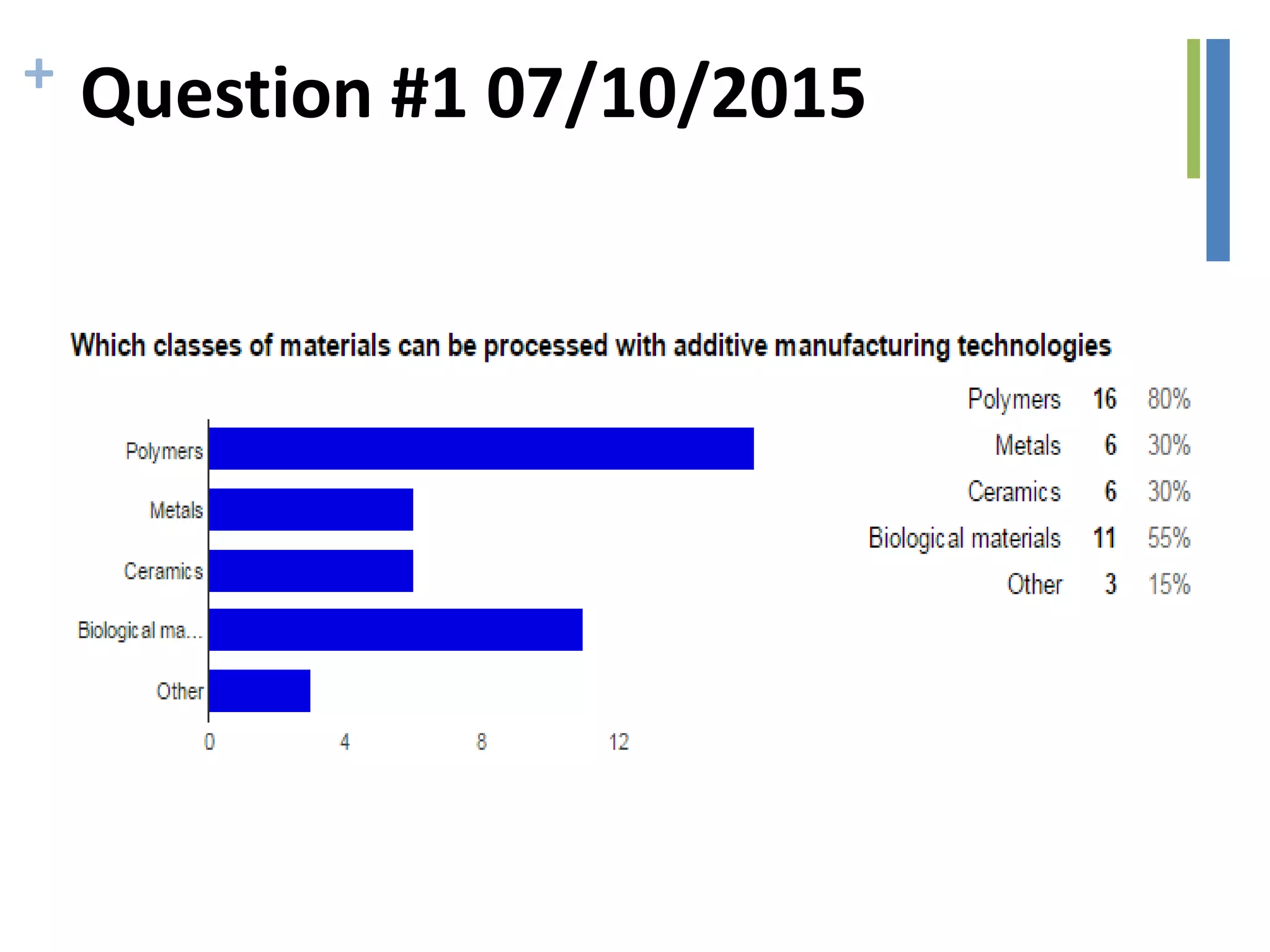
+ Question #1 07/10/2015
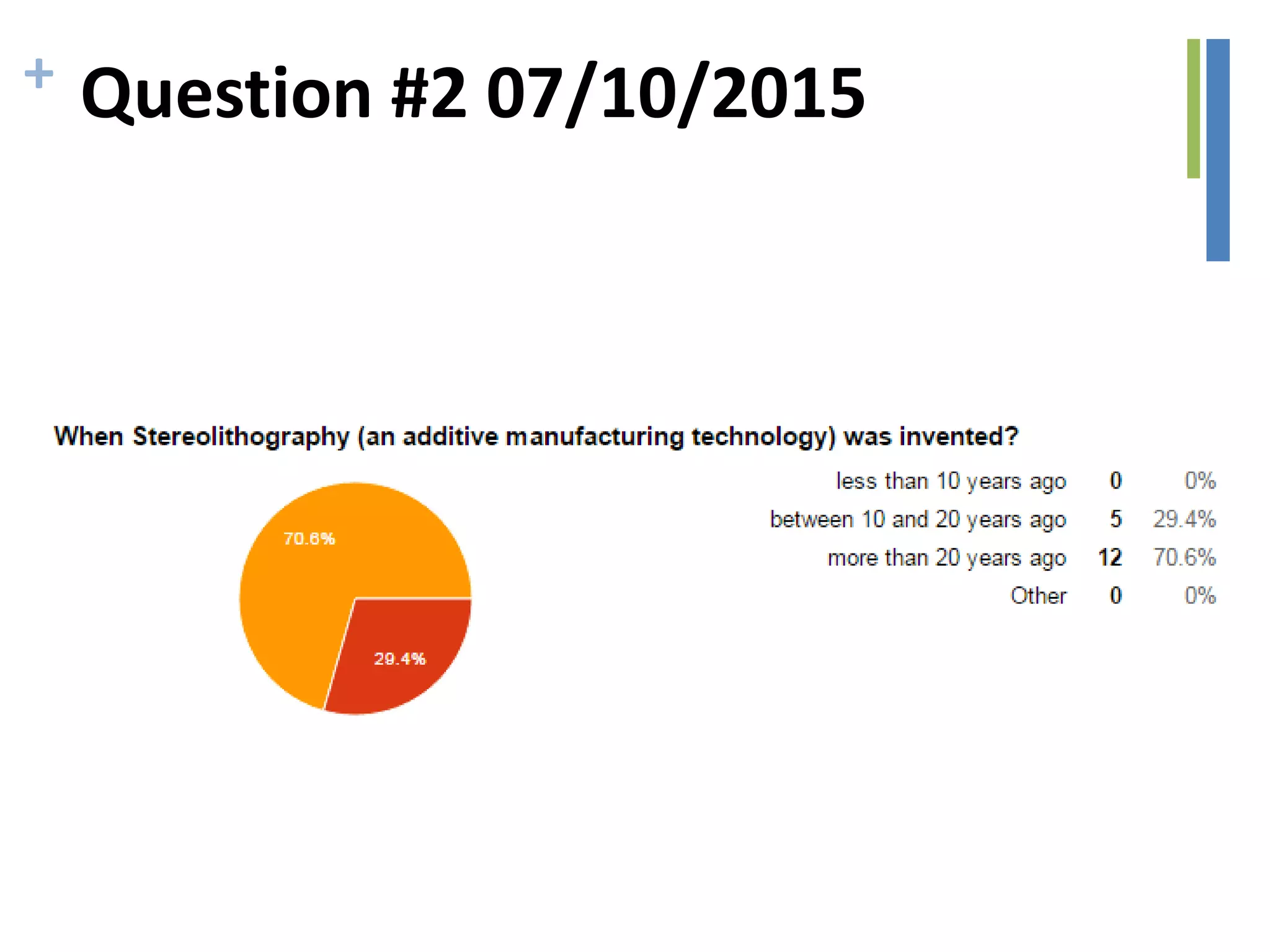
+ Question #2 07/10/2015
MEDICAL APPLICATION
OF RAPID PROTOTYPING
+ Invisalign Orthodontic Aligners
• An aligner for orthodontic use manufactured using
a combination of rapid tooling and
thermoforming.
Manufacturing, Engineering & Technology, Fifth Edition, by Serope Kalpakjian and Steven R. Schmid.
ISBN 0-13-148965-8. © 2006 Pearson Education, Inc., Upper Saddle River, NJ. All rights reserved.
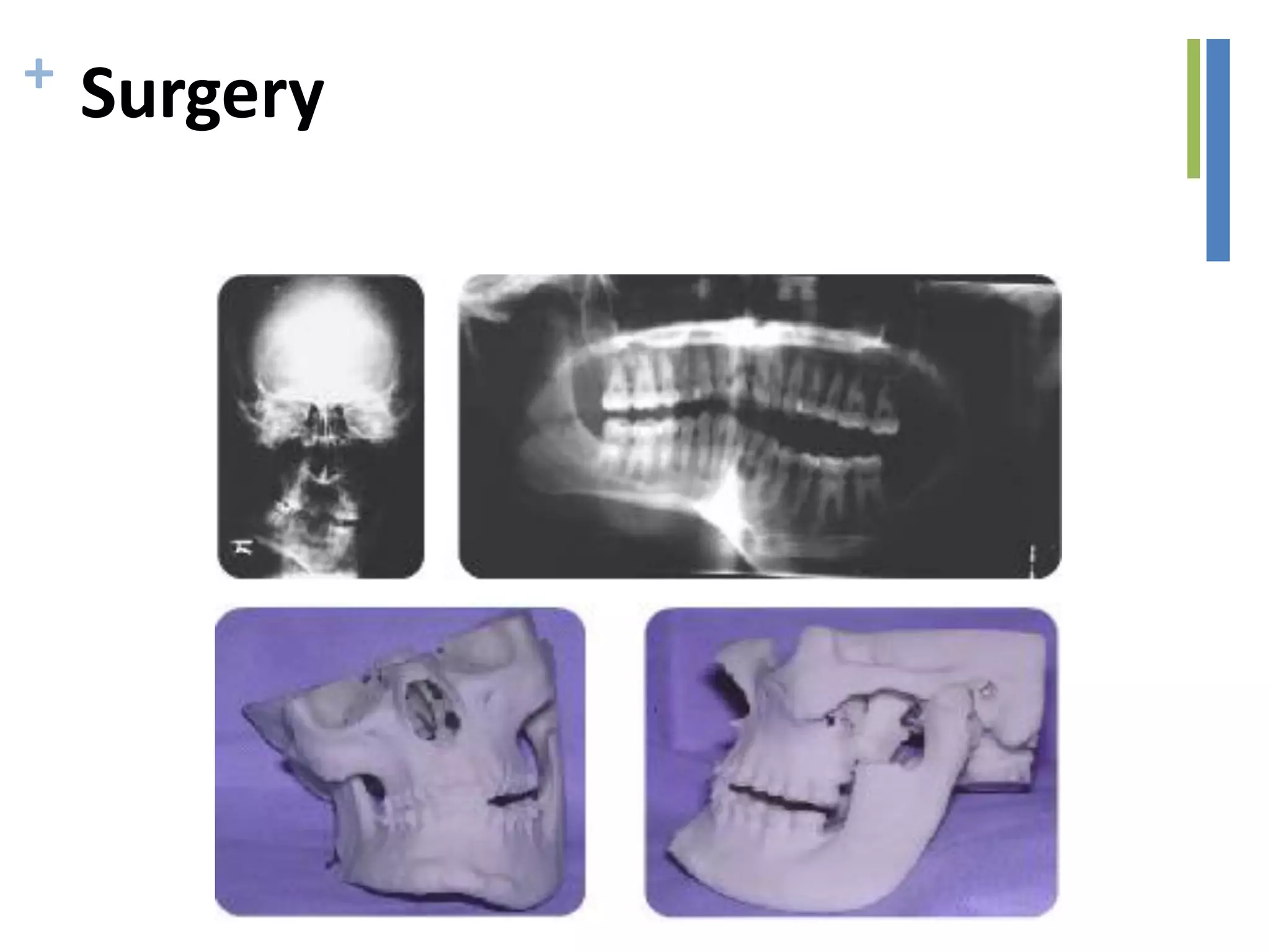
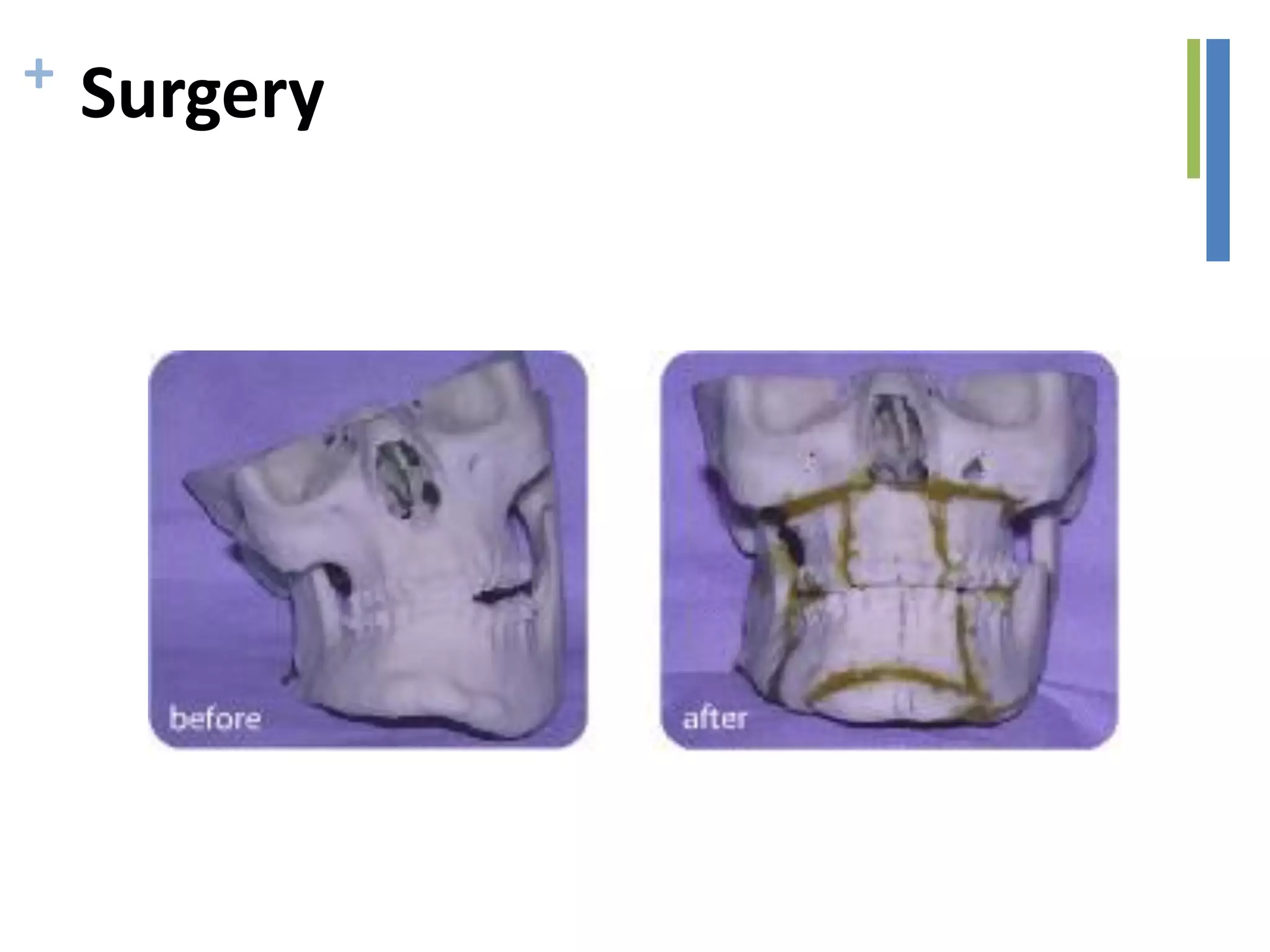
+ Surgery
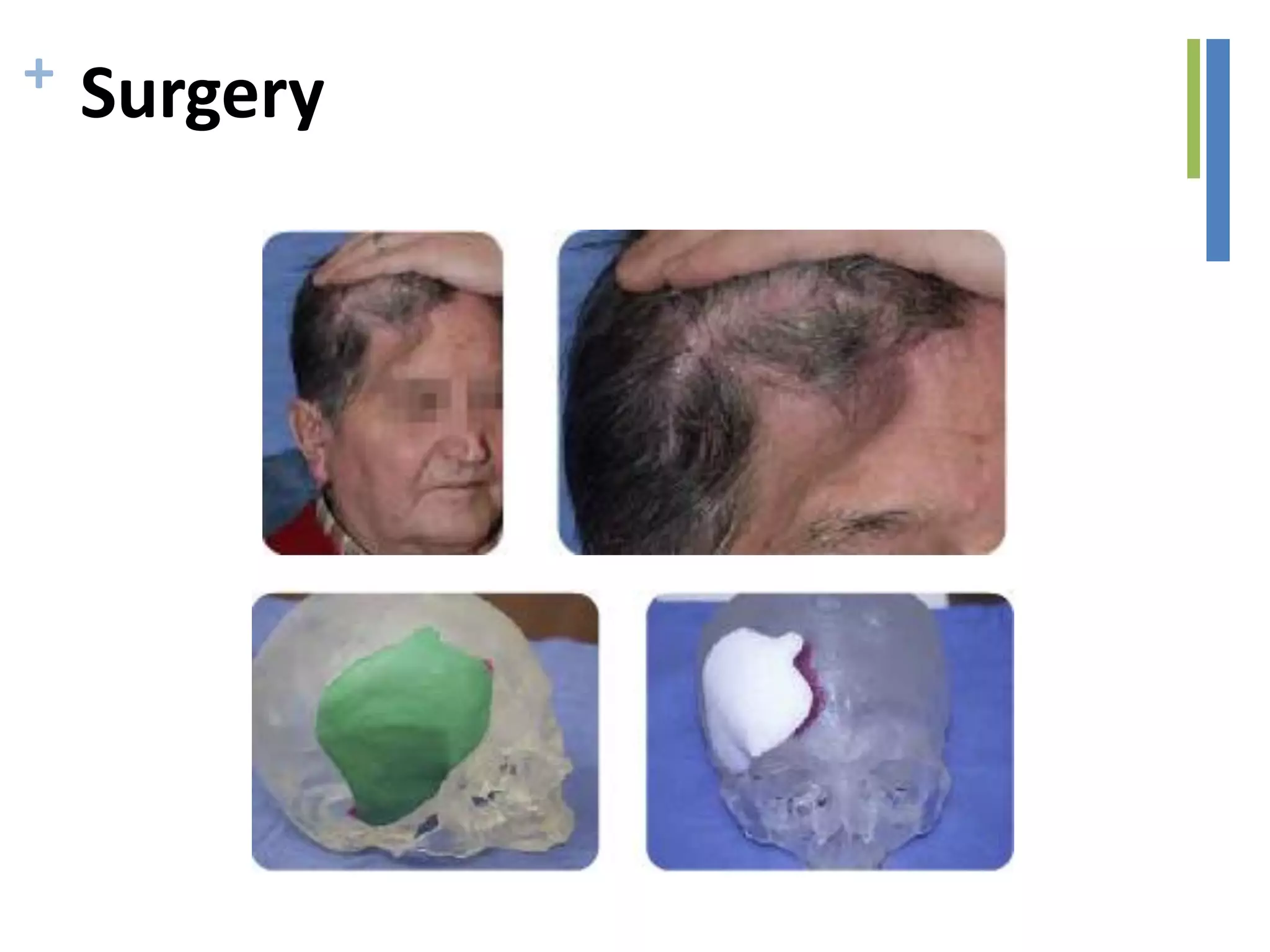
+ Surgery
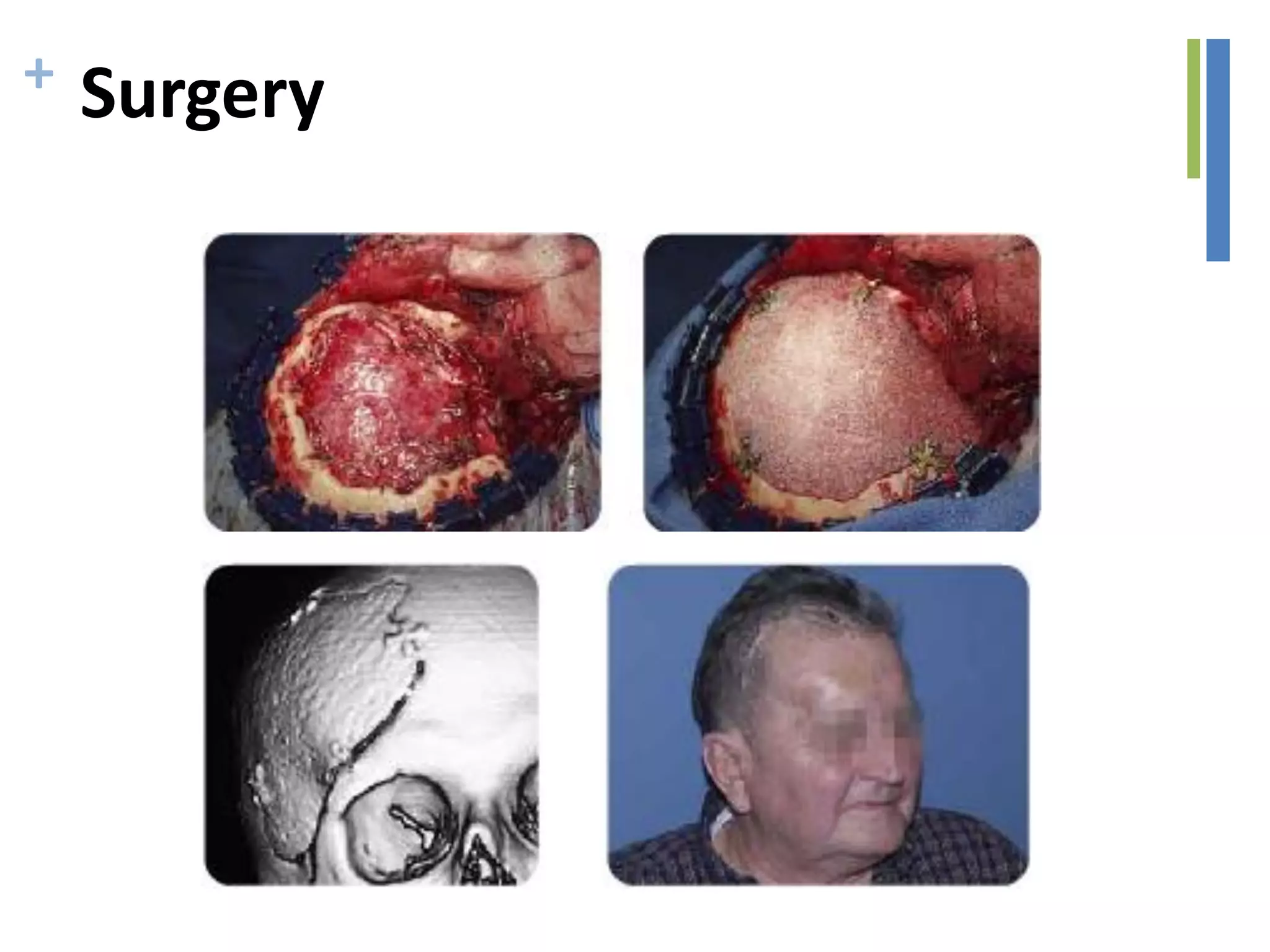
+ Surgery
+ Surgery
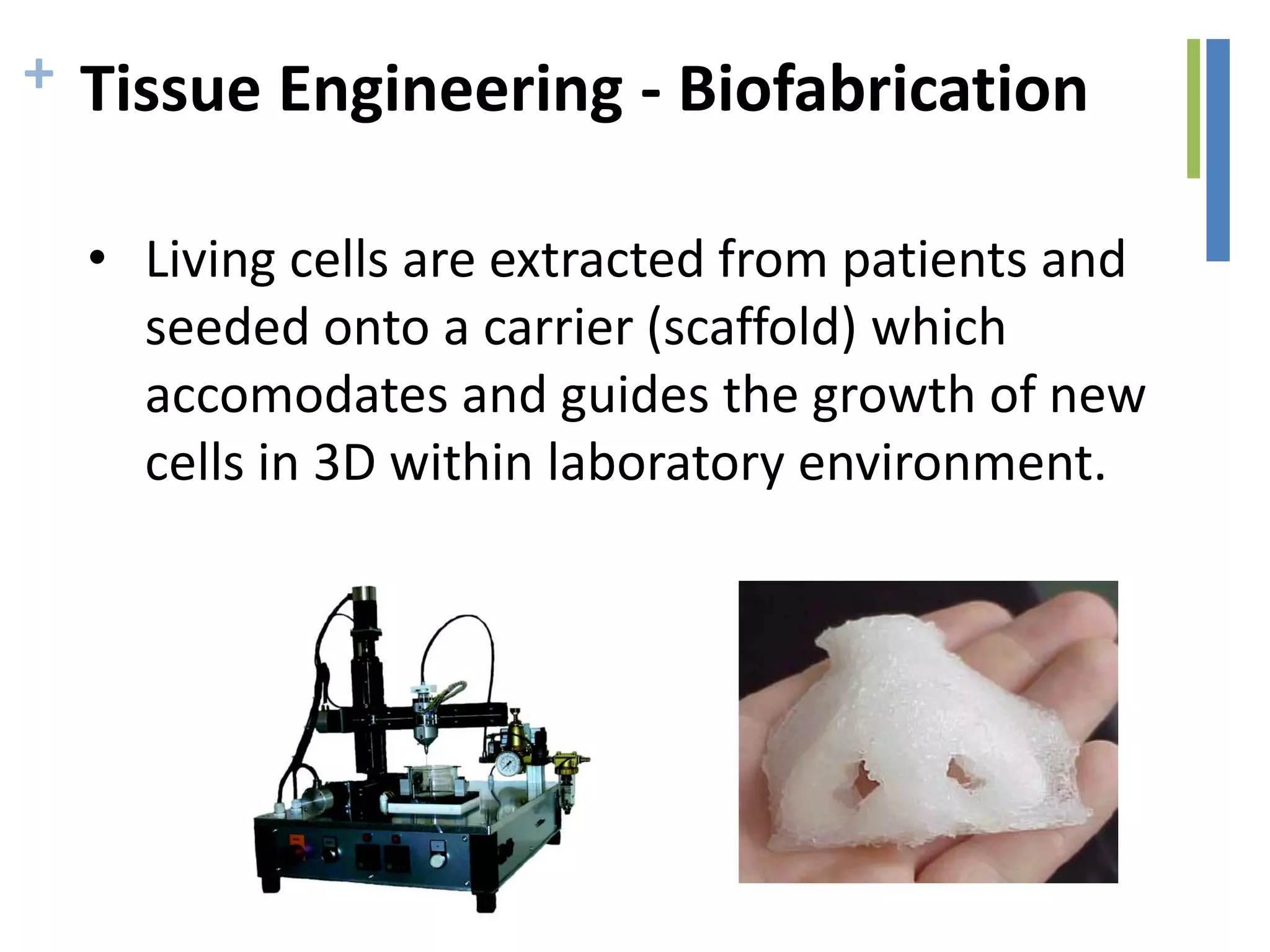
+ Tissue Engineering - Biofabrication
• Living cells are extracted from patients and
seeded onto a carrier (scaffold) which
accomodates and guides the growth of new
cells in 3D within laboratory environment.
+ Tissue Engineering - Biofabrication
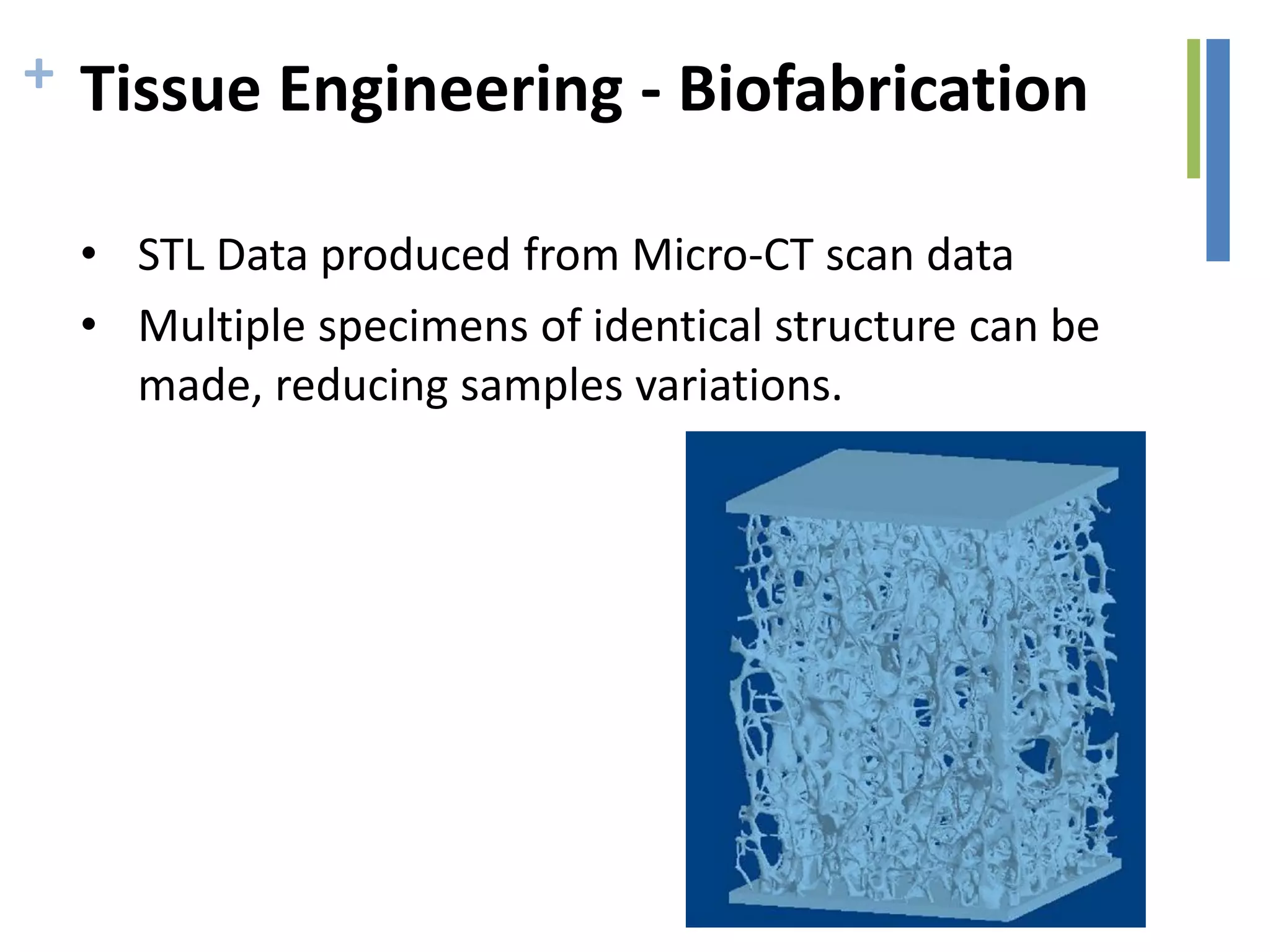
• STL Data produced from Micro-CT scan data
• Multiple specimens of identical structure can be
made, reducing samples variations.
OPEN QUESTION
+ Open questions
• WHICH ARE THE INTELLECTUAL PROPERTY
IMPLICATIONS OF
LOW-COST 3D PRINTING?
• IS THE OPEN SOURCE 3-D PRINTING AN ENABLING
TECHNOLOGY FOR SELF-DIRECTED SUSTAINABLE
DEVELOPMENT?
• CAN A 3D PRINTED ORGAN BE PATENTED?
Software for
Additive manufacturing
carmelo.demaria@centropiaggio.unipi.it
+ Additive manufacturing
Process Flow
• Solid Modelling
• Tesselation/Generation of STL file
• Support Generation
• “Slicing” of the Model
• Model Physical Buildup
• Cleanup and Post Curing
• Surface Finishing
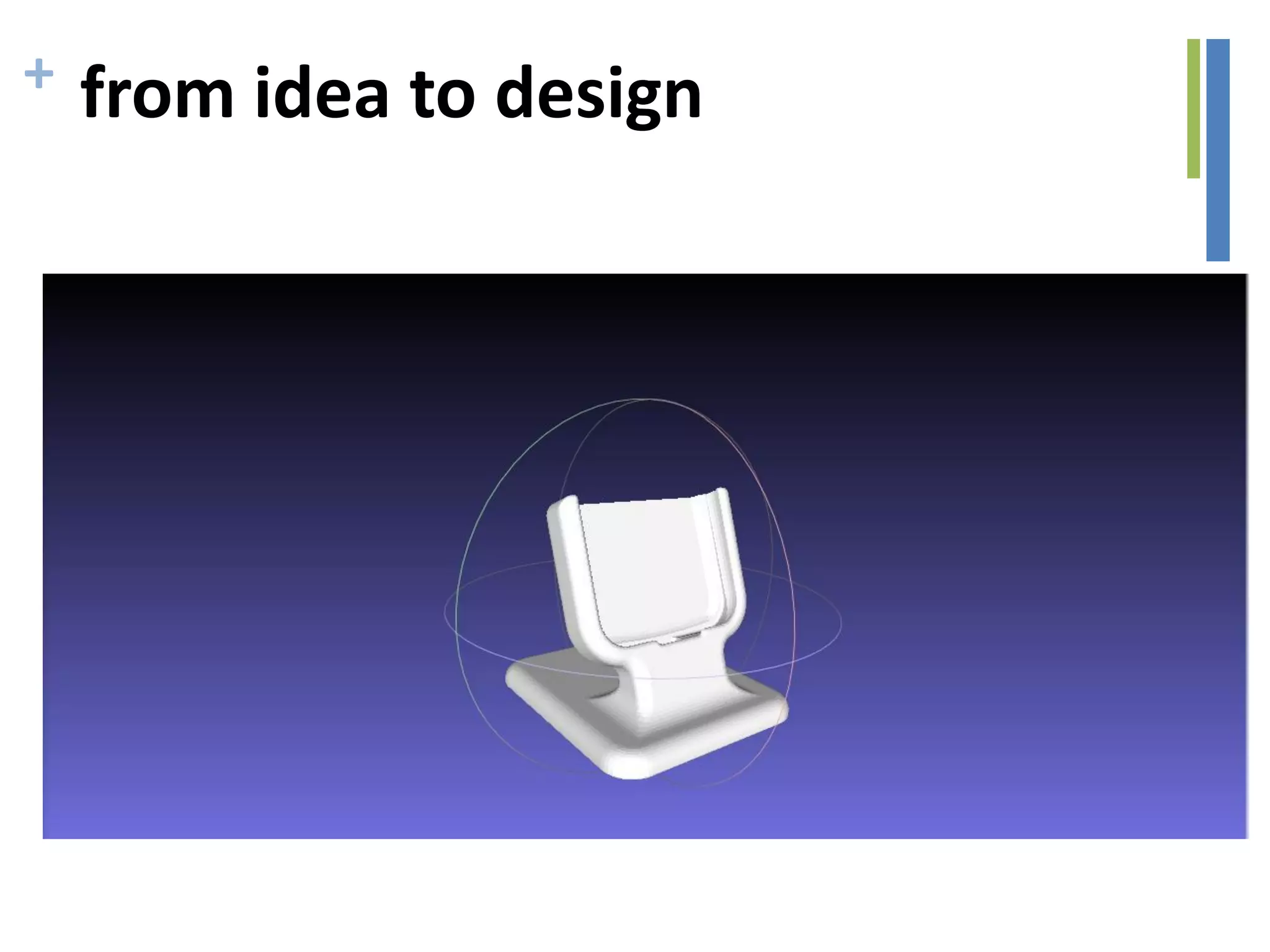
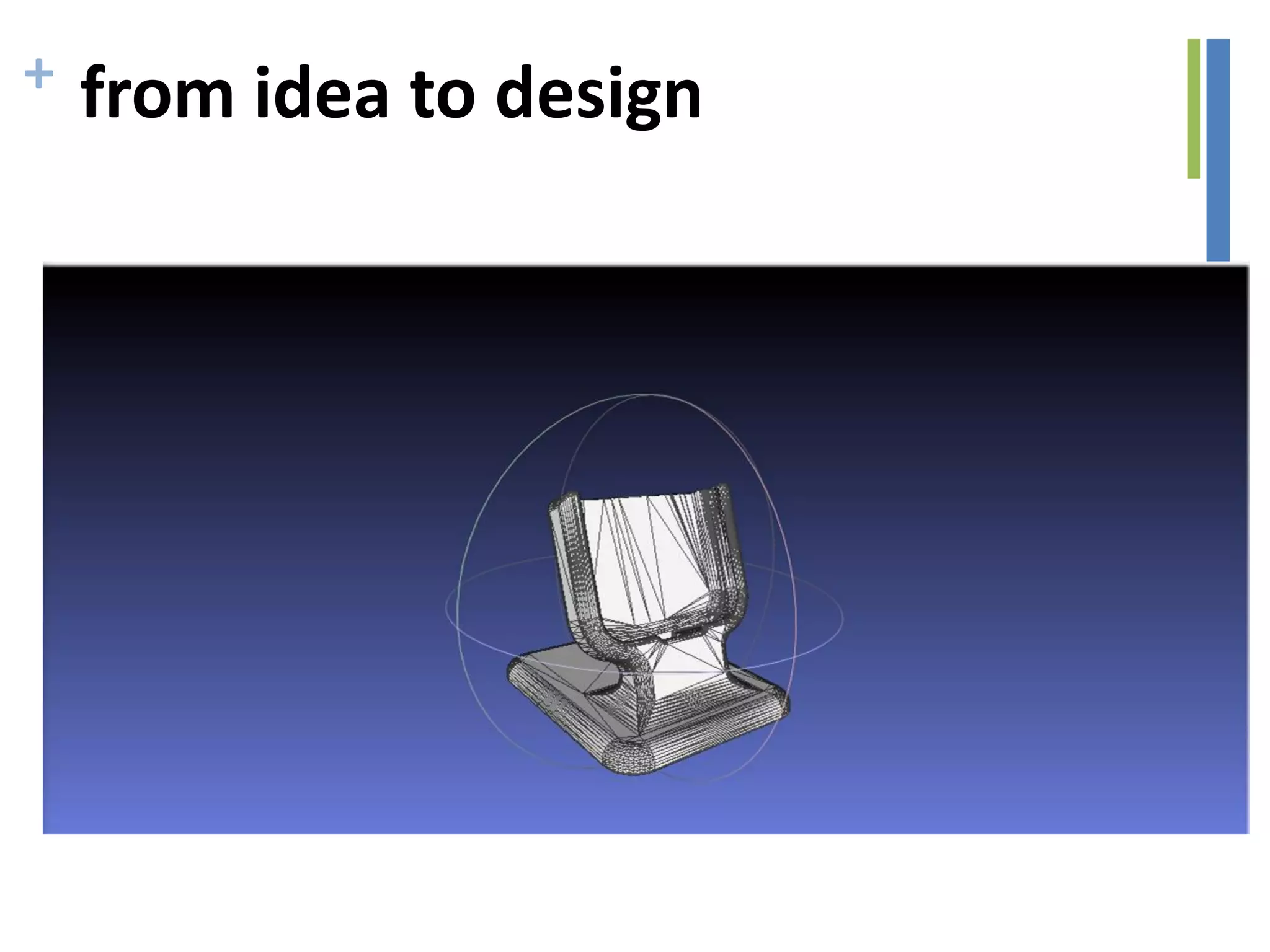
+ from idea to design
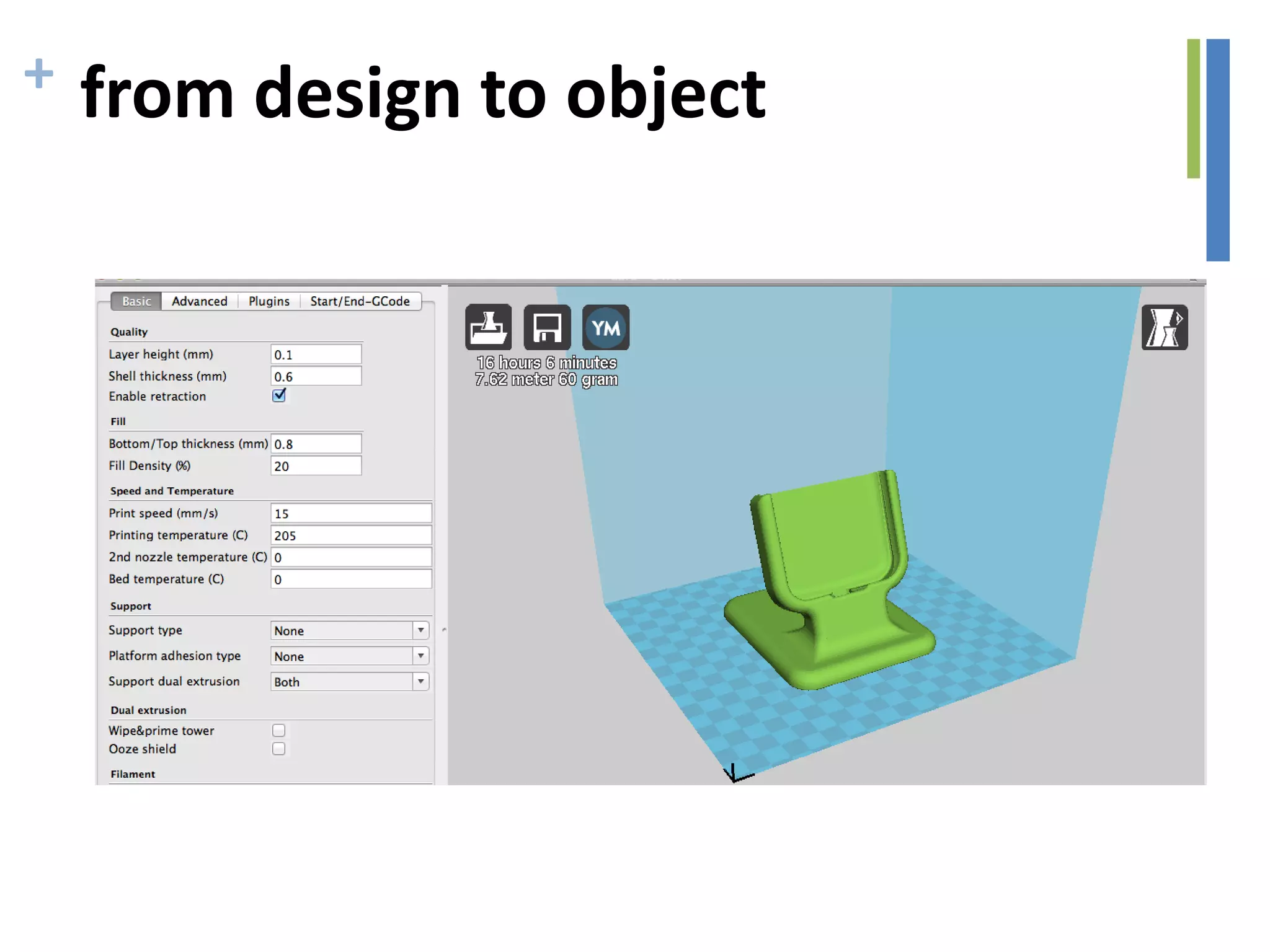
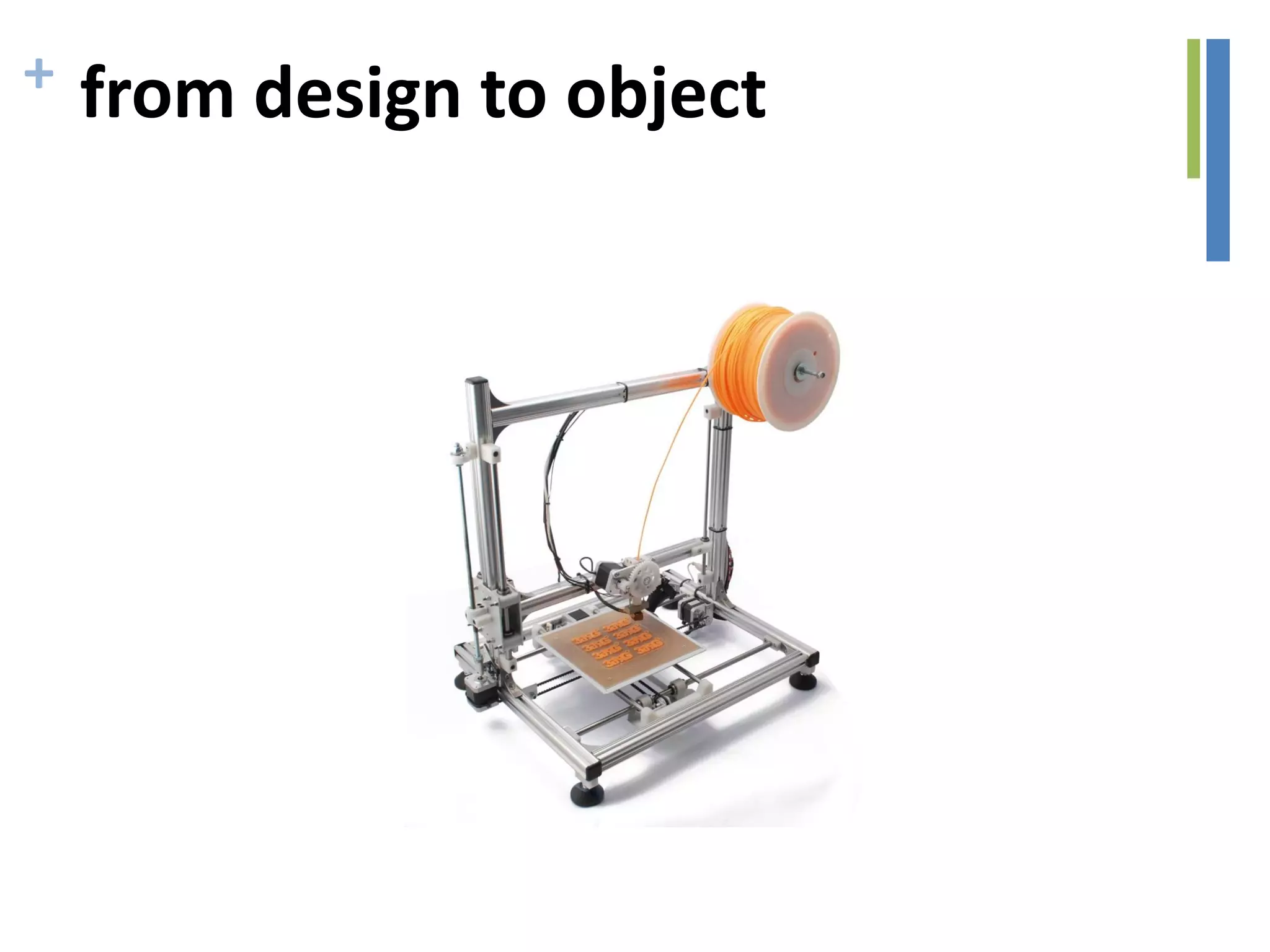
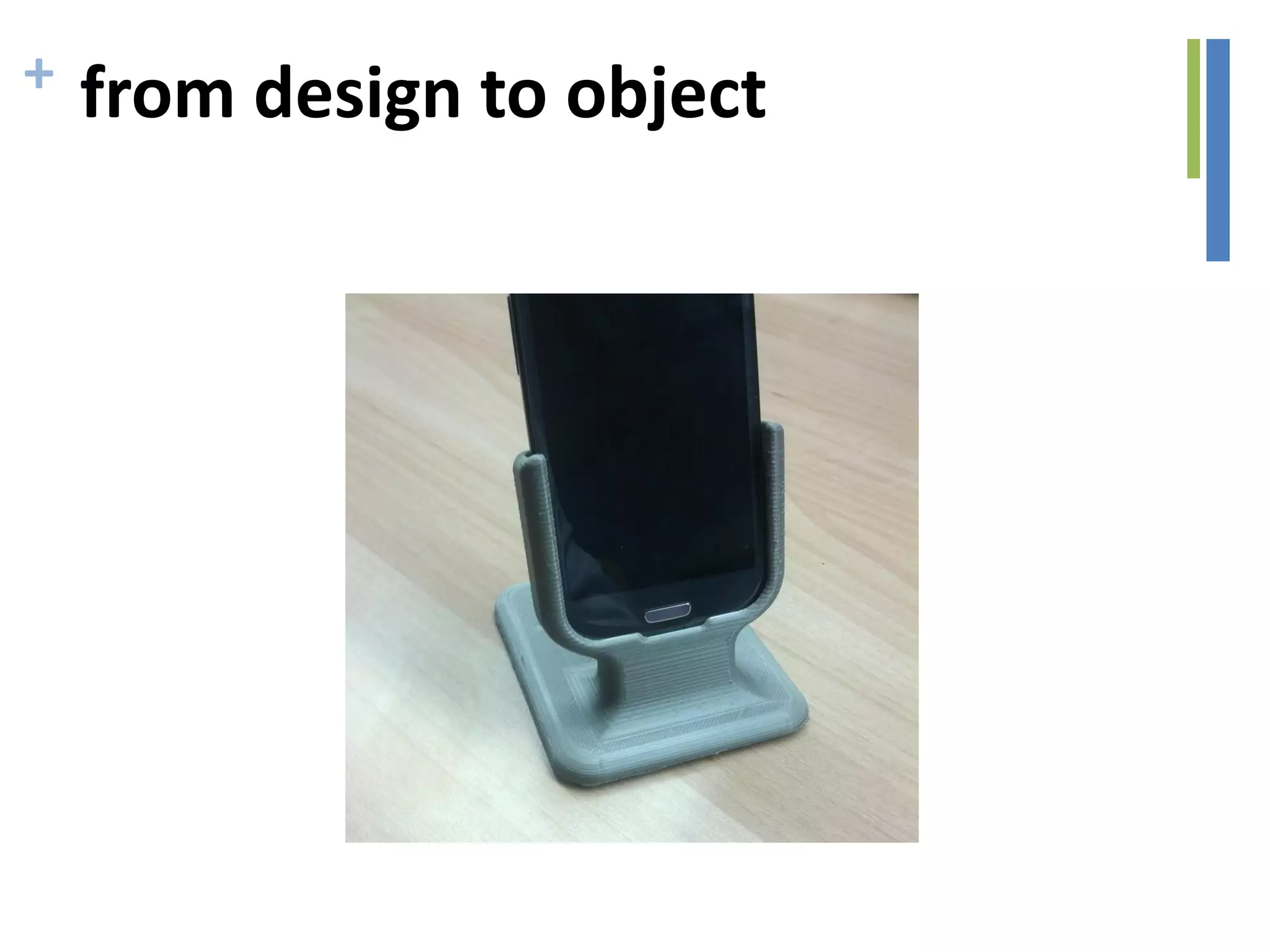
+ from design to object
+
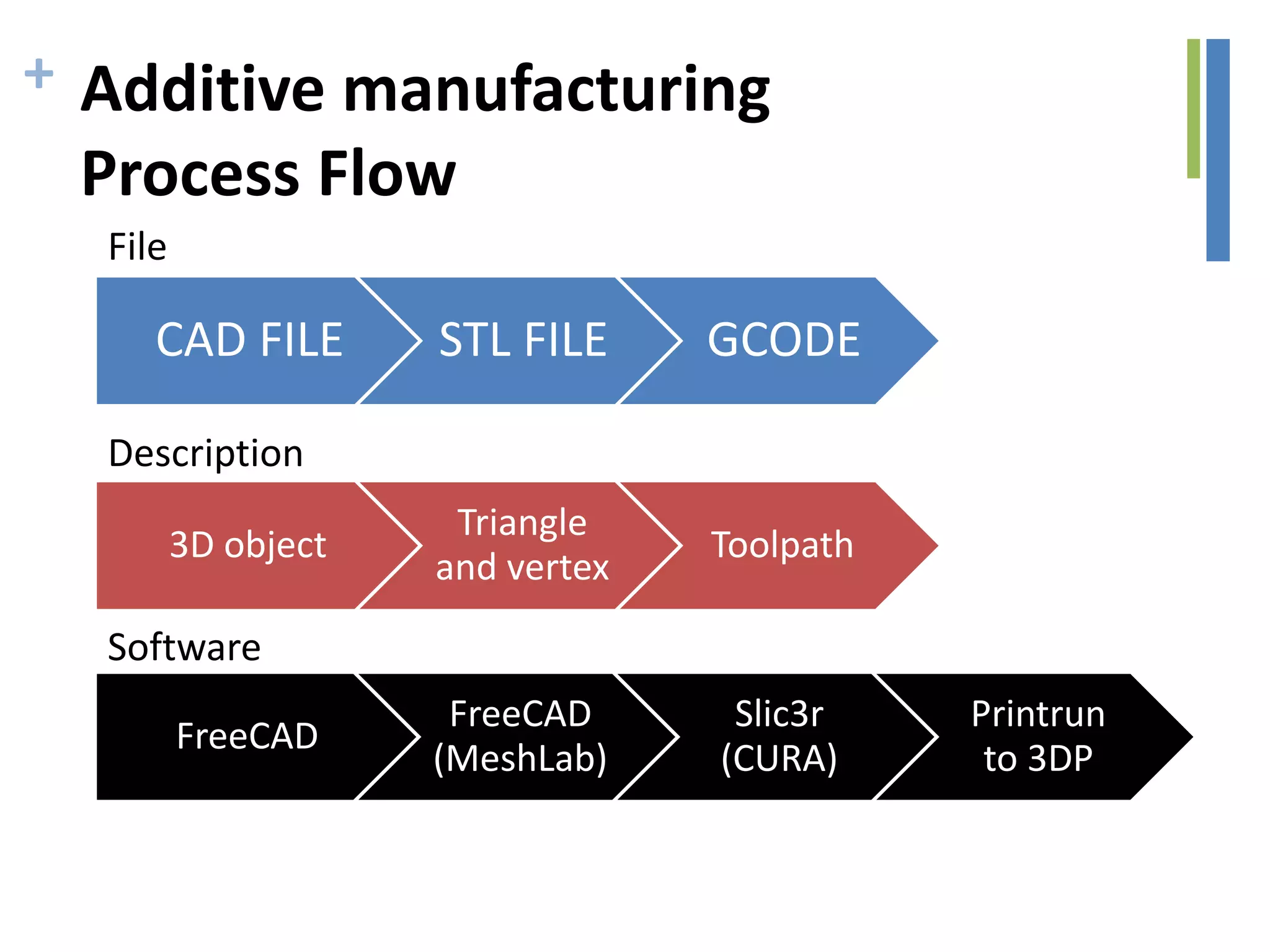
CAD FILE STL FILE GCODE
3D object
Triangle
and vertex
Toolpath
FreeCAD
FreeCAD
(MeshLab)
Slic3r
(CURA)
Printrun
to 3DP
File
Description
Software
Additive manufacturing
Process Flow
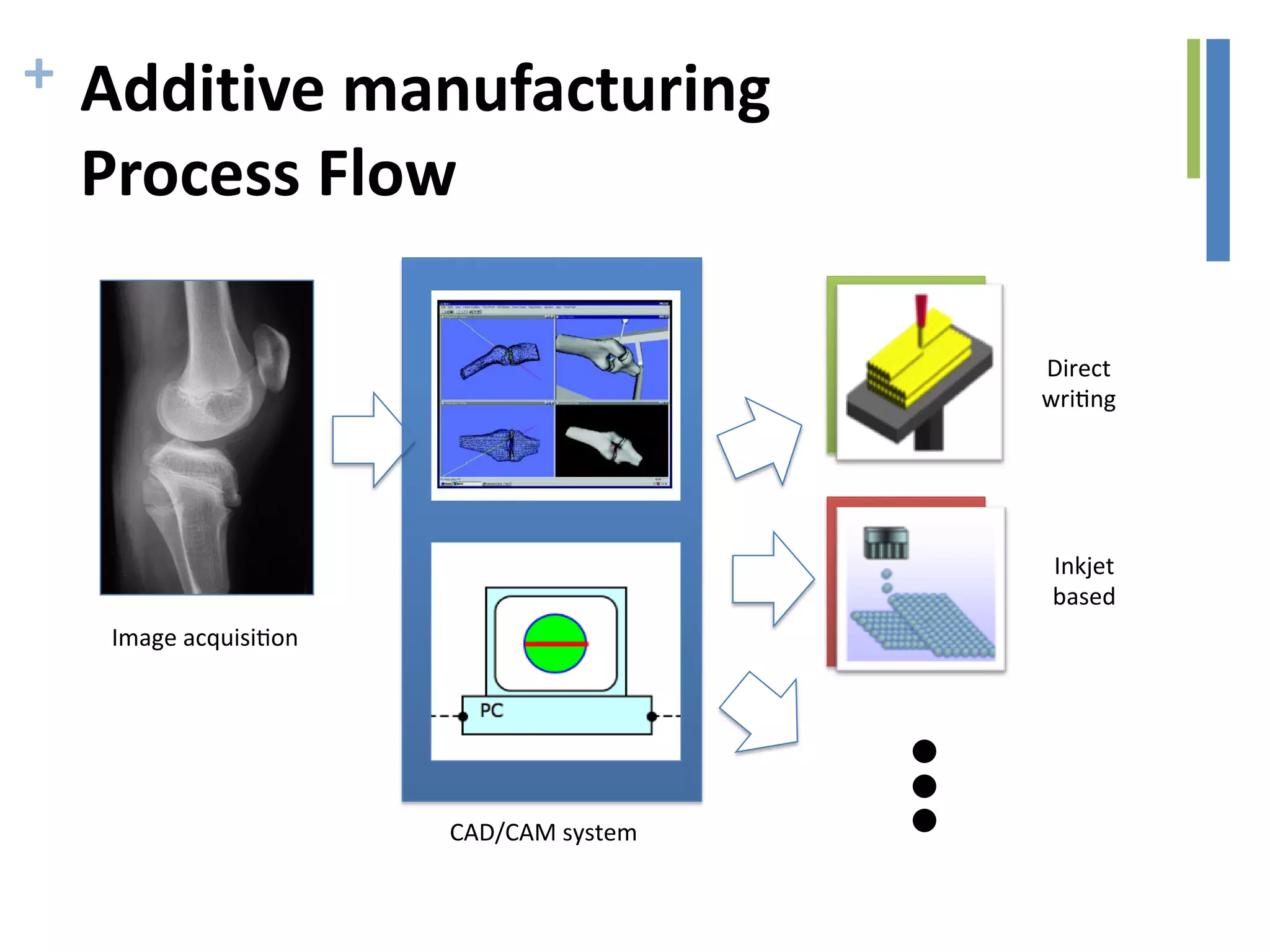
+ Additive manufacturing
Process Flow
CAD/CAM system
Image acquisi on
Inkjet
based
Direct
wri ng
DATA SOURCE
+ Data source
• Representation of a volume
– CAD model
– Instruments output
• CT
• RM
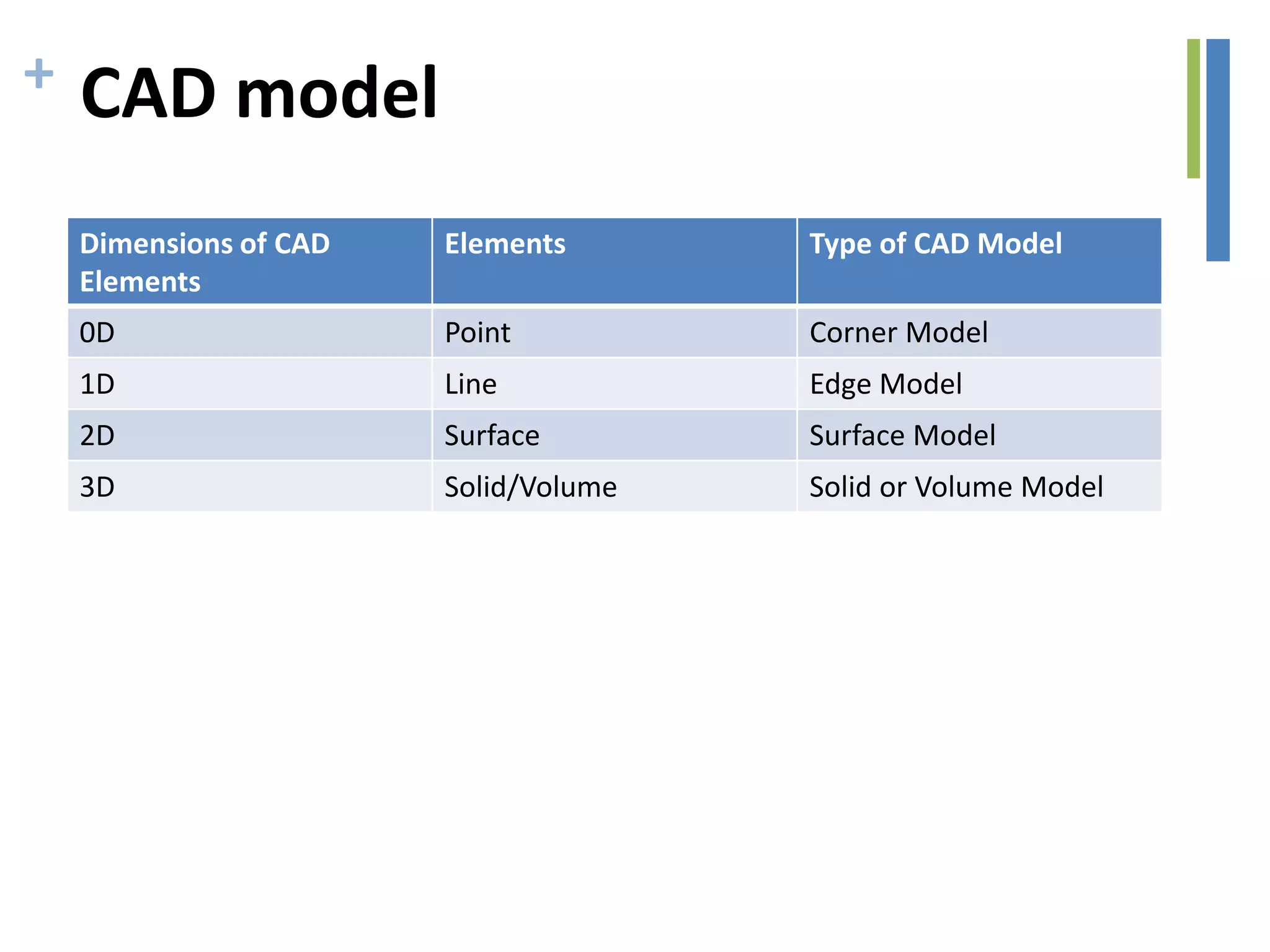
+ CAD model
Dimensions of CAD
Elements
Elements Type of CAD Model
0D Point Corner Model
1D Line Edge Model
2D Surface Surface Model
3D Solid/Volume Solid or Volume Model
FROM MEDICAL IMAGES TO STL
Example 1
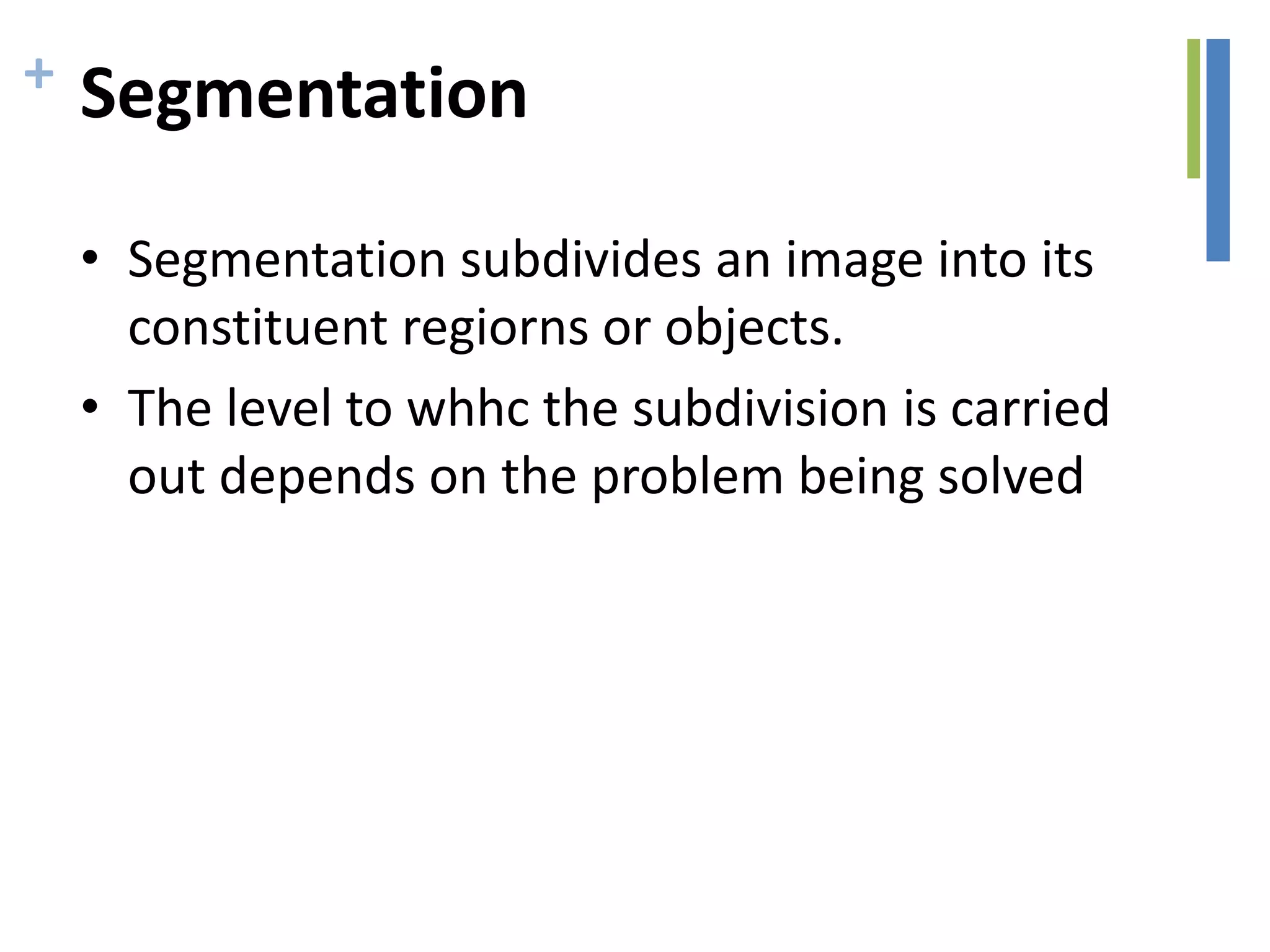
+ Segmentation
• Segmentation subdivides an image into its
constituent regiorns or objects.
• The level to whhc the subdivision is carried
out depends on the problem being solved
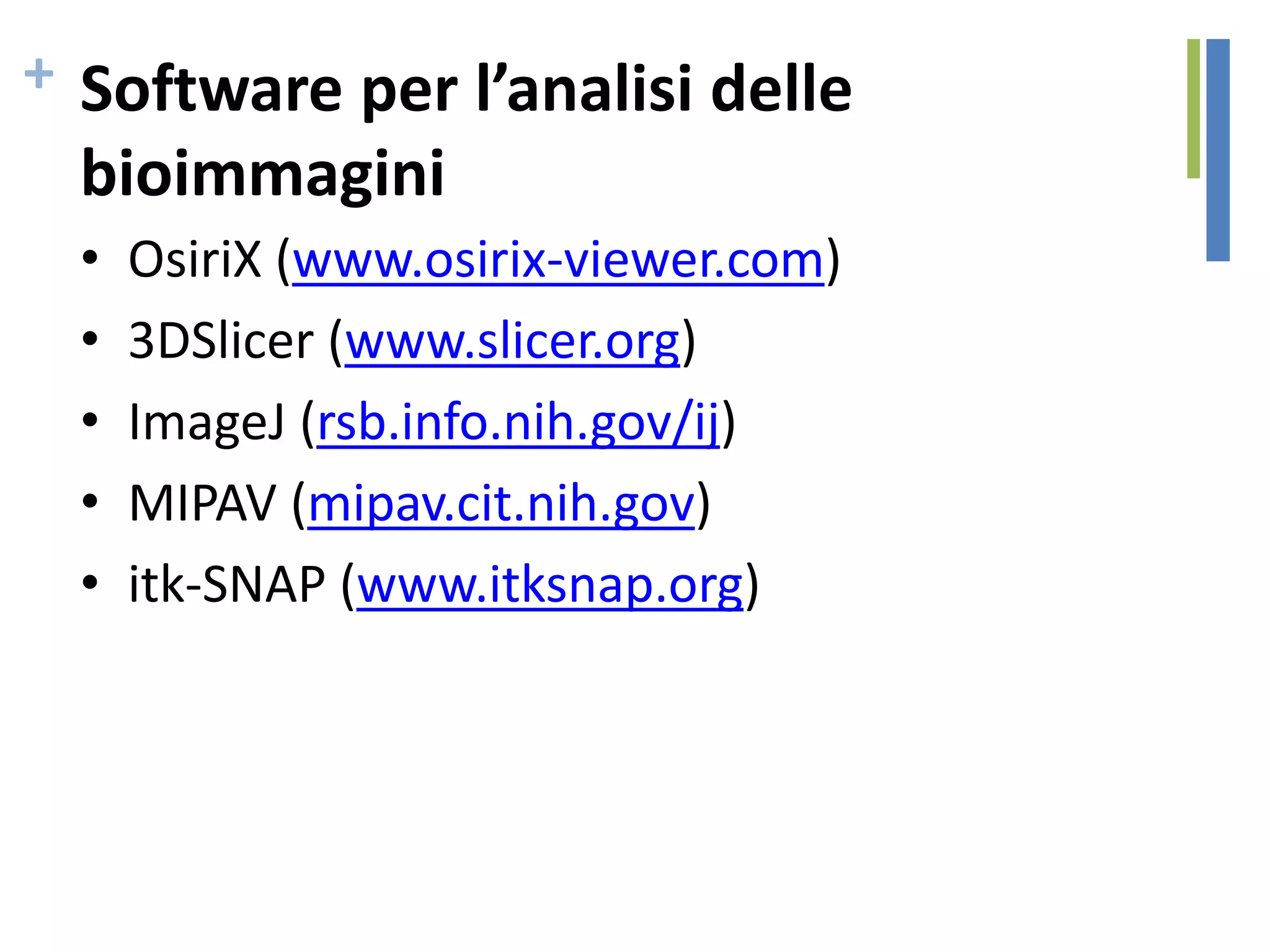
+ Software per l’analisi delle
bioimmagini
• OsiriX (www.osirix-viewer.com)
• 3DSlicer (www.slicer.org)
• ImageJ (rsb.info.nih.gov/ij)
• MIPAV (mipav.cit.nih.gov)
• itk-SNAP (www.itksnap.org)
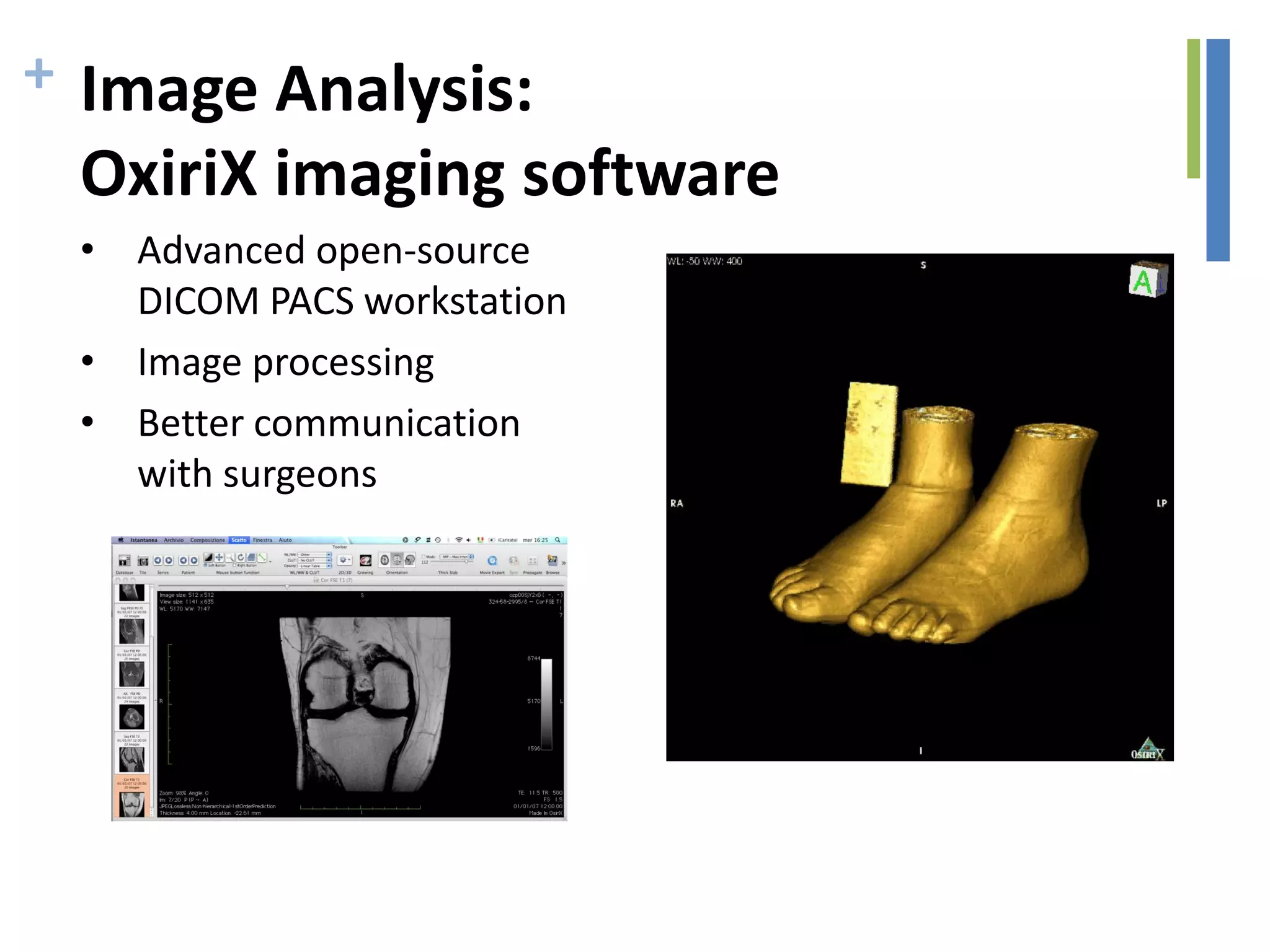
+ Image Analysis:
OxiriX imaging software
• Advanced open-source
DICOM PACS workstation
• Image processing
• Better communication
with surgeons
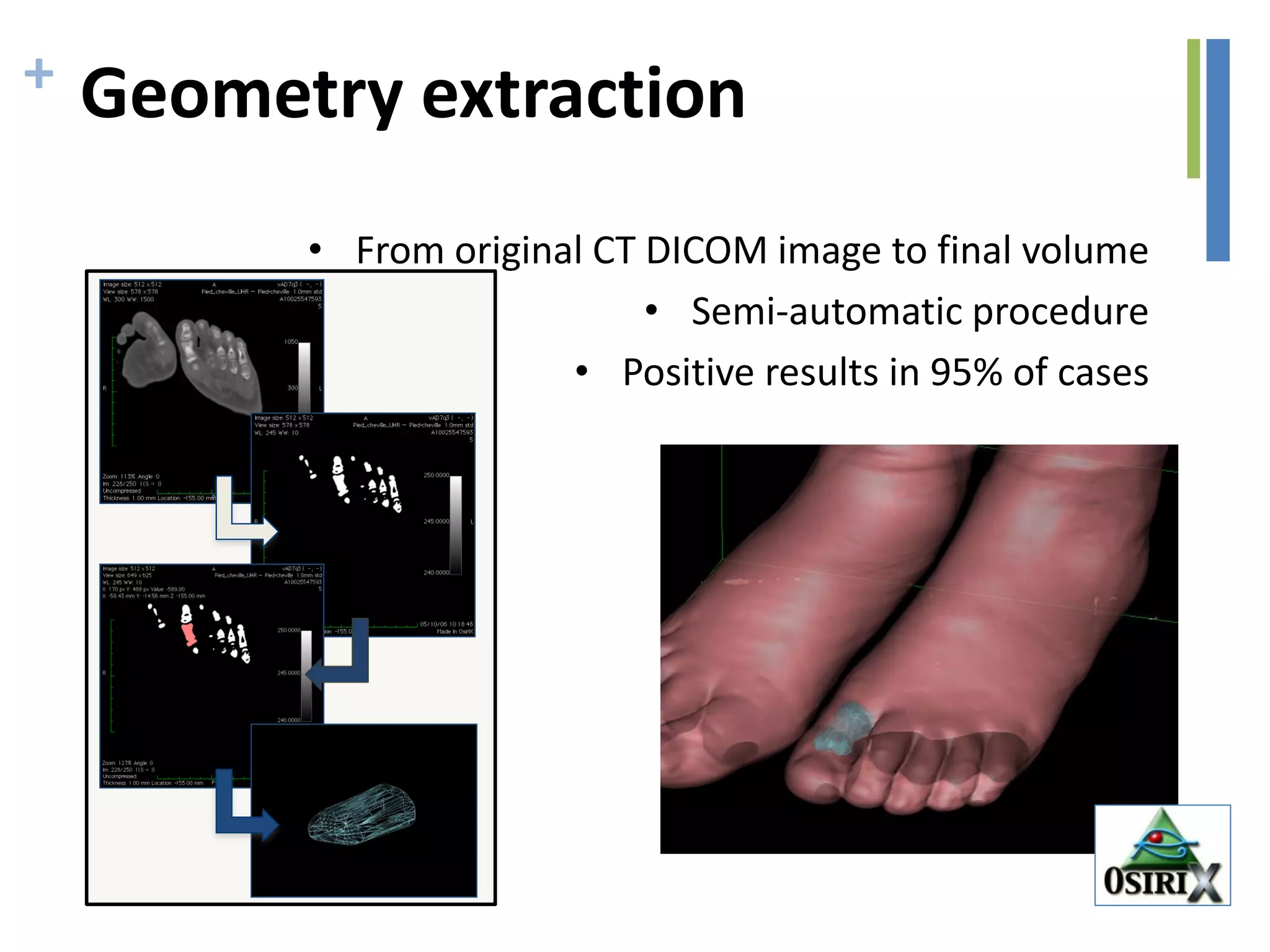
+ Geometry extraction
• From original CT DICOM image to final volume
• Semi-automatic procedure
• Positive results in 95% of cases
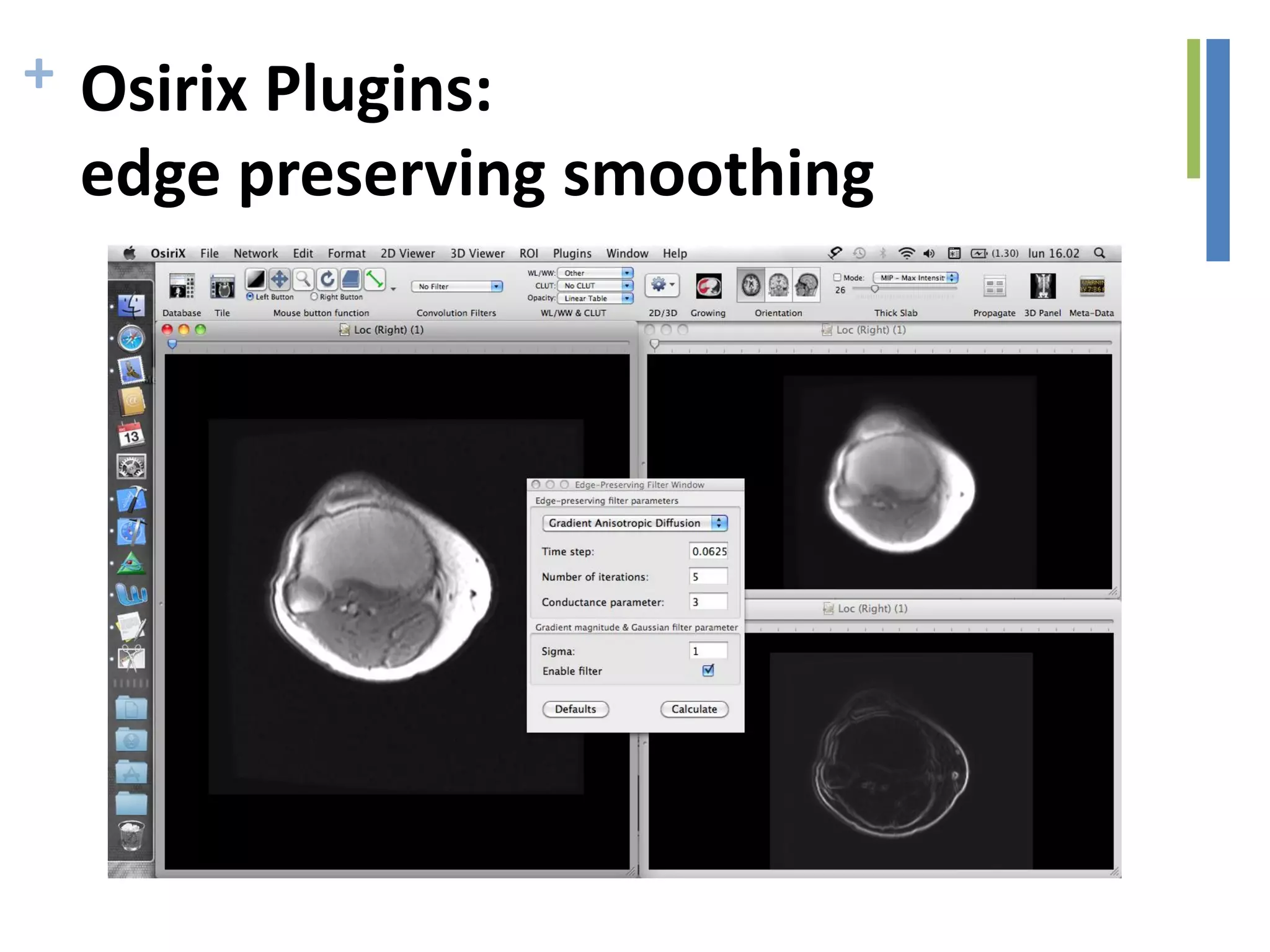
+ Osirix Plugins:
edge preserving smoothing
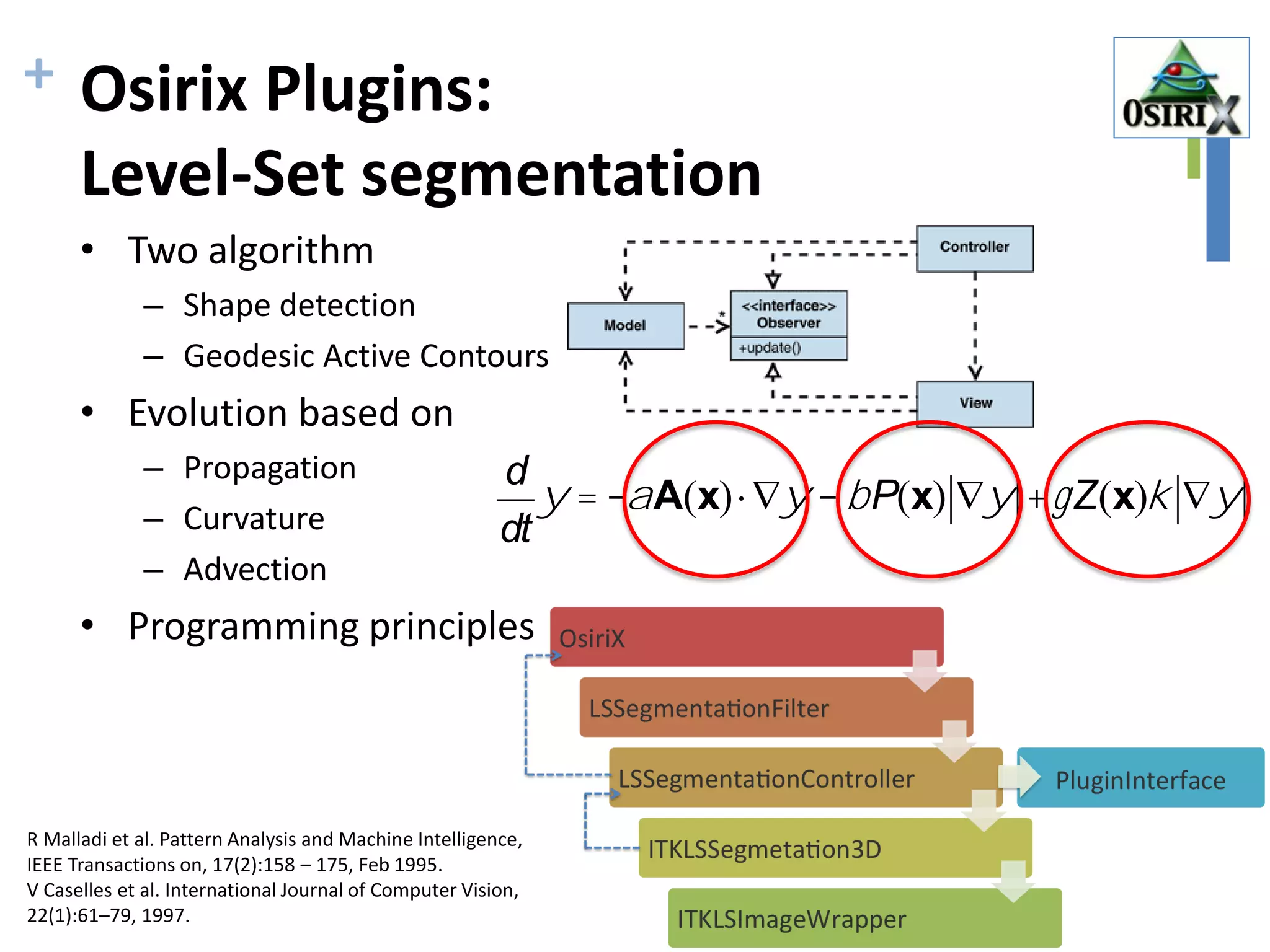
+ Osirix Plugins:
Level-Set segmentation
• Two algorithm
– Shape detection
– Geodesic Active Contours
• Evolution based on
– Propagation
– Curvature
– Advection
• Programming principles
d
dt
y = -aA(x)×Ñy -bP(x) Ñy +gZ(x)k Ñy
R Malladi et al. Pattern Analysis and Machine Intelligence,
IEEE Transactions on, 17(2):158 – 175, Feb 1995.
V Caselles et al. International Journal of Computer Vision,
22(1):61–79, 1997.
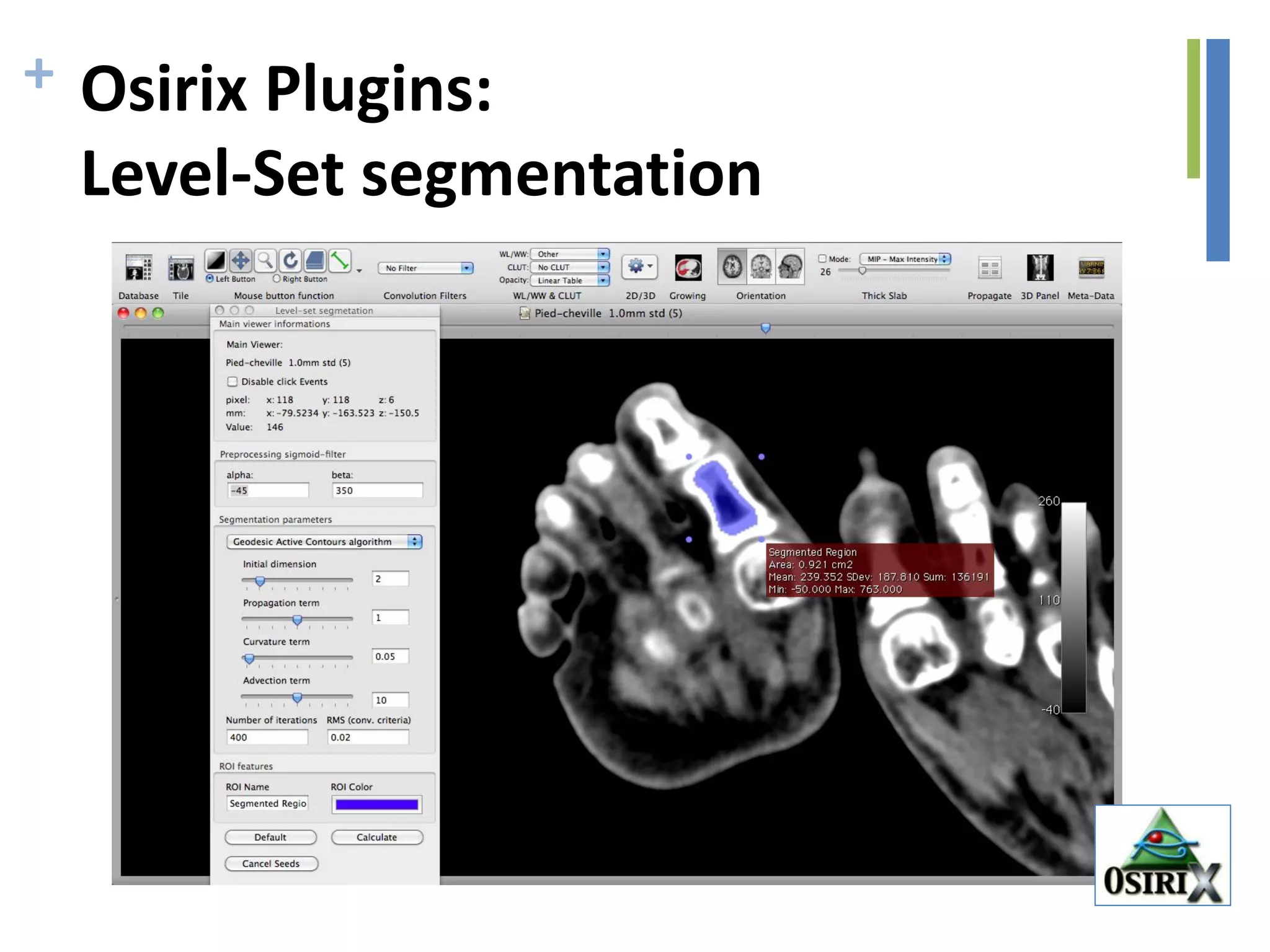
+ Osirix Plugins:
Level-Set segmentation
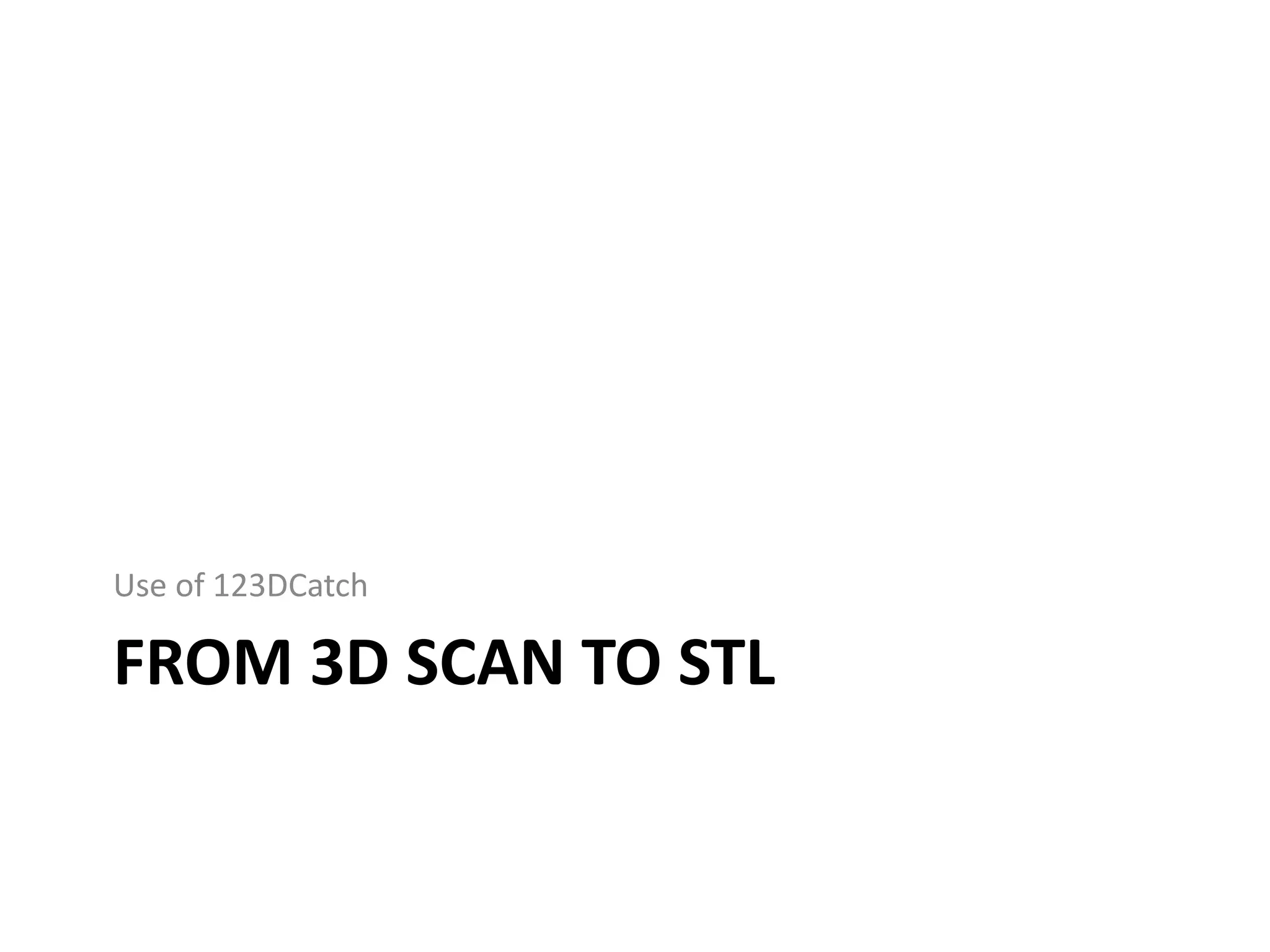
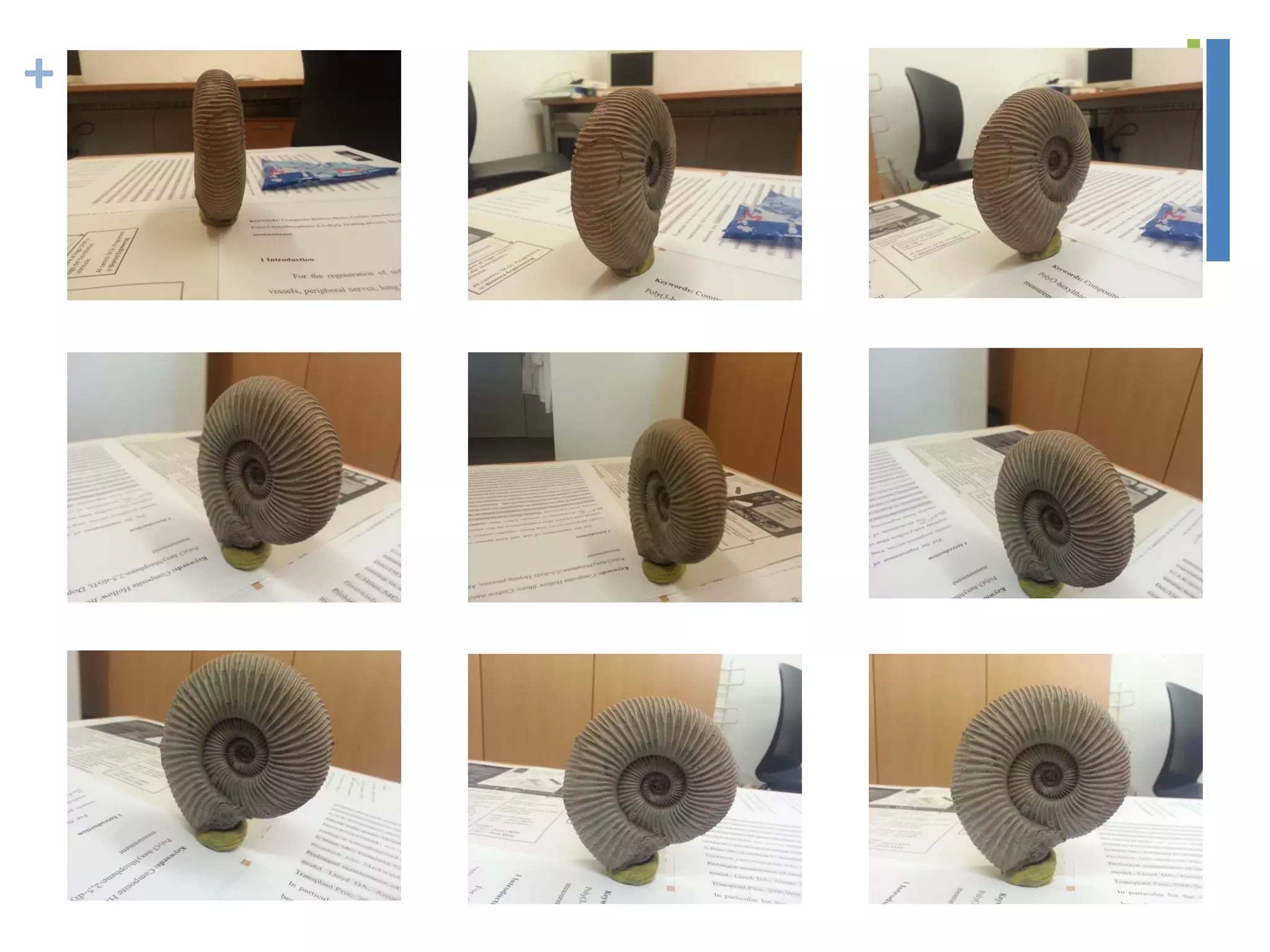
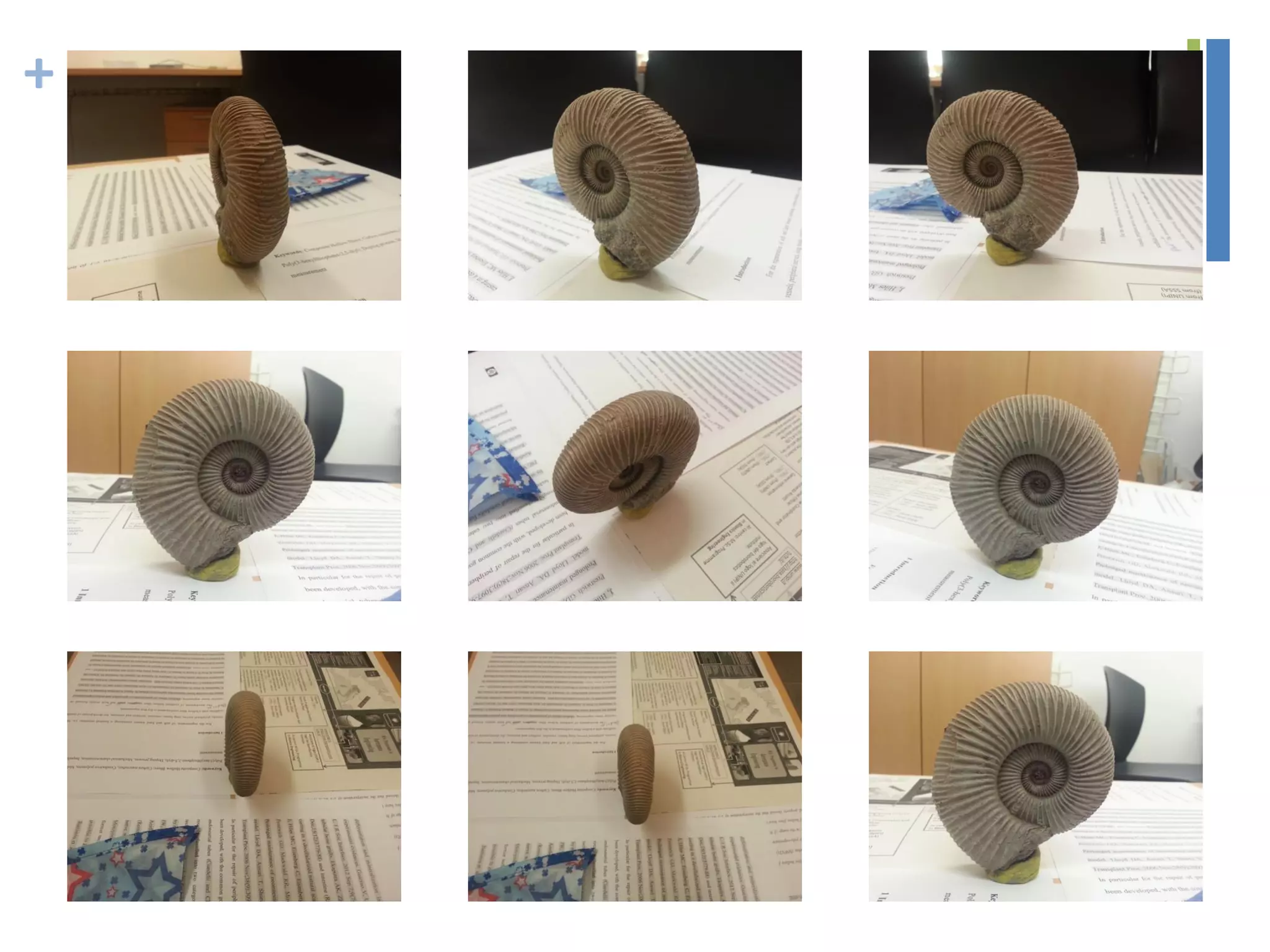
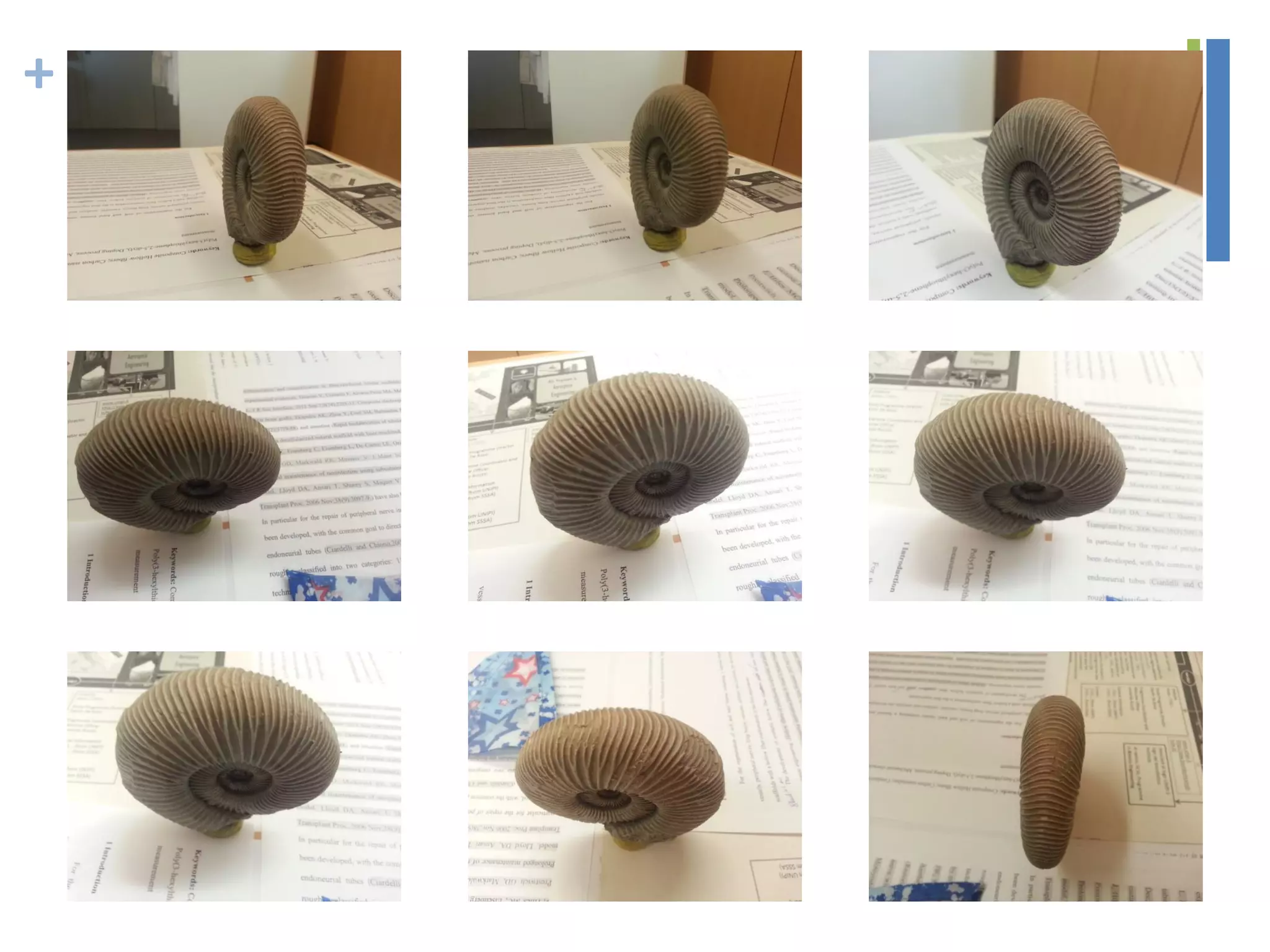
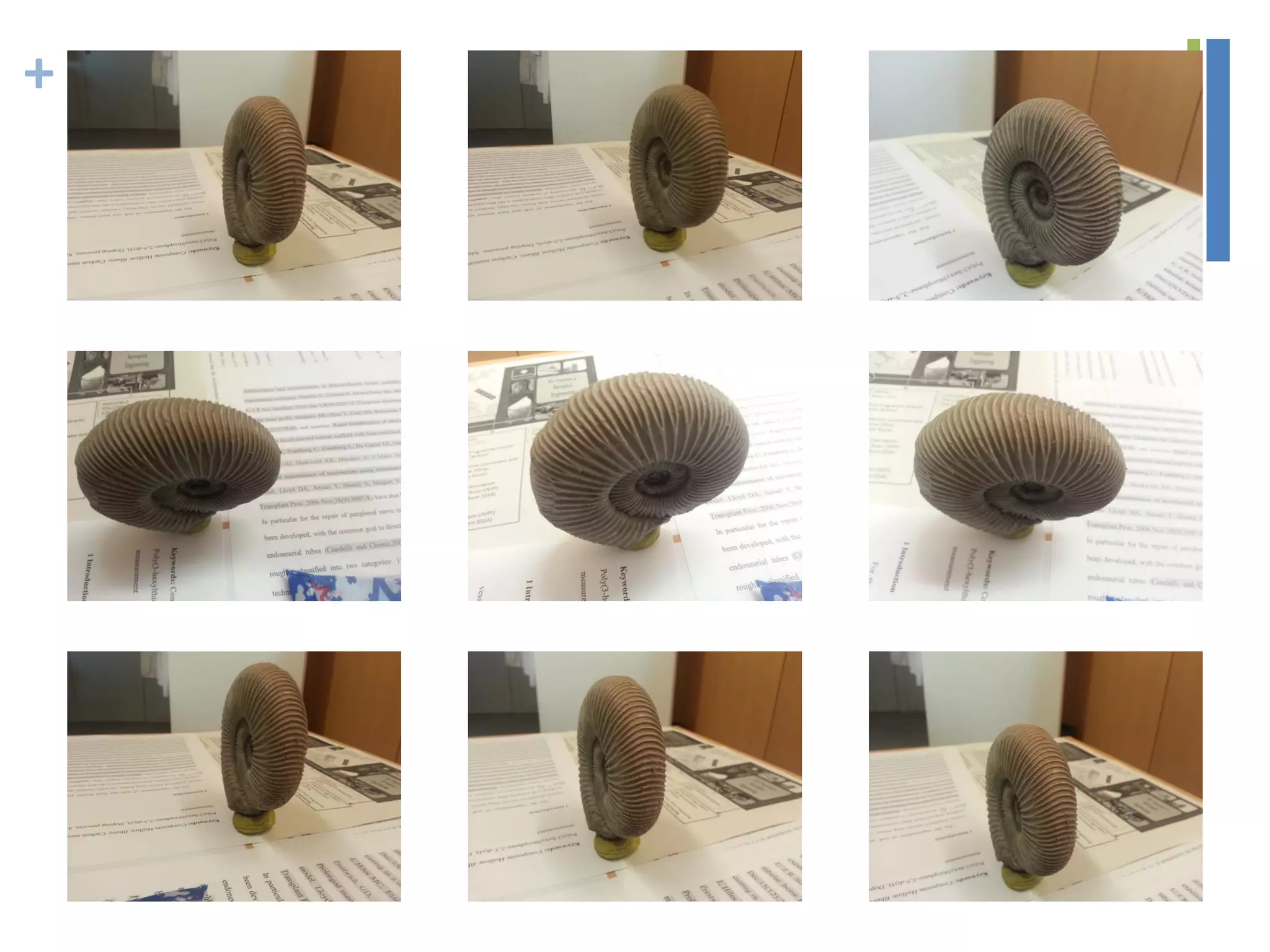
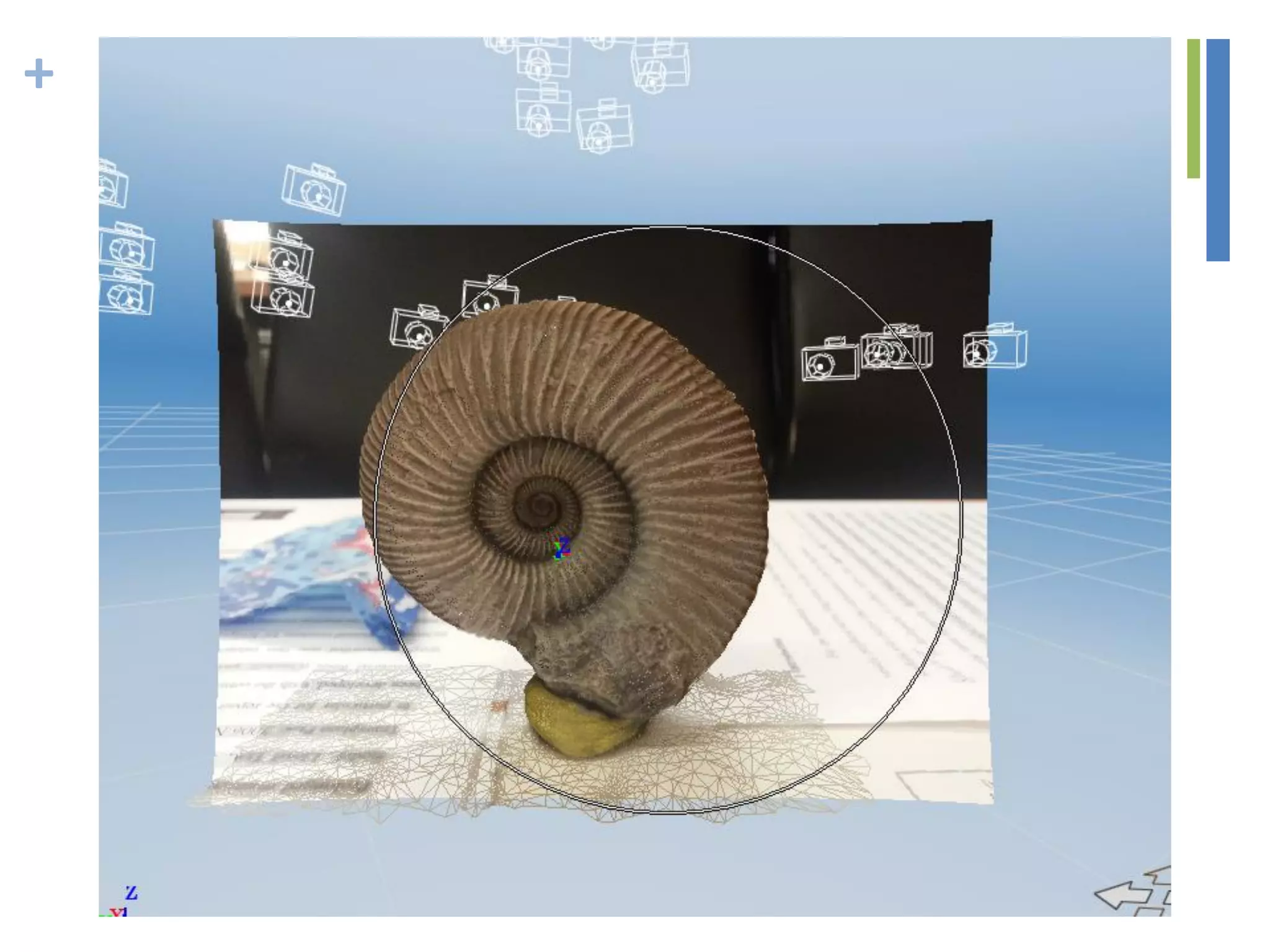
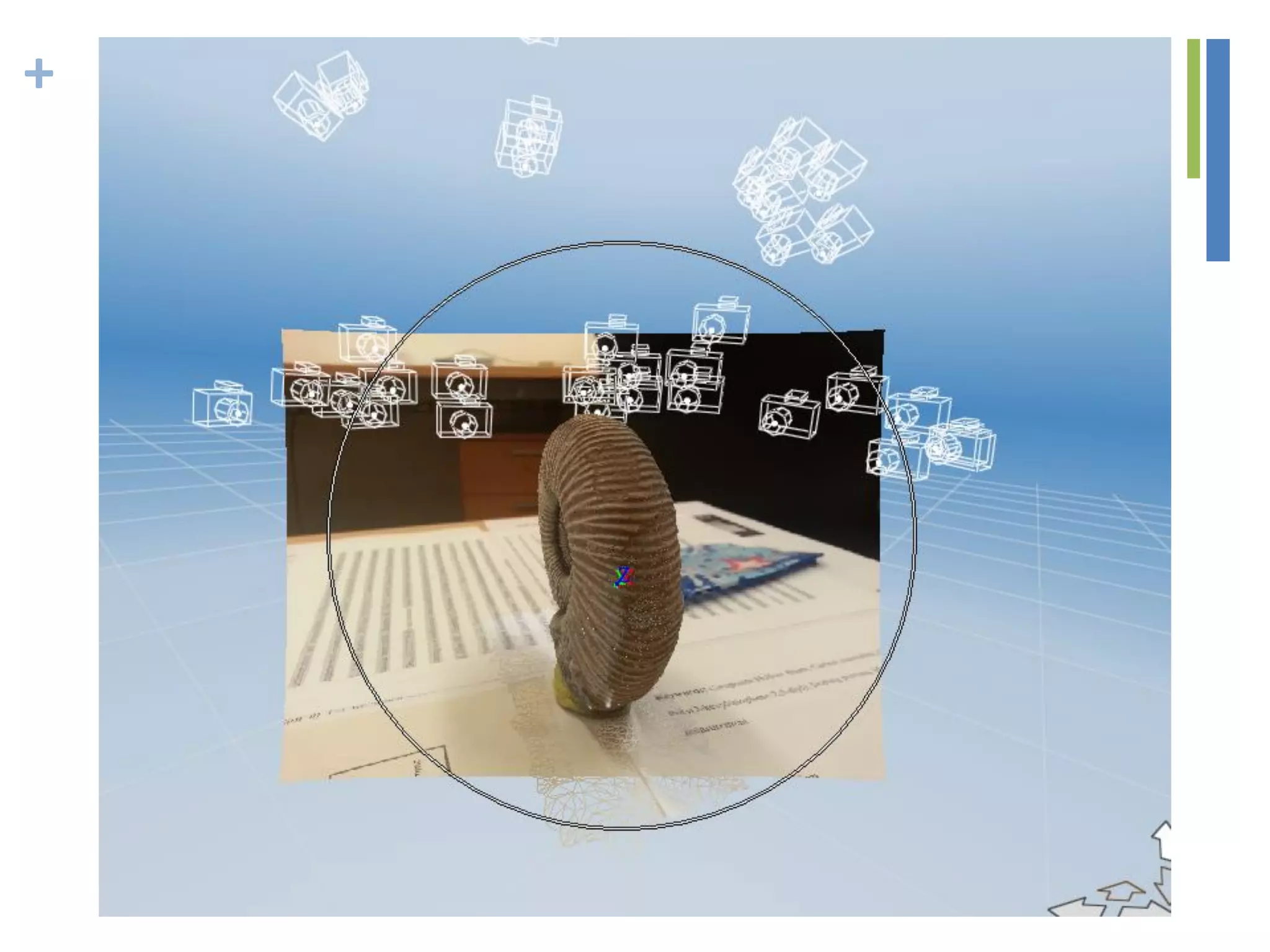
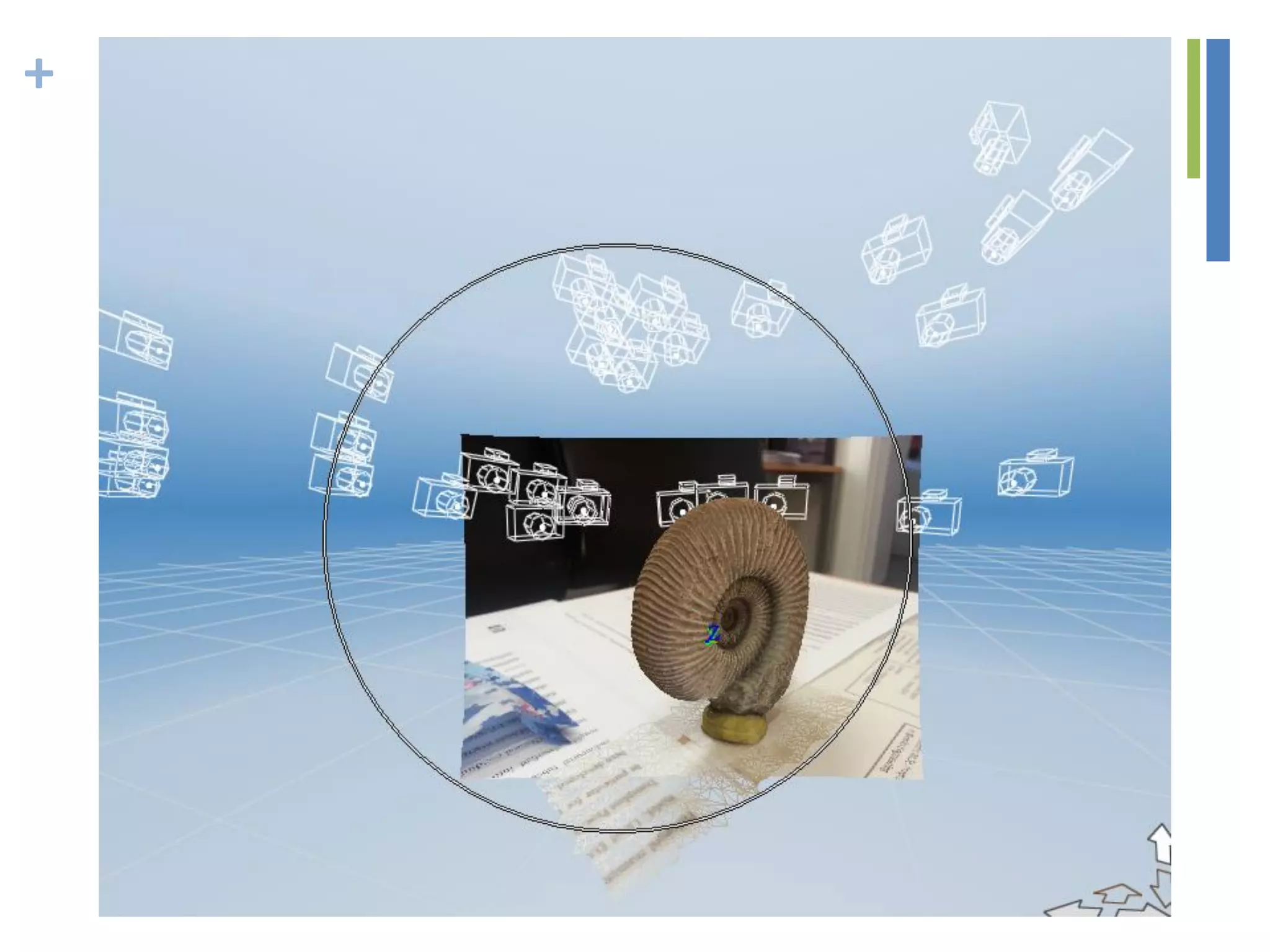
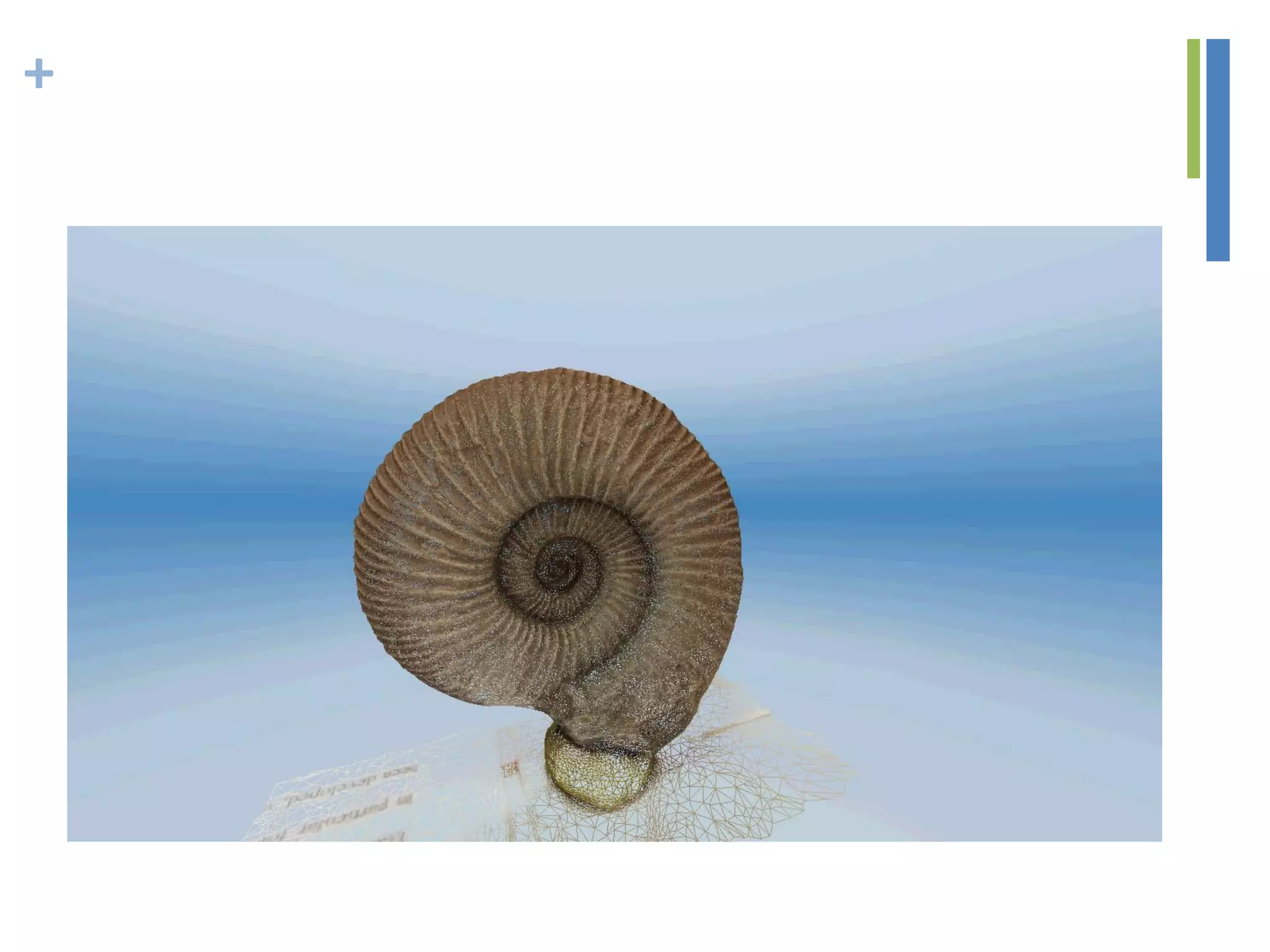
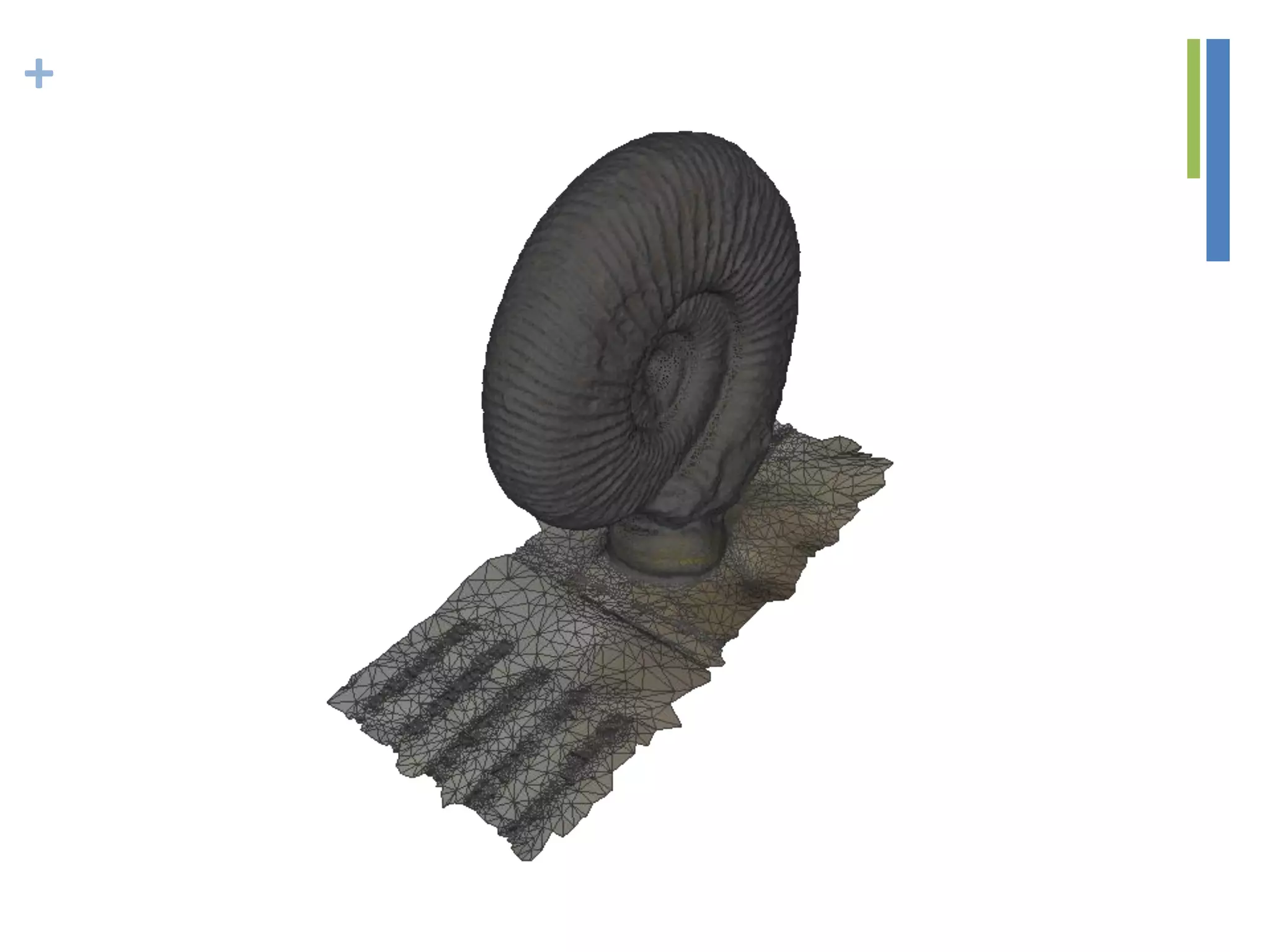
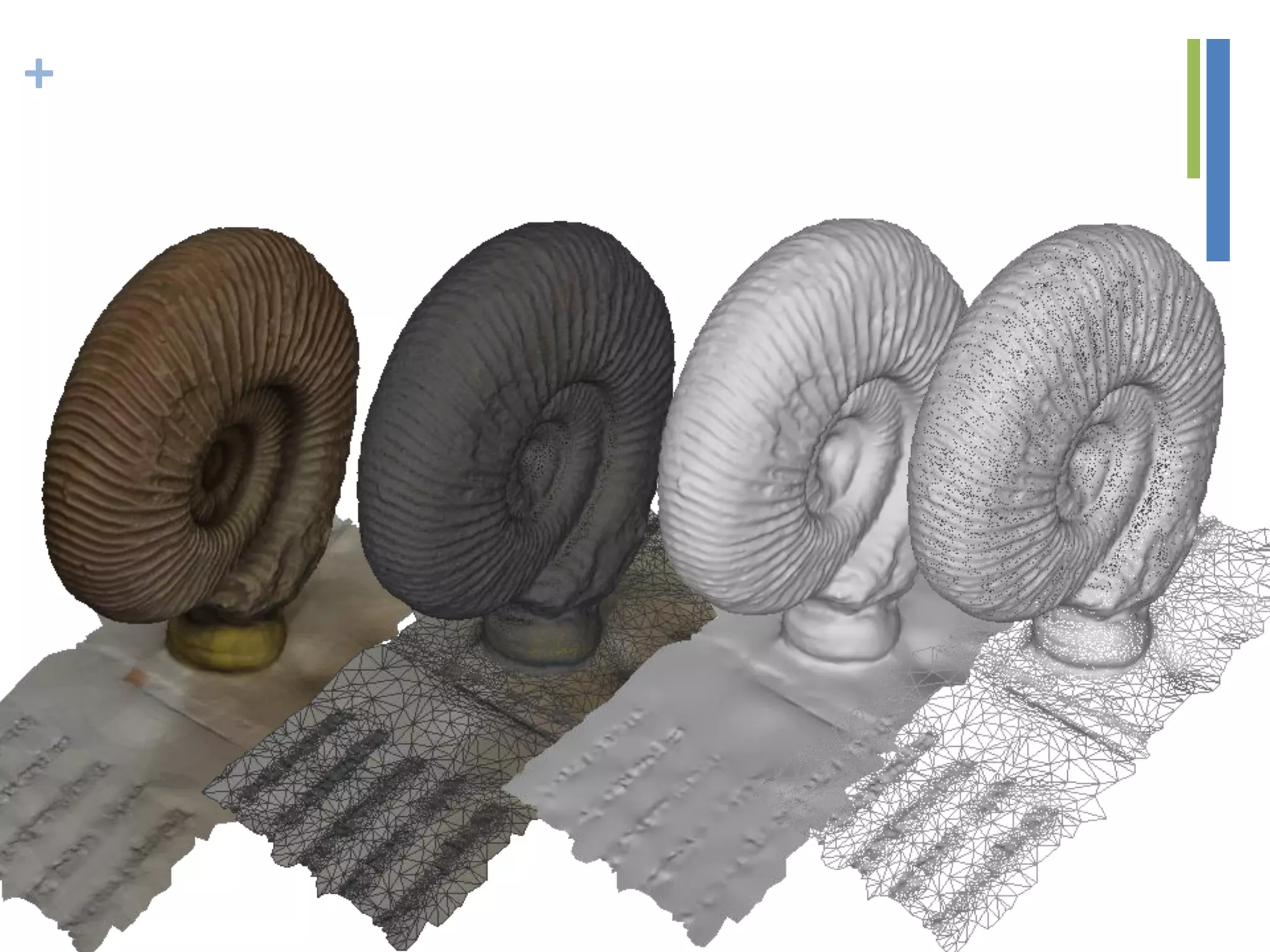
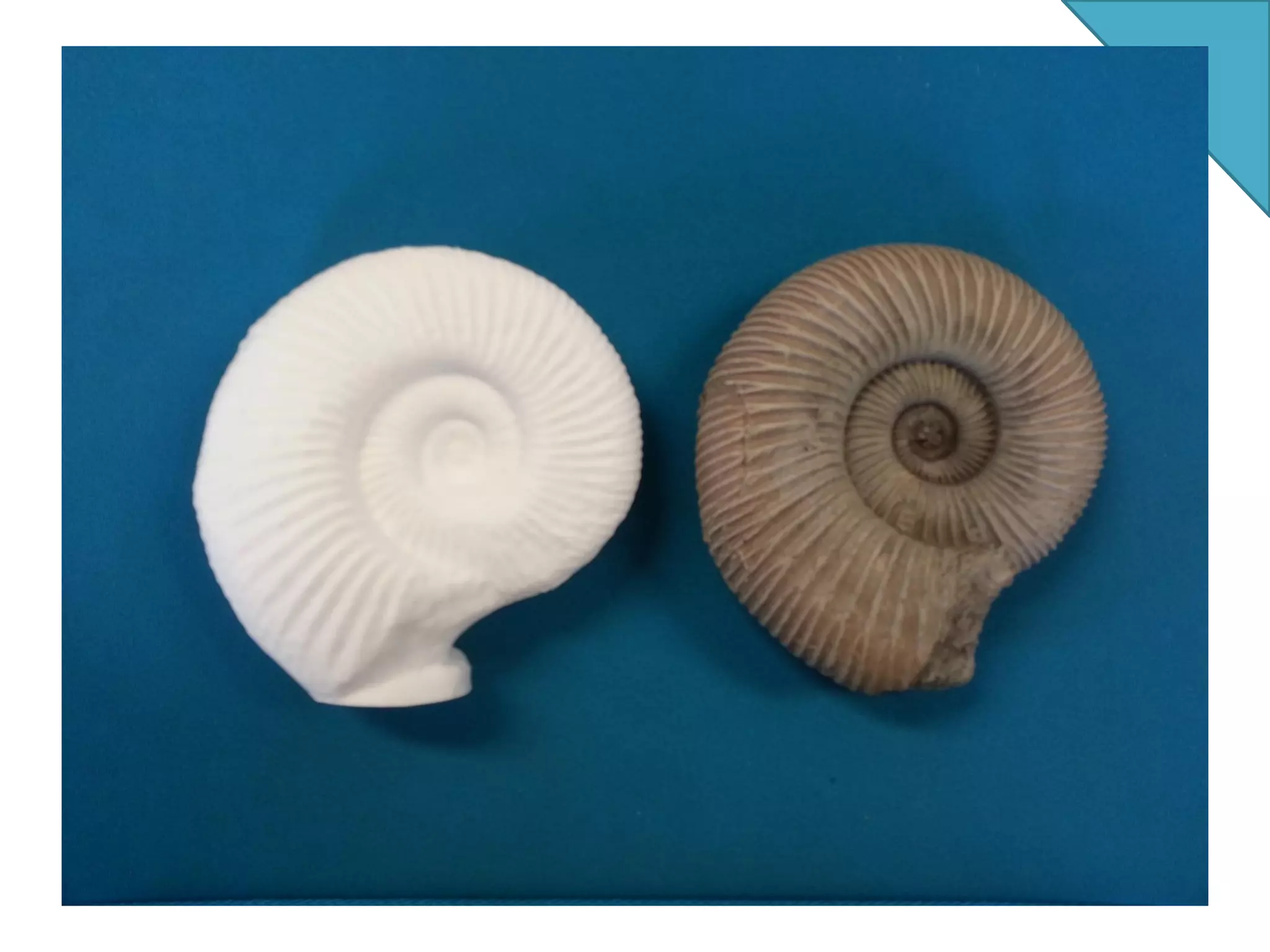
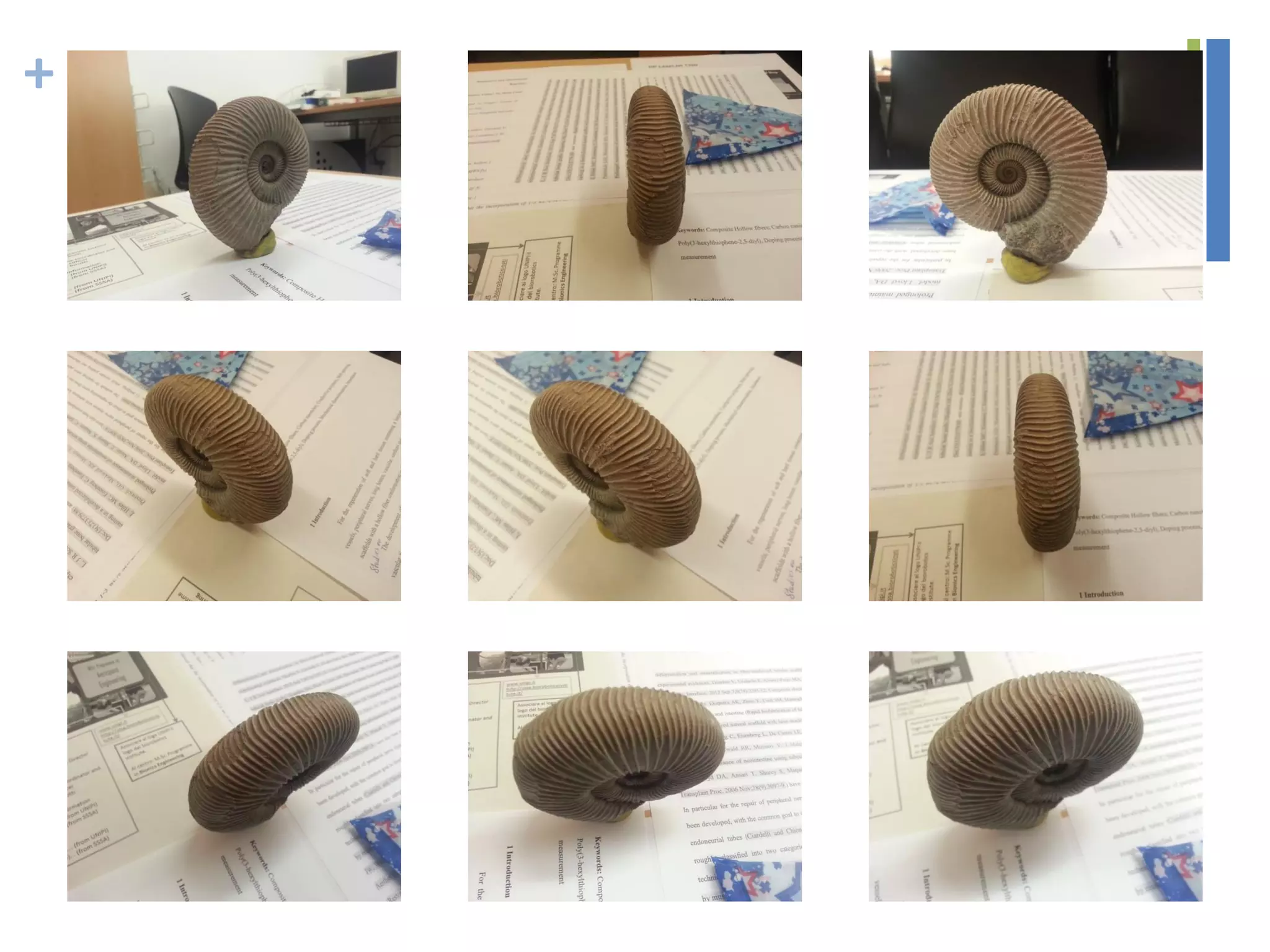
FROM 3D SCAN TO STL
Use of 123DCatch
+
+
+
+
+
+
+
+
+
+
+
+
+
EXCHANGE FORMATS
+ Stereolithograpy Interface
• Stereolithograpy was first commercial Solid
Freeform Manufacturing (SFM) process,
released in 80’s by 3-D Systems
• 3-D Systems developed interface between CAD
systems and their machine
• STL files (*.stl) allow CAD systems to interface
with 3-D system machines
• Virtually all subsequent SFM processes can use
this same format (SFM industry standard)
• Many CAD programs now can export the *.stl
file for easy conversion from CAD to part
+ STL Files (*.stl)
• STL files were based on a program called Silverscreen
CAD
• Silverscreen CAD represent boundary with all surfaces
being approximated by polygons or groups of polygons
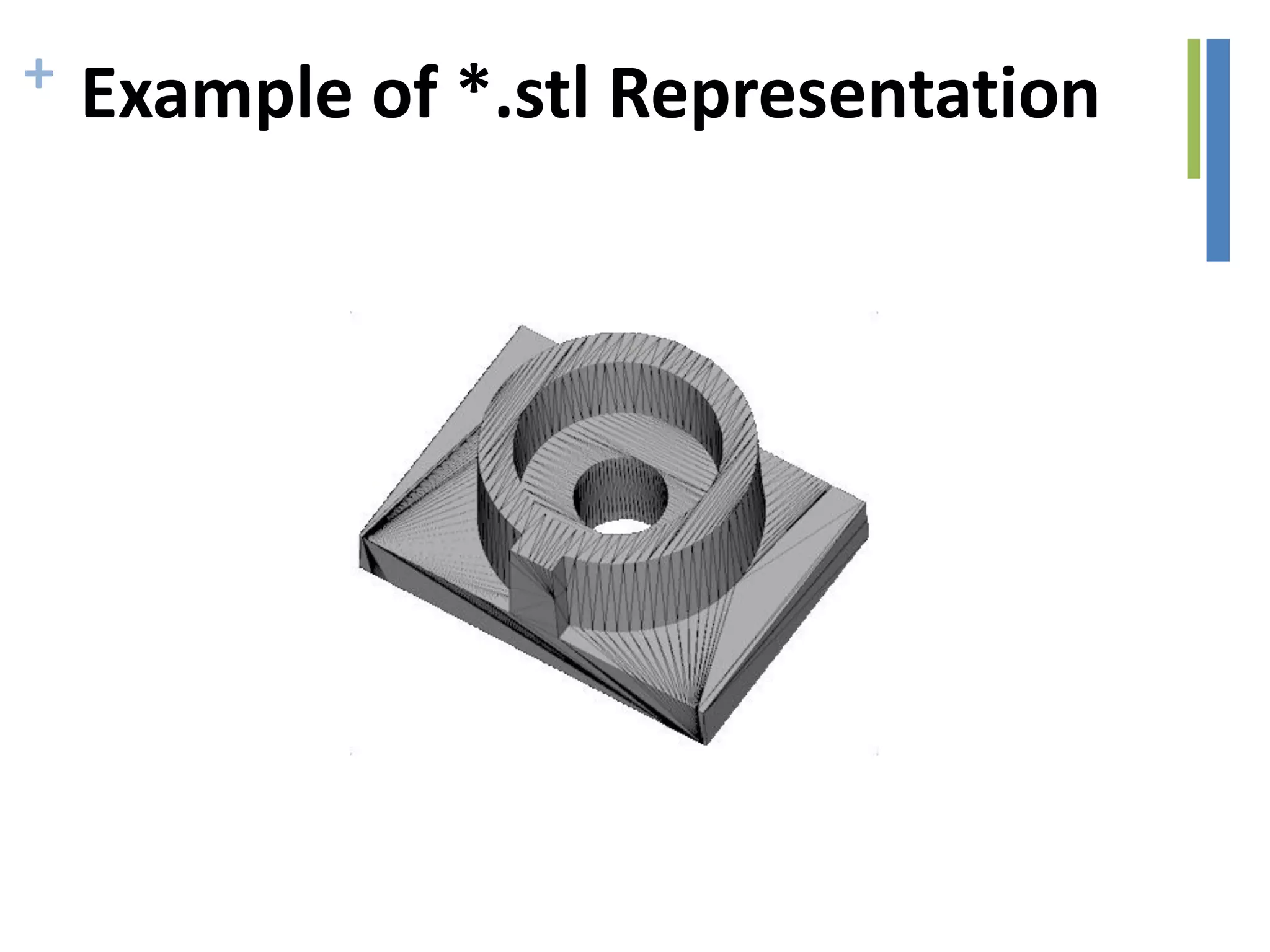
• *.stl files use triangles or groups of triangles to
approximate surfaces
• Accuracy depends on the triangle sizes (Smaller facets
produce a higher quality surface)
• Triangles assigned normal vectors for outward surface
normal
• Parts are defined by representing all their bounding
surfaces as faceted surfaces, using the triangular patches
+ STL Files (*.stl)
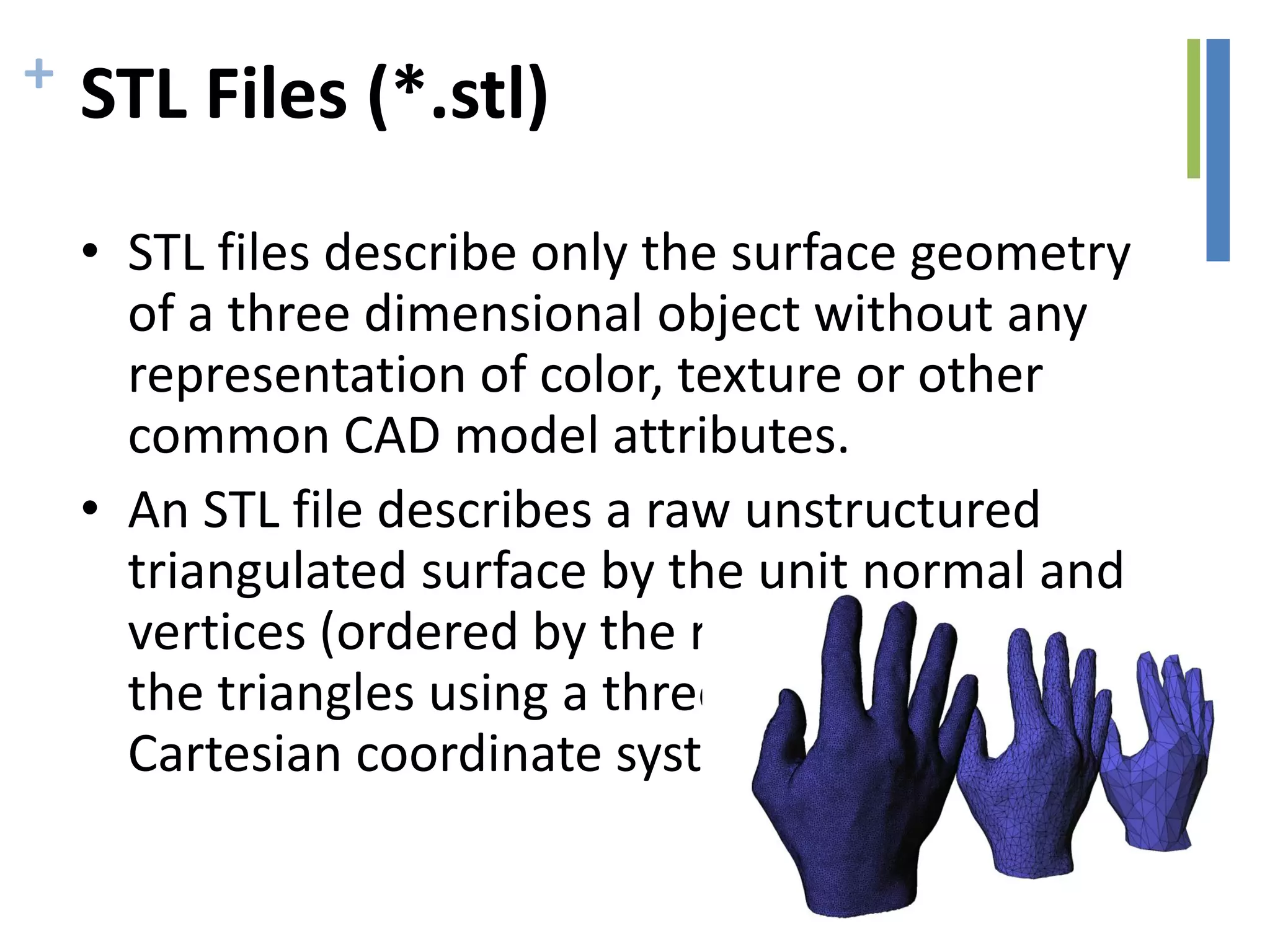
• STL files describe only the surface geometry
of a three dimensional object without any
representation of color, texture or other
common CAD model attributes.
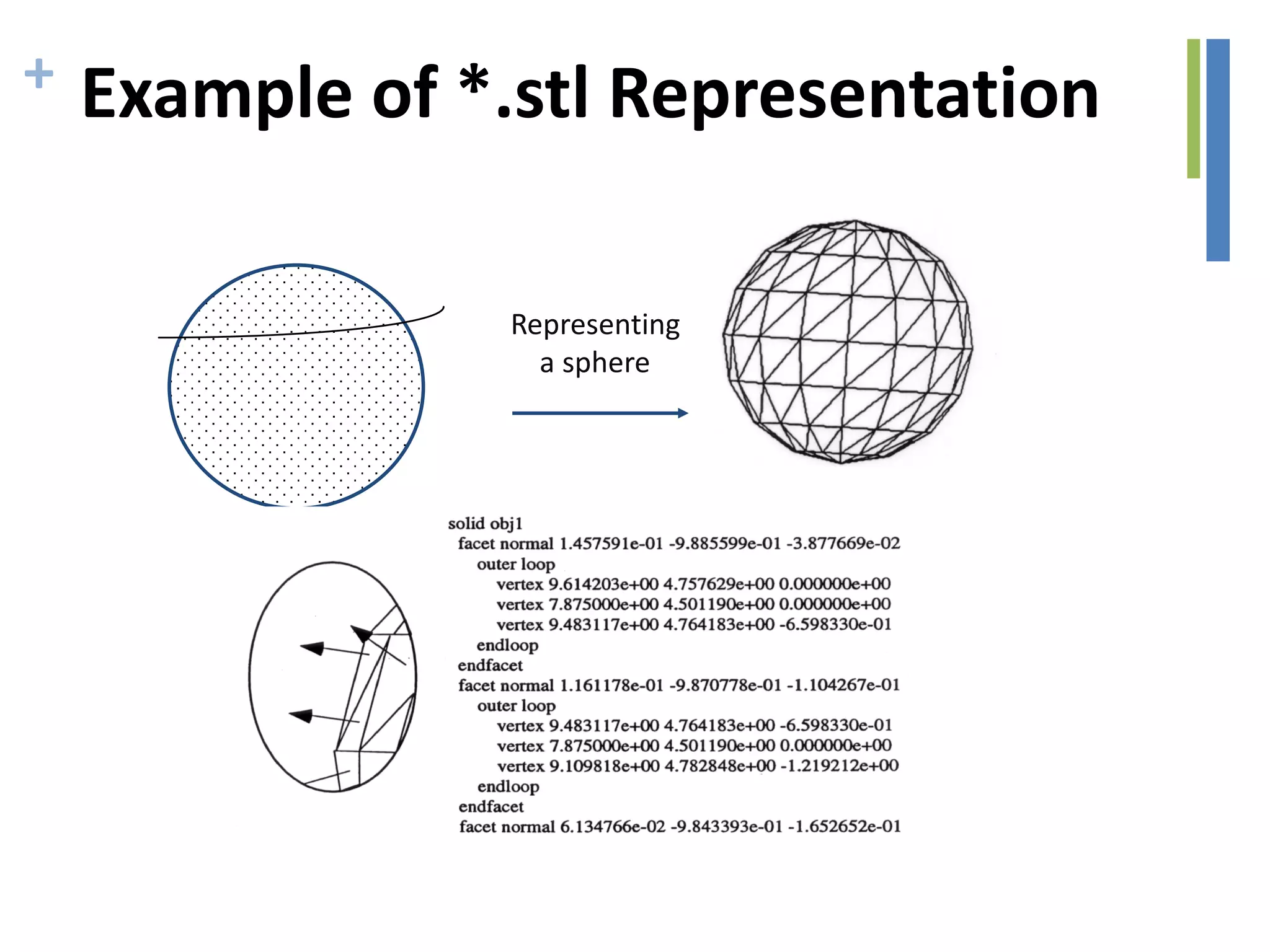
• An STL file describes a raw unstructured
triangulated surface by the unit normal and
vertices (ordered by the right-hand rule) of
the triangles using a three-dimensional
Cartesian coordinate system.
+ Example of *.stl Representation
Representing
a sphere
+ Example of *.stl Representation
+ Existing Formats (1/2)
• 3D PDF
– Proprietary, closed
• ISO 14649 (STEP-NC)
– Mostly for NC control, G-Code
• STEP / IGES, SAT, Parasolid
– Too complex, missing features e.g. no
mesostructure
• X3D VRML
– Mesh, color, texture, lighting
All: no provision for AM, e.g. materials,
internal structure
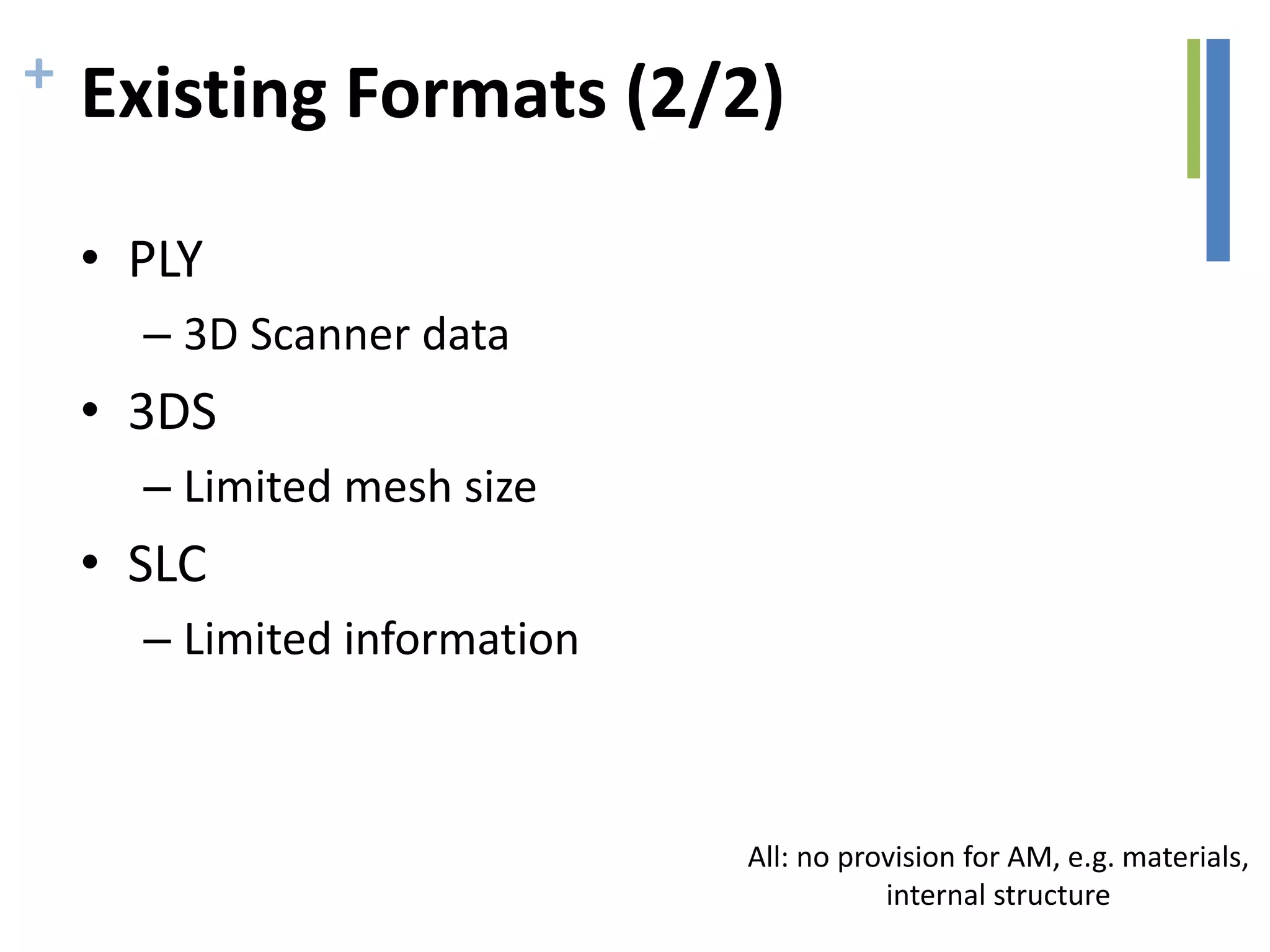
+ Existing Formats (2/2)
• PLY
– 3D Scanner data
• 3DS
– Limited mesh size
• SLC
– Limited information
All: no provision for AM, e.g. materials,
internal structure
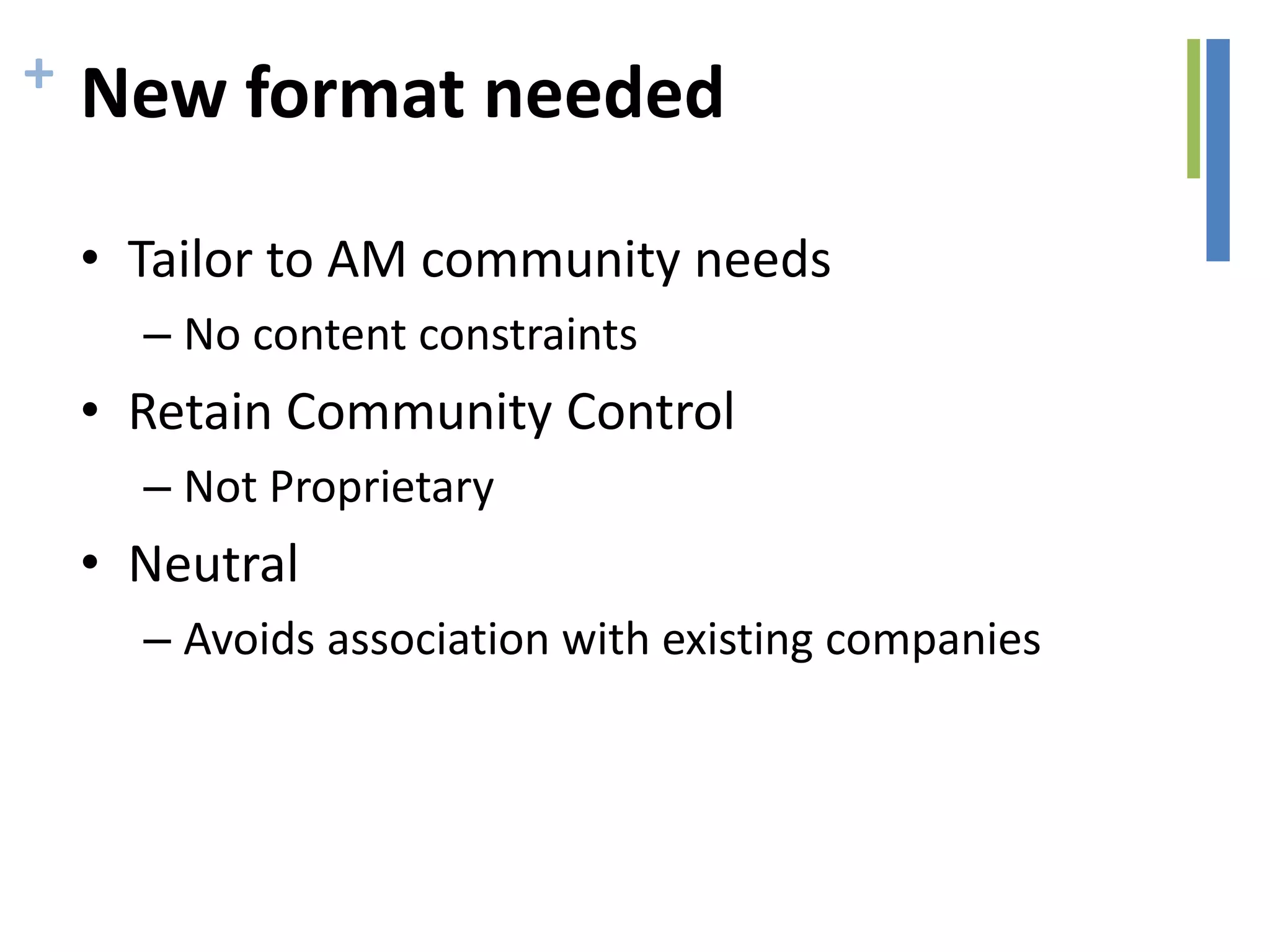
+ New format needed
• Tailor to AM community needs
– No content constraints
• Retain Community Control
– Not Proprietary
• Neutral
– Avoids association with existing companies
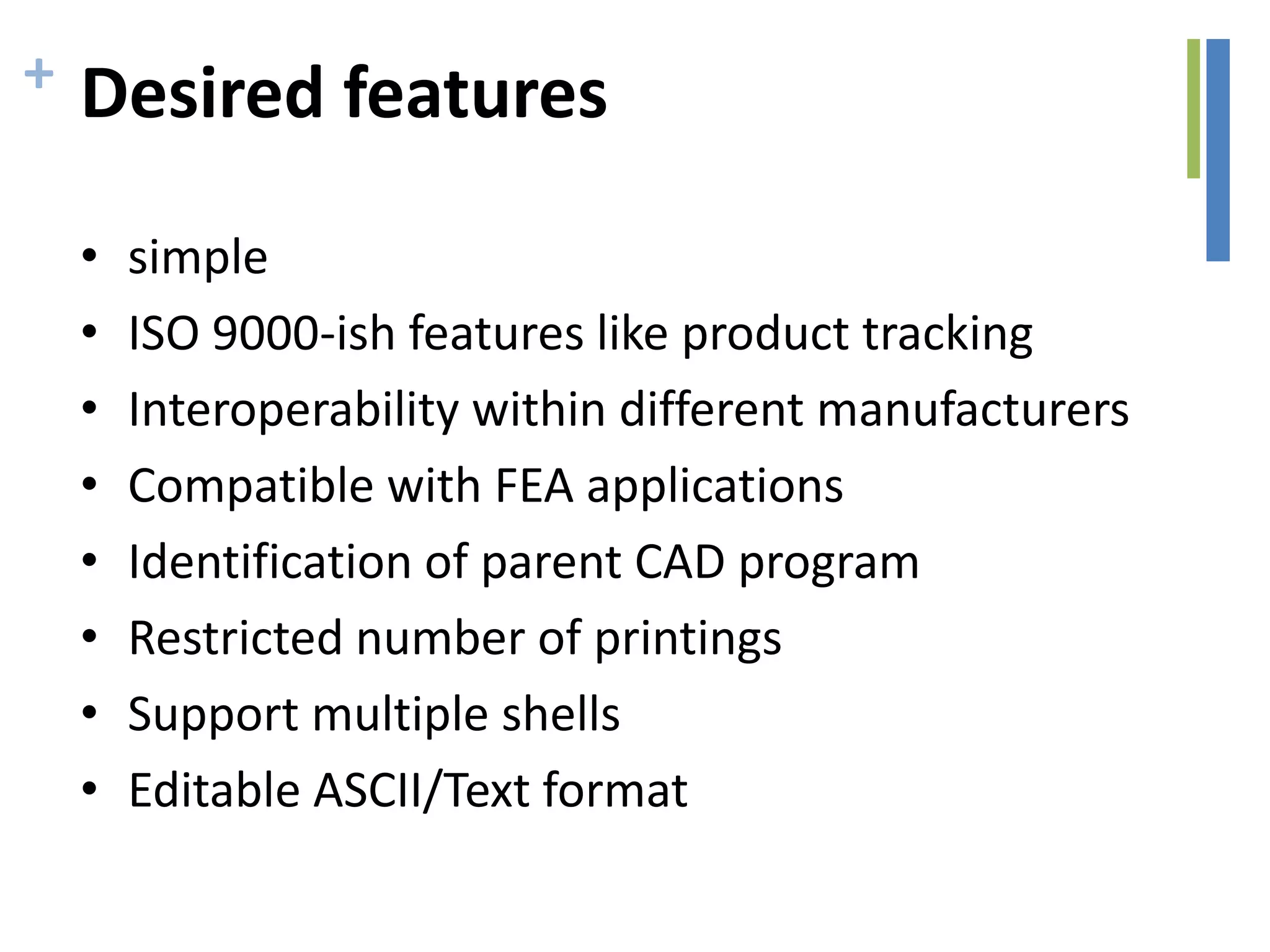
+ Desired features
• simple
• ISO 9000-ish features like product tracking
• Interoperability within different manufacturers
• Compatible with FEA applications
• Identification of parent CAD program
• Restricted number of printings
• Support multiple shells
• Editable ASCII/Text format
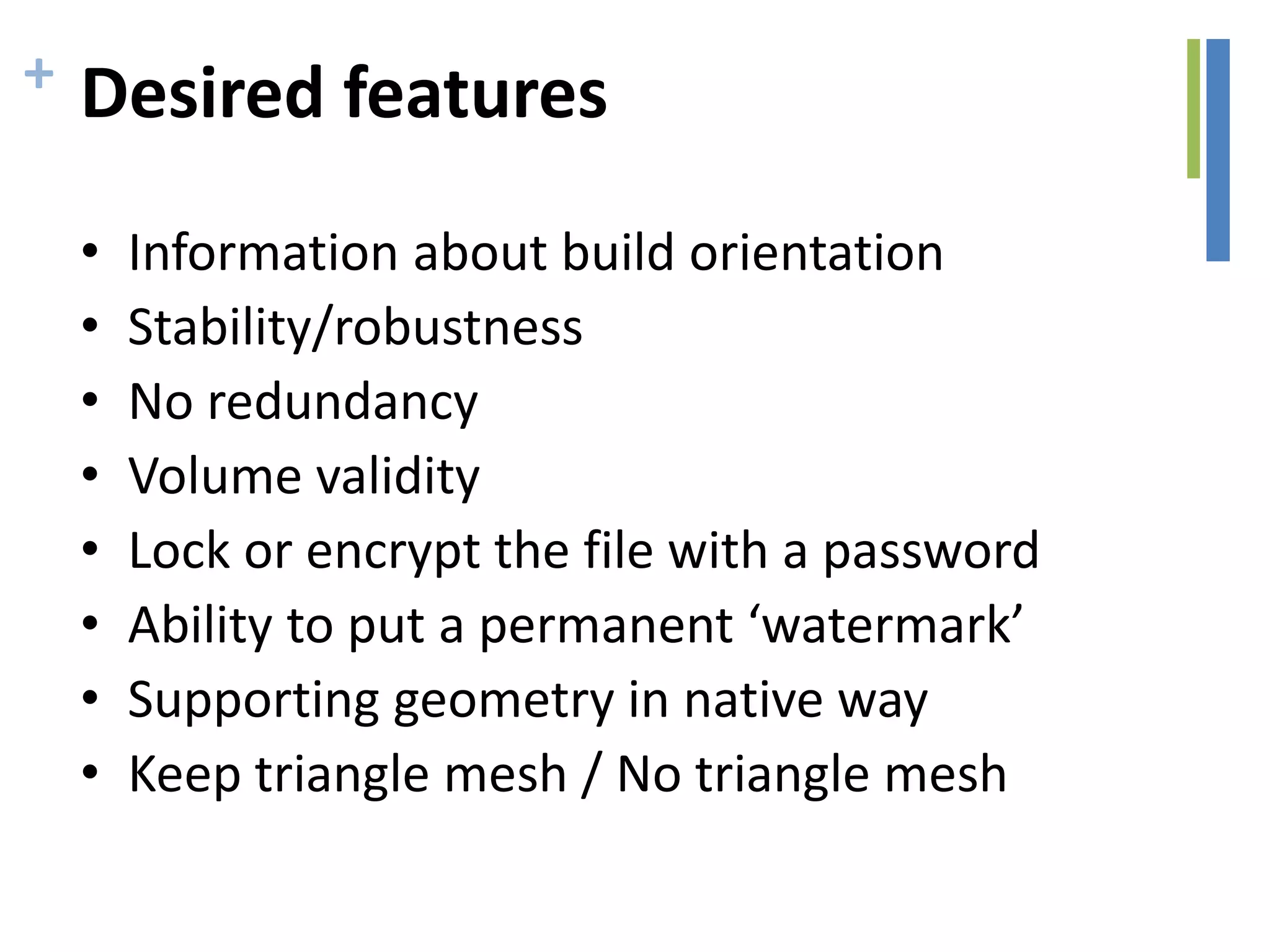
+ Desired features
• Information about build orientation
• Stability/robustness
• No redundancy
• Volume validity
• Lock or encrypt the file with a password
• Ability to put a permanent ‘watermark’
• Supporting geometry in native way
• Keep triangle mesh / No triangle mesh
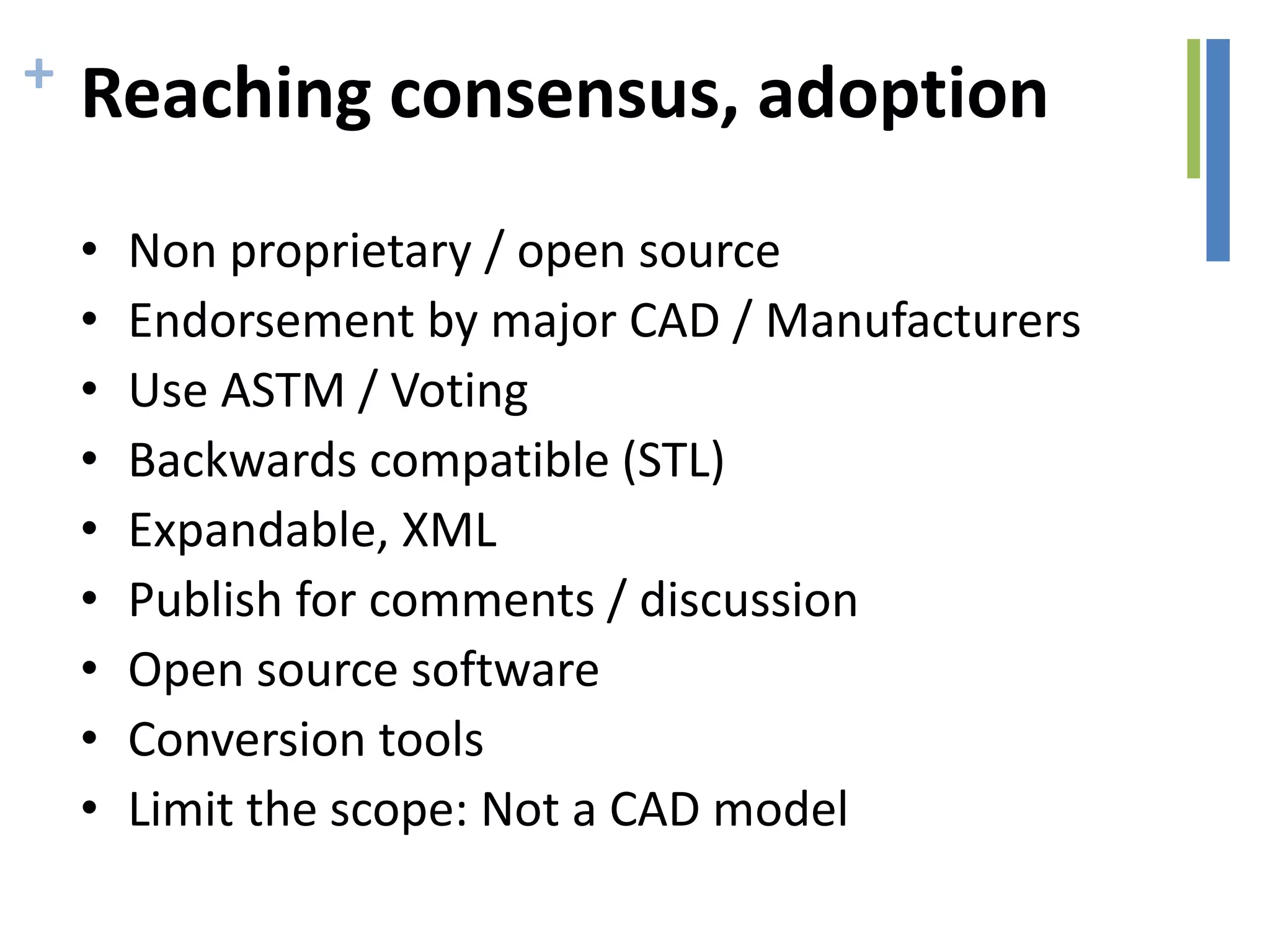
+ Reaching consensus, adoption
• Non proprietary / open source
• Endorsement by major CAD / Manufacturers
• Use ASTM / Voting
• Backwards compatible (STL)
• Expandable, XML
• Publish for comments / discussion
• Open source software
• Conversion tools
• Limit the scope: Not a CAD model
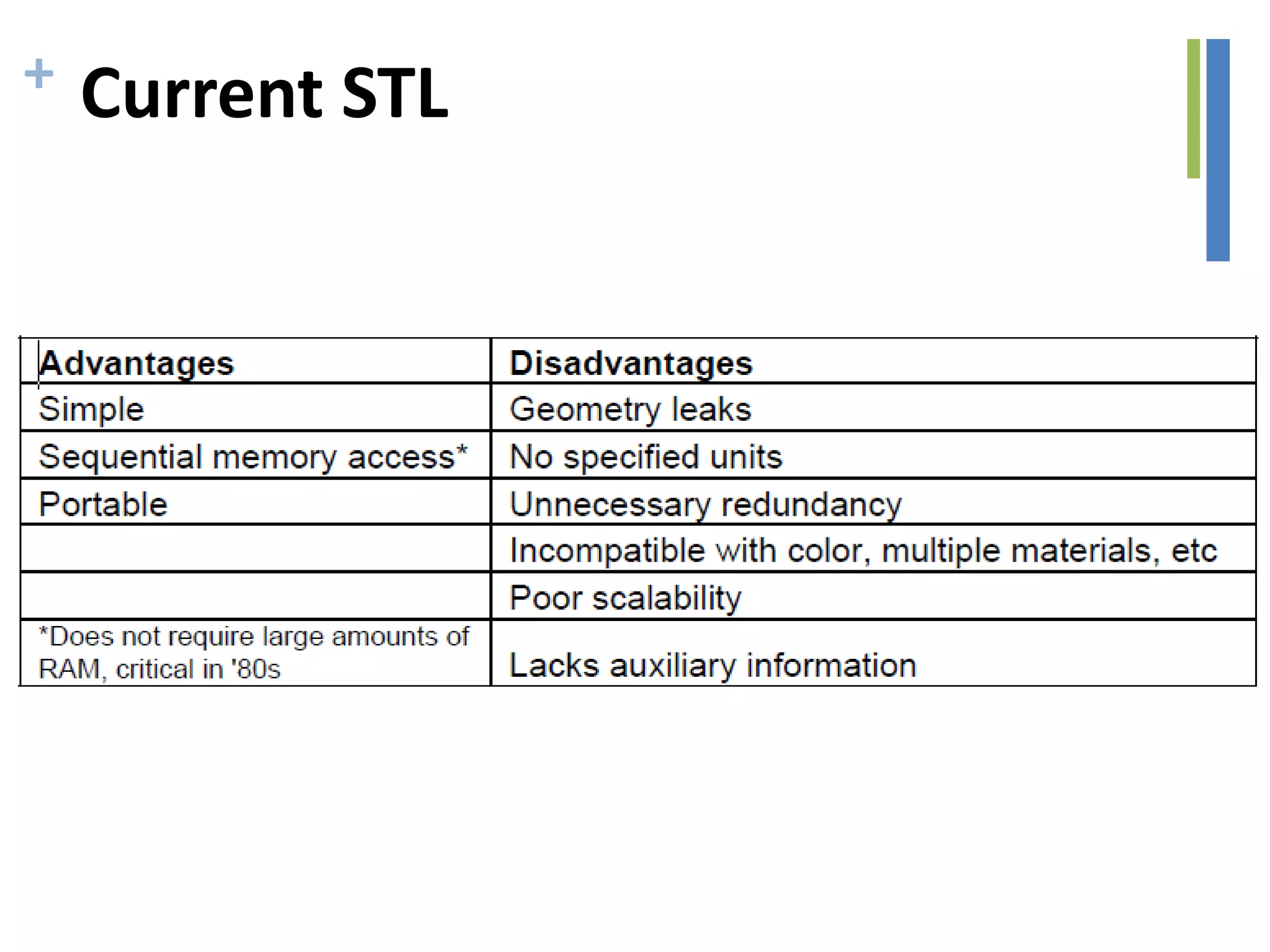
+ Current STL
+ The new proposed format
• AMF
– Additive Manufacturing Format
– Additive Manufacturing File
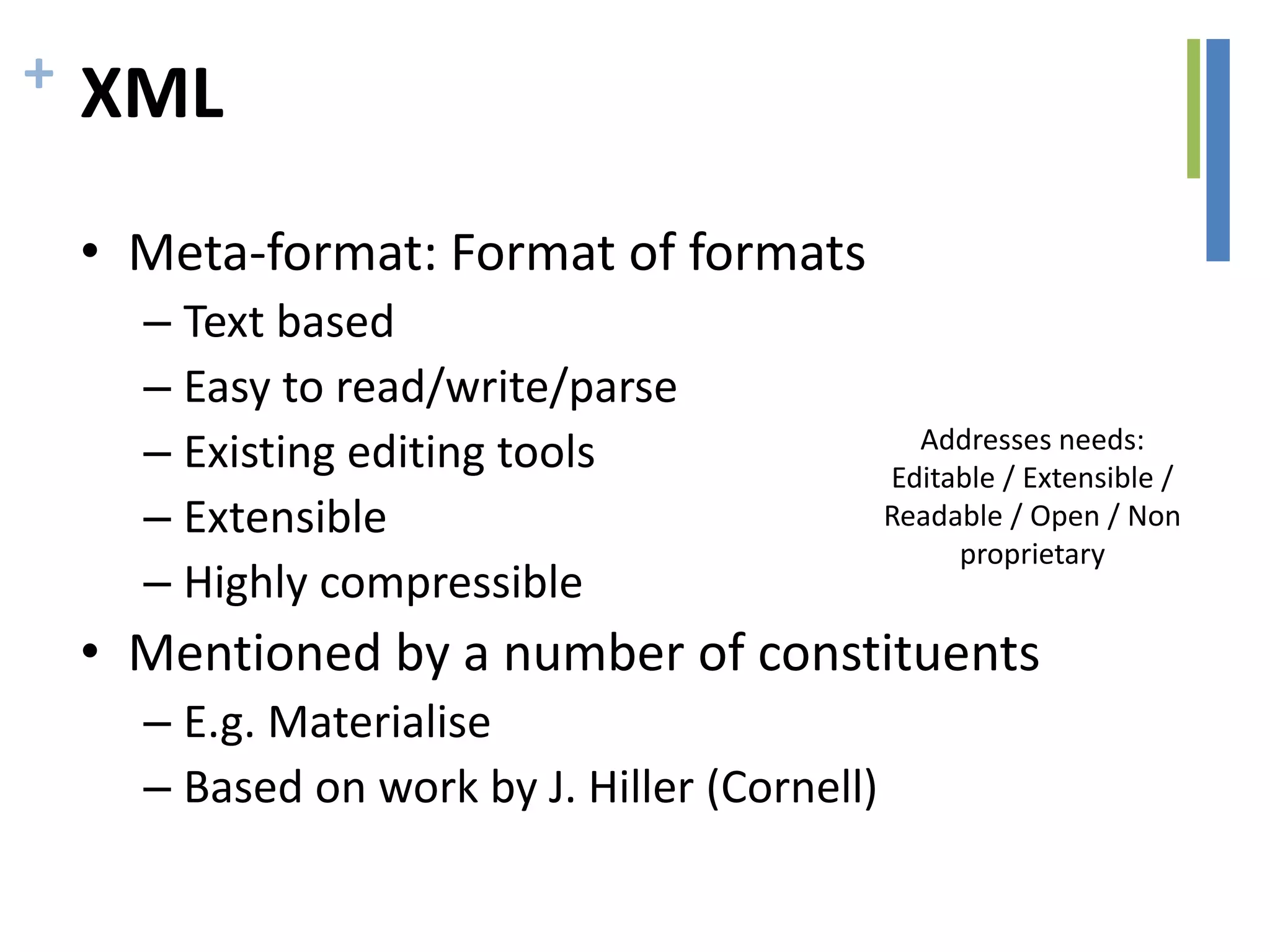
+ XML
• Meta-format: Format of formats
– Text based
– Easy to read/write/parse
– Existing editing tools
– Extensible
– Highly compressible
• Mentioned by a number of constituents
– E.g. Materialise
– Based on work by J. Hiller (Cornell)
Addresses needs:
Editable / Extensible /
Readable / Open / Non
proprietary
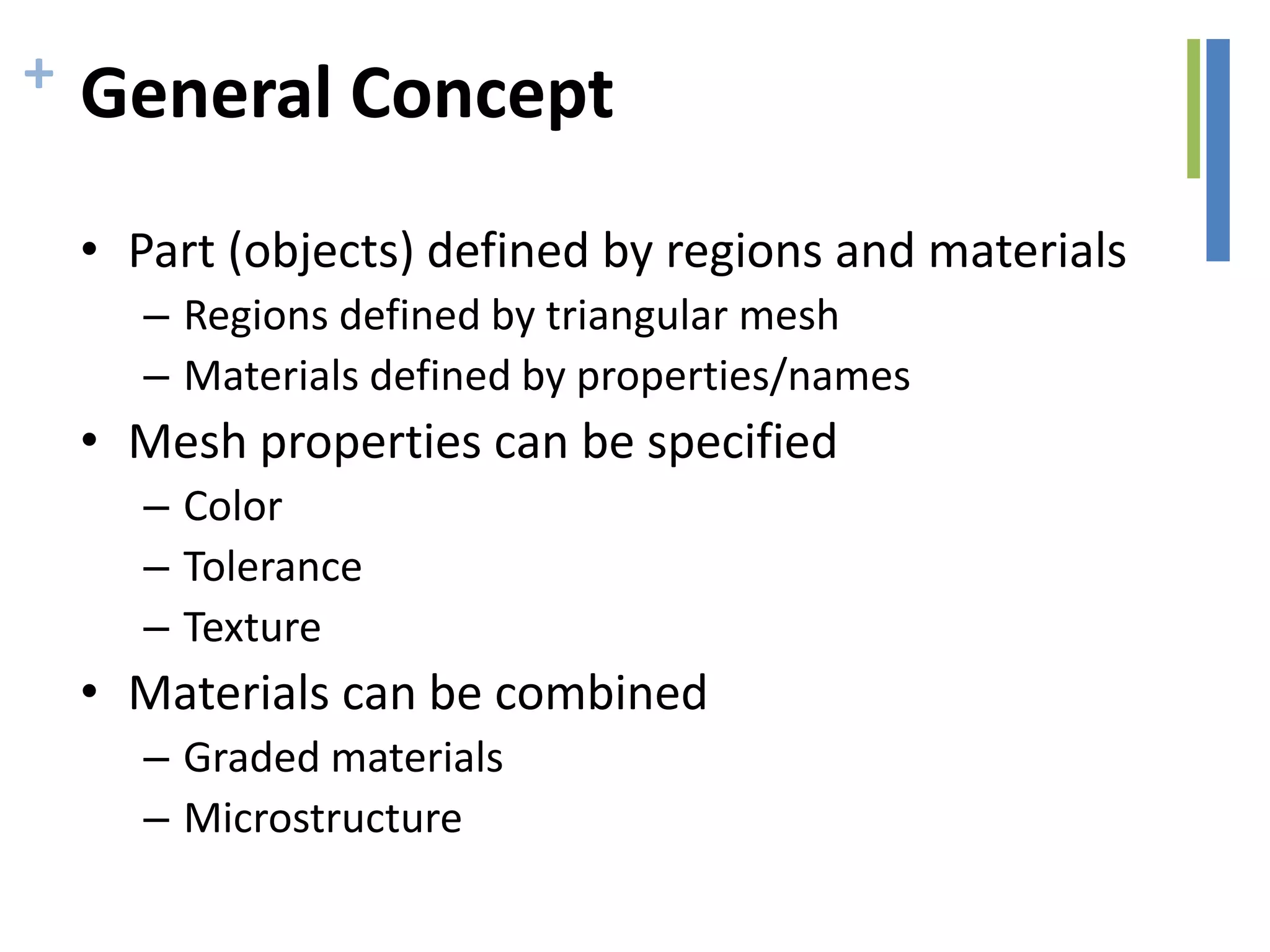
+ General Concept
• Part (objects) defined by regions and materials
– Regions defined by triangular mesh
– Materials defined by properties/names
• Mesh properties can be specified
– Color
– Tolerance
– Texture
• Materials can be combined
– Graded materials
– Microstructure
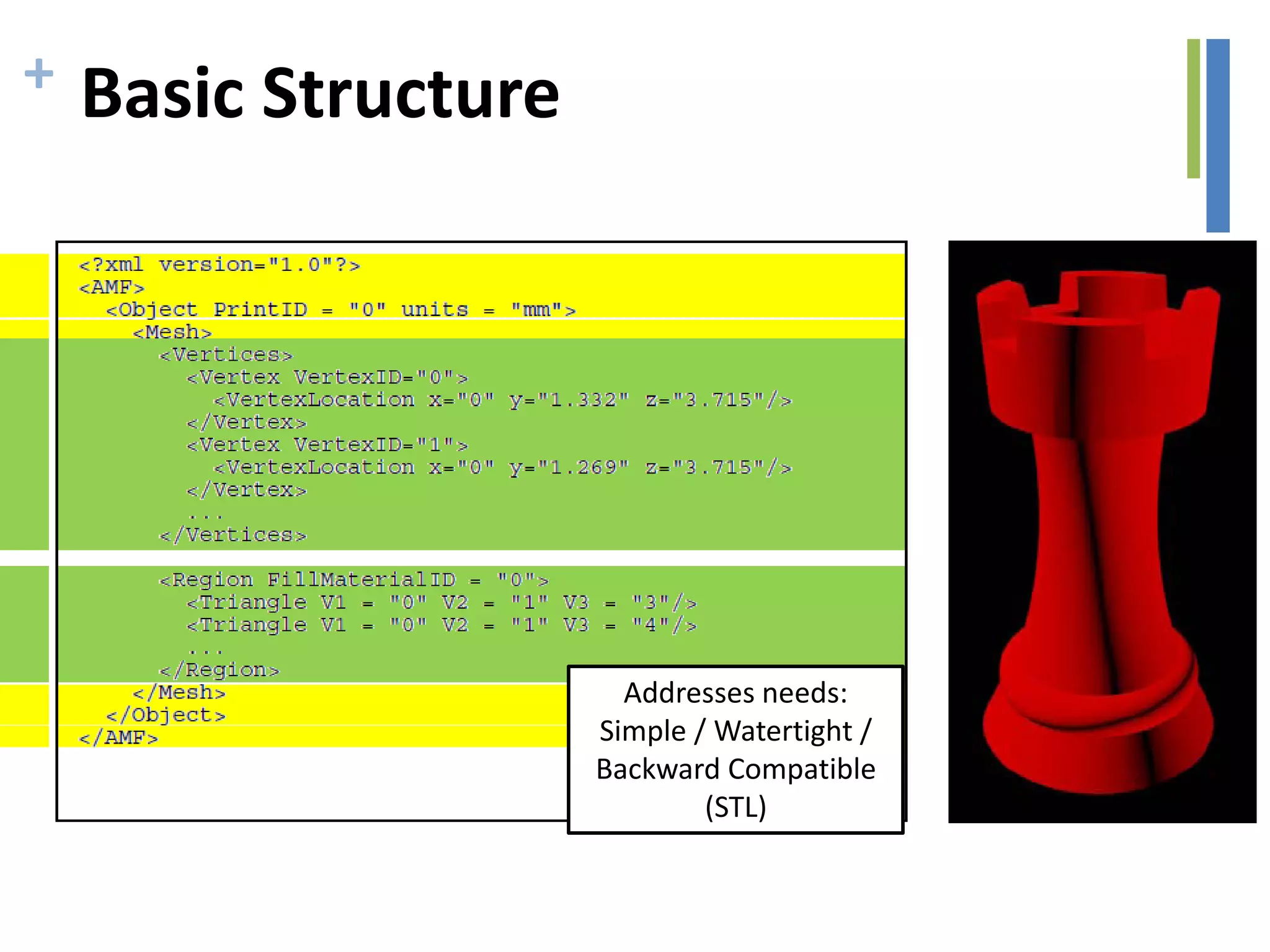
+ Basic Structure
Addresses needs:
Simple / Watertight /
Backward Compatible
(STL)
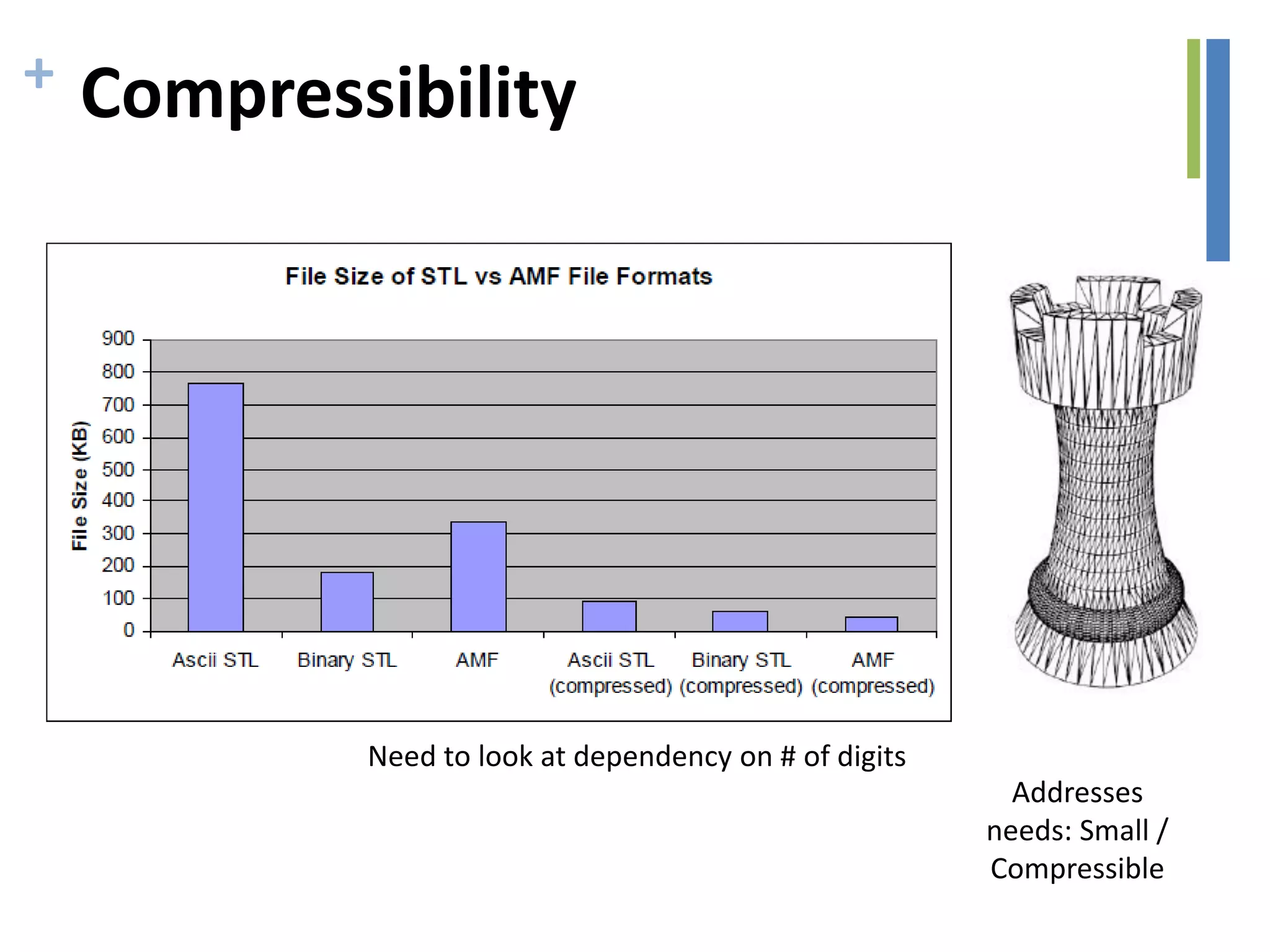
+ Compressibility
Addresses
needs: Small /
Compressible
Need to look at dependency on # of digits
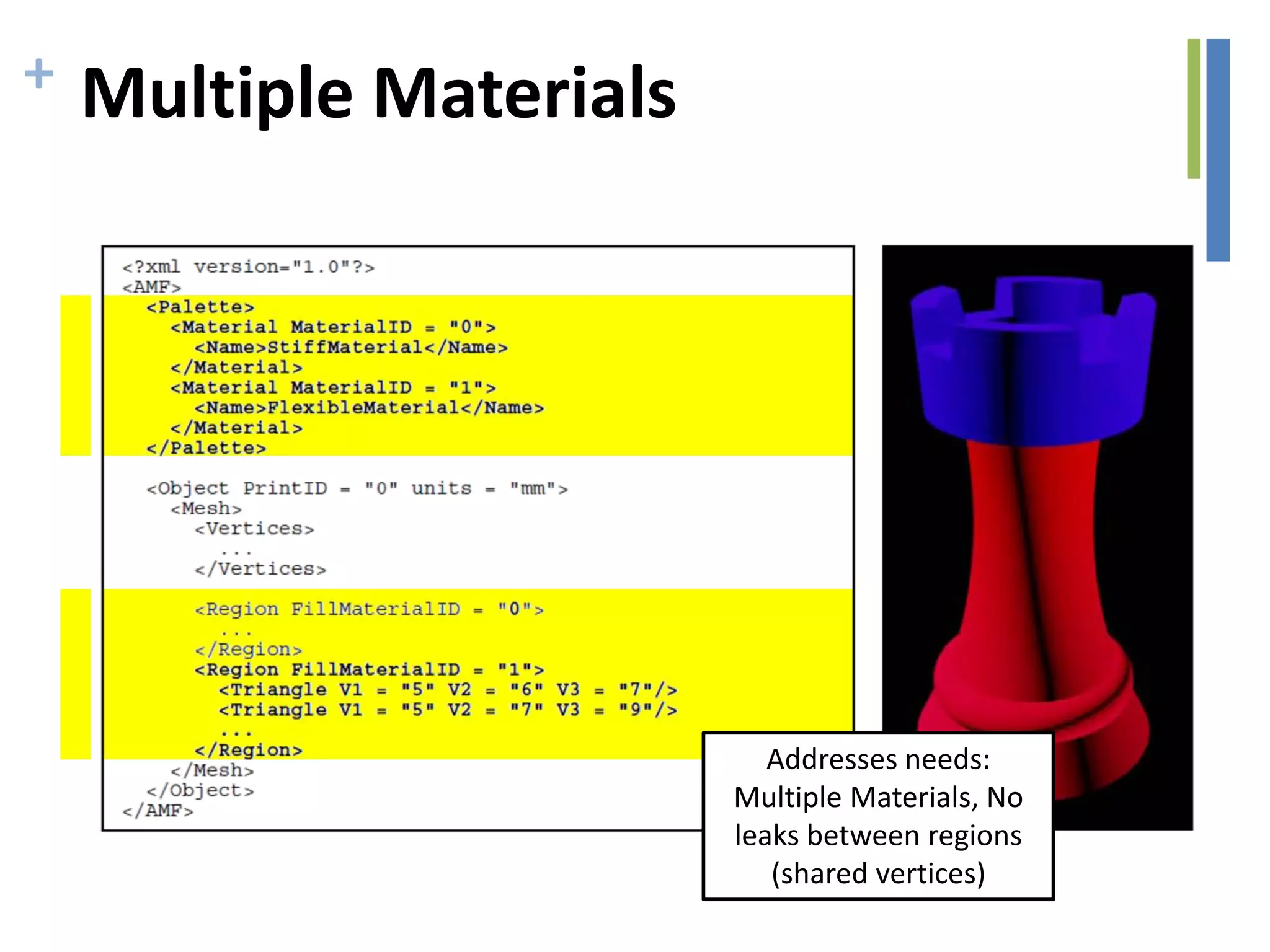
+ Multiple Materials
Addresses needs:
Multiple Materials, No
leaks between regions
(shared vertices)
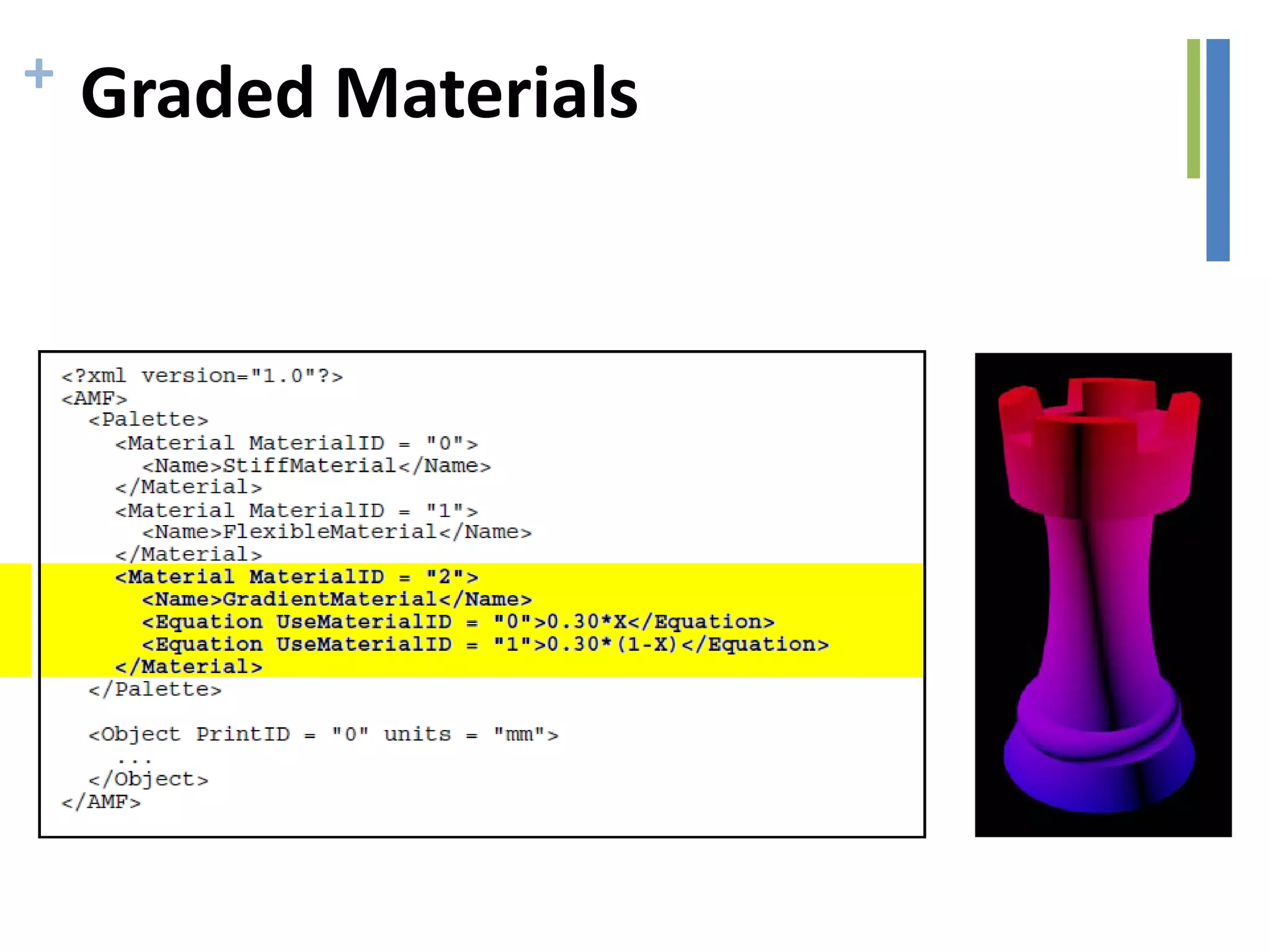
+ Graded Materials
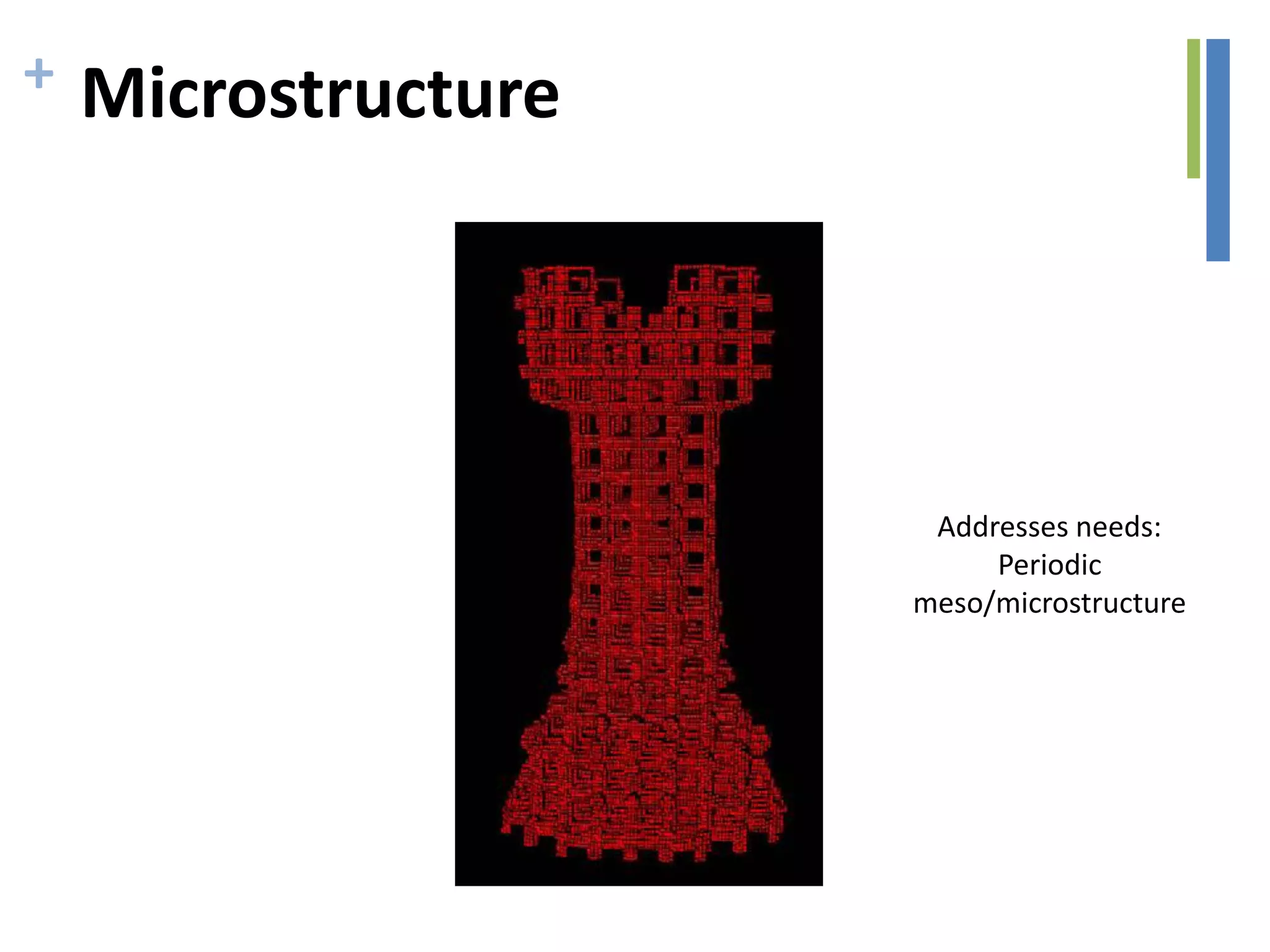
+ Microstructure
Addresses needs:
Periodic
meso/microstructure
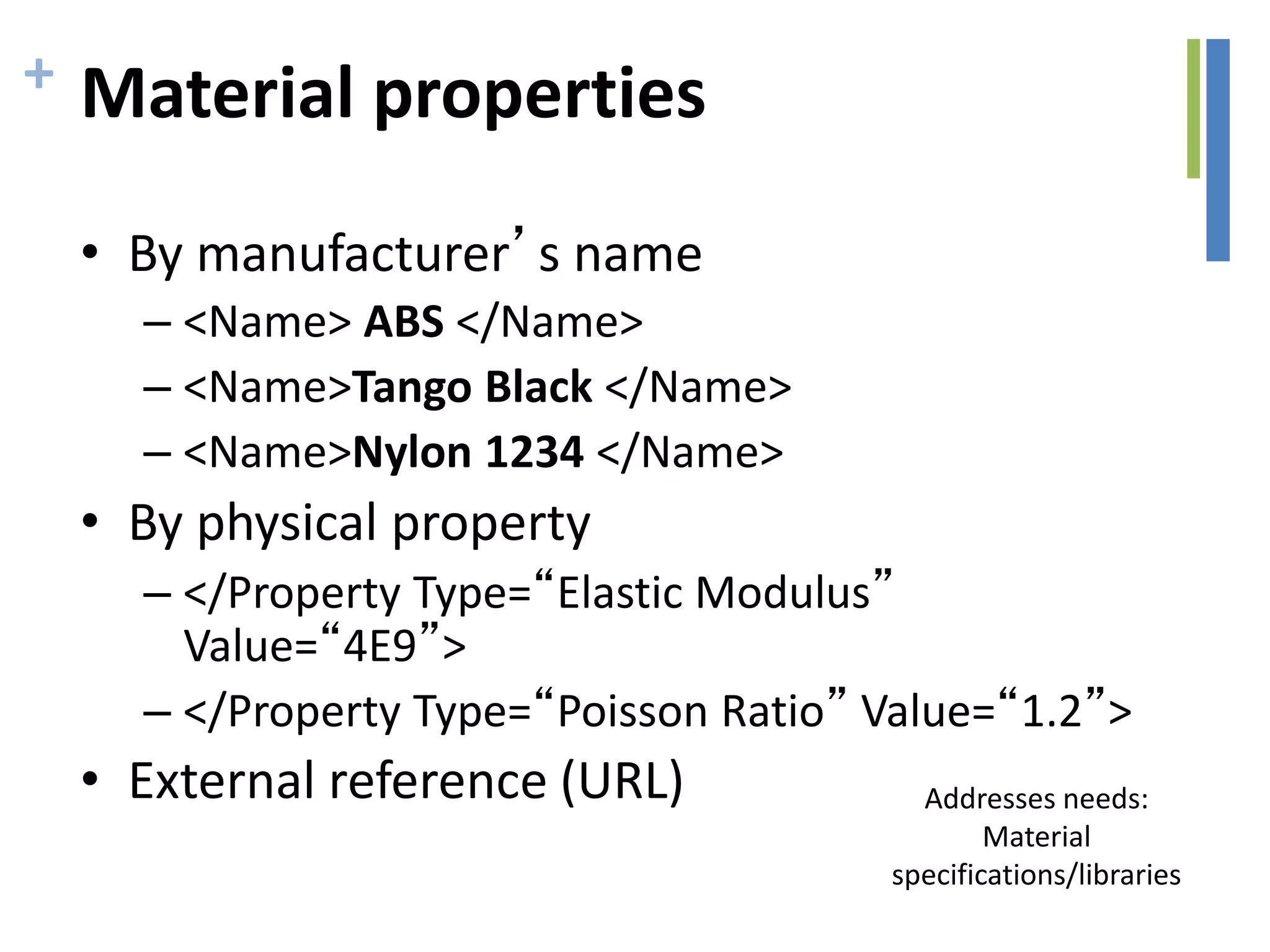
+ Material properties
• By manufacturer’s name
– <Name> ABS </Name>
– <Name>Tango Black </Name>
– <Name>Nylon 1234 </Name>
• By physical property
– </Property Type=“Elastic Modulus”
Value=“4E9”>
– </Property Type=“Poisson Ratio” Value=“1.2”>
• External reference (URL) Addresses needs:
Material
specifications/libraries
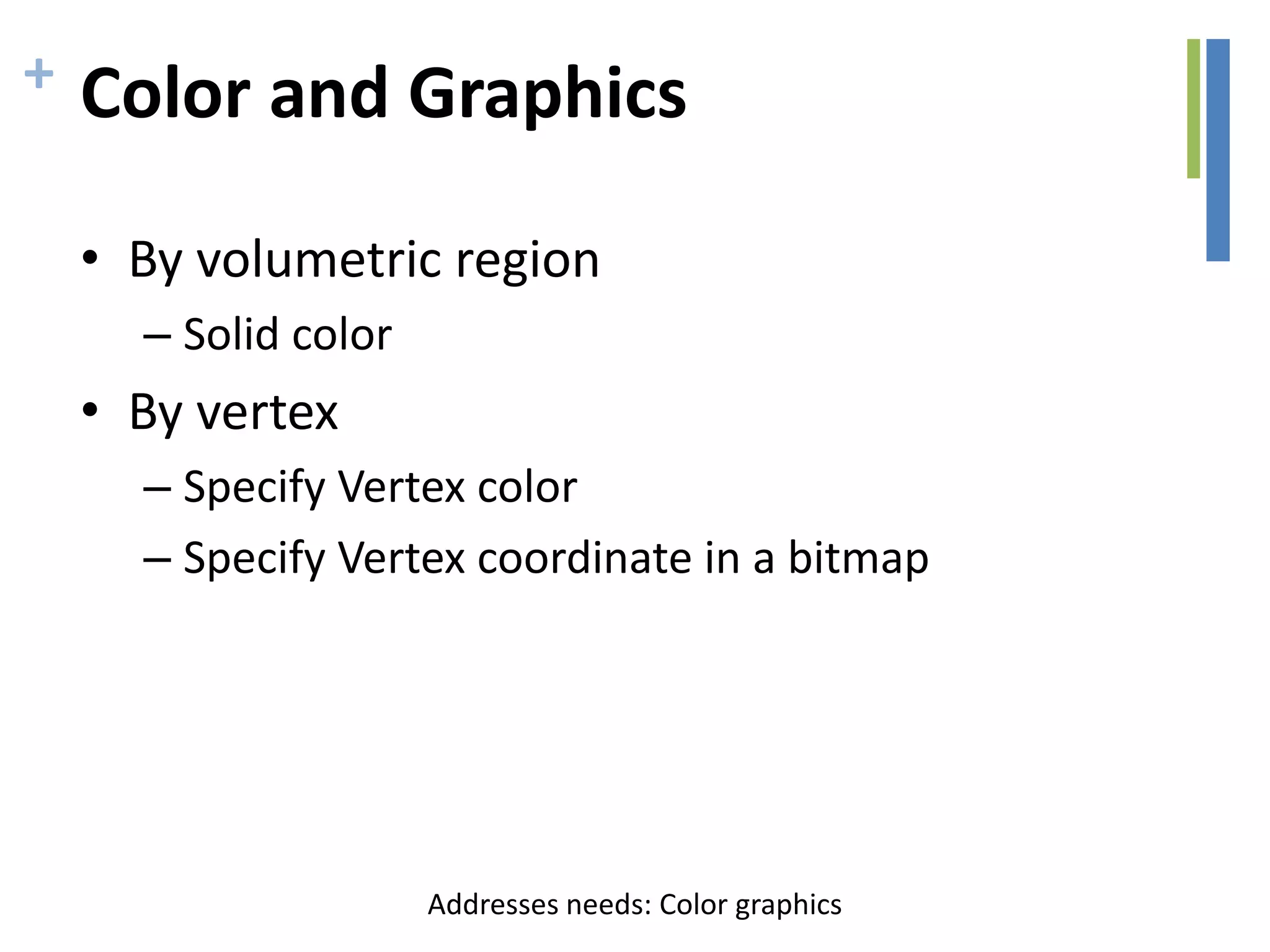
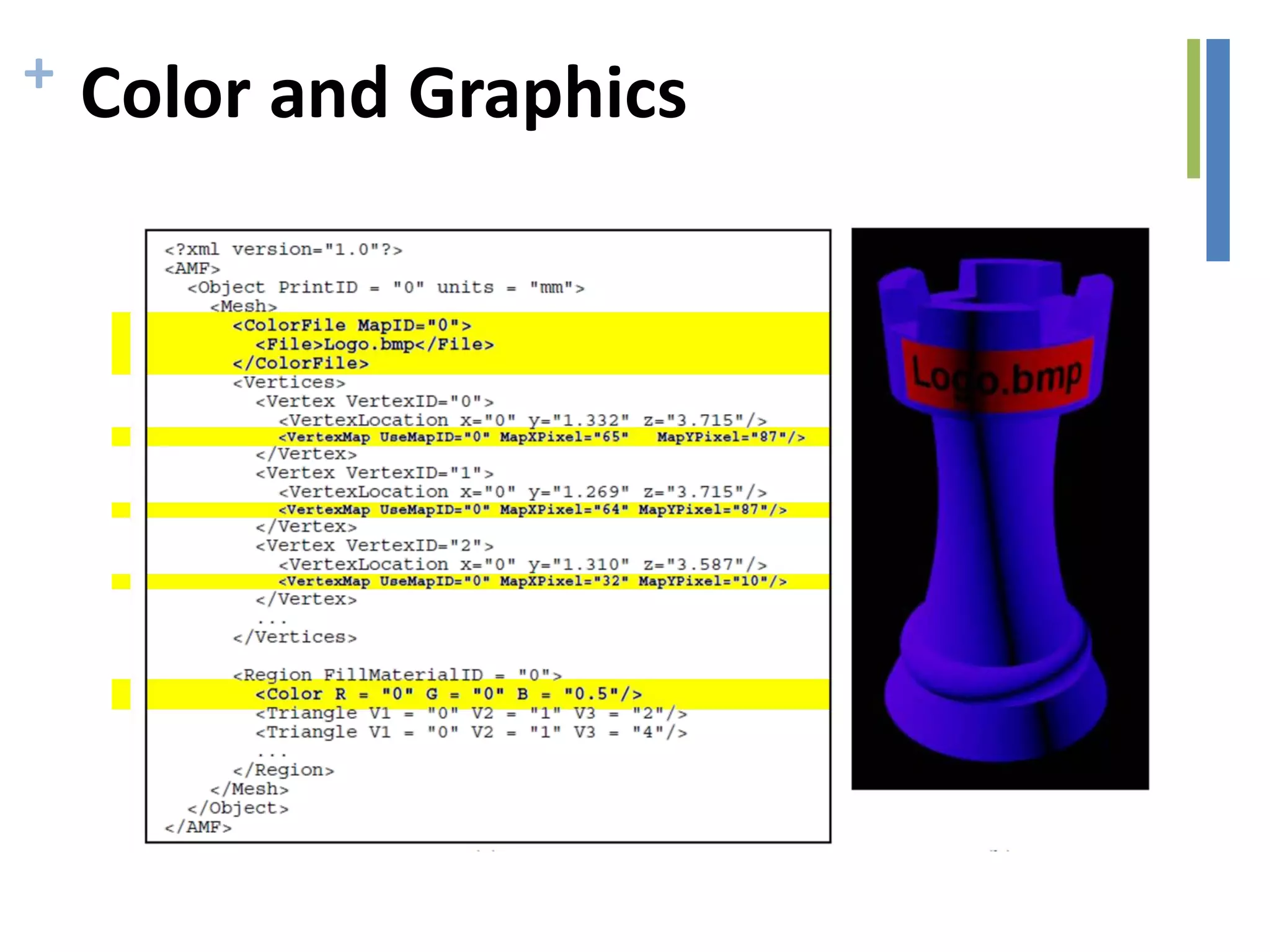
+ Color and Graphics
• By volumetric region
– Solid color
• By vertex
– Specify Vertex color
– Specify Vertex coordinate in a bitmap
Addresses needs: Color graphics
+ Color and Graphics
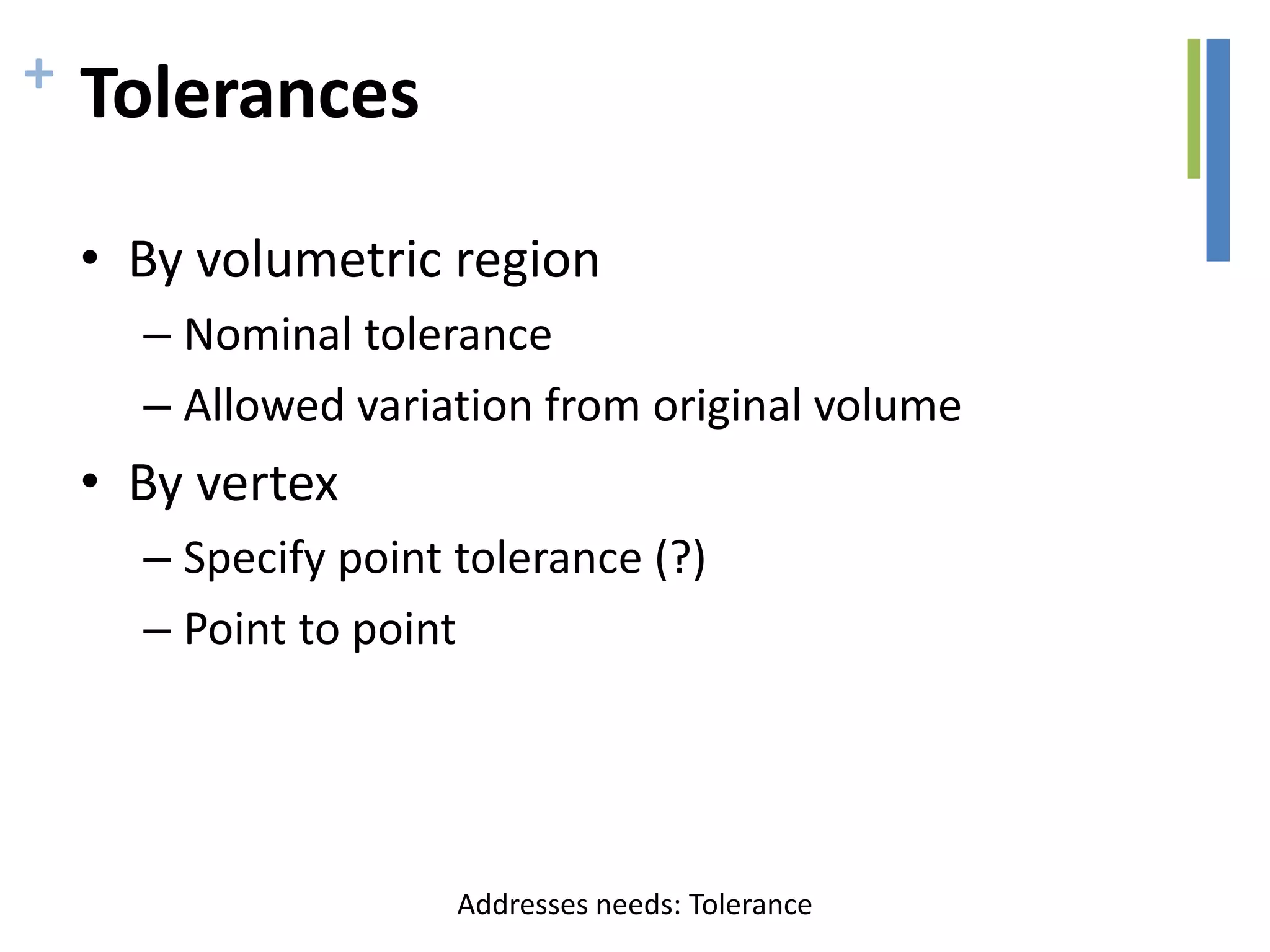
+ Tolerances
• By volumetric region
– Nominal tolerance
– Allowed variation from original volume
• By vertex
– Specify point tolerance (?)
– Point to point
Addresses needs: Tolerance
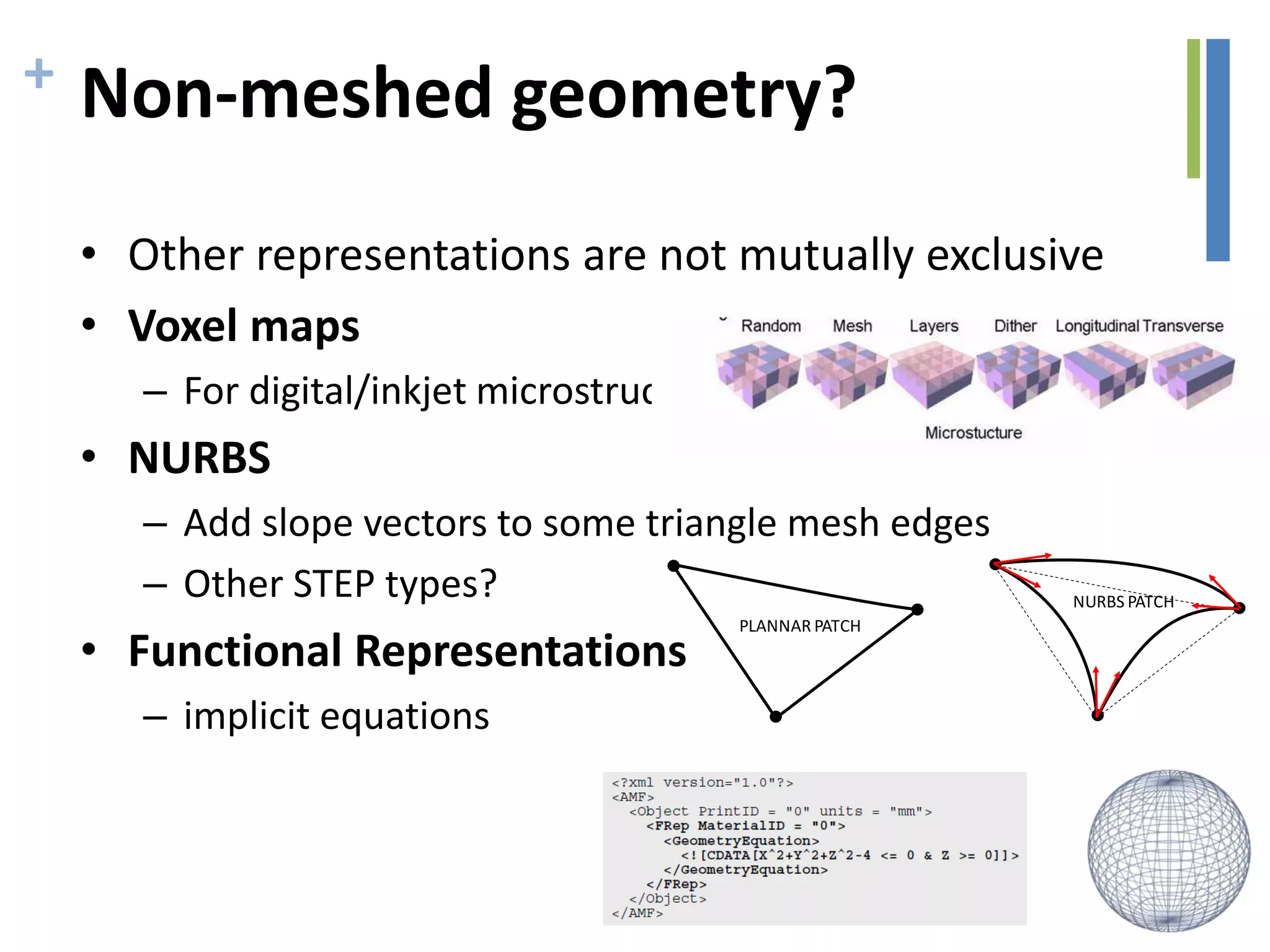
+ Non-meshed geometry?
• Other representations are not mutually exclusive
• Voxel maps
– For digital/inkjet microstructure
• NURBS
– Add slope vectors to some triangle mesh edges
– Other STEP types?
• Functional Representations
– implicit equations
NURBS PATCH
PLANNAR PATCH
+
NURBS PATCH
PLANNAR PATCH
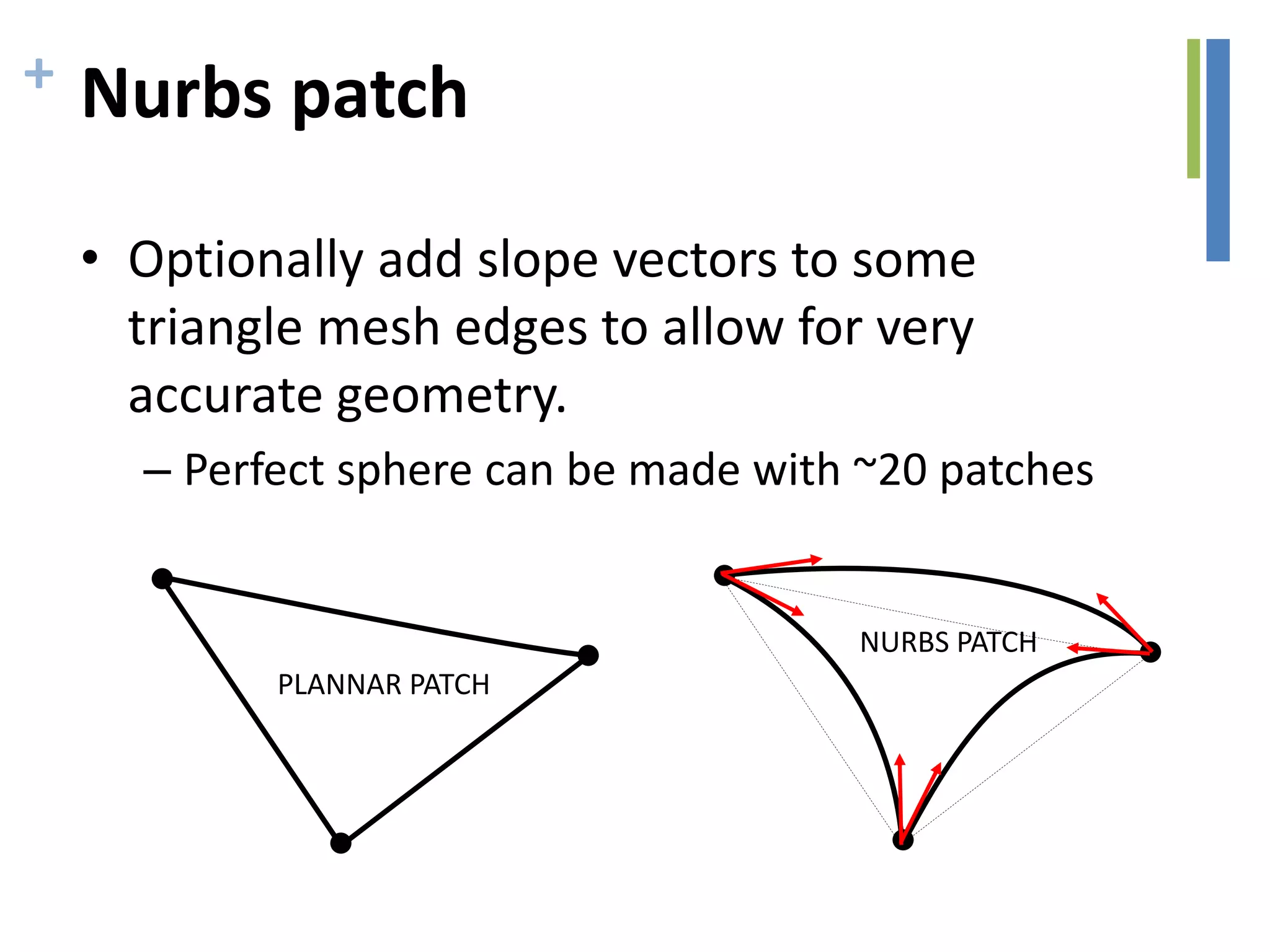
Nurbs patch
• Optionally add slope vectors to some
triangle mesh edges to allow for very
accurate geometry.
– Perfect sphere can be made with ~20 patches
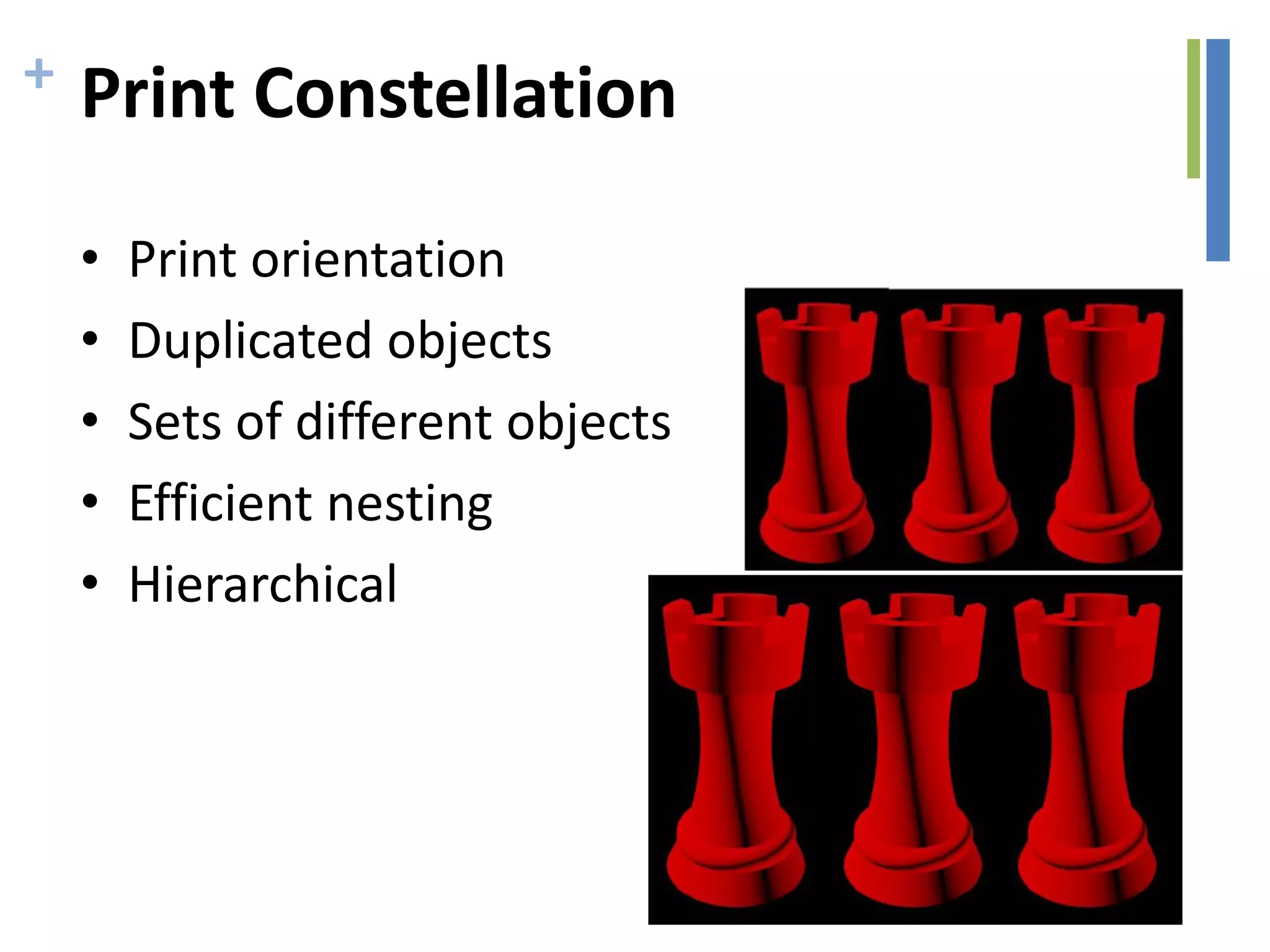
+ Print Constellation
• Print orientation
• Duplicated objects
• Sets of different objects
• Efficient nesting
• Hierarchical
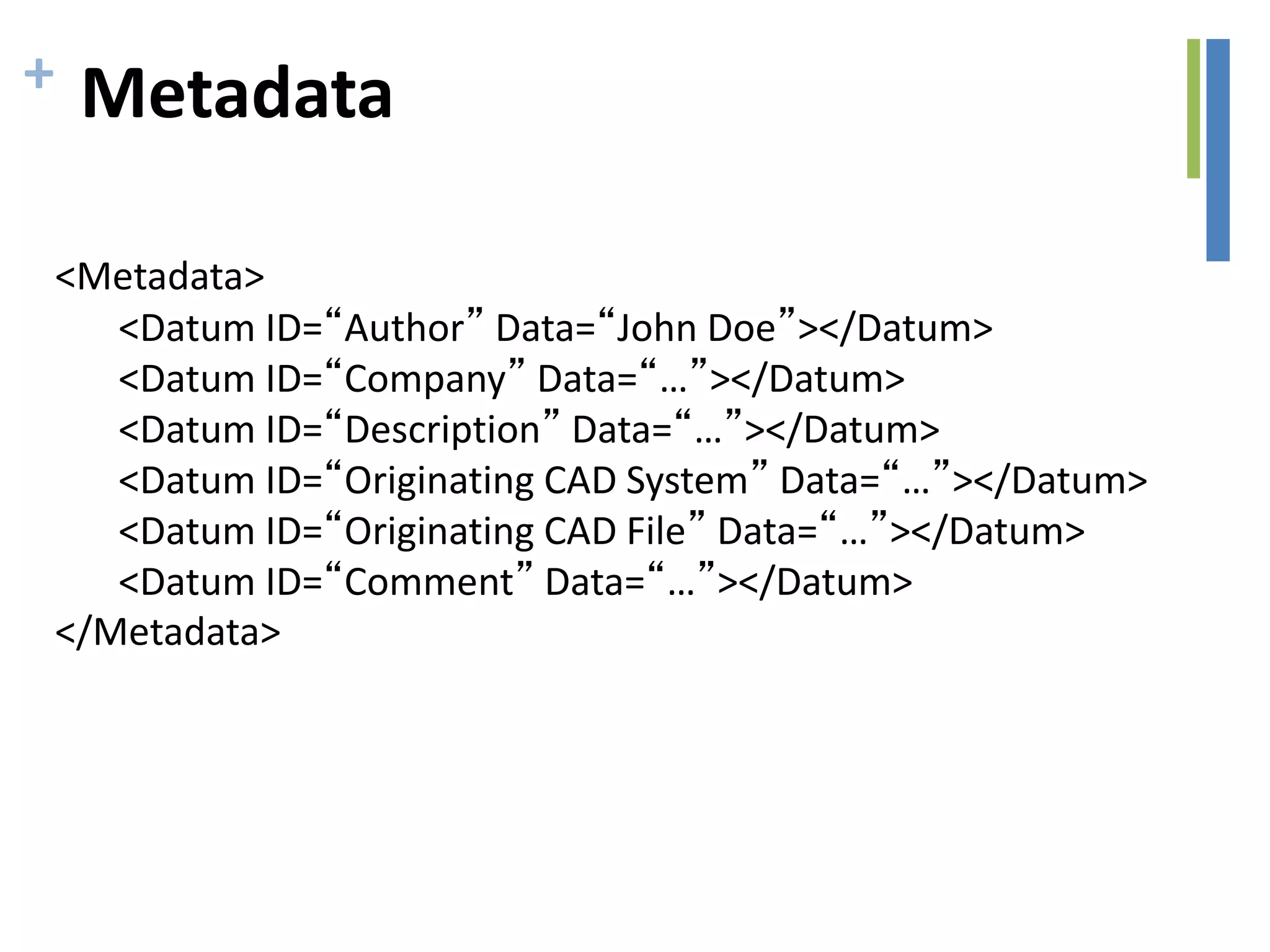
+ Metadata
<Metadata>
<Datum ID=“Author” Data=“John Doe”></Datum>
<Datum ID=“Company” Data=“…”></Datum>
<Datum ID=“Description” Data=“…”></Datum>
<Datum ID=“Originating CAD System” Data=“…”></Datum>
<Datum ID=“Originating CAD File” Data=“…”></Datum>
<Datum ID=“Comment” Data=“…”></Datum>
</Metadata>
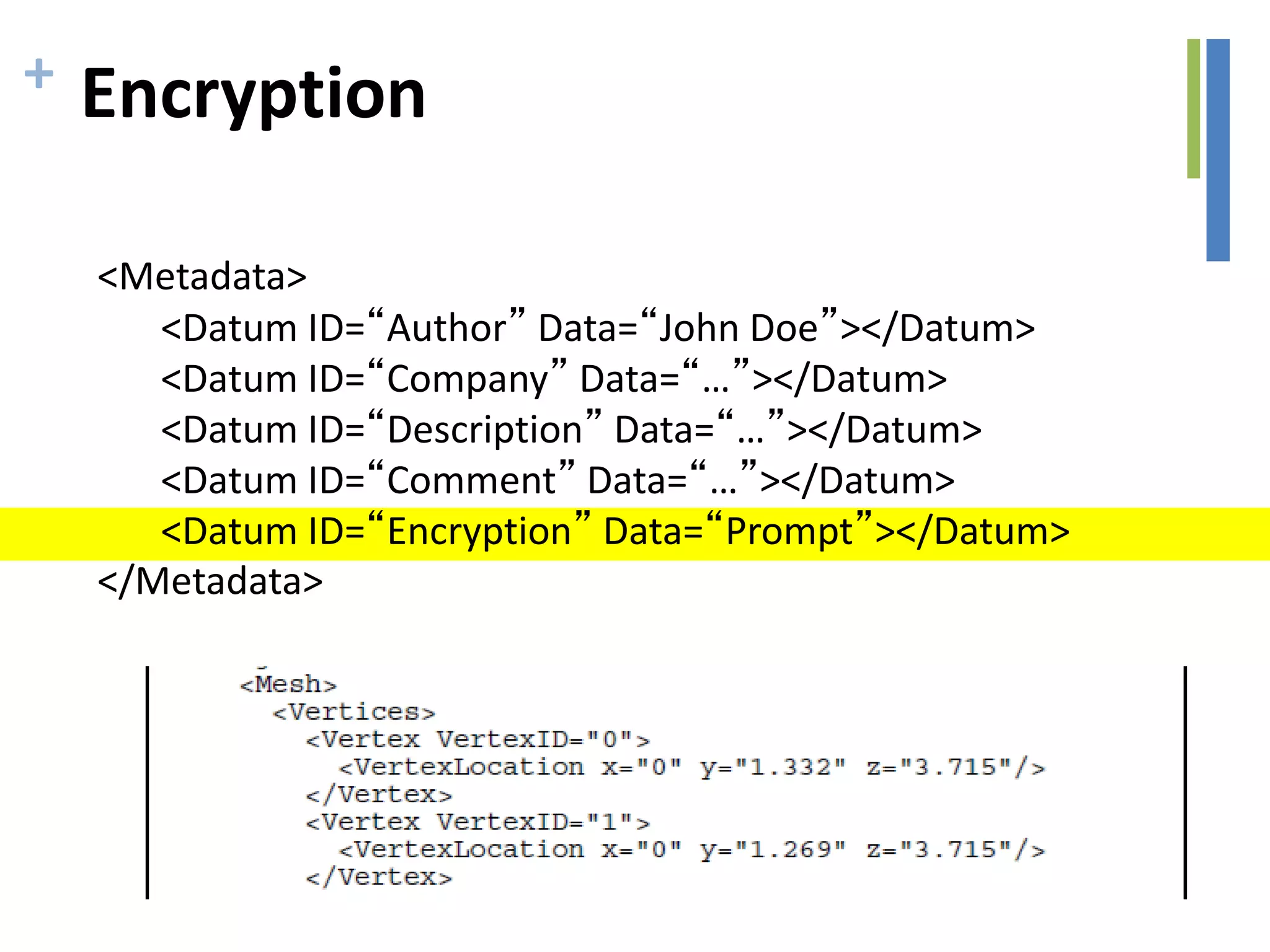
+ Encryption
<Metadata>
<Datum ID=“Author” Data=“John Doe”></Datum>
<Datum ID=“Company” Data=“…”></Datum>
<Datum ID=“Description” Data=“…”></Datum>
<Datum ID=“Comment” Data=“…”></Datum>
<Datum ID=“Encryption” Data=“Prompt”></Datum>
</Metadata>
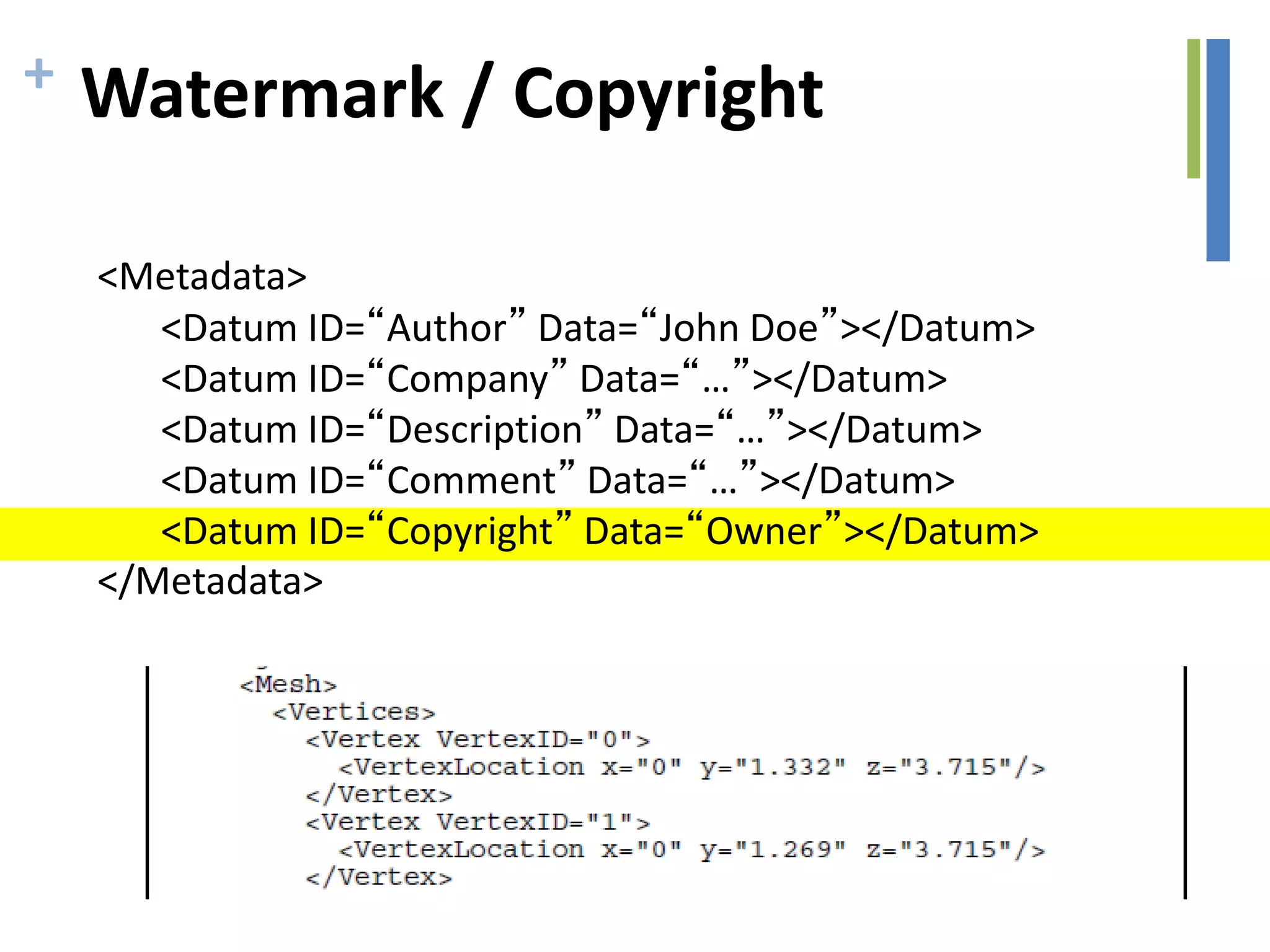
+ Watermark / Copyright
<Metadata>
<Datum ID=“Author” Data=“John Doe”></Datum>
<Datum ID=“Company” Data=“…”></Datum>
<Datum ID=“Description” Data=“…”></Datum>
<Datum ID=“Comment” Data=“…”></Datum>
<Datum ID=“Copyright” Data=“Owner”></Datum>
</Metadata>
+ Other features
• URL can be used in lieu of material data to
allow for external libraries
• Validation checksums
– E.g. Original vs. actual part/region volumes
• Automatic error checking
– Readers/writers must check for intact topology,
e.g.
• All nodes referenced by at least 3 triangles
• All edges referenced exactly twice per region
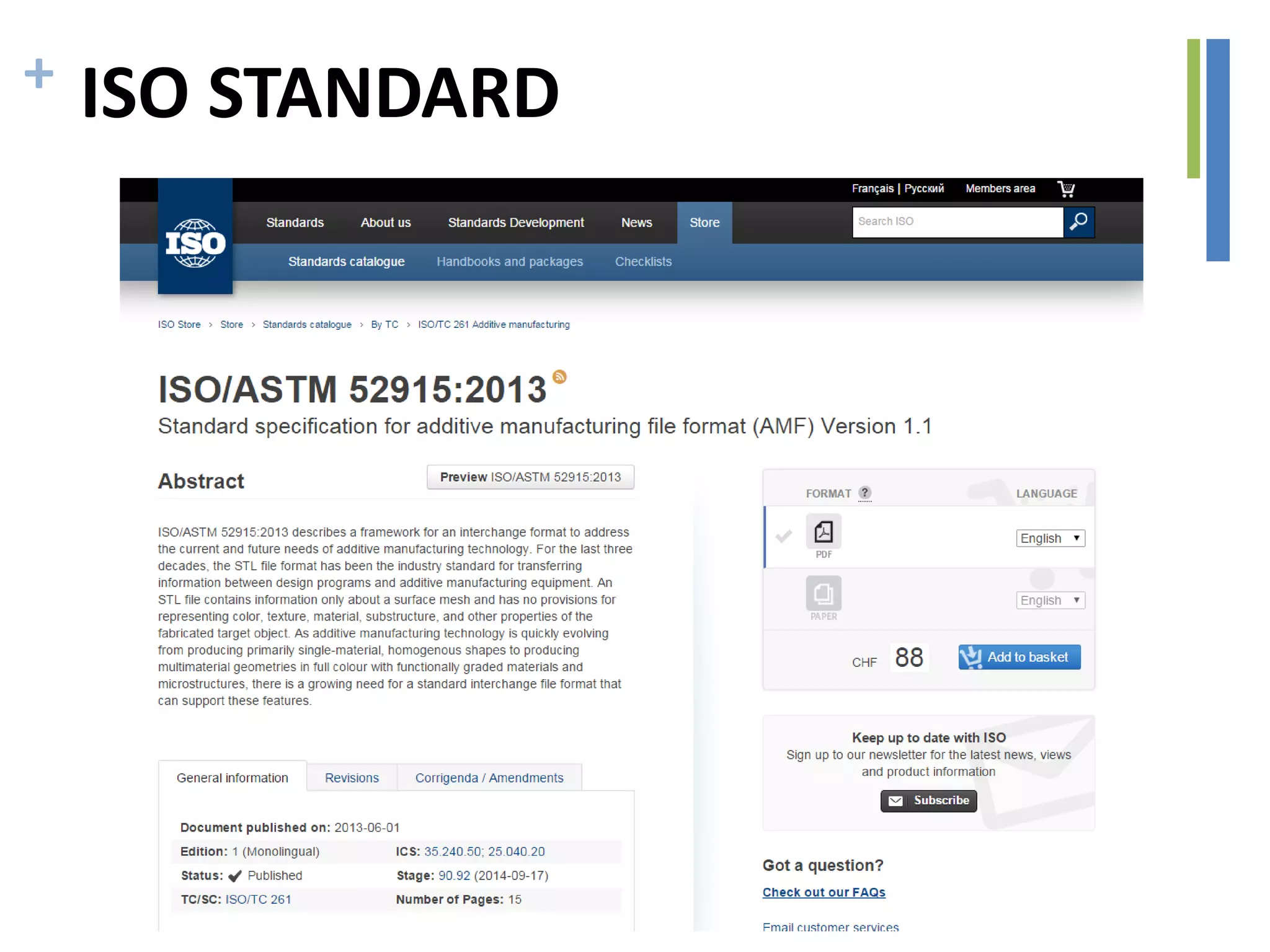
+ ISO STANDARD

2015 10-08 - additive manufacturing software 1

  • 1.
  • 2.
    + Question #107/10/2015
  • 3.
    + Question #207/10/2015
  • 4.
  • 5.
    + Invisalign OrthodonticAligners • An aligner for orthodontic use manufactured using a combination of rapid tooling and thermoforming. Manufacturing, Engineering & Technology, Fifth Edition, by Serope Kalpakjian and Steven R. Schmid. ISBN 0-13-148965-8. © 2006 Pearson Education, Inc., Upper Saddle River, NJ. All rights reserved.
  • 6.
  • 7.
  • 8.
  • 9.
  • 10.
    + Tissue Engineering- Biofabrication • Living cells are extracted from patients and seeded onto a carrier (scaffold) which accomodates and guides the growth of new cells in 3D within laboratory environment.
  • 11.
    + Tissue Engineering- Biofabrication • STL Data produced from Micro-CT scan data • Multiple specimens of identical structure can be made, reducing samples variations.
  • 12.
  • 13.
    + Open questions •WHICH ARE THE INTELLECTUAL PROPERTY IMPLICATIONS OF LOW-COST 3D PRINTING? • IS THE OPEN SOURCE 3-D PRINTING AN ENABLING TECHNOLOGY FOR SELF-DIRECTED SUSTAINABLE DEVELOPMENT? • CAN A 3D PRINTED ORGAN BE PATENTED?
  • 14.
  • 15.
    + Additive manufacturing ProcessFlow • Solid Modelling • Tesselation/Generation of STL file • Support Generation • “Slicing” of the Model • Model Physical Buildup • Cleanup and Post Curing • Surface Finishing
  • 16.
    + from ideato design
  • 17.
    + from ideato design
  • 18.
    + from designto object
  • 19.
    + from designto object
  • 20.
    + from designto object
  • 21.
    + CAD FILE STLFILE GCODE 3D object Triangle and vertex Toolpath FreeCAD FreeCAD (MeshLab) Slic3r (CURA) Printrun to 3DP File Description Software Additive manufacturing Process Flow
  • 22.
    + Additive manufacturing ProcessFlow CAD/CAM system Image acquisi on Inkjet based Direct wri ng
  • 23.
  • 24.
    + Data source •Representation of a volume – CAD model – Instruments output • CT • RM
  • 25.
    + CAD model Dimensionsof CAD Elements Elements Type of CAD Model 0D Point Corner Model 1D Line Edge Model 2D Surface Surface Model 3D Solid/Volume Solid or Volume Model
  • 26.
    FROM MEDICAL IMAGESTO STL Example 1
  • 27.
    + Segmentation • Segmentationsubdivides an image into its constituent regiorns or objects. • The level to whhc the subdivision is carried out depends on the problem being solved
  • 28.
    + Software perl’analisi delle bioimmagini • OsiriX (www.osirix-viewer.com) • 3DSlicer (www.slicer.org) • ImageJ (rsb.info.nih.gov/ij) • MIPAV (mipav.cit.nih.gov) • itk-SNAP (www.itksnap.org)
  • 29.
    + Image Analysis: OxiriXimaging software • Advanced open-source DICOM PACS workstation • Image processing • Better communication with surgeons
  • 30.
    + Geometry extraction •From original CT DICOM image to final volume • Semi-automatic procedure • Positive results in 95% of cases
  • 31.
    + Osirix Plugins: edgepreserving smoothing
  • 32.
    + Osirix Plugins: Level-Setsegmentation • Two algorithm – Shape detection – Geodesic Active Contours • Evolution based on – Propagation – Curvature – Advection • Programming principles d dt y = -aA(x)×Ñy -bP(x) Ñy +gZ(x)k Ñy R Malladi et al. Pattern Analysis and Machine Intelligence, IEEE Transactions on, 17(2):158 – 175, Feb 1995. V Caselles et al. International Journal of Computer Vision, 22(1):61–79, 1997.
  • 33.
  • 34.
    FROM 3D SCANTO STL Use of 123DCatch
  • 35.
  • 36.
  • 37.
  • 38.
  • 39.
  • 40.
  • 41.
  • 42.
  • 43.
  • 44.
  • 45.
  • 46.
  • 47.
  • 50.
  • 51.
    + Stereolithograpy Interface •Stereolithograpy was first commercial Solid Freeform Manufacturing (SFM) process, released in 80’s by 3-D Systems • 3-D Systems developed interface between CAD systems and their machine • STL files (*.stl) allow CAD systems to interface with 3-D system machines • Virtually all subsequent SFM processes can use this same format (SFM industry standard) • Many CAD programs now can export the *.stl file for easy conversion from CAD to part
  • 52.
    + STL Files(*.stl) • STL files were based on a program called Silverscreen CAD • Silverscreen CAD represent boundary with all surfaces being approximated by polygons or groups of polygons • *.stl files use triangles or groups of triangles to approximate surfaces • Accuracy depends on the triangle sizes (Smaller facets produce a higher quality surface) • Triangles assigned normal vectors for outward surface normal • Parts are defined by representing all their bounding surfaces as faceted surfaces, using the triangular patches
  • 53.
    + STL Files(*.stl) • STL files describe only the surface geometry of a three dimensional object without any representation of color, texture or other common CAD model attributes. • An STL file describes a raw unstructured triangulated surface by the unit normal and vertices (ordered by the right-hand rule) of the triangles using a three-dimensional Cartesian coordinate system.
  • 54.
    + Example of*.stl Representation Representing a sphere
  • 55.
    + Example of*.stl Representation
  • 56.
    + Existing Formats(1/2) • 3D PDF – Proprietary, closed • ISO 14649 (STEP-NC) – Mostly for NC control, G-Code • STEP / IGES, SAT, Parasolid – Too complex, missing features e.g. no mesostructure • X3D VRML – Mesh, color, texture, lighting All: no provision for AM, e.g. materials, internal structure
  • 57.
    + Existing Formats(2/2) • PLY – 3D Scanner data • 3DS – Limited mesh size • SLC – Limited information All: no provision for AM, e.g. materials, internal structure
  • 58.
    + New formatneeded • Tailor to AM community needs – No content constraints • Retain Community Control – Not Proprietary • Neutral – Avoids association with existing companies
  • 59.
    + Desired features •simple • ISO 9000-ish features like product tracking • Interoperability within different manufacturers • Compatible with FEA applications • Identification of parent CAD program • Restricted number of printings • Support multiple shells • Editable ASCII/Text format
  • 60.
    + Desired features •Information about build orientation • Stability/robustness • No redundancy • Volume validity • Lock or encrypt the file with a password • Ability to put a permanent ‘watermark’ • Supporting geometry in native way • Keep triangle mesh / No triangle mesh
  • 61.
    + Reaching consensus,adoption • Non proprietary / open source • Endorsement by major CAD / Manufacturers • Use ASTM / Voting • Backwards compatible (STL) • Expandable, XML • Publish for comments / discussion • Open source software • Conversion tools • Limit the scope: Not a CAD model
  • 62.
  • 63.
    + The newproposed format • AMF – Additive Manufacturing Format – Additive Manufacturing File
  • 64.
    + XML • Meta-format:Format of formats – Text based – Easy to read/write/parse – Existing editing tools – Extensible – Highly compressible • Mentioned by a number of constituents – E.g. Materialise – Based on work by J. Hiller (Cornell) Addresses needs: Editable / Extensible / Readable / Open / Non proprietary
  • 65.
    + General Concept •Part (objects) defined by regions and materials – Regions defined by triangular mesh – Materials defined by properties/names • Mesh properties can be specified – Color – Tolerance – Texture • Materials can be combined – Graded materials – Microstructure
  • 66.
    + Basic Structure Addressesneeds: Simple / Watertight / Backward Compatible (STL)
  • 67.
    + Compressibility Addresses needs: Small/ Compressible Need to look at dependency on # of digits
  • 68.
    + Multiple Materials Addressesneeds: Multiple Materials, No leaks between regions (shared vertices)
  • 69.
  • 70.
  • 71.
    + Material properties •By manufacturer’s name – <Name> ABS </Name> – <Name>Tango Black </Name> – <Name>Nylon 1234 </Name> • By physical property – </Property Type=“Elastic Modulus” Value=“4E9”> – </Property Type=“Poisson Ratio” Value=“1.2”> • External reference (URL) Addresses needs: Material specifications/libraries
  • 72.
    + Color andGraphics • By volumetric region – Solid color • By vertex – Specify Vertex color – Specify Vertex coordinate in a bitmap Addresses needs: Color graphics
  • 73.
    + Color andGraphics
  • 74.
    + Tolerances • Byvolumetric region – Nominal tolerance – Allowed variation from original volume • By vertex – Specify point tolerance (?) – Point to point Addresses needs: Tolerance
  • 75.
    + Non-meshed geometry? •Other representations are not mutually exclusive • Voxel maps – For digital/inkjet microstructure • NURBS – Add slope vectors to some triangle mesh edges – Other STEP types? • Functional Representations – implicit equations NURBS PATCH PLANNAR PATCH
  • 76.
    + NURBS PATCH PLANNAR PATCH Nurbspatch • Optionally add slope vectors to some triangle mesh edges to allow for very accurate geometry. – Perfect sphere can be made with ~20 patches
  • 77.
    + Print Constellation •Print orientation • Duplicated objects • Sets of different objects • Efficient nesting • Hierarchical
  • 78.
    + Metadata <Metadata> <Datum ID=“Author”Data=“John Doe”></Datum> <Datum ID=“Company” Data=“…”></Datum> <Datum ID=“Description” Data=“…”></Datum> <Datum ID=“Originating CAD System” Data=“…”></Datum> <Datum ID=“Originating CAD File” Data=“…”></Datum> <Datum ID=“Comment” Data=“…”></Datum> </Metadata>
  • 79.
    + Encryption <Metadata> <Datum ID=“Author”Data=“John Doe”></Datum> <Datum ID=“Company” Data=“…”></Datum> <Datum ID=“Description” Data=“…”></Datum> <Datum ID=“Comment” Data=“…”></Datum> <Datum ID=“Encryption” Data=“Prompt”></Datum> </Metadata>
  • 80.
    + Watermark /Copyright <Metadata> <Datum ID=“Author” Data=“John Doe”></Datum> <Datum ID=“Company” Data=“…”></Datum> <Datum ID=“Description” Data=“…”></Datum> <Datum ID=“Comment” Data=“…”></Datum> <Datum ID=“Copyright” Data=“Owner”></Datum> </Metadata>
  • 81.
    + Other features •URL can be used in lieu of material data to allow for external libraries • Validation checksums – E.g. Original vs. actual part/region volumes • Automatic error checking – Readers/writers must check for intact topology, e.g. • All nodes referenced by at least 3 triangles • All edges referenced exactly twice per region
  • 82.