Rapid Prototyping
(Introduction)
1
Introduction
 Prototype: It is a model fabricated to prove out a
concept or an idea.
 Solid Modelling: It’s a branch of CAD that produces
2D or 3D objects in an electronic format.
 Rapid prototyping is basically a additive
manufacturing process used to quickly fabricate a
model of a part using 3-D CAM data.
 It can also be defined as layer by layer fabrication of
3D physical models directly from CAD.
Need for Rapid Prototyping
 To increase effective communication.
 To decrease development time.
 To decrease costly mistakes.
 To minimise sustaining engineering changes.
 To extend product life time by adding necessary
features & eliminating redundant features early in
the design.
Trends in manufacturing industries
emphasis the following
 Increasing the no of variants of products.
 Increase in product complexity.
 Decrease in product lifetime before obsolescence.
 Decrease in delivery time.
 Product development by Rapid prototyping by
enabling better communication.
Conventional Machining
 Its not suitable for complex shapes because they are
difficult to machine.
 Time consuming
 Very costly
 Tedious or very laborious.
 Skilled operator is required.
 Accuracy will be less.
 Increased product development time.
 Pre-processing:- CAD model slicing & setting algorithms
applied for various RP systems.
 Post-processing:-Cleaning operations required to finish a
part after removing it from RP machine.
 Materials for Rapid Prototyping: Paper, Wax, Plastics,
Resins, Metallic powders.
History of Rapid Prototyping
 It started in 1980’s
 First technique is Stereolithography (SLA)
 It was developed by 3D systems of Valencia in California, USA in
1986.
 Fused deposition modelling (FDM) developed by stratasys company
in 1988.
 Laminated object manufacturing (LOM) developed by Helisis (USA).
 Solid ground Curing developed by Cubitol corporation of Israel.
 Selective laser sintering developed by DTM of Austin, Texas (USA)
in 1989.
 Sanders Model maker developed by Wilton incorporation USA in
1990.
 Multi Jet Modelling by 3D systems.
 3-D Printing by Solygen incorporation, MIT, USA.
Rapid Prototyping and
Tooling
In the development of a new product, there is a need to produce a
single prototype, of a designed part or system before allocating large
amounts of capital to new production facilities or assembly lines.
Consequently, a working prototype is needed for design evaluation
and troubleshooting before a complex product or system is ready to be
produced and marketed.
The traditional method of fabricating a prototype part is machining,
which can require significant lead times.
A virtual prototype, which is a computer model of the part design on a
CAD system, may not be adequate for the designer to visualize the
part.
It certainly is not sufficient to conduct real physical tests on the part,
although it is possible to perform simulated tests by finite element
analysis or other methods.
Advantages of RPT
Rapid prototyping serves as an important tool for visualization and for concept
verification.
With suitable materials, the prototype can be used in subsequent manufacturing
operations to produce the final parts. Sometimes called direct prototyping, this approach
can serve as an important manufacturing technology.
Rapid-prototyping operations can be used in some applications to produce actual tooling
for manufacturing operations. Thus, one can obtain tooling in a matter of a few days.
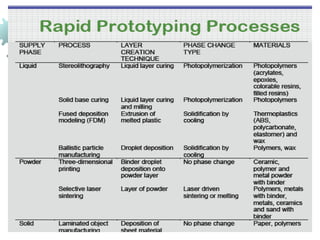
Rapid-prototyping processes can be classified into
three major groups:
Subtractive: removal from a workpiece that is larger than
the final part.
Virtualprocesses: Use advanced computer-based
visualization technologies.
Additive processes: build up a part by adding material
incrementally to produce the part.
Classification of
RPT
Additive Process techniques
include;
Stereolitliograpliy,
MultiJet/ PolyJet modeling,
Fused deposition modeling,
Ballistic-particle manufacturing,
3D printing,
Selective laser sintering,
Electron-beam and
Laminated-object manufacturing.
What is a STL File?
A STL file is a format used by Stereolithography software to
generate information needed to produce 3D models on
Stereolithography machines. In fact, the extension "stl" is said
to be derived from the word "Stereolithography."
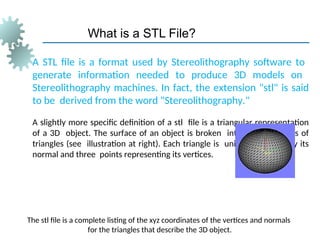
A slightly more specific definition of a stl file is a triangular representation
of a 3D object. The surface of an object is broken into a logical series of
triangles (see illustration at right). Each triangle is uniquely defined by its
normal and three points representing its vertices.
The stl file is a complete listing of the xyz coordinates of the vertices and normals
for the triangles that describe the 3D object.
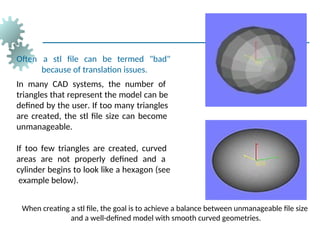
Often a stl file can be termed "bad"
because of translation issues.
In many CAD systems, the number of
triangles that represent the model can be
defined by the user. If too many triangles
are created, the stl file size can become
unmanageable.
If too few triangles are created, curved
areas are not properly defined and a
cylinder begins to look like a hexagon (see
example below).
When creating a stl file, the goal is to achieve a balance between unmanageable file size
and a well-defined model with smooth curved geometries.
How to create a STL file?
Most CAD software packages offer stl conversion add-ins.
If we have access to conversion software, stl translation is relatively
simple as long as you have a clean-surfaced 3D model and a high-end
computer.
Traditionally when converting to a stl file, the user is given several
options for resolution (sometimes called chord height, triangle
tolerance, etc.). Depending upon the size of the model, the geometry
of small details, and the overall curvature of the part, the tolerance can
typically be set to .001 inch for average models.
Small parts or models with fine details may require a tighter
tolerance.
RP Applications
 Applications of rapid prototyping can be classified
into three categories:
1. Design
2. Engineering analysis and planning
3. Tooling and manufacturing
Problems with Rapid Prototyping
 Part accuracy:
 Staircase appearance for a sloping part surface
due to layering
 Shrinkage and distortion of RP parts
 Limited variety of materials in RP
 Mechanical performance of the fabricated parts is
limited by the materials that must be used in the
RP process
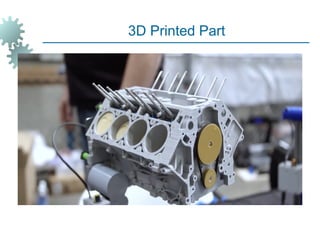
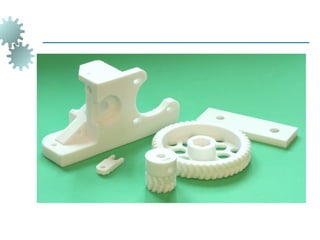
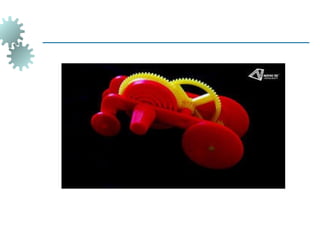
3D Printed Part
Introduction to 3D Printing with rapid prototyping

Introduction to 3D Printing with rapid prototyping

  • 1.
  • 2.
    Introduction  Prototype: Itis a model fabricated to prove out a concept or an idea.  Solid Modelling: It’s a branch of CAD that produces 2D or 3D objects in an electronic format.  Rapid prototyping is basically a additive manufacturing process used to quickly fabricate a model of a part using 3-D CAM data.  It can also be defined as layer by layer fabrication of 3D physical models directly from CAD.
  • 3.
    Need for RapidPrototyping  To increase effective communication.  To decrease development time.  To decrease costly mistakes.  To minimise sustaining engineering changes.  To extend product life time by adding necessary features & eliminating redundant features early in the design.
  • 4.
    Trends in manufacturingindustries emphasis the following  Increasing the no of variants of products.  Increase in product complexity.  Decrease in product lifetime before obsolescence.  Decrease in delivery time.  Product development by Rapid prototyping by enabling better communication.
  • 5.
    Conventional Machining  Itsnot suitable for complex shapes because they are difficult to machine.  Time consuming  Very costly  Tedious or very laborious.  Skilled operator is required.  Accuracy will be less.  Increased product development time.
  • 6.
     Pre-processing:- CADmodel slicing & setting algorithms applied for various RP systems.  Post-processing:-Cleaning operations required to finish a part after removing it from RP machine.  Materials for Rapid Prototyping: Paper, Wax, Plastics, Resins, Metallic powders.
  • 7.
    History of RapidPrototyping  It started in 1980’s  First technique is Stereolithography (SLA)  It was developed by 3D systems of Valencia in California, USA in 1986.  Fused deposition modelling (FDM) developed by stratasys company in 1988.  Laminated object manufacturing (LOM) developed by Helisis (USA).  Solid ground Curing developed by Cubitol corporation of Israel.  Selective laser sintering developed by DTM of Austin, Texas (USA) in 1989.  Sanders Model maker developed by Wilton incorporation USA in 1990.  Multi Jet Modelling by 3D systems.  3-D Printing by Solygen incorporation, MIT, USA.
  • 8.
    Rapid Prototyping and Tooling Inthe development of a new product, there is a need to produce a single prototype, of a designed part or system before allocating large amounts of capital to new production facilities or assembly lines. Consequently, a working prototype is needed for design evaluation and troubleshooting before a complex product or system is ready to be produced and marketed. The traditional method of fabricating a prototype part is machining, which can require significant lead times. A virtual prototype, which is a computer model of the part design on a CAD system, may not be adequate for the designer to visualize the part. It certainly is not sufficient to conduct real physical tests on the part, although it is possible to perform simulated tests by finite element analysis or other methods.
  • 9.
    Advantages of RPT Rapidprototyping serves as an important tool for visualization and for concept verification. With suitable materials, the prototype can be used in subsequent manufacturing operations to produce the final parts. Sometimes called direct prototyping, this approach can serve as an important manufacturing technology. Rapid-prototyping operations can be used in some applications to produce actual tooling for manufacturing operations. Thus, one can obtain tooling in a matter of a few days.
  • 10.
    Rapid-prototyping processes canbe classified into three major groups: Subtractive: removal from a workpiece that is larger than the final part. Virtualprocesses: Use advanced computer-based visualization technologies. Additive processes: build up a part by adding material incrementally to produce the part. Classification of RPT
  • 11.
    Additive Process techniques include; Stereolitliograpliy, MultiJet/PolyJet modeling, Fused deposition modeling, Ballistic-particle manufacturing, 3D printing, Selective laser sintering, Electron-beam and Laminated-object manufacturing.
  • 13.
    What is aSTL File? A STL file is a format used by Stereolithography software to generate information needed to produce 3D models on Stereolithography machines. In fact, the extension "stl" is said to be derived from the word "Stereolithography." A slightly more specific definition of a stl file is a triangular representation of a 3D object. The surface of an object is broken into a logical series of triangles (see illustration at right). Each triangle is uniquely defined by its normal and three points representing its vertices. The stl file is a complete listing of the xyz coordinates of the vertices and normals for the triangles that describe the 3D object.
  • 14.
    Often a stlfile can be termed "bad" because of translation issues. In many CAD systems, the number of triangles that represent the model can be defined by the user. If too many triangles are created, the stl file size can become unmanageable. If too few triangles are created, curved areas are not properly defined and a cylinder begins to look like a hexagon (see example below). When creating a stl file, the goal is to achieve a balance between unmanageable file size and a well-defined model with smooth curved geometries.
  • 15.
    How to createa STL file? Most CAD software packages offer stl conversion add-ins. If we have access to conversion software, stl translation is relatively simple as long as you have a clean-surfaced 3D model and a high-end computer. Traditionally when converting to a stl file, the user is given several options for resolution (sometimes called chord height, triangle tolerance, etc.). Depending upon the size of the model, the geometry of small details, and the overall curvature of the part, the tolerance can typically be set to .001 inch for average models. Small parts or models with fine details may require a tighter tolerance.
  • 16.
    RP Applications  Applicationsof rapid prototyping can be classified into three categories: 1. Design 2. Engineering analysis and planning 3. Tooling and manufacturing
  • 17.
    Problems with RapidPrototyping  Part accuracy:  Staircase appearance for a sloping part surface due to layering  Shrinkage and distortion of RP parts  Limited variety of materials in RP  Mechanical performance of the fabricated parts is limited by the materials that must be used in the RP process
  • 18.