Environmental fallout of GMOs
Dr. N. Yuvaraj
Assistant Professor
Achariya Arts and Science College
Villianur , Puducherry
Can GM food solve shortages ?
MICROORGANISMS
(e.g. modified lactobacilli, modified yeast, enzymes from
the modified microorganisms – invertase, renin, etc.)
ANIMALS
(super-salmon, vaccine proteins in milk, prion protein-less
cows)
PLANTS
(nearly all cultivated species modified, few used in large-
scale agricultural production)
SOURCES of GM FOOD:
Cultivars developed through genetic engineering
Genetically Modified Organisms
(GMOs) = Transgenics
Also known as:
Genetically Engineered Organisms
Genetically Enhanced Organisms
Biotech Crop
Frankenstein Food
GM plants and derived food and feed that are currently on the
market, have been modified through insertion of single or a few
genes which express traits, such as providing herbicide
tolerance and/or insect resistance.
Apart from the intended alterations in their composition, these
plants show no evidence for alterations in phenotype and basal
composition.
Plant Biotechnology
 These genes are very specific and allow the plant to
precisely express the desired trait.
Plant Biotechnology
 Using plant biotechnology, a single gene may
be added to the strand.
 Allows for the transfer of a greater variety of genetic
information in a more precise manner.
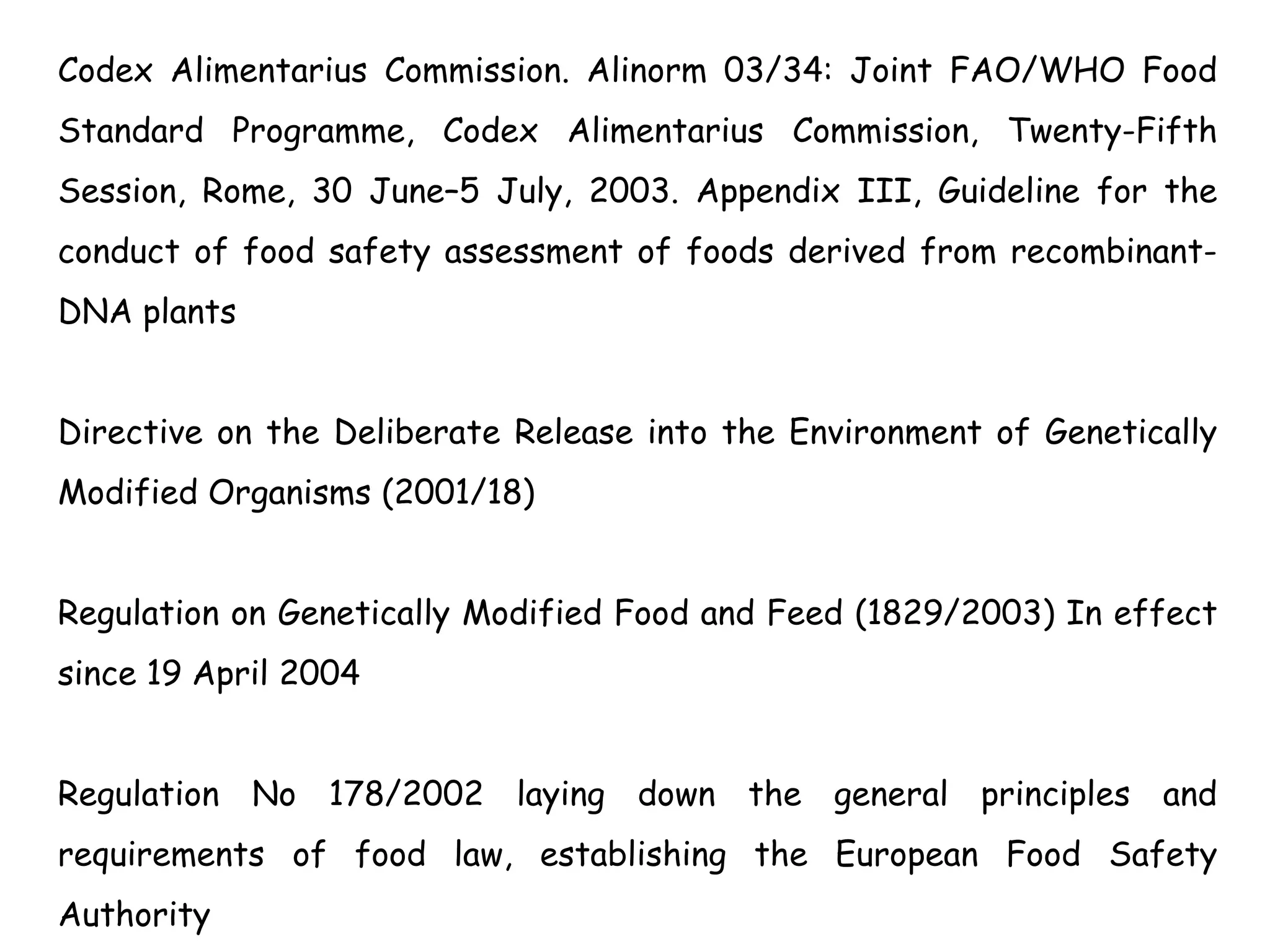
Bacillus thuringiensis
toxin crystal
GENETIC MODIFICATION OF PLANTS
Genes of interest: examples
Environmental fallout
Risk
Assessment
Hazard
Risk
-Likelihood
-Magnitude
Uncertainty
Risk
Management
Cost-Benefit
Analysis
Risk
Mitigation
Risk Communication
RISK ANALYSISRisk Analysis
Potential Risks from GMO used in food or feed
 Health risks
 Environment risks
 Socio-economic risks
 Ethical conflicts
Precautionary Principle Described in
the Rio Declaration (1992):
Nations shall use the precautionary approach to protect the
environment.
Where there are threats of serious or irreversible damage,
scientific uncertainty shall not be used to postpone cost-
effective measures to prevent environmental degradation.
Definition of the Precautionary Principle (Cynical American
Version)
The Precautionary Principle is a nebulous doctrine developed by
Europeans as a means to erect a trade barrier against any item
that can be produced more efficiently in the United States.
Implications of Problems in European
Agriculture
 Recent agriculture industry problems in EU countries include:
 BSE (Mad Cow Disease)
 Hoof and mouth disease
 Dioxins in chicken feed
 These problems have led to public distrust and to support for the
Precautionary Principle.
 The Precautionary Principle justifies exclusion of usual US food
products, even though the US has had none of these agricultural
problems
Codex Alimentarius Commission. Alinorm 03/34: Joint FAO/WHO Food
Standard Programme, Codex Alimentarius Commission, Twenty-Fifth
Session, Rome, 30 June–5 July, 2003. Appendix III, Guideline for the
conduct of food safety assessment of foods derived from recombinant-
DNA plants
Directive on the Deliberate Release into the Environment of Genetically
Modified Organisms (2001/18)
Regulation on Genetically Modified Food and Feed (1829/2003) In effect
since 19 April 2004
Regulation No 178/2002 laying down the general principles and
requirements of food law, establishing the European Food Safety
Authority
EFSA - advancing risk assessment in the EU
• Systems established to ensure improved
– management/planning of risk assessment (workplan,
timelines)
– transparency
– risk communication
– stakeholder engagement
– interaction of risk assessment/risk management
– interaction with national authorities
EFSA risk assessment structure
Scientific Committee + 8 Scientific Panels
 156 experts
Additional external experts (working groups)
External agencies
EFSA scientific/management/administrative staff
EFSA Risk Communication function
EFSA-Panel GMO
Elements to be considered in the safety assessment process
 Molecular characteristics of the GMO taking into account the
characteristics of the donor and recipient organisms
 Potential environmental impact following a deliberate release
 Compositional, nutritional, safety and agronomic characteristics
 Potential toxicity and allergenicity of gene products and
metabolites
 Nutritional assessment of the GM food and feed
The safety assessment of GM foods generally investigates:
(a) direct health effects (toxicity),
(b) tendencies to provoke allergic reaction (allergenicity);
(c) specific components thought to have nutritional or toxic
properties;
(d) the stability of the inserted gene;
(e) nutritional effects associated with genetic modification;
(f) any unintended effects which could result from the gene
insertion.
`
Processing of the applications for food and feed that was
made from or contains GM plants
1) Application submitted to EFSA
2) Scientific evaluation from expert committee
3) Recommendation made by EFSA
4) Draft for decision from the European Commission Vote in the
"Standing Committee for the Food Chain and Food Safety"
(Member States)
The European Commission's draft may be accepted or rejected
with a qualified majority. If no qualified majority can be reached,
the European Commission submits its draft to the Council of
Ministers.
5) Vote in the Council of Ministers.
Approval or rejection by qualified majority - without qualified
majority the Commission's draft takes effect.
Regulation 1829/2003
Substantial Equivalence
 Expert Consultations convened by FAO/WHO and OECD
have recommended that substantial equivalence be an
important component in the safety assessment of foods
derived from GMP .

 Not to establishing absolute safety but to consider
whether the GMF is as safe as its traditional counterpart
Substantial Equivalence in EU-Legislation
 not explicitly detailed in EU legislation
 Simple procedure (Art 5) in Novel Food Regulation
 ―Substantial Equivalence‖ on the basis of the scientific
evidence available and generally recognized or on the basis
of an opinion delivered by one of the competent bodies
Substantial Equivalence in EU-Legislation
 SE-Data widespread – no special chapter
 composition data of raw products and/or processed products
and/or information on processing (and exposition and/or
consumption) are scattered throughout dossiers
 Composition analyses: GLP not evident
 Analyses of kernels – extended to processed products
 Maize dossiers: only descriptions of processing procedures
 Rape dossiers: Data of processed products (limited scale and
set of parameters)
 Barely Data on Consumption
Substantial Equivalence in EU-Legislation
• Solid statistical evaluation questionable
– No continuous statistic evaluation
– Missing information on methods/software/CI
--> Cannot be concluded, that in each case the statistical evaluation is
actually state of the art
• Significant/remarkable compositional differences in all dossiers
– Differences dismissed without adequate explanation or by arbitrarily
citing literature ranges or „normal― ranges
– No rerun of analyses taking into account a broader spectrum of
compounds
• To get a better overview on compositional equivalence and
• To better address the hazard of secondary/unintended effects
Weaknesses SE
 Compositional analyses as screening method for unintended
effects of the genetic modification has its limitations
 in particular regarding unknown anti-nutrients and natural
toxins
 ―finer screening‖ - DNA analysis, messenger-RNA
fingerprinting, protein fingerprinting, secondary
metabolite profiling and in vitro toxicity testing
Nutritional Evaluation
Low-glutelin-Rice - unintended increase in levels of
prolamins (not relevant for sake-brewing but in
case of nutrition)
would not have been detected by standard
composition analyses (total protein; AA-
profiles)
„Golden Rice― - unexpected accumulation of
xanthophylls
would not have been apparent from standard
analyses
Allergenicity
As a matter of principle, the transfer of genes from commonly
allergenic foods is discouraged unless it can be demonstrated that
the protein product of the transferred gene is not allergenic.
While traditionally developed foods are not generally tested for
allergenicity, protocols for tests for GM foods have been evaluated
by the Food and Agriculture Organization of the United Nations
(FAO) and WHO.
No allergic effects have been found relative to GM foods
currently on the market.
In 1998 Árpád Puzstai said in an interview on a World in Action
program that his group had observed damage to the intestines and
immune systems of rats fed the genetically modified potatoes. He
also said "If I had the choice I would certainly not eat it", and that
"I find it's very unfair to use our fellow citizens as guinea pigs".
Wikipedia
Controversies in GM food health risk assessment
Effect of diets containing genetically modified potatoes expressing
Galanthus nivalis lectin on rat small intestine
Stanley W B Ewen, Arpad Pusztai THE LANCET • Vol 354 • October
16, 1999
Diets containing genetically modified (GM) potatoes expressing the
lectin Galanthus nivalis agglutinin (GNA) had variable effects on
different parts of the rat gastrointestinal tract. Some effects, such
as the proliferation of the gastric mucosa, were mainly due to the
expression of the GNA transgene. However, other parts of the
construct or the genetic transformation (or both) could also have
contributed to the overall biological effects of the GNA-GM
potatoes, particularly on the small intestine and caecum.
Controversies in GM food health risk assessment
GM soybeans and health safety—a controversy
reexamined
NATURE BIOTECHNOLOGY VOLUME 25 NUMBER
9 SEPTEMBER 2007
Irina Ermakova, the author of controversial studies
reporting soybeans genetically modified for resistance to
glyphosate may be dangerous to newborns
An unprecedented study claiming that transgenic soybeans
compromise the fertility of rats and the survival and growth of
their offspring has garnered widespread media and political
attention but remains unpublished in the peer-reviewed
literature.
Controversies in GM food health risk assessment
Gilles-Eric Séralini. et al. (2007)
New Analysis of a Rat Feeding Study with a
Genetically Modified Maize Reveals Signs of
Hepatorenal Toxicity Archives of Environmental
Contamination and Toxicology
Suggesting improvements in feeding tests
Recommendations
Standardise – and rationalise – the principles involved in the
evaluation and approval of new crop varieties (whether produced by
so-called conventional, marker assisted breeding, or GE
technologies) universally so that they are scientific, risk-based,
predictable and transparent.
It is critical that the scope of what is subject to case-by-case
review is as important as the actual review itself; it must also be
scientific and risk-based.
PAS Study Week, Vatican City, 15-19 May 2009
Nanotechnology applications are expected to bring new tastes,
textures and sensations, less use of fat, enhanced absorption of
nutrients, improved packaging, traceability and security of food
products.
Nanotech-derived food products are set to grow worldwide and a
variety of food ingredients, additives, carriers for
nutrients/supplements and food contact materials is already
available.
New challenges for health risk assessment
The current level of applications in the European food sector is at
an elementary stage; however, more and more products will be
available in the EU over the coming years.
The toxicological nature of hazard, likelihood of exposure and risk
to consumers from nanotechnology-derived food/food packaging
are largely unknown.
Food Additives and Contaminants, March 2008;
Environmental fallout

Environmental fallout

  • 1.
    Environmental fallout ofGMOs Dr. N. Yuvaraj Assistant Professor Achariya Arts and Science College Villianur , Puducherry
  • 2.
    Can GM foodsolve shortages ?
  • 3.
    MICROORGANISMS (e.g. modified lactobacilli,modified yeast, enzymes from the modified microorganisms – invertase, renin, etc.) ANIMALS (super-salmon, vaccine proteins in milk, prion protein-less cows) PLANTS (nearly all cultivated species modified, few used in large- scale agricultural production) SOURCES of GM FOOD:
  • 4.
    Cultivars developed throughgenetic engineering Genetically Modified Organisms (GMOs) = Transgenics Also known as: Genetically Engineered Organisms Genetically Enhanced Organisms Biotech Crop Frankenstein Food
  • 5.
    GM plants andderived food and feed that are currently on the market, have been modified through insertion of single or a few genes which express traits, such as providing herbicide tolerance and/or insect resistance. Apart from the intended alterations in their composition, these plants show no evidence for alterations in phenotype and basal composition. Plant Biotechnology
  • 6.
     These genesare very specific and allow the plant to precisely express the desired trait. Plant Biotechnology  Using plant biotechnology, a single gene may be added to the strand.  Allows for the transfer of a greater variety of genetic information in a more precise manner.
  • 7.
    Bacillus thuringiensis toxin crystal GENETICMODIFICATION OF PLANTS Genes of interest: examples
  • 8.
  • 9.
  • 10.
    Potential Risks fromGMO used in food or feed  Health risks  Environment risks  Socio-economic risks  Ethical conflicts
  • 11.
    Precautionary Principle Describedin the Rio Declaration (1992): Nations shall use the precautionary approach to protect the environment. Where there are threats of serious or irreversible damage, scientific uncertainty shall not be used to postpone cost- effective measures to prevent environmental degradation.
  • 12.
    Definition of thePrecautionary Principle (Cynical American Version) The Precautionary Principle is a nebulous doctrine developed by Europeans as a means to erect a trade barrier against any item that can be produced more efficiently in the United States.
  • 13.
    Implications of Problemsin European Agriculture  Recent agriculture industry problems in EU countries include:  BSE (Mad Cow Disease)  Hoof and mouth disease  Dioxins in chicken feed  These problems have led to public distrust and to support for the Precautionary Principle.  The Precautionary Principle justifies exclusion of usual US food products, even though the US has had none of these agricultural problems
  • 14.
    Codex Alimentarius Commission.Alinorm 03/34: Joint FAO/WHO Food Standard Programme, Codex Alimentarius Commission, Twenty-Fifth Session, Rome, 30 June–5 July, 2003. Appendix III, Guideline for the conduct of food safety assessment of foods derived from recombinant- DNA plants Directive on the Deliberate Release into the Environment of Genetically Modified Organisms (2001/18) Regulation on Genetically Modified Food and Feed (1829/2003) In effect since 19 April 2004 Regulation No 178/2002 laying down the general principles and requirements of food law, establishing the European Food Safety Authority
  • 15.
    EFSA - advancingrisk assessment in the EU • Systems established to ensure improved – management/planning of risk assessment (workplan, timelines) – transparency – risk communication – stakeholder engagement – interaction of risk assessment/risk management – interaction with national authorities
  • 16.
    EFSA risk assessmentstructure Scientific Committee + 8 Scientific Panels  156 experts Additional external experts (working groups) External agencies EFSA scientific/management/administrative staff EFSA Risk Communication function
  • 17.
    EFSA-Panel GMO Elements tobe considered in the safety assessment process  Molecular characteristics of the GMO taking into account the characteristics of the donor and recipient organisms  Potential environmental impact following a deliberate release  Compositional, nutritional, safety and agronomic characteristics  Potential toxicity and allergenicity of gene products and metabolites  Nutritional assessment of the GM food and feed
  • 18.
    The safety assessmentof GM foods generally investigates: (a) direct health effects (toxicity), (b) tendencies to provoke allergic reaction (allergenicity); (c) specific components thought to have nutritional or toxic properties; (d) the stability of the inserted gene; (e) nutritional effects associated with genetic modification; (f) any unintended effects which could result from the gene insertion. `
  • 19.
    Processing of theapplications for food and feed that was made from or contains GM plants 1) Application submitted to EFSA 2) Scientific evaluation from expert committee 3) Recommendation made by EFSA 4) Draft for decision from the European Commission Vote in the "Standing Committee for the Food Chain and Food Safety" (Member States) The European Commission's draft may be accepted or rejected with a qualified majority. If no qualified majority can be reached, the European Commission submits its draft to the Council of Ministers. 5) Vote in the Council of Ministers. Approval or rejection by qualified majority - without qualified majority the Commission's draft takes effect. Regulation 1829/2003
  • 21.
    Substantial Equivalence  ExpertConsultations convened by FAO/WHO and OECD have recommended that substantial equivalence be an important component in the safety assessment of foods derived from GMP .   Not to establishing absolute safety but to consider whether the GMF is as safe as its traditional counterpart
  • 22.
    Substantial Equivalence inEU-Legislation  not explicitly detailed in EU legislation  Simple procedure (Art 5) in Novel Food Regulation  ―Substantial Equivalence‖ on the basis of the scientific evidence available and generally recognized or on the basis of an opinion delivered by one of the competent bodies
  • 23.
    Substantial Equivalence inEU-Legislation  SE-Data widespread – no special chapter  composition data of raw products and/or processed products and/or information on processing (and exposition and/or consumption) are scattered throughout dossiers  Composition analyses: GLP not evident  Analyses of kernels – extended to processed products  Maize dossiers: only descriptions of processing procedures  Rape dossiers: Data of processed products (limited scale and set of parameters)  Barely Data on Consumption
  • 24.
    Substantial Equivalence inEU-Legislation • Solid statistical evaluation questionable – No continuous statistic evaluation – Missing information on methods/software/CI --> Cannot be concluded, that in each case the statistical evaluation is actually state of the art • Significant/remarkable compositional differences in all dossiers – Differences dismissed without adequate explanation or by arbitrarily citing literature ranges or „normal― ranges – No rerun of analyses taking into account a broader spectrum of compounds • To get a better overview on compositional equivalence and • To better address the hazard of secondary/unintended effects
  • 25.
    Weaknesses SE  Compositionalanalyses as screening method for unintended effects of the genetic modification has its limitations  in particular regarding unknown anti-nutrients and natural toxins  ―finer screening‖ - DNA analysis, messenger-RNA fingerprinting, protein fingerprinting, secondary metabolite profiling and in vitro toxicity testing
  • 26.
    Nutritional Evaluation Low-glutelin-Rice -unintended increase in levels of prolamins (not relevant for sake-brewing but in case of nutrition) would not have been detected by standard composition analyses (total protein; AA- profiles) „Golden Rice― - unexpected accumulation of xanthophylls would not have been apparent from standard analyses
  • 27.
    Allergenicity As a matterof principle, the transfer of genes from commonly allergenic foods is discouraged unless it can be demonstrated that the protein product of the transferred gene is not allergenic. While traditionally developed foods are not generally tested for allergenicity, protocols for tests for GM foods have been evaluated by the Food and Agriculture Organization of the United Nations (FAO) and WHO. No allergic effects have been found relative to GM foods currently on the market.
  • 28.
    In 1998 ÁrpádPuzstai said in an interview on a World in Action program that his group had observed damage to the intestines and immune systems of rats fed the genetically modified potatoes. He also said "If I had the choice I would certainly not eat it", and that "I find it's very unfair to use our fellow citizens as guinea pigs". Wikipedia Controversies in GM food health risk assessment
  • 29.
    Effect of dietscontaining genetically modified potatoes expressing Galanthus nivalis lectin on rat small intestine Stanley W B Ewen, Arpad Pusztai THE LANCET • Vol 354 • October 16, 1999 Diets containing genetically modified (GM) potatoes expressing the lectin Galanthus nivalis agglutinin (GNA) had variable effects on different parts of the rat gastrointestinal tract. Some effects, such as the proliferation of the gastric mucosa, were mainly due to the expression of the GNA transgene. However, other parts of the construct or the genetic transformation (or both) could also have contributed to the overall biological effects of the GNA-GM potatoes, particularly on the small intestine and caecum. Controversies in GM food health risk assessment
  • 30.
    GM soybeans andhealth safety—a controversy reexamined NATURE BIOTECHNOLOGY VOLUME 25 NUMBER 9 SEPTEMBER 2007 Irina Ermakova, the author of controversial studies reporting soybeans genetically modified for resistance to glyphosate may be dangerous to newborns An unprecedented study claiming that transgenic soybeans compromise the fertility of rats and the survival and growth of their offspring has garnered widespread media and political attention but remains unpublished in the peer-reviewed literature. Controversies in GM food health risk assessment
  • 31.
    Gilles-Eric Séralini. etal. (2007) New Analysis of a Rat Feeding Study with a Genetically Modified Maize Reveals Signs of Hepatorenal Toxicity Archives of Environmental Contamination and Toxicology
  • 33.
  • 34.
  • 35.
    Recommendations Standardise – andrationalise – the principles involved in the evaluation and approval of new crop varieties (whether produced by so-called conventional, marker assisted breeding, or GE technologies) universally so that they are scientific, risk-based, predictable and transparent. It is critical that the scope of what is subject to case-by-case review is as important as the actual review itself; it must also be scientific and risk-based. PAS Study Week, Vatican City, 15-19 May 2009
  • 36.
    Nanotechnology applications areexpected to bring new tastes, textures and sensations, less use of fat, enhanced absorption of nutrients, improved packaging, traceability and security of food products. Nanotech-derived food products are set to grow worldwide and a variety of food ingredients, additives, carriers for nutrients/supplements and food contact materials is already available. New challenges for health risk assessment
  • 37.
    The current levelof applications in the European food sector is at an elementary stage; however, more and more products will be available in the EU over the coming years. The toxicological nature of hazard, likelihood of exposure and risk to consumers from nanotechnology-derived food/food packaging are largely unknown. Food Additives and Contaminants, March 2008;