By: Sathmica K
What is import?
• The word is derived from the conceptual meaning
as to bring in the goods and services into the port of
country.
• The buyer of such goods and services are called
importer.
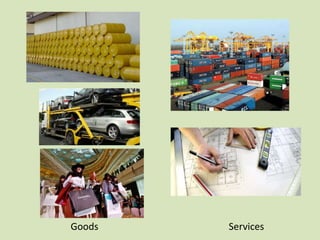
Goods Services
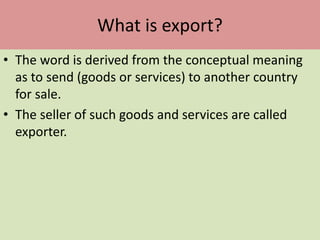
What is export?
• The word is derived from the conceptual meaning
as to send (goods or services) to another country
for sale.
• The seller of such goods and services are called
exporter.
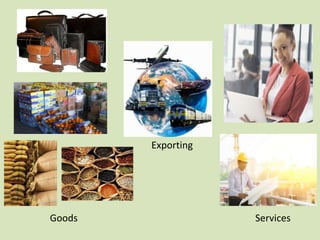
Goods
Exporting
Services
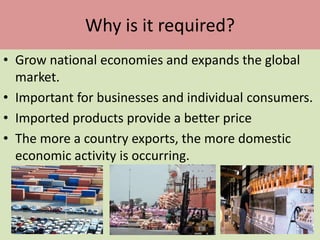
Why is it required?
• Grow national economies and expands the global
market.
• Important for businesses and individual consumers.
• Imported products provide a better price
• The more a country exports, the more domestic
economic activity is occurring.
History
• Economic contact between Native Americans and
European colonists began in the 16th century and
lasted until the late 19th century.
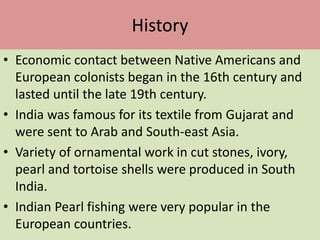
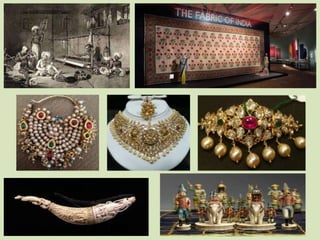
• India was famous for its textile from Gujarat and
were sent to Arab and South-east Asia.
• Variety of ornamental work in cut stones, ivory,
pearl and tortoise shells were produced in South
India.
• Indian Pearl fishing were very popular in the
European countries.
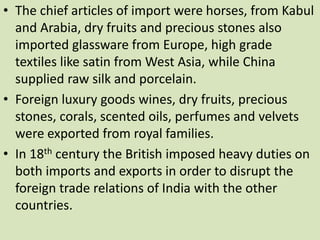
• The chief articles of import were horses, from Kabul
and Arabia, dry fruits and precious stones also
imported glassware from Europe, high grade
textiles like satin from West Asia, while China
supplied raw silk and porcelain.
• Foreign luxury goods wines, dry fruits, precious
stones, corals, scented oils, perfumes and velvets
were exported from royal families.
• In 18th century the British imposed heavy duties on
both imports and exports in order to disrupt the
foreign trade relations of India with the other
countries.
• 1962, the Government of India appointed a special
EXIM POLICY.
• Mr.V. P. Singh announced the Exim Policy on the
12th of April, 1985.
• EXIM Policy was introduced for the period of two
years.
• Two phases of EXIM Policy:
Pre 90’s
Post 90’s
• Various organisations of Imports and Exports are:
WTO(World Trade Organisation)
IMF(International Monetary Fund)
ADB(Asian Development Bank)
• WTO is major international trade board for
liberalisation.
• WTO came into in the year 1995 jan 1st.
• GATT agreement required to be member of WTO.
• Major part of WTO is FTRB(Foreign Trade Review
Body).
• After 1991 EXIM policies were reviewed for every 5
years.
• First policy 1992-1997
1997-2002
2002-2007
2004-2009(change in govt)
• More number of procedures to export Agricultural
products, Handlooms, Handicrafts and textiles.
What is Import Export Policy?
• POLICY of India is guided by the Export Import in
known as in short EXIM Policy of the Indian
Government
• EXIM Policy is a set of guidelines and instructions
established by the DGFT in matters related to the
import and export of goods in India.
• DGFT-Directorate General of Foreign Trade
• It is regulated by the Foreign Trade Development
and Regulation Act, 1992.
• Trade Policy is prepared and announced by the
Central Government (Ministry of Commerce).
• Foreign Trade Act has replaced the earlier law
known as the imports and Exports (Control) Act
1947.
• Government control import of non-essential items
through the EXIM Policy.
• Policy is announced for a five- year period,
announcing a Policy on March 31st of every year.
• Indian EXIM Policy contains various policy related
decisions taken by the government in the sphere of
Foreign Trade, EXPORT PORMOTIONAL MEASURES.
EXPORT PORMOTIONAL MEASURES like
Assistance to State Governments to Infrastructure
Development of Exports (ASIDE)
Market Access Initiative (MAI)
Marketing Development Assistance (MDA)
Meeting Legal
Towns of Export Excellence(TEE)
Brand Promotion Quality
Test Houses
Quality Complaints/Disputes
Trade Disputes Affecting Trade Relations
Export and Trading Houses
• Policy is updated every year with some
modifications and new schemes.
Some policies are as follows:
• SIMPLIFICATION & MERGER OF REWARD SCHEMES
• BOOST TO "MAKE IN INDIA“
• TRADE FACILITATION & EASE OF DOING BUSINESS
• Other new Initiatives
Objectives of EXIM policy
• To accelerate the economy from low level of
economic activities to high level of economic
activities by making it a globally oriented vibrant
economy and to derive maximum benefits from
expanding global market opportunities.
• To stimulate sustained economic growth by
providing access to essential raw materials,
intermediates, components,' consumables and
capital goods required for augmenting production.
• To enhance the techno local strength and efficiency
of Indian agriculture, industry and services, thereby,
improving their competitiveness.
• To generate new employment.
• Opportunities and encourage the attainment of
internationally accepted standards of quality.
• To provide quality consumer products at reasonable
prices.
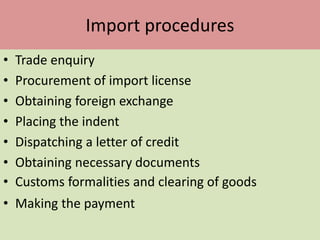
Import procedures
• Trade enquiry
• Procurement of import license
• Obtaining foreign exchange
• Placing the indent
• Dispatching a letter of credit
• Obtaining necessary documents
• Customs formalities and clearing of goods
• Making the payment
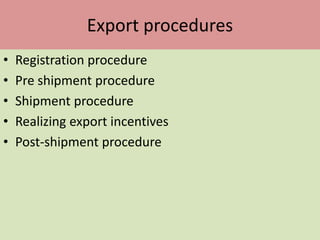
Export procedures
• Registration procedure
• Pre shipment procedure
• Shipment procedure
• Realizing export incentives
• Post-shipment procedure
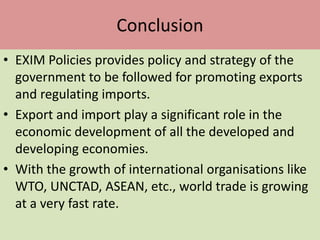
Conclusion
• EXIM Policies provides policy and strategy of the
government to be followed for promoting exports
and regulating imports.
• Export and import play a significant role in the
economic development of all the developed and
developing economies.
• With the growth of international organisations like
WTO, UNCTAD, ASEAN, etc., world trade is growing
at a very fast rate.
THANK YOU

Import and Export policies and procedures

  • 1.
  • 2.
    What is import? •The word is derived from the conceptual meaning as to bring in the goods and services into the port of country. • The buyer of such goods and services are called importer.
  • 3.
  • 4.
    What is export? •The word is derived from the conceptual meaning as to send (goods or services) to another country for sale. • The seller of such goods and services are called exporter.
  • 5.
  • 6.
    Why is itrequired? • Grow national economies and expands the global market. • Important for businesses and individual consumers. • Imported products provide a better price • The more a country exports, the more domestic economic activity is occurring.
  • 7.
    History • Economic contactbetween Native Americans and European colonists began in the 16th century and lasted until the late 19th century. • India was famous for its textile from Gujarat and were sent to Arab and South-east Asia. • Variety of ornamental work in cut stones, ivory, pearl and tortoise shells were produced in South India. • Indian Pearl fishing were very popular in the European countries.
  • 9.
    • The chiefarticles of import were horses, from Kabul and Arabia, dry fruits and precious stones also imported glassware from Europe, high grade textiles like satin from West Asia, while China supplied raw silk and porcelain. • Foreign luxury goods wines, dry fruits, precious stones, corals, scented oils, perfumes and velvets were exported from royal families. • In 18th century the British imposed heavy duties on both imports and exports in order to disrupt the foreign trade relations of India with the other countries.
  • 11.
    • 1962, theGovernment of India appointed a special EXIM POLICY. • Mr.V. P. Singh announced the Exim Policy on the 12th of April, 1985. • EXIM Policy was introduced for the period of two years. • Two phases of EXIM Policy: Pre 90’s Post 90’s
  • 12.
    • Various organisationsof Imports and Exports are: WTO(World Trade Organisation) IMF(International Monetary Fund) ADB(Asian Development Bank) • WTO is major international trade board for liberalisation. • WTO came into in the year 1995 jan 1st. • GATT agreement required to be member of WTO. • Major part of WTO is FTRB(Foreign Trade Review Body).
  • 13.
    • After 1991EXIM policies were reviewed for every 5 years. • First policy 1992-1997 1997-2002 2002-2007 2004-2009(change in govt) • More number of procedures to export Agricultural products, Handlooms, Handicrafts and textiles.
  • 14.
    What is ImportExport Policy? • POLICY of India is guided by the Export Import in known as in short EXIM Policy of the Indian Government • EXIM Policy is a set of guidelines and instructions established by the DGFT in matters related to the import and export of goods in India. • DGFT-Directorate General of Foreign Trade • It is regulated by the Foreign Trade Development and Regulation Act, 1992.
  • 15.
    • Trade Policyis prepared and announced by the Central Government (Ministry of Commerce). • Foreign Trade Act has replaced the earlier law known as the imports and Exports (Control) Act 1947. • Government control import of non-essential items through the EXIM Policy. • Policy is announced for a five- year period, announcing a Policy on March 31st of every year. • Indian EXIM Policy contains various policy related decisions taken by the government in the sphere of Foreign Trade, EXPORT PORMOTIONAL MEASURES.
  • 16.
    EXPORT PORMOTIONAL MEASURESlike Assistance to State Governments to Infrastructure Development of Exports (ASIDE) Market Access Initiative (MAI) Marketing Development Assistance (MDA) Meeting Legal Towns of Export Excellence(TEE) Brand Promotion Quality Test Houses Quality Complaints/Disputes Trade Disputes Affecting Trade Relations Export and Trading Houses
  • 17.
    • Policy isupdated every year with some modifications and new schemes. Some policies are as follows: • SIMPLIFICATION & MERGER OF REWARD SCHEMES • BOOST TO "MAKE IN INDIA“ • TRADE FACILITATION & EASE OF DOING BUSINESS • Other new Initiatives
  • 18.
    Objectives of EXIMpolicy • To accelerate the economy from low level of economic activities to high level of economic activities by making it a globally oriented vibrant economy and to derive maximum benefits from expanding global market opportunities. • To stimulate sustained economic growth by providing access to essential raw materials, intermediates, components,' consumables and capital goods required for augmenting production.
  • 19.
    • To enhancethe techno local strength and efficiency of Indian agriculture, industry and services, thereby, improving their competitiveness. • To generate new employment. • Opportunities and encourage the attainment of internationally accepted standards of quality. • To provide quality consumer products at reasonable prices.
  • 20.
    Import procedures • Tradeenquiry • Procurement of import license • Obtaining foreign exchange • Placing the indent • Dispatching a letter of credit • Obtaining necessary documents • Customs formalities and clearing of goods • Making the payment
  • 21.
    Export procedures • Registrationprocedure • Pre shipment procedure • Shipment procedure • Realizing export incentives • Post-shipment procedure
  • 22.
    Conclusion • EXIM Policiesprovides policy and strategy of the government to be followed for promoting exports and regulating imports. • Export and import play a significant role in the economic development of all the developed and developing economies. • With the growth of international organisations like WTO, UNCTAD, ASEAN, etc., world trade is growing at a very fast rate.
  • 23.

Editor's Notes