SEQUENCE
AND SERIES
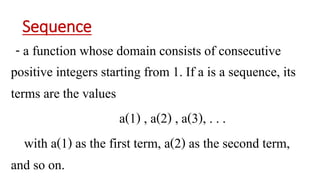
Sequence
- a function whose domain consists of consecutive
positive integers starting from 1. If a is a sequence, its
terms are the values
a(1) , a(2) , a(3), . . .
with a(1) as the first term, a(2) as the second term,
and so on.
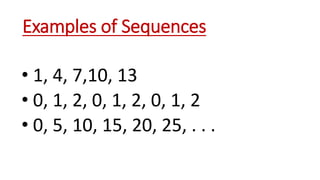
Examples of Sequences
• 1, 4, 7,10, 13
• 0, 1, 2, 0, 1, 2, 0, 1, 2
• 0, 5, 10, 15, 20, 25, . . .
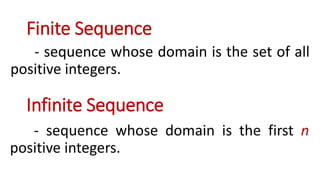
Infinite Sequence
- sequence whose domain is the set of all
positive integers.
Finite Sequence
- sequence whose domain is the first n
positive integers.
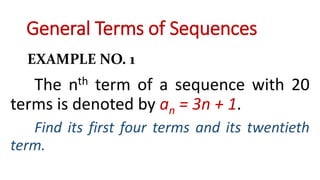
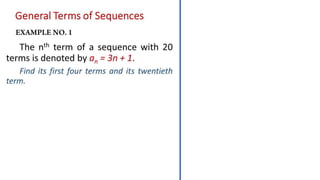
General Terms of Sequences
EXAMPLE NO. 1
The nth term of a sequence with 20
terms is denoted by an = 3n + 1.
Find its first four terms and its twentieth
term.
General Terms of Sequences
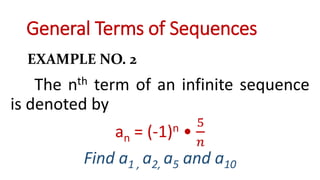
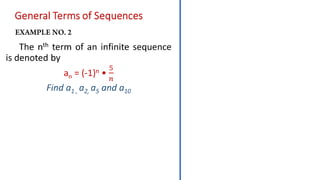
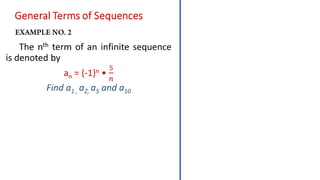
EXAMPLE NO. 2
The nth term of an infinite sequence
is denoted by
an = (-1)n •
5
𝑛
Find a1 , a2, a5 and a10
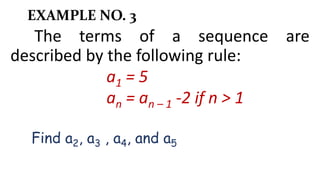
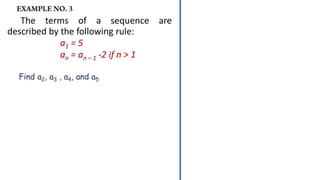
EXAMPLE NO. 3
The terms of a sequence are
described by the following rule:
a1 = 5
an = an – 1 -2 if n > 1
Find a2, a3 , a4, and a5
ACTIVITY NO. 1
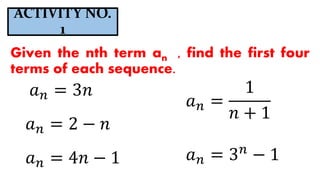
𝑎𝑛 = 3𝑛
𝑎𝑛 = 2 − 𝑛
𝑎𝑛 = 4𝑛 − 1 𝑎𝑛 = 3𝑛
− 1
𝑎𝑛 =
1
𝑛 + 1
Given the nth term an , find the first four
terms of each sequence.
ACTIVITY NO.
1
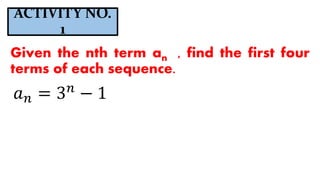
𝑎𝑛 = 3𝑛
− 1
Given the nth term an , find the first four
terms of each sequence.
ACTIVITY NO.
1
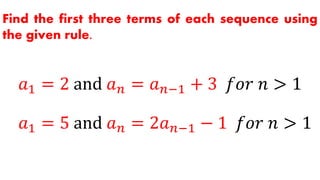
𝑎1 = 2 and 𝑎𝑛 = 𝑎𝑛−1 + 3 𝑓𝑜𝑟 𝑛 > 1
Find the first three terms of each sequence using
the given rule.
𝑎1 = 5 and 𝑎𝑛 = 2𝑎𝑛−1 − 1 𝑓𝑜𝑟 𝑛 > 1
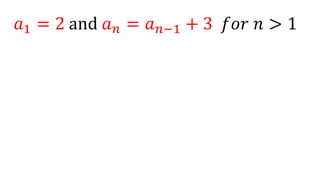
𝑎1 = 2 and 𝑎𝑛 = 𝑎𝑛−1 + 3 𝑓𝑜𝑟 𝑛 > 1

MATH10 SEQUENCE AND SERIES

  • 1.
  • 2.
    Sequence - a functionwhose domain consists of consecutive positive integers starting from 1. If a is a sequence, its terms are the values a(1) , a(2) , a(3), . . . with a(1) as the first term, a(2) as the second term, and so on.
  • 3.
    Examples of Sequences •1, 4, 7,10, 13 • 0, 1, 2, 0, 1, 2, 0, 1, 2 • 0, 5, 10, 15, 20, 25, . . .
  • 4.
    Infinite Sequence - sequencewhose domain is the set of all positive integers. Finite Sequence - sequence whose domain is the first n positive integers.
  • 5.
    General Terms ofSequences EXAMPLE NO. 1 The nth term of a sequence with 20 terms is denoted by an = 3n + 1. Find its first four terms and its twentieth term.
  • 8.
    General Terms ofSequences EXAMPLE NO. 2 The nth term of an infinite sequence is denoted by an = (-1)n • 5 𝑛 Find a1 , a2, a5 and a10
  • 11.
    EXAMPLE NO. 3 Theterms of a sequence are described by the following rule: a1 = 5 an = an – 1 -2 if n > 1 Find a2, a3 , a4, and a5
  • 13.
  • 14.
    𝑎𝑛 = 3𝑛 𝑎𝑛= 2 − 𝑛 𝑎𝑛 = 4𝑛 − 1 𝑎𝑛 = 3𝑛 − 1 𝑎𝑛 = 1 𝑛 + 1 Given the nth term an , find the first four terms of each sequence. ACTIVITY NO. 1
  • 15.
    𝑎𝑛 = 3𝑛 −1 Given the nth term an , find the first four terms of each sequence. ACTIVITY NO. 1
  • 16.
    𝑎1 = 2and 𝑎𝑛 = 𝑎𝑛−1 + 3 𝑓𝑜𝑟 𝑛 > 1 Find the first three terms of each sequence using the given rule. 𝑎1 = 5 and 𝑎𝑛 = 2𝑎𝑛−1 − 1 𝑓𝑜𝑟 𝑛 > 1
  • 17.
    𝑎1 = 2and 𝑎𝑛 = 𝑎𝑛−1 + 3 𝑓𝑜𝑟 𝑛 > 1

Editor's Notes

  • #5 Finite sequence have its last term while infinite sequence does not have last term