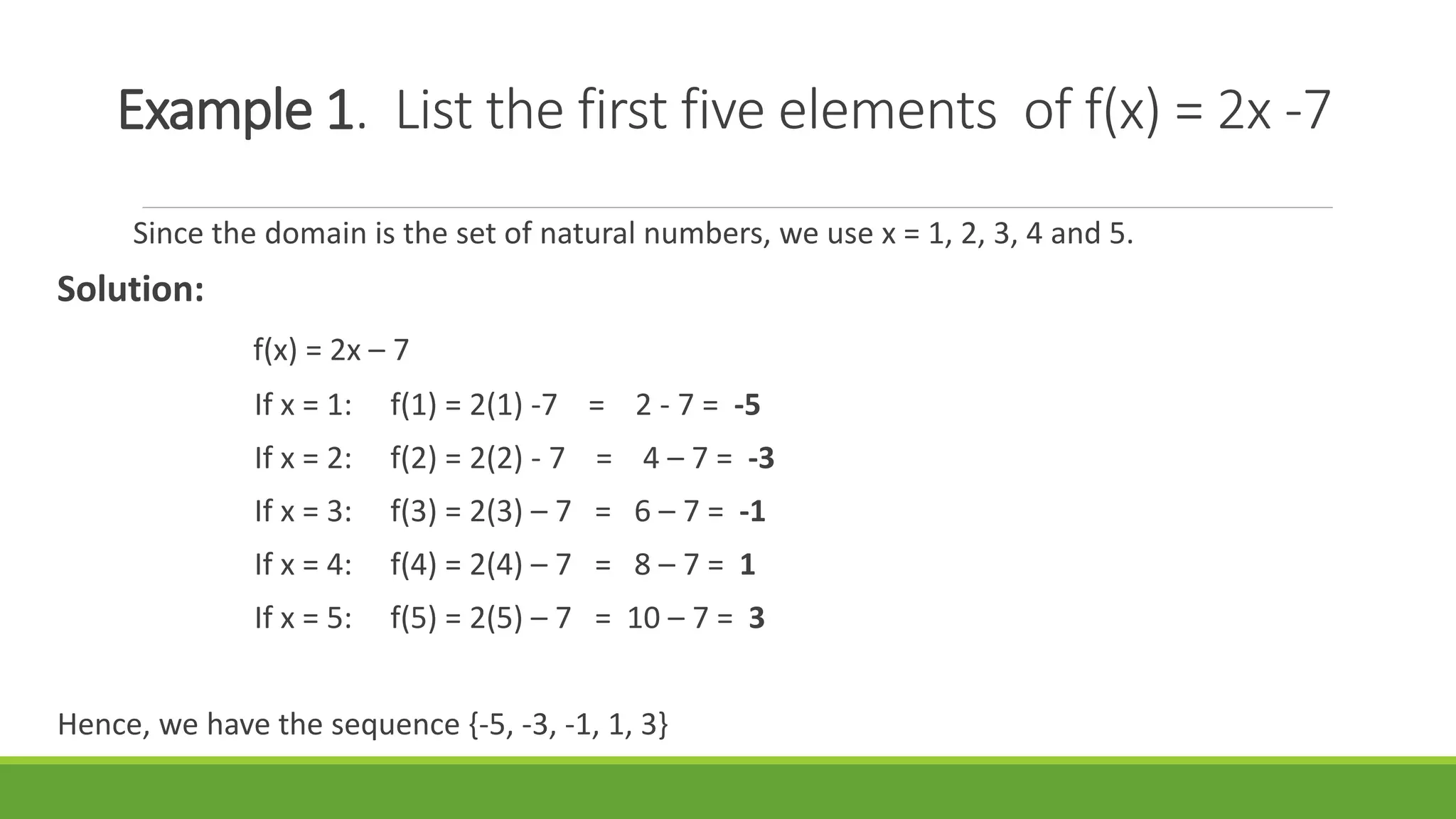
Example 1. List the first five elements of f(x) = 2x -7
Since the domain is the set of natural numbers, we use x = 1, 2, 3, 4 and 5.
Solution:
f(x) = 2x – 7
If x = 1: f(1) = 2(1) -7 = 2 - 7 = -5
If x = 2: f(2) = 2(2) - 7 = 4 – 7 = -3
If x = 3: f(3) = 2(3) – 7 = 6 – 7 = -1
If x = 4: f(4) = 2(4) – 7 = 8 – 7 = 1
If x = 5: f(5) = 2(5) – 7 = 10 – 7 = 3
Hence, we have the sequence {-5, -3, -1, 1, 3}
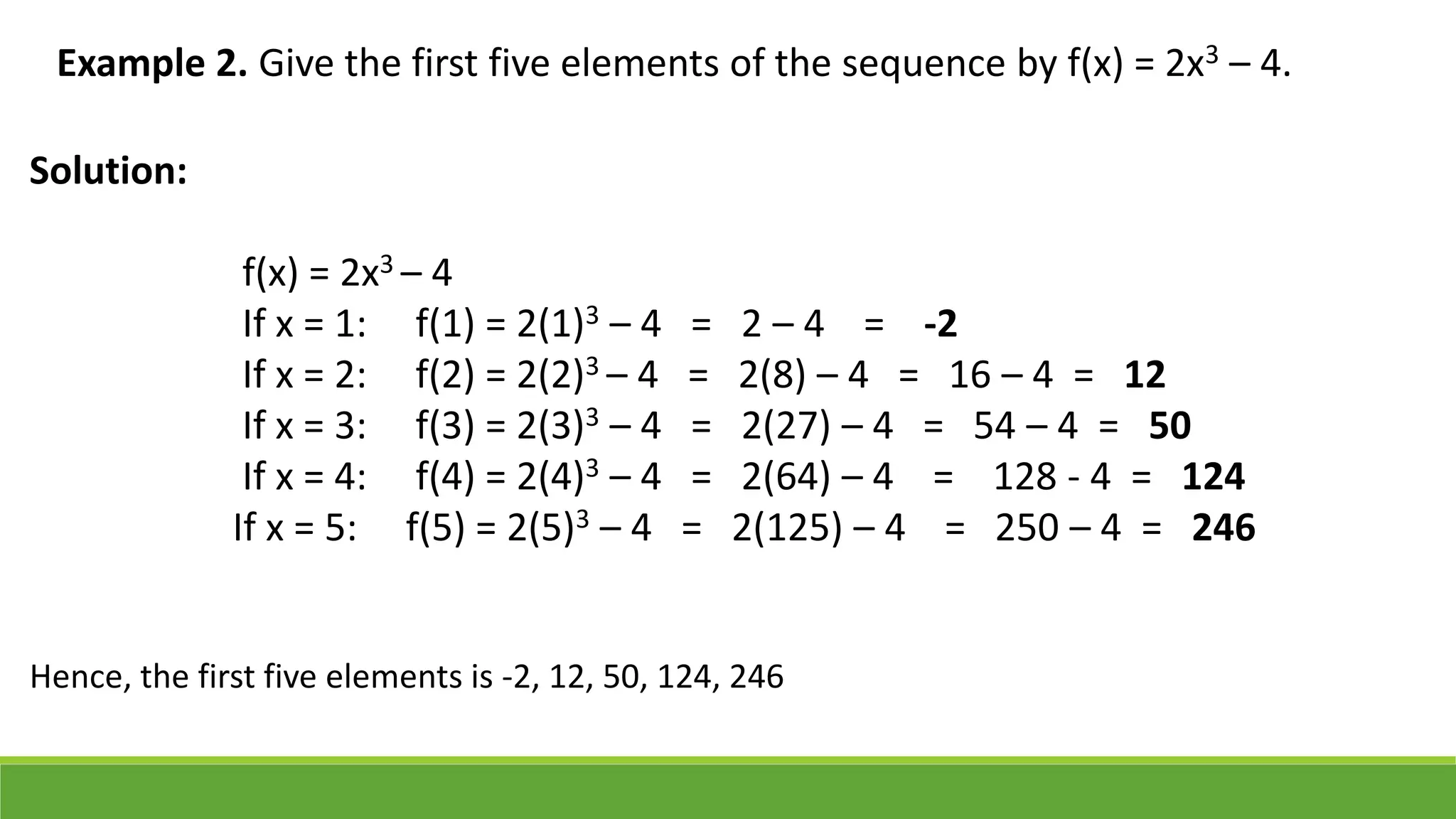
Example 2. Give the first five elements of the sequence by f(x) = 2x3 – 4.
Solution:
f(x) = 2x3 – 4
If x = 1: f(1) = 2(1)3 – 4 = 2 – 4 = -2
If x = 2: f(2) = 2(2)3 – 4 = 2(8) – 4 = 16 – 4 = 12
If x = 3: f(3) = 2(3)3 – 4 = 2(27) – 4 = 54 – 4 = 50
If x = 4: f(4) = 2(4)3 – 4 = 2(64) – 4 = 128 - 4 = 124
If x = 5: f(5) = 2(5)3 – 4 = 2(125) – 4 = 250 – 4 = 246
Hence, the first five elements is -2, 12, 50, 124, 246
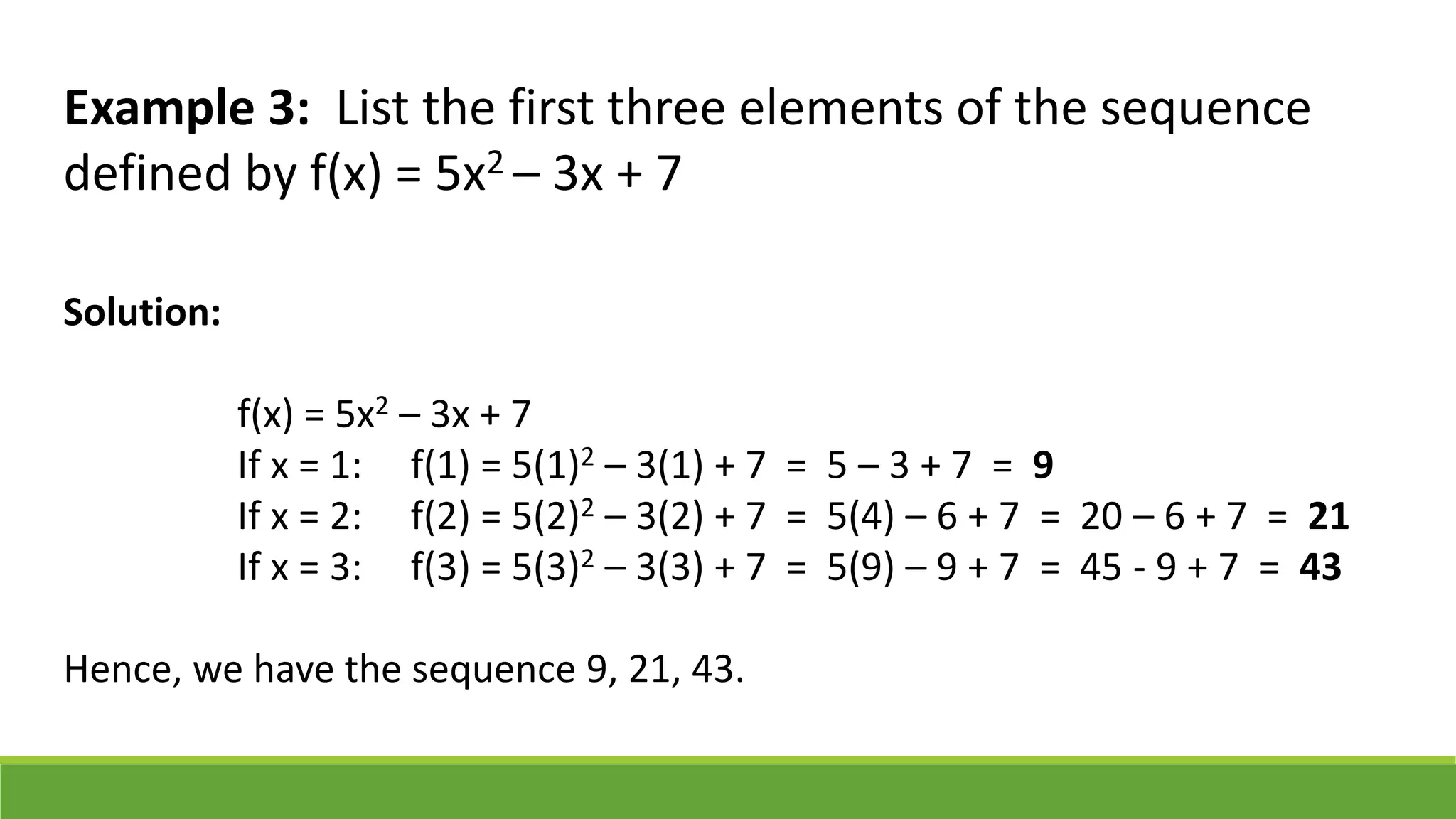
Example 3: List the first three elements of the sequence
defined by f(x) = 5x2 – 3x + 7
Solution:
f(x) = 5x2 – 3x + 7
If x = 1: f(1) = 5(1)2 – 3(1) + 7 = 5 – 3 + 7 = 9
If x = 2: f(2) = 5(2)2 – 3(2) + 7 = 5(4) – 6 + 7 = 20 – 6 + 7 = 21
If x = 3: f(3) = 5(3)2 – 3(3) + 7 = 5(9) – 9 + 7 = 45 - 9 + 7 = 43
Hence, we have the sequence 9, 21, 43.
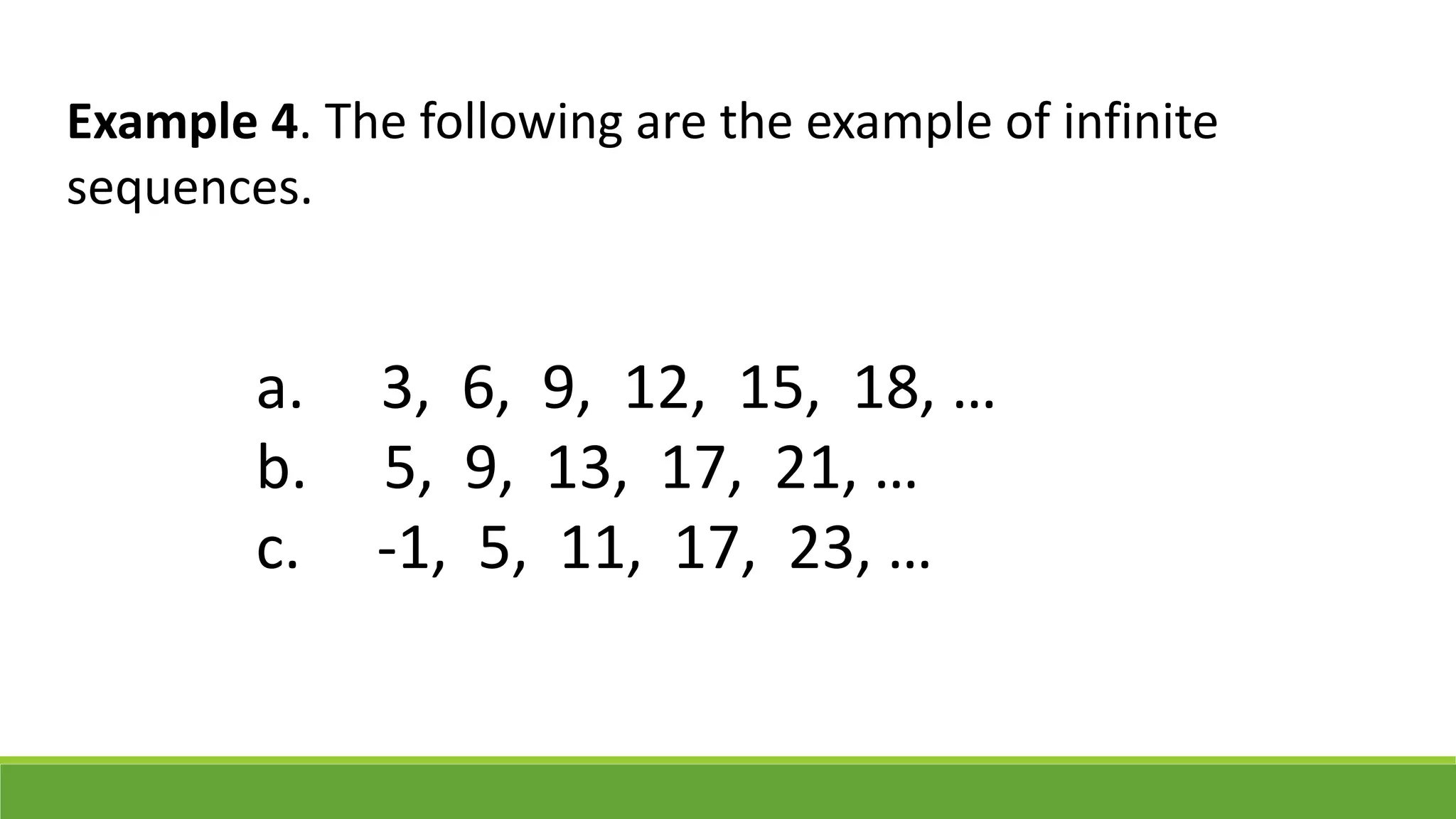
Example 4. The following are the example of infinite
sequences.
a. 3, 6, 9, 12, 15, 18, …
b. 5, 9, 13, 17, 21, …
c. -1, 5, 11, 17, 23, …
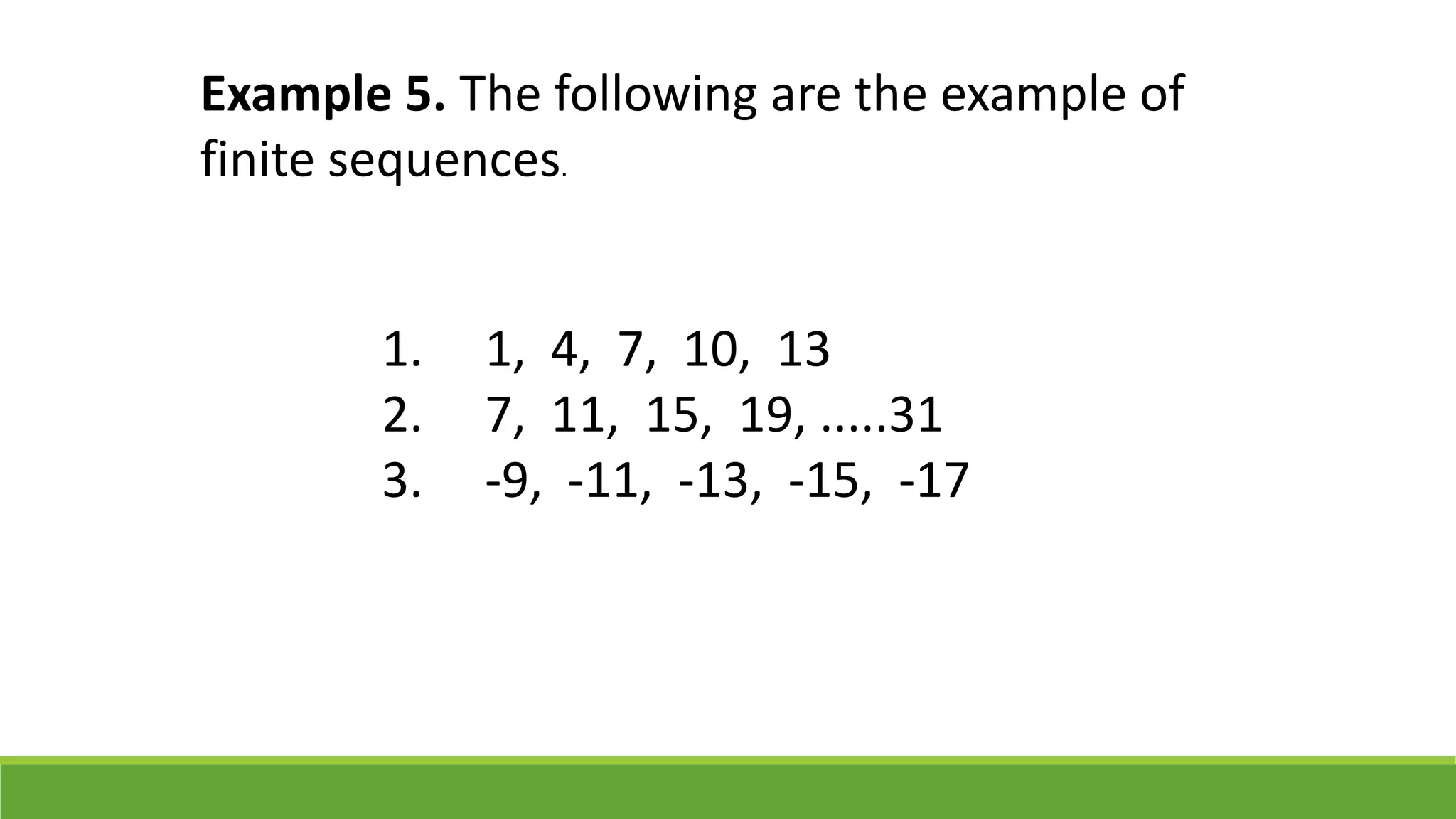
Example 5. The following are the example of
finite sequences.
1. 1, 4, 7, 10, 13
2. 7, 11, 15, 19, .....31
3. -9, -11, -13, -15, -17

Elements of a sequence

  • 2.
    Example 1. Listthe first five elements of f(x) = 2x -7 Since the domain is the set of natural numbers, we use x = 1, 2, 3, 4 and 5. Solution: f(x) = 2x – 7 If x = 1: f(1) = 2(1) -7 = 2 - 7 = -5 If x = 2: f(2) = 2(2) - 7 = 4 – 7 = -3 If x = 3: f(3) = 2(3) – 7 = 6 – 7 = -1 If x = 4: f(4) = 2(4) – 7 = 8 – 7 = 1 If x = 5: f(5) = 2(5) – 7 = 10 – 7 = 3 Hence, we have the sequence {-5, -3, -1, 1, 3}
  • 3.
    Example 2. Givethe first five elements of the sequence by f(x) = 2x3 – 4. Solution: f(x) = 2x3 – 4 If x = 1: f(1) = 2(1)3 – 4 = 2 – 4 = -2 If x = 2: f(2) = 2(2)3 – 4 = 2(8) – 4 = 16 – 4 = 12 If x = 3: f(3) = 2(3)3 – 4 = 2(27) – 4 = 54 – 4 = 50 If x = 4: f(4) = 2(4)3 – 4 = 2(64) – 4 = 128 - 4 = 124 If x = 5: f(5) = 2(5)3 – 4 = 2(125) – 4 = 250 – 4 = 246 Hence, the first five elements is -2, 12, 50, 124, 246
  • 4.
    Example 3: Listthe first three elements of the sequence defined by f(x) = 5x2 – 3x + 7 Solution: f(x) = 5x2 – 3x + 7 If x = 1: f(1) = 5(1)2 – 3(1) + 7 = 5 – 3 + 7 = 9 If x = 2: f(2) = 5(2)2 – 3(2) + 7 = 5(4) – 6 + 7 = 20 – 6 + 7 = 21 If x = 3: f(3) = 5(3)2 – 3(3) + 7 = 5(9) – 9 + 7 = 45 - 9 + 7 = 43 Hence, we have the sequence 9, 21, 43.
  • 5.
    Example 4. Thefollowing are the example of infinite sequences. a. 3, 6, 9, 12, 15, 18, … b. 5, 9, 13, 17, 21, … c. -1, 5, 11, 17, 23, …
  • 6.
    Example 5. Thefollowing are the example of finite sequences. 1. 1, 4, 7, 10, 13 2. 7, 11, 15, 19, .....31 3. -9, -11, -13, -15, -17