A REVIEW ON A JOURNAL ARTICLE
By Abdul Najib Tuanany
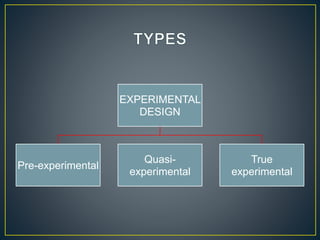
EXPERIMENTAL
DESIGN
Pre-experimental
Quasi-
experimental
True
experimental
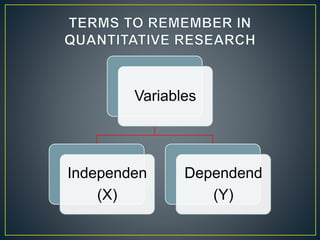
Variables
Independen
(X)
Dependend
(Y)
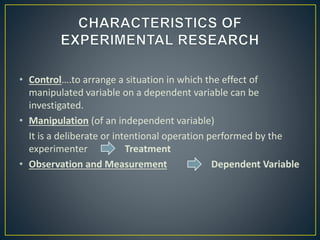
• Control….to arrange a situation in which the effect of
manipulated variable on a dependent variable can be
investigated.
• Manipulation (of an independent variable)
It is a deliberate or intentional operation performed by the
experimenter Treatment
• Observation and Measurement Dependent Variable
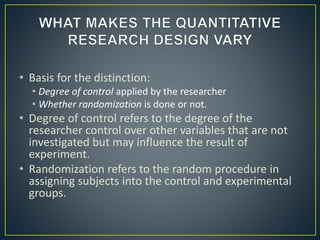
• Basis for the distinction:
• Degree of control applied by the researcher
• Whether randomization is done or not.
• Degree of control refers to the degree of the
researcher control over other variables that are not
investigated but may influence the result of
experiment.
• Randomization refers to the random procedure in
assigning subjects into the control and experimental
groups.
• A Quasi-Experimental Study on Using Short Stories:
Statistical and Inferential Analyses on the Non-
English Major University Students’ Speaking and
Writing Achievement
• Written By Jaya Nur Iman
• Published in International Journal of Languages’
Education and Teaching
Volume 5, Issue 1, April2017, p. 421-433
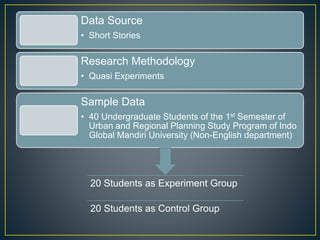
Data Source
• Short Stories
Research Methodology
• Quasi Experiments
Sample Data
• 40 Undergraduate Students of the 1st Semester of
Urban and Regional Planning Study Program of Indo
Global Mandiri University (Non-English department)
20 Students as Experiment Group
20 Students as Control Group
Research Time
• One Semester of active and learning
process
Research Aim
• Increasing Students’ Speaking and
Writing Skills
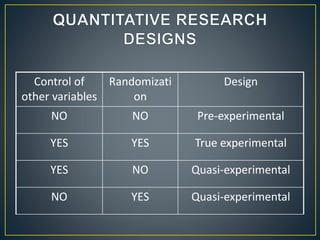
Control of
other variables
Randomizati
on
Design
NO NO Pre-experimental
YES YES True experimental
YES NO Quasi-experimental
NO YES Quasi-experimental
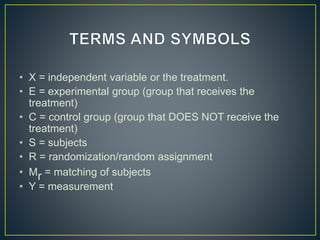
• X = independent variable or the treatment.
• E = experimental group (group that receives the
treatment)
• C = control group (group that DOES NOT receive the
treatment)
• S = subjects
• R = randomization/random assignment
• Mr = matching of subjects
• Y = measurement
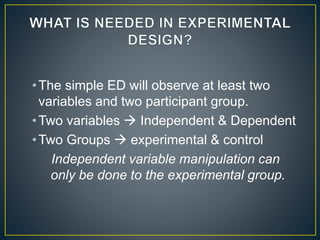
•The simple ED will observe at least two
variables and two participant group.
•Two variables  Independent & Dependent
•Two Groups  experimental & control
Independent variable manipulation can
only be done to the experimental group.
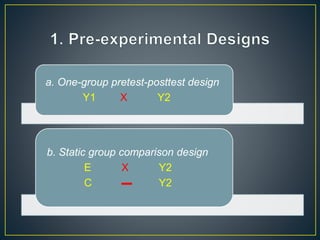
a. One-group pretest-posttest design
Y1 X Y2
b. Static group comparison design
E X Y2
C ▬ Y2
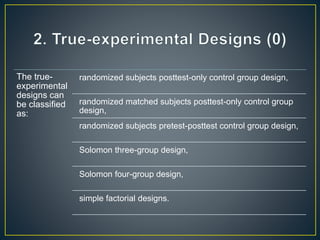
The true-
experimental
designs can
be classified
as:
randomized subjects posttest-only control group design,
randomized matched subjects posttest-only control group
design,
randomized subjects pretest-posttest control group design,
Solomon three-group design,
Solomon four-group design,
simple factorial designs.
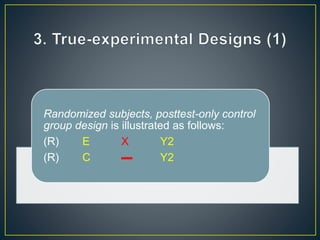
Randomized subjects, posttest-only control
group design is illustrated as follows:
(R) E X Y2
(R) C ▬ Y2

Quasi experimental design

  • 1.
    A REVIEW ONA JOURNAL ARTICLE By Abdul Najib Tuanany
  • 3.
  • 4.
  • 5.
    • Control….to arrangea situation in which the effect of manipulated variable on a dependent variable can be investigated. • Manipulation (of an independent variable) It is a deliberate or intentional operation performed by the experimenter Treatment • Observation and Measurement Dependent Variable
  • 6.
    • Basis forthe distinction: • Degree of control applied by the researcher • Whether randomization is done or not. • Degree of control refers to the degree of the researcher control over other variables that are not investigated but may influence the result of experiment. • Randomization refers to the random procedure in assigning subjects into the control and experimental groups.
  • 7.
    • A Quasi-ExperimentalStudy on Using Short Stories: Statistical and Inferential Analyses on the Non- English Major University Students’ Speaking and Writing Achievement • Written By Jaya Nur Iman • Published in International Journal of Languages’ Education and Teaching Volume 5, Issue 1, April2017, p. 421-433
  • 8.
    Data Source • ShortStories Research Methodology • Quasi Experiments Sample Data • 40 Undergraduate Students of the 1st Semester of Urban and Regional Planning Study Program of Indo Global Mandiri University (Non-English department) 20 Students as Experiment Group 20 Students as Control Group
  • 9.
    Research Time • OneSemester of active and learning process Research Aim • Increasing Students’ Speaking and Writing Skills
  • 10.
    Control of other variables Randomizati on Design NONO Pre-experimental YES YES True experimental YES NO Quasi-experimental NO YES Quasi-experimental
  • 11.
    • X =independent variable or the treatment. • E = experimental group (group that receives the treatment) • C = control group (group that DOES NOT receive the treatment) • S = subjects • R = randomization/random assignment • Mr = matching of subjects • Y = measurement
  • 12.
    •The simple EDwill observe at least two variables and two participant group. •Two variables  Independent & Dependent •Two Groups  experimental & control Independent variable manipulation can only be done to the experimental group.
  • 13.
    a. One-group pretest-posttestdesign Y1 X Y2 b. Static group comparison design E X Y2 C ▬ Y2
  • 14.
    The true- experimental designs can beclassified as: randomized subjects posttest-only control group design, randomized matched subjects posttest-only control group design, randomized subjects pretest-posttest control group design, Solomon three-group design, Solomon four-group design, simple factorial designs.
  • 15.
    Randomized subjects, posttest-onlycontrol group design is illustrated as follows: (R) E X Y2 (R) C ▬ Y2