Reading
Research
Reverse Jenga
Building a tower with gaps:
✘What are the research words you know?
✘What activities do you know happen in
research (you don’t need to know the
words)?
What is Research?
✘Research is the generation of knowledge
✘We are all born researchers
✘There are three major types of research
Qualitative
Quantitative
Mixed
✘Researchers follow set methods and processes
✘Good research is be guided by a question
✘Research can be applied to practice
The New Language & Rules
✘Data
✘Method
✘Methodology
✘Tests
✘Surveys
✘Interviews
✘Focus Groups
✘Observation
✘Literature Review
✘Analysis
✘Significance
✘Mode
✘Medium
✘Mean/Average
✘Theme
✘Percentage
✘Trianglation
The Research Question
✘The question determines the type of research
How effective is … Quantitative/Mixed
What are the experiences of …. Qualitative
✘The question determines how and takes into context: time, money,
context
✘The question determines the appropriate methods
✘The question determines how the data is analysed
The Research
Process
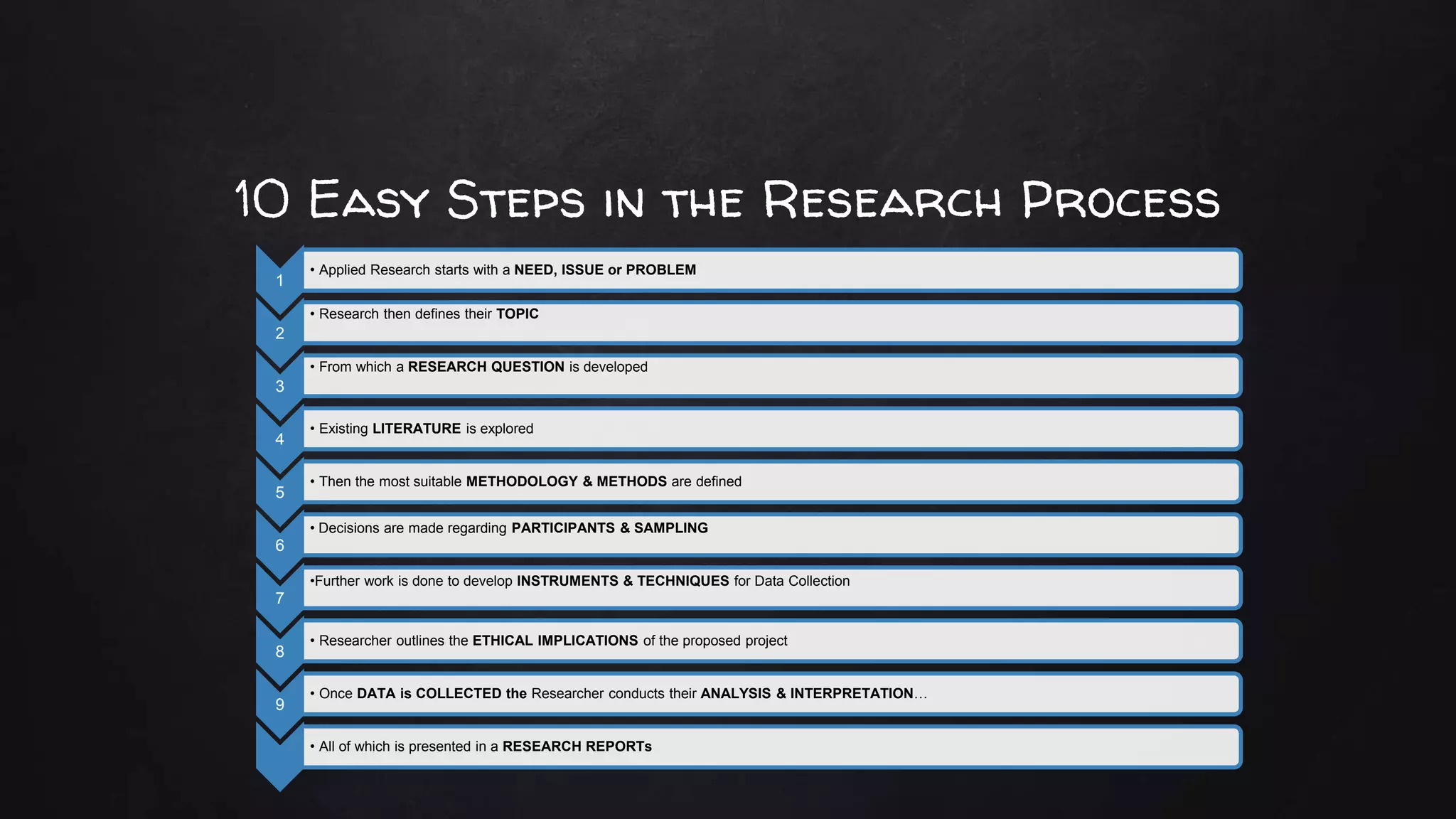
10 Easy Steps in the Research Process
1
• Applied Research starts with a NEED, ISSUE or PROBLEM
2
• Research then defines their TOPIC
3
• From which a RESEARCH QUESTION is developed
4
• Existing LITERATURE is explored
5
• Then the most suitable METHODOLOGY & METHODS are defined
6
• Decisions are made regarding PARTICIPANTS & SAMPLING
7
•Further work is done to develop INSTRUMENTS & TECHNIQUES for Data Collection
8
• Researcher outlines the ETHICAL IMPLICATIONS of the proposed project
9
• Once DATA is COLLECTED the Researcher conducts their ANALYSIS & INTERPRETATION…
• All of which is presented in a RESEARCH REPORTs
Doing research
✘The question will determine whether your research is qualitative,
quantitative or mixed
✘This then restricts the way you gather your data
✘It also dictates how you will analyse your data
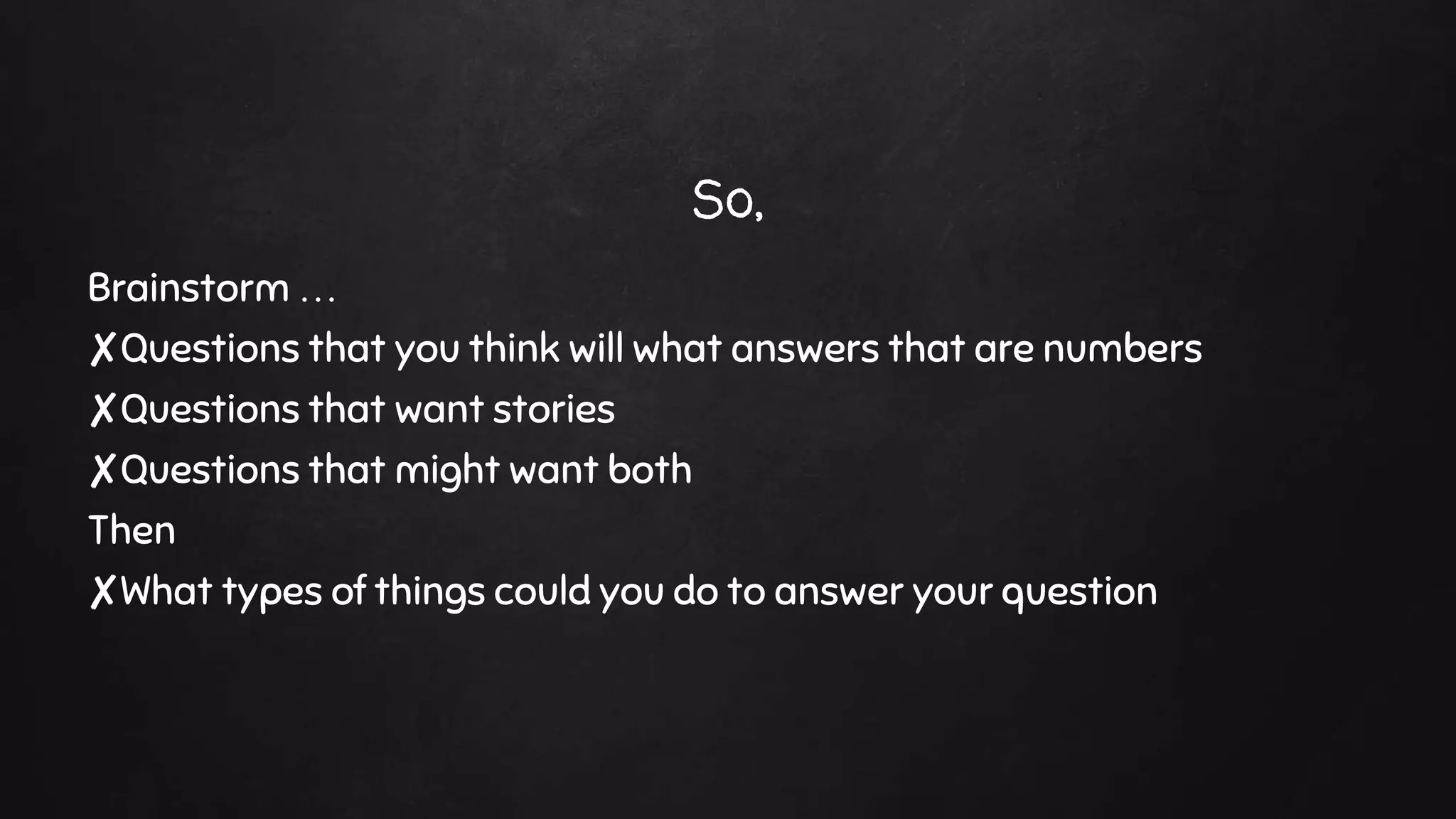
So,
Brainstorm …
✘Questions that you think will what answers that are numbers
✘Questions that want stories
✘Questions that might want both
Then
✘What types of things could you do to answer your question
Writing research/
Reading research
Reading Research
✘Tends to follow a set format - IMRaD
Abstract/Executive Summary
Introduction/Literature Review
Methodology/Methods
Results/Findings
and
Discussion/Analysis
Bradford Hill’s Questions
✘Introduction Why did you start?
✘Methods What did you do?
✘Results What did you find?
and
✘Discussion What does this mean?
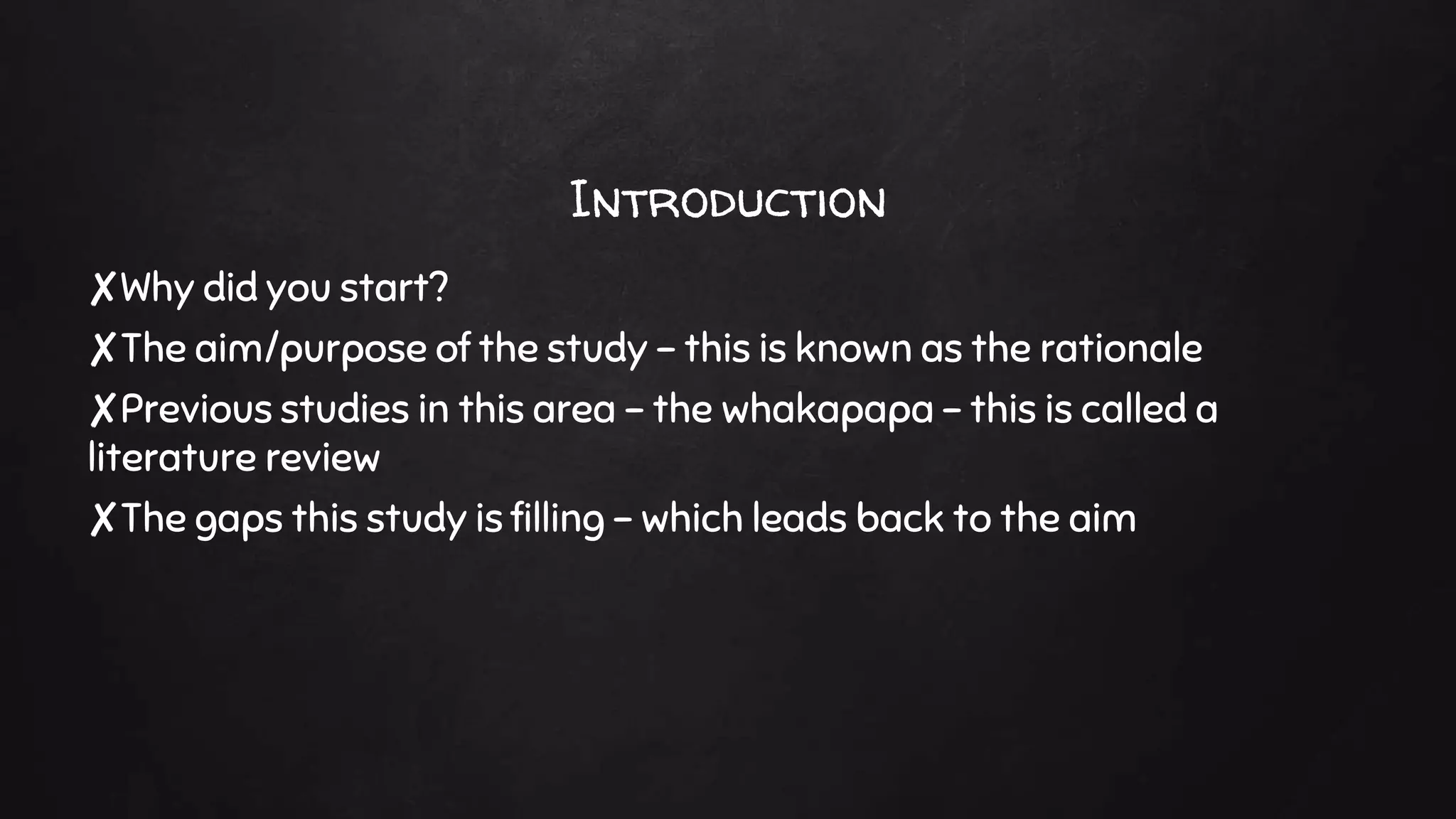
Introduction
✘Why did you start?
✘The aim/purpose of the study – this is known as the rationale
✘Previous studies in this area – the whakapapa – this is called a
literature review
✘The gaps this study is filling – which leads back to the aim
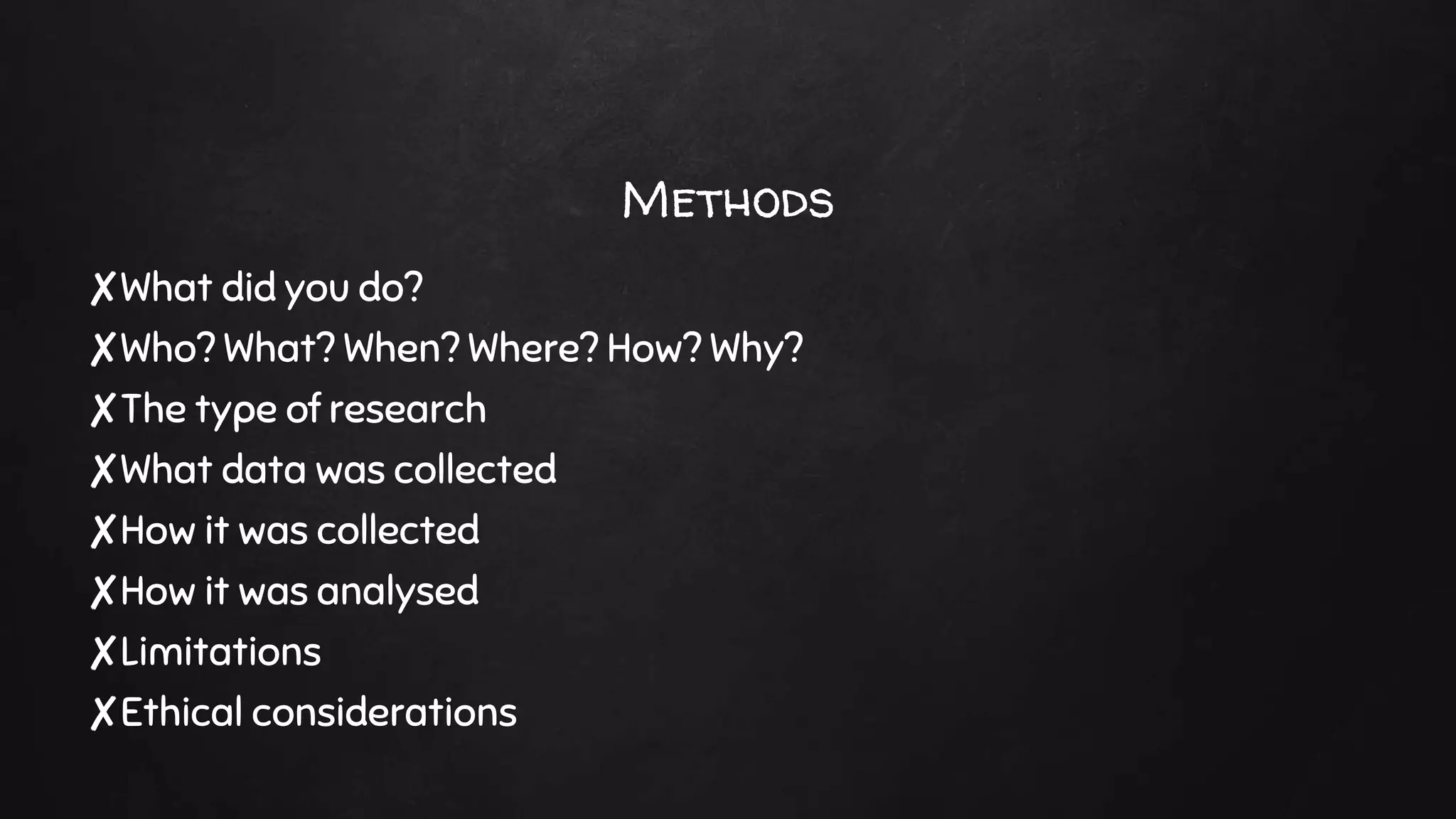
Methods
✘What did you do?
✘Who? What? When? Where? How? Why?
✘The type of research
✘What data was collected
✘How it was collected
✘How it was analysed
✘Limitations
✘Ethical considerations
Results
✘What did you find?
✘A bit about the participants
✘With numbers – statistical analysis, charts, tables and graphs
✘Words that describe the numbers using correct statistics and careful
use of words like ‘significance’, ‘random’, and ‘correlation’
✘With stories – quotes, images etc
✘Words that describe the stories
Discussion
✘What does it all mean
✘Repeat key findings and mention interesting minor findings
✘Possible explanations – referring often back to the literature
✘Implications and limitations
✘Questions arising
✘Conclusion
Getting into reading
Know your purpose
✘FIRST – skim and answer the IMRAD questions - then
✘Read to answer your own questions
✘Read to see if the work is sound:
Does the research have a sound purpose with the appropriate
methodology and analysis
If quantitative are the numbers sound, use of key words right
and the limitations stated?
If qualitative are the stories rich with different voices, is the
story not shown as one shared by all and the limitations stated?
Your Turn
1) Look at the article’s headings, what do these headings tell you about the
research
2) Why would researchers have literature reviews; what is the purpose of it
in an article?
3) What do the methodology sections share?
4) How are the findings sections similar and different?
5) What is the purpose of the analysis section?
6) How does research overflow into our professional practice?
Now dig deep
1) What was the purpose of the research (can you reword into the question)?
2) Is the methodology appropriate?
3) Is the analysis following the rules – numbers for quantitative, stories for
qualitative?
4) Is percentages been used correctly?
5) Are the graphs correct?
6) Are the stories about the numbers and the quotes clear?
7) Can you apply to your own learning or practice?
Credits
Special thanks to all the people who made and released
these awesome resources for free:
✘ Presentation template by SlidesCarnival
✘ Photographs by Unsplash

Reading research

  • 1.
  • 2.
    Reverse Jenga Building atower with gaps: ✘What are the research words you know? ✘What activities do you know happen in research (you don’t need to know the words)?
  • 3.
    What is Research? ✘Researchis the generation of knowledge ✘We are all born researchers ✘There are three major types of research Qualitative Quantitative Mixed ✘Researchers follow set methods and processes ✘Good research is be guided by a question ✘Research can be applied to practice
  • 4.
    The New Language& Rules ✘Data ✘Method ✘Methodology ✘Tests ✘Surveys ✘Interviews ✘Focus Groups ✘Observation ✘Literature Review ✘Analysis ✘Significance ✘Mode ✘Medium ✘Mean/Average ✘Theme ✘Percentage ✘Trianglation
  • 5.
    The Research Question ✘Thequestion determines the type of research How effective is … Quantitative/Mixed What are the experiences of …. Qualitative ✘The question determines how and takes into context: time, money, context ✘The question determines the appropriate methods ✘The question determines how the data is analysed
  • 6.
  • 7.
    10 Easy Stepsin the Research Process 1 • Applied Research starts with a NEED, ISSUE or PROBLEM 2 • Research then defines their TOPIC 3 • From which a RESEARCH QUESTION is developed 4 • Existing LITERATURE is explored 5 • Then the most suitable METHODOLOGY & METHODS are defined 6 • Decisions are made regarding PARTICIPANTS & SAMPLING 7 •Further work is done to develop INSTRUMENTS & TECHNIQUES for Data Collection 8 • Researcher outlines the ETHICAL IMPLICATIONS of the proposed project 9 • Once DATA is COLLECTED the Researcher conducts their ANALYSIS & INTERPRETATION… • All of which is presented in a RESEARCH REPORTs
  • 8.
    Doing research ✘The questionwill determine whether your research is qualitative, quantitative or mixed ✘This then restricts the way you gather your data ✘It also dictates how you will analyse your data
  • 9.
    So, Brainstorm … ✘Questions thatyou think will what answers that are numbers ✘Questions that want stories ✘Questions that might want both Then ✘What types of things could you do to answer your question
  • 10.
  • 11.
    Reading Research ✘Tends tofollow a set format - IMRaD Abstract/Executive Summary Introduction/Literature Review Methodology/Methods Results/Findings and Discussion/Analysis
  • 12.
    Bradford Hill’s Questions ✘IntroductionWhy did you start? ✘Methods What did you do? ✘Results What did you find? and ✘Discussion What does this mean?
  • 13.
    Introduction ✘Why did youstart? ✘The aim/purpose of the study – this is known as the rationale ✘Previous studies in this area – the whakapapa – this is called a literature review ✘The gaps this study is filling – which leads back to the aim
  • 14.
    Methods ✘What did youdo? ✘Who? What? When? Where? How? Why? ✘The type of research ✘What data was collected ✘How it was collected ✘How it was analysed ✘Limitations ✘Ethical considerations
  • 15.
    Results ✘What did youfind? ✘A bit about the participants ✘With numbers – statistical analysis, charts, tables and graphs ✘Words that describe the numbers using correct statistics and careful use of words like ‘significance’, ‘random’, and ‘correlation’ ✘With stories – quotes, images etc ✘Words that describe the stories
  • 16.
    Discussion ✘What does itall mean ✘Repeat key findings and mention interesting minor findings ✘Possible explanations – referring often back to the literature ✘Implications and limitations ✘Questions arising ✘Conclusion
  • 17.
  • 18.
    Know your purpose ✘FIRST– skim and answer the IMRAD questions - then ✘Read to answer your own questions ✘Read to see if the work is sound: Does the research have a sound purpose with the appropriate methodology and analysis If quantitative are the numbers sound, use of key words right and the limitations stated? If qualitative are the stories rich with different voices, is the story not shown as one shared by all and the limitations stated?
  • 19.
    Your Turn 1) Lookat the article’s headings, what do these headings tell you about the research 2) Why would researchers have literature reviews; what is the purpose of it in an article? 3) What do the methodology sections share? 4) How are the findings sections similar and different? 5) What is the purpose of the analysis section? 6) How does research overflow into our professional practice?
  • 20.
    Now dig deep 1)What was the purpose of the research (can you reword into the question)? 2) Is the methodology appropriate? 3) Is the analysis following the rules – numbers for quantitative, stories for qualitative? 4) Is percentages been used correctly? 5) Are the graphs correct? 6) Are the stories about the numbers and the quotes clear? 7) Can you apply to your own learning or practice?
  • 21.
    Credits Special thanks toall the people who made and released these awesome resources for free: ✘ Presentation template by SlidesCarnival ✘ Photographs by Unsplash

Editor's Notes

  • #4 Born researchers – Piaget and cognitive development – assimilation and accommodation means we constantly engage in inductive and deductive reasoning – the ways in which researchers think Empirical – knowledge can be discovered and there is truth Keeping knowledge base current in a changing social/economic/ cultural environment Enrich Your own practice Widening the knowledge of others Informing policy Evidence –based practice Evaluating programmes To educate clients Needs analysis Relativistic – knowledge is created by humans so is truth and all truth can be questioned
  • #5 Once you have your key questions you then situate your questions within a paradigm of research and develop an appropriate methodology taking into account any constraints. Hence, it is important to recognise that it is not the paradigm or the methodology that drives the research but it is the question. Returning to my Masters research this is probably where I went wrong – I first selected a paradigm of research (post-strucuturalism) and then designed a project that fitted within a paradigm. This worked but it is questionable as to whether the research is effective or whether the research would stand up under tougher scrutiny. Indeed, later, when I had my first meeting with my PhD supervisors they asked me what I was interested in – I talked about representations of youth crime and then said that if I could I would like to do an archaeological discourse analysis – I was quickly corrected and told that it was really about selecting the appropriate methodology for my question not dibble-dabbling in research methodologies. This does not mean that you cannot prefer to use a particular methodology or paradigm – but it must match your question, it must fit within the constraints of your research, it must lead to a cohesive study which, to use a qualitative term, leads to an authenticity of the story you want to tell. In short, there must be a fusion of questions, theory, and methodology which is not hindered by the constraints surrounding your research. So what are these paradigms and what sorts of questions do they lead to?
  • #6 Once you have your key questions you then situate your questions within a paradigm of research and develop an appropriate methodology taking into account any constraints. Hence, it is important to recognise that it is not the paradigm or the methodology that drives the research but it is the question. Returning to my Masters research this is probably where I went wrong – I first selected a paradigm of research (post-strucuturalism) and then designed a project that fitted within a paradigm. This worked but it is questionable as to whether the research is effective or whether the research would stand up under tougher scrutiny. Indeed, later, when I had my first meeting with my PhD supervisors they asked me what I was interested in – I talked about representations of youth crime and then said that if I could I would like to do an archaeological discourse analysis – I was quickly corrected and told that it was really about selecting the appropriate methodology for my question not dibble-dabbling in research methodologies. This does not mean that you cannot prefer to use a particular methodology or paradigm – but it must match your question, it must fit within the constraints of your research, it must lead to a cohesive study which, to use a qualitative term, leads to an authenticity of the story you want to tell. In short, there must be a fusion of questions, theory, and methodology which is not hindered by the constraints surrounding your research. So what are these paradigms and what sorts of questions do they lead to?
  • #20 Research derived 'facts' are only as good as the methodology that produces them. Science is an ongoing process. Theories and facts can get overturned. What we have is 'current best explanations' • The data 'supports' or 'fails to support' the theory. • No result can 'prove' a theory is correct. • We obtain data that is consistent with our theory ( or not consistent). • As we build up more support for a theory we come to have more confidence in it. • Scientific theories are challenged by competing scientific theories. • Be cautious about the results of a single study (which may be flawed). • Patterns of results are more convincing.
  • #21 Research derived 'facts' are only as good as the methodology that produces them. Science is an ongoing process. Theories and facts can get overturned. What we have is 'current best explanations' • The data 'supports' or 'fails to support' the theory. • No result can 'prove' a theory is correct. • We obtain data that is consistent with our theory ( or not consistent). • As we build up more support for a theory we come to have more confidence in it. • Scientific theories are challenged by competing scientific theories. • Be cautious about the results of a single study (which may be flawed). • Patterns of results are more convincing.